Archive for the ‘ancestors’ Category
[Part 1 | Part 2 | Part 3 | Part 4 | Part 5 | Part 6 | Part 7 | Part 8 | Part 9]
In our last conversation, Aithne had said nothing about needing my help. All this stuff about ancestors and bloodlines, and now I was wondering about that piece. Had she forgotten? But even if she did need me in any way, how could I really help? After several decades of living, I have a pretty clear sense of my talents and abilities. It wasn’t false modesty that told me both Rosmert and Aithne could certainly handle challenges and obstacles I couldn’t. Wasn’t that why they were teaching me, and not the other way around? There’s an innate order to things that we ignore at our own peril but that we can also learn to our advantage — that’s one of the foundations of my worldview. I guess when I thought about it that I saw helping others along the path is a form of payback, or maybe paying it forward. It’s a way to show gratitude, a way to keep the heart open. Gratitude feels good. Just do it.
So it was when all of this was still spinning through my brain that Aithne appeared again. It had been more than a few days since I’d tended to my Sacred Grove. The excuse doesn’t matter; it’s a poor one. But shortly after I returned, there she was. But she certainly was not dressed the same this time. Biker chick was all I could think: leather jacket, torn and faded jeans, bandanna, dark glasses, snake tattoo on her neck, even chains. Again she was gazing off into the distance, and when she turned toward me she took off the sunglasses and winked.
“You ready?” she asked.
“For what?” I replied. That was Aithne, I was beginning to understand. Small talk rated low among her priorities. And it was rubbing off.
“A ride,” she said. “I’ve got an ’86 Harley Sportster, 1100 cc’s. Want to try it out?”
And that was how, maybe an hour later, Aithne and I were roaring down a little-traveled country road that arrowed flat and straight toward the western horizon. After a series of lessons, practice runs, one spill and a bruised right knee, I felt reasonably confident handling the heavy machine. I wasn’t ready for a lot of traffic yet, but the basics were coming along nicely.
“We’ve got clear road,” she said. “Let’s open it up for a couple miles.”
The big bike still ran smooth when we topped 80 mph. I eased back on the throttle, listening to engine as it lost the high-pitched whine of speed. A few minutes later we were sitting on the side of the road, sipping Gatorade. Aithne was studying a ladybug on a blade of grass she held in both hands.
“You can help me, you know,” she said. “We need you healthy for the work, and for your part which only you can do. That’s your focus for now. Get healthy, and balanced.”
“I wanted to ask you about that. What can I do?”
“You can begin again.”
“Begin what?”
“You’ve completed another spiral. The next months may look familiar, but they aren’t the same thing that’s come before. Pay attention to what they can show you.”
“But what am I supposed to be looking for?” I asked.
Aithne paused and looked at me for a moment.
“You’re thinking about quitting your job after this academic year. You’re wondering how little you can live on if you do, how much food you can grow for yourself back in Vermont. Those aren’t bad things by any means, but your principal focus needs to go beyond that. Those aren’t ultimately pathways to the next two decades. You’re looking at surviving. I’m talking about thriving.”
“After the last couple of years, surviving looks pretty good to me.”
“And it is,” she said. “We had to work with your wife to get you to that surgeon in Baltimore. You weren’t listening when you most needed to. Fortunately, she was. So you survived the shift, you kept this body through the turn. You’re still here, and the ancestors aren’t finished with you in this life yet. You’re on commission. Did you know that?”
“Commission for … for what?” I stuttered. “Can I have some clarity just once about what I’m supposed to be doing?”
“You’re confusing clarity with looking back on a path you’ve already walked,” she said. “So often you can know by going. And for as long as you’re here, you’ll find that’s one of the things time’s for.”
And then I was back in my living room. The clock said 9:48 pm. It had been a long day, and I had much to think about.
/|\ /|\ /|\
Updated 23 April 2015
[Part 1 | Part 2 | Part 3 | Part 4 | Part 5 | Part 6 | Part 7 | Part 8 | Part 9]
“The Blood of Veen is a key to new insights for you,” said Aithne. “Your ancestors reach you through the body — your body. You carry them with you wherever you go, in your cell memory, your DNA, your genetic coding, and the energy signatures scientists are just on the edges of discovering, which are part of the bonds that link the physical body to the other worlds.”
“So how does the Blood of Veen connect with me personally?”
“If you visit a place where your ancestors lived, you may have a dream or vision that teaches you something you need to know.” Aithne stood gazing a little above my left shoulder, or head, as if she was watching something move there. “Veen is in the province of Brabant.” She paused, apparently studying empty air. “And some of your mother’s ancestors came from that region,” she added. Aithne’s knowledge startled me. One of my mother’s aunts had traced much of the family line back to medieval France and Belgium. Some of her ancestors came from Brabant, including a noble named Joscelyn de Louvain, when Brabant was a Duchy. (Don’t get the wrong idea here. I have my full share of black sheep in the family, too!) And Louvain is a city in Brabant — its capital, in fact.
“But I can’t just pick up and visit Brabant or anywhere else in the world at the drop of a hat! Most people don’t have the time or money to track down their ancestors in other countries or take some sort of reincarnation tour.”
“You don’t need to,” said Aithne, ignoring my flash of irritation. “Pictures can help. And there are online forums where you can ask questions and find out detailed information about almost anything you want to know. Let your curiosity work for you. After all, how much time do you waste online as it is?!” Her sudden smile was teasing. “Make the first move, and the ancestors will respond. You’ll have a dream, find a book, ‘happen’ to meet someone, make a connection. They will guide you.”
Somehow it surprised me that Aithne knew these things. While I’ve come to expect my inner experiences to bring me general insights and hints and nudges on occasion, whenever I receive specific information it still surprises me. A few years ago in a dream I got the name of a small British town in Devon where some of my father’s family originated. I’d never heard of it before, and it no longer exists today. For that reason I know that no one in my family had ever mentioned it. But there are archaeological records and mentions of the town in chronicles and censuses of the period showing that it once did exist.
That was the outer confirmation of an inner experience. Such validation doesn’t always come, but when it does, I feel a shiver of awe and wonder. These things are real. The worlds link however briefly, and lives change as a result. I know this, I’ve experienced it before enough time to silence any doubt, but my inner doubter doesn’t care. He’s achieved pro status by this point, and just goes about pointing out sly new possibilities of self-deception. I guess my ancestors have to be pretty patient with me to get through at all. I often think they must find other descendants more worth their time. Then I remember they’re working outside of time — at least outside of my time. They can afford a little patience with the stubborn and half-deaf ones like me.
Aithne seemed to be following my thought. She was nodding slightly, and then she said, “Sometimes the act of inquiring leads you to new people and experiences that are beneficial for everyone involved. You know this,” she said.
“I’ll return one more time,” she said. “We have a few more things to discuss.”
/|\ /|\ /|\
Updated 23 April 2015
To “winter over” has always sounded encouraging to me. It may be a matter of full-on hibernation …

or merely that human sleep of cold weather that lingers through the darkness, drives us to seek out heavy, fat, rich foods in ancestral echo of our animal heritage, and longs to do nothing more strenuous than curl up and dream. There is animal “faith,” if you want to call it that, built into our bones and blood: the world will not turn away from us while we sleep, and we shall wake again to life.
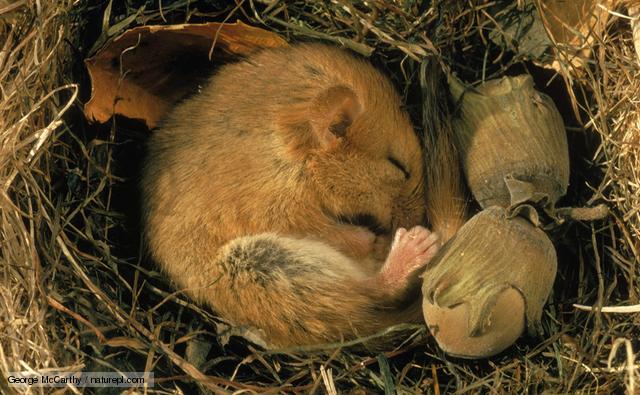
The dormouse in the picture has it about right: sleep with food half your size (hazelnuts, in this case), wake up, snack, pee, then back to sleep again. Drowsing comes much more easily now, especially after daylight savings time has shifted our days and brought evening creeping into the afternoons. With that extra jolt of possible light (this IS November, after all), mornings may be brighter and better, if you’re a morning person, but let 5:00 or 5:30 pm roll around and it feels like late evening already. Then today, with snowfall along the east coast as the winter storm makes its way along the same path Sandy took a short time ago, and you have hibernation mode with a vengeance.
May New York and New Jersey find their hazelnuts, their winter store of energy and life. A prayer to the South, where the people are cold in the dark, and my living breath upon it. A prayer to the west, where the frozen time has come, and my living breath upon it. A prayer to the north, warmer than many places closer to the equator: my living breath upon it. A prayer to the east, with winds cold and damp: my living breath upon it. Let all that breathes move its prayer with each inhalation and exhalation.
/|\ /|\ /|\
Image: dormouse.
Updated 8 Nov ’12
One of the challenges for contemporary Druids is to reconnect with the land where we live and find old and new paths of harmony to walk on it.
Back in CT for the coming year, we won’t need right away most of the firewood we’ve carefully stacked in VT, except to warm the house during the occasional weekend jaunt back north to check on pipes and windows, and stay over for a night or two.
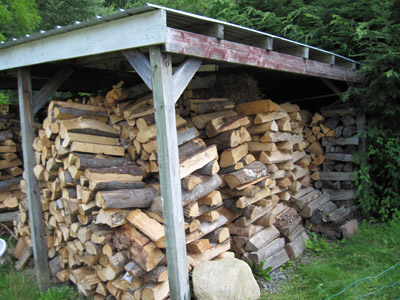 Seeing woodpiles, our own and others’, makes me realize how they’re among the treasures of the landscape, this long-inhabited place it’s our turn to live in and re-learn. Energy for the future. Trees cut locally (to limit the spread of arboreal pests) mean an opportunity for a new generation to leaf and grow. Once almost completely deforested in colonial times, both VT and NH are well-treed now. We get it, our green gold.
And we’ve held on as well, as much of the U.S. has, to the legacy of at least some of the old names and their stories: Ascutney, Memphremagog, Queechee, Maquam, Missisquoi, Sunapee, Ossipee, Winnipesaukee, Monadnock, Merrimack, Nubanusit, Contoocook … and my personal favorite, because my wife tells NH family stories about it, Skatutakee (pronounced skuh-TOO-tuh-kee). The names evoke for me a landscape of moose and bear, autumn fogs and spring mud, glacially fresh chill air and sky-blessed summer days, maple syrup and heirloom apples, blueberries and squash, small town greens and sheer church spires, seasonal tourist hordes and perfect frigid midwinter stillnesses. A marvelous locale to be all Druidy in.
But here in CT I’m drawn back into the local landscape too, the names of trees on campus, copper beech (fagus sylvatica) and charter oak and smaller ornamentals we just don’t see in VT. So I’ve resolved to “meet the locals,” and visit them in all four seasons, as we were reminded at the Gathering to do if we truly want to begin to know them well. My goal is to learn 25 new trees this year. (I’ll let you know how it goes in a future post.)
Digging for the future is putting down roots, knowing your place — not in the submissive way that the expression is used so often, but literally. How many of us have passed years of our lives and never known the trees who provide the oxygen we breathe, and shape the land we pass through and live in? I know it’s many times I’ve ignored them. But once the trees made themselves known to me, it seemed downright rude not to greet them every time I pass by, to cheer them on, if I’m walking to touch them, to cast my affection abroad, rather than hoard it tight in my heart. I dig for the future whenever I lay down a layer of my life that will become part of the contours of next year, or five years, ten years on. Excavation in reverse. Living fully now helps excavate what’s yet to come, brings it into view, lets it breathe and stretch and begin to grow towards its own good self. And trees? Trees were the first Druids.
/|\ /|\ /|\
Updated 26 Sept., 10:27 pm
After my father passed away in the winter of 2008, I wasn’t able to scatter his ashes the following spring as I’d planned. A cancer diagnosis laid me low soon after his final decline, and his childhood home in Niagara Falls in western NY state, as well as the farms he had owned and worked for decades, and where I grew up, were 450 miles from my wife’s and my home and jobs in CT. During my medical journey, we’d also bought a house in VT, and with follow-up radiation and a personal leave from our work, along with numerous loose ends to tie up, there’d simply been no good time. And the task and my intention, if not my father’s, deserved good time.
My dad had always been indifferent about the whole thing. Beyond asking to be cremated, he seemed to feel, perhaps from the many animal deaths and births that inevitably accrue in a lifetime of farming, that one more dead body was something to dispose of, but nothing worth much fuss. “Throw me on the manure spreader when you go out next, and toss me at the back of the cornfield,” he’d always say in his wry way, whenever I asked him one more time about his wishes. That was what we did with the occasional calf that died of pneumonia or scours. In six months, crows and time would eventually leave just whitening bones. But at the time of my dad’s death, we no longer owned the farm, and in any case, beyond a certain undeniable fitness to his request, a desire to make that one last gesture for the good of the land, as human fertilizer, there was the small matter of legality.)
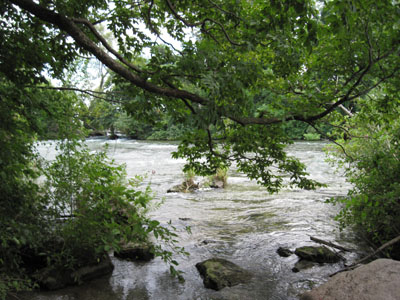
This summer a family reunion in Pittsburgh provided the opportunity to attend to this final matter. My wife and I drove there and back, and on the way out last Friday afternoon, after a slow cruise along Lakeshore Drive that hugs the south shore of Lake Ontario, we made our way to downtown Niagara Falls and then over the bridge onto Goat Island. So around 2:00 pm or so, you could have seen me squatting at the edge of the Niagara River, a few hundred yards above the Falls, on the second of the Three Sisters islands that cling to rocky outcrops in the rapids. The day was overcast but pleasant — typical of western NY, with its delightfully mellow lake-effect summers. Between my feet rested the heavy plastic bag of dad’s ashes, in the plain box the funeral home had provided.
I had nothing to say — no particular ceremony in mind. Words earlier, words around and after his death, words a week or so ago in a dream, but nothing now. This was for experiencing, not talking. Six years before, I’d returned my mother’s ashes to the Shellrock River in the small Iowa town of her childhood. That day, the easy meander of the river, the June sun on my back, the midday stillness, and the intermittent buzz of dragonflies skimming the water lent the moment a meditative calm. As my wife and two of my mother’s cousins watched, I slowly poured the powdery ashes into the river, and the water eddied and swirled as it bore them downstream. Watching the ash disperse downstream, I felt peace. Thus we can go home.
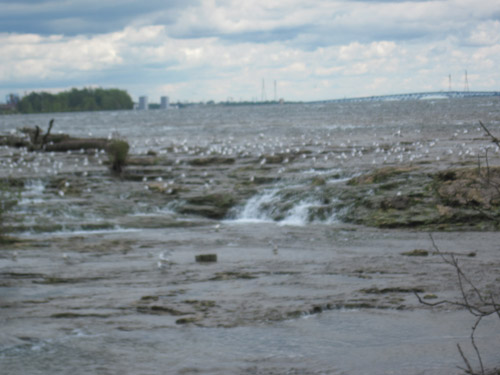
This day was different. A steady damp breeze rustled the leaves of the trees. On another treeless outcrop a short way upriver, the harsh voices of the flock of gulls were only intermittently inaudible over the tumble of water and the dull roar of the falls downriver.
I sat, heels in mud, watching the current on its endless course past and away. When I opened the bag of ashes, a sudden gust of wind caught some and dusted my left arm, which startled me, then made me smile. It was as if my father approved — that behind his gruffness, the elemental beauty of the spot, a family favorite, might matter after all. I brushed off my arm, and then poured the chalky ash into the spinning waters and watched it spread and then, eventually, the water cleared as it washed away.
/|\ /|\ /|\
[Earth Mysteries 1 | 2 | 3 | 4 | 5 | 6 | 7]
Here, in the third of this series on J. M. Greer’s principles from his book Mystery Teachings, we come to the Law of Balance:
“Everything that exists can continue to exist only by being in balance with itself, with other things, and with the whole system of which it is a part. That balance is not found by going to one extreme or the other or by remaining fixed at a static point; it is created by self-correcting movements to either side of a midpoint.”*
The Dao de Jing (Tao Te Ching), another keen guide to the natural order of things, observes, “Extremes do not last long.” After storm, sun. After destruction, rebirth. But what are we to make of natural disasters? How in hell, literally, are we supposed to “live in harmony” with an earthquake or hurricane or tornado?
Our science, which is just another word for knowing or wisdom, has only begun to recover some of the nature wisdom of our ancestors and spiritual traditions. And perhaps too much time, at least in some of the “hard” sciences, is spent in pursuit of a grand theory, where close observation might serve our immediate purposes better. But we’re recovering lost ground as we can.
The horrific tsunami of December 2004 in southeast Asia makes for a good study. Here and there, among the human and natural devastation in its wake, are curious and instructive stories. The case of 10-year Tilly Smith, vacationing with her parents in Phuket, Thailand, merits recounting. According to the Telegraph‘s article, Tilly saw the tide drop unnaturally, remembered a recent geography lesson about tsunami warning signs from her school back in the U.K., and alerted her parents. They were wise enough to listen to their daughter, warned the hotel where they were staying to evacuate inland, and over a hundred lives were saved as a result.
Another story comes from off the coast of India, in the Andaman Islands. One of the aboriginal peoples living there is the Onge, who still practice hunting-gathering. When the sea level dropped abruptly, the tribe responded immediately. After a quick ritual scattering of pig and turtle skulls to propitiate the evil spirits they perceived at work, they retreated inland. Unsuspecting tourists and local fisherman walked the exposed beach and gathered the fish floundering there, only to perish in the approaching monster waves. The National Geographic account from about a month afterwards includes commentary from Bernice Notenboom, president of a travel company specializing in indigenous cultural tourism and one of the few westerners to have visited the area. She observed of the Onge, “Their awareness of the ocean, earth, and the movement of animals has been accumulated over 60,000 years of inhabiting the islands.”
While this isn’t exactly expert testimony, every member of the tribe did survive, and her reasoning is sound. The commercial influence of Western culture has uprooted many tribes, and this is something Notenboom does know, since she’s on the forefront of it with her tour company. She remarked that one day in another nearby village, an old man approached her and said, “It is great to have you here, but let’s not make it a habit.” There can be a cost to careless physical ease and the acquisition of material abundance, and if we “gain the whole world and lose our souls,” to paraphrase the renowned Galilean master, we may be swallowed up, figuratively or literally.
Balance doesn’t mean stagnation. Many Westerners have felt the stirrings of a vague dis-ease with their own lives. We point to this or that cause, shuffle our politicians and opinions, our allegiances and subscriptions to cable, but to reuse the almost-cliche, it’s another version of rearranging deck chairs on the Titanic. When the problem is systemic, tinkering with symptoms won’t help. The “solution” is not one single thing to apply like a band-aid, but it will indeed involve changes of heart, which will come in different ways for different people over time. Anyone who has a single prescription for the troubles that ail us is frankly talking out his ass. Getting the ____ into or out of political office won’t budge the problem.
The “self-correcting movements to either side of a midpoint” of the Law of Balance sound so innocent. But whenever the balance shifts, the corrections come just as predictably and inevitably. Whether we like them or not, welcome or resist them, is another matter entirely. We forget that we’re not “in control”: there’s no helm to manage, no boss to prop up in place so that “things keep going the way they always have.” Already they aren’t, and they won’t. We’re part of a whole: whatever happens to the whole happens to us, and what happens to us happens to the whole. This is good news for those who work with the whole, and bad news for those who think this particular rule doesn’t apply to them.
There is such a thing as natural “justice” — it’s another name for rebalancing — but not always as humans would have it. There’s no court of appeal when we’ve fouled the air and water, destroyed local economies with mega-corporations, junk-fed ourselves sick, fought our way to a glutton’s share of the world’s resources which are running out, and tried to rationalize it all. Now we have to find ways to live through the re-balancing. What tools do we need? The inner resources are still available, though we’ve burnt through so many outer ones. The classic question of “Where is wisdom to be found?” really needs to be answered individually. It’s a fine quest to devote a life to, one that I happen to think is far better than anything else you can name. Right now especially, money certainly doesn’t look like it’s worth the game. I know that I feel more alive looking for wisdom, and finding a piece of it I can test and try out in my own life, than I do swallowing anybody else’s brand of fear and paranoia and cynicism. This blog is a piece of that quest for me. Whose life is this, anyway? Make of life a laboratory for truth.
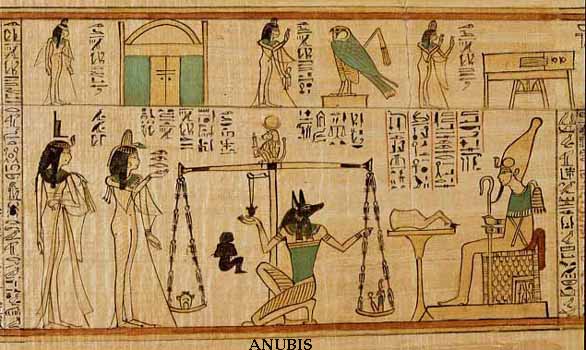
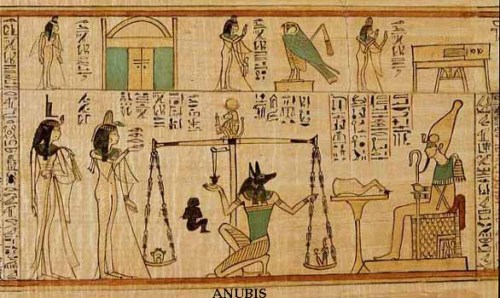 In the end, balance really is a matter of the heart. One Egyptian image of the after-world that’s stuck with me is the Scales of Anubis. The jackal-god of the Underworld places the human heart of the deceased in his scales, to weigh it against the feather of truth, of Ma’at, the natural order, cosmic justice or balance. (For inquiring minds, that’s Anubis to the right of the support post.) Only a light heart, literally one not weighted down by human heaviness (you can fill in the ____ with your favorite kinds), can pass muster. One distinguishing quality of the truly holy or wise ones that we encounter in their presence is a lightness of being, a kind of expansion and opening up. There is always possibility, a way forward. Whatever happens, we can face it better with that kind of heart beating in our chests. Look for that, in others and yourself, in your quest.
/|\ /|\ /|\
Image: scales of Anubis.
*Greer, John Michael. Mystery Teachings from the Living Earth. Weiser, 2012.
Edited/updated 11 October 2017
This post is self-indulgent, so if you’re not feeling mellow enough to tolerate such things, best move on and come back another time. OK, you’ve been warned.
Beside me as I write this lies a thick paperback copy of J. P. Mallory’s cumbersomely titled The Oxford Introduction to Proto-Indo-European and the Proto-Indo-European World. Since it’s a week-end day like today, and nothing presses me to get up and pretend to accomplish anything, I pull it from the nightstand and lie abed thumbing through it. Yes, I’ll say it first: “Nerds ‘R’ Us.”
I confess to abject weakness for books like this one about Proto-Indo-European, the reconstructed mother tongue of everyone who speaks one of the approximately 100 languages descended from it — roughly half the planet, three billion people, give or take a few million. I open the book and pause at a list of less well-known extinct language names — Illyrian, Dacian, Thracian, Macedonian, Phrygian — that evoke salad dressings, or obscure vintages, or mysterious bloodlines of characters in an occult novel. To anyone wired just a little differently, the whole thing must just scream B O R I N G. Though if you’re such a person, you’ve probably stopped reading this already.
My addiction occasions sighs from my wife, because my corridor of facing bookcases dominates a little-used hallway which has now transformed into a single-file passage to the front door of our house. Language books fill one whole bookcase. No, not for the most part languages I speak or know in any worldly useful way, but languages I drink from, for their beauty and architecture and sound (and ideas for my own conlangs*). I know things about them not even their native speakers know, but I couldn’t speak most of them to save my life. So this is language as first morning coffee, as comfort food, as fix. Even the abbreviation PIE, for Proto-Indo-European, is comforting. Pie. Whipped cream. Dessert. Maybe for breakfast. Flaky crust and steaming freshly baked fruit. Ah.
The underlying draw of such things (beyond the sensuous indulgence I confess to above) seems quest-like. After a long climb I crest a hilltop, the mist clears, and there before me are the ruins, thousands of years old. Only instead of fallen pillars, abandoned steps, doorways opening on empty air, the ruins are words. Ancient words, weathered, yet often still bearing a family likeness. Wiros, gwena, brater, swesor. Man, woman, brother, sister. Mus, gwous, deiwos. Mouse, cow, god. Sedo, bhero. I sit, I bear. Oinos, dwou, treyes, kwetwor, penkwe. One, two, three, four, five. The likenesses grow if you know even a little Latin or a Romance language, or one of their cousins in India.
Some of the same fascination with this proto-language stirred in the first linguists who considered the verbal ruins they were painstakingly excavating and reconstructing. Word by word, through comparisons of living languages and their structures and patterns, the older ancestral language was and is rebuilt. See where the stones are notched, worn, and smudged with soot, and reassemble the fireplace they once made. And there’s part of a wheel, an urn, a head-dress. August Schleicher, who flourished in the first half of the 1800s, “sifted through the reconstructed Indo-European of his day for enough usable words to compose a short narrative tale … published in 1868” (Mallory, 45). His colleagues caught something of the same fever, kept tweaking Schleicher’s story over the ensuing decades, and here’s a contemporary “version of their version” of the first sentence that I’ve made somewhat more pronounceable for English speakers by taking a few small liberties. Linguists will see the changes at once and cluck their tongues at me, and no one else will care:
Gurei owis, kwesyo ulna ne est, ekwons speket, oinom ge gurum wogom wegontem, oinom-kwe megam borom, oinom-kwe gumenem oku berontem.
“A sheep that had no wool saw [some] horses, one pulling a heavy wagon, one a heavy load, and another swiftly bearing a man” (ibid).
Maybe it comes down to this: through such reconstructions we can come closer to talking with the ancestors — and maybe join them in their drinking songs, rather than expecting them just to sing along with ours.
/|\ /|\ /|\
*My most developed conlang or constructed language is called Thosk. (The name is cognate with Old English theod “people,” Oscan teuta “people,” Latin teutonicus, and German Deutsch.) Its word-stock and grammar are very Indo-European, and so it’s a sibling of English, Spanish, Latin, Hindi, Armenian, Greek, Pashto, French, Latvian, Swedish, Russian, Bengali, Serbian, Danish, Romanian, Ukrainian, Sanskrit, Farsi, Albanian, Dutch, Gujerati … you get the idea. Here’s a simple sentence in Thosk: Men ta tha moi urht bev ahi sumbend no meve klase. “I give more work to anyone sleeping in my classes.”
Mallory, J. P. and D. Q. Adams. The Oxford Introduction to Proto-Indo-European and the Proto-Indo-European World. New York: Oxford University Press, 2006.
Some teachings run you through their rituals.
Find your own way – individuals
know what works beyond the shown way:
try out drinking with the Ancestors.
Chat ‘em up — don’t merely greet ‘em;
such rites are chummy: do more than meet ’em.
(Spend your weekends with a mummy?)
But I like drinking with my Ancestors.
Another round of pints and glasses
will have us falling on our asses.
Leave off ritual when they’re calling —
you’ll be drinking with your Ancestors.
By and with the spirits near us —
“Don’t invoke us if you fear us” —
good advice: if you lose focus
though you’re drinking with your Ancestors,
in the morning you’ll be uncertain
if you just dreamed or drew the curtain
on some world where it more than seemed
that you were drinking with your Ancestors.
Alcohol works its own magic,
and not all good – it’s downright tragic
if you’re just hung over from what could
have been you drinking with your Ancestors.
They come in all shapes, and in all sizes:
some are heroes, some no prizes
(they’re like us in all our guises).
Listen: they are singing, they are cussing,
they can advise us if we’re fussing
over where our lives might go
or put on a ghostly show.
We’re the upshot, on the down low.
We’re the payoff, crown and fruit
(we got their genetic trash, and loot),
we’re their future – “build to suit.”
So start drinking with your ancestors.
* * *
Ancestor “worship” is sometimes a misnomer, though not always — some cultures do in fact pray to, propitiate and appease the spirits of the ancestral dead in ways indistinguishable from worship. But others acknowledge what is simply fact — an awful lot (the simple fact that we’re here means our ancestors for the most part aren’t literally “an awful lot”) of people stand in line behind us. Their lives lead directly to our own. With the advent of photography it’s become possible to see images beyond the three- or four-generation remove that usually binds us to our immediate forebears. I’m lucky to have a Civil War photo of my great-great grandfather, taken when he was about my age, in his early fifties. In the way of generations past, he looks older than that, face seamed and thinned and worn.
The faces of our ancestral dead are often rightfully spooky. We carry their genetics, of course, and often enough a distant echo of their family traditions, rhythms, expectations, and stories in our own lives — a composite of “stuff,” of excellences and limitations, that can qualify as karma in its most literal sense: both the action and the results of doing. But more than that, in the peculiar way of images, the light frozen there on the photograph in patches of bright and dark is some of the purest magic we have. My great-great-grandfather James looks out toward some indeterminate distance — and in the moment of the photo, time — and that moment is now oddly immortal. Who knows if it was one of his better days? He posed for a photo, and no doubt had other things on his mind at the time, as we all do. We are rarely completely present for whatever we’re doing, instead always on to the next thing, or caught up in the past, wondering why that dog keeps barking somewhere in the background, wondering what’s for dinner, what tomorrow will bring, whether any of our hopes and ambitions and worries justify the energy we pour into them so recklessly.
And I sit here gazing at that photo, or summoning his image from what is now visual memory of the photo, as if I met him, which in some way I now have. Time stamps our lives onto our faces and here is his face. No Botox for him. Every line and crease is his from simply living. And around him in my imagination I can pose him with his spouse and children (among them my great-grandfather William) and parents, and so on, back as far — almost unimaginably far — as we are human. Fifty thousand years? Two hundred thousand? A million? Yes, by the time that strain reaches me it’s a ridiculously thin trickle. But then, if we look back far enough for the connection, it’s the same trickle, so we’re told, that flows in the veins of millions of others around us. If we can trust the work of evolutionary biologists and geneticists, a very large number of people alive on the planet today descend from a relative handful of ultimate ancestors. Which seems at first glance to fly in the face of our instinct and of simple mathematics, for that spreading tree of ancestors which, by the time it reaches my great-great-grandfather’s generation, includes thirty people directly responsible for my existence (two parents, four grandparents, eight great-grandparents and sixteen great-great grandparents). Someone called evolution the “ultimate game of survivor.” And now I break off one line, stalling forever this one particular evolutionary parade, because my wife and I have no children.
The poem of mine that opened this entry, “Drinking with the Ancestors,” suggests we can indeed meet and take counsel with members of this immense throng through the exercise of inhibition-lowering and imagination-freeing imbibing of alcohol. Of course there are also visualization exercises and still other techniques that are suitably alcohol-free — more decorous and tame. Depending on who you want to talk to among your clan, you can have an experience as real as most face-to-face talks with people who have skin on. The difference between us in-carnate and ex-carnate folks is indeed the carne. No sudden dispensation of wisdom automatically accrues to us just because we croak. A living idiot becomes a dead idiot. Likewise a wise soul is wise, in or out of flesh.
It seems fitting to end with an experience of the ancestors. Not mine, this time — I keep such things close, because often when we experience them, they are for us alone, and retain their significance and power only if we do not diminish them by laying them out for others who may know nothing of our circumstances and experiences. Wisdom is not a majority vote. Even my wife and I may not share certain inner discoveries. We’ve both learned the hard way that some experiences are for ourselves alone. But it’s a judgment call. Some things I share.
So in my place I give you Mary Stewart’s Merlin, in her novel The Hollow Hills*, recounting his quest for Excalibur, and an ancestor dream-vision that slides into waking. The flavor of it captures one way such an ancestral encounter can go, the opposite end of the easy beery camaraderie that can issue from making the libations that welcome ancestral spirits to a festival or party, as in my poem. Note the transition to daytime consciousness, the thin edge of difference between dream and waking.
I said “Father? Sir?” but, as sometimes happens in dreams, I could make no sound. But he looked up. There were no eyes under the peak of the helmet. The hands that held the sword were the hands of a skeleton … He held the sword out to me. A voice that was not my father’s said, “Take it.” It was not a ghost’s voice, or the voice of bidding that comes with vision. I have heard these, and there is no blood in them; it is as if the wind breathed through an empty horn. This was a man’s voice, deep and abrupt and accustomed to command, with a rough edge to it, such as comes from anger, or sometimes from drunkenness; or sometimes, as now, from fatigue.
I tried to move, but I could not, any more than I could speak. I have never feared a spirit, but I feared this man. From the blank of shadow below the helmet came the voice again, grim, and with a faint amusement, that crept along my skin like the brush of a wolf’s pelt felt in the dark. My breath stopped and my skin shivered. He said, and I now clearly heard the weariness in the voice: “You need not fear me. Nor should you fear the sword. I am not your father, but you are my seed. Take it, Merlinus Ambrosius. You will find no rest until you do.”
I approached him. The fire had dwindled, and it was almost dark. I put my hands out for the sword and he reached to lay it across them … As the sword left his grip it fell, through his hands and through mine, and between us to the ground. I knelt, groping in the darkness, but my hand met nothing. I could feel his breath above me, warm as a living man’s, and his cloak brushed my cheek. I heard him say: “Find it. There is no one else who can find it.” Then my eyes were open and it was full noon, and the strawberry mare was nuzzling at me where I lay, with her mane brushing my face (226-7).
/|\ /|\ /|\
*Stewart, Mary. The Hollow Hills. New York: Fawcett Crest Books, 1974.



 A Druid Way