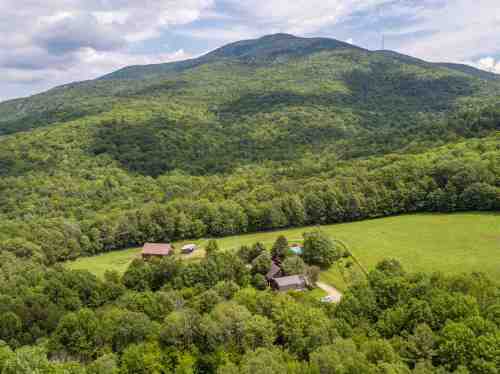
Mt. Ascutney, seen from West Windsor on a clear day.
Our local OBOD Seed Group is planning to gather on Vermont’s Mt. Ascutney for Lunasa in about a week, and so I scouted locations on the mountain this morning. We’ve had rain in Vermont since Sunday, so not surprisingly fog shrouded the crown of Ascutney, which stands at 3144 feet (958 meters).
Every leaf was dripping, and the blacktop glistened dully as I drove the 4-mile road to summit parking. When I arrived around 10:30 this morning, mine was the only car in the lot, which has spaces for 50.
If you’d told me that with climate shifts parts of New England are destined to become temperate rain forest, this morning at least I would have believed you. More likely we may well face sustained droughts here as elsewhere, but for now, Vermont lives fully up to its name of the Green Mountain state.
I scolded myself for not bringing my camera — next week will have to try to make up for the lapse. But it’s right I did not even try to capture in a frame what I saw and felt. Fern and myrtle, moss and emerald, shades of wet green I have no names for. Bird-calls sounded through the mist, and rivulets sparkled crossing the slabs of stone of the 2/3 mile trail and final 300 feet of ascent.
Fog-weaving at such times needs so little effort. The climb quickens the breath, and the cool air is lush with oxygen. Without the chatter of any human companion as a distraction, and with the fog collapsing the field of vision to just a few dozen yards in any direction, your attention narrows in on step after deliberate step. Light trance comes on like cloud itself. Without thought you can slip through to the “realm next door” between one step and the next, and you may sense the god dreaming on the peak. And rather than needing human action or imagination to weave or conjure vision, the fog itself curtains or reveals what is already there.
For some forty minutes I was alone on the mountaintop. Only on the last leg of the descent back to the parking lot did I meet another solitary hiker, rainjacket tied around his waist as we passed each other.
So did I “meet Lugh”? As a god of storm, sun and high places, he wrapped the mountain with his long arm, as one of his epithets, Lugh Lamhfada, names him. In such places and spaces, the ideas and doubts of rational consciousness don’t intrude. That’s for before, and after.
Even an hour later, with a second or third cloudburst filling the air with its sound, as I stepped out of the car in the parking lot of the medical office for an afternoon eye appointment, perhaps I didn’t “meet the god of storm”. But rain spattered my glasses, ran down my cheeks, wet my bare legs and left my feet squelching in sandals. I quickly pulled my raincoat around me and headed for the entrance.
And there in the waiting room I sat damply, thumbing through a National Geographic magazine, gazing at pictures of endangered birds. I didn’t “meet” those birds, you could argue, and in a sense you’d be right, of course, yet light from images of them reached my eyes and brain, and I know what they look like. I can describe them to you.
I may or may not have “met Lugh”, but water from his storm, and a sense of his long-armed presence continued to accompany me after the appointment as I recalled the climb, and thought about him on the drive home. My clothes are wet, I stood on that mountain, and I can tell you what makes Lugh different from Brighid.
And I am content, “without any irritable reaching after fact and reason” * during such experiences — more than content — whatever I may think or do or say after them. And that proportion — a “during” that is different from a “before” and an “after” — seems to me a good one. Relinquish nothing, gain all.
1–Your grandmother’s Druids were most likely members of a fraternal order, similar to the Masons.
Many contemporary Druid orders seek to assist members in developing a spiritual foundation and fostering a training equal to the challenges humans face over the coming decades and centuries, where new understandings will help us adapt successfully to more limited resources, a hotter planet, rising oceans, pollution, species die-off, massive social unrest and population migration, and still other shifts and changes we do not yet foresee.
Even if the challenges remain exactly as they already stand today — even if all predictions, forecasts, and extrapolations from available evidence are hopelessly inaccurate — it’s clear we already need wiser approaches and clearer thinking to grapple with them. In this predicament, however, we do not confront anything new. The human experience over the history of our species is one of frequent and sometimes dire challenge and change. In any case, one of the benefits of Druidry is the gift [link to “Seven Gifts of Druidry”] of wisdom and foresight — always useful skills.
To explore a play on words, the difference between change and challenge is lle— the Welsh word for “place, room, accommodation”. As soon as we “make room” for actual reality, then, we can deal more effectively and creatively with change. It is only when we deny, balk, block, resist, fear or ignore a challenge that the initial change has no place to manifest, and so it pools, darkens, and accumulates into something much more difficult later, when it finally breaks through, whether it’s an individual illness, societal breakdown or planetary shift. Further, a major “secret” to dealing with challenge is respect for place, for the “room” or space we inhabit. Our ability to care for it, listen to it, learn from it and live in it more fully will help many thrive.
2–Your grandmother’s Druids generally sought and found inspiration and example in both the limited information surviving in classical sources, and in the Druid Revival beginning in the 17th century, which drew on practically every source that didn’t run away first, and on some that did.
As the growth and development of modern Druidry continued, and with contributions from Celtic Reconstructionists like ADF, who stressed historical authenticity and searched for the half-hidden remnants we still possess of older Druid traditions*, new teachings, practices, insights and shifts in emphasis emerged in many established Revival orders like AODA, OBOD and BDO. These “new” teachings are in fact often very old, reintroducing images, stories, understandings and quite specific herbal knowledge tribal peoples worldwide have long possessed. (As a single example, see the work of Druid and master herbalist Ellen Evert Hopman.)
3–Your grandmother’s Druids were generally, officially and at least nominally Christian. While other varieties no doubt existed, it was often both dangerous and illegal until surprisingly recently to be too open about believing and practicing anything other than some version of Christianity.
Today’s Druids span a much wider range of backgrounds, with atheist, pantheist, animist, Christian, Jewish, Hindu and other traditions influencing and being influenced by Druidic perspectives and practices. As with Alexandria and Rome in the centuries before and after Christ, a stir of Gnostic, Egyptian, Chaldean, Christian, Neo-Platonist and Pythagorean mystery teachings, practices, ideas and perspectives produced a potent ferment that still pervades much contemporary culture worldwide.
4–If your grandmother’s Druids were challenged with the oft-heard critique “You can’t be a real Druid because we know hardly anything about ancient Druidry,” they might readily concur and acknowledge that their Druidry is a fraternal order, inspired by the romantic image of the Druid as a learned leader and cultural arbiter and repository of tribal memory.
Today’s Druids still hear this increasingly ridiculous challenge, about as accurate as early challenges that “Christians practice cannibalism” because they ritually drank the blood of Christ in the Mass.
In fact, a surprising amount of information survives about older Druid practice and training, outside of the fragmentary Classical references, largely in Irish but also in Welsh sources.
Members of OBOD can trace the increasing influence of these sources in the revisions of the OBOD coursework, first in the transition from Chosen Chief Nuinn/Ross Nichols to Philip Carr-Gomm, and in the new Chosen Chief Eimear Burke, who has said that OBOD “isn’t broken so it doesn’t need fixing”, but that an increased focus on Irish material will be a natural outcome of her Irish identity and experience.
For a quick overview of the hundredsof sources available, of varying age, usefulness, completeness and provenance, check out this link at the Celtic Literature Collective. Here’s just a small fraction:
Trioedd Ynys Prydein / Triads of the Island of Britain. Versions in 13th century White Book of Rhydderch / Llyfr Gwyn Rhydderch, the Red Book of Hergest / Llyfr Coch Hergest, and the Peniarth Manuscripts.
The Mabinogi(on) / Another link. One of the most famous of sources listed here. Welsh tales, legends, philosophy, magic, training, etc., from the medieval period.
Book of Ballymote / (Wikipedia link.) Leabhar Baile an Mhota. 1400s. Includes the “Instructions of King Cormac”, stories of Fionn Mac Cumhaill, and other tales.
Auraicept na n-Éces / Another link. An ogham treatise dating from the 7th century, with later interpolations.
Dindsenchas / The Lore of Places. A “recounting the origins of place-names and traditions concerning events and characters associated with the places” (Wikipedia) and vital as a gateway to understanding much of Irish myth and legend. Many are found in the Book of Leinster.
Brehon law / Senchus Mor or “Gael Law” — numerous collections (see link at beginning of sentence), the earliest dating from the 700s — “possibly the oldest surviving codified legal system in Europe” (Wikipedia). Focusing on restorative rather than punitive justice, and on care of the land. See also Laurence Ginnell’s 1894 The Brehon Laws: A Legal Handbook, full text online here.
“But what can we do?” people often ask. Whatever the need, the question is a perennially valid one. What action is best for me to pursue, yes. But also, what can I do before I act, before the main event, so to speak, so that I can choose more wisely how to act on that larger scale? The Hopi of the American Southwest use a ceremonial pipe they call natwanpi — literally, “instrument of preparation”. What can I do to make of my actions a natwanpi in my own life as often as possible? How can I act now to prepare for the next action needed? How can my deeds begin to form a shining set of links, not merely a random assemblage?
Try opening to Awen not when it’s easy, but when it’s difficult: not when you can be still and nothing is disturbing you, but when there’s chaos around you, and life is far from easy. See if you can find Awen in those moments. It’s harder, much harder, but when you do, it’s like walking through a doorway in a grimy city street to discover a secret garden that has always been there – quiet and tranquil, an oasis of calm and beauty. One way to do this, is just to tell yourself gently “Stop!” Life can be so demanding, so entrancing, that it carries us away, and we get pulled off-centre. If we tell ourselves to stop for a moment, this gives us the opportunity to stop identifying with the drama around us, and to come back to a sense of ourselves, of the innate stillness within our being.
Of course, one key is to practice the Awen when it IS easy, so that it becomes a skill and a habit to draw on when “life is far from easy”. Right now I take this advice, pause from writing this, and chant three awens quietly.
After all, what good is any spiritual practice if it doesn’t help when I need it most? I find this holds true especially with beliefs, which is why so many contemporary people have abandoned religious belief, and thereby think they’ve also “abandoned religion”. All they’ve done, often, is abandon one set of perhaps semi-examined beliefs for another set they may not have examined at all. “Carried away, pulled off-centre” — we’ve all been there. But each moment, in the wry paradox of being human, is also calling us home, “back to a sense of ourselves”.
A few weeks ago I had cataract surgery on my right eye. I was surprised how the looming procedure, with its success rate of above 95%, kicked up old fears in me from the major cancer surgery I’d experienced a decade ago. Coupled with that was a series of dreams I’d had a few years ago about going blind. Altogether not an enjoyable mindset to approach a delicate procedure on the eyes.
But instead of the victim version of the question “Why is this happening to me?” I can choose to ask the curious version of the same question. Insofar as anything in my life responds to events and causes I have set in motion, it’s a most legitimate question.
The answers, I find, can be surprising.
I feared loss of spiritual vision, because I was drifting away from the other spiritual path I practice. This is clearly a cause I’ve launched. I didn’t approach the surgery as some kind of superstitious opportunity for the universe to “pay me back” for spiritual neglect, as if the cosmos operates like a sinister debt collection agency. But if I approach my whole life as an instance of an intelligent universe constantly communicating with me, my fears have a cause, and an effect, and my experiences will mirror all that I am and bring to each moment. Not out of some sort of spiteful cosmic vindictiveness, but because all things, it seems, prod us along the next arm of the spiral. We’re all part of the Web. The same force, I believe, that pushes up the first flowers in spring, in spite of the lingering danger of frosts, the force that urges birds to nest and hatch a fleet of fledglings, even though a percentage will die before reaching adulthood, is the same force alive in me and in my life and the lives of every other being on this planet. Even our seemingly static mountains weather slowly in wind and rain, frost and sun.
Christians focus closely about “being in right relationship” with God. Druids and other practitioners of earth-spirituality are likewise seeking harmonious relations with the world around us. Though a god or gods may not have exclusive claims on me, still, if one makes herself know to me, it’s not a bad idea to pay attention. Same with anything else that knocks for my attention — and deserves it. Day-to-day practice of an earth path like Druidry is an ongoing opportunity to seek out new kinds of harmony as well keep to ones I’ve tried and tested, an opportunity to balance claims of allegiance and attention and energy, to make good choices, and to stand by them as much as I can. (Of course I’ll mess up from time to time. Part of the fun is seeing if I can mess up in a new way this time, to keep myself entertained, if nothing else. Why hoe a row I’ve already weeded, unless it really needs tilling again?!)
/|\ /|\ /|\
With Lunasa in the northern hemisphere comes Imbolc in the southern one. The ley lines linking the earth festivals around the world deserve my attention, I find, as much as the lines of connection between hills and wells, trees and stones on my continent.
So it is that Brighid of many skills, healing and poetry and smithcraft among them, pairs well with Lugh Samildanach, Lugh “equally gifted” in all the arts and crafts. Both at Imbolc with the kindling of a new cycle of birth and growth, and at Lunasa as first of the harvest festivals, we’re reminded of origins of the crafts of civilization. With human and divine inspiration and gifts supporting our lives, we draw our existence today. I eat because my ancestors tilled the earth and lived to birth and teach the next generation. I wear this body because spirit clothed itself in this form among all the other forms it takes. I peer out at the world and at all the other forms who are likewise looking at and listening to the ongoing waves of existence. From this perspective, how can I not celebrate in simple amazement?!
We’ve all felt those moments when life seems paradoxically dreamlike and marvelously real. Robert Frost, bard of New England and a Wise One I keep turning to for counsel, says,
Only where love and need are one,
And the work is play for mortal stakes.
Is the deed ever truly done.
For Heaven and the future’s sakes.
Where love and need are one: how often do I separate them? Do I respect my need enough to love it, or truly need what it is I think I love? Can I align these two and make them one? Mortal stakes: is what I spend the greatest energy on actually contributing to life, my own life among others? After all, Druidry urges me to consider that each life is worthy and valuable, mine no more but also no less than others.
A Frostian triad emerges: There are three things fitting for the aspirant to wisdom — a seeking after unity of love and need, a work which is play for mortal stakes, and deeds done for heaven and the future.
/|\ /|\ /|\
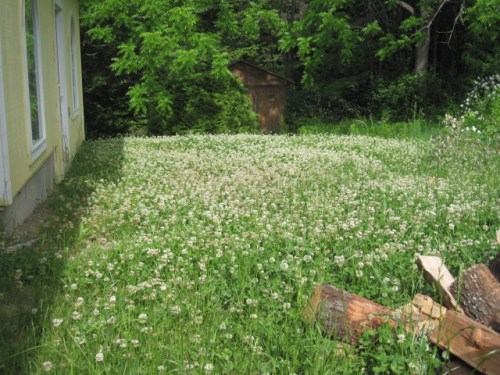
After the builders finished the weaving studio addition (visible on the left), they seeded the lawn with clover, and now we have a lovely nitrogen-fixing, weed-inhibiting perennial I refuse to mow. The bees have been loud and happy, cheering at my choice, and the crop will also hold down the still-loose soil against runoff, and help it firm up.
You can see, too, in the foreground the edge of the recent delivery of firewood I need to go stack.
“There are different ways to fry tomatoes”, begins one utterly inane piece of spam I opened this morning. But it’s true.
Whatever my tomato is — God, sex, politics — one or more of that original neon trifecta, or something else altogether, different ways abound. More than just two roads diverge in the yellow wood of any moment, Robert. (If I’m gonna argue, let me argue with the best.) Continuing the challenge from the previous post, what limiting duality is my task to work on for today?
/|\ /|\ /|\
The “solar question” for the day in Caitlin Matthews’ Celtic Devotional reads: “Are you misusing responsibility or power?” Is there a missing third, or fourth, etc., or in fact are those always the sole two options to choose from? “Cash or credit”? Or coffee, tea, milk, juice, water, nothing, etc.?
(Incidentally, I prefer guilt to blame, because at least guilt makes me less of a victim. “Which one have I misused thistime?!” Because if I messed up before, I can do it differently. But if it’s somebody else’s fault — the blame game — the job’s a lot harder. I have to get them to accept responsibility or exercise their power. Guilt, often, is for the lazy — my kind of people. “Creativity is allowing yourself to make mistakes. Art is knowing which ones to keep” said some wise person. So I’m running with the scissors of responsibility, power, guilt and art. What could possibly go wrong?!)
I haul out my table of correspondences and assign each one — responsibility, power, guilt and art — to one of the four directions. Guilt feels earthy, heavy, rooting us in place, rubbing our noses in thing and fact. North it is. Power we’ll place in the south, all fiery and energetic, especially while the Solstice still pulses so brightly. Responsibility I’ll set in the East, that dawning of awareness of cause and effect, that light on our lives that helps us see a path. Art, then, is West, pooling in the emotions and intuition where it’s always ready to leap forth, salmon-like, into beauty and unlooked-for surprise. (Adjust these to taste.)
Or fashion out of the quartet a Triad, chucking guilt and finding a balance of power, responsibility and creativity manifesting in the art of a life lived richly, felt deeply.
So which am I misusing right now? Responsibility or power? The power to act, to fire up my responsibility so that I’m not the unwitting effect of others’ causes, but in fact I claim my human birthright, I originate from my own self a course of action right for me? Or the responsibility to use my power, not to fear it and tuck it away, because it might hurt me or someone else?
In the West, still, women are often shamed for using their power, and men for not using theirs. So we gender power in an attempt to contain it, ending up not with an honest recognition of its many different expressions, but with bitches and bros, power and responsibility both misused in these two common but by no means only possible ways.
There are different ways to fry tomatoes. We tend to think of a perspective, a culture or civilization — if it’s ours — as the best or in fact the only way to fry tomatoes. Given 7+ billion of us humans, not to mention all our other companion species, it’s faintly possible that’s less than likely.
The Hanged Man of the Tarot has been recently in my awareness a lot. I’ve been fascinated how his legs describe a 4 — an image I take to mean the four elements, directions, etc. in balance or harmony. The elemental forces are written in and on all our bodies, but we don’t always live from this powerful awareness, and our resulting imbalances afflict us in a multitude of ways, individually and civilizationally.
If the Hanged Man represents, among other things, self-sacrifice, it’s a sacrifice of limitation — but one which can only happen when I’ve recovered a balance or recognition of the energies at work and available to me. Smaller and greater moments of casting off limitation, of sacrifice of a limited sense of self occur throughout our lives. But it’s vanishingly rare that I can effect self-sacrifice in another person. For that reason alone I find it’s easier (my favorite theme of laziness again — or, if you prefer, greatest return on investment of time and energy) to work on myself rather than on the culture. Let change flow from my changed consciousness — indeed, that’s how most changes flow anyway, from what I’ve seen. Enough small changes occur, a critical mass builds, and what appeared insoluble, impossible, even unthinkable, tips an energetic balance in mass consciousness, and becomes commonplace. (A handful of us stand up as heroes and heroines, shove publicly to make it all happen sooner, and as often as not are assassinated for our efforts. “A heroic destiny for you is on sale now!”)
This particular version of the Hanged Man expresses such themes well, to my thinking. He’s hanged, but he holds the power and the responsibility. And what lies just beneath him? A pool of water, of the unconscious, perhaps, but also of intuition, of discovery, of autumn, of fullness of awareness, of completion, of harvest. He is just able to touch it. As an image for the coming seasons of the year, the Hanged Man is a worthy guide. We sacrifice most authentically, powerfully, responsibly and artfully when it is ourselves.
[Solstice light and fire can fill us with energy to tackle the big stuff. At least, that’s my sense of this post, after drafting and revising it. Here goes.]
MAGUS ’18 fire circle. Photo courtesy Crystal Collins.
The title for this post comes from a line in a recent column in the UK paper The Guardian. (I routinely skim the foreign press both as an escape from the breathless hyper-partisanship of U.S. media and also for key perspectives often wholly absent from American consciousness.)
Every age has ’em: the issues screeching for our attention, promising imminent peril and world-flattening disaster if we don’t ramp up our paranoia, doubt, fear and despair to the pitch of the writer, pol, preacher, activist, etc., etc. If you haven’t developed a nervous twitch just from hearing certain triggering labels in the 24-hour news-cycle, you obviously haven’t been paying attention.
Which is exactly what I try to practice and quietly urge on others, if they choose to give me space to talk. Often they don’t, and I don’t insist. Stop paying attention, which is a form of our energy, to absolutely everything, just because it asks for it. Pay attention specifically to what builds, to what gives joy and life to you and others. Otherwise, why bother?
What follows is geek-talk, if you’re not a Tolkien-fan. You might as well use the search box at the top left to find a topic that interests you, or wander elsewhere on the Net to track down what will feed and nourish your powers. Surf well.
OK, you’ve been warned.
Remember the Council of Elrond in The Lord of the Rings? In that remarkable extended scene with its many speakers, Gloin recounts how an emissary from Mordor comes to Dain Ironfoot, king of the Dwarves in Moria, and demands Dain’s compliance with a request. Dain answers prudently:
“I say neither yea nor nay. I must consider this message and what it means under its fair cloak.”
“Consider well, but not too long,” said he [the emissary].
“The time of my thought is my own to spend,” answered Dain.
“For the present,” said he, and rode off into the darkness.
We’re always asked to decide, to react — preferably as-quickly-as-possible — but certainly notto spend our time considering the messages we receive, or to originate a response that’s not simply a manipulated reaction for or against.
The time of our thought is our own to spend, if we reclaim it, which is precisely what we need to do if we’re to find a balance and poise that will let us act prudently, navigate our own lives with a measure of confidence and joy, avoid inadvertently assisting the dis-eases of our times, and possibly aid the forces of light. (Yes, sometimes the admittedly exalted and grandiloquent language of fantasy has its place in a realist view of things. In times that feel over-the-top, eloquence and dramatic language fit perfectly. If they move us in any way to preserve our own integrity, they merit a place in the action.)
And we each need to do this in our own ways, which means no single formula that I or anyone else proposes will suit us all. No OSFA.* The Druid tradition of the triad quietly tells us to look beyond crippling polarities — it bids us ask where the third factor lies, and what it contributes to the situation — but it’s far from the “only solution”. Other factors shape any situation, but threes at least have the virtue of avoiding the potential deadlock of twos. A tie-breaker is built-in, so to speak. Freed from the grip of either-or, many a situation opens onto unexpected possibilities and directions.
I refuse — with the defiant gesture of Galadriel repulsing the Shadow — to spend my hours in despair, like Denethor, who thought he saw truly with his palantir, when all he perceived were the visions Sauron fed him. And a corollary: If I can’t contribute effectively to matters I care about, I will work where I cancreate and originate something positive, however modest. Instead of complaint, muddying the atmosphere for myself and those around me, I will build as much as I can.
And I vow — with the wisdom of the exchange of Elrond and Gimli following the Council — to keep faith with my own ideals, even as I test their validity.
“Faithless is he that says farewell when the road darkens,” said Gimli.
“Maybe,” said Elrond. “But let him not vow to walk in the dark, who has not seen the nightfall.”
“Yet sworn word may strengthen quaking heart,” said Gimli.
“Or break it,” said Elrond. “Look not too far ahead, But go now with good hearts!”
But what does that mean in my case? Showing up to write this blog, I reach 400+ people who find some value in what I say. If I can help raise spirits, I’ve found one way to serve. We each have many, and to identify them and give them attention can be a revelatory experience. We each matter much more than we believe or feel most days. (What dark magic have we allowed to enspell us that we think so little of ourselves?)
Lastly, I swear fealty to what I know of the highest and best, trusting that any purgation I face, should I fall short of my own ideals — as I have and will again, no doubt — will necessarily restore me at length to the commitment and service I aspire to.
There, a triad for myself, and for any others who may find value in adapting it to their situation, experience and capacities.
/|\ /|\ /|\
*OSFA: “one size fits all” — a personal meme reminding me to suspect the single fix, the one answer, the sole acceptable response, the cloned ideal, the mono-culture, etc.
1–Keep a night-long vigil the night before the longest day. The company of friends, a fire, some music or reading, help a lot.
2–Take a bath in fresh herbs, including St. John’s wort [NIH info on St. John’s Wort and depression], long associated with summer — to bring the energy and healing of the season to your body in a physical way,
3–Pour a libation to a flourishing tree in your yard/block/region. (Avoid painful irony: check that the offering you pour won’t injure the living thing you’re celebrating.)
Irises edging our driveway a few days ago.
4–Plant a tree in an area where you can tend and care for it until it’s well-established.
5–Celebrate with others. Check your local papers, TV, etc. for places and times. Live in a Christian area that discourages Pagan events? Celebrate St. John’s Day with Orthodox or Catholic communities. Or gather with a few friends. The sharing is the main point.
6–Erect a sundial. Wikipedia offers a particularly helpful and thorough article on sundials.
7–Take advantage of solar power. If you’re not able to add solar panels or pre-hot-water heating to your dwelling, consider investing in a local solar co-op that offers rebates, off-sets, etc. to your electric bill.
8–Give thanks for those things in your life growing and flourishing, in their prime, at or nearing their peak, etc.
9–Plant a second crop of quick-maturing vegetables like lettuce, chard, spinach, etc. Pot herbs and vegetables can be surprisingly productive, if you don’t have garden space but you do have a sunny spot to set the pot in. We’re growing peppers in pots because our neighborhood woodchuck ate them last year (!!) — this year we can move them at need.
10–Take advantage of the sun to dry grass and shrub clippings/remove excess nitrogen, then add them to your compost pile (the link lists things good and not good to compost). Don’t have one? Start one! Right next to your current garden, within reach of your garden hose, etc., where it’s easy to tend. No garden space? Start a worm bin for household scraps.
11–Make a flower crown and wear it for a day. If it might feel just a little out of place (or out of character) for the office, wait till the weekend and wear it at home.
12–Write a note thanking someone you’ve fallen out of touch with, or just letting them know you’re thinking of them — “bring light and sun in”. I did this with my high-school French teacher and got a lovely note in return — in French, of course — that detailed her life since retirement and recalled details from our class I’d forgotten.
13–Celebrate shade, too. Sit under a leafy tree and enjoy the coolness and relief if the day’s too warm. Find a pillbug (link to my previous post on armadillidium vulgare) under a board or stone and consider and bless the small lives that help clean and re-balance the land cycles.
14–Follow a link online to the opposite hemisphere, which now is approaching the winter solstice, and see what’s happening there. Or jump six months forward, and watch and listen to the classic Aussie Christmas carol, Six White Boomers (kangaroos!) — Christmas in the middle of the Southern Summer.
15–Fast from something you don’t really need or want anyway. Social media. A particular food. Soda. A habit you can alter — like the route you drive to work every day, the leg you first put into your pants, the side of your body you dry first when you step out of the shower. Anything that helps us notice things we do without noticing can be a place to discover, uncover and recover awareness and energy. You decide (that’s the whole point.)
16–Check out musical offerings in your area and choose where and when to celebrate with family. Make it special, especially if like many you have a limited budget for entertainment. It’s hard to beat a live performance of a musician or group you enjoy. Invite someone who wouldn’t normally go — especially go alone. Here is a link for some of what’s happening this summer in my home state of Vermont.
17–At this time of maximum light and energy, commit to a small change you desire — or simply one you want to try out. As I’ve written elsewhere, one of my strategies with making changes is to make them so small and so easy you almost can’t not do them. Do it for a week and it’s likely to stick. Then try a month.
18–Finish a project — or take another look at one you’ve laid aside — to see whether in this time of energy you have new insight, a different approach, a rekindling of the fires that launched you in the first place to start it. Or clear it away to make room for something new.
19–Make a prayer/dream stick. Include found feathers, twigs from trees whose energy you want to include, a leather thong holding a piece of quartz found on a walk, a bone whistle to blow each time you pick it up — anything to personalize it and incline you toward handling it, renewing the intention, the focus, the request, or the goal you carried in its making.
Þurh mægen steorran and stānes,
þurh mægen þæs landes innan and ūtan,
þurh eal þæt fæger biþ and frēo,
wē ēow welcumiaþ tō þissum,
ūrum gerȳne þæs sumerlīcan sunnstedes.
Sometimes you need to see the familiar with new eyes. Above are the common opening lines of OBOD ritual for celebrating the “Great Eight” annual festivals — in Old English.
The exercise isn’t meant to obscure the words or come across all mysterious — here they are in more familiar guise:
By the power of star and stone,
by the power of the Land within and without,
by all that is fair and free,
be welcome to this our ritual
of the Summer Solstice.
And as usual, words set me thinking and asking. (Join me in mind-mode.) What IS the “power of star and stone”? We say this, or at least hear it, eight times a year, every six weeks or so. Is it the same thing as the “power of the Land”? What is the “Land Within”? The Otherworld? My own imaginal experience of the outer Land? And what’s excluded from “all that is fair and free”? All that is “homely and bound”?
Dude, just enjoy the poetry of the lines! And I do.
But does it matter that in the fourth line the Old English reads “we welcome you” rather than “Be welcome”, because it sounds more natural that way? Is any part of ritual “natural”?!
(And the people all answered “No!” “Yes!”)
What do I do with the word “ritual” itself? The OE word (ge)blōt means “sacrifice” and has Asatru associations which belong more fittingly to Northern Heathenism with its offerings to Northern gods, and less to Druidry. The OE word I chose, geryne, is related to “rune” and is a plural meaning “mysteries”, but that’s not exactly right. (I mean, yes, there aremysteries, but the rite isn’t for “members only”. If it’s public — in “the eye of the sun” — you can come and stand in the circle with us, whoever you are, as long as you’re respectful, and participate in mystery as much as any of us. Do we have tools that can help matters? Of course. Otherwise, what’s a Druid? But the “first Druid” started where any visitor can start — in curiosity, gratitude, reverence and even — though the word’s out of fashion, now — awe. Not awe at our amazing Druidness. Awe at being here, alive, at all.)
And hālgung — “hallowing or consecration” — no, that’s not quite right either. The elements, the day, are already hallowed and sacred. That’s why we’re celebrating them. We consecrate or hallow our awareness — I’ll grant that much.
No exact translation. We get it. But it’s more than that.
By tradition, from the Druid Revival onward, most Druids hold major rites “in the eye of the sun” — in public, where guests are welcome. Join British Druids at Glastonbury, or any of hundreds of other spots around the world where the Summer Solstice gets celebrated Druid-style. It’s all there for anyone to hear.
True, you probably won’t attend one of the all-night vigils some Druids observe before the Solstice, so you’ll miss the great conversations that often happen around night-long fire-circles. (You can stay up through the shortest night of the year on your own, or with friends.) Many “9-to-5” working Druids need their sleep and can’t take part. But carry the kinds of questions I asked above with you into such spaces, and you may well receive insight. Probably indirectly. Even if you ask outright, someone may smile and change the subject. Those particular questions simply don’t interest them. How this batch of mead turned out, or what last year’s ritual foretold, or whether the gods really reward the effort to learn the languages of those who revered them in the old stories — those things, now, they deserve pondering and reflection.
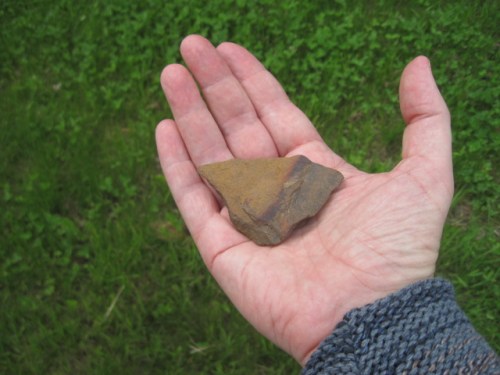
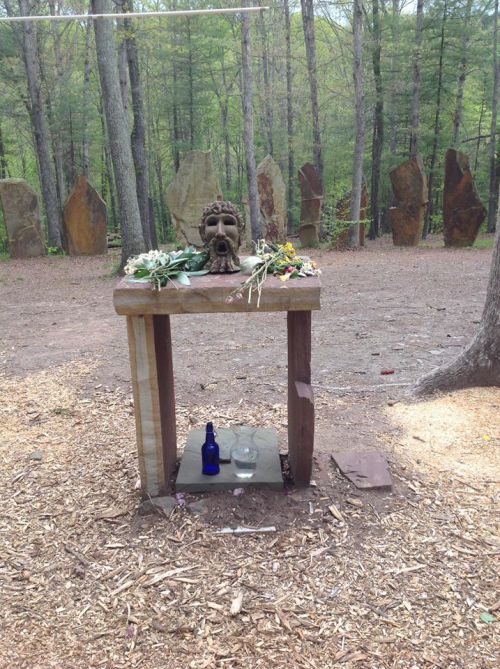
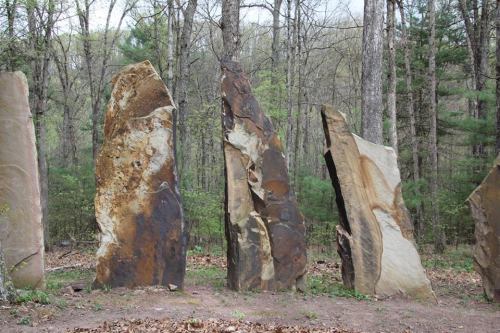
Above is the ley line stone I brought back from MAGUS ’18. It’s “cooled off” since the ritual, but it still hums in the hand. Power of star and stone indeed. For a small stone, it’s curiously heavy. I chose it because its hue recalls the ochres, rust-browns and other shadings of many stones in the great stone circle at Four Quarters Sanctuary which hosted our Beltane gathering. Take a look at the shot of the Circle below and you’ll see what I mean.
photo courtesy Wanda Flaherty
“In the Eye of the Sun there are no shadows”. Really? Sometimes stone wisdom arrives, all authoritative-like, and you find yourself wantingto accept it. It came, after all, gift-wrapped, unbidden, dropped on your inner doorstep, sitting there glistening with morning dew when you opened the inner door to your Grove. It soundstrue. And so on.
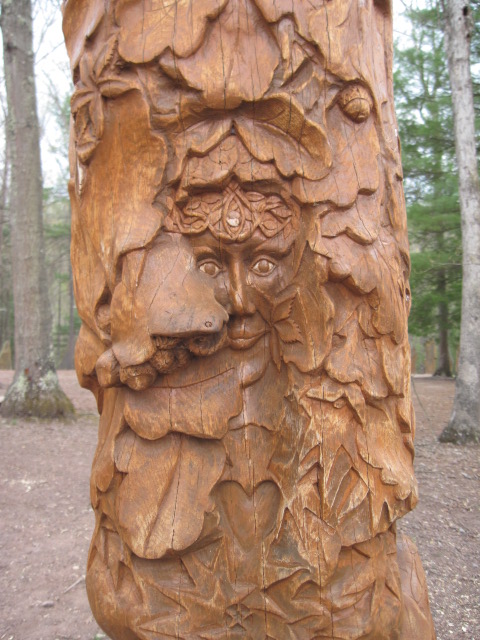
Not everything stands forth in bright light. And more likely I remain, rather than blessed or cursed with certainty, perpetually astonished instead, my mouth open in an O of surprise, just like the stone head of the Ancestor on the altar above.
I didn’t get to the stone-carving workshop that weekend of MAGUS, so mine remains blank. I’ve thought of it since as a Daoist “uncarved block“.
There’s been a bit of banter on Facebook since, about how centuries from now, anthropologists and archeologists may uncover our stones etched with ogham and wonder who put them there. Mine will settle contentedly into the earth, causing no such inquiry. Its power may have no words except the ones I give it, but power remains, wordless, a thrum on the edge of hearing. It talks with no words to the other stones from the ritual.
Jesus was talking to the Pharisees; he said about his disciples, “If they keep silent, the stones will cry out”*.
The title for this post comes directly from a Druid friend’s recent Facebook post. “Spoiler Alert — there are no coincidences”, he writes. “Details later”. That’s a teaser for a whole lifetime.
He’s right, of course. And wrong, in another sense. Everythingis coincident — it happens together with at least one other thing, and usually along with whole bunches of things. How could we recognize any event if it didn’t come wrapped up in everything else? Consciousness depends on noticing differences and distinctions. That’s how our primate brains are wired. We catch things that stand out from other things. We scan the field or background looking for what’s most salient — and that becomes foreground. Food? Sex? Danger? Beyond those three, we can get down to the business of culture, civilization, a lovely meandering conversation with a friend, drinks in hand, on a balmy summer afternoon, discussing unintentional magics like Manhattanhenge.
In this sense, looking for signs is wasted effort. Everything’sa potential sign, because everything is coincident with something else. Events arrive together like a large litter of puppies or kittens (your preference), and we lift one up to our faces to cuddle it, feel its softness against our skin, smell that delicious newborn animal smell of fur and warmth and milk-fed baby-hood. For the moment, at least, that’s our sign, our focus, our access-point to now, the thing that fills most or all of our attention.
But soon enough there comes a moment when our attention, which has dis-membered the whole of the moment in order to grasp at one piece of it, subsides, turning to the next thing, while intuition, the subconscious, a whole host of perceptions and awarenesses linked to but not the same as conscious attention, have been having their own party and we — by which ego often means conscious self — can feel we weren’t invited. The hint, the nudge, the ache, the sense of missing something, until we re-member some of the original whole and just maybe pick up on other elements we didn’t track and hone in on the first time round. But we often suspect this re-membering because it doesn’t originate with that first conscious attention, but pushes up from beneath like a touch of green where we didn’t plant anything. And we have to wait an interval to see whether it’s a weed or not. If like me you’ve been well brainwashed ahem trained! by many Western methods of education, your response is to uproot it at the first sign of its non-approved life.
What’s all this got to do with Druidry? The gifts or original blessing that Druidry takes up and acknowledges in its rituals and perspectives, this embodied existence, along with all the other access-points of awareness and connection, is one key to spiritual practice. We’re not here “for a reason” — reason’s not some kind of cause of things, which if we deciphered it would finally open all the doors. What launches us, and the Land, all its many inhabitants, the whole cosmos, comes before our thoughts about it. Thought is a stop-gap between us and immensity. We’re not here “for a reason” because reason is simply too small to contain more than the most minute fraction of that immensity. But we can treasure and acknowledge being here, and make the most of it — not in some consumerist way, or antagonistic self-against-the-world way, but in an amazed self-in-the-world-with-other-selves way. Of course, reasons may come out of existence, rather than the other way around. Funny, though — they’re no longer reasons as commonly understood, but purposes — oodles of purposes waiting for us to notice and choose and commit to them. No longer the often forlorn quest for a “because”, but so many quests for “in order to” available, sitting or standing, playing their guitars or sleeping, each of them dreaming and longing for some particular one of us, in their Quest Waiting Area. (Settle into even some modest silence and you can hear them breathing and whispering as they dream.)
Druid practice, ritual, harvesting St. John’s wort (it’s almost Solstice, after all!), the work with animal oracles, the curve of a bird’s wing, gardening, the whispers of the Ancestors, the nudges of an animal guide, the fascination of so many branches of learning as they touch on greater mystery the deeper they reach, the quest for wisdom — these are all ways to participate in the blessing, and many more besides.
As far as we can tell, that blessing is inexhaustible. Or if it isn’t, no one’s seen the edge of the cosmos yet. Like the old medieval maps, announcing the edge of the world beyond which yawns emptiness or dragons or an eternal drop into nothing, our little human reason doesn’t do well trying to dissect the cosmos and “figure it all out”. So we try instead to set it to work on things it’s actually good at. Load it with purpose and it takes off like a rocket.
Look at the numbers of people who really want a purpose, but feel they lack one, and the greater culture has no other answer than consume (and spend even more time online).
Time to get to true work, time — we discover with amazement — time to get to joy.
Festivals such as the Solstice, like any enduring spiritual practice, offer times for ritual connection, because ritual is one way to touch the sacred, to sing the awen again.
The challenge, often, is for those who’ve either never experienced ritual and are put off by the thought, or for those who’ve grown allergic to it and are also put off by the thought. Ritual is QWERTY spirituality: a set of keys most of us have heard about and probably know in some way, and second nature for anyone who uses an English keyboard.
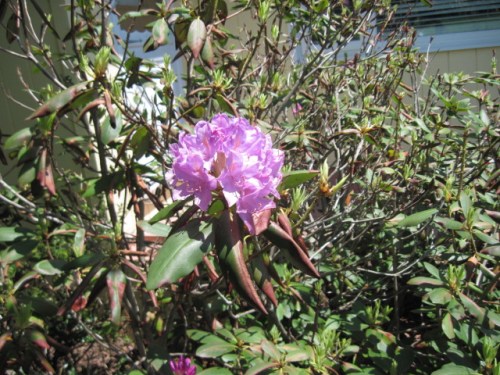
first full rhododendron flower, front yard, 5 minutes ago
QWERTY keys aren’t the only set, or the “best”, or any other exclusive label we may try to put on them. But one of their great advantages is that they’re accessible. And practicing them long enough gives us the confidence to try out other combinations — other keys on the keyboard which we may not even have seen, before we gained familiarity with QWERTY. We make the path by walking.
Can I work with that funny word QWERTY and generate a useful though admittedly adhoc guide for ritual planning? Let’s see.
Questioning, wondering, expecting, readying, touching, and y — a dependent variable. We might call it manifestation, or coincidence, or fit. Sometimes it’s the path of least resistance.
Questioning: What’s the ritual for? (Do I need a ritual?) What’s the issue? Who else is involved, visible and invisible? When is the best time? Who can I ask for help? Who’s attending? How many people will take part? How can I maximize their involvement? Where should the ritual take place? How simple could it be? What does divination suggest? What other signs should I consider? How can I acknowledge my guides?
Wondering: Where has my attention been recently? I wonder how my dreams and the coincidences of the past month play into this moment and the ritual I’m considering. What’s my vision of an ideal ritual here? I wonder how I can involve chance, serendipity, inspiration, the awen.
Expecting: I expect about X many people. I imagine good energies at play. I play through a possible ritual in daydream or guided meditation, I anticipate the materials I need, I collaborate with friends, I bless and ask for blessing of the undertaking.
Readying: I clean and purify the ritual space as needed, inwardly or outwardly, I rely on others to do their part, I drop unneeded attitudes and thoughts, I gather materials, I double-check, I do another divination as needed, I listen to guidance, I practice common sense, I rehearse with others.
Touching: earth under our feet, breath in our lungs, light in our eyes, blood in our veins. Gifts already granted. Sweet incense, woodsmoke, breeze, rich scent of flowers, buzz of insects, animal calls, hawk crying overhead at the moment the ritual shifts, a burst of wind, sun emerging from behind a cloud. Touch and be touched.
Y — the dependent variable: Sometimes we won’t perceive this till well after a ritual. Sometimes it arrives in the middle of doing it, unbidden, grace or spiritual presence. Sometimes one person is led to act or speak in a way that makes all the difference. Whatever the dependent variable is, I can’t control it. It’s the universe participating, it’s the magic of manifestation, or coincidence, or fit. Sometimes it’s the path of least resistance spirit takes, like water along a channel, or blood through the veins. Almost always it’s saying “yes” to possibility, change, inspiration, growth and transformation.
And the awen, I notice, asks for “we” from QWERTY. We can find it in community, in the middle of the ritual, in the common experience we all share.
[An exercise from a draft of a book on Druid spiritual practices I’m writing.]
Using your own name, a specific goal boiled down to a word or two, a god-name, an ancestral name, etc., spell the name or word, giving a separate line for each letter (an acrostic). Then, in a meditation or ritual, dream or other prompting, ask for guidance. Write what comes to you. You may wish to do this on successive days, either with the same focus, or a succession of names.
For practice with this exercise, I chose my grandfather’s middle name, William. He died more than twenty years before I was born. We share the same first name — when I was young, I heard people talking about him using “my” name. I first saw a picture of him when I was 10 years old. (I always wondered why my grandmother had so few family pictures in general — maybe memory was painful enough without reminders. He died when she was still in her thirties, left to raise two children through the Depression.)
Hearing and sharing the same name set up a connection, and seeing his formal portrait, and later other pictures of him, confirmed a link I value to this day. I’ve deepened it with writing about him in pieces like the one below.
Though this one’s not specifically about him, it’s about connecting with the ancestral legacy we all bear, about the Ovate flavor of experiencing the inward journey, about the Bardic encounter with ever-deepening mystery at the heart of things. In the end, they’re not separate, and it’s a relief not to struggle to sort them out, but wait until they clarify, like a muddy stream will, in a few days, after a rainstorm roils the waters.
Just pay attention, whisper the Ancestors. That’s a good half of everything we ask of you.
/|\ /|\ /|\
Ancestral
Washed out of my bones I fly across an ocean green as glass, lifting easy above whitecaps.
Loosed from cages of chest and skull I see them all at once along this dark shore — shadows, lights
moving to music I can’t quite hear,
am always hearing —
ash, ember, blood drum.
/|\ /|\ /|\
Sometimes what you receive or create is for you alone. It is sacred, which means no one else has any say in the matter, nor any opinion to touch upon what is inmost in you, unless you grant it. What you welcome is not for others’ commentary or reaction or judgment, but for blessing and connection and the kindling of a holy fire within.
Other times, you may receive inward blessing to share, but these decisions themselves are not for debate with others. Choose prudently.
/|\ /|\ /|\
In the poem above I underlined the letters of the name prompt. The two final lines, both beginning with the letter “a”, came after some listening time, later the same day. When I say the lines to myself I hear them now as a kind of breathing, or sigh, or a voice without words, a sound at the edge of hearing.
“As he read, I fell in love the way you fall asleep: slowly, and then all at once” ― John Green, The Fault in Our Stars.
/|\ /|\ /|\
Slow, then sudden — this two-part rhythm is more widespread than we often notice. Not only with love, as John Green’s young-adult novel observes, but with much else besides.
If you garden, the seeds you plant can seem like they “take forever” to germinate, but then abruptly poke through the soil as if it’s really the first day of their existence and they’re busy to get on with it. A “breakout” artist shoots to fame “overnight” — except that happens very rarely. The apparent “overnightness” in truth often is years in coming. “A watched pot never boils” — until it does. Never mind the behind-the-scenes activity, the preparation, the earlier drafts, the years of sweat and doubt, the obscurity and perseverance. The American myth of “instant success”, like instant coffee, is a poor substitute for the slow-brewed original.
What then can we make of this pattern and rhythm? If it’s built into the universe as one kind of energy flow, it deserves study. And of course in other guises it has indeed been studied for a long time. We hear of critical mass, we’ve seen plots of the sine wave, the surfer knows how to ride the ocean’s waves, and researchers looking for alternate energy sources attempt to capture the power of the tides and the rise and fall of sea surges.
Magic, like so much else, can often manifest this way: “nothing happens” and “nothing continues to happen”, until something does.
One of the things this tells me, anyway, is that attention, practice, energy can all accumulate. Repetition doesn’t automatically mean wasted energy. We dance because the universe dances — it looks like a primary parameter of the cosmos that merits our respect and imitation.
The child hounds the parent because past experiences suggest he or she will, sooner or late, cave. The clutch of gangly skateboarders hogging that sidewalk or parking lot repeat and repeat and repeat that impossible trick or sweet move, failing and failing and failing — until they succeed.
“Third time’s the charm” goes the proverb — maybe not literally accurate, but a piece of observational wisdom about the value and power of repetition. Even by the third attempt, we often see with many things that we can “improve the move”.
Animals do it. The play that the young of so many species engages in isn’t “for real” — until it is, and all those rehearsed moves, the testing of the limits of flesh and bone and sinew in self and other, the reflexes, the rhythms, the habits of feint and parry, attack and retreat “pay off” in victory or dominance or “simple” survival.
The profligate production of seeds in the plant kingdom mirrors this principle: bombard the Land with possibilities, and some at least will take root and flourish. Jesus offers the Parable of the Sower in the three synoptic Gospels (Matthew 13, Mark 4, Luke 8) as an image, as we might choose to read it, of the “spiritual kingdom” of our actions:
And he spake many things unto them in parables, saying, Behold, a sower went forth to sow; And when he sowed, some seeds fell by the way side, and the fowls came and devoured them up: Some fell upon stony places, where they had not much earth: and forthwith they sprung up, because they had no deepness of earth: And when the sun was up, they were scorched; and because they had no root, they withered away. And some fell among thorns; and the thorns sprung up, and choked them: But other fell into good ground, and brought forth fruit, some an hundredfold, some sixtyfold, some thirtyfold. Who hath ears to hear, let him hear.
If we’re all “sowers” or planters of seed, initiating actions, putting energy into manifesting what we desire, making choices, responding poorly or well to situations and challenges, growing and dying and being reborn throughout our lives, do we have the ears to hear, and the eyes to see, this profound pattern inherent in the “way of things”? If not, we’re missing out on a powerful strategy for living.
Almost as important, I don’t have to aim big from the very outset (though it’s true that will teach me a whole host of things I can’t learn so quickly any other way). I can start small; I make a habit of saying “thank you” in many ways and mean it, and slowly build a reputation as a respectful and courteous person, setting in motion a vibration that accompanies me wherever I go. Or I don’t. I gather with fellow Druids, or do rituals alone, and the regular practice, daily and at the “Great Eight”, slowly attunes me to a larger harmonic that helps hold me together when chaotic energies flash around me intermittently. A practice builds stamina, even as it plants the seeds for the breakout, the germination, the mastery, the arrival, the highpoint, the culimination.
ADF Druids ask, “Why not excellence?” knowing its achievement may well take place “as fast as a speeding oak!”
And one ideal among Native Americans recognizes the time that full manifestation can take. Wikipedia notes that “Seventh generation stewardship”
urges the current generation of humans to live and work for the benefit of the seventh generation into the future. It originated with … the Great Law of the Iroquois – which holds it appropriate to think seven generations ahead (about 140 years into the future) and decide whether the decisions they make today would benefit their children seven generations into the future. It is frequently associated with the modern, popular concept of environmental stewardship or ‘sustainability’ but it is much broader in context … [applicable] in all our deliberations …
Wisdom, insight — these too seem to follow the same rhythm, accumulating like water in a well, until they fill and we can draw on them.
As a Druid I try to have the sense to apprentice myself to the living world. As the late U K LeGuin writes in A Wizard of Earthsea of her main character, Ged:
From that time forth he believed that the wise man is one who never sets himself apart from other living things, whether they have speech or not, and in later years he strove long to learn what can be learned, in silence, from the eyes of animals, the flight of birds, the great slow gestures of trees.
O maple I transplanted four days ago, from where you were poking through the hedge, hungry for light, I’m trying to listen.
If we wish to align these hours with the Four Directions, one possible table could work out like this:
Pylgeint and Bore, late night to mid-morning — East
Anterth and Nawn, mid-morning to mid-afternoon — South
Echwydd and Hwyr, mid-afternoon to evening — West
Ucher and Dewaint, early to late night — North
Here each pair of tides is a time of transition with ever-shifting energies, as the flow created by the “daily generator” of our diurnal cycle moves from the North around the compass and back again.
Or to give a specific example, say it’s 8:00 in the morning. That puts us in the second part of Bore (the Welsh word for “morning”, as in bore da “good morning”), and nearing the transition to South, as daylight continues to grow. This time of year in the Northern Hemisphere, Bore and the Solstice link closely, as light and heat wax and increase day by day, and also during each day. Each day shows in miniature the cycle of the year, with light growing and lessening, dark growing and lessening.
What possible uses of this naming and patterning come to mind?
Well, if I’m awake, a prayer or charm I recite for each of the eight tides, or of the four pairs of them, as I become aware of them. They offer a chance to lift me out of narrow concerns into larger ones. They are a freedom I can give to myself.
Acknowledging the dominant direction and tide at the time of any significant action I (or others) undertake.
Meditating on the shifting force of each direction on each tide as the light and dark ebb and flow, alternating through the year.
Mapping on my own locale the activity and impact of actions taken during the different tides, of weather (especially as the planetary and local climate shifts and heats up), bird and animal and plant life, my own energy and awareness, and so on. To give one obvious example, this time of year our back yard doesn’t receive direct sunlight until well into Bore. Our house lies north-south, with much of the backyard in shadow by late afternoon. What can it teach me, this “Shadow of the West”? An opportunity the land where I live offers me.
Devising personal ritual and dedicating my awareness according to the tides of the days. This can shift daily, or seasonally, as I desire and need. The tides give me a focus for meditation, and a chosen context or “energy border” for my work with the Ovate grade.
As I finish up this post, I’ve entered Nawn, 12:00 to 3:00 pm. Though it’s a rainy day, and I can celebrate the coming of water to plants and trees, keeping the Northeastern U.S. its habitual and lovely green, and replenishing water tables, I can also sense the waxing sun behind the clouds. Delighting in the enchantment of the apparent world, and watching as that enchantment fades, as OBOD ritual frequently proclaims, are twin kinds of awareness that deserve exploration and cultivation.
“When I call your name”, says Professor McGonagall in the first Harry Potter film, “you will come forth. I shall place the sorting hat on your head, and you will be sorted into your Houses”.
How many of us have heard others (or ourselves) say at some point, “I hate labels!”
Well and good. We’ve all been mislabelled throughout our lives, so it’s not surprising we’ve come to dislike careless and indifferent labels, and especially loathe the unfair or cruel ones that stick like chewing gum to our heels. What we hate, I’m asserting here, are inaccuratelabels. But we long for recognition or acknowledgment of our true qualities. We want to be known. To be called — labelled — as friend, beloved, loyal, true — few of us indeed would refuse these labels.
Why then does Hogwarts sort students into Houses from the outset of their time in Hogwarts? Isn’t that the worst kind of labelling — setting up and closing off expectations that may harm the still-emerging personality and talents of each young student?
Let’s examine the scene.
First, the students have been chosen to attend the School. It’s certainly possible, I suppose, that a student could refuse to attend for any number of reasons. (Doubtless someone deep into Potter lore can tell me if I’m misconstruing this particular point in some way.) But I do know that when Wise Ones call us to accept a kind of destiny like this, it often opens up a corresponding inner recognition in us that our time has come. (Or if it doesn’t, it’s probably not yet our time after all.)
Second, McGonagall calls each name. Insofar as our names represent us (and some choose a Craft or magical name for just such reasons), we face an accurate or honest recognition of who we are, and who we can become. Called by name, we emerge from a group and are assessed individually. “You will come forth” — the real you. Our specific and unique potentials are each recognized.
Third, it’s neither a casual acquaintance nor a cruel bully labelling us, but the Sorting Hat, an intelligence and insight above our own — literally, in the case of the Hat resting on top of each student’s head. (Note for a moment how McGonagall’s hat is virtually identical in its shape and crook, though not color, to the Sorting Hat.)
Fourth, no student — or anyone else assembled — questions the Hat’s judgment (though Harry whispers the fervent request “Not Slytherin!” — which the Hat, after assessing him carefully, does honor). We retain our individual choice. Most of the new students look pleased at the Hat’s judgment.
An accurate assessment of our talents and potentials means we can deepen what we do well, while borrowing some of the confidence and insight and skill we’ve built up and already possess to tackle new areas and abilities. As a shy and bookish adolescent, I continually faced challenges to speak up, to express myself, to “not hide my light under a bushel”, to practice confidence around others until I both increased my store of it, and could also mock it up and enter situations where I might never have ventured before.
Or to play with words for a moment, one possible anagram of the name Hogwarts seems helpful (it’s easy to get caught up in such things and push them beyond their utility): “as growth”. Hogwarts is a metaphor, an image or icon or analogy of life-as-growth. It’s not the same thing, but an image of the same, a representation or likeness.
As George Bernard Shaw puts it,
This is the true joy in life, the being used for a purpose recognized by yourself as a mighty one; the being thoroughly worn out before you are thrown on the scrap heap; the being a force of Nature instead of a feverish selfish little clod of ailments and grievances complaining that the world will not devote itself to making you happy (Dedication, Man and Superman, 1903).
Each of the four Houses corresponds in Rowlings’ universe to one of the classical elements. Gryffindor is Fire, the will, the self that chooses, focuses energy, manifests. The Sorting Hat, recognizing and representing our True Will, and serving as its mouthpiece in the sorting ceremony of Rowlings’ novels, knows us truly for what we are, and for what we may become.
Inspiration, the awen of the Bard, isn’t all or nothing. Sometimes you get one corner, a kind of foothold, a vantage point, enough to see more, to see a whole landscape through a window just before the window closes.
The house of fire —
no closed doors —
only porches and windows
opening onto flame.
A few notes for other stanzas, and that was it. But sometimes a fragment is enough. You can jump-start with it, from it, months afterward.
/|\ /|\ /|\
Sometimes, likewise, if we’re open and available, the trees really do tell us what we need.
I help oak, and oak helps me —
we’ll join to hold the energy.
This little rhyme came to me while we meditated at the foot of an oak — part of our ritual prep for the main ley-line rite at MAGUS ’18 last weekend. As much as the oak ogham stave in my hand, the rhyme helped me focus during the ritual. Our outer duir oak ring was charged with gathering and holding the energy the ritual would generate, until the moment our ring moved to the center altar and charged the stones waiting there. One fellow outer-ring participant said it felt at first like a very small pup trying to corral a very large beach ball. But then we joined together to “become one big-ass dog that could tackle it”.
Not surprisingly, the carefully-planned ritual generated a lot of power. I know I can often be slow in picking up on magical energies flowing around me. “Obtuse” wouldn’t be too harsh a word, much of the time. So I knew I had to deal with doubts about my usefulfulness as well as concerns about my vulnerability.
Now it’s easy to rationalize almost all magic. I do it myself, and I often do it well. But rather than debating whether it — or any other experience — is “real” or “genuine”, I can opt to apply different criteria and free myself for more useful tasks. A good logic-fest can be fun at times, but it’s often a tail-chasing exercise. Whether we’re falling in love, writing a song, painting, gardening, caring for others, or working with a dream journal, logic typically isn’t the first or the best tool to employ. A chisel, sandpaper, a potter’s wheel — all produce markedly different effects. They’re so notinterchangeable!
Philip Carr-Gomm addresses the issue in his characteristically understated way. In this short Youtube clip he proposes something other than logic for looking at and assessing experience:
Rather than obsessing over whether an experience is true or genuine, I can contemplate its effect on me and my life. Have I benefited from the experience? While not all experiences are easy or painless, is the insight, perspective or compassion for others than I have gained worth it? “Is the juice worth the squeeze?”
Sometimes, a full answer to those questions may not come for months or years. And that’s OK. By themselves, experiences can resemble an afternoon at an amusement park. Pay your money, get your experiences. But their long-term effect and value is a more helpful measure of their worth.
After a hard winter in much of the U.S., a vigorous flourish of Spring greeted participants of MAGUS 2018 arriving in south-central Pennsylvania at Four Quarters Sanctuary. Blessings of Beltane!
photo courtesy Srinivas Anand
photo courtesy Fae Hanks
photo courtesy Srinivas Anand
EMBODYING SACRED TIME and SPACE
The 2018 Gathering theme “Sacred Time, Sacred Space” emerged in a closely-linked series of workshops preparing the ground for the main ritual of the Gathering.
The saying “If you build it, they will come” has now passed into common lore, but a variation of it is also beautifully true: “If they come, you can build it.” Plan thoroughly, call the Tribe, put your heart into it all, and group magic happens with each person contributing. This holds true each summer for Four Quarters’ “Stones Rising” festival, when another stone is erected in the Stone Circle using neolithic methods, sweat and determination. And it certainly held true this Beltane.
View of a portion of the Stone Circle. Photo courtesy Anna Oakflower.
THURSDAY
After an 12-hour drive from Vermont to Pennsylvania, broken by a stop-over in Binghamton Wednesday night at the house of an OBOD friend also attending the Gathering, we arrived in time to settle into tent and bunkhouse, and attend the first workshop Thursday afternoon, “Envisioning the Future of American Druidry”.
Dana led us to examine what, after all, we do as Druids in the 21st century in this land. What matters to us? What tasks come to our hands as a result of being alive now and here, rather than at any other time and place? How do we acknowledge and interact with a sacred landscape?
After opening ritual later that evening, several of us gathered briefly in the dining pavilion with seven Bards asking for group initiation the next morning, in order to answer questions and attend to final details.
I was privileged once again to participate as a initiation celebrant. As I’ve written elsewhere, this is joyful service. As we perform the ritual of initiation, we strengthen the bonds with our community, we open the circle of Druidry to another person who wishes to stand with us, and we renew our own commitment.
“We swear”, go the ritual words,
by peace and love to stand,
heart to heart and hand in hand.
Mark, O Spirit, and hear us now,
confirming this, our sacred vow.
FRIDAY
The morning dawned warm and mostly sunny, and celebrants welcomed new Bards one by one in the Stone Circle, a powerful setting for initiation. Recognize and invite the ancestors over time, and not surprisingly you begin to pay attention to them more carefully, and sense their presence.
wood pillar, northeast quarter of Stone Circle.
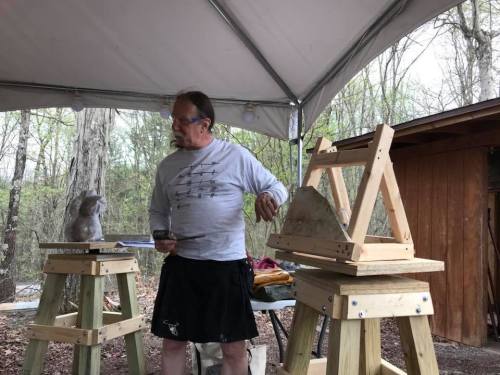
WIth the blessings and active involvement of Four Quarters staff, each MAGUS attendee found a stone for the main ritual, and many attended Forest’s Stone Carving workshop Friday afternoon to incise on them one of four ogham of the sacred trees we were working with in preparation for the ritual — birch, white pine, elder and oak.
Forest’s Stone Carving workshop. Photo courtesy Patricia Woodruff.
After dinner Friday evening came the workshop “Chanting for Sacred Time and Space”, with Tom and Loam helping us to tune to the land and to each other with group songs and melodies.
Later, several of us gathered by Sideling Creek for the night-time Ovate initiations. A few brief spatters of rain refreshed rather than soaked us. Peepers and owls sang the initiates through the rite.
The Fire Circle that evening was livelier than Thursday’s. I longed to stay, but I couldn’t keep my eyes open for more than another half hour, so voices and drums and laughter saw me off to bed.
Photo courtesy Crystal Collins.
Forest models a t-shirt. Photo courtesy Patricia Woodruff.
SATURDAY
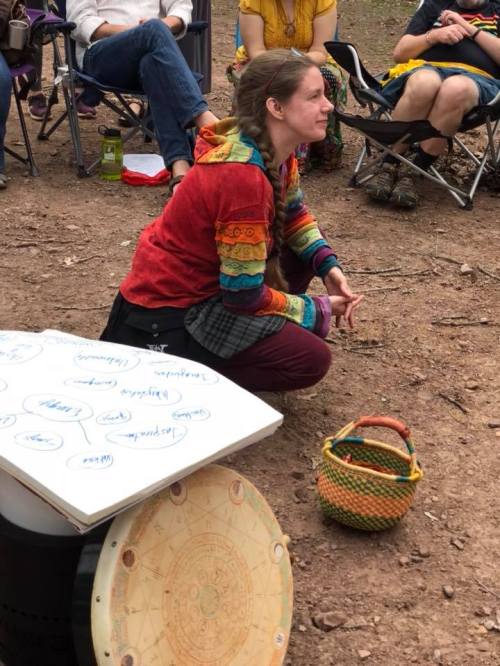
Cat’s morning workshop, “Terra Incognita: Mapping the Sacred”, helped expand our sense of maps and spaces, and led us deeper into the energy ley lines can carry.
Cat’s workshop on mapping the Sacred. Photo courtesy Patricia Woodruff.
That afternoon, in “Creating an American Ley Line Network”, Dana focused us further, letting us draw an ogham stave with one of the four tree ogham. Now grouped with the others who drew the same staves, together with our group leaders we practiced chanting galdr, the tree/ogham name, and meditated to strengthen our connection to our specific tree.
MAIN RITUAL
Preparing the Main Ritual space. Photo courtesy Dana Driscoll.
By 4:30 pm Saturday we’d assembled in the Stone Circle, transformed earlier in the day by the ritual team who marked out the sacred space. Now it was sparking with energy from the bright yellow cornmeal rangoli. [For a picture of the rangoli at ECG 2017, go here, and scroll down to the ninth image.]
Participants each brought their stones to lay in the center of the ritual circle, ready for charging in the powerful galdr ritual that followed.
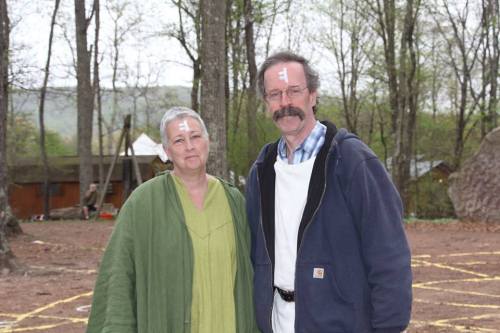
Below, Sue and I stand together briefly after ritual and our group’s grounding session, the ogham duir “oak” in white on our foreheads.
Photo courtesy Anna Oakflower.
Careful attention by the ritual leaders kept us all grounded and centered, though you can see we still look a little dazed. The Four Quarters kitchen staff made sure we had a meat option at dinner a quarter hour later, to help us earth any remaining energy.
EISTEDDFOD
And of course no Druid Gathering is complete without the Bardic arts of music, poetry, drama, etc. This year MAGUS added a visual arts eisteddfod to celebrate a wider array of skill. Below, the eisteddfod continues in spite of rain, indoors in the dining pavilion.
Photo courtesy Patricia Woodruff.
SUNDAY
Linked now by magical intention and the physical key of a sacred rock each will take home, we closed the weekend in a gentle rain with our final ritual. An extended acknowledgment of each person who had contributed to the weekend helped ground us and speak our gratitude as the MAGUS team recognized workshop leaders, ritualists, support staff, organizers and Four Quarters staff.
We said our goodbyes, and departed. I know I will return, in the meantime “singing up the ley lines”, as the verse of one of our chants reminds us to do. I whisper the words as we drive home in the spring rain.
As I wrote for MAGUS ’17,
How to convey the blend of the speaking land, the personal and the tribal at such Gatherings?! You come as someone new to Paganism, or to OBOD more specifically. Or you come knowing you’ll reunite with your people once more, across the miles. If we saw each other every day, we might begin to forget the human and spiritual wealth that surrounds us. In ritual, in conversations in the dining pavilion, or over coffee during breaks, we’re reminded that we’re never alone, no matter how solitary we may live the rest of the year. Inner connection exists over any distance.
/|\ /|\ /|\
[For those interested in further details and the perspective of one of the principal Gathering ritual organizers and leaders, here’s the most recent of Dana’s posts on “An American Ley Line Network: A Ritual Of Creation”.]





 For practice with this exercise, I chose my grandfather’s middle name, William. He died more than twenty years before I was born. We share the same first name — when I was young, I heard people talking about him using “my” name. I first saw a picture of him when I was 10 years old. (I always wondered why my grandmother had so few family pictures in general — maybe memory was painful enough without reminders. He died when she was still in her thirties, left to raise two children through the Depression.)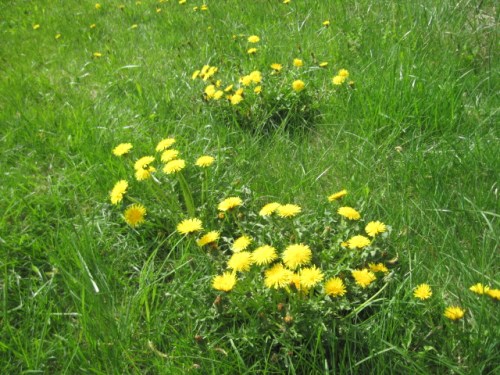
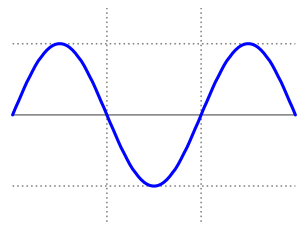 What then can we make of this pattern and rhythm? If it’s built into the universe as one kind of energy flow, it deserves study. And of course in other guises it has indeed been studied for a long time. We hear of critical mass, we’ve seen plots of the sine wave, the surfer knows how to ride the ocean’s waves, and researchers looking for alternate energy sources attempt to capture the power of the tides and the rise and fall of sea surges.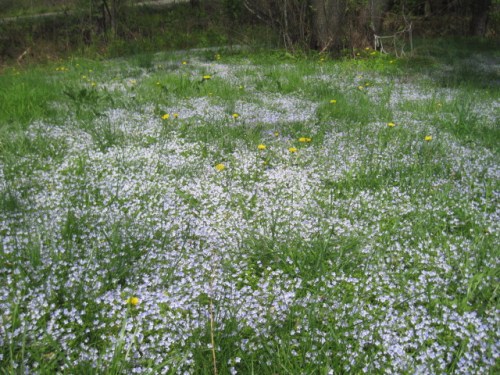






 A Druid Way

