Author Archive
Tree Prayer
Oak, shade my path. I welcome your wisdom.
Birch, green my way. I call on your courage.
Hemlock, heal my heart. I fast under your foliage.
Pine, scent my dreaming. I gather your gifts.
Tree companions all, I seek the shelter of your boughs.
May my days make return for your abundance.
/|\ /|\ /|\
I’m still working on and tweaking and listening to this prayer, as I say it out under the trees. I suspect we’re composing it together.
I invite you to try out this prayer — really out — outdoors, and to post your experiences, revisions, smoother versions, and so on.
/|\ /|\ /|\
“isn’t to make Druids”, a fellow Druid remarked to me over the Solstice weekend at our Vermont Gathering.
Huh. I thought. Right! As soon as you say it …
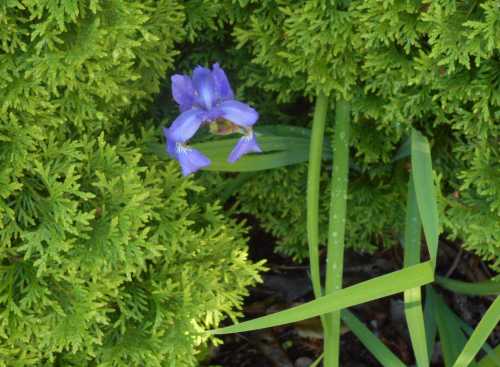
strayed iris along our driveway
Druidry’s a practice to re-connect with Spirit. What aspect of Spirit you reconnect with, how you reconnect, why, and what you call yourself — these matters circle round the rim of the practice, however helpful or significant they may be. They’re not the hub, like the practice of connection is. (A wheel, of course, is more than its hub.)
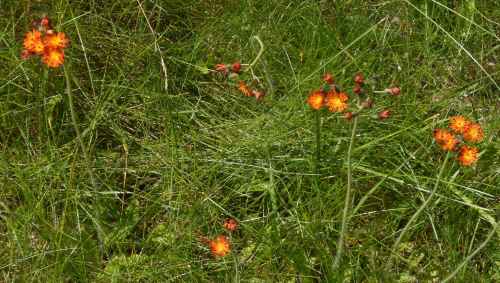
devil’s paintbrush (Hieracium aurantiacum; Pilosella aurantiaca) aka orange hawkweed — one of my favorite “unplanted flowers”. They set the lawn on fire!
The metaphors that bubble up when we try to talk about a practice matter, too. Circle, spiral, wheel. The patterns of the oldest games we play as children, the deepest truths of existence we perceive.
When you’re reconnecting, the tree-wisdom that is one probable etymology of the word Druid is at work in your life.
How does it manifest?
For me, it takes increasingly specific forms that become my practice by themselves. I know something larger than me and my hopes, fears and dreams. I find I want to honor it, and strive to live in harmony with it. The more I give it my love and attention, the more numerous my encounters. I slowly discover how interactions and exchanges with it are mutually beneficial. I work to bring more of my life into a dance with its rhythms.
/|\ /|\ /|\
Part of my particular how of connecting and manifesting lies in where I find myself, as does yours, if you’re seeking to connect.
I bless the previous owner, as you know from previous posts, for the Rowan in our front yard, and also for the row of three old blueberry bushes in the back. We’re letting blackberries grow up near them. Both like the acidic soil we try to provide with pine needle mulch, and after the spate of bitter weather this past January, we’re seeing some die-back among them and the rhododendrons out front. As if to compensate, this has been a particularly wet year, and a warm one, once it got going.
Blessings on Europe, and a request to Spirit to temper the heat burning there. Balance, balance.

Everything wants to make a gift of itself to you, came the insight one morning some years ago.
Sh*t! I remember thinking. Really?!
But the message wasn’t done yet. Reject it and the gift often comes harder, more insistent and difficult, in less easy forms.
All right, I think. Well, no. A little right. This will take some getting used to.
Everything?!
Difficult gifts … I’ll tell you mine if you tell me yours.
/|\ /|\ /|\
Yesterday was too rainy, so it wasn’t until this morning I finally thought to get a shot of the two pine trunks I rolled from where our friend and neighbor Chris helped to cut them into manageable lengths with his chainsaw in May.
For a month they lay there, too heavy to move.
So thank-yous to all of you who contributed Solstice energy to our recent Vermont Weekend and helped me raise these “Alban Gates”!!
After meditating and listening for a bit about where I should set them, I raised them as gateposts for my backyard grove over the weekend. They now sit on stone footers, with wedges to steady them. I’ll be adding some side supports and possibly a lintel post later.
Below is a pic of them, looking west towards our house. The slightly larger left trunk is about my height, to give a sense of scale. Thank Spirit they’re pine. They won’t last as long, but I wouldn’t have been able to lift and set them in place if they were as heavy as oak, or the cherry of our recent Solstice bonfire.
I’m still listening about when to dedicate them. Lunasa, or the next full moon, maybe.
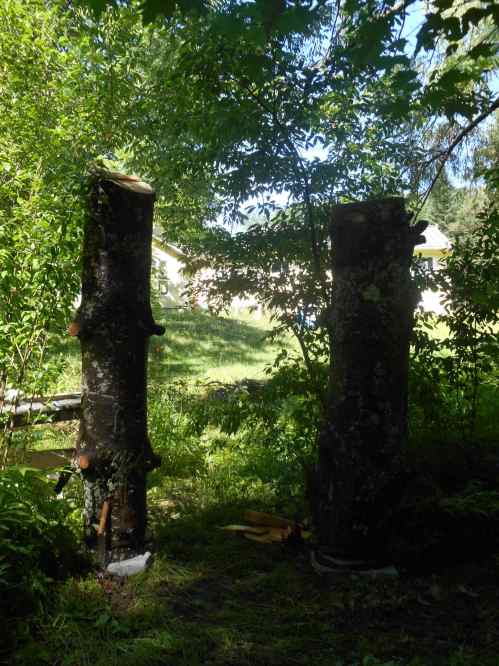
Solstice energy to raise and open the “Alban Gates”! Facing west toward house.

Same pillars, facing east — with the mystery of light on leaves
/|\ /|\ /|\
“Wood-month” is upon us. Or at least on many Vermonters. Everywhere, a store of winter fuel dropped off on roadsides, yards, driveways, ready for the work of stacking. Sweat equity for stacking makes up the significant difference between cost per cord and cost per gallon of fuel oil. As long as I can, I’ll sweat instead. I’m still more cheap than lazy at this point. Of course, I can virtuously claim to be a little “greener” as well.

We manifest here by applying effort. It’s one of our special abilities. Spirit (and other beings without physical bodies) need incarnate beings to achieve such things, and humans are especially good at this, at building and shaping and moving stuff around. Part of why we’re here is to learn to do it more wisely, at need and not merely at whim.
Solwom wesutai syet. For the good of the whole …
/|\ /|\ /|\
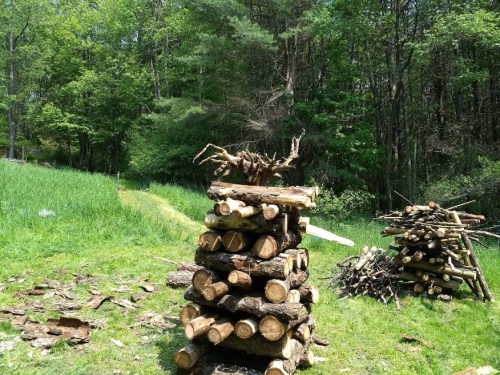
Cherry deadfall bonfire wood stacked and drying — photo courtesy BW
The Southern Vermont Summer Solstice plans finally all came together this weekend, with about 20 people from Massachusetts, New Hampshire and Vermont groves and seed groups gathering to celebrate the Solstice and camp on the land of our host BW.

Potluck, Friday evening 21 June 2019. Photo courtesy FH.

“Friday evening ease”, 21 June 2019, BW’s house.
After dinner Friday, we drove to Putney Mountain to see the sunset of the longest day and watch the stars come out. A marvelous breeze kept the bugs off.

Solstice sunset Friday 21 June 2019 on Putney Mountain. Photo courtesy FH.
The next day we drove and hiked to the Putney Stone Chambers, which I also wrote about here last September.
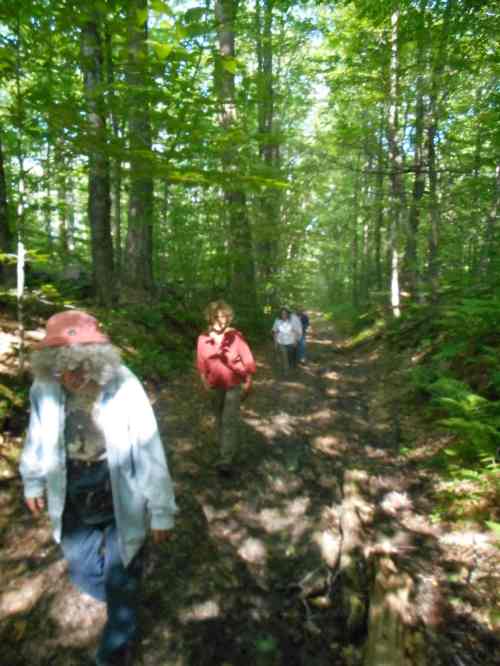
Saturday afternoon 22 June 2019 hike to the Putney Stone Chambers
The walk to the most impressive of the chambers follows a Class 4 road.

mossy stone on hike
Recent rains have kept the mosses and ferns green.

Investigating a smaller stone chamber. Photo courtesy FH
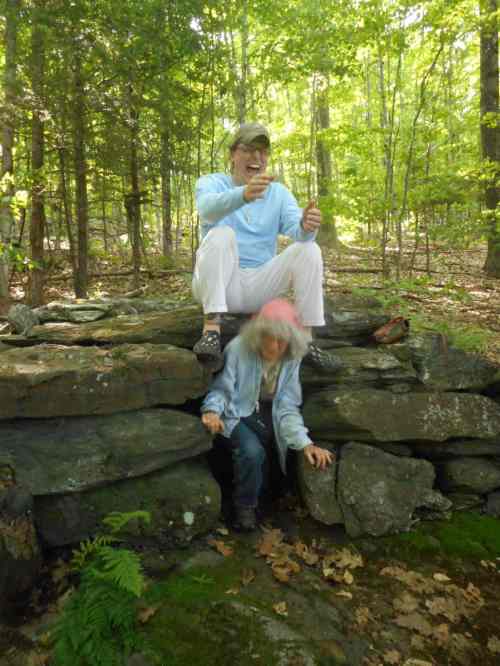
“Rebirth from the earth”
We nicknamed the largest chamber the kiva, after a similar design in the American southwest.
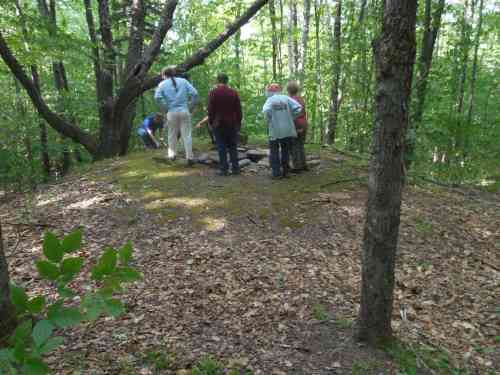
Gathered at the “kiva” entrance
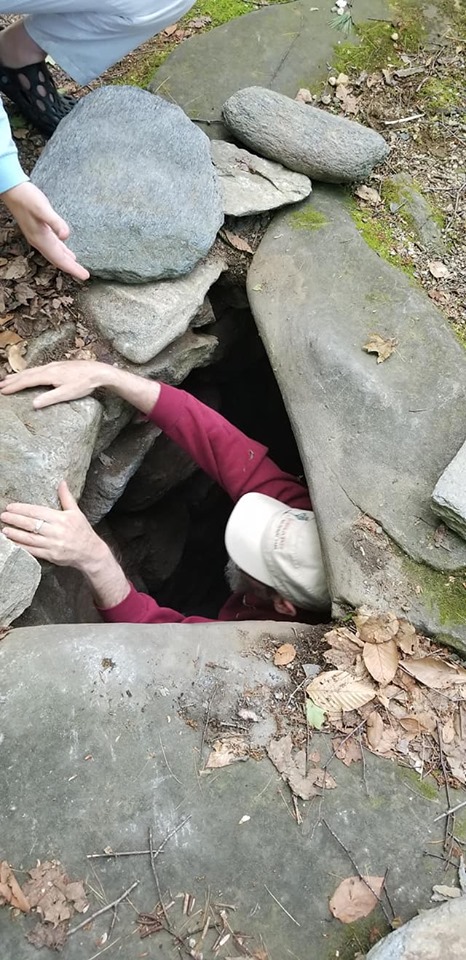
Entrance to the “kiva” — BW is standing showing depth of chamber. Photo courtesy FH

“Into the kiva — 1”
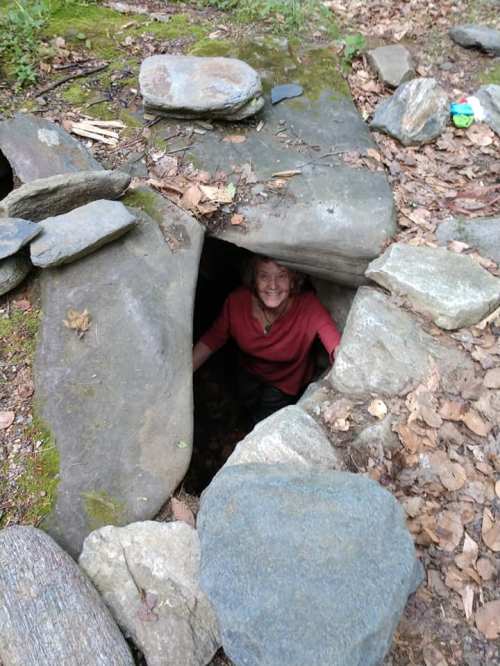
SF in kiva — photo courtesy BB.
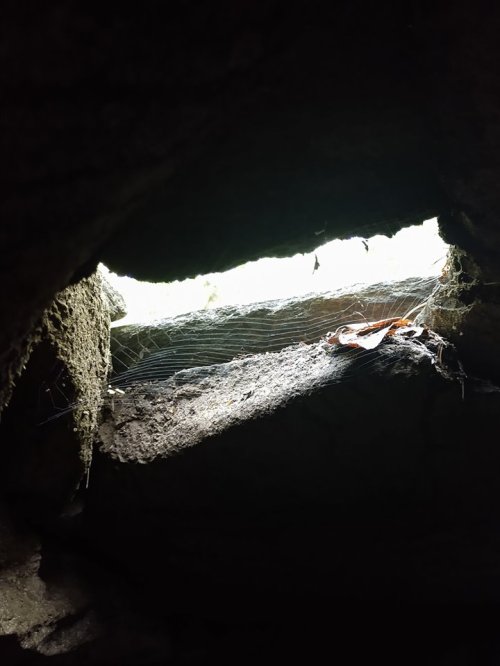
Spiderweb over kiva vent hole — view from inside — photo courtesy GN

“Druid at ease” — MH in a tree near the kiva. Saturday 22 June 2019
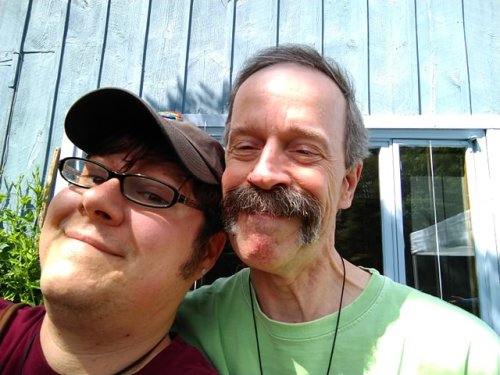
Mugging for the selfie — BB (left) and me (right)
“Ignition” — bonfire Saturday evening 22 June 2019 after ritual. AB is blowing the sparks to flame.
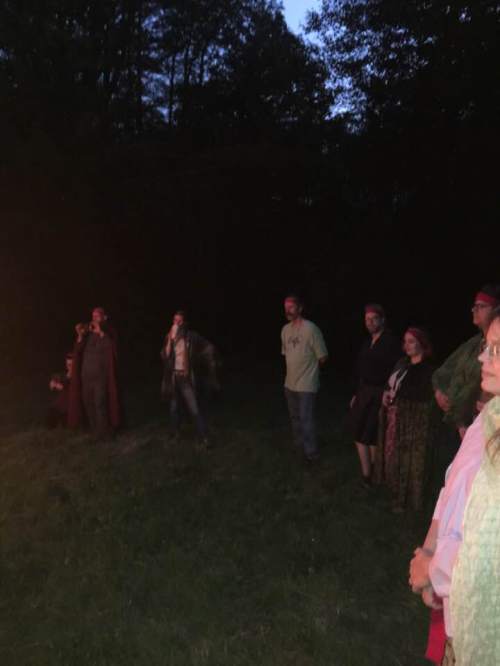
Shortly after ritual, as we watch the bonfire light. We’re still wearing red headbands from the rite. Photo courtesy CG.
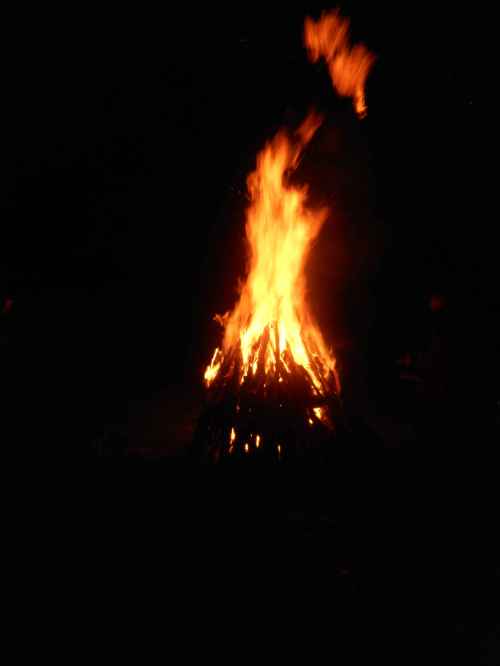
Young fire. Saturday 22 June 2019
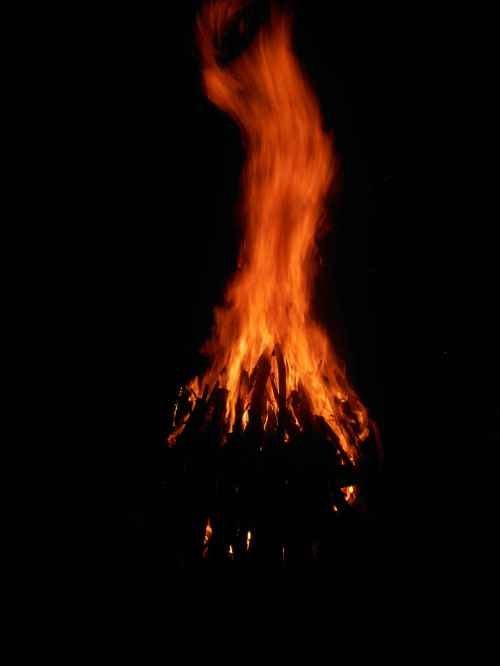
Young fire, Saturday 22 June 2019. Figure within flames?
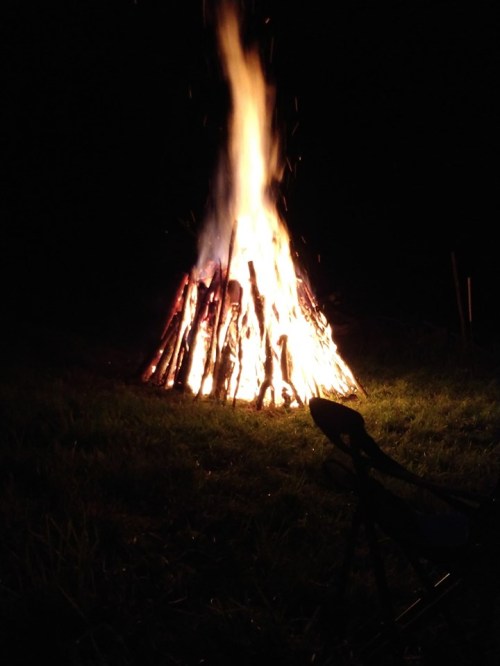
Bonfire in full burn Saturday 22 June 2019. Photo courtesy CG

Moon at sunrise this morning, Sunday 23 June 2019. Photo courtesy BW.
We closed the weekend this Sunday morning with offerings of cedar boughs and whiskey around a small fire, as we gave thanks for the weekend and the community we share.

Basket of cedar and whiskey bottle. Sunday morning 23 June 2019. Photo courtesy BB.
/|\ /|\ /|\
Happy Solstices! — Summer in the Northern, Winter in the Southern Hemisphere.
Here is “Eagle Poem” by Joy Harjo, which we’ll be sharing tonight at the opening potluck supper of our Solstice weekend gathering here in Southern Vermont.
To pray you open your whole self
To sky, to earth, to sun, to moon
To one whole voice that is you.
And know there is more
That you can’t see, can’t hear
Can’t know except in moments
Steadily growing, and in languages
That aren’t always sound but other
Circles of motion.
Like eagle that Sunday morning
Over Salt River. Circles in blue sky
In wind, swept our hearts clean
With sacred wings.
We see you, see ourselves and know
That we must take the utmost care
And kindness in all things.
Breathe in, knowing we are made of
All this, and breathe, knowing
We are truly blessed because we
Were born, and die soon, within a
True circle of motion,
Like eagle rounding out the morning
Inside us.
We pray that it will be done
In beauty.
In beauty.
— Joy Harjo
/|\ /|\ /|\
One breath follows another. You’re doing it right. Keep going!
The air kisses you as soon as you step outdoors. No judgment!

Sun, stars, clouds, moon, rain, snow — they each greet you in their seasons. They’re with you, doing what they are, just like you do.
Fur companions in your life, their moist noses and soft, warm coats, a blessing. What I do is me*, they remind us. You do you. No one else can.
Trees do it every day, breathing out what we breathe in, breathing in what we breathe out. It’s a prayer-song — you may have already heard versions of it. If not, make one up right now. You can hum it to yourself around the trees, setting a tune, letting them know you know, telling them they’re doing it right. They know, but it’s good when we do, too, and we say so.
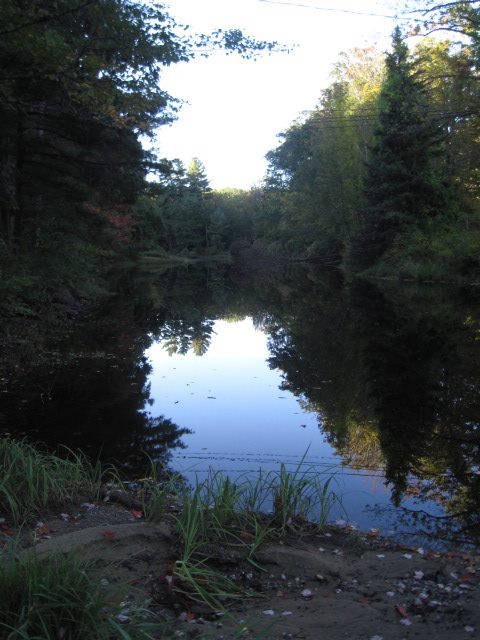
“No one knows what will rise, when the pond is working” — Linda Allardt
Solstice, greatest of all the Feasts of Fire, beloved of the Faerie Folk …
I don’t know about you, but I hear that and I’m there. It’s a line from OBOD ritual, and we’ll be saying it this weekend at our Alban Hefin/solstice celebration.
I whisper it now to myself, this word-charm, along with that earlier line about breathing, and I listen to the rhythm, the music, as I speak the syllables:
Greatest of all the Feasts of Fire, beloved of the Faerie Folk …
We breathe in what you breathe out, we breathe out what you breathe in …
And I imagine singing this as a round at our ritual.
The exchange between realms sustains both.
/|\ /|\ /|\
*See my recent post, with Hopkins’ poem.
Druidry, writes Philip Carr-Gomm in his foreword to Nuinn’s (Ross Nichols) Book of Druidry,
is a way of working with the natural world, and is not a dogma or religion … Druidry honours, above all, the freedom of the individual to follow their own path through life, offering only guides and suggestions, schemes of understanding, methods of celebration and mythical ideas — which can be used or not as the practitioner sees fit (pg. 14).
You could just stop there, and run with that, because this post eventually descends into a rant. Or irascible prayer. OK, you were warned.

clover overtaking weeds — no mowing needed! (but woodchucks love it)
<begin rant>
The word “honours” matters in the quote above. Not “grants” or “permits” freedom. Druidry recognizes something that’s already there. Druidry says Pay attention, so you can recognize these things, too.
Freedom, guides, suggestions, schemes, methods, celebrations, myths. These are the “seven paths in freedom” I want to look at in this post. Don’t worry, it’s not really a numbered list. A different Song is playing. The Song matters more than any list.
Freedom, that much abused and misunderstood word, is an actual thing we can experience and live from, not merely a “concept” or an “idea”, though it’s these things, too. It’s not only “in my head”. Freedom, like any song, comes first, then we have thoughts about it. It’s a gift, just like our lives. A melody at the heart of things. And like our lives, we can end our own freedom in so many ways. Turn off the music. (At least temporarily, though the Spiral remains, all the way down into our DNA.) If you need to be reminded how, just read the headlines. It’s practically multiple-choice at this point. Fifty ways to leave your lover, sings Paul Simon. Shedding your skin, walking on the other side, is a really good option at this point. We do it every night in dream. How about while awake?
A free person gives freedom to those nearby. Freedom spreads, like air, fragrance, sound, waves. We all know others who take from us when we’re around them, just like we know people who give, who make space, and work not to impose their limitations on us. Sometimes we read of the “torch of freedom” — and though cynicism is a popular defensive shield these days, that’s a live metaphor for the sense of kindling and expansion we feel in the presence of a free person. May we meet — and be — such people!
Don’t want to, or can’t, join a Druid Order? You’re a Druid from the day you accept your freedom, and act from it. An Order’s just a form, a guide, a suggestion, to try or not.
If we act from freedom, we discover everything is a guide, a suggestion. The old challenge, Everything is permitted, provided you can accept responsibility for what you do, is a rich seed for meditation. How far can I go toward testing it?! Not Is it true? but How is it true? When is it true? In what ways is it true? These tests, and their results, work much more creatively and productively, at least for me, than a simple “yes/no” Is it true? Because I’ve found pretty much everything is both not true, and true, depending. So that question’s off the list, until I can come back to it on a higher spiral, when it may turn out useful once again, after I manage to learn a few more things. Consciousness makes all the difference: it’s the “depending”.
Druidry offers some things to try out. (Now I’m imagining that as my quick seven-word answer to anybody who asks “So what is Druidry?”!)
Ground a practice in the things of my world: air, water, fire, earth. Not just ritual, though that too. Expand my rituals. Thinking, this morning, while I wash two-days-dried dirty dishes in warm water: air/thought, water (obvious!), fire/heat of the water, of my blood, of the sunlight streaming through the kitchen window; earth of my bones and flesh, of the food scraps on the plates and pots and silverware, of the sink and walls and world all around.
Brother Lawrence wrote a wonderful classic, Practicing the Presence of God. You almost don’t need to read it, the title says so much. If you do read through, be patient with it and yourself — you’ll need to do some digging to excavate the gold, given the change of cultural understandings.
It’s a practice, not a one-time deal. You get better.
Listen to other beings. The white ants that come every summer to our kitchen have more to teach me than the last book I read, whatever it was. Practice asking good questions. I’ve spent at least four decades on that one, and no sign of stopping yet. You know — magic in, magic out. Or the opposite.
“My God is bigger”, said a Christian to an author friend of mine. “Maybe that’s because your need is bigger”, said the friend.
An infinite abyss separates any two moments in time, in eternity, says one of the Wise. I practice resting there, feeling the lightness of spirit, of creative fire, of the awen as it flows. I set my hand on a blank journal page, a computer screen blog post, and enter that abyss. If like me you flash on vertigo for a moment, know too how weightless is fire, always rising up, climbing the spirals we all walk. If a child falls in a dream, the Senoi people of Malaysia encourage the child to fall, and not wake up to escape the dream. “They taught the children to fall, knowing they wouldn’t be hurt, and to climb, to travel, or fly to unknown places, to unknown cultures, to learn new things. If they woke up instead, they would be advised not to escape from such dreams the next time they occurred”, write Stewart and Garfield in their 1972 book Creative Dreaming. Easier on everybody than the wrenching costs of the rising suicide rates in the U.S. and elsewhere.
Schemes of understanding, patterns, webs, networks, interconnections, links, circuits. Our “marvels of modern technology” work (when they work) by building with earth — metal, glass, rare earth elements. Technology grounds these sometimes abstract, intellectual facets of elemental Air and manifests them, re-alizes them, makes them what Latin calls res — things. Ground and center, counsels beginning practice, again and again and again. I always need to earth what’s goin’ down.
Heirs though we are of two thousand years of Christianized thinking, somehow we’re still more Gnostic than Christian, eager to flee this world, constantly forgetting the god at the heart of Christianity who incarnated, became flesh, manifested, took on a body, got as earthy as anybody can, and died that way too. Eucharist, literally thanksgiving — this is my body, this is my blood. The Things of Earth are holy, divine.
Pilgrim on earth, thy home is heaven. Stranger, thou art the guest of God(s).
And yes, William Carlos Williams, you turn out to be right on both counts: “It’s difficult to get the news from poems, but men die miserably every day for lack of what is found there”. You write about a fracking flower [short / long] and stake us through the heart. Bards, tell us how it is, how it can be. Now take out the comma. Bards tell us how it is, how it can be. I’m still practicing as I listen harder.
Or another take, if you like or need it: “Earth’s crammed with heaven” , says Elizabeth Barrett Browning. “And every common bush afire with God;/But only he who sees, takes off his shoes./The rest sit around and pluck blackberries,/And daub their natural faces unaware …” Another practice, taking off my shoes, and walking through the grass.
And that’s fine, too, says Druidry. The Spiral always waits. No one’s reached the end yet … There are always rest-points. We need ’em.
Methods, celebrations, myths. Five, six and seven, if you’re counting. J. M. Greer says one key is “embracing an experiential approach to religious questions, one that abandons rigid belief systems in favor of inner development and individual contact with the realms of nature and spirit”.
Everything’s political? Nope — everything’s spiritual. Or mythical, if you prefer. Politics wants the power and energy, but without bothering about the spirit that powers them. (Zeus tried all that out long ago, and look where it got him!) Things of this world? Sure! But just know where they come from. Get the order right. That’s why we keep screwing ourselves over with men (and it’s still mostly men) of power. Give the women a chance to mess things up, too!
They can’t give us what we really want. But we keep handing politicians our freedom anyway, as if they knew better what to do with it than we do. Reclaiming, Starhawk calls her Witchcraft tradition. Get it back! Don’t give it away again!
<end rant>
/|\ /|\ /|\

Fallen pine, cut into lengths: edging for more raised beds? Gateposts for my backyard grove?
Solstices.
Just as at the Winter Solstice we celebrate the shortest day and longest night, knowing that light will grow again, so at the Summer Solstice we celebrate the longest day and shortest night, knowing that daylight will now shorten. Here is a teaching of paradox: each peak, dark or light, contains the seeds of its own change. And as Taoist tradition teaches, “When Yang peaks, it shifts to Yin; when Yin peaks, it shifts to Yang.” — adapted from OBOD publications.
I begin again. A couple of deep breaths, to center myself. Then the awen, or another sacred word. Open the inner doorways.
Get out in the sun, advises the OBOD ritual booklet for Summer Solstice. Sit in a shadow. I love these two apparent contradictories, side by side! So perfect! Harvest your garlic. Sunburned, shaded, garlicked, I proceed.
Having neglected to grow either St. John’s Wort or Vervain for our Solstice rite next weekend, I’m on the lookout for them along the road, in fields nearby, or at a farmers’ market. We’re naming the local landscape and its creatures in our Solstice ritual script, listening between the words for their other names, ones they may not tell everyone. Indian Place Names of New England, in a hodgepodge of less-than-complete formatting for online viewing, gives one Native American name for our local Vermont region: Kawassentekwa “barren spot along the (Connecticut) River”! One more way to laugh, to stay humble, to see and work for possibility where, outwardly, things look bare.
Apparent world, crazy uncle at the door, we hug you and invite you in to join us at the Festival table. Meet the others here!
/|\ /|\ /|\
The heat is on — at least for a few days here in Southern VT, where temps yesterday and today reached 80 F / 27 C.
Do you feel it, that flaming toward summer solstice? If you’ve spent time outdoors, even at sunrise or sunset, you can sense the shift. The birds feel it, launching their first songs when the sun still lacks half an hour to cresting the horizon. Trees know it, their leaves finally fully unfurled and deeply green.
We’re two weeks out from the longest day — about the time I frequently sense a shift, turn my thoughts toward the next festival, and “listen harder”.
Just about year ago I posted 19 Ways to Celebrate Summer Solstice, and looking at it again, I see how many of the 19 Ways are for solitaries. Part of the appeal of Druidry is how any one of us can begin it, and deepen it, right where we are. We don’t need to find or start a group, though groups can provide fellowship and community, a hearth to cherish, a portable temple to support our practice, and also those chance conversations that can transform a ritual afternoon or evening, spark a friendship, mark a turning point, or open up a new direction for us to take. Yet most of the Ways could also fit group practice as well.
But I also want to yellow my nose with dandelion pollen as I sniff the flowers, stretch out full length in the grass, run my fingers over the bark as I listen to a favorite tree, anticipate the berries that will follow the delicate white flowers now on the berry vines, mark the slow dissolution of a fallen branch as the earth takes it back, ponder an anthill, study the mud-dauber wasp as it enlarges its nest. So many lives neighboring mine, why would I want to miss them? I have an appointment with the wild I will not miss.
The lore of the solstices is wisdom. Just as it reaches the heyday of its strength, the sun’s light yields, and the days once again start to shorten. And in the southern hemisphere, dark now rules over half of each day, but come winter solstice and the light will slowly begin to grow again.
From the traditions of OBOD, the Order I belong to, emerge older accounts of a three-part observance, a vigil till midnight (and for those willing, an all-night watch, interspersing periods of meditation with music, storytelling, etc.), a dawn ceremony to welcome the shortest day on Solstice itself, and a final noon rite several hours after that. Our local Vermont Druid group is hosting a full Solstice weekend, with a Friday evening mountain-top potluck, a sundown ritual Saturday evening, followed by night drumming, discussion and vigil, and a breakfast the next morning.
Harvesting and hauling firewood for the ritual a week ago, from the conservancy forest land where our “host for the Solstice” lives, we came on a large half-standing cherry, whose wood we cut and stacked, to await the bonfire.
Cherry bonfire wood stacked. Photo courtesy Bruce W.
We can read rituals and myths, imagine them enacted, choose a portion which we will enact and dramatize, or maybe leave in half-symbolic form. The Oak King reaches his greatest power at Summer Solstice, and we crown him with a chaplet made of his own leaves. Yet it is the Holly King who rises, going forward, as the Oak weakens. We pass the oak-leaf crown to each other, and perhaps some of us hold in our thoughts the ancient proverb: nomine mutato, de te fabula narratur. Change the names, and it’s a story about you. A little shiver in the heat.
May your Solstice burn brightly!
/|\ /|\ /|\
[I first drafted this short post in early May, and I’m returning to it now, leaving its seasonal references untouched.]
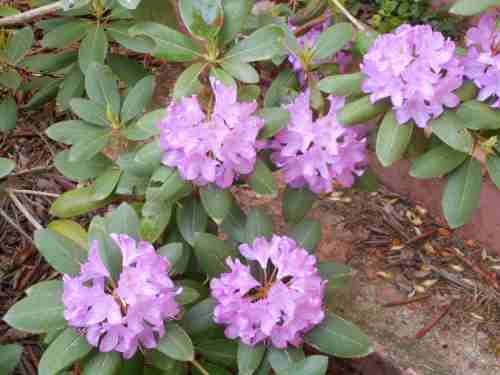
part of our two rhododendrons that survived the winter, now blooming in June
Penguin/Random House provides this excerpt from the late Mary Oliver‘s 2016 book, a collection of essays called Upstream.
“Attention is the beginning of devotion”, she writes, at the end of a section.
Druidry, like other true practices, is devotion, a measure of life away from distraction and toward attention. What do I mean by “measure”? A choice, a predilection, a heeding of instinct, or as Robert Frost puts it, a “stay against confusion”. After all, it’s we who do the measuring. (Or else we yield that privilege to others less worthy, less qualified to know what’s best for us. Until we do the difficult work of reclaiming.)
Truth, I find, sorts itself out marvelously well, once we start paying attention. Love itself is a kind of attention, a focus on what matters to us. I look into my partner of 31 years and discover a being new, mysterious — she’s becoming more of who she is. Both of us are graying and wrinkling, our kinship with trees ever more visible in the likenesses between bark and skin.
Attend, and we encounter. We meet other beings, landscapes, presences, the place we’re standing, feet pressed against the earth, the air we breathe, our own bodies, breathing and pumping blood, sweating under the early summer sun, or shivering slightly in this May air that only days ago frosted the grass and blackened the first brave flowers. Just beyond our skin, the cosmos. Looking only at the proportions of existence that are me and not me, you’d think attention might be in fact a wholly reasonable thing, though much modern life tells us no. So it is that the “apparent world” named in Druid ritual is what we’ve created — a sometimes-useful bridge that may not accommodate all the cars we wish to drive across it. At need, I remind myself, let that world fade away. Don’t worry — it’ll be there when I return.
There and back again, writes Tolkien. True voyage is return, writes U. K. LeGuin.
May you go there, and return — often.
/|\ /|\ /|\
For this post I’m returning to a thoughtful comment by Lorna Smithers from several years ago:
The division between what remains in the journal and what to communicate is a question I confront continuously as a Bard, for unlike with a path that focuses solely on personal transformation through magic, Bards are expected to share their inspiration.
I find that some experiences are OK to share immediately, others need time to gestate for the meanings to evolve and take on a clearer form, and a select few may always stay secret.
I see good craftmanship to be the key [to] sharing experiences. In contrast to the vomit of ‘compulsive confession’, well-wrought craft lifts the raw material into the realms of art, creating works that affirm the awe and wonder of the magical world.

I can’t simply mechanically transcribe from my journal (or my id — sometimes the same thing) onto the page or screen and expect comprehension, let alone value, or anything remotely approaching art. We’ve all heard about how social media has enervated meaningful communication, gutted nascent relationships, obliterated thoughtful engagement with alternative ideas and perspectives, and helped fuel partisanship, indifference, callousness and a host of our worst impulses. But we also know how much of value we’ve all found online that we might never have encountered anywhere else. There might even be a clue in all of that about where else to look for a solution, a response, a direction, a path to take through the digital (and other) wildernesses we traverse.
Craft, like any choice, applies to our spiritual journeys, too. From the baseline of a regular practice, I find I can achieve greater insight, connection, growth than without it. Craft is care, attention, devotion, dedication to a standard I’ve taken to heart because I understand its value. We used to apprentice ourselves to a master in order to learn not only the technical points — what woods to use, how to mix the paint, what companion plantings work best, how to splint a compound fracture, what to do about obsessive thoughts during meditation, what a recurrent dream can reveal — but also to absorb a set of attitudes and stances and inner disciplines: how to persist in the face of discouragement, failure, boredom, lack of patronage, incomprehension, inner silence in the face of years of effort, and other joy-annihilating experiences.
Cræft bið betera þonne æhta. A craft or skill is better than possessions, goes the Old English proverb. And further, Se cræft ðæs lareowdomes biþ cræft ealra cræfta. The craft of teaching is the craft of all crafts. If I manage to apprentice myself to a good teacher — bird, beast, tree, or even human — I learn not only the craft but the heart behind it. Craft begets craft.
And by a happy synonymy, OE cræft has the same additional meaning that its descendant does in Modern English of “boat, ship” — we’ve enlarged the reach of it with “spacecraft”.
Craft is the craft that will carry us across, to where we want to go.
/|\ /|\ /|\
Image: Pexels. com
That — according to the statistics WordPress freely offers to the obsessed among each of its subscribers — is today’s proportion of published posts to unpublished drafts sitting on this site that never made it to your eyes. Except the number is misleading. All of the published posts were drafts at one point. (Many feel like they still are.) It’s all draft till you die, said one of my writing instructors. So you can always revise. A poem (a life) is never finished, simply abandoned. Then mix in the perspective of this Druid who sees rebirth as part of the process, and death as simply the end of a chapter, a stanza, not the book, not the Song.

Original and image. Courtesy Pexels.com free images.
My chosen magic, I’ve discovered (What’s yours? Have you found it yet?), is to write myself into new spaces and truths. Yes, often an experience will boot me into new territory, but it’s reflecting on it, writing about it, trying on multiple understandings of it, that converts much raw experience into its subsequent effect on me — turns it into resource, compost, practice, training, the tenor and temper of my days.
How else to explain two people, same experience, very different outcomes? It’s what we do with what happens that matters. And what I “do” isn’t ever “done” — I’m what I’m doing, after all. (As you are you.) I keep adding, revising, re-imagining. Or I can, at any point along the way. The inexpressible freedom of this is something I keep encountering, flowering where I least expect it, hidden beyond the rise of the next hill, flickering through the screen of leaves in the woods around my house. An eye or ear or sometimes a whole face shows through the leaves, then disappears behind them again.
Gerard Manley Hopkins gets it, writes it:
As kingfishers catch fire, dragonflies draw flame;
As tumbled over rim in roundy wells
Stones ring; like each tucked string tells, each hung bell’s
Bow swung finds tongue to fling out broad its name;
Each mortal thing does one thing and the same:
Deals out that being indoors each one dwells;
Selves — goes itself; myself it speaks and spells,
Crying Whát I dó is me: for that I came.
Am I really listening? Do I hear it? Listen harder, says one of my teachers. Each mortal thing does one thing and the same. I read the poem aloud to myself again, not troubling over meaning, just attending to the sounds and echoes of the words.
Other counsel: Peace I leave with you, my peace I give unto you: not as the world gives, give I unto you. Let not your heart be troubled, neither let it be afraid, says the Galilean master. Peace, a different kind of giving, no need for trouble or fear: immense gifts. Gifts Druids often claim. Gifts bigger, for the world today at least, even than any kind of salvation “down the road” — bigger to our current time-fixated mindsets, anyway, because they’re gifts for here, now. We need them today!
So am I called to receive differently — not as the world receives — in order to recognize and accept the gift? (If the gift is different, then — so my thought runs — my receiving of it must be different, too.) It sure looks like it. And that could explain much of our current sense of estrangement from “how things should be” — the sense of wrongness abundant in personal and public spaces, the partisanship, the distrust and anger and fear. “The time is out of joint”, exclaims Hamlet. But we may or may not share his corresponding sense of duty towards the situation: “O cursed spite, that ever I was born to set it right!” (Not the whole show, Hamlet. Just your piece of it. Or at least start there.)
But how do I receive differently? As a Druid, I tell myself, I look to what I’m already doing. (Truth be told, as I’m still learning, we never start from scratch. There’s always a pilot light burning somewhere, at the heart of things. If I’ve lost sight of it, then that’s my practice: recovery.) I breathe, yes, but the air is also ready to come in and go out at the same time. Thus do many spiritual traditions counsel us to watch our breathing as one of the first and readiest and most powerful meditations or spiritual exercises. Do that attentively, regularly, and you’re halfway home.
Likewise my heart beats. (Through certain yogic practices, if you accept the evidence, it’s possible to achieve a level of physical mastery where you can stop and start the heart at will. Though for reasons that should be clear, I’m not spending my time learning that particular skill.) Can I receive the truth of how much of my life is a gift already, however I choose to honor or ignore it? Can I live the gift?
Let the fraction that is the title of this post remind me how much more I receive than I know or acknowledge. How else, indeed, is a life possible? So much flows through us to sustain us in every moment. Receive differently, tune into what’s going on this instant, then every subsequent instant.
OK, got it, I say to myself. But how to actualize this, to turn what is, after all, just a momentary perception into something useful and workable? Ah, there’s the need for a practice. Oh, we’ve attended the workshop, dived into the retreat, felt the flush of inspiration, had a mystic moment or two on our own, uninvited, or called by ritual, intoxication, chance, gift, an instant of vulnerability, openness. Useful, needful, helpful things. But to transform such a moment or interval into the richest soil where I can root and grow — that’s the work worthy of a life. And I know of no one who accomplishes that in any other way than by a spiritual practice.
That’s the magnum opus, the Great Work: to make of a life a gift in return. It is in giving that we receive, sings St. Francis.
Whitman sings in Song of Myself:
Stop this day and night with me …
You shall possess the good of the earth and sun, (there are millions
of suns left,)
You shall no longer take things at second or third hand, nor look
through the eyes of the dead, nor feed on the spectres in
books,
You shall not look through my eyes either, nor take things from me,
You shall listen to all sides and filter them from your self.
/|\ /|\ /|\
The page is never blank, though it looks that way each time I click “new post”. Always the track of beast flares across the path, the flight or song of bird ignites the sky. All beings burn with life. Any blankness I may encounter is specific terrain I’ve chosen somewhere, sometime. Now to learn just where I took that quirk in the path. I tremble as I ask, I’ve sown it, so let me own it.
If “I have it in me so much nearer home/To scare myself with my own desert places” as Frost says in “Desert Spaces”, I also carry within me other worlds upon worlds, mirroring all the ones around me. I stand at a mid-point, and so much flows through me, through us all. Do I even notice? (Do I want to?)
Seamus Heaney observes of these lines that
… whatever risk they run of making the speaker seem to congratulate himself too easily as an initiate of darkness, superior to the deluded common crowd … they still succeed convincingly … [an] undeniable emotional occurrence which the whole poem represents.
I call it an emotional occurrence, yet it is preeminently a rhythmic one, an animation via the ear of the whole nervous apparatus …
If I’m looking for awen, for spiritual energy and music and delight, for movement into the wider self that includes but never stops with the apparent world, then rhythm and melody will take me there — the drums of Beltane beating on my inner ear, the hum and whisper of birdsong and newly-minted leaves. (Doubt just becomes boring, no use.) Once out of my head and into such prayer and listening, the recovery of life-giving vision can proceed. Lock myself into my own concerns, though, and that’s where I’ll remain. Meanwhile the cosmos keeps saying enlarge, enlarge — “an animation via the ear of the whole nervous apparatus”. Let me sync with what’s playing all around me. Ah, there it is again, that Song in all things.
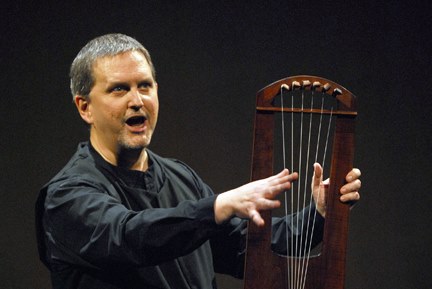
Bagby at play. Photo courtesy NY Classical Review.
Follow me, friend, as I take this tangent: tonight I’m leading the second of two local discussions of Beowulf, Tolkien, and Benjamin Bagby, who performs the first third of the Old English poem in the original language, accompanying himself on a reproduction harp. Bagby’s coming to perform in Vermont next month — the surface occasion for tonight’s discussion.
We’ll talk, among other things, about wyrd, that old word that still half-lives in modern English weird, lives more fully in the Weird Sisters of Macbeth, and most fully in its original sense of the pattern of things which is both destiny or fate, and also the stage for meaningful human choice and action. Beowulf falls to wyrd, but also survives because of it.
Anglo-Saxonist author Stephen Pollington puts it this way:
The analogy of a spider web is usefully employed in considering wyrd. Each section of the web is a discreet part of the whole, yet the tiniest ensnared insect will set the entire web vibrating. Whether the spider wins her dinner depends on how skillfully she has woven her web, how quickly she reacts, and the chances of the captured insect to struggle free. The web is wyrd, but what the actors do upon it will decide the outcome.
Wyrd, says the poem, oft nereð unfægne man þonne his ellen deah. Taking Pollington’s analogy to heart, I render this as “The Pattern often saves an undoomed man when his courage holds” (Beowulf line 572). And I repeat to myself the charm: What the actors do upon the Web will decide the outcome.
We’re all “initiates of darkness”, of fates and destinies set in motion and still unfolding, yes — but that doesn’t define us. It just leavens the crusty bread that we are. Without a taste of that Old Tree of the knowledge of good and evil, what after all could we manage to accomplish? The first breath of any opposition would blow us away like dandelion fluff, like breadcrumbs. (No inner resources, I can hear my grandmother sniff.) We didn’t start the fire, sings Billy Joel. It was always burning/Since the world’s been turning.
Part of the journey beyond Druidry 101, as on any path worthy of the name, is the discovery of the usefulness of opposition. In careful measure (wyrd measures out some, yes, but so do I, each day), it gives us something to push against, a resistance, like weights in the gym, the settings on the stairclimber, the hills that are part of my dog-walk. I find out where I am, in the face of it — it’s potent in dispelling my illusions. It’s part of our training for what a world of polarities means. Armed and tested with this hard-won wisdom, we’re ready for realms of light. A Druid can aspire to live, serve and create anywhere. (And until that day of fuller mastery, there’s today with its choices and challenges. The poor, says the Galilean master, you will always have with you. What is my poverty?)
Some days, of course, I long for a cosmos that’s easy, or even just easy-er. But, I notice, after some time there, I’m restless again, eager to jump back into the fray and play of a more demanding laboratory world, where just about everything is subject to change and experimentation. So what happens if I take this tangent?
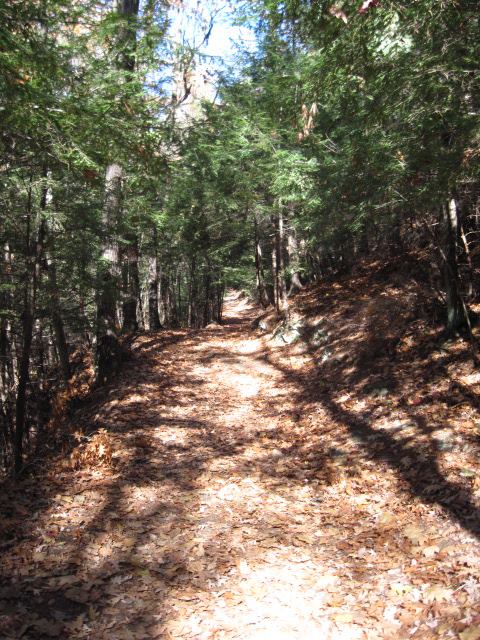
Mount Wantastiquet trail.
Meanwhile, I pray with the Leaf-Lords and Ladies around me:
Oak, shade my path. I welcome your wisdom.
Birch, green my way. I call on your courage.
Hemlock, heal my heart. I fast under your foliage.
Pine of all lands, I gather your gifts.
Tree companions all, I seek the shelter of your boughs.
/|\ /|\ /|\
Images: Bagby.
So you’ve made your way as a solitary practitioner, to the point where you know your land, the compass directions you salute, the spirits you greet and work with, the seasons, sun and moon, and the local weather-signs that signal storm or heat or simply change. You may well hold to an idiosyncratic practice that nevertheless works for you, drawn from dream, instinct, wide reading, the place you find yourself, discoveries that have proven to work, chance, ancestral memory, trial and error, divination, or direct instruction from a tree, guide, spirit, the land, another person.
If none of the foregoing sounds like you or your path — if you’re not a Druid, but Druid-friendly, or Druid-curious — nevertheless you can describe your path (and might benefit from putting such an overview into words, if only for yourself, as a record, a milestone, a signpost, a witness).
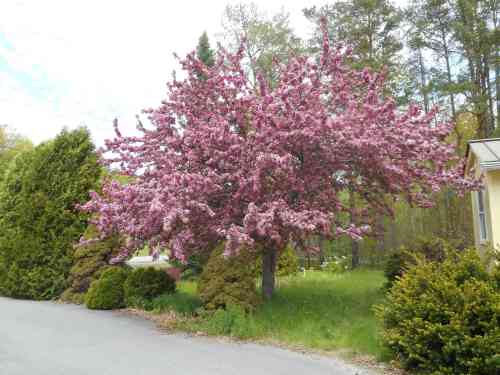
Spring, says Kipling in The Jungle Book … “the time of New Talk”
Or you’ve joined an order or grove or ritual group, you meet intermittently or regularly, you’ve settled on a basic ritual format that you spin variations on, you have your favorite festivals and ritual locations, and after a time you may start leading or writing your group’s rituals, or holding informal talks, or teaching divination, healing, permaculture, magic, and so on.
In either case, how many things can a Druid study or practice? Yes, you get the idea: the reach of it all widens far beyond the circle of the horizon.
In other words, you’re no longer a beginner at this stuff. You’re at least a “201-er” (following the numbering of university courses in many places, with 100-level classes signalling no prior knowledge or prerequisite coursework, and 200-level and above indicating intermediate and more advanced levels). You may not (ever) feel ready to write a book on what you know (though you could do so, nonetheless). You may never be approached by students eager to learn what you’ve painstakingly put together on your own (though that could happen, too). But you know enough, have learned enough, that when you act (or refrain from acting), things ripple from that choice, and you know it.
What’s next? Or what work lies ahead? And how do you figure that out?
The challenge of naming such next steps partly explains why there are so few non-beginner books and guides.
If you’ve stayed with any path long enough, and kept growing, you’ve learned how to begin taking those next steps, or — if they haven’t yet come into view — at least how to look and listen for them. You’ve also probably experienced “spiritual dryness” as well, those periods of inner drought where nothing’s kicking, and you just go through the motions like a wind-up toy. Patience is our greatest discipline and practice, says more than one spiritual teaching. Like trees and mountains, sometimes we need to weather for a while. And that can be the hardest work we do.
From the outside, even to close friends or family, it may look like we’re doing precisely nothing, when in fact we’re holding on and letting go all at once, questing for doors, gates, guides, signs, hints and clues, treading water, running in place, flexing all our limbs to stay as supple as possible, or — sometimes — dissolving into a complete funk and thinking we may just chuck it all. Heave a lifetime into the garbage bin and start fresh. Or abandon the whole project of having a project in the first place. Go fishing. Get and stay drunk, maybe for a few years. Have a midlife (or late-life) crisis. You’d run away, if it didn’t take so much energy. (Find a quiet corner and huddle there for a while, muttering to yourself. Yes, you’ve become one of those people now.)
201 is a point, or interval, where diverse spiritual traditions find considerable overlap, and the insights from one tradition can aid people in another. The most dogmatic and inflexible practitioners of any tradition usually haven’t wandered away from the home fires of their own hearths to the edges of the Forest, or into it. (You know what the capital letter stands for.) Or if they have, what they experienced there so terrified them that they fled and returned, hearts thumping wildly in their chests, determined to erect barriers, rules, ideologies, locks, guardians, gatekeepers to prevent others from enduring the same.
201 takes us into myth, archetype, confronting the self. 201, to borrow from Tolkien for a minute, drops us between the worlds of Man and Elf:
The real theme for me [in my fiction] is about something much more permanent and difficult; Death and Immortality: the mystery of the love of the world in the hearts of a race ‘doomed’ to leave and seemingly lose it [Men]; the anguish in the hearts of a race ‘doomed’ not to leave it [the Elves]. — Letters, no. 86.
To paraphrase and summarize a conversation between Elf and Man I can’t locate right now (probably from the Silmarillion, or from Athrabeth Finrod ah Andreth, the Discussion between the Elven King Finrod and the Mortal woman Andreth), “Which of us should therefore envy the other?”
Meanwhile, the Renewers of the cosmos, whoever they are, send us challenges to sweep us beyond such dichotomies. What does Life or Death have to do with the Song of Awen endlessly pouring forth through everything? To one stifling in spiritual dryness, the endless streaming of Awen all around can form part of the suffering that may accompany us during such periods. “Why is so much happening and flowing and flourishing all around me, while I sit here, a husk, waiting, endlessly, for something — anything?”
But write such things in a 201 book, and most readers would burn the damn thing, if they read it at all. Sometimes it can seem our patience and persistence have merely enlarged our capacity for suffering. And that’s really not what you want to share with anyone who casually inquires “So how’s it goin’?”!
Ubi sapientia invenitur? goes the old query. Where can wisdom be found?
If you know Kate Chopin’s “Story of an Hour” (and if you don’t, go read it right now — it’s very short, a matter of just a few minutes rather than an hour — so that the very next few phrases and sentences aren’t spoilers for you), you know that the main character, with a weakened heart, faces freedom and dies.
We’re called to live, instead.

New growth at the tips will be the most tender and sensitive, counsels the Green World.
Often the best cure is service. Not unwilling drudgery. But something worth doing. Find some way to give back, to unblock the flow of awen, of deep spirit, that has steadily been growing, pooling and accumulating, and now is a torment, because we can no longer give enough of it away, fast enough. (The cauldron is full to bursting. The weight of water in the reservoir builds and builds. Give more away, for the love of the sweet green earth!)
Instead of following a scripted plan for service (unless that appeals to you), ask for how you can serve. (Our talents can be used in ways we enjoy.) Then trust what comes, even as you test it step by step.
That, I’m still learning, turns out to be one of the bargains the universe, or the Gods, like best.
/|\ /|\ /|\
[Updated 5 August 2020]
See also my post Moon Ritual Scrapbook with a basic moon ritual.

Full Moon, May 18, 2019 @ MAGUS Gathering. Photo courtesy Marianne Gainey.
With last night’s May full moon, and searches from this blog for the words “full moon ritual”, it feels like time to talk a little more about ritual. Google “ritual design” and you’ll find many helpful sites. John Beckett’s helpful A Pagan Ritual Outline derives from his own long experience.
Ritual is at heart a form to focus awareness, like a melody focuses sound, like a kata or “form” focuses movement in the martial arts.
OBOD founder Ross Nichols observed that “Ritual is poetry in the world of acts”. That is, it’s distinguishable from other actions we do by its intent, its shape and form, and often by care for its appeal to the senses. Poetry and song rely on rhyme, rhythm, melody, harmony, counterpoint, emotion, symmetry, repetition and variation (chorus and new verse). It’s no surprise that effective and memorable ritual draws on the same components. Theater also underlies ritual with gesture, movement, surprise, audience participation, intonation, staging, lighting, costume, etc.
The full moon, by its shape, suggests completion of a cycle, a high point or climax in a developing change, a major turn in a process (you can’t get fuller until you empty again). More imaginatively, it can also suggest an open eye, a womb, a mirror of the sun, and so on. These and many other associations and symbolic patterns can feed into a moon ritual. (Take a moment and write down your associations for the sliver of new moon, and you’ll be on your way to a new moon ritual.)
It helps to work with an outline or script — not as something prescribed, or to be rigidly followed without thought, but from a sense of flow and sequence. Even “spontaneous” ritual, especially for solitaries, often flows from a sense of rightness at the moment. In neither case do you need something written down to read from or use as a guide. But if that helps, or makes a big difference in quality, why not use it? Think of a favorite song you know by heart. Is knowing it so well a weakness?

Li Bai (Wikipedia/public domain)
A few lines of the famous poem by Tang dynasty poet Li Bai (701-762), rendered more or less as “Drinking Alone with the Moon”, offer us a ritual moment:
Among flowers sits the jug of wine.
I pour alone, no other friend nearby.
I lift the cup to invite the moon
and with my shadow we make three.
(That’s my plain rendering. You can read multiple and more poetic versions of the whole poem here. The Chinese words: hua1 jian1 yi1 hu2 jiu3/du2 zhuo2 wu1 xiangqin1/ju3 bei1 yao1 ming2 yue4/dui4 ying3 cheng2 san1 ren2.)
Sometimes simplest is best. The experience of the moon shining through the flowers onto the wine, the solitary drinker, the cup, and the whole evening all around participate in the ritual just as much as the few words the speaker says to welcome the moon. Yet the ritual wouldn’t be complete without the words, because they’re called for. How does the solitary drinker “know what to say”? What fits the moment. And being alone (and possibly already a little mellowed with wine) helps shape what fits the moment. The moon is both familiar and wholly new in the moment, as are the feelings and thoughts of the drinker. A poem becomes a ritual. A ritual becomes a poem.
“Bigger” rituals work the same way. And planning and preparation can be just as effective in providing a form for rituals where gods speak, fire falls from the heavens, and the Earth Mother whispers her deepest secrets to gathered mortals.
In a Druid triad of ritual, three things happen: you open the door to the ritual, the heart of the rite takes place, and then you close the door. In Li Bai’s poem of informal ritual, the wine, moon, cup, speaker, flowers and moment each play their parts to open the door. The moon is present, and the flowers and wine and place. The speaker feels the moment, says the words, drinks, and the moment passes. The poem-as-script (re-)establishes the moment, records it, and closes it when the poem ends. Or think poem-as-ritual-photo. It’s not actually the speaker performing the ritual, but it records some part of it.
Let’s expand on the Druid triad of ritual. Below are twelve components to consider as you develop a ritual:
1–INTENTION — why are you performing the ritual? The whole ritual follows from this. A clear intention, large or small, leads to effective and enjoyable ritual.
2–MATERIALS NEEDED — cycle back here to add to your list as you develop the ritual. “Keep it simple” is a good principle. Ritual stuff isn’t the main event. But lacking the one or two things you DO need in the middle of the ritual, once the script grows to include them, is a real downer. That ritual knife, candle, bell, bowl of water, smudge stick now needs to be there. Do you need ritual clothing, body marking, etc.? Make sure it gets on the list.
3–PARTICIPANTS and ROLES — how many does the ritual need? Again, cycle back to update your “cast of characters” as your ritual plans develop. In the event of missing participants, how can you double up on roles?
Is there something for guests to do who aren’t speaking or performing major ritual actions? Can there be? Do participants — or visitors — need to prepare in advance in some way? Learn a short chant by heart? A melody? A ritual gesture? Vigils, fasts, prayer, meditation, questing, etc. can help participants bring their full ritual selves to the rite from the beginning.
4–PLACE and TIME — flexibility is key, especially if weather, reservations, or schedules have other ideas for your ritual. Pre-planned alternative locations in case of rain, etc., announced in advance, keep crowd control, confusion and disappointment to a minimum. Is accessibility an issue for any participants or visitors?
5–RITUAL HOUSEKEEPING — “Please turn off your cell phones!” Run through any details guests need to know. “This is what we’ll be doing. Don’t break the circle, or cut yourself a door in it, or ask a ritual celebrant to do so for you. Restrooms are at the end of the hall, or 20 miles away; find a tree. That’s north, so this is west.”
6–FORMAL OPENING — some combination and sequence of purification, grounding, centering, welcoming, proclaiming ritual intent, honoring and inviting Others to be present. Bells, singing bowls, incense, water, fire, salt, chant, drums, etc. all can help. Casting a circle, establishing sacred space, erecting or acknowledging altars, redefining the status of participants, the place, objects nearby or some combination of these may be appropriate. Choose who does these things, and why, and how others can take part. Less talk is usually better. So is simplicity.
7–The MAIN RITE — what you’ve gathered to do. Re-enacting a myth; marking the changed status of a participant through initiation, etc.; celebrating the season, a date, festival, harvest, planting, boat-launch, new home, new family member, etc. Healing, defending, strengthening, commemorating, blessing, gifting. Where you do the stuff specific to your tradition, practice, gods, calendar, and so on.

MAGUS 2019 Maypole!
8–FEAST, ritual meal, distribution of ritual objects, etc. — a piece of maypole ribbon, a slice of apple (showing the star), a drink, a stave of ritual significance, a card or picture, stone, sea-shell, etc.
9–READINGS, Music, Poetry, Blessings, Prayers — this important portion of a ritual can accompany the Feast, etc. to help sustain the ritual energy, hold focus, minimize side chatter, etc. It also gives everyone present a chance to contribute personal requests, blessings, songs, etc.
10–CLOSING — reverse what you did for the opening: thank Others you invited, uncast the circle, return ritual elements to their original places, desanctify what needs desanctifying, take down the altar. Ring the bell, beat the drum formally, close the ritual. Re-establish the world before the ritual began. Again, simple is good.
11–ANNOUNCEMENTS — upcoming events, requests for help with clean-up, calendars, thanking visitors, etc.
12–CLEAN-UP — leave the ritual space as pristine — or more so — than when you arrived. Make this a ritual act of service and gratitude.
Conversation following the rite can be an opportunity for formal teaching, Q-and-A, casual discussion, ritual debriefing and a post-mortem “how did it go?”, planning for another event, a meal at a favorite restaurant (which can be announced on Meet-up, etc., as an outreach tool).
Were you expecting a script for a specific ritual here? No need — you know enough to develop one of your own better suited to you, your situation, your practice and your intention. And after a few run-throughs, you’ll be on your way to developing your own ritual design “best practices”.
/|\ /|\ /|\
Looking for more detail? Check out Isaac Bonewits’ excellent Neopagan Rites: A Guide to Creating Public Rituals that Work (Llewellyn, 2007), available used for just a couple of dollars.
No, this isn’t the D&D you’re looking for. Or perhaps it is.
Last month, on the way home from our nephew’s Southern wedding, my wife and I met my two Pennsylvania cousins for breakfast. We hadn’t gotten together since their father, my uncle, passed on almost two years ago. In his mid-90s, he’d wanted a minimal funeral: “No reason to prolong your grief, or spend money doing so”, he’d said. The rite ended up so modest and unannounced only his daughters and grandkids attended. We were just hearing details now.
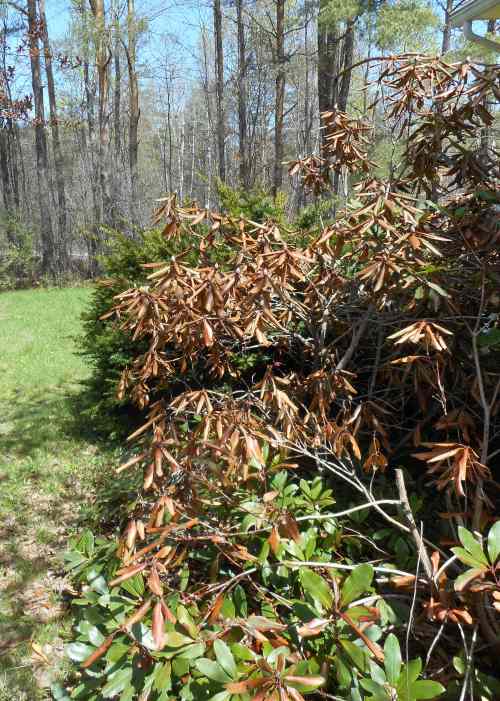
Our front-yard rhododendrons, with winter-kill on top, and the lower (snow-protected) green branches
Because of course funerals are very much for the living, too. And in spite of our callous and oblivious Western cultures so uncomfortable and unhelpful around death, we don’t “get over” grief after any fixed period of time. My younger cousin, I know, still carries hers around, like a tight knot in her chest, a cannonball of hurt.
“We’re not supposed to die!” she exclaimed at our breakfast, and I bit my tongue not to offer Druid things to her, knowing she still took a hard Evangelical Christian line about death: that it’s a punishment for sin, not a natural part of a cycle in worlds of time and space; that it’s a penalty for disobedience, not the consequence of wearing bodies that will, over time, wear out. Are autumn and winter unnatural?
Sometimes you just need to be heard in your grief, without judgment, without reply or attempts at comfort that, for you, ring false. No need to argue about death, for anyone’s sakes. I only hope she’ll find upcoming deaths, and her own, not a punishment but another step on our long journey.
Of course Druids no more “believe the same thing” than any other group of contrary, year-marked, and opinionated humans. One of my techniques, field-tested over my decades, if I can remember to turn to it — rather than bothering with belief, or non-belief — is to ask how is it true? When or where is it true, has it been true, will or can it be true again? These, to my mind, are larger, “better” questions, questions that still sidetrack me very helpfully, and fascinate me — much more than trying to lock down the moving target of “what a person can reasonably be expected to believe these days”. The answers, often spinning on to more questions, also fit poet Mary Oliver’s criteria: “so many questions more beautiful than answers”. Yup, says my inner Druid, trust the bards on this one, too.
Or as an artist friend said last night in Brandon VT, at her first major show of approximately 40 exquisite watercolors, quoting her mentor: the artist’s job (all our jobs, really) is to “deepen the mystery”, to pay attention.
As I’ve written elsewhere on this blog, I don’t so much believe in life after death as I suspect there’s life after death. It’s a hunch, an itch, a ripple up and down the spine, one way to make sense of too many experiences that otherwise don’t fit. This life is already so strange and unexpected, that to be here at all is no more or less unlikely than to continue after the change of death.
Another way to understand it: any “afterlife” has already begun. I just wasn’t paying attention. This is the afterlife of my previous life: what am I gonna do with it? Fried chicken and beer, operas and curry, sex and drugs, art and amazement, fasting and penance, profit and politics — each of us finds a set of pleasures and purposes to round out the strangeness of being here at all, along with any other projects we try our hands at.
Or, with a turn toward pop culture, with some Appropriation for Druid Purposes: “Ye best start believin’ in ghost stories, Miss Turner”, says Captain Barbossa in Pirates of the Carribean. “Ye’re in one!”
Alastair Reid writes in his poem “Curiosity“:
… that dying is what the living do,
that dying is what the loving do,
and that dead dogs are those who do not know
that dying is what, to live, each has to do.
And because you know I rely on our bards to heal and guide us, here’s Mary Oliver again, one of our master Bards, on grief, with a perfect Druid triad:
To live in this world
you must be able
to do three things:
to love what is mortal;
to hold it
against your bones knowing
your own life depends on it;
and, when the time comes to let it go,
to let it go.
Another chance for Bards to have the last word: a page of ten particularly apt poems on the immense range of our griefs and losses.
/|\ /|\ /|\
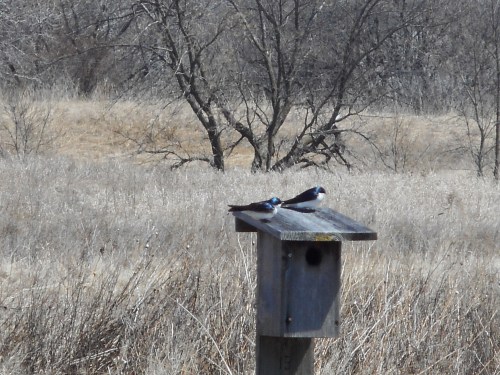
tree swallows sunning themselves — mid-April 2019
In a comment to John Beckett’s blogpost of March 28, Gordon Cooper covers several topics and throws out material very rich for reflection and experimentation.
Cooper first addresses the development of modern polytheism:
How can polytheists who honor non-Indo-European gods replicate the successes that Druidry has had?
I would suggest that the success OBOD has had and continues to have is rooted in some fairly simple and old fashioned tools — a correspondence course, mentors, and lots of engagement by the members. The first time I went to the OBOD Lughnasad gathering at the Vale of the White Horse, I was deeply impressed by the amount and quality of work I saw. One person learned ceramics, built a hand-painted and fired series of tiled walls on her properties with elemental dragon meditations she’d realized. Others had voluminous scrapbooks filled with meditations, plant studies, ritual walks, etc. Their other secret weapon is Philip. He’s an international treasure for all druids, at least in my experience.
The combination of well-thought-out instructional materials and mentors, together with a dedicated and generous leader, and the developing nature of most strands of Druidry as supportive and inspirational practices, have proven its value yet again. If the non-European gods have means of access to power in this realm, through their priests and their own natures as deities, can they inspire and help manifest similar supports for their devotees and adherents?
And yes, much of modern Druidry and Paganism in general finds a priceless resource in books. Cooper continues:
If a group chooses to start from Nuinn’s [Ross Nichols, founder of OBOD] druidry, as it seems to be articulated in “The Cosmic Shape” it is possible to arrive at a non-IE druidry by treating this as an embodied expression in ritual, artistic and land-based practices that manifests over time and space differently in each era and place. I strongly encourage reading the entirely of ‘Cosmic Shape” as one point of departure.
Cooper next tackles a particular source-text — Iolo Morganwg’s Barddas (link to complete text at Sacred Texts).
Moving to the Barddas as a possible base, regardless of how one considers the authenticity of Iolo’s writing, his notions around ritual, nature study and the sciences, poetry and justice are values that I think can be applied to many circumstances and cultures. Besides, anyone borrowing from an Egregore that includes Iolo, William Blake and a French Spy-cum-Mesmerist alchemist is likely to be in for an artistic and interesting ride.
All of us have experience with egregores of groups we’ve joined, been born into, or witnessed from outside as they variously manifested their energies. Political parties, churches, families, clubs, sports teams, other special-interest groups and so on are non-magical examples. Consciously-created and energized egregores deployed magically are potentially just “more so” — stronger, more durable, more capable of great (and also terrible) things. The principle at work is “the whole is greater than the sum of its parts”. Magic as an amplifier simply magnifies that whole.
Cooper then goes on to suggest provocatively, in a quick paragraph, one way to develop a valid Paganism or Druidry that grows organically from wherever we find ourselves, one that need not worry over cultural appropriation or validity:
I’m working on a very small group-focused practice that’s designed from the ground-up to be derived from the local biome and skills of the folks living there. It is being field tested in Bremerton [Washington state] now with the Delsarte Home Circle. It incorporates Ecopsychology, poetics, local kami, nature studies, personalized and group moving meditations and other meditation forms along with a customized ritual calendar derived from the specific region. It is appropriation-free and includes classical Spiritualist training. If interested, please contact me for details.
On the issue of Pagan or Druid chaplains, Cooper also speaks from (local) experience:
I’d say that Pagan chaplains in hospital systems are likely to find themselves in an ethical bind from time to time, as they’d be called on to engaged with YWYH on behalf of ill or dying patients in hospitals or elsewhere.
The VA Chaplains don’t serve or acknowledge the validity of druids and witches, at least at the Seattle VA. This isn’t going to happen with the current staff, and as I receive all of my medical services there, I am not inclined to fight an uphill and contentious battle.
Not all of us are called to fight outwardly — a misconception activists of all stripes are especially prone to. Following your own path is often powerful enough — the patient persistent effort of being a genuine self in a world of delusion and false directions is a forceful life stance, an essential kind of witness both to others and oneself, with consequences we often do not see. Not all music is scored as trumpet fanfare. Some of us are strings, oboes, flutes, drums, or the rests and silences between notes.
/|\ /|\ /|\


 A Druid Way