With Raven poking his bill into things, Boar shows up to remind me it’s been some time since we’ve run together.
You might think I’d be more mindful of a guide that stalked me for decades until I finally took notice, a guide notable for access to healing (who doesn’t need that from time to time?), and an all-around lively companion to take with me on walks and into meditations. I run my hand along her back (sometimes it’s him, this evening it’s her) — our preferred point of initial connection, and re-affirm the link that’s always there.
Sometimes I can’t quite reach the inward space I need to inhabit for healing. But I can reach for my inner guide, through long familiarity, and touch the bristly fur on his back. Touch was one of my first experiences of my guide — totally unremarkable to me, when I was looking for something more dramatic — and less “mundane”, less physical. For whatever reason, I can readily feel his fur, his pleasure at our connection. Only later, as I note in the post linked in the previous paragraph, did I read in the Druid Animal Oracle the entry for Torc, the Boar: “… he is a representative of the Goddess — his skin can heal you” (Philip and Stephanie Carr-Gomm, The Druid Animal Oracle, Fireside/Simon and Schuster, 1994, p. 39). And I began to appreciate this “earthed” mode of access for what it was, a priceless gift. Once again — you’d think I’d know this by now as one of my ongoing biases — I overlooked the obvious, minimized a non-flashy spiritual connection.
Long-time readers know I often try to convey the ups and downs of a spiritual journey, the human tricks and quirks of consciousness, the ironies and paradoxes and eddies of the life-current that sweeps us along. We are not permitted to linger, even with what is most intimate, Rilke reminds me. All right, Bard, I mutter. But what about returning?
Mara Freeman writes of the imagination needful for working with our own lives in her Grail Alchemy:
… the imagination is the language of the soul. It is the equivalent of our most important sensory organ — sight — only turned inward rather than outward. Every non-physical thing that exists expresses itself as energy, or Force. The imagination is a creative mechanism that enables us to give Form to Forces of the non-physical planes. (Introduction, Kindle location 349).
I love that: imagination “enables us to give Form to Forces of the non-physical planes”. And no, it doesn’t have to be visual. Look at Boar, not choosing my default, strongest sense, but reaching me through touch instead.
/|\ /|\ /|\
None of this, without the impetus to write these daily posts for a month. The struggle to re-establish a flow of writing, after long drought. The richness that starts to emerge, a droplet, a smallest trickle.
Part of the point of this series is to put in a period of steady writing. As a spiritual practice, it has much to recommend it. The commitment gets things into words that wouldn’t otherwise arrive there. And if you’re a Druid on top of that, you naturally get at least some things that are Druidic into words, too.
The theme I thought would jump-start me was berrying. But all day, nothing was stirring. I found myself avoiding this blog altogether. (Just day three and he’s dead in the water, mutters the inner censor.) Yes, I probably could have gone out to our half-wild blackberry bushes in the back yard, taken a picture, and found in that interaction at least my triggering subject. Poet Richard Hugo writes in his delightful 1979 book The Triggering Town:
A poem can be said to have two subjects, the initiating or triggering subject, which starts the poem or “causes” the poem to be written, and the real or generated subject, which the poem comes to say or mean, and which is generated or discovered in the poem during the writing. That’s not quite right because it suggests that the poet recognizes the real subject. The poet may not be aware of what the real subject is but only have some instinctive feeling that the poem is done.
Young poets find it difficult to free themselves from the initiating subject. The poet puts down the title: “Autumn Rain.” He finds two or three good lines about Autumn Rain. Then things start to break down. He cannot find anything more to say about Autumn Rain so he starts making up things, he strains, he goes abstract, he starts telling us the meaning of what he has already said. The mistake he is making, of course, is that he feels obligated to go on talking about Autumn Rain, because that, he feels, is the subject. Well, it isn’t the subject. You don’t know what the subject is, and the moment you run out of things to say about Autumn Rain start talking about something else. In fact, it’s a good idea to talk about something else before you run out of things to say about Autumn Rain.
As with so many human crafts and skills, each has much that wise observers learn they can transfer — or maybe transpose — to living a life. The equation isn’t always one-to-one. We’ve become accustomed in the last century to photographs. We point to an image of ourselves frozen on a a flat phone screen or hard-copy print-out and declare “that’s me” without thinking much about how strange such a statement is. I can be both “here” and “there”, in the same way that human beings in the Hebrew Bible are made in the “image of God”, both divine and not at all. The image both is and isn’t the same as the thing it images. The triggering subject often works similarly, pointing us beyond. I start a blogpost about berrying and I know at this point that the title and possibly some ghosts of ideas will linger in the draft folder on WordPress. That idea got me onto my blog. A starting point, a seed crystal. A prompt. But that’s not the current title.
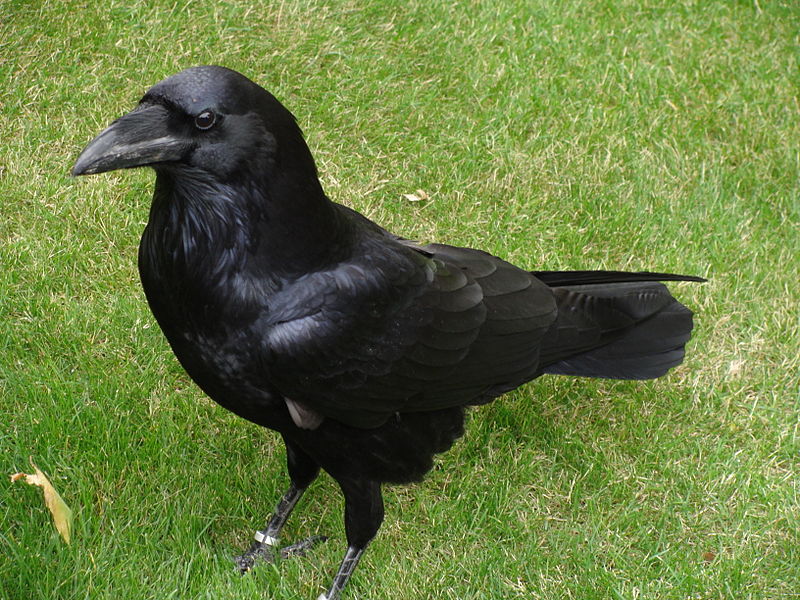
My wife and I were sitting out back eating diner an hour ago when we heard a series of gronks emanating from the front yard. She hadn’t paid much attention to such calls before, though I know she’s heard them, and she couldn’t identify the creature making them. What IS that? she said. As the calls became more insistent, I knew that Raven was asking for my focus. One call probably wouldn’t have been enough to break through. But a series of them did. What made the conversation even more interesting and significant is that we’d just been talking about ravens, among the other birds that frequent our hilltop, including waxwings as they migrate north and south, bluebirds that occasionally nest here, and an assortment of woodpeckers.
As a bird with world-wide associations and symbolism, the Raven naturally lends itself to varied interpretation. While we needn’t discount such ready hints and clues, we don’t need to ascribe to them invariant significance either. Google “the name raven” and you’ll dredge a surprisingly muddled set of potential meanings and mis-meanings suitable for any bias. Your best friend means something quite different to you than to his parents, children, co-workers, the pedestrian he or she cut off in traffic, and so on. An actual being interacts with so many others, and picks up meanings and interpretations like carrion attracts flies. The simile is intentional — the Raven is a messenger or guide between realms in very many cultures, including the realm of the dead. But as Hamlet quips to his mother, “Tis not alone my inky cloak … that can denote me truly”. Meanings can be slippery things. Check it out before you check it in.
This particular raven was going about his own business. While simultaneity put us both in proximity and brought my wife and me to hear his cries, the raven doesn’t have to “mean something” to have profound significance. What did my conversation with my wife “mean” to him? Is he now divining in a book of Raven Wisdom to learn what his recent interaction with two humans meant? (Maybe he is!) We were brief interactions in a cosmos stuffed with them every instant. Wisdom can help us learn from our interactions.
For one thing, a raven close by could be a sign that the owl pair nesting up the hill from us hasn’t decimated the local bird population. For another, “Crows, ravens, magpies, and jays are not just feathered machines, rigidly programmed by their genetics. Instead, they are beings that, within the constraints of their molecular inheritance, make complex decisions and show every sign of enjoying a rich awareness”, notes the Wikipedia entry for common raven. My inclination, rooted in decades of practice, is to remain alert for future appearances, other coincidences, (dis)confirmation of speculations, and direct inquiry in meditation. Raven, what do you want to say to me?
Call this “Raven divination” if you want to. It’s also a form of creative play. The universe seems to play catch with meanings, tossing them towards us to see how many we’ll even notice, let alone return.
As with the other “Great Eight” days of the Druid (and wider Pagan) calendar, I find the festivals are more whole seasons than individual days. While a full or new or dark moon is an obvious time-marker, for the rest of the month, time-keeping often isn’t exact. Our modern time sense that seems to require us to celebrate “on the day” can miss the larger energies of the season.
In this, I know I’ve been influenced by Caitlin Matthews and her Celtic Devotional, which also supplied the title for this post: “As you travel through the country of Autumn, relate your spiritual journey to the rich gifts available at this time” (pg. 97).
Of course, early August isn’t autumn yet in many ways. It’s still “high summer” with days of heat and languor and vacation for children and teachers before school resumes. But this country of a season, with its borders and boundaries different from its interior or far realms, still announces autumn with its first harvests, its shortening daylight hours, its subtly altered and shifting rhythms.
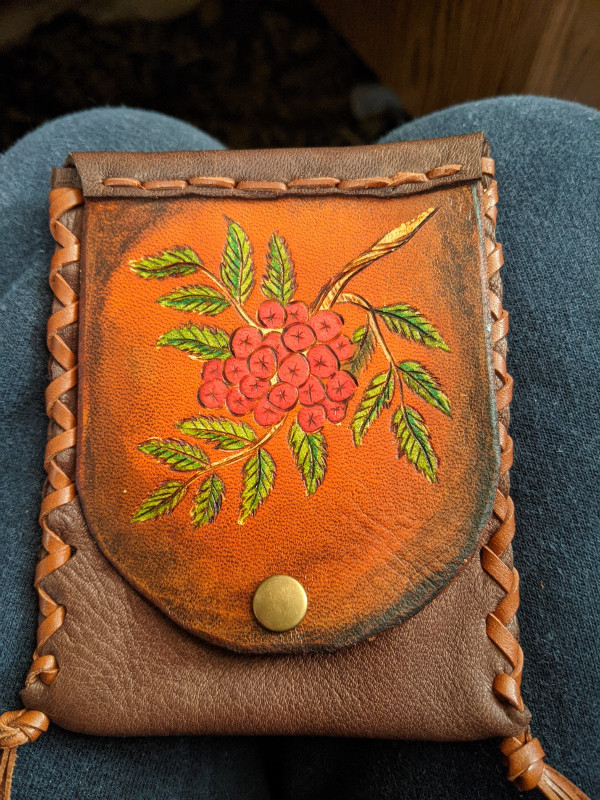
My go-to magical tree, our front-yard guardian Rowan, already has reddening berries, though the overcast sky dulls their hues. And as if to announce the season, I recently received from New Hampshire Druid friends a lovely personalized gift of a leather offering-pouch, crafted by AODA archdruid Dana Driscoll, featuring “my” Rowan in full red-berry mode. The Rowan dons its spring-in-autumn guise, having something to say in all its seasons, whether or not I’m listening.
Relate your spiritual journey to the gifts of the season. Wise counsel. I find as I age I need to resist a tendency to veer off on curmudgeonly tangents, defaulting to wry cynicism. The gifts of the season ARE my spiritual journey, and vice versa. A friend on an Old English site I moderate posted an excerpt from the Old English Herbarium on betony, which advises us to harvest it in August: þus þu hi niman scealt on Agustes monþe butan iserne “thus thou shalt take (or harvest) it in the month of August without iron”. Magical instruction, to forgo that metal hateful to the realms of otherkin? No knives, in other words. Harvest by hand.
You can usually wring both instruction and a laugh from the old herbals. The London herbalist John Gerard noted in 1597 that betony “maketh a man to pisse well” — a diuretic, if you need one. But the Herbarium is more to the point, suggesting different preparations for a range of ailments and maladies: Wiþ egene dymnesse genim þære ylcan wyrte … “against the dimness of the eyes, take that same herb …” How has my vision dimmed, or what afflicts my sight? Culpeper’s The English Physician, later named the Complete Herbal, ascribes substantial powers to the herb: “it preserves the liver and bodies of men from the danger of epidemical diseases, and from witchcraft also” and “this is a precious herb, well worth keeping in your house”. I’m not looking to betony for a physical panacea, but the spirit of betony may well be a potent ally to explore. Use your powers of discrimination, my guides whisper to me.
Yesterday, water: the image of the waterfall. Today, vision, across the elemental circle, from west to east, and air, intellectual activity and acuity. Is tomorrow north, or should I be particularly attentive to images of earth, the body, groundedness? Or let them come of themselves, if they will.
Blessed Lughnasadh to you! And a Blessed Imbolc to you in the South! This post begins a 30-day series for August 2021.
A theme that came to me in meditation this morning is caretaking. We ask others we cherish to “take care”. And these days, to take care of themselves. If you’re like me, you tend to think of taking care as a kind of opposite of passionate engagement. You take care when things, including yourself, need tending, need slowing down and nurturing. Caretaking becomes a form of caution.
The god Lugh for whom Lughnasadh is named has always manifested to me as a figure of passionate engagement. He’s given the epithet samildanach in Irish — equally skilled (in many things) — for a reason. Not much room for caution, when I consider the god. He throws himself into experience because that’s how you harvest it for what it offers. His caretaking is involvement, is testing himself against others — against the spiritual status quo?
When I don’t connect with one deity among a pantheon, it’s helpful to look at another. Longtime readers here know I’m not really polytheist so much as animist. The whole cosmos is talking, and different voices find me at different times. I’ve noted in previous posts how the hemispheres teach us to look at what’s happening across the world. As the north arrives at Lunasa, to give the more modern spelling, the south greets Brighid at Imbolc, as winter begins to yield to spring. The Lunasa harvest feeds awakening earth, awakening consciousness of Imbolc. What do my harvests feed? What do the fruits of my words, thoughts, deeds and feelings earn me and nourish in me? What awakens as a consequence? Where has my life shaped me to become more samildanach, more equally skilled, much as I may resist it at the time?
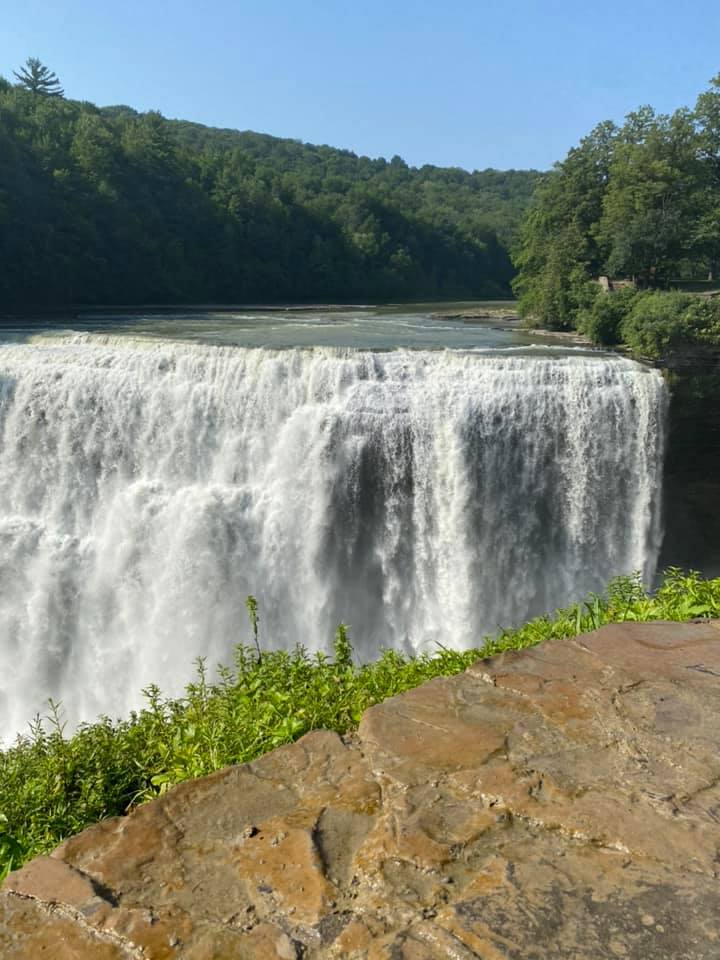
I include this image of the Middle Falls at Letchworth State Park in western New York because it’s my childhood spiritual home. A friend just took this shot on 26 July. A 20-minute bike ride from my father’s farm used to bring me to one of the park entrances, and another few minutes would bring me to this cascade. I’m a Druid today in part because I was blessed with such beauty in my youth.
Waterfalls signal abundance for me. The excess, the vast volume of water over a large falls like this one, reminds me how much happens every moment beyond my little circle of awareness. One of the benefits of ritual observance is its enlarging quality. We’re lifted, even if only briefly and momentarily, into larger worlds.




 A Druid Way