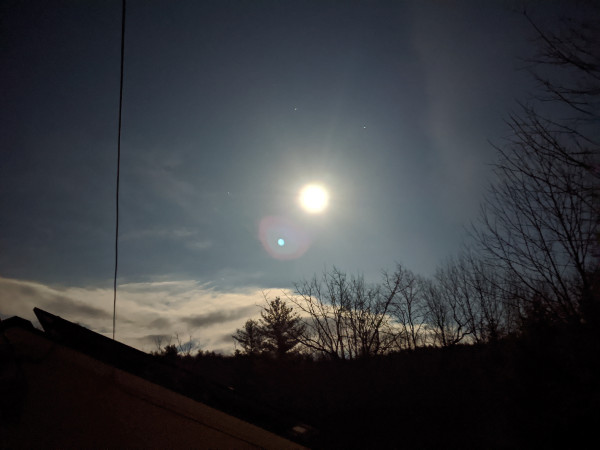
Ready or not, here I come! says Moon, childhood companion of so many days and nights.
According to a handy online app, some 760 full moons have lit the sky since I arrived in this incarnation. How many of them have I even noticed? Of those, how many have I celebrated? Does that number matter? Or is celebration of what is, right now, a better focus?
It’s good to see readership for “Towards a Full Moon Ritual” climb each month in the days before a full moon. More of us seek out the “how” — we often have some sense of the “what” already. That post, and many others here, arose from my experiences of less and more effective ritual. Some of the “best” rituals are the ones that “didn’t work”, that provoked inquiry, or reflection that in spite of “appearances”, something happened that matters. Maybe I “didn’t feel it”, but it felt me, changed me in ways that the ritual helped shape. Experience remains the supreme teacher. (If you don’t believe it, just scan the day’s headlines. Slow learners, every one of us.)
How bright the darkness, how dark the light …
Google “What does the moon mean?” — because you’re bored, because procrastination is better than anything else on offer right now, because Google can entertain with such questions and their crowd-sourcing answers — and the first result may tell you something like “The moon is a feminine symbol”. Really? That would be news to the Anglo-Saxons a millennium ago. To speakers of Old English, the sun sēo sunne is feminine, and the moon se mōna is masculine. Ever hear of the Man in the Moon? Or consider the image of a woman some have identified as Mary in Revelation 12, “clothed with the sun …”
When we Druid the moon, we can discover our meanings, plural. When things mean, it’s we who are “doing the meaning”, after all. For if meanings inhere in things independently of our perception, where do they come from? Does each thing arrive on the scene with a full set of ’em, hanging off them like holiday decorations? Does the moon “represent a feminine symbol” to last night’s owl? Or to the pines and hemlocks swaying in the wind out my window right now, as a cold front works its way through the northeastern U.S.? Is the moon “meaningful” only to humans?
I stand in moonlight as I sing. Moonlight and shadow make a ring. The moon could mean most anything — don’t wait to find out …
That’s better. Too much thought, not enough song. Wait to find out and I could wait a long time. But song — that leads me straight to the heart of things.
/|\ /|\ /|\
Often the moon is more of a mood than a meaning. There it is, mooning us all month long, silver arrows lodging in our hearts. Because some months, basking in moonlight may be all the ritual you need.
/|\ /|\ /|\
Here we are, just past the Equinox, just past Emnight [1 | 2]. Doth the moon shine that night we play our play? asks Snout in A Midsummer Night’s Dream. And Bottom answers, Find out moonshine, find out moonshine! — some of the best advice anyone could give me, whatever my season.
Moonlight is my ritual, says the Moon-Druid. Let the Moon sing me, the whole dream long.
Recently there was a heartfelt inquiry on a Druid forum asking for suggestions for adapting to a new home in an unfamiliar region. We all face this challenge in some form, either connecting to a landscape with ancestral presences, or finding our way in a new place. And how many times must our ancestors also have faced a similar experience?
Other helpful responses from commenters included making offerings, walking the land, asking for guidance, and — because Kris Hughes’ marvelous new book is still buzzing in my awareness — here’s this edited version of my response.
/|\ /|\ /|\
My instinct is to begin with individuals, along the lines some others have described. That particular tree, this stone, that stream, and so on. Often they can be an individual welcome-point. (Not all trees pay attention equally, at least where I live. Some don’t talk as much, either, while some talk a lot.)
Kris Hughes writes wonderfully about this in his latest book, Cerridwen: Celtic Goddess of Inspiration:
“I recall quite vividly a workshop where I was given the task to go and speak to a tree and glean any wisdom from it or anything indicative of communication. I failed miserably … How could I be a Pagan if I couldn’t speak to trees?”
“It took one sentence from someone completely unrelated to trees or Paganism to transform the way I perceived communication. It was a Welsh documentary about Bardism, and within it, one of the interviewees casually said that regardless of how different we may perceive ourselves to be from any other life form, we all have one thing in common: we all sing the song of Awen. The Awen’s music is the same in everyone and everything, it is the lyrics that differ according to one’s experience. The resulting song is unique, and it is the tool by which the Awen and, in turn, the universe experiences itself through the countless windows of expression. So I took to thinking that if I contain the music of Awen, then so would that rowan tree I was trying desperately to communicate with. The lyrics, of course, would be different, mine based on the fact that I am a human being … But how on earth would I hear her song?”
“It still didn’t make a lot of sense to me. I needed to do something that would bridge that logical side of my mind with the subtle, invisible spectrum. And the answer to that was to sing” (pgs. 241-242).
So I sing to the trees and the stones, the waters and the land.
/|\ /|\ /|\
Greetings to a first-time visitor from the Dominican Republic. (I find the flag counter app in the sidebar a great reminder every time I see it that Druidry and an interest in understanding and honoring and celebrating our home are worldwide.)
There’s been a lot of talk in recent decades about choice, and about freedom. Do we know what these things are, or how to perceive them? And if we know and perceive them, what do we do with them? What will we create?
Spring Dreaming … 15 Mar 2021
“As this circle is cast, the enchantment of the apparent world subsides”, says the first part of standard OBOD ritual. These are the words we hear at the same time we see — feel — hear — another Druid physically creating a ritual circle. The ritualist’s circular movement achieves this, along with any intention that person has as they cast the circle. The ritualist doesn’t stand alone, but enjoys the help of anyone else participating, with or without skin on. Visualizing, intending, choosing, celebrating, focusing energy, inviting the circle to manifest. Seeing and sensing it do so.
Any participants in the ritual are already standing in a circle before they hear the words — a kind of reversal of the usual affirmation: as below, so above. The physical reality of people gathered at the event precedes the circle that will be completed inwardly. You might see this as a Druid version of “an outward and visible sign of an inward and spiritual grace”. Or in fact is this too part of the enchantment — that we may confuse outer and inner, or think that one “precedes” and the other “follows”? Are they, or can they be, facets of the same thing, standing outside time even as they manifest within it?
Each person participating may also hear and experience the “subsiding of the apparent world” differently: as a gentle suggestion, or as a simple statement of fact. Or maybe it’s a ritual assumption, something “you do during ritual”. Or perhaps it’s “just words, like all the rest of the ritual”, a kind of communal game or sport or play: ritual theater. Or it’s an observation about transformation and magic. Each of us inhabits multiple apparent worlds already. Literally, worlds that appear to us, that invite or seduce or beguile or convince us in turn, that lure us with promise of their own particular enchantments. If they appear, they also may disappear. Ritual invites us into this possibility of choice and transformation, suggesting we may choose and create more consciously and intentionally. (We may just need to choose an appropriate world, rather than insist on forcing one that may not be the best stage for manifesting a particular choice.)
Which worlds deserve my attention? Which one(s) am I in at the present moment? Can I achieve my purposes best by focusing on this particular world, or are there others where I may be freer to act and to fulfill my intentions more joyously? Does one need to recede so I can better focus on others?
“Come! Be a physical body, experience touch and time, change and pleasure, death and birth, loss and love,” one world invites us. “Ah! Wear a body of light, and move across the cosmos to serve where you are needed”, sings another world. “Won’t you join others in their quest to X?” whispers a third.
Or if this is the only world there is, then when the “apparent world” fades, what’s left? Where am I? Do I jump into “ritual vertigo” if I let go of this world? Is ritual in fact “safe”? And so I enter yet another world with its own answers to such questions, if I choose to accept them.
One link, or common thread, or clue, or all three at once and more besides, for me anyway, rests in the awen. As I’ve written elsewhere on this blog, this is the longest practice I’ve kept up, to enter the world of primordial sound and creativity.
As with most Druid practices, this isn’t one that requires me to believe anything, but simply do something. Over time I may well come to believe certain things, much as someone who has seen the sun rise in the east for decades might begin to be confident it will to do so again tomorrow. I can’t “prove” it, but proof just isn’t all that interesting to me anymore. There are much better things to focus on, more interesting and deserving worlds to choose.
In his new book Cerridwen: Celtic Goddess of Inspiration, Kristoffer Hughes notes that when we enter this soundscape and world of awen, “several things will happen on a number of levels. On a physiological level, something particularly magical happens with the systems of your body. Song and singing profoundly affects almost all of our senses, and the vibratory quality of the sound is particularly affecting, having direct action on the cells of your body…” (pg. 243). He goes on to explore other effects of awen as a practice, on other levels, as a way to communicate with life and lives. Even a little singing or chanting can produce results.
I return yet again to an observation by Philip Carr-Gomm which strikes me as uncommon good sense in these challenging times:
Try opening to Awen not when it’s easy, but when it’s difficult: not when you can be still and nothing is disturbing you, but when there’s chaos around you, and life is far from easy. See if you can find Awen in those moments. It’s harder, much harder, but when you do, it’s like walking through a doorway in a grimy city street to discover a secret garden that has always been there – quiet and tranquil, an oasis of calm and beauty. One way to do this, is just to tell yourself gently “Stop!” Life can be so demanding, so entrancing, that it carries us away, and we get pulled off-centre. If we tell ourselves to stop for a moment, this gives us the opportunity to stop identifying with the drama around us, and to come back to a sense of ourselves, of the innate stillness within our being. And then, sometimes, we are rewarded with Awen at precisely this moment.
Rather than judging one world as “good” and another as “bad”, I can simply note if I’m pulled off-center while I’m in it. (Sometimes the distraction is the point!) If you’re like me, you may only realize this after the fact. Then I ask if that’s what I want. If I’m pulled away from myself, and if I’ve identified with the drama around me, rather than with what I am, I can test a world further: can I act freely and creatively as the presence of awen in this moment? The awen I sing, from the deep I bring it, sings Taliesin. Can I do that right now? Can I come back to a sense of myself and act in my best interests?
If I can, the way of awen is a good way for me. And if I can’t? Then the way of awen might be a good way for me …
/|\ /|\ /|\
This post has offered a number of seeds for contemplation and practice. As we near the equinox, a time of balance, they can give us fruitful ways to manifest and mirror what the seasons are doing around us.
Part 2 — because how can a book of lore that also offers a path of initiation and suggestions for a regular practice be properly reviewed in a single take?
Kristoffer Hughes has helpfully made Youtube recordings of some of the Welsh that appears in this book, because the sound of the language is one approach among others to entering into sacred space with the goddess. As of today, there are four videos on his Youtube channel: “Ritual to meet Cerridwen”, “Welsh ritual phrases”, “Guide to Welsh pronunciation”, and “Cerridwen: glossary of words”.
The dedication page is brief: I Cerridwen — Mam yr Awen: “To Cerridwen — Mother of Awen”. And because she is Mother, Kris reminds us, we are Plant Cerridwen — the children of Cerridwen.
All of us, whether we’re Welsh or not? Of course. But a caveat … As Kris notes in the opening paragraphs of his first chapter, “The Quest for Cerridwen”:
The current New Age trend of spiritual commercialism has dissected the mysteries to their component parts … This has profoundly affected our relationship with the mysteries … The permanent individuation of the gods to the exclusion of the landscape in which they exist does them a disservice, for the landscape inspires and breathes life into the divine … (pgs. 1-2).
Yes, those wishing to enter relationship with Cerridwen and gain initiatory wisdom and insight from her mysteries can do so anywhere. No, she is not “a universal goddess, never mind what we call her”. So if we wish to avoid “damage to an archetype” as Kris calls it, a real possibility if we wield our indifference like a blunt instrument, and thereby miss much that Cerridwen asks of us and offers in return, there are several things we can put into practice. One that should come as no surprise is observance of the Wheel of the Year.
Such observance “causes us to stop, take heed, and observe a world that we believe we are familiar with. To those who fully engage, they begin to sense more to the world than first meets the eye” (pg. 202). The “apparent world fades”, as OBOD standard ritual reminds us — a world largely created by the inner chatter that, unchecked, fills our waking hours. “To sense the subtle and perceive the space between spaces that connects all beings, we must learn to be still and identify that space within our own beings. In my tradition we have a name for this process: we call it finding one’s taw” (pg. 202).
In a section titled “Appropriate Appropriation”, Kris addresses such concerns head on:
There is a strong possibility that you, reading this book right now, may not be Welsh or even have a connection to Wales. But somehow, by some means, you have found your way to reading this particular book. Cerridwen has found a way to seed within you the spark of Awen. You are the sum totality of all things that went before you, including the magic of the Welsh bardic tradition, which is held somewhere deep in the recesses of our species memory. By all means, learn a little Welsh or at least strive to understand the complexities of the history that brought Cerridwen into the light of twenty-first century Paganism. Know that you are equally expressive of the Plant Cerridwen and have as much right to claim that title as any Welsh person.
Whilst it is important to develop honest, nonappropriative practise, do not ever think that you don’t have the right to claim Cerridwen as a goddess that is valid for you … she is more alive today than she has been for the last four hundred years (pg. 261).
Kris then offers 13 excellent suggestions for ways to develop a non-appropriative practice that will not cramp anyone’s style. He also states clearly that any limitations we face as modern people can serve as opportunities for creative work-arounds:
I cannot see Cerridwen physically–she does not possess a carbon based physical body–so the manner by which I develop my relationship with her must somehow address these limitations. Nothing beats heading over to Bala for an afternoon spent at her lake, for there is a sense there that is different to anywhere else on earth–there is a tangibility to her presence in that location, as if the landscape holds a different kind of lyric. However, Bala is just over an hour from my home, and my schedule does not permit me the luxury of going there every day. Therefore I have re-created a sense of what I feel at Bala at home, and it is centred around my altar … (pgs. 264-5).
This book is rich in suggestion and opportunity, with keys Kris draws from personal experience. Visualization proves difficult for many, and Kris supplies a most helpful tool in the form of sigils — several appear throughout the text. As he notes, “… application of the magic will invariably have a physical aspect to it” (pg. 204). Just like humans need to ground and center, magic needs that grounding too, or it remains a mental head-trip the other parts of ourselves never take.
It is perhaps inevitable that some readers will merely skim the book and zero in on the section “Stirring the Cauldron”, with its wealth of suggestions for practice. But practice often runs dry without roots, which the text amply supplies, and a practice unmoored in understanding and respect for a tradition will soon leave the restless seeker wandering off to the next book. The fulfillment of anything that worthwhile books promise can only come from the same thing such books usually counsel us to remember and put into practice — full immersion.
For us to practice such immersion, the Welsh traditions of song and awen, poetry and inspiration, silence and speech have literal significance and application:
The Awen is active, and to sense its blowing through us, we must actively vocalise and energetically move into its power. We live on a unique world, a place where expression is facilitated by the atmosphere that surrounds and imbibes us. Breath is the bridge between the density of the physical and the lightness of spirit (pg. 246).
Quick take: In his latest book, Hughes gifts us with a marvelous resource. Drawing on native Welsh sources — his first language, his place of residence, his own spiritual practice, and the central Celtic myth of several Druid orders — he writes with passion and profound insight.
In-depth Take: Unlike my other book reviews, this one will have several parts, as I begin to work with and through the rich material Kris provides here and to offer what can only be provisional insights. That is as it should be.
A personal note: I’ve met Kris several times at Gatherings in the States, where he was the special guest and main speaker. Most recently, at East Coast Gathering 2018, he gave a Tarot workshop, with this book already very much on his mind — so much so, that when he spoke briefly but movingly of awen and Cerridwen, several of us begged for him to say more. “That’s another workshop”, he replied. “And another book — this one”, he might have added.
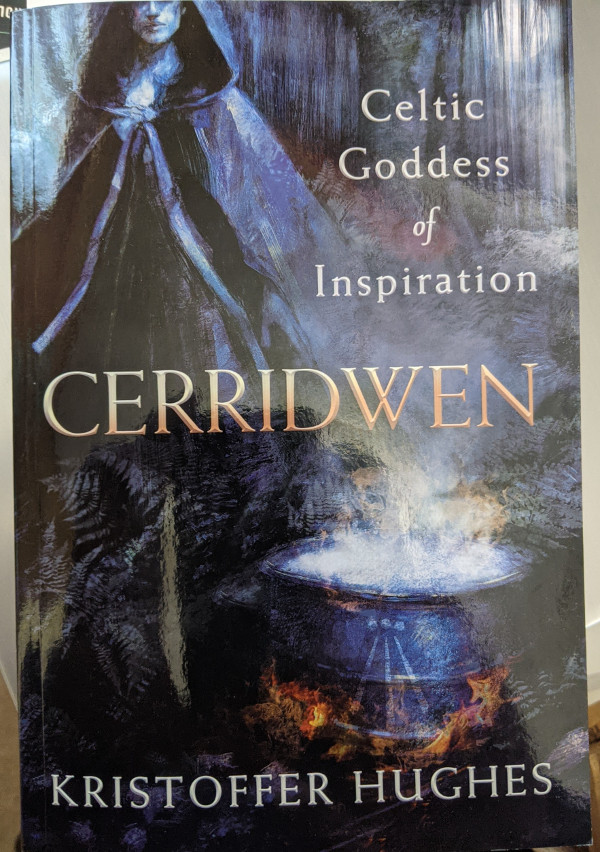
Let’s start with the cover: we see only part of Cerridwen’s face — fitting for a goddess of mystery and initiation. Whatever your stance toward the divine, Kris notes in the introduction,
“This book does not expect you to conform to the manner by which I work with and experience deity. There are a number of ways that people may develop relationship with what some may refer to as god or goddess, and neither is right or wrong. In that spirit, I do not expect you, the reader, to even be a theist, or an individual that works with deity. Cerridwen is flexible enough to be a psychological component to those who may be atheistic or nontheists. The rise of a figure to the status of deity is a process referred to as apotheosis, and this is important, for often the main complaint and criticism of modern-day Pagan practitioners is that they connect to and are often devoted to deities that may not ever have been identified as such in the past. I shall delve deeper into the function of apotheosis in the coming chapters” (pg. xix).
This richness of perspective and detail, drawn from personal experiences which Kris shares throughout, makes the book both a wisdom-meditation and a guide. Often in Druid books we get the distillation of insight, but without the personal component that lets us in sympathetically, imaginatively, emotionally. And “letting ourselves in” — in this case, into relationship with Cerridwen and similar deified energies and persons — is what this book accomplishes so well.
“The journey into relationship with Cerridwen and her myth is not safe — how can it be? For in so doing, one potentially positions oneself at the edge of the cauldron of inspiration and transformation. Your life may never be the same again” (pg. 27).
Of course many books promise much — good marketing is a part of how they sell, after all. But the substance that underlies any promise is where Kris prefers to focus. Issues of cultural heritage, appropriation and authenticity still loom large for much of the Pagan world. Ideally, such grappling will eventually lead to greater clarity and integrity.
Kris notes:
“The difficulties that people face when attempting to move into relationship with mythologies, particularly those that they may be culturally removed from, is the perception that the very words on paper contain the mystery. Modernity has preserved the words themselves whilst simultaneously causing many to consider that only the words themselves matter, and the eye is taken away from the vast space between the lines — wherein lies the magic” (pg. 16).
One key to crossing the river gorges and chasms along our paths is finding useful bridges. Not everything that “takes us across” leaves us where we want or need to be. Kris notes:
“The promise of sweet mystery may well turn sour during one’s exploration, particularly if one cannot make the content applicable in practice … The Pagan traditions work best when orthodoxy, something one believes in, is combined with orthopraxy, something that one does. This book will provide keys to effective and essential practice in order to transform myths from static stories to elements of spiritual practice, illumination and inspiration” (pgs. 13-14).
This core insight is a key that anyone can use, with any mythology — that is, with any story that makes sense of the cosmos. If we love and cherish the story, how do we light it up with life and fire? (That’s what can happen, what Kris wants to help happen for us, when we’re in relationship with a deity.) Christianity excels in orthodoxy, in instructing its communities of believers about what to believe, to the point where recitations of creeds have become the primary identifying feature of different denominations. What Christianity often lacks, and what has led people to find instruction elsewhere, are effective practices that make its teachings something one can actually begin to embody concretely, hour to hour, outside of “church”.
Do people nowadays “know Christians by their love”, as the Christian song lyrics say? It remains an open question. Likewise, do we recognize Druids by a characteristic wisdom and inspiration?
This morning, a post on a constructed language forum I frequent asked how one might go about expressing what we mean by “rights” in English. There’s a lot of talk these days about rights and freedoms, but much less about what these things are. Whenever we use unexamined words in such prominent ways, it pays to take a look at what we’re talking about. We often use words like “rights” and “freedom” to mean something we presume is self-evident, but it seems that much of our disagreement arises because they actually don’t mean the same thing to everyone.
Depending on the era and the culture, rights are given to us by gods or culture heroes; or they’re baked into The Mix from the outset; or they’re balanced — and dependent on — our fulfillment of obligations that are paired with each right we desire; or they’re human creations, meaning they’re entirely under our control. When I look at my own understandings, I see flavors of each of these perspectives. No wonder we’re struggling. (If you’ve figured it out, are you running for office? Or do you have a workshop we can attend for more money than we make in a month?)
If you see rights as something given, they’re not up for revision. But if you think we humans created them, you’re more inclined to tinker, and to recreate them to fit your current vision.
In older cultures like that of Vedic India, the cosmic order or rta is “the principle of natural order which regulates and coordinates the operation of the universe and everything within it”. Rta is something to find out, to discover, to align with. It can’t be legislated into or out of existence. Regardless of human law and laws which may come to overlay it, it persists as a foundation — or the foundation — for how the universe works. It takes in physics as well as morality. We can’t cancel gravity, in spite of its behavior. There may be comparable things at work within humans that we’ve overlooked.
There’s a certain Druidic sympathy for much of this view. The natural world embodies a significant expression of the harmony we aspire to. We choose nature as one of our teachers, birds and beasts and trees as fellow-travelers with us, each possessed of their own truths and gifts. Nature, we’re still learning, offers healing and wisdom for many of our ills, if we can learn to re-apprentice ourselves to it.
Many people feel that morality is much less (or not at all) “built into things” but instead more or entirely a matter of human choice, consciousness and active shaping. There are physical laws, but human society is a created thing, a part of human culture. That means, or should mean, that we can make it whatever we want it to be. Any injustice is a human choice, therefore, as are the inequalities of our social order. If we made them, the thinking goes, we can change and improve them. Resist such an obvious good, goes the thinking, and you’re just on the wrong side of history. You’re selfish, wrong, null and void, past your expiration date, hateful and evil, and above all you deserve to be outed and stopped.
One of the ancient insights of established religions is that there is a force, principle, entity, counter-balance — something or Someone, depending on your predilection to personify — that often causes our best-laid plans to go off the rails, turn awry, flounder and founder and crash and burn. Raven, Loki, Trickster, that strange neighbor — take your pick. We readily find reasons to blame some Other for mucking things up, not ourselves. But many ancient wisdoms would point us to tendencies within each of us that we need to face and work with. Gods know we’ve certainly all had long enough to get it right.
The fault, dear Brutus, is not in our stars but in ourselves, that we are underlings, says Cassius in Julius Caesar. What’s so wonderful about Cassius’ words is that they are both beautifully true in general and evilly true in particular. We want to revolt, but against whom?
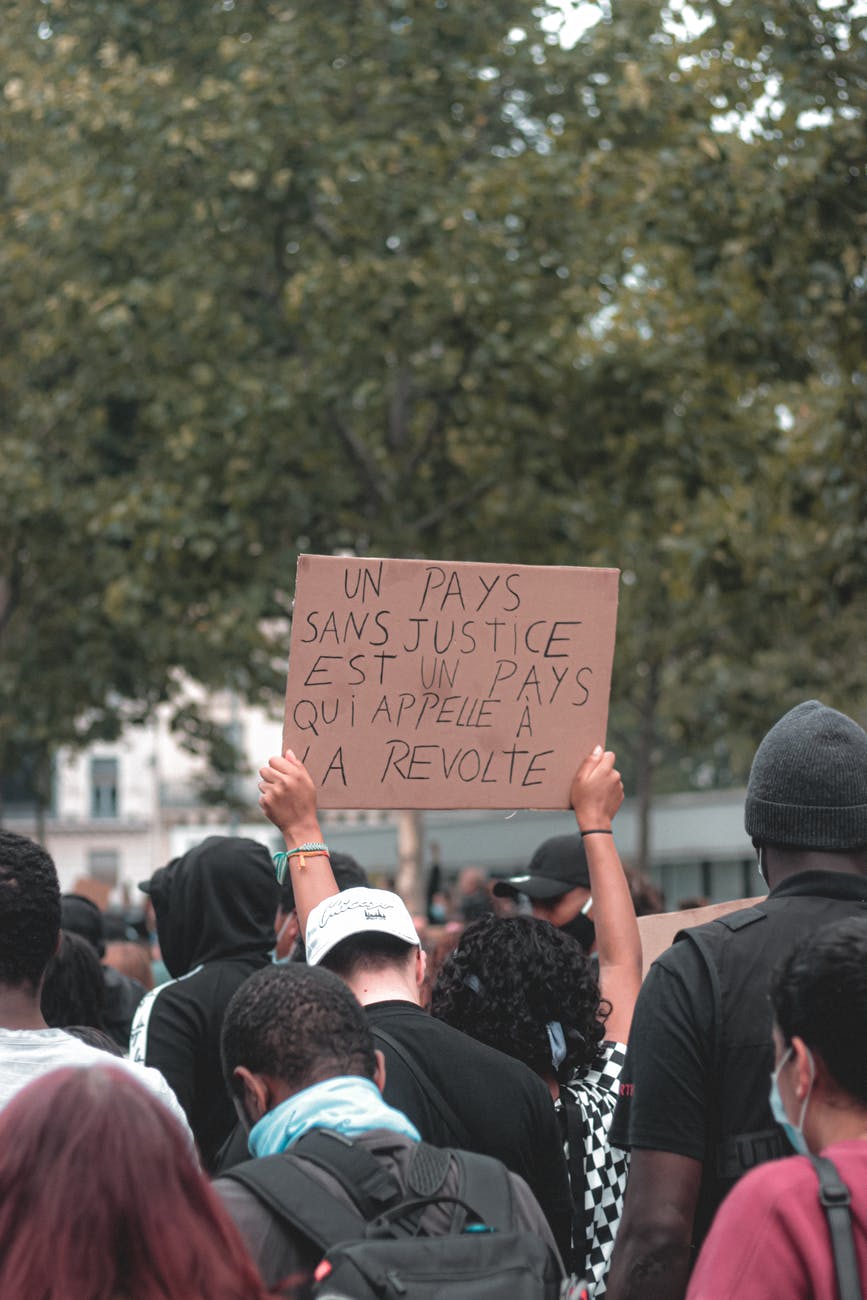
“A country without justice is a country that calls for a revolt …” Justice for who? How?
It’s certainly an accurate diagnosis that we often and too readily yield up our sovereignty to others — gods, partners, friends, corporations, the majority, the Party, The Man, the Patriarchy, the evil Leftists/Rightists/Centrists, etc. — and then we complain when they act in their own interests, and make us suffer, whether intentionally or not. We all repeatedly make ourselves “underlings” in amazingly short-sighted ways, then struggle long and bitterly to reclaim our power. Along the way, it seems we have to reinvent the wheel each time, making enough mistakes that at least half the time we’re Part of The Problem we’re trying to fix. Slow learners, every one of us.
Some religions call this tendency in us evil or sin. We might use vocabulary from physics or biology and just as reasonably call it inertia, finiteness, self-preservation and a number of other observable tendencies that carry less judgment with them. As Andy Dufresne says in The Shawshank Redemption, “you get busy living or get busy dying”. How often do we think we know which one we’re doing, only to discover to our dismay that we’ve been doing the opposite. The natural/organic/biologique food we pay more to buy turns out to be slathered in pesticides by an unscrupulous grower. The journalist we abused for critiquing our favorite new governor turns out to have been right after all. Someone oughta pay! Too often, it’s us. And along with us, the planet, the truth and others’ trust.
We’re constantly told to “just be ourselves”. Seems obvious. But do we know how? Why is that apparently so hard? Hundreds of solutions on tap, and not a single one working for everybody. Part of this — THIS — is that we have to find our own path. Though it will — blessedly — intersect many times with the paths of others.
One of the great insights of Druidry is that working with the awen, with our creativity, is a profound and pleasurable way to restore and reclaim much that we have lost. It is not The Sole Solution (though it’s a Soul solution), but it IS a practice that can lead us toward solutions more productively than much else we’ve tried. When we align with Spirit and our own genius and connection to the worlds, beautiful and inspiring things result.
We can always use more of that.
/|\ /|\ /|\
Welcome to Bangladesh as the newest first-time visitor!



 A Druid Way