[Related posts: Shinto & Shrine Druidry 1 | 2 | 3 || Shinto — Way of the Gods || Renewing the Shrine 1 | 2 || Boku no Shinto — My Shinto 1 | 2 ]
Paramahamsa Yogananda
“Its technique will be your guru.” With these words (ch. 11 of his famous Autobiography, online here), a young Paramahansa Yogananda (1893-1952), founder of Self-Realization Fellowship (SRF) and a principal exponent of Kriya Yoga in the West, counsels a peer he has just initiated into the tradition he follows himself. With these words he also points toward a kind of spiritual path that Westerners, rightly wary of super-sized personalities and god-realized con-men, can approach and walk. A flexible and potent technique can be a trustworthy, profound and endlessly patient guide.
Technique as guru: as a practitioner of OBOD Druidry and Eckankar, I know firsthand that a technique responds to practice and devotion as much as any teacher. Religious and spiritual practice will always be as much art as science, because they welcome (and can profoundly benefit from) our subjectivity, even as they also point to their scientific aspect — definite and repeatable results we can achieve from dedication and regular practice. My emotions, my commitment, my ambition and drive, my struggles and dreams can all contribute to my practice — leaven it and enrich it and make it “mine.”
“other” as double: both of us angry at each other
My anger at the driver who cut me off in traffic last week, on my way back from dropping my wife off to stay with her cousin, can help me uncover other unexplored pools of anger I can work to identify, learn from, and transform. Anger by itself need not be bad, only unconscious anger, anger I act from unthinkingly, little different from a live wire I brush against in the dark, unintentionally — or attach to a light fixture and illuminate another step along the way. Without the experience of anger, I might well miss the wire altogether, and forfeit a chance at illumination.
I can, if I listen, come to see that my whole life is laboratory — not only what I close the door on at 4:00 or 5:00 pm each weekday and return home from. The individualistic-narcissistic-tending “MY spirituality” gets whittled down to more beneficial size through ongoing spiritual practice. And paradoxically reveals a personalized curriculum tailored to me, right now and here. Anger? Yup — that’s on my curriculum, though it may not be on yours. And my life is ideally set up to help me work with precisely that curriculum point, just as yours is for your distinct points. Yes — we share a “common core,” too.
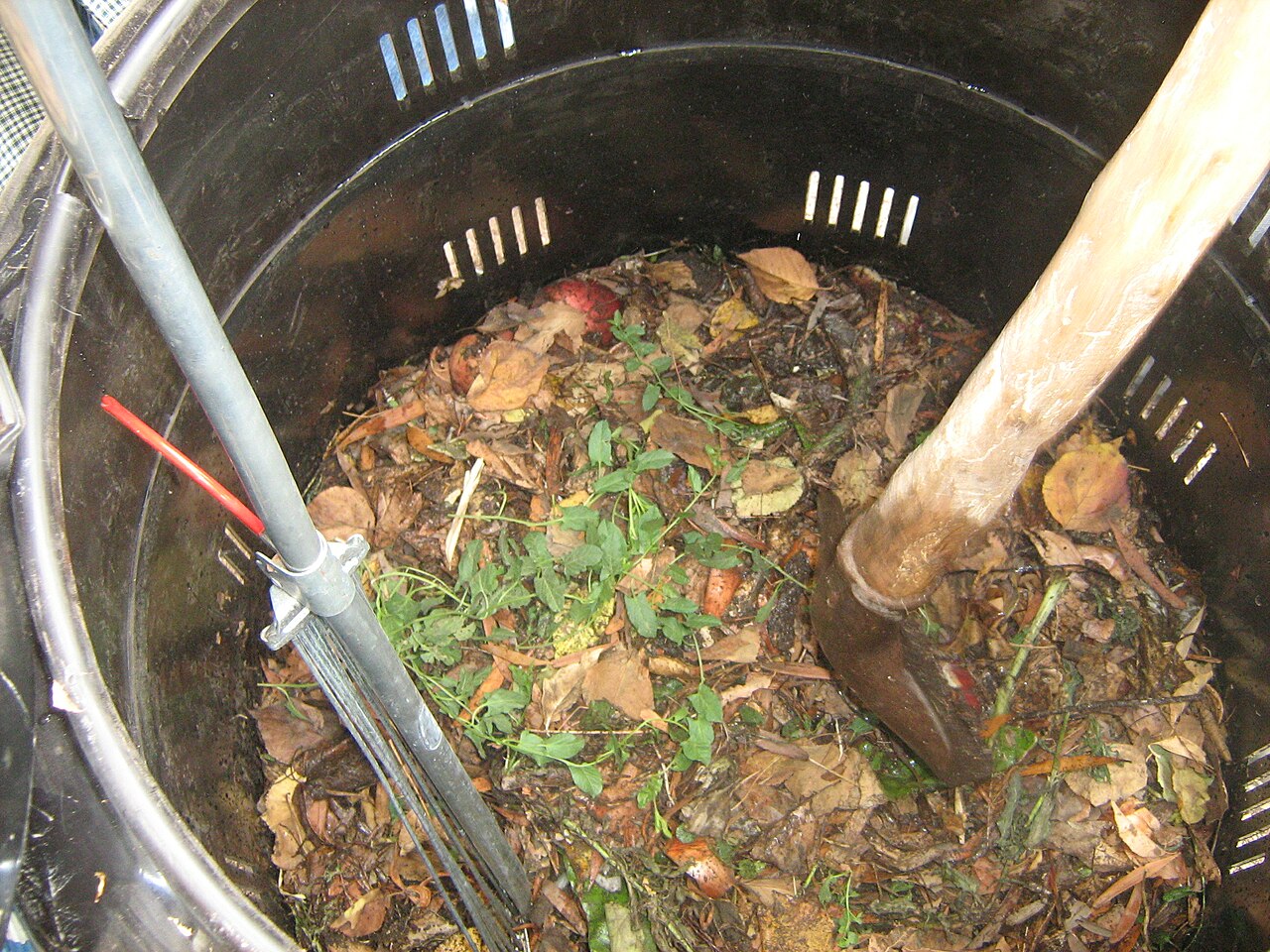
compost: just another point along a transition
A practice like Druidry that places me in the natural world immediately begins to slim down ego in concrete ways and immediately accessible ways: merely walk out the door, and at once it’s clear I’m not the center, nor even the “most important” thing in the universe. I constantly meet the “spirit other”: animals, birds, trees, and beings without skin on — or bark, or fur, or scales. I am a paragraph in a chapter, not the whole story. And that’s a good thing, because the world is guru, too. Hard limits of some kind are the only way a world can work (try seriously to imagine one without them), but if I engage them wisely, they build spiritual strength rather than frustration, nihilism and despair. This physical body is eventual compost, like everything else: but not yet. And this interval is all. (Whether it is also “only” is an experiential question, one which only experience can accurately answer, not some dogma to be believed or rejected.)
“My Shinto,” my Way of the Spiritual Order of Things — let’s call it WOTSOOT — begins with the circumstances of my life today. Here I am, a 55 year-old white male, a teacher, a cancer survivor, married, nearsighted, in fair health. The initial details of your personal WOTSOOT naturally vary less or more from mine. They’re also often quite superficial — party chitchat, gossip in my cul-de-sac. Because I am also a point and vector of conscious energy situated in widening networks of energy exchange. I breathe, and chlorophyll all around me gets inputs it needs. Bacteria on my skin and in my gut flourish, and help me flourish too, if I stay alert to their balance. I sweat and crap and piss, and nutrients move where other beings can begin to use them. I consume some of these other beings — not too many, if the system is to remain in equilibrium — just as some them will consume me. New networks arise, as older ones shift or die. And part of my practice is: all praise* to the WOTSOOT!
Such processes of the physical realm are both fairly well understood and all too rarely incorporated into larger networks that spiritual teachings of all kinds tell us glow and ripple and transform and pervade the universe. Scientific insight begins to catch up here and there with spiritual wisdom. Not dogma, not theology, not creeds — that’s merely paparazzi spirituality — but insights into living networks — the shin-to, the “spirit-way.” As I write and you eventually read this, we use an electronic network we’ve crafted that simulates in surprising ways organically occurring ones, and we can acknowledge the remarkable power and potential of such interactive patterns of energy and information flow as analogs to the ones we are born into.
One valuable key to working with the WOTSOOT that I keep reminding myself of is “small steps. ” This works both as a starting point and a successful process, too. Any attempt at change, on any level, meets what we experience as resistance, because of inertia and equilibrium implicit in networks. (Otherwise, without inertia or resistance, they’d never have a chance to grow and develop at all, shifting and falling apart at the least push or pull from outside. They wouldn’t become “things,” which are semi-lasting whorls and eddies in the flow of WOTSOOT.)
We all have heard that “If it works, don’t fix it,” which is fine, except that a corresponding inherent tendency toward change means that even as it’s working, it’s also changing, or accumulating energy toward change. Often the changes are small, and if we model ourselves on this larger pattern, our small changes will accord with the flow around us. (Small ongoing changes help us avoid really disabling larger ones, that can manage to accumulate a staggering wallop of energy if we don’t make those smaller changes.)
“Change your life,” counsels your friendly neighborhood deity of choice. Okay: but do it in manageable chunks, unless a cataclysm conveniently presents itself to you, ready-made. I have a profoundly messy office right now: too much for a single day of cleaning, without a herculean effort. Sometimes I can muster one. But one box today, one shelf tomorrow? That I can manage most days. Thus both my spiritual paths exhort me to daily practice. (With two paths, as long as I get in at one least set of practices, I’m usually ahead of the game. I double my options — and find overlaps and interweave and insight from such doubled options — the paths are no longer nearly so separate, but feed each other and me.)
our local VT electrical utility
In concrete terms of just one network, in one person’s life? — Let’s choose the physical for convenience, since we’ve established and can understand a set of fairly common labels like physical measures. My wife and I have reduced our “garbage” to an average of 8 pounds a week — mostly non-biodegradable packaging and other non-compostables at this point — and I’m working to bring it down from there. (Why? Throw it “away”? Nothing goes “away” — it always ends up somewhere, and the nastier it is, the deeper it usually sinks its fangs in my butt when it returns. Part of my practice, then, is shrinking my “away” — out of pure self-interest, mind you!) Everything else we’re able to compost or recycle, thanks to recycling options in our region of southern Vermont. We continue to tweak our car and woodstove emissions by wise use, insulation, consolidation of trips, carpooling, etc. Infrastructure shifts will eventually impact these, as mass transit improves and efficiencies increase, or whole modes (like petroleum-sourced energy) eventually fall out of use. Only this February 2014, out of the past 24 months, did we use more electricity than our solar panels generated, so we’re in the black there. But a chunk of that comes from liberal surplus buy-back subsidies from GMP, our local electrical utility company.
Cap’n Henry T.
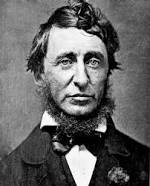
All told, apart from property taxes, our annual shelter costs run roughly $600 — for firewood. I mention all this as evidence for one person’s start at working with one network among many — by no means an endpoint, nor a claim for any kind of praise or desire for virtue** or self-satisfaction. It’s part of practice, a point along a continuum, remembering my practice is both a “what to live for,” and also a “how to live” at all. And again I repeat: yourpractice, because you areyou, necessarily differs. As H. D. Thoreau observes, “I desire that there may be as many different persons in the world as possible; but I would have each one be very careful to find out and pursue his own way, and not his father’s or his mother’s or his neighbor’s instead.”
*I don’t know about you, but I can feel gratitude without needing a target, a recipient or respondent: a magnificent cloudy sky or bright flash of plumage or swirling blizzard evokes awe and gratitude I love to express. Do I need to say I’m grateful toAnyone? Can’t I simply be grateful for? Of course! Gratitude feels good. Why deny myself such pleasure? There’s a motivation if you need it: practice gratitude out of selfishness, because it makes you feel good, if for no other reason! Or if I choose to thank a spirit or Spirit, that in no way detracts from my gratitude. A target for it is another kind of pleasure I choose not to deny myself.
**Except for virtuein the older sense of “strength” or “power.” This kind of “original virtue” is literally “manliness” — what a vir“man” ideally accomplishes that makes him worthy to be called vir— to de-gender it, “what humans do at their best.” And what’s “best”? That which accords with the Way, the Tao or pattern of the universe.
Many spiritual and religious traditions feature a special language used for ritual purposes. The most visible example in the West is Latin. The Latin Mass remains popular, and though the mid-1960s reforms of Vatican II allowed the use of local vernacular languages for worship, they never prohibited Latin. For some Catholics, the use of vernacular reduced the mystery, the beauty and ultimately, in some sense, the sacredness of the rites. If you visit an Orthodox Christian or Jewish service, you may encounter other languages. Within an hour’s drive of my house in southern Vermont, you can encounter Greek, Hebrew, Russian, Arabic and Tibetan used in prayer and ritual.
Language as Sacrament
The heightened language characteristic of ritual, such as prayer and chant, can be a powerful shaper of consciousness. The 5-minute VedicSanskrit video below can begin to approximate for one watching it a worship experience of sound and image and sensory engagement that transcends mere linguistic meaning. The rhythmic chanting, the ritual fire, the sacrificial gathering, the flowers and other sacred offerings, the memory of past rituals, the complex network of many kinds of meaning all join to form a potentially powerful ritual experience. What the ritual “means” is only partly mediated by the significance of the words. Language used in ritual in such ways transcends verbal meaning and becomes Word — sacrament as language, language as sacrament — a way of manifesting, expressing, reaching, participating in the holy.
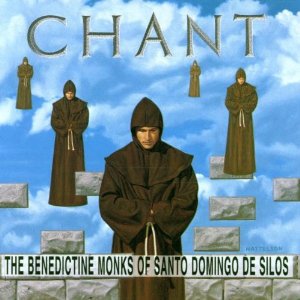
And depending on your age and attention at the time, you may recall the renewed popularity of Gregorian chant starting two decades ago in 1994, starting with the simply-titled Chant, a collection by a group of Benedictines.
Issues with Ritual Language
One great challenge is to keep ritual and worship accessible. Does the experience of mystery and holiness need, or benefit from, the aid of a special ritual language? Do mystery and holiness deserve such language as one sign of respect we can offer? Should we expect to learn a new language, or special form of our own language, as part of our dedication and worship? Is hearing and being sacramentally influenced by the language enough, even if we don’t “understand” it? These aren’t always easy questions to answer.
“The King’s English”
For English-speaking Christians and for educated speakers of English in general, the King James Bible* continues to exert remarkable influence more than 400 years after its publication in 1611. What is now the early modern English grammar and vocabulary of Elizabethan England, in the minds of many, contribute to the “majesty of the language,” setting it apart from daily speech in powerful and useful ways. Think of the Lord’s Prayer, with its “thy” and “thine” and “lead us not”: the rhythms of liturgical — in this case, older — English are part of modern Christian worship for many, though more recent translations have also made their way into common use. A surprising number of people make decisions on which religious community to join on the basis of what language(s) are, or aren’t, used in worship.
Druid and Pagan Practice
When it comes to Druid practice (and Pagan practice more generally), attitudes toward special language, like attitudes towards much else, vary considerably. Some find anything that excludes full participation in ritual to be an unnecessary obstacle to be avoided. Of course, the same argument can be made for almost any aspect of Druid practice, or spiritual practice in general. Does the form of any rite inevitably exclude, if it doesn’t speak to all potential participants? If I consider my individual practice, it thrives in part because of improvisation, personal preference and spontaneity. It’s tailor-made for me, open to inspiration at the moment, though still shaped by group experience and the forms of OBOD ritual I have both studied and participated in. Is that exclusionary?
Ritual Primers
Unless they’re Catholic or particularly “high”-church Anglican/Episcopalian, many Westerners, including aspiring Druids, are often unacquainted with ritual. What is it? Why do it? How should or can you do it? What options are there? ADF offers some helpful guidance about ritual more generally in their Druid Ritual Primer page. The observations there are well worth reflecting on, if only to clarify your own sensibility and ideas. To sum up the first part all too quickly: Anyone can worship without clergy. That said, clergy often are the ones who show up! In a world of time and space, ritual has basic limits, like size and start time. Ignore them and the ritual fails, at least for you. Change, even or especially in ritual, is good and healthy. However, “With all this change everyone must still be on the same sheet of music.” As with so much else, what you get from ritual depends on what you give. And finally, people can and will make mistakes. In other words, there’s no “perfect” ritual — or perfect ritualists, either.
(Re)Inventing Ritual Wheels
Let me cite another specific example for illustration, to get at some of these issues in a slightly different way. In the recent Druidcast 82 interview, host Damh the Bard interviews OBOD’s Chosen Chief, Philip Carr-Gomm, who notes that some OBOD-trained Druids seem compelled to write their own liturgies rather than use OBOD rites and language. While he notes that “hiving off” from an existing group is natural and healthy, he asks why we shouldn’t retain beautiful language where it already exists. He also observes that Druidry appeals to many because it coincides with a widespread human tendency in this present period to seek out simplicity. This quest for simplicity has ritual consequences, one of which is that such Druidry can also help to heal the Pagan and Non-Pagan divide by not excluding the Christian Druid or Buddhist Druid, who can join rituals and rub shoulders with their “hard polytheist” and atheist brothers and sisters. (Yes, more exclusionary forms of Druidry do exist, as they do in any human endeavor, but thankfully they aren’t the mainstream.)
About this attitude towards what in other posts I’ve termed OGRELD, a belief in “One Genuine Real Live Druidry,” Carr-Gomm notes, “The idea that you can’t mix practices from different sources or traditions comes from an erroneous idea of purity.” Yes, we should be mindful of cultural appropriation. Of course, as he continues, “Every path is a mixture already … To quote Ronald Hutton, mention purity and ‘you can hear the sound of jackboots and smell the disinfectant.'” An obsession with that elusive One Genuine Real Live Whatever often misses present possibilities for some mythical, fundamentalist Other-time Neverland and Perfect Practice Pleasing to The Powers-That-Be. That said, “there arecertain combinations that don’t work.” But these are better found out in practice than prescribed (or proscribed) up front, out of dogma rather than experience. In Druidry there’s a “recognition that there is an essence that we share,” which includes a common core of practices and values.
As a result, to give another instance, Carr-Gomm says, “If you take Druidry and Wicca, some people love to combine them and find they fit rather well together,” resulting in practices like Druidcraft. After all, boxes are for things, not people. Damh the Bard concurs at that point in the interview, asserting that, “To say you can’t [mix or combine elements] is a fake boundary.”
Yet facing this openness and Universalist tendency in much modern Druidry is the challenge of particularity. When I practice Druidry, it’s myexperience last week, yesterday and tomorrow of the smell of sage smoke, the taste of mead, wine or apple juice, the sounds of drums, song, chant, the feel of wind or sun or rain on my face, the presence of others or Others, Spirit, awen, the god(s) in the rite. The Druid order ADF, after all, is named Ár nDraíocht Féin — the three initials often rendered in English as “A Druid Fellowship” but literally meaning “Our Own Druidry” in Gaelic.
A Human Undersong
Where to go from here? Carr-Gomm notes what Henry David Thoreau called an “undersong” inside all of us, underlying experience. “We sense intuitively that there’s this undersong,” says Carr-Gomm. “It’s your song, inside you. The Order and the course and the trainings [of groups like OBOD] — it’s all about helping you to find that song. It’s universal.” As humans we usually strive to increase such access-points to the universal whenever historical, political and cultural conditions are favorable, as they have been for the last several decades in the West.
Paradoxes of Particularity
Yet the point remains that each of us finds such access in the particulars of our experience. (Christians call it the “scandal of particularity”; in their case, the difficulty of their doctrine that one being, Jesus, is the sole saviour for all people — the single manifestation of the divine available to us.**) And the use of heightened ritual language can be one of those “particulars,” a doorway that can also admittedly exclude, an especially powerful access point, because even ordinary language mediates so much human reality. We quite literally say who and what we are. The stroke victim who cannot speak or speaks only with difficulty, the aphasic, the abused and isolated child who never acquires language beyond rudimentary words or gestures, the foreigner who never learns the local tongue — all demonstrate the degree to which the presence or absence of language enfolds us in or excludes us from human community and culture. And that includes spirituality, where — side by side with art and music — we are at our most human in every sense.
In the second post in this series, I’ll shift modes, moving from the context I’ve begun to outline here, and look at some specific candidates for a DRL — a Druidic Ritual Language.
*Go here for a higher-resolution image of the title page of the first King James Bible pictured above.
**In a 2012 post, Patheos blogger Tim Suttle quotes Franciscan friar and Father Richard Rohr at length on the force of particularity in a Christian context. If Christian imagery and language still work for you at all, you may find his words useful and inspiring. Wonder is at the heart of it. Here Rohr talks about Christmas, incarnation and access to the divine in Christian terms, but pointing to an encounter with the holy — the transforming experience behind why people seek out the holy in the first place:
A human woman is the mother of God, and God is the son of a human mother!
Do we have any idea what this sentence means, or what it might imply? Is it really true? If it is, then we are living in an entirely different universe than we imagine, or even can imagine. If the major division between Creator and creature can be overcome, then all others can be overcome too. To paraphrase Oswald Chambers “this is a truth that dumbly struggles in us for utterance!” It is too much to be true and too good to be true. So we can only resort to metaphors, images, poets, music, and artists of every stripe.
I have long felt that Christmas is a feast which is largely celebrating humanity’s unconscious desire and goal. Its meaning is too much for the rational mind to process, so God graciously puts this Big Truth on a small stage so that we can wrap our mind and heart around it over time. No philosopher would dare to imagine “the materialization of God,” so we are just presented with a very human image of a poor woman and her husband with a newly born child. (I am told that the Madonna is by far the most painted image in Western civilization. It heals all mothers and all children of mothers, if we can only look deeply and softly.)
Pope Benedict, who addressed 250 artists in the Sistine Chapel before Michelangelo’s half-naked and often grotesque images, said quite brilliantly, “An essential function of genuine beauty is that it gives humanity a healthy shock!” And then he went on to quote Simone Weil who said that “Beauty is the experimental proof that incarnation is in fact possible.” Today is our beautiful feast of a possible and even probable Incarnation!
If there is one moment of beauty, then beauty can indeed exist on this earth. If there is one true moment of full Incarnation, then why not Incarnation everywhere? The beauty of this day is enough healthy shock for a lifetime, which leaves us all dumbly struggling for utterance.
Henry David Thoreau wrote in his manifesto, Walden, that he wished to follow “the bent of my genius, which is a very crooked one, every moment.” Let’s suspend belief about the “every moment” part for now. Most of us slack off; we’re not up to full time bent-ness. But I suspect every genius is “bent” by the time it emerges, after the intense discoveries and trials of childhood and adolescence. It is, after all, a time when we each face a personal apocalypse which — apart from recent 2012 apocalypse kerfluffle (a profoundly scientific and precise term), itself only the most recent instance of a few millenia’s worth of end-times hysterias* — is at root not a disaster per se, but an unveiling, a revealing.
That’s why the Biblical apocalypsis, a Greek word, gets translated “Revelations.”** A revelation needn’t be a disaster. We may seek from many sources for revelation or insight into our lives and situations. But as far as adolescence goes, whether it’s some profound additional shock, or the more routine experience of our physical bodies running mad with hormones, hair, smells, urges and general mayhem, it can be a real humdinger of a decade.
Among other things, we begin to come to terms with the full measure of shadow and light we each carry around with us, a personal atmosphere with its own storms and sun, its seasons of gloom and glory. As Hamlet exclaims to Ophelia (Act 3, scene 1): “I am myself indifferent honest; but yet I could accuse me of such things that it were better my mother had not borne me: I am very proud, revengeful, ambitious, with more offences at my beck than I have thoughts to put them in, imagination to give them shape, or time to act them in. What should such fellows as I do crawling between earth and heaven? We are arrant knaves, all; believe none of us.”
Quite a catalog of self-condemnation. But on our “crawl between earth and heaven,” we can choose to do more than indulge in self-loathing. It’s not a competitive sport, after all. No prizes for “arrant-ness,” to use Shakespeare’s word. This being human is a mixed bag, a potluck. We work out our own answers to the question of what to do crawling between earth and heaven. It’s an apt description: we truly are suspended at times, halfway to both realms, too rarely at home in either.
And so, rather than New Year’s resolutions, I prefer to look at themes and nudges. If I take my own advice, courtesy of Yoda, and tell myself “do or do not, there is no try,” then “small moves” becomes the game. Nudge a little here, prod a little there. Few life trajectories change overnight. If yours does, then all bets are off. You’re probably in full-on apocalypse mode right now — and that’s apocalypse in the 2012 “all-hell-about-to-break-loose” sense. It’s time to rewrite the manual, reboot, do over. But the rest of the time, the smallest change can eventually lead to big consequences. Lower expectations. Make it almost impossible for yourself not to follow through.
Now you’re not trying to change; you’re playing with change — which has a very different feel. If you want to commit to half an hour of exercise a day, for instance, make it five minutes instead. Psych yourself out or in, your choice. Small moves. Make it foolishly easy, like using a credit card. It’s just a piece of plastic, just a small thing you’re doing. A game really. I’ve been surprised how I can make changes, as long as I make them small enough, rather than big enough. Seduce yourself into change so small you can’t resist, like those bite-sized pieces of your current favorite snack addiction. “Nobody can eat just one.” And so on.
We think too much of ourselves. I’ll think less, on alternate days, to see how it feels. This is real trying — not an attempt that focuses on probable failure, but the testing, the probing, the experimenting, as in “trying the cookie dough,” or “trying a kiss on the first date,” or “trying on a new set of clothes.” There’s self-forgetfulness available in the fascination of the game-like quality life takes on when we cease to take ourselves quite so seriously. Instead, we may come to revere some other thing than the self. Because one of her insights is apropos of what I’m getting at, I’ll close here with Barbara Brown Taylor, from her 2009 book An Altar in the World:
According to the classical philosopher Paul Woodruff, reverence is the virtue that keeps people from trying to act like gods. ‘To forget that you are only human,’ he says, ‘to think you can act like a god — that is the opposite of reverence.’ While most of us live in a culture that reveres money, reveres power, reveres education and religion, Woodruff argues that true reverence cannot be for anything that human beings can make or manage by ourselves.
By definition, he says, reverence is the recognition of something greater than the self–something that is beyond human creation or control, that transcends full human understanding. God certainly meets those criteria, but so do birth, death, sex, nature, justice, and wisdom. A Native American elder I know says that he begins teaching people reverence by steering them over to the nearest tree.
‘Do you know that you didn’t make this tree?’ he asks them. If they say yes, then he knows that they are on their way (20).
So maybe I’ve seduced you into trying or tasting your life and its possibilities instead of getting hung over changing it. May you find yourself on your way, may you celebrate what you discover there, may you delight in reverence.***
/|\ /|\ /|\
*See John Michael Greer’s Apocalypse Not (Viva Editions, 2011) for an amusing take on our enduring fetish for cataclysm and disaster. You’d think that after Katrina, the Gulf oil spill, the Japanese tsunami and nuclear disaster, hurricane Sandy, and the yearly shootings we endure, we’d be fed up with real actually-documentable apocalypses. But no …
**The name of the Greek sea-nymph Kalypso means “Concealer.” Undo or take off the concealment and you have apo-kalypse, unconcealing: revelation.
***Once my attention is off myself, I find that change often happens with less wear and tear. Reverence can seduce us into other ways of being that don’t involve the stressors we were “trying to change.” We may not even notice until later. I get so busy watching the moon rise I forget what I was angry about. Anger fades. Moon takes it. Reverence, o gift of gods I may not know or worship, I thank you nonetheless …









 A Druid Way