[Edited 20 June 2018]
Ah, Samhain, you’re here again. This solemn time to honor our dead and acknowledge the things that have passed from our lives. This joyous time to celebrate the harvest and the warmth of friends and loved ones to carry us through the dark half of the year. This reminder of the balance inherent in all transient things. Our work, if we choose, with the earth.
Halloween-time, to carve a pumpkin, set out the candy for the trick-or-treaters, remember to put the car in the garage the previous evening so next morning the windows aren’t all frosted over. Time for mulled cider, fallen leaves, bonfires, the possible gift of a few more mild, bright days before the snow comes. As a friend remarked yesterday, Halloween is the true start of our winter, here in the Northeastern U.S. where I live. The earth doing its thing. Earth-work.
/|\ /|\ /|\
Ushtogaysky Square, Kazakhstan — immense millennia-old earthworks make headlines …
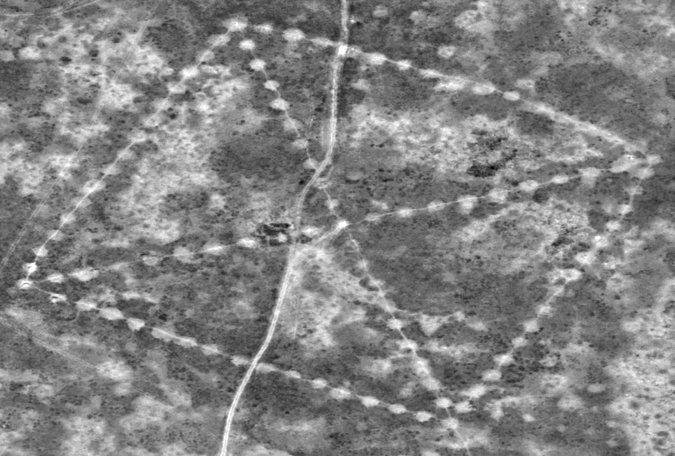
NASA photo at the New York Times link above
X marks the spot of a different kind of earth-work. (We’re always at the center.) I jump from this macrocosmic image to the microcosm of my personal work on earth. After you’ve finished groaning, come with me, to see whether whatever I can mine from it has any value for you, for this blog. Here goes …
Over the past several days a virus has been racking my joints and muscles and leaving me achy, feverish, weak. In other words, no gift to take along with me to an early Samhain celebration an OBOD friend was hosting last night. He lives “across the water” in New Hampshire, and the dozen or so folks he expected to join him included out-of-towners bringing kids and planning to sleep over. (The Samhain ritual took place later in the evening, after a typical Halloween party for the younger set).
 So I stayed home instead, built up the fire, hydrated myself with tea and soups, and slept. Sometimes what we leave behind gets pried from us through mild (or great) suffering. Sometimes, of course, we can leave it more willingly. And we can try to make something of it, if there’s anything left of us in the moment, and turn to old spiritual technologies like fasting that may have slipped out of fashion but have never lost their worth.
We already fast when we refuse to accept the memes of fear and despair and business-as-usual of too much modern life. We purge. We deny some negative shard a foothold, most effectively by replacing it with a positive alternative. If you’re interested in anything, why not start where it’s actually already a part of your life? In my life, if I look around, this seems to be true of many more things than I’d ever believed possible. How many access-points and footholds and innate spiritual “flux-capacitors” (courtesy of the Back to the Future wiki) we have for almost anything we can imagine. Transform, transform, whispers the cosmos.
 Many people think fasting belongs to Christianity. No meat — fish is fine! — on Fridays. Look Medieval, and maybe skeletal monks and nuns come to mind. Ascetics whipping themselves with a cat of nine tails.
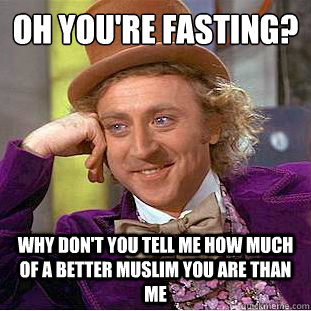
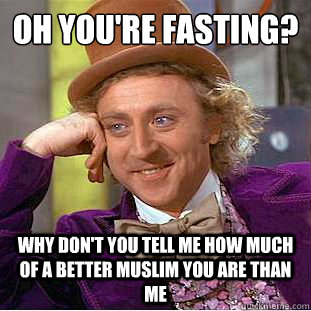
There’s the Yom Kippur fast. Or, if you have a Muslim co-worker or friend, you’ve possibly heard them talk about keeping the fast for the month of Ramadan. Not to pick on Muslims, as the ubiquitous Gene Wilder memes like the one to the left would wrongly imply: anyone can be obnoxious and obvious about such practices, which is one reason they go through cycles and fall out of favor for a while. Mirror, mirror on the wall.
For about a decade I fasted once a week. This was a significant practice of the other spiritual path I follow. Like many disciplines, fasting’s less daunting after you actually do it a few times. You learn how your body reacts, how to ease into it the day before, how to come off a fast, what food and drink work best for your own particular circumstances and body chemistry and goal. Partial fast, water or juice fast, complete fast. (Ooh, you’re hardcore.)
Headaches from dehydration? Sure. Greater susceptibility to cold, since you’re not stoking the furnace several times during the day? Yep. Bad breath? Perfectly possible. Absolute joy at breaking a fast — how delicious almost any decent (or indecent) food tastes, how much the fast may have subtly reset some of your programming, how your dream recall can be improved, how an old habit may loosen its hold, how you have more faith in and less fear of your own body? Check, check, check.
 A fast can be difficult, sure. But not, I usually found, because of hunger. That comes and goes, and it’s often the least challenging aspect of fasting. No, to many others besides just me, one of the truly interesting parts of a fast is what it may reveal about attitudes, attachments and mindsets that deserve a careful look. And it’s just the scrutiny they don’t usually get in the scramble to ingest the daily three squares, plus the obligatory snacking an overfed Westerner like me makes sure to practice as faithfully as any religious devotee. Food Yoga, anyone? Follow the Calorie Sutra? Junk-food Gita? The venerable Maha-salsa-and-chips? Down with that.
A physical fast also begins to open up unforeseen and potential valuable energies for other things than preparing, consuming and digesting food. Plenty of books and other resources address those advantages.
And for clarity and vision-questing around Samhain, a fast can offer one more valuable tool to those who want to look beyond the usual boundaries and curtains over our awareness.
As I’ve aged, and as accumulated physical issues make a food-fast a cause of more problems than benefits, I’ve turned more to mental fasts. (This could be one alternative to people struggling with food issues like bulimia and anorexia.) In addition to its purpose as a ritual offering, a devotion which deserves its own post, keeping the attention on a chosen object, image, mantra, deity, etc., for a twenty-four hour period drops all kinds of issues front and center stage. Lacking things to work on? Feeling like I fully qualify for Ancient Honorable Thrice-Sanctified Adeptus XI? Nothing quite like a fast to reveal my crap-of-the-day and put me in my place.
So I take inventory every hour and return, return, return the attention to its focus. Technology helps. (Got the latest fast-app?! A simple e-timer can help a lot. Try a “tasteful chime,” as one friend calls it.)
How good is my concentration? Is my chosen focus for the day even worthwhile? What is devotion, anyhow? What distracts me the most? What claims to be more important, or insists it’s a valid priority? How do I respond to others who ask why I may seem a little absent-minded or distracted today? Do I listen carefully enough to perceive who really wants to know, and who — if I tell them — may mock what they don’t understand? How much of this particular fast is just an exercise of ego or will-power, and how much is meaningful devotion?
OK, you get the idea. Illness can provide a natural push toward a mental fast. You can’t jump into your normal routine, you may find yourself in bed, and rather than relying on cable, Netflix, Hulu, net-surfing or some other drug of choice to fill every single minute you’re not moaning for sympathy, soaking in warm water to soothe your unhappy bone-house*, tossing and turning because you can’t sleep, or downing pills, extracts, roots, powders, potions or elixirs, why not use even a fraction of the time to experiment … on yourself? Best laboratory ever! No? Still not convinced?
I’m a sucker for squeezing every experience for what I can gain from it. (At least that’s what I tell myself. Some future fast will without a doubt show me where that’s no longer true, or never was.)
Meanwhile, I’m looking forward to a holiday fest this evening with some friends and neighbors. Just the four of us. A mostly veggie potluck meal, because that’s what’s come from our gardens. A short blessing (probably the one that opens my About page) in lieu of a longer ritual. And the fasting I did yesterday, imperfect, illness-prodded, leaves me grateful to today to be feeling better. No small thing.
Here for your delectation is a short Youtube clip from the 2014 Edinburgh Samhuinn Fire Festival:
Happy Samhain/Halloween to you all!
/|\ /|\ /|\
Images: 40-day word fast; Gene Wilder fast-meme pic; Come at me, bro!;
*Old English bán-hús: body, chest; literally, “bone-house.”


 A Druid Way