Mantle of Brighid about me,
Memory of Brighid within me,
Protection of Brighid around me
keeping me from harm,
from ignorance, from heartlessness,
this day and night,
from dawn till dark,
from dark till dawn.
— John O’Donohue (adapted), The Four Elements, Transworld Ireland, 2010, pg. 109. (Also available in Random House editions.)
I find in this poem a prayer most fitting for these darkening days till Yule and sun-return (never mind the ritual season). I add to it these visualizations as I say the opening triad of actions:
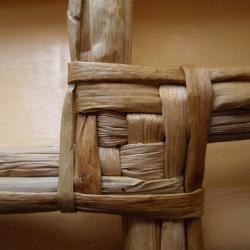
I see and feel the soft, warm cloak of Brighid furl and drop around me. I touch the weave of the cloth. I see the mantle extend outward, expanding the presence of Brighid all around me. “Beneath your mantle you gather us.”
I feel the memory of Brighid arrive as I whisper her name, her presence in thought and feeling, in the hearth-fire, in human warmth and affection, in animal caresses, in the sun’s brightness, hidden behind clouds or yellow in the December sky. Her mantle means we help manifest her, bring her here. “Remind us how to kindle the hearth.”
I feel the awen of the divine kindling in and around me whenever I put off despair and choose better. I sense the awen in others, upholding me even as I uphold them. I name them now, sitting or standing before any fire or flame or light, which I declare Brighid’s fire and flame and light.
O’Donohue writes: “One of the reasons for the modern poverty of spirit is amnesia. Even though there is a great harvest of healing energy within memory, people seem to make so little use of it. Rather than living from this harvest within them, they seem in the demented rush of modern life to live more out of their poverty” (pg. 113).
I hold my hands up before me and say more of this prayer-poem:
To keep it bright,
to preserve the flame,
your hands are ours,
our hands in yours
to kindle the light
both day and night.
And then I close, repeating the opening triad once or twice more as it feels right.
Mantle of Brighid about me,
Memory of Brighid within me,
Protection of Brighid around me.
And I see Brighid’s cross, feel it foursquare, if I receive no other intimation of the goddess. I sein my thoughts, feelings, and actions of the day with it, sometimes continuously through the hours if I need it, to preserve, preserve, preserve the flame.
To begin this post I invoke with the words of a great Bard, the late Leonard Cohen, who sings in his song “Anthem” : “Ring your bells that still can ring./Forget your perfect offering./There’s a crack, a crack in everything./That’s how the light gets in.”
/|\ /|\ /|\
Doing my small part to ring some bells and locate some nearby cracks to work with, it’s been in my thought more and more to explore Wantastiquet. But it took word of another’s recent climb to the peak to prod me into visiting this local treasure. As a Nigerian acquaintance said to me recently, quoting an African proverb, “Those who live nearest the church arrive late.”
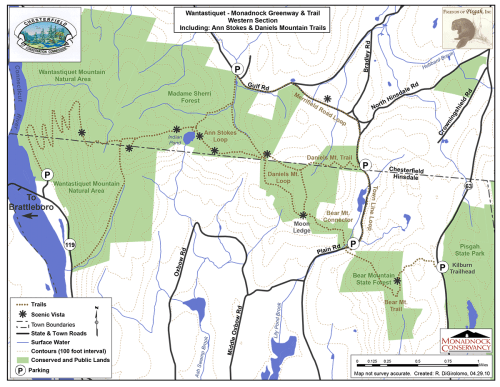
Just over the Connecticut river east into New Hampshire, Wantastiquet Mountain rises to approx. 1350 feet. It’s a moderate 1.5 mile hike to the summit — about an hour’s walk along numerous switchbacks for this 57-year old. From downtown Brattleboro it’s a little over half a mile to the foot of the mountain, so plenty of hikers and their dogs were out enjoying the afternoon. The sunny weather hovered in the mid 50s, oak leaves carpeted the trail all the way to the top, and as mountain treks often do for me, the climb had the feel of pilgrimage. There is a berg-geist, a mountain spirit, if I silence the mind chatter and attend. The rumble of weekend traffic from nearby interstate 91 which the river valley amplifies begins to fade around 500 feet up.
The site is a perfect shanshui — landscape, literally “mountain-water” — one of my favorite Chinese words from a year in the mid-80s spent teaching English in the People’s Republic of China. The Connecticut river valley defines the state line between New Hampshire and Vermont for 150 miles, and seen from the west, the peak appears to ascend right out of the river. Here’s a view from perhaps 70 feet up on the trail, looking back toward Vermont.
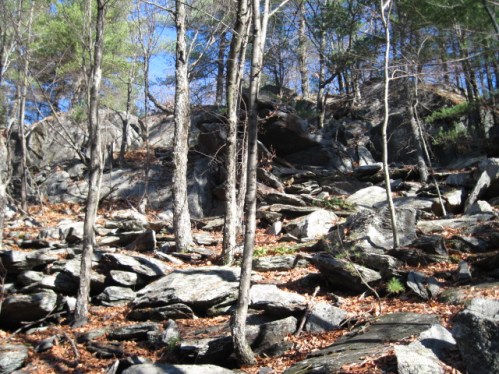
Evergreens march along either side of the path, but the few remaining leaves on oak branches above them account for the trail’s leaf cover.
The pines and oaks busy themselves both splitting the rock and holding it in place.
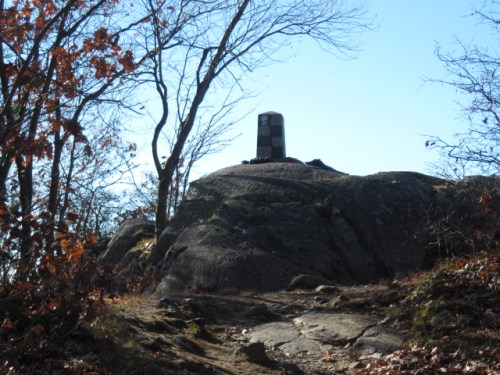
Gathered near the marker at the summit were several resting hikers who left shortly after I arrived.
In the distance, the peaks of Ascutney (45 miles north) and Hogback (13 miles due west) loom through the haze.
I’d gathered a handful of acorns along the way, thinking to plant them as I establish my grove at home. But as I neared the top, an impromptu ritual (my favorite kind) threaded into my attention and I made an offering instead. Finding a clearing a few hundred yards away, I bowed to each direction.
[This is an early version of what is becoming a page on Ritual, a link from the header menu above.]
From small rituals like shaking hands vs. bowing, or saying your culture’s equivalents of “please” and “thank you,” to family traditions at the holidays, and outward to public ceremonies like reunions, annual festivals, weddings, funerals, ship-launchings, inaugurations, dedications, etc., ritual pervades all human cultures.
Even animals exhibit ritualized behavior, if we count courtship displays, and dominance/submission behavior in pack and herd animals. What is instinctive in animals becomes conscious among humans, and though anthropologists and psychologists have developed a range of explanatory theories, none captures all the richness, variety and potential power of ritual.
Whenever I catch myself thinking “empty ritual,” I realize I’m what’s missing. Ritual is simply a form, like a recipe or dance move or martial arts kata. And like a kata, it’s “a routine or pattern of behavior that is practiced to various levels of mastery,” as the Wikipedia entry for kata puts it.
So if my heart isn’t in it, if the pattern-making doesn’t hold my attention, if it doesn’t carry significance to me, it will naturally feel empty to me — because I haven’t filled it with my dedication, my energy and imagination, my preparation, my sense of participating in something larger than myself. The essential component is me. If we want meaningful rituals, it’s up to us to create them.
Families and friends develop rituals to celebrate their relationship — you may have our own examples of a favorite gathering-place, in-group slang and allusions to past shared events opaque to outsiders, and so on. Humans are meaning-seekers and pattern-makers. Ritual is one expression of how human consciousness works.
/|\ THE WHEEL OF THE YEAR
Ritual is simply another tool, and Druidry as an earth-centered spirituality includes the ritual celebration of the seasons. The eight-fold seasonal cycle common to Wicca and Druidry and many Pagans generally is a modern conception. It appears to be the happy result of a collaboration, or at least of mutual influence, between Gerald Gardner and Ross Nichols. In the middle of the last century they were inspired to merge the four Fire Festivals of the Celts of early February, May, August and November with the equinoxes and solstices. The names we give the holidays may vary, but roughly every six weeks you can find a festival marking the turning of the Wheel of the Year.*
Ritual can be magically simple, and needn’t take place only on one of the “Great Eights.” Ritual needs nothing more than you and your intention. You visit a favorite meadow or grove or stone outcropping, and you whisper to yourself a favorite poem, maybe even a verse — simplicity itself — like “This is my rock” by David McCord:
This is my rock
and here I run
to steal the secret of the sun;
This is my rock,
and here come I
before the night has swept the sky;
This is my rock,
this is the place
I meet the evening face to face.
/|\ /|\ /|\
*The Wheel of the Year
October 31 – November 2: Hallowe’en, Samhain/Samhuinn, All Hallows Eve, All Saints Day, All Souls Day, Todos Santos, Day of the Dead, Dia de Muertos.
December 20-22: Yule, Winter Solstice, Alban Arthan.
February 1-2: Imbolc, Oimelc, St. Brigid’s Day, Groundhog Day, Candlemas.
March 20-22: Spring Equinox, Ostara, Alban Eilir.
May 1: May Day, Beltane, Bealtainne, Walpurgis Night.
June 20-22: Summer Solstice, Midsummer, St. John’s Day, Litha, Alban Hefin.
August 1: Lughnasad/Lunasa, Lammas(tide).
September 20-22: Autumn Equinox, Alban Elfed, Mabon.
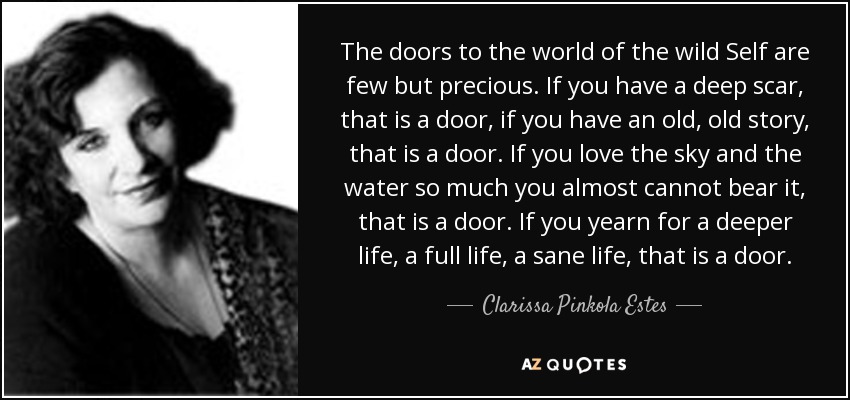
You can find out more about Clarissa Pinkola Estés here.
In part, the doors Estés refers to are a matter of human time. Live long enough and you’ll very likely wear such scars, carry such stories, cherish such loves. One way to find common ground with others is to focus on these doors. And one of the best ways to access them is by careful listening to ourselves and to each other.
Often enough, we may fear such a world and such a self as much as we yearn for it. A doorway means change. Even if it just opens onto another room, it’s not the room we were in a moment ago. Fears can outline such a door, too — including fear of a door itself. If you’re anything like me, you know or have been someone who at one time or another has walked into a cage and exulted as it clanged shut behind you, reassured that at least you wouldn’t have to walk through yet another damned door.
How to recapture the sense of the preciousness of these doors, as Estes calls it? For in the end our own longing compels us to find them and walk through. Ritual is one way, though by no means the only. By defining boundaries in ritual we can make a door easier to see and peek through. If the past is difficult country for me, I can approach it with safeguards in place. Ritual can help with its prescribed beginnings and endings, its containers of energy and wisdom we can safely draw on at need for balance and perspective and protection. A holiday like the upcoming Samhain, like Hallowe’en, a holy evening for remembering who and what has passed from our lives, offers a safe space to honor and to say farewell to what is gone. Sometimes all that is needed is for us to agree that we can finally let go.
One of the most moving Samhain celebrations I’ve ever experienced was organized by a high-school student — I’ll call her C. — who during her senior year led the Alternative Spiritualities group I advised while teaching at my former school. C. was an atheist who deeply understood the power of ritual theater. Under her leadership, our meetings often were focused discussions about perception and consciousness. Ritual, however, happened just once.
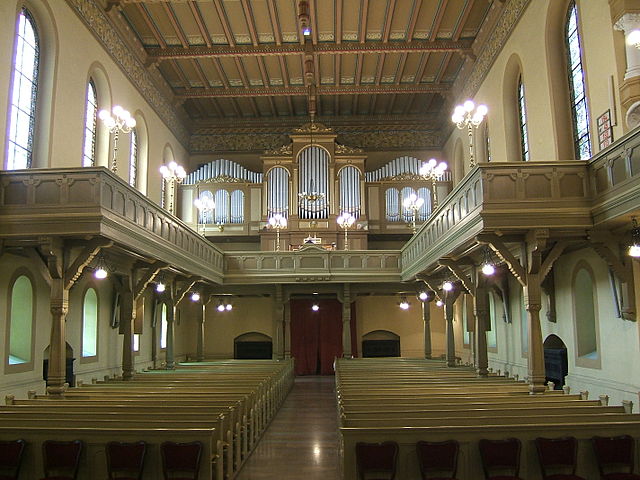
Interior of a Protestant church, looking from the altar toward the rear entrance.
Halloween fell on a Saturday that fall, as it does this weekend. Just after sundown a group of perhaps a dozen students and I gathered in our school chapel with its old, austere New England style, opened the windows — it was a mild October evening — and lit incense and candles. You take, and make, doors where you find them.
C. briefly explained what we’d be doing, then gathered us in a circle, led us in a simple chant and circle dance, and at length asked us to recall someone or something we wanted to say goodbye to. Any script C. had was entirely in her head. The ritual flowed smoothly because everyone knew its purpose and no one was worried about making mistakes. After all, you couldn’t go off-script. Both tears and laughter fit any moment of that evening.
We each wrote the name of this person or thing on a slip of paper and folded it tightly. One person collected them, and then ceremonially burnt them in a large bucket of sand in the center of our circle on the chapel floor. We chanted as the smoke rose, and I saw several students crying quietly. We cleaned up and sat on the altar steps for candy and snacks and soda, sugaring ourselves into a lighter mood. Many students said at our next meeting the following week how meaningful the experience was for them.
Reclaiming the wild self is work we’re all doing. Much of what I try to write about here is an attempt to document my journey to do just that, along with my sidesteps, mishaps, meanderings and insights along the way. We may call this spiritual objective by different names, but the deep yearning in us is the same, if we stop and talk with and listen to each other. We can if we wish walk part of the way in each other’s company.
May you find such doorways on your own journey, and may they be blessings.
This last weekend marks the 5th East Coast Gathering I’ve attended, the 6th since its launch in 2010, and another gift of Spirit and mortal effort.
You can read my accounts of three of the previous years: 2012 | 2013 | 2014. A special thank-you to John Beckett, several of whose professional photographs illustrate this post. You can visit John’s own articulate and insightful blog “Under the Ancient Oaks: Musings of a Pagan Druid and Unitarian Universalist” over at Patheos here.
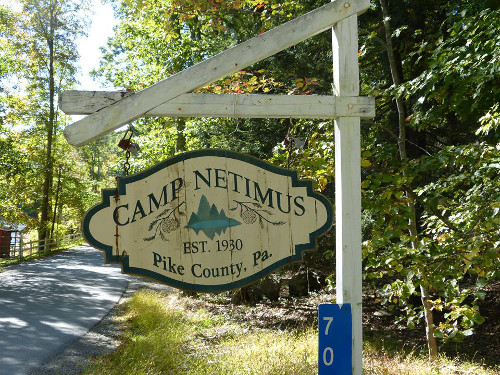
Camp Netimus — site of the ECG. Photo courtesy Krista Carter
Registration for the weekend filled within 20 hours of opening this last spring. Gatherings like this answer an obvious need in the Druid and Pagan community, and more are in the works in other locations. It’s on us to help make them happen. A dedicated team can bring the same joy, support, inspiration and community to other regions.
Yes, we’re all solitaries some or much of the time, but every solitary benefits from celebrating and learning in the company of others. That chance conversation, ritual insight, day- or night-dream, word or phrase that lights up just for you, the hugs you give and receive, the opportunities to serve the community through offering a workshop, cooking, cleaning, organizing, driving — these make Gatherings like this such richly rewarding experiences. The dark and light halves of each year are real, and we need all the help and laughter we can find to thread our way through the labyrinth of time.
/|\ /|\ /|\
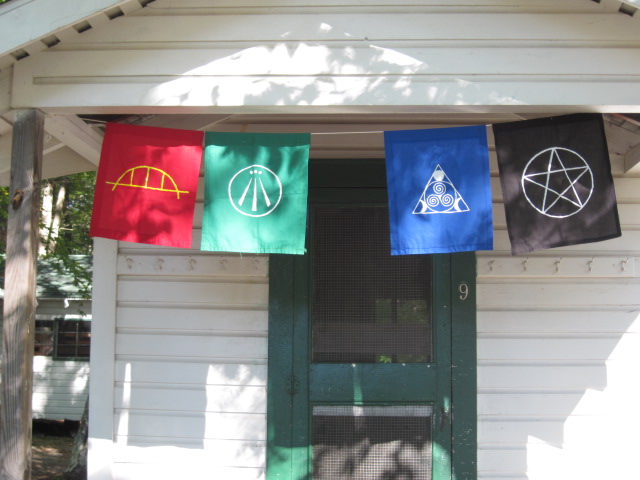
I arrived Thursday afternoon early enough to check in and unpack before the opening ritual. My cabin mates had already hoisted a banner, which also made the building easier to distinguish from the others in the dark, when the “9” on the door was no longer readily visible.
Cabin banner. Photo by A Druid Way
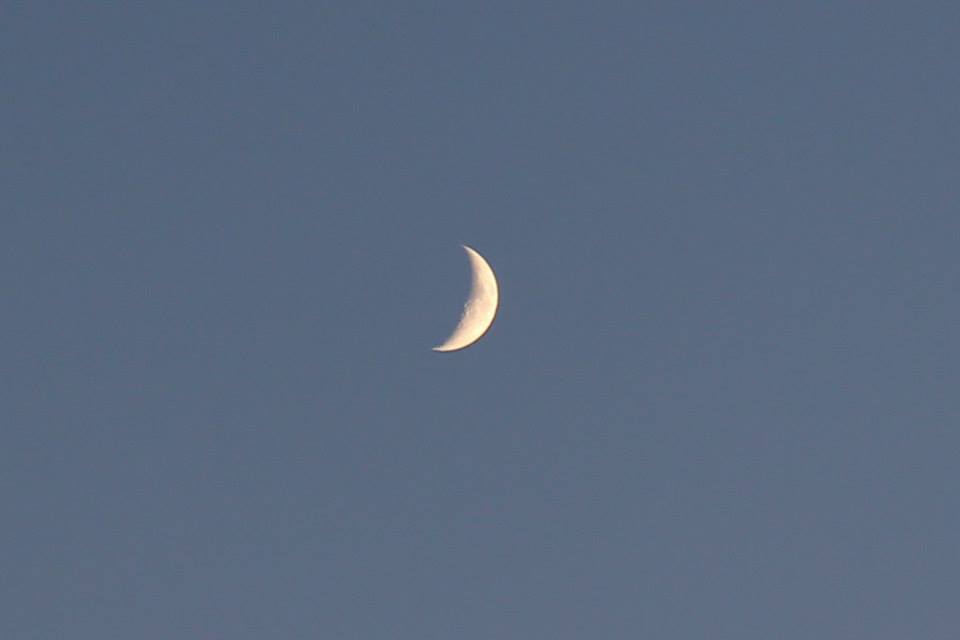
Equinox marks the shifting energies of days and nights, rebalancing the world. A lovely moon bore witness, waxing each evening through wonderfully clear skies, lighting the path to evening events like the Ovate initiation ritual and illuminating the short uphill walk from the cafeteria to the nightly fire circle.
Crescent moon in a twilit sky. Photo courtesy John Beckett
The theme this year was ritual, and the whole weekend focused our attention on its magical possibilities through a dozen workshops, demonstrations and ceremonies. You can get a sense of the range of approaches from the list of workshops here. We also welcomed returning U. K. guests Damh the Bard, Cerri Lee, and Kristoffer Hughes.
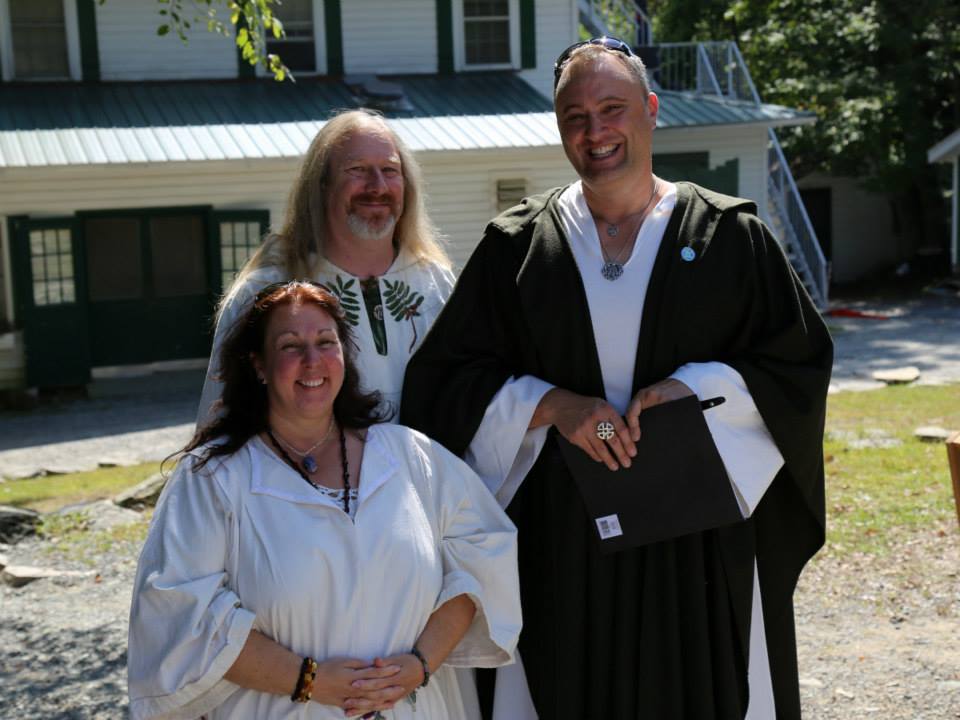
Cerri Lee, Damh the Bard and Kris Hughes. Photo courtesy John Beckett
/|\ /|\ /|\
Damh’s workshop on “The Bardic Voice” underscored the centrality of the Bard in Druidry. Like many Druid groups, OBOD orders its teaching in the sequence of Bard, Ovate and Druid. But they do not form a linear progress or erect a hierarchy of achievement. They spiral. In an Ovate breakout group a day later, several people mentioned how they often return to the Bardic coursework, its insights deepening through their Ovate practice. And likewise with the work of the Druid grade.
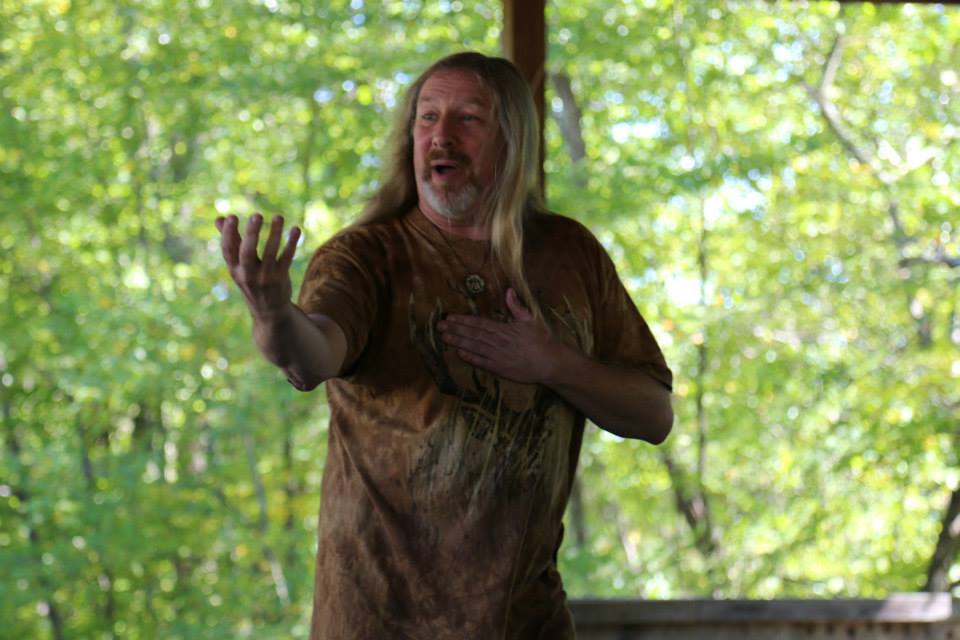
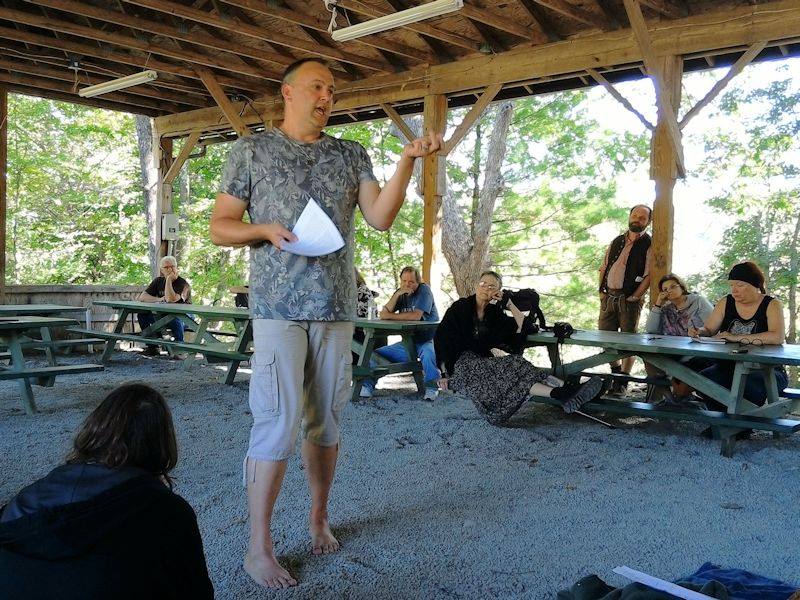
Damh is a fine teacher, an animated storyteller and ritualist of deep experience. With his wife Cerri he leads Anderida Grove. [For an audio inspiration, listen to his hour-long recording for inner journeying here.]
Damh in teaching mode. Photo courtesy John Beckett
/|\ /|\ /|\
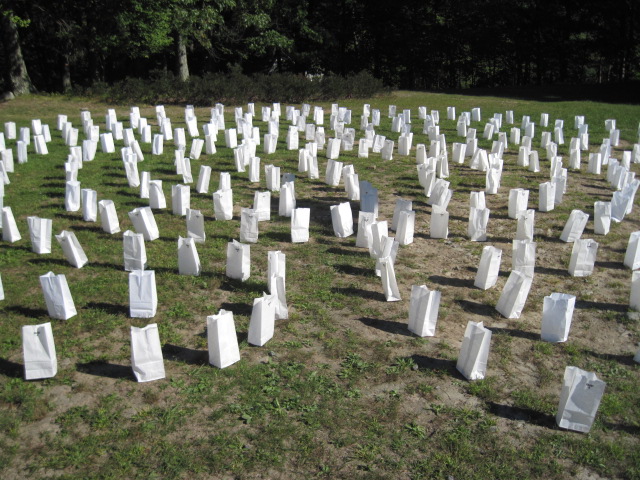
Reminders of ritual possibility filled the weekend. Below is a picture of a labyrinth, another gift of the weekend, lovingly constructed by Cat Hughes and friends.
Labyrinth by day — entrance. Photo by A Druid Way.
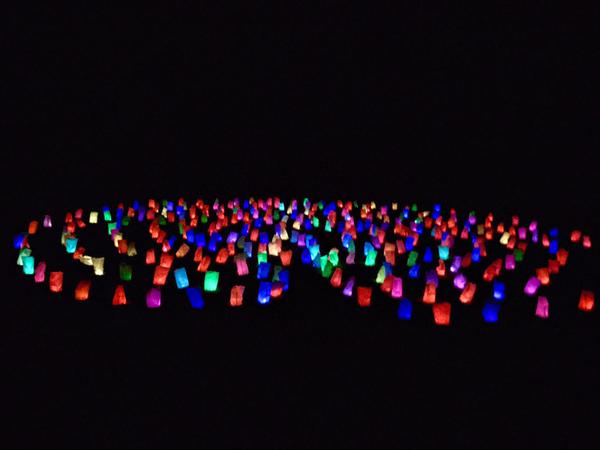
Volunteers switched on each light every evening, then turned them off again when everyone else had gone to bed.
Labyrinth by night. Photo courtesy Damh the Bard.
/|\ /|\ /|\
Kris’s workshop, “Laudanum, Literature and Liturgy — the Ritual Legacy of Iolo Morganwg,” featured the ritual — in Welsh — that Morganwg first performed on the Summer Solstice on Primrose Hill (London) in 1792, launching the Druid Revival and establishing the Welsh Gorsedd of Bards. Morganwg is also the author of the Druid’s Prayer, still used in many modern Druid groups including OBOD, and a major influence on generations of Druids from his time to the present. Kris’s Celtic eloquence in praise of Morganwg and his passion for Druidry took him off script and left many of us with tears in our eyes.
Kris during his workshop on Iolo Morganwg. Photo courtesy of Dana Wiyninger.
/|\ /|\ /|\
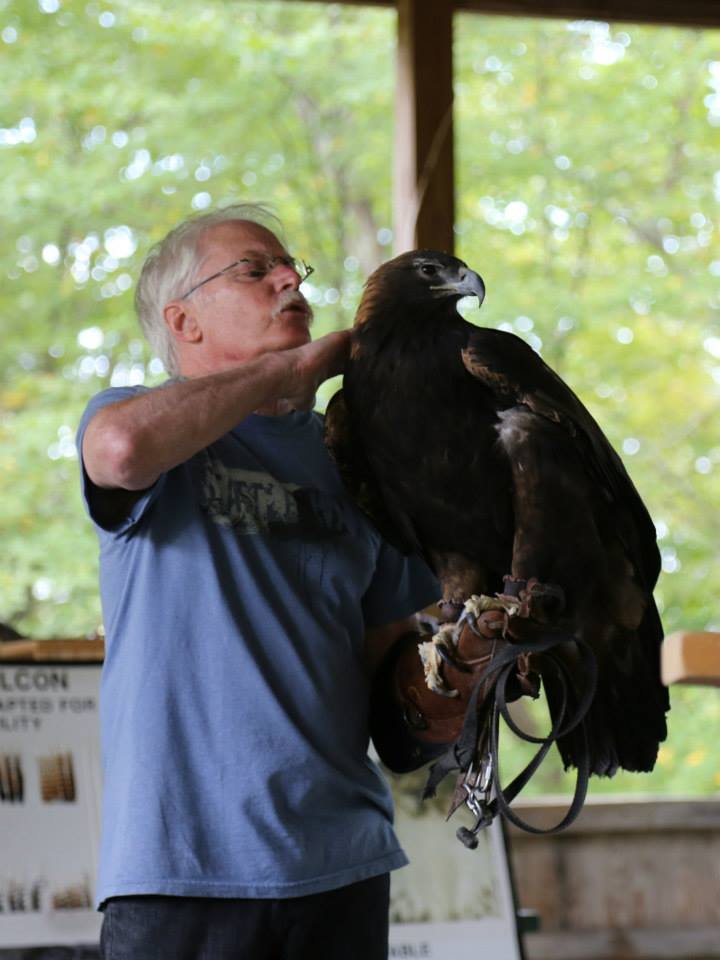
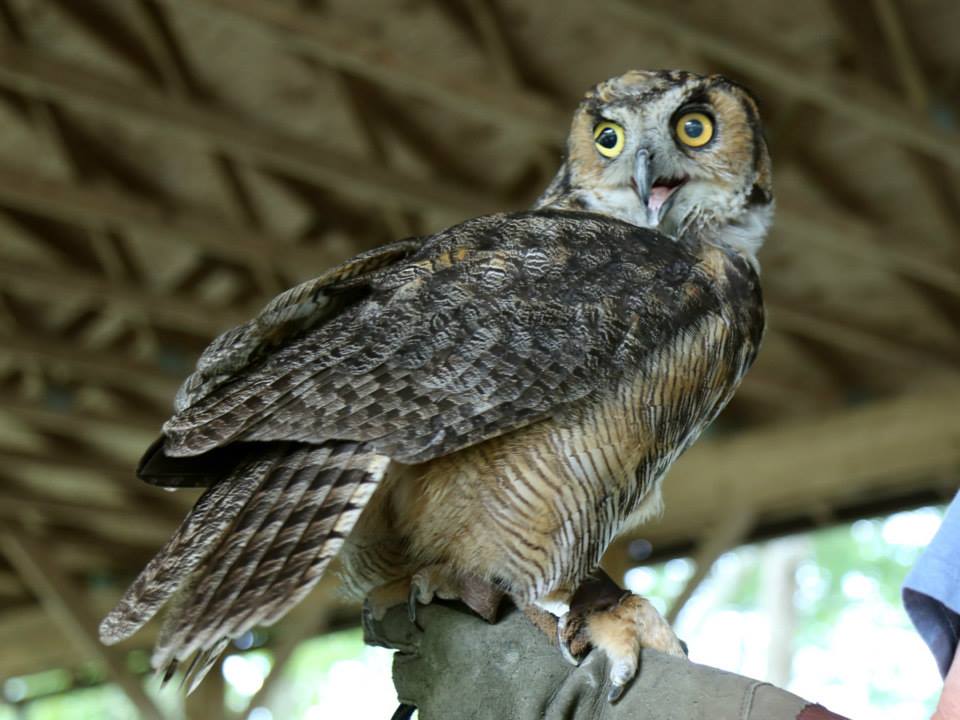
Bill Streeter from the Delaware Valley Raptor Center, the charity designated for this year’s Gathering donation, brought six birds and made a fine presentation on raptors, their abilities, the dangers (mostly human) facing them, and the challenges of rehabilitating injured birds.
Bill Streeter of the DVRC with a golden eagle. Photo courtesy John Beckett.
These magnificent birds have often suffered neurological injuries that worsen over time. Though both the eagle above and the owl below look normal, both are blind in one or both eyes, or suffer other injuries like crippled wings, and thus could not survive in the wild. But the birds help save the lives of their kin through their appearances in info sessions like this one.
Great Horned Owl. Photo courtesy John Beckett.
/|\ /|\ /|\
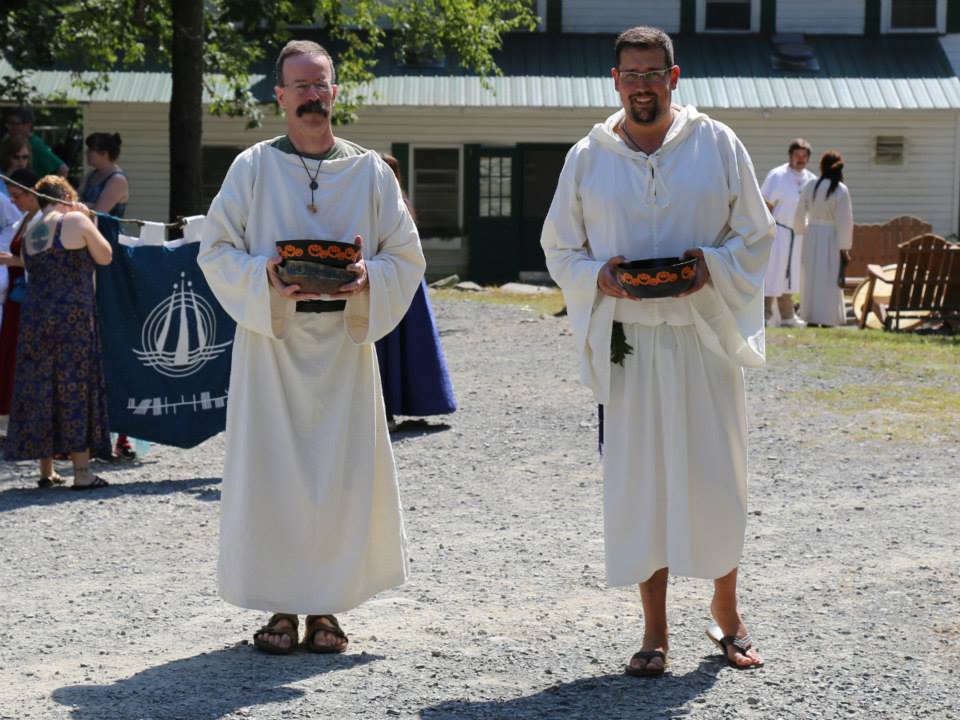
The Alban Elfed ritual celebrating the Equinox includes gifts from children, guests and each of the three grades of Bards, Ovates and Druids. Here are Chris and I holding bowls of acorns, part of the Ovates’ ritual gift, just before the ritual procession into the Circle.
Chris (r) and I (l) just before Alban Elfed ritual. Photo courtesy John Beckett.
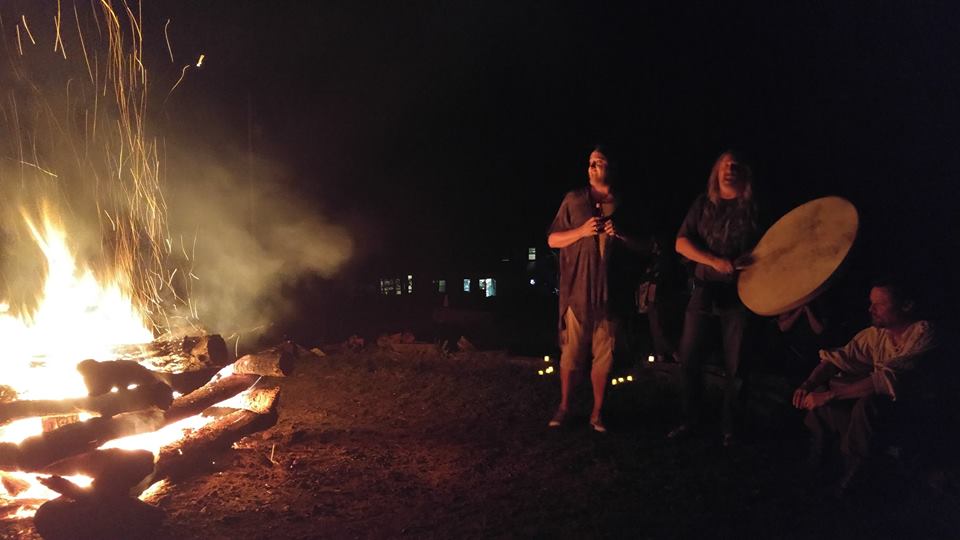
The evening eisteddfod (music and poetry circle) one night featured a splendid duet from Kris and Damh — see the image below.
Kris and Damh singing at the fire circle. Photo courtesy Hex Nottingham.
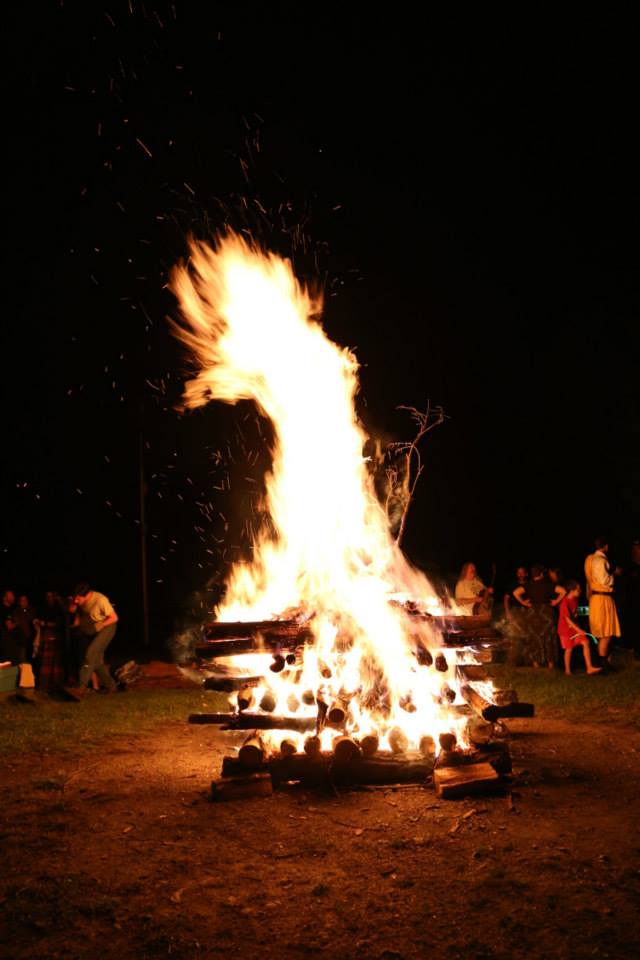
Below is another pic of the fire circle one night. Our enthusiastic and skilful fire-makers Derek and Brom love large, carefully-constructed bonfires.
Evening bonfire. Photo courtesy John Beckett.
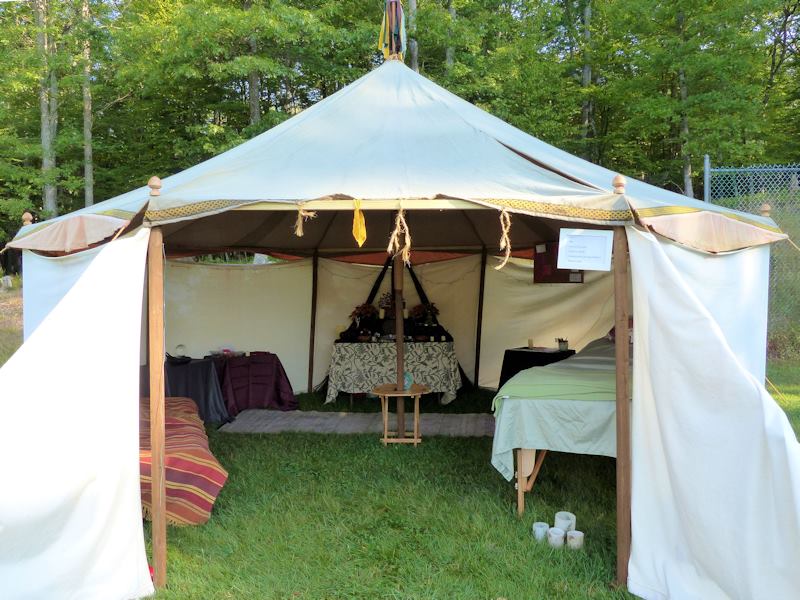
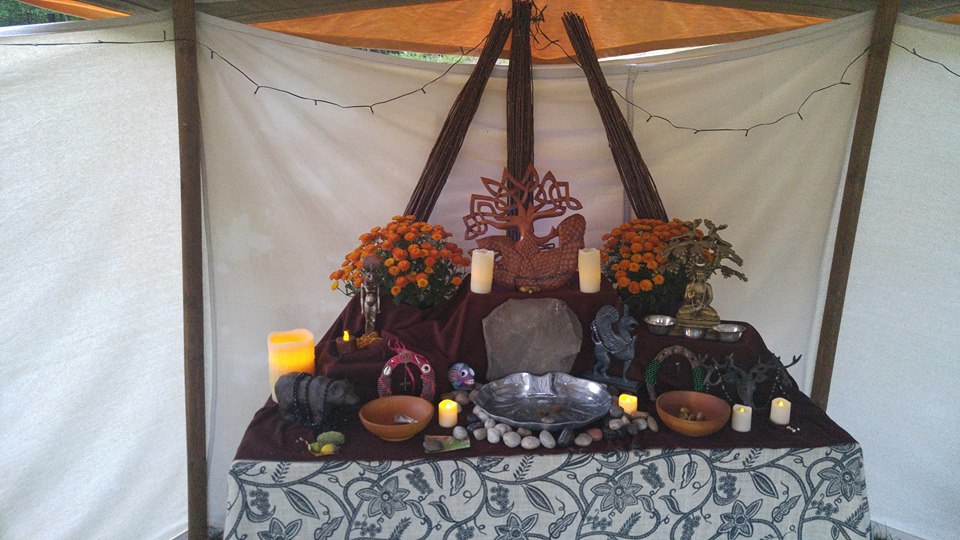
Once again Dana set up her meditation tent on the campground for all to visit and enjoy.
Approaching the tent. Photo courtesy Dana Wiyninger
Altar in Dana’s meditation tent on the camping field. Photo courtesy Hex Nottingham.
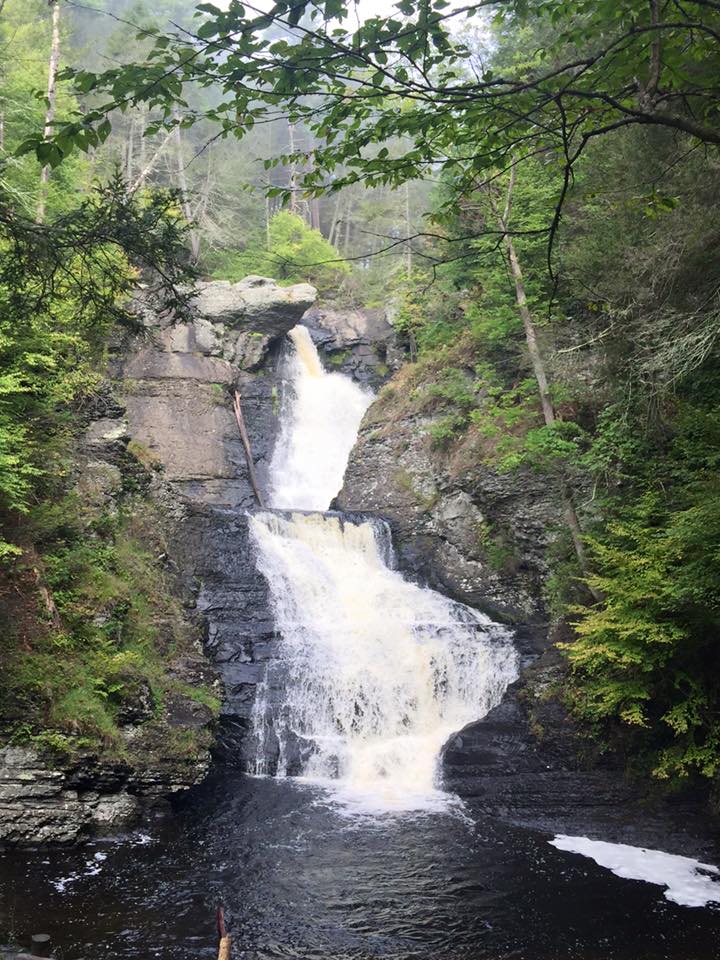
A small group made a side excursion to nearby Raymondskill Falls. Here’s a view of one of the waterfalls.
And for those of us who can’t wait an entire year, the Gulf Coast Gathering will celebrate its second year in March 2016. Blessings of the Equinox to all!
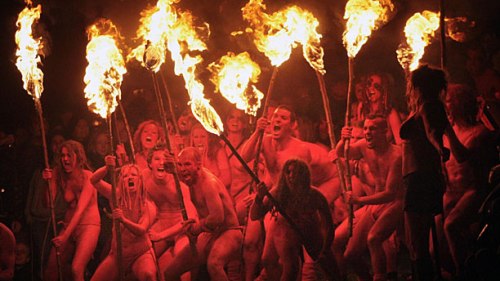
Here we are, about two weeks out from Beltane/May Day — or Samhuinn if you live Down Under in the Southern Hemisphere. And with a Full Moon on May 3, there’s a excellent gathering of “earth events” to work with, if you choose. Thanks to the annual Edinburgh Fire Festival, we once again have Beltane-ish images of the fire energy of this ancient Festival marking the start of Summer.
You may find like I do that Festival energies of the “Great Eight”* kick in at about this range — half a month or so in advance. A nudge, a hint, a restlessness that eases, a tickle that subsides, or shifts toward knowing, with a glance at the calendar. Ah! Here we are again!
For me, that’s regardless of whether I’m involved in any public gathering, or anticipating the time — because it’s never anything as rigid as one single day, but rather an elastic interval — on my own.
Yes, purists may insist on specifics, and calculate their moons and Festivals down to the hour, so as not to miss the supposed peak energies of the time. And if this gives you a psychological boost to know and do this that’s worth the fuss, go for it.
Below is Midnightblueowl’s marvelous painted “Wheel of the Year” (with Beltane at approximately 9 o’clock). With its colors and images, it captures something of the feeling of the Year as we walk it — a human cycle older than religions and civilizations. Or the cycle helped make us human, changing us as we began to notice and acknowledge and celebrate it. Try looking at it both ways, and see what comes of that.
Painted “Wheel of the Year” by Midnightblueowl. Licensed under CC BY-SA 3.0 via Wikimedia Commons
/|\ /|\ /|\
For today I take as divination the message below, which got promptly diverted to the spam folder: “This page decidedly has whole of the information I precious astir this dependent and didn’t make love who to ask.”
O crazy spam-scribe of the ethers, you stumbled onto one of the Great Paradoxes, best stated by William Blake, with his “infinity in the palm of your hand, eternity in an hour.” In that sense, yes: this page “decidedly has whole of the information” though it is also what it is, a finite thing. Like each of us, like the tools we use to connect to What Matters, like the sneaking suspicion that will not go away that there’s Something More. (Even if it’s just an explanation of what’s up with all these capital letters, anyway?)
And since Beltane’s approaching, there is indeed a “precious astir” at work as the energies swirl. Who or what is “dependent”?! The writer of the spam, not knowing “who to ask” and even acknowledging he “didn’t make love.” And all of us, dependent on the earth and each other.
I bless you, oh Visitor to this e-shrine, workshop, journal — the many-selfed thing that blogs can be and become. Who to ask? you inquire. Your inward Guide, always present and waiting for you where you are most true. Or the face of the Guide as it manifests again and again in your life — stranger at the market who smiles at you, bird that catches your eye, tune you find yourself humming.
How to get there, that place we all long for, that colors our thinking and follows and leads us in day- and night-dreams? Place that Festivals and holidays and time and pain and love and living all — sometimes — remind us of? Ah, you mean The Question! Love, gratitude, service — all things any of us can begin today; all things, it’s important to remember, we already do in some measure, or we would die. Too easy? Or you already know that? There’s also ritual — finite, imperfect ritual, our human dance. Mark, O Spirit, and hear us now, confirming this our sacred vow …
What’s your sacred vow? Don’t know yet? Got some work to do? Tune in to the next post for more.
*The “Great Eight” yearly festivals with their OBOD names: Imbolc, Alban Eilir/Spring Equinox, Bealteinne, Alban Hefin/Summer Solstice, Lughnasadh, Alban Elfed/Autumn Equinox, Samhuinn, Alban Arthan/Winter Solstice. Many alternate names exist, and almost every one has a Christian festival on or near it, too.
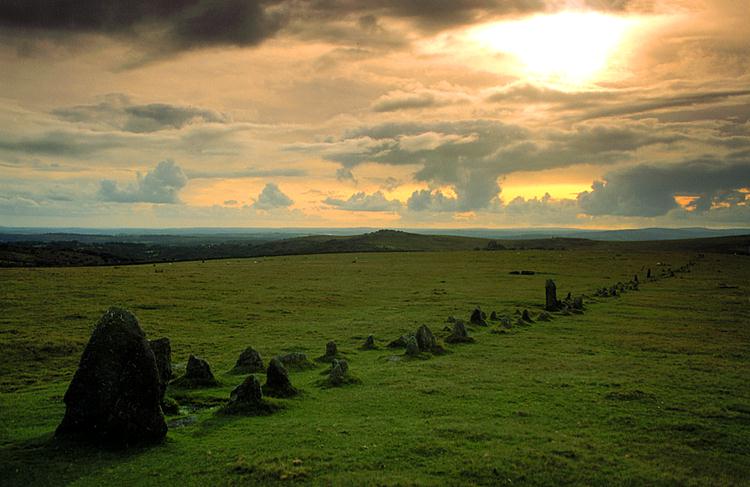
Anciently, Ireland was known as Inis Fail, the Isle of the Lia Fail, the Stone of Fal from the magical city of Falias and the Goddess Danu, one of the Four Hallows of Ireland, also called the Stone of Destiny, which roared when a true king sat or stood upon it. The Isle of Britain was called Clas Myrddin, Merlin’s Enclosure, and continuing the island theme, its holy and magical city Glastonbury was Ynys Witrin, the Isle of Glass. Such lore can indeed take you some way along a path, the names themselves an invocation as magical as any.
Merrivale Stone Rows, Devon
Outside of Britain we may well long for our own mythological names, gestures of respect and power toward the spirits of the land, honoring them with noble names, and opening doorways. Yes, by borrowing for an interval a tongue from across the Water and bowing to our ancestors of spirit from there, we could do worse than call North America by one of its native names, Turtle Island, rendering it in Welsh: Ynys Crwban. Old tongue, New World. But the spirits here aren’t Welsh, and they’re wilder, and steeped in their own ways and works.
Still, Earth and Stone are North, and Winter, and Night. I sit and calm myself, finding the Pole Star in inner sight. The sky’s too cloudy for it outwardly, with a light snow falling most of the day and into the evening. I do a private ritual, and then in vision I’m drawn toward a stone circle. But instead of the broad windswept Salisbury Plain, and the great Henge there that all know, I’m given to see a different circle. Here the stones set their feet deeper, cradled in earth. The place feels both older and more intimate. The lintels stand just chest-high, low enough I can see over their tops and into the circle, which is some twenty feet across.
Vision wavers for a moment. Briefly I’m back and conscious of the room. Yes, I sit here in Vermont, just feet from snowdrifts outside the window, but in vision rough gray stones rise from a green cloak of moss that more than half-covers them. I’m there again. To enter the circle I have to go down on all fours and crawl through the space between two uprights and a heavy lintel. My palms and legs rub against the cool dampness. The rich chocolate scent of earth fills my nose — leaf-rot, moss, lichen, chlorophyll — the planet’s kitchen working, working endlessly. Each pace forward and I move over lives too small to see unaided. But they’re still here. Then I’m inside. I begin to sense an invisible dome overhead, a kind of presence shaping the space. The stones hum just below hearing, holy engines, the sound stillness makes, not empty at all.
Suddenly needing their strength I rise to my knees and hug an upright stone, its cool solidity reassuring against my arms and cheek and chest. With that, the welcome surges through me. You’re here, you’re here, we say to each other. In that instant I don’t worry who or what I’m talking to, only that we’re glad to be together — together again. This is not the first time for any of us. I spin in a half-dance, half-frenzy, soon enough falling dizzily to the ground. Wetness on my face — rain, tears, I’m not sure which. Both. I am earthed, spent, embraced, recharged, home.
A log shifts in the stove in the next room and brings me back. Now is the hour of recall, goes the line from OBOD ritual. The Circle in the vision is real enough it’s got me wondering if it exists on this plane. The thought comes Build it so it does. I sit with that impression a while longer, trying to absorb the implications for this vision and others. Build it so it exists on this plane.
/|\ /|\ /|\
The Piccolo San Bernardo Circle in Val d’Aosta, Italy, straddles the French-Italian border in a mountain pass at about 2000 meters. The circle appears for only a few weeks each year, when the snows recede enough to reveal the stones. The ancient Roman satirist Petronius appears to refer to it and remarks, “Winter covers it with a persistent snow and it raises its white head to the stars.” This seemed a fitting image to close with for the solstice in the North. What will manifest in our circles, when the circles themselves lie half-hidden to our sight?
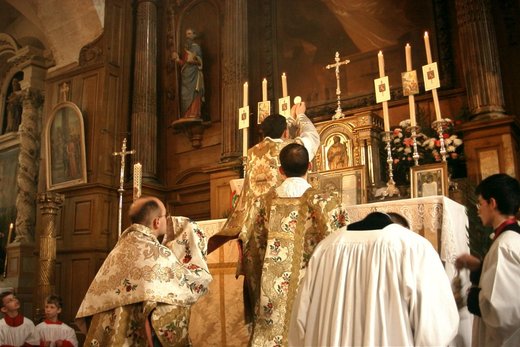
Many spiritual and religious traditions feature a special language used for ritual purposes. The most visible example in the West is Latin. The Latin Mass remains popular, and though the mid-1960s reforms of Vatican II allowed the use of local vernacular languages for worship, they never prohibited Latin. For some Catholics, the use of vernacular reduced the mystery, the beauty and ultimately, in some sense, the sacredness of the rites. If you visit an Orthodox Christian or Jewish service, you may encounter other languages. Within an hour’s drive of my house in southern Vermont, you can encounter Greek, Hebrew, Russian, Arabic and Tibetan used in prayer and ritual.
Language as Sacrament
The heightened language characteristic of ritual, such as prayer and chant, can be a powerful shaper of consciousness. The 5-minute VedicSanskrit video below can begin to approximate for one watching it a worship experience of sound and image and sensory engagement that transcends mere linguistic meaning. The rhythmic chanting, the ritual fire, the sacrificial gathering, the flowers and other sacred offerings, the memory of past rituals, the complex network of many kinds of meaning all join to form a potentially powerful ritual experience. What the ritual “means” is only partly mediated by the significance of the words. Language used in ritual in such ways transcends verbal meaning and becomes Word — sacrament as language, language as sacrament — a way of manifesting, expressing, reaching, participating in the holy.
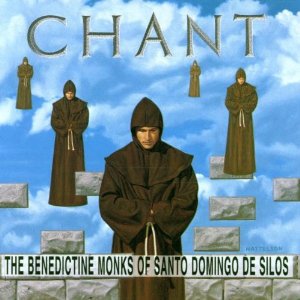
And depending on your age and attention at the time, you may recall the renewed popularity of Gregorian chant starting two decades ago in 1994, starting with the simply-titled Chant, a collection by a group of Benedictines.
Issues with Ritual Language
One great challenge is to keep ritual and worship accessible. Does the experience of mystery and holiness need, or benefit from, the aid of a special ritual language? Do mystery and holiness deserve such language as one sign of respect we can offer? Should we expect to learn a new language, or special form of our own language, as part of our dedication and worship? Is hearing and being sacramentally influenced by the language enough, even if we don’t “understand” it? These aren’t always easy questions to answer.
“The King’s English”
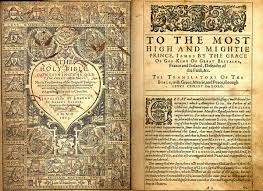
For English-speaking Christians and for educated speakers of English in general, the King James Bible* continues to exert remarkable influence more than 400 years after its publication in 1611. What is now the early modern English grammar and vocabulary of Elizabethan England, in the minds of many, contribute to the “majesty of the language,” setting it apart from daily speech in powerful and useful ways. Think of the Lord’s Prayer, with its “thy” and “thine” and “lead us not”: the rhythms of liturgical — in this case, older — English are part of modern Christian worship for many, though more recent translations have also made their way into common use. A surprising number of people make decisions on which religious community to join on the basis of what language(s) are, or aren’t, used in worship.
Druid and Pagan Practice
When it comes to Druid practice (and Pagan practice more generally), attitudes toward special language, like attitudes towards much else, vary considerably. Some find anything that excludes full participation in ritual to be an unnecessary obstacle to be avoided. Of course, the same argument can be made for almost any aspect of Druid practice, or spiritual practice in general. Does the form of any rite inevitably exclude, if it doesn’t speak to all potential participants? If I consider my individual practice, it thrives in part because of improvisation, personal preference and spontaneity. It’s tailor-made for me, open to inspiration at the moment, though still shaped by group experience and the forms of OBOD ritual I have both studied and participated in. Is that exclusionary?
Ritual Primers
Unless they’re Catholic or particularly “high”-church Anglican/Episcopalian, many Westerners, including aspiring Druids, are often unacquainted with ritual. What is it? Why do it? How should or can you do it? What options are there? ADF offers some helpful guidance about ritual more generally in their Druid Ritual Primer page. The observations there are well worth reflecting on, if only to clarify your own sensibility and ideas. To sum up the first part all too quickly: Anyone can worship without clergy. That said, clergy often are the ones who show up! In a world of time and space, ritual has basic limits, like size and start time. Ignore them and the ritual fails, at least for you. Change, even or especially in ritual, is good and healthy. However, “With all this change everyone must still be on the same sheet of music.” As with so much else, what you get from ritual depends on what you give. And finally, people can and will make mistakes. In other words, there’s no “perfect” ritual — or perfect ritualists, either.
(Re)Inventing Ritual Wheels
Let me cite another specific example for illustration, to get at some of these issues in a slightly different way. In the recent Druidcast 82 interview, host Damh the Bard interviews OBOD’s Chosen Chief, Philip Carr-Gomm, who notes that some OBOD-trained Druids seem compelled to write their own liturgies rather than use OBOD rites and language. While he notes that “hiving off” from an existing group is natural and healthy, he asks why we shouldn’t retain beautiful language where it already exists. He also observes that Druidry appeals to many because it coincides with a widespread human tendency in this present period to seek out simplicity. This quest for simplicity has ritual consequences, one of which is that such Druidry can also help to heal the Pagan and Non-Pagan divide by not excluding the Christian Druid or Buddhist Druid, who can join rituals and rub shoulders with their “hard polytheist” and atheist brothers and sisters. (Yes, more exclusionary forms of Druidry do exist, as they do in any human endeavor, but thankfully they aren’t the mainstream.)
About this attitude towards what in other posts I’ve termed OGRELD, a belief in “One Genuine Real Live Druidry,” Carr-Gomm notes, “The idea that you can’t mix practices from different sources or traditions comes from an erroneous idea of purity.” Yes, we should be mindful of cultural appropriation. Of course, as he continues, “Every path is a mixture already … To quote Ronald Hutton, mention purity and ‘you can hear the sound of jackboots and smell the disinfectant.'” An obsession with that elusive One Genuine Real Live Whatever often misses present possibilities for some mythical, fundamentalist Other-time Neverland and Perfect Practice Pleasing to The Powers-That-Be. That said, “there arecertain combinations that don’t work.” But these are better found out in practice than prescribed (or proscribed) up front, out of dogma rather than experience. In Druidry there’s a “recognition that there is an essence that we share,” which includes a common core of practices and values.
As a result, to give another instance, Carr-Gomm says, “If you take Druidry and Wicca, some people love to combine them and find they fit rather well together,” resulting in practices like Druidcraft. After all, boxes are for things, not people. Damh the Bard concurs at that point in the interview, asserting that, “To say you can’t [mix or combine elements] is a fake boundary.”
Yet facing this openness and Universalist tendency in much modern Druidry is the challenge of particularity. When I practice Druidry, it’s myexperience last week, yesterday and tomorrow of the smell of sage smoke, the taste of mead, wine or apple juice, the sounds of drums, song, chant, the feel of wind or sun or rain on my face, the presence of others or Others, Spirit, awen, the god(s) in the rite. The Druid order ADF, after all, is named Ár nDraíocht Féin — the three initials often rendered in English as “A Druid Fellowship” but literally meaning “Our Own Druidry” in Gaelic.
A Human Undersong
Where to go from here? Carr-Gomm notes what Henry David Thoreau called an “undersong” inside all of us, underlying experience. “We sense intuitively that there’s this undersong,” says Carr-Gomm. “It’s your song, inside you. The Order and the course and the trainings [of groups like OBOD] — it’s all about helping you to find that song. It’s universal.” As humans we usually strive to increase such access-points to the universal whenever historical, political and cultural conditions are favorable, as they have been for the last several decades in the West.
Paradoxes of Particularity
Yet the point remains that each of us finds such access in the particulars of our experience. (Christians call it the “scandal of particularity”; in their case, the difficulty of their doctrine that one being, Jesus, is the sole saviour for all people — the single manifestation of the divine available to us.**) And the use of heightened ritual language can be one of those “particulars,” a doorway that can also admittedly exclude, an especially powerful access point, because even ordinary language mediates so much human reality. We quite literally say who and what we are. The stroke victim who cannot speak or speaks only with difficulty, the aphasic, the abused and isolated child who never acquires language beyond rudimentary words or gestures, the foreigner who never learns the local tongue — all demonstrate the degree to which the presence or absence of language enfolds us in or excludes us from human community and culture. And that includes spirituality, where — side by side with art and music — we are at our most human in every sense.
In the second post in this series, I’ll shift modes, moving from the context I’ve begun to outline here, and look at some specific candidates for a DRL — a Druidic Ritual Language.
*Go here for a higher-resolution image of the title page of the first King James Bible pictured above.
**In a 2012 post, Patheos blogger Tim Suttle quotes Franciscan friar and Father Richard Rohr at length on the force of particularity in a Christian context. If Christian imagery and language still work for you at all, you may find his words useful and inspiring. Wonder is at the heart of it. Here Rohr talks about Christmas, incarnation and access to the divine in Christian terms, but pointing to an encounter with the holy — the transforming experience behind why people seek out the holy in the first place:
A human woman is the mother of God, and God is the son of a human mother!
Do we have any idea what this sentence means, or what it might imply? Is it really true? If it is, then we are living in an entirely different universe than we imagine, or even can imagine. If the major division between Creator and creature can be overcome, then all others can be overcome too. To paraphrase Oswald Chambers “this is a truth that dumbly struggles in us for utterance!” It is too much to be true and too good to be true. So we can only resort to metaphors, images, poets, music, and artists of every stripe.
I have long felt that Christmas is a feast which is largely celebrating humanity’s unconscious desire and goal. Its meaning is too much for the rational mind to process, so God graciously puts this Big Truth on a small stage so that we can wrap our mind and heart around it over time. No philosopher would dare to imagine “the materialization of God,” so we are just presented with a very human image of a poor woman and her husband with a newly born child. (I am told that the Madonna is by far the most painted image in Western civilization. It heals all mothers and all children of mothers, if we can only look deeply and softly.)
Pope Benedict, who addressed 250 artists in the Sistine Chapel before Michelangelo’s half-naked and often grotesque images, said quite brilliantly, “An essential function of genuine beauty is that it gives humanity a healthy shock!” And then he went on to quote Simone Weil who said that “Beauty is the experimental proof that incarnation is in fact possible.” Today is our beautiful feast of a possible and even probable Incarnation!
If there is one moment of beauty, then beauty can indeed exist on this earth. If there is one true moment of full Incarnation, then why not Incarnation everywhere? The beauty of this day is enough healthy shock for a lifetime, which leaves us all dumbly struggling for utterance.
[Related posts: Shinto & Shrine Druidry 1 | 2 | 3 || Shinto — Way of the Gods || Renewing the Shrine 1 | 2 || My Shinto 1 | 2 ]
What is it about renewal? We need and long for it, desperately, a hunger nothing else can satisfy, though we try to fill it with things rather than with actual transformation. Too often we get cynical when hopes and dreams don’t pan out. I saw a fair amount of this, sadly, in the adolescents I worked with as a high school teacher. Of course, some of it was learned from adults. Renewal and revitalization can seem remote, hard to access. Too often we mock the sentimentalist and the optimist for living in “another world.” Maybe that’s partly because we know deep down that the renewal we need is in this one.
In Part One I wrote about the Japanese Shinto practice of Shikinen Sengu, a ceremony that occurs every twenty years, in which the most important shrine in Japan, at Ise Jingu, is ritually rebuilt and renewed. The biggest shrine most of us have is our homes, where we erect a mirror for our lives by our choice of partners, children, pets, clothing, furnishings, beloved objects and spaces. So a ceremony in a foreign country, and one focusing on a foreign spiritual practice on top of that, may seem like a backwards way, to say no more, of getting at anything important or useful to say about living life in 21st century America. But bear with me.
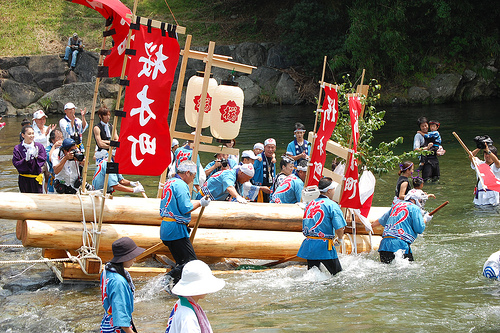
Here wood for the new shrine is floated down the Isuzu River toward the site:
When we hear words like ‘globalization’ we may not realize how dramatic the changes have actually been, since we simply live through many of them in some form, often unawares. To give just one local example, the recent decision to close our nuclear plant, Vermont Yankee, was driven by economic forces more than anything else, but among those were the mounting costs of meeting a tightening of regulations by the Nuclear Regulatory Commission, in response to the disaster at the Fukushima nuclear plant in Japan following the tsunami two years ago. Our lives are already linked to those of many others we will never meet. Globalization isn’t a choice, it’s a phenomenon like the seasons — it’s part of living on earth in this era. We’re neighbors already — distances between us collapse to nothing.
The Roman writer Terence (Terentius) captures something of this in one of his plays with the wonderfully opaque title Heauton Timoroumenos, which can be translated as the “The Self-Tormentor.” In this short excerpt*, two country neighbors, Menedemus and Chremes, speak candidly to each other:
MENEDEMUS: Chremes, can you spare a moment from your own affairs to listen to someone else’s–even if they don’t really concern you?
CHREMES: I’m human, so any human interest is my concern. Call it solicitude or curiosity on my part, whichever you like. If you’re right I’ll copy you, and if you’re wrong I’ll try to make you mend your ways.
Where am I going with all this? Chremes’ attitude is a valuable one, if we’re to thrive. If I can learn something useful from Shinto, even from a crazy ceremony that rebuilds a perfectly good building right next door, I’ll try to pay attention and learn. Notice Chremes isn’t forfeiting his own judgment. In love with its own exceptionalism, America sometimes seems preoccupied with the second half of Chremes’ response: “if you’re wrong I’ll try to make you mend your ways” — while ignoring the possibility that the former might also be occasionally worthwhile: “If you’re right I’ll copy you.”
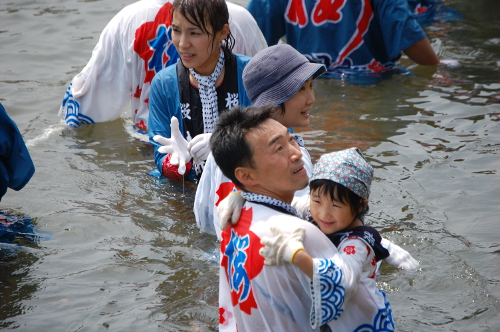
Shikinen Sengu is a family affair. Occurring as it does every two decades, the ceremony happens three to four times in the average person’s lifespan.
Another aspect of the Shikinen Sengu ceremony deserving mention is its “greenness.” In a footnote, the JNTO brochure I cited in Part One observes:
Many trees are felled in preparation for each Shikinen Sengu. These logs are carefully selected and then transported to the reconstruction site at Ise, where new life is endowed to the logs. Young trees are carefully planted to replace those fallen in order to perpetuate the forest. The timbers removed when the Shrine is rebuilt are distributed to shrines throughout Japan, where they are reused, particularly to disaster or earthquake-stricken regions. Some of the sacrificial offerings and other contents of the shrine are also distributed among other shrines. Following the 61st Shikinen Sengu, lumber and contents of the Shrine were distributed among 169 shrines throughout Japan.
In Shinto as in Druidry, spirituality is life — there’s no separation. What we do to maintain our connection with Spirit is what we do already as humans in living fully and well. Here’s how the Japanese themselves talk about the ceremony:
As food, clothing and shelter form the requisites of our life, we have to prepare similar requisites for the kami, if we wish to receive blessings from them. Therefore, the ceremony of the Shikinen Sengu includes the renewal of buildings (shelter) as well as the renewal of the treasures (clothing) and the offering of first fruits (food). By performing the Shikinen Sengu, we renew our minds by remembering that our ancestors had enshrined Amaterasu Omikami in Ise, and praying that the Emperor will live long, and that peace will prevail in Japan and the world. It also involves the wish that Japanese traditional culture should be transmitted to the next generation. The renewal of the buildings and of the treasures has been conducted in the same traditional way ever since the first Shikinen Sengu had been performed 1300 years ago. The scientific development makes manual technology obsolete in some fields. However, by performing the Shikinen Sengu, traditional technologies are preserved.
Ritual and ceremony still have important roles to play in keeping us balanced, connected and mindful of our heritage. Even more, ritual and ceremony remind us of our place in this world, as beings who share a planet with so many others. This is one way to understand the Japanese kami or spirit: not so much separate things or “gods” as they are personifications of the profound links we share with the world and the other beings in it. The links exist, and deserve our acknowledgement. Our culture has dispensed with much former ritual, not always to the bettering of our Western lives. We need the connections that ritual can help us form and maintain, and which help nourish and sustain us.
Of course, families usually make their own traditions and rituals instinctively, regardless of what the larger culture is doing. It’s the start of football season, and how many families do you know who have special recipes, traditions, gatherings, rites to celebrate their favorite teams and the hours of television ahead? We do ritual because we’re human. The old ceremonies that no longer hold meaning or value need to be updated, renewed, or replaced with others — but not abandoned, any more than we abandon our humanness merely because one way of being human needs refreshing, renewing or transforming. To do otherwise means living stunted, incomplete lives.
Here’s one of my favorite poems by the late William Stafford which addresses this human need for connection, renewal and watchfulness vividly:
A Ritual to Read to Each Other
If you don’t know the kind of person I am
and I don’t know the kind of person you are
a pattern that others made may prevail in the world
and following the wrong god home we may miss our star.
For there is many a small betrayal in the mind,
a shrug that lets the fragile sequence break
sending with shouts the horrible errors of childhood
storming out to play through the broken dyke.
And as elephants parade holding each elephant’s tail,
but if one wanders the circus won’t find the park,
I call it cruel and maybe the root of all cruelty
to know what occurs but not recognize the fact.
And so I appeal to a voice, to something shadowy,
a remote important region in all who talk:
though we could fool each other, we should consider–
lest the parade of our mutual life get lost in the dark.
For it is important that awake people be awake,
or a breaking line may discourage them back to sleep;
the signals we give–yes or no, or maybe–
should be clear: the darkness around us is deep.
Some teachings run you through their rituals.
Find your own way – individuals
know what works beyond the shown way:
try out drinking with the Ancestors.
Chat ‘em up — don’t merely greet ‘em;
such rites are chummy: do more than meet ’em.
(Spend your weekends with a mummy?)
But I like drinking with my Ancestors.
Another round of pints and glasses
will have us falling on our asses.
Leave off ritual when they’re calling —
you’ll be drinking with your Ancestors.
By and with the spirits near us —
“Don’t invoke us if you fear us” —
good advice: if you lose focus
though you’re drinking with your Ancestors,
in the morning you’ll be uncertain
if you just dreamed or drew the curtain
on some world where it more than seemed
that you were drinking with your Ancestors.
Alcohol works its own magic,
and not all good – it’s downright tragic
if you’re just hung over from what could
have been you drinking with your Ancestors.
They come in all shapes, and in all sizes:
some are heroes, some no prizes
(they’re like us in all our guises).
Listen: they are singing, they are cussing,
they can advise us if we’re fussing
over where our lives might go
or put on a ghostly show.
We’re the upshot, on the down low.
We’re the payoff, crown and fruit
(we got their genetic trash, and loot),
we’re their future – “build to suit.”
So start drinking with your ancestors.
* * *
Ancestor “worship” is sometimes a misnomer, though not always — some cultures do in fact pray to, propitiate and appease the spirits of the ancestral dead in ways indistinguishable from worship. But others acknowledge what is simply fact — an awful lot (the simple fact that we’re here means our ancestors for the most part aren’t literally “an awful lot”) of people stand in line behind us. Their lives lead directly to our own. With the advent of photography it’s become possible to see images beyond the three- or four-generation remove that usually binds us to our immediate forebears. I’m lucky to have a Civil War photo of my great-great grandfather, taken when he was about my age, in his early fifties. In the way of generations past, he looks older than that, face seamed and thinned and worn.
The faces of our ancestral dead are often rightfully spooky. We carry their genetics, of course, and often enough a distant echo of their family traditions, rhythms, expectations, and stories in our own lives — a composite of “stuff,” of excellences and limitations, that can qualify as karma in its most literal sense: both the action and the results of doing. But more than that, in the peculiar way of images, the light frozen there on the photograph in patches of bright and dark is some of the purest magic we have. My great-great-grandfather James looks out toward some indeterminate distance — and in the moment of the photo, time — and that moment is now oddly immortal. Who knows if it was one of his better days? He posed for a photo, and no doubt had other things on his mind at the time, as we all do. We are rarely completely present for whatever we’re doing, instead always on to the next thing, or caught up in the past, wondering why that dog keeps barking somewhere in the background, wondering what’s for dinner, what tomorrow will bring, whether any of our hopes and ambitions and worries justify the energy we pour into them so recklessly.
And I sit here gazing at that photo, or summoning his image from what is now visual memory of the photo, as if I met him, which in some way I now have. Time stamps our lives onto our faces and here is his face. No Botox for him. Every line and crease is his from simply living. And around him in my imagination I can pose him with his spouse and children (among them my great-grandfather William) and parents, and so on, back as far — almost unimaginably far — as we are human. Fifty thousand years? Two hundred thousand? A million? Yes, by the time that strain reaches me it’s a ridiculously thin trickle. But then, if we look back far enough for the connection, it’s the same trickle, so we’re told, that flows in the veins of millions of others around us. If we can trust the work of evolutionary biologists and geneticists, a very large number of people alive on the planet today descend from a relative handful of ultimate ancestors. Which seems at first glance to fly in the face of our instinct and of simple mathematics, for that spreading tree of ancestors which, by the time it reaches my great-great-grandfather’s generation, includes thirty people directly responsible for my existence (two parents, four grandparents, eight great-grandparents and sixteen great-great grandparents). Someone called evolution the “ultimate game of survivor.” And now I break off one line, stalling forever this one particular evolutionary parade, because my wife and I have no children.
The poem of mine that opened this entry, “Drinking with the Ancestors,” suggests we can indeed meet and take counsel with members of this immense throng through the exercise of inhibition-lowering and imagination-freeing imbibing of alcohol. Of course there are also visualization exercises and still other techniques that are suitably alcohol-free — more decorous and tame. Depending on who you want to talk to among your clan, you can have an experience as real as most face-to-face talks with people who have skin on. The difference between us in-carnate and ex-carnate folks is indeed the carne. No sudden dispensation of wisdom automatically accrues to us just because we croak. A living idiot becomes a dead idiot. Likewise a wise soul is wise, in or out of flesh.
It seems fitting to end with an experience of the ancestors. Not mine, this time — I keep such things close, because often when we experience them, they are for us alone, and retain their significance and power only if we do not diminish them by laying them out for others who may know nothing of our circumstances and experiences. Wisdom is not a majority vote. Even my wife and I may not share certain inner discoveries. We’ve both learned the hard way that some experiences are for ourselves alone. But it’s a judgment call. Some things I share.
So in my place I give you Mary Stewart’s Merlin, in her novel The Hollow Hills*, recounting his quest for Excalibur, and an ancestor dream-vision that slides into waking. The flavor of it captures one way such an ancestral encounter can go, the opposite end of the easy beery camaraderie that can issue from making the libations that welcome ancestral spirits to a festival or party, as in my poem. Note the transition to daytime consciousness, the thin edge of difference between dream and waking.
I said “Father? Sir?” but, as sometimes happens in dreams, I could make no sound. But he looked up. There were no eyes under the peak of the helmet. The hands that held the sword were the hands of a skeleton … He held the sword out to me. A voice that was not my father’s said, “Take it.” It was not a ghost’s voice, or the voice of bidding that comes with vision. I have heard these, and there is no blood in them; it is as if the wind breathed through an empty horn. This was a man’s voice, deep and abrupt and accustomed to command, with a rough edge to it, such as comes from anger, or sometimes from drunkenness; or sometimes, as now, from fatigue.
I tried to move, but I could not, any more than I could speak. I have never feared a spirit, but I feared this man. From the blank of shadow below the helmet came the voice again, grim, and with a faint amusement, that crept along my skin like the brush of a wolf’s pelt felt in the dark. My breath stopped and my skin shivered. He said, and I now clearly heard the weariness in the voice: “You need not fear me. Nor should you fear the sword. I am not your father, but you are my seed. Take it, Merlinus Ambrosius. You will find no rest until you do.”
I approached him. The fire had dwindled, and it was almost dark. I put my hands out for the sword and he reached to lay it across them … As the sword left his grip it fell, through his hands and through mine, and between us to the ground. I knelt, groping in the darkness, but my hand met nothing. I could feel his breath above me, warm as a living man’s, and his cloak brushed my cheek. I heard him say: “Find it. There is no one else who can find it.” Then my eyes were open and it was full noon, and the strawberry mare was nuzzling at me where I lay, with her mane brushing my face (226-7).
/|\ /|\ /|\
*Stewart, Mary. The Hollow Hills. New York: Fawcett Crest Books, 1974.
An altar is an important element of very many spiritualities around the world. It gives a structure to space, and orients the practitioner, the worshipper, the participant (and any observers) to objects, symbols and energies. It’s a spiritual signpost, a landmark for identifying and entering sacred space. It accomplishes this without words, simply by existing. The red color of the Taoist altar below immediately alerts the eye to its importance and energy.
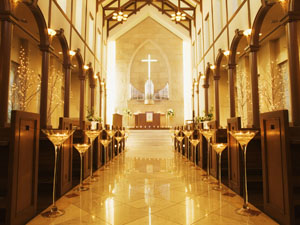
As a center of ritual action and visual attention, an altar is positioned to draw the eye as much as any other sense. In Christian churches like the one below, everything is subordinated to the Cross and the altar immediately below it. Church architecture typically highlights this focus through symmetry and lighting. But in every case, enter the sacred space which an altar delineates, and it tells you what matters by how it is shaped and ordered and organized.
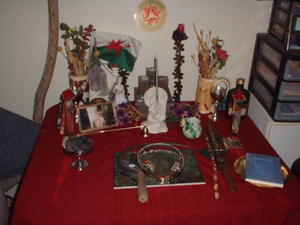
Part of OBOD* training is the establishment and maintenance of a personal altar as part of regular spiritual practice. Here’s a Druid altar spread on a tabletop. Nothing “mundane” or arbitrary occupies the space — everything has ritual or spiritual purpose and significance to its creator.
Such obviously physical objects and actions and their appeal to the senses as aids in spiritual practice all spring from human necessity. We need the grounding of our practices in the physical world of words, acts and sensations in order to “bring them home to us,” and make them real or “thingly,” which is what “real” (from Latin res “thing”) means.
Religions and spiritual teachings accomplish this in rich and diverse ways. We have only to think of Christian baptism, communion and the imposition of ashes at Easter; Hindu prasad and tilak; Jewish bris/brit (circumcision) and tallit (prayer shawl) and so on.
Atheists who focus exclusively on belief in their critiques and debates thus forget the very real, concrete and physical aspects of religious and spiritual practice which invest actions, objects and words with spiritual meaning that cannot be dismissed merely by pointing out any logical or rational cracks in a set of beliefs. Though you may present “evidence that God doesn’t exist” that seems irrefutable to you, you haven’t even begun to touch the beauty of an altar or spiritual structure, the warmth of a religious community of people you know and worship with, the power of a liturgy, the smell of incense, the tastes of ritual meals, the sounds of ritual music and song.
Just as we hear people describe themselves as “spiritual without being religious” as they struggle to sift forms of religion from the supposed “heart” of spirituality, plenty of so-called “believers” are “religious without being spiritual.” The forms of their spiritual and religious practice are rich with association, memory and community, and can be as important as — or more so than — a particular creed or set of beliefs.
Having said all of this, I’ve had a set of experiences that incline me away from erecting a physical altar for my Druid practice. So I’m working toward a solution to the spiritual “problem” this presents. Let me approach it indirectly. Once again, and hardly surprising to anyone who’s followed this blog or is as bookish as I am, the trail runs through books.
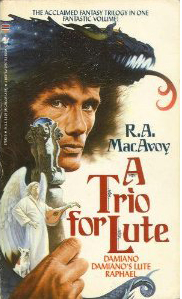
Damiano, the first volume in a fabulous (and sadly under-known) trilogy by R. A. MacAvoy, and recently reissued as part of an omnibus edition called Trio for Lute, supplies an image for today’s post. Damiano Delstrego is a young Renaissance Italian who happens to be both witch and aspiring musician. His magic depends for its focus on a staff, and we see both the strengths and limitations of such magical tools in various episodes in the novel, and most particularly when he encounters a Finnish woman who practices a singing magic.
When I read the trilogy at its first publication in the 80s, the Finnish magic sans tools seemed to me much superior to “staff-based” power. (Partly in the wake of Harry Potter and the prevalence of wands and wand-wielders in the books and films, there’s a resurgence of interest in this aspect of the art, and an interesting new book just published reflecting that “tool-based” bias, titled Wandlore: the Art of Crafting the Ultimate Magical Tool).
So when I then read news of church burnings, desecrated holy sites, quests for lost spiritual objects (like the Holy Grail) and so on, the wisdom of reposing such power in a physical object seemed to me dubious at best. For whatever your own beliefs, magic energy — whether imbued by intention, Spirit, habit, the Devil, long practice, belief in a bogus or real power — keeps proving perilously vulnerable to misplacement, loss or wholesale destruction. Add to this Jesus’ observation that we are each the temple of Spirit, and my growing sense of the potential of that inner temple of contemplation — also a feature of OBOD practice — and you get my perspective.
Carrying this admitted bias with me over the years, when I came last year to the lesson in the OBOD Bardic series that introduced the personal altar, I realized I would need both contemplation and creativity to find my way.
My solution so far is a work in progress, an alpha or possibly a beta version. My altar is portable, consisting of just five small stones, one for each of the classic European five elements — four plus Spirit. Of course I have other associations, visualizations and a more elaborate (and still evolving) practice I do not share here. But you get the idea. (If you engage in a more Native-American nourished practice, you might choose seven instead: the four horizontal directions, above [the zenith], below [the nadir] and the center.)
I can pocket my altar in a flash, and re-deploy it on a minimal flat space (or — in a pinch — right on the palm of my hand). One indulgence I’ve permitted myself: the stones originate from a ritual gift, so they do in fact have personal symbolic — or magical, if you will — significance for me. But each altar ritual I do includes both an invitation for descent and re-ascent of power or imagery or magic to and away from the particular stones that represent my altar. Lose them, and others can take their place for me with minimal ritual “loss” or disruption. Time and practice will reveal whether this is a serviceable solution.
This post is already long enough, so I’ll defer till later any discussion of the fitness of elemental earth/stone standing in for the other elements.
/|\ /|\ /|\
*OBOD — the particular “flavor” of Druidry I’m studying and practicing.

 I find in this poem a prayer most fitting for these darkening days till Yule and sun-return (never mind the ritual season). I add to it these visualizations as I say the opening triad of actions:







 A Druid Way