Archive for the ‘poetry’ Tag
Go to Part 1 | Part 2 | Part 3 | Part 4 | Part 5 | Part 6
I speak for myself, of course. It’s all that any of us can do. But as I approach what is most deeply true for me, I find I can begin to speak true for others, too. Most of us have had such an experience, and it’s an instance of the deep connections between us that we often forget or discount. I’m adding this Part Two because the site stats say the earlier post on initiation continues to be popular.
/|\ /|\ /|\
Within us are secrets. Not because anyone hides some truths from us, but because we have not yet realized them. The truest initiations we experience seem ultimately to issue from this inner realm of consciousness where the secrets arise. Deeper than any ocean, our inner worlds are often completely unknown to us. “Man is ‘only’ an animal,” we hear. Sometimes that seems the deepest truth we can know. But animals also share in profound connections we have only begun to discover. We can’t escape quite so easily.
Our truest initiations issue from inside us. Sometimes these initiations come unsought. Or so we think. Maybe you go in to work on a day like any other, and yet you come home somehow different. Or you’re doing something physical that does not demand intellect and in that moment you realize a freedom or opening of consciousness. Sometimes it can arrive with a punch of dismay, particularly if you have closed yourself off from the changes on the move in your life. In its more dramatic forms initiation can bring with it a curious sense of vulnerability, or even brokenness — the brokenness of an egg that cracks as this new thing emerges, glistening, trembling. You are not the same, can never be the same again.
The German poet Rilke tries to catch something of this in his poem “Archaic Torso of Apollo.” He’d been blocking at writing the poems he desired, poems of greater depth and substance, instead of the often abstract work he’d composed until then, and his friend the sculptor Rodin sets him to studying animals. Rilke admires Rodin’s intensely physical forms and figures, and Rilke ends up writing about a classic figure of Apollo that is missing the head. Yet this headless torso still somehow looks at him, holds him with eyes that are not there. Initiation is both encounter, and its after-effects.
We cannot know his legendary head
with eyes like ripening fruit. And yet his torso
is still suffused with brilliance from inside,
like a lamp, in which his gaze, now turned to low,
gleams in all its power. Otherwise
the curved breast could not dazzle you so, nor could
a smile run through the placid hips and thighs
to that dark center where procreation flared.
I may witness something that is simply not there for others, but nonetheless it is profoundly present for me. Or I see something that is not for the head to decipher, interpret, judge and comment on. There’s nothing there for the intellect to grasp. In the poem, the head of the sculpture of Apollo is missing, and yet it sees me, and I see or know things not available to my head. I feel the gaze of the sculpture. I encounter a god. Or just a piece of stone someone shaped long ago into a human figure, that somehow crystallizes everything in my life for me right now. Or both.
The sensation of initiation can be as intensely felt and as physical as sexuality, “that dark center where procreation flared.” It hits you in your center, where you attach to your flesh, a mortal blow from a sword or a gesture that never reaches you, but which still leaves you dizzy, bleeding or gasping for breath. Or it comes nothing like this, but like an echo of all these things which have somehow already happened to you, and you didn’t know it at the time — it somehow skipped right past you. But now you’re left to pick up the pieces of this thing that used to be your life.
Otherwise this stone would seem defaced
beneath the translucent cascade of the shoulders
and would not glisten like a wild beast’s fur:
would not, from all the borders of itself,
burst like a star: for here there is no place
that does not see you. You must change your life.
You feel Rilke’s discovery in those last lines*, the urgency, the knowledge arriving from nowhere we can track. I have to change, and I’ve already changed. I know something with my body, in my gut, that my head may have a thousand opinions about. I may try to talk myself out of it, but I must change. Or die in some way. A little death of something I can’t afford to have die. There is no place in my life that does not see me, that feeling rises that I can’t escape, and yet I must escape. It’s part of what drives some people to therapy. Sometimes we fight change until our last breath, and it takes everything from us. Or we change without knowing it, until someone who knows us says, “You’ve changed. There’s something different about you. I can’t put my finger on it,” or they freak at the changes and accuse us, as if we did it specifically to spite them. “You’re not the person you used to be,” meaning you’re no longer part of the old energy dynamic that helps them be who they are, and now they must change too. Initiation ripples outward. John Donne says, “No man is an island, entire of itself. Each man is a piece of the continent, a part of the main.” Sometimes it’s my own initiation, sometime I’m feeling the ripples from somebody else’s. The earthquake is in the neighborhood, right down the street, in the next room, here — or across the ocean. But ripples in each case.
Sometimes we “catch” initiation from others, like a fire igniting. We encounter a shift in our awareness, and now we see something that was formerly obscure. It was there all along, nothing has changed, and yet … now we know something we didn’t before. This happens often enough in matters of love. The other person may have been with us all along, nothing has changed … and yet now we feel today something we didn’t feel yesterday. We know it as surely as we know our bones. We can feel the shift under our skin. The inner door is open. Do we walk through?
Go to Part 1 | Part 2 | Part 3 | Part 4 | Part 5 | Part 6
/|\ /|\ /|\
*Mitchell, Stephen, trans. The Selected Poetry of Rainer Maria Rilke (English and German edition). Vintage, 1989.
Some teachings run you through their rituals.
Find your own way – individuals
know what works beyond the shown way:
try out drinking with the Ancestors.
Chat ‘em up — don’t merely greet ‘em;
such rites are chummy: do more than meet ’em.
(Spend your weekends with a mummy?)
But I like drinking with my Ancestors.
Another round of pints and glasses
will have us falling on our asses.
Leave off ritual when they’re calling —
you’ll be drinking with your Ancestors.
By and with the spirits near us —
“Don’t invoke us if you fear us” —
good advice: if you lose focus
though you’re drinking with your Ancestors,
in the morning you’ll be uncertain
if you just dreamed or drew the curtain
on some world where it more than seemed
that you were drinking with your Ancestors.
Alcohol works its own magic,
and not all good – it’s downright tragic
if you’re just hung over from what could
have been you drinking with your Ancestors.
They come in all shapes, and in all sizes:
some are heroes, some no prizes
(they’re like us in all our guises).
Listen: they are singing, they are cussing,
they can advise us if we’re fussing
over where our lives might go
or put on a ghostly show.
We’re the upshot, on the down low.
We’re the payoff, crown and fruit
(we got their genetic trash, and loot),
we’re their future – “build to suit.”
So start drinking with your ancestors.
* * *
Ancestor “worship” is sometimes a misnomer, though not always — some cultures do in fact pray to, propitiate and appease the spirits of the ancestral dead in ways indistinguishable from worship. But others acknowledge what is simply fact — an awful lot (the simple fact that we’re here means our ancestors for the most part aren’t literally “an awful lot”) of people stand in line behind us. Their lives lead directly to our own. With the advent of photography it’s become possible to see images beyond the three- or four-generation remove that usually binds us to our immediate forebears. I’m lucky to have a Civil War photo of my great-great grandfather, taken when he was about my age, in his early fifties. In the way of generations past, he looks older than that, face seamed and thinned and worn.
The faces of our ancestral dead are often rightfully spooky. We carry their genetics, of course, and often enough a distant echo of their family traditions, rhythms, expectations, and stories in our own lives — a composite of “stuff,” of excellences and limitations, that can qualify as karma in its most literal sense: both the action and the results of doing. But more than that, in the peculiar way of images, the light frozen there on the photograph in patches of bright and dark is some of the purest magic we have. My great-great-grandfather James looks out toward some indeterminate distance — and in the moment of the photo, time — and that moment is now oddly immortal. Who knows if it was one of his better days? He posed for a photo, and no doubt had other things on his mind at the time, as we all do. We are rarely completely present for whatever we’re doing, instead always on to the next thing, or caught up in the past, wondering why that dog keeps barking somewhere in the background, wondering what’s for dinner, what tomorrow will bring, whether any of our hopes and ambitions and worries justify the energy we pour into them so recklessly.
And I sit here gazing at that photo, or summoning his image from what is now visual memory of the photo, as if I met him, which in some way I now have. Time stamps our lives onto our faces and here is his face. No Botox for him. Every line and crease is his from simply living. And around him in my imagination I can pose him with his spouse and children (among them my great-grandfather William) and parents, and so on, back as far — almost unimaginably far — as we are human. Fifty thousand years? Two hundred thousand? A million? Yes, by the time that strain reaches me it’s a ridiculously thin trickle. But then, if we look back far enough for the connection, it’s the same trickle, so we’re told, that flows in the veins of millions of others around us. If we can trust the work of evolutionary biologists and geneticists, a very large number of people alive on the planet today descend from a relative handful of ultimate ancestors. Which seems at first glance to fly in the face of our instinct and of simple mathematics, for that spreading tree of ancestors which, by the time it reaches my great-great-grandfather’s generation, includes thirty people directly responsible for my existence (two parents, four grandparents, eight great-grandparents and sixteen great-great grandparents). Someone called evolution the “ultimate game of survivor.” And now I break off one line, stalling forever this one particular evolutionary parade, because my wife and I have no children.
The poem of mine that opened this entry, “Drinking with the Ancestors,” suggests we can indeed meet and take counsel with members of this immense throng through the exercise of inhibition-lowering and imagination-freeing imbibing of alcohol. Of course there are also visualization exercises and still other techniques that are suitably alcohol-free — more decorous and tame. Depending on who you want to talk to among your clan, you can have an experience as real as most face-to-face talks with people who have skin on. The difference between us in-carnate and ex-carnate folks is indeed the carne. No sudden dispensation of wisdom automatically accrues to us just because we croak. A living idiot becomes a dead idiot. Likewise a wise soul is wise, in or out of flesh.
It seems fitting to end with an experience of the ancestors. Not mine, this time — I keep such things close, because often when we experience them, they are for us alone, and retain their significance and power only if we do not diminish them by laying them out for others who may know nothing of our circumstances and experiences. Wisdom is not a majority vote. Even my wife and I may not share certain inner discoveries. We’ve both learned the hard way that some experiences are for ourselves alone. But it’s a judgment call. Some things I share.
So in my place I give you Mary Stewart’s Merlin, in her novel The Hollow Hills*, recounting his quest for Excalibur, and an ancestor dream-vision that slides into waking. The flavor of it captures one way such an ancestral encounter can go, the opposite end of the easy beery camaraderie that can issue from making the libations that welcome ancestral spirits to a festival or party, as in my poem. Note the transition to daytime consciousness, the thin edge of difference between dream and waking.
I said “Father? Sir?” but, as sometimes happens in dreams, I could make no sound. But he looked up. There were no eyes under the peak of the helmet. The hands that held the sword were the hands of a skeleton … He held the sword out to me. A voice that was not my father’s said, “Take it.” It was not a ghost’s voice, or the voice of bidding that comes with vision. I have heard these, and there is no blood in them; it is as if the wind breathed through an empty horn. This was a man’s voice, deep and abrupt and accustomed to command, with a rough edge to it, such as comes from anger, or sometimes from drunkenness; or sometimes, as now, from fatigue.
I tried to move, but I could not, any more than I could speak. I have never feared a spirit, but I feared this man. From the blank of shadow below the helmet came the voice again, grim, and with a faint amusement, that crept along my skin like the brush of a wolf’s pelt felt in the dark. My breath stopped and my skin shivered. He said, and I now clearly heard the weariness in the voice: “You need not fear me. Nor should you fear the sword. I am not your father, but you are my seed. Take it, Merlinus Ambrosius. You will find no rest until you do.”
I approached him. The fire had dwindled, and it was almost dark. I put my hands out for the sword and he reached to lay it across them … As the sword left his grip it fell, through his hands and through mine, and between us to the ground. I knelt, groping in the darkness, but my hand met nothing. I could feel his breath above me, warm as a living man’s, and his cloak brushed my cheek. I heard him say: “Find it. There is no one else who can find it.” Then my eyes were open and it was full noon, and the strawberry mare was nuzzling at me where I lay, with her mane brushing my face (226-7).
/|\ /|\ /|\
*Stewart, Mary. The Hollow Hills. New York: Fawcett Crest Books, 1974.
What makes a language “sacred”? I find that it’s in sacred language that we most clearly hear echoes of the love we are and the love we seek. Much that I write here is an exploration through the channel or “ray” of wisdom and my search for it. But the channel or ray of love is at least as potent, and for many people more accessible.
Here’s an adaptation of a prose-poem by 17th century Anglican writer Thomas Traherne, who lived only to age 38. In his writing he captures something of this love.
The whole world is the theater for our love.
We are made to love, both to satisfy this necessity within us
and also to answer the love of creation around us.
By love our souls are joined and married to the world around us.
If we focus upon only one part of creation,
we are not loving it too much, but the other parts too little.
Never was anything in this world loved too much.
What a treasure is a grain of sand when it is truly understood!
All infinite goodness and wisdom and power are in it.
What a world this would be if everything were loved as it should be.*
This then is one noble and worthwhile task, if we choose to accept it: to love everything in the world as it should be loved. We hear of those who “love too much,” or those who, like Othello, loved “not wisely but too well.” We may recollect, too, those who love their abusers and do not flee them: here’s a needed perspective on their situation. A complete and powerful guide to living, summed up in ten lines.
/|\ /|\ /|\
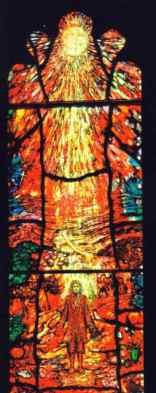 *Sections 65-67, “Second Century,” from Centuries of Meditation by 17th century writer and Anglican priest Thomas Traherne, adapted by Higginbotham, Paganism, 149-150. You can find Traherne’s complete original here.
The image is of a stained glass window “by Tom Denny, reflecting the thinking of Traherne, in Audley Chapel, off Lady Chapel, Hereford Cathedral, dedicated in March 2007.”
“And some of the Pharisees from among the multitude said unto him, Master, rebuke thy disciples. And he answered and said unto them, I tell you that, if these should hold their peace, the stones would immediately cry out.” (Luke 19:39-40)
What shall we do till the stones start to speak,
or whom can we turn to and trust in these days?
Can we hear even echoes of truths that we seek,
catch mere flickers of fire to illumine our ways?
The stones broadcast secrets we now scarcely hear —
the earth bears true witness, though leaders stay mute,
to remind us of love that is stronger than fear.
Goal and path rise within us — there’s no other route.
The animals know much — in each neighboring eye
is the ghost of the knowledge hard-won from their days:
make the most of each moment, for this body will die —
tomorrow’s new compost, though it shouldn’t amaze
us when walls turn to doors: we walk through them to find
the doors of our hearts were more narrow by far.
Trust the paint-box you’re given, though your dear ones are blind,
though your culture berates you, fear sets up a bar.
We must watch as we journey, be mindful of stones
that mumble or shout, rousing sleepers to wake.
Learn to feel the right path in the set of our bones,
trust the deep self to know the next step to take.


 A Druid Way