Here at year’s end, I’m finally getting around to reading the next-to-most-recent Mt. Haemus paper, RoMa Johnson’s “The Well and the Chapel: Confluence”. This ongoing series, sponsored by OBOD, has produced substantial papers on a range of topics since 2000, and last year’s 21st paper is of particular interest to me. Readers here know of my investigation of some of the intersections of Druidry and Christianity. In her paper, Johnson looks at five specific aspects of her topic: “Worldviews—Immanence and Imminence; Justice—Sin, Responsibility and Restoration; The Three—The Sacred Feminine and the Trinity; Immrama—The Soul’s Journey and Inspiration; and Confluence”.
Johnson also quotes Trappist monk and author Thomas Merton: “If I were more fully attentive to the word of God I would be much less troubled and disturbed by events of our time: not that I would be indifferent or passive, but I could gain strength of union with the deepest currents of history, the sacred currents, which run opposite to those on the surface a great deal of the time!”
Let me do a Druid transform of this with a few but significant tweaks, and make for myself a spiritual affirmation and guide: “When I am fully attentive to Spirit stirring throughout the worlds, I am less troubled and disturbed by events of our time: not that I am indifferent or passive, but I gain strength of union with the deepest currents of history, the sacred currents, which run opposite to those on the surface a great deal of the time”.
Often you can find this kind of spiritual wealth hidden just below the surface, as Merton’s words suggest, with a little meditation and creativity. At least, that’s one of my practices.
/|\ /|\ /|\
wood-snow, snow-wood …
A listing of the titles with links to transcripts of each lecture in the Mt. Haemus series provides a rich and broad source of contemplation and meditation seeds, as well as directions for study and practice. You can preview each paper, read it online, or download it for free from the OBOD site at the link above at the start of the paragraph.
More ambitious, and looking for study material for 2021? Or not a member of any Order, but looking for substance, as opposed to the ubiquitous fluff all over the Web? These 22 papers will give you a full year’s curriculum and then some, if you give yourself time to absorb them, follow up on bibliographical links, and explore their significance and implications in your own life and circumstances. The bios of the varied authors are also fascinating by themselves!
1: The Origins of Modern Druidry — Ronald Hutton 2: Druidry – Exported Possibilities and Manifestations — Gordon Cooper 3: Phallic Religion in the Druid Revival — J M Greer 4: Question, Answer and the Transmission of Wisdom in Celtic and Druidic Tradition — John and Caitlin Matthews 5: Universal Majesty, Verity and Love Infinite – A Life of George Watson Macgregor Reid — Dr. Adam Stout 6: Working with Animals — Prof Roland Rotheram 7: ‘I Would Know My Shadow and My Light’ – An exploration of Michael Tippett’s ‘The Midsummer Marriage’ and its relevance to a study of Druidism — Philip Carr-Gomm 8: Entering Faerie – Elves, Ancestors & Imagination — Dr. James Maertens 9: How Beautiful Are They – Some thoughts on Ethics in Celtic and European Mythology — Dr. Brendan Myers 10: What is a Bard? — Dr. Andy Letcher 11: Druidry & Transpersonal History — Dr. Thomas C Daffern 12: From solstice to equinox and back again – The influence of the midpoint on human health and the use of plants to modify such effects — Julian Barker 13: Magical Transformation in the Book of Taliesin and the Spoils of Annwn — Kristoffer Hughes 14: Music and the Celtic Otherworld — Dr. Karen Ralls 15: ‘Almost unmentionable in polite society’? Druidry and Archaeologists in the Later Twentieth Century — Dr. Julia Farley 16: Gathering Mistletoe – an approach to the Work of E. Graham Howe — Ian Rees 17: Tree Lore is Wisdom — Mike Darton 18: Lecture The Elementary Forms of Druidic Life – Towards a Moral Ecology of Land, Sea, and Sky — Jonathan Woolley 19: Channeling the Awen Within: An Exploratory Study of the Bardic Arts in the Modern Druid Tradition — Dr. Dana Driscoll 20: What Druidry does – a perspective on the spiritual dynamics of the OBOD course — Dr. Susan Jones 21: The Well and the Chapel: Confluence — RoMa Johnson, MDiv. 22: The Feminist Druid: Making Way for New Stories/New Work — Dr. Michelle LaFrance
We inhabit a speaking cosmos. (World, would you call me home?) I don’t know about you, but that’s what I keep on concluding, when I consider my own history, the breadth of divination systems, the experiences of many who report contact with other beings, sought and unsought, the writings in world-wide cultures attesting to the existence of persons both with and without skins on, and many other odd and assorted pieces of evidence. How to connect, how to join the conversation, is what remains, and that can become part of a regular practice. For that, here’s one more item from my toolkit.
Diyeshegwanhi dee-yeh-sheh-gwahn-hee — the “seven directions”. It’s a word that came to me in meditation many years ago, and I use it when I do this particular divination. An awareness of the cosmos with seven directions appears in a number of traditions: the cardinal four of north, east, south and west, with the addition of above, below and toward the center. Often the starting direction varies, but I almost always end with toward the center. It focuses and closes the divination with what is going on within — something good to attend to, that guides without dominating the divination.
After grounding and centering, I invite the directions, acknowledging my kinship with the beings who inhabit each of them. Recently I’ve been reading about ancestors who lived and are buried in northern Vermont, so today I begin with north.
North of my kindred, I greet and bow to you! [Pause] May I attend to your wisdom.
And so on through the directions, making it a meditation, a ritual, a prayer, and varying what I name and attend to as I go. Sometimes it’s enough just to turn in the direction, or to visualize it (which can mean other senses than site — the focus of imagination IS visualization, regardless of the active sense. I may feel north, for instance, rather than hear or see anything).
I write down what I sense/visualize, and that’s my divination, always shaped by the final focus on what’s going on inwardly, which guides my interpretation. (I often use the abbreviations n-e-s-w-a-b for north, east, south, west, above, below in my notes — holding the center apart — and so I think of the meditation as my neswab meditation.)
This morning’s divination:
North: birdsong East: shadow under the willow South: morning haze West: openness Above: a swirling or whorl of energies Below: containment Center: movement across, or transverse
I am moving across a field with both song and shadow. I’m open or accessible to these energies emotionally, while my field of movement, my perception or awareness of a range of action, as well as my intention, may be obscured by haze and shadow, or by a confusion of energies. Goals: attend as I move, watch and work for clarity, and sharpen my intention. Because the field is in transition — because I’m transiting it — now isn’t the time for insisting on substantial or enduring perceptions, but for a sounding of what’s current, timely, of the moment, as a guide for what’s coming next.
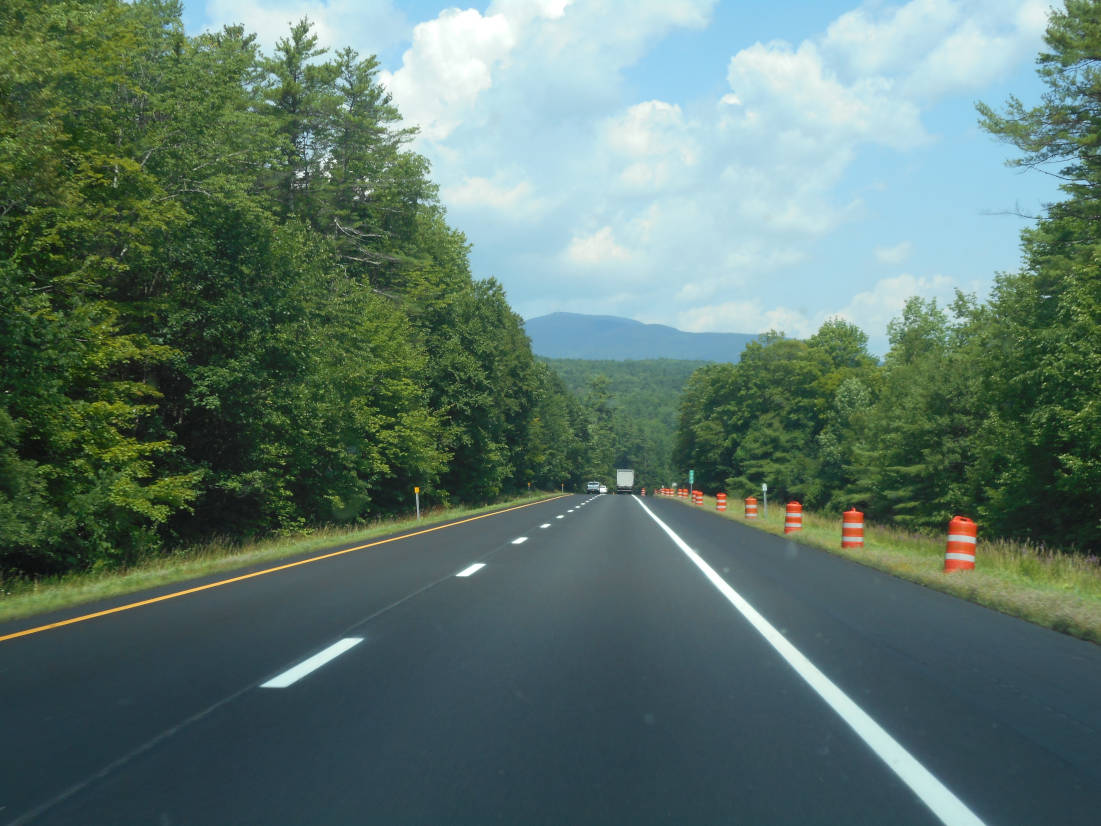
Mt. Ascutney from the south on Rt. 91N
Now it’s certainly possible — and maybe desirable, depending on your inner guidance — to expand this to include other correspondences: the chakras, the notes between octaves, and so on. Personally, I find my own associations much more useful than someone else’s. Your mileage will vary. The point with any divination system is its practicality: does it serve? If not, its neatness, symmetry, complexity, etc. are all distractions.
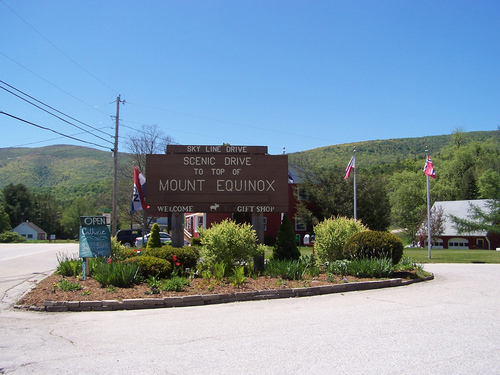
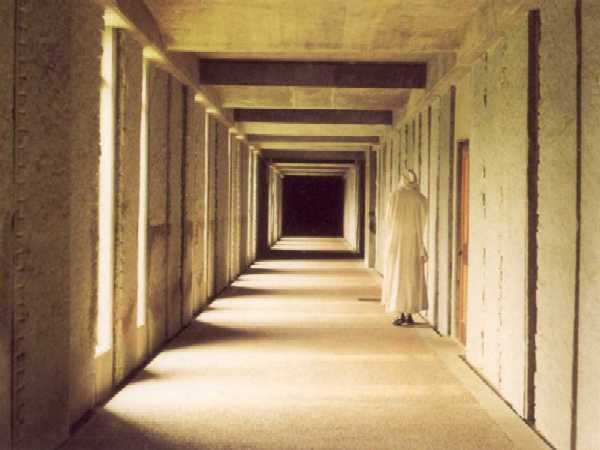
If it helps, for instance, to associate the directions with sacred spots on your own local landscape, follow through. Four New England mountains lie along my cardinal directions: to the east is Mount Monadnock; to my south, Putney Mountain; north is Ascutney; and west is Mount Equinox. I’ve visited all but Equinox, and it happens to lie in the west, and be the home of the only Carthusian monastery in the U.S. — the Charterhouse of the Transfiguration.
To take just one obvious tack from my divination, what needs transfiguring that I haven’t yet visited or invited into my experience? And given my interest in Druid-Christian linkages, what should I be focusing on there? The home page of the monastery website, as a pointer, notes “The Transfiguration of the Lord contains all the constitutive elements of Christian contemplation”. The Carthusian prescription for contact, for connection, is silence and solitude, and of course prayer.
All of this is a helpful reminder for someone like me who can spend too much time online. That’s what bloggers often end up doing. So a regular period of fasting from social media is one way for me to bring more solitude and silence into my life, where I can then hear the awen more clearly.
/|\ /|\ /|\
If you find yourself asking But where’s the Druid(ry) in all this? you might enjoy reading the current (21st) Mt. Haemus lecture, sponsored by OBOD, which this year is “The Well and the Chapel: Confluence” by RoMa Johnson, MA, MDiv, addressing connections between Druidry (the Well) and Christianity (the Chapel). The link takes you to an OBOD subpage where you can learn more about the author, and download a PDF of the lecture.
Johnson explores five sub-topics: Worldviews—Immanence and Imminence; Justice—Sin, Responsibility and Restoration; The Three—The Sacred Feminine and the Trinity; Immrama—The Soul’s Journey and Inspiration; and Confluence.




 A Druid Way