Normally I tend to breeze past self-help titles. It’s true they’re sometimes spontaneously (or cynically) fashionable, hitting whatever the current zeitgeist is at its geisty-est. For that reason they can be deeply culture-specific. What resonates in the U.S. may not catch on at all in France or Fiji. It’s also true that the slickest of the titles tend towards the simplistic. Anyone who’s read more than one knows they typically repackage highly useful and applicable age-old wisdom under new headings. Not a bad thing at all — sometimes that’s what we need, especially if the old sources fail us, and we’re looking for guidance. Some titles can serve a deep need very well.
We’ve all had the experience of clicking with a mentor or teacher who gets how we think, how we process the world. With a good match-up between student and mentor, we learn far more effectively and enjoyably. Likewise with a bad match, it’s often just hell for all concerned. Witness the Youtube popularity of good explainers and effective speakers. There’s a reason the best TED talks continue to draw big viewership stats.
And we do love our lists and numbers! Consider film and TV titles: 8 Simple Rules (for Dating My Teenage Daughter); Ten Things I Hate about You; Four Weddings and Funeral; Three’s Company; Twelve Angry Men; A Few Good Men; Five Hundred Days of Summer; Sixteen Candles; Thirteen; Seven Brides for Seven Brothers; Seven Samurai; Eight Crazy Nights; the Ocean’s series (11, 12, 13, 8). Some (or many) of these series and films may not have reached your shores, but you get the idea.
So when online I ran across Jed Diamond’s recent book 12 Rules for Good Men, no surprise, the title caught my eye. A disclaimer here — I haven’t read the book. Ultimately the book isn’t directly relevant to this post. Because after reading the summary of Diamond’s rules in reviews of the twelve things men can do to better their lives (you can see a version of the original list here), I wanted to open it up just a little and make it applicable to everyone — because it is. “Rules for Humans”. Actually, I prefer Practices. Rather than “following” or “breaking” a rule, why not pick up a practice? Try it out, see if it helps. If it does, great. If not, move on. (Who ever says that about “rules”?) Let such practices be things to get better at, one of the reasons we practice. We don’t normally “practice” rules.
Consider these Thirteen Practices of a Wise Druid:
Practice #1: Find a group (or more than one!) that supports and challenges you.
Practice #2: Investigate the various boxes you find yourself in. (Some boxes help give us needed structure! Some are too comfortable, or constricting.)
Practice #3: Accept the gifts of gender and sexuality. (We’re still just beginning to discover what these are.)
Practice #4: Embrace your billion-year human history. (Time, often, is on our side.)
Practice #5: Work with your angers and fears to release their insights and wisdom. (We’ve all got these priceless materials ready to hand. Both store tremendous energy.)
Practice #6: Learn the secrets of love. (Dogs and cats are often our best mentors.)
Practice #7: Undergo meaningful rites of passage. (We all have some in place already.)
Practice #8: Celebrate your true nature as a spiritual being. (Again, you already do. Why not enlarge!)
Practice #9: Understand and grow from your childhood. (Two endless sources of discovery: childhood and dream.)
Practice #10: Grow your nurturer to become more of the nurturer you can be. (Earth, our first nurturer …)
Practice #11: Move through and beyond repeating patterns and the blockage, depression and frustration they produce. (Harnessing the cycle.)
Practice #12: Identify your mission and play your part skillfully and joyfully. (We’re all on a mission. Beta-testing!)
What about Practice #13 — the Thirteenth of the post title? That’s doing these things in our own ways, with the stamp of our unique awen on them — the spiritual creativity that’s the birthright we all possess. (Not feeling especially creative? There’s a practice for that!) That spiritual creativity is what makes my path both recognizably human and also distinct from yours. It’s what makes any worthwhile practices part of a life-long path. It’s what makes them practices rather than rules. (Don’t look now, but it’s also what powers the other practices.)
Now the parentheticals after each practice above are my own provisional notes for where I might go next with them. Already I can feel an itch to rephrase them, personalize them, see which practices might be most beneficial — and most enjoyable. (When was the last time I experienced joy?) To see which practices I’m already doing, and how I can fine-tune them and do them more consciously and creatively and intensely. And to surprise myself with ones I can see in new ways.
It’s interesting to me that with the 13th Practice in place, the very center, counting from either direction, is occupied by Practice 7: Undergo Meaningful Rites of Passage.
This is one of the things Druidry puts before us, urging us to find our own ways to bring such practices into our lives. Some of my previous posts, and some of your comments and site searches, touch on the value and the challenge of ritual and rite and ceremony. “Meaningful” is key. Getting together is friends and family is understandably high on so many of our lists. Often the simplest of these things bring the most joy. My wife and I miss sitting around fires with a neighbor couple, something we’ve done year-round for the past several years. Nothing “huge”, but everything deeply human: the elemental presence of fire, the warmth of company and touch, conversation and good food. This is certainly part of our human heritage for tens of thousands of years (if not our “billion-year history”). This rite of passage is to honor the transient, the fleeting beauty and depth of moments that nevertheless make up most of our lives.
Druidry offers a number of forms, and also training in their use as containers for transformation. Why does transformation need to be “contained”? Often because that helps to build up the temperature, pressure, awareness, power, etc. that catalyze the transformation. Think tea kettle, forge, pump, oven, etc. Scatter or disperse these forces, and the transformation fizzles, stalls, loses momentum, dies down, darkens — pick your metaphor.
Another of the things that Druidry puts before us is a sensitivity to rhythms. So among a range of possible containers, I find myself looking at how I could connect each of these 13 practices to the moon. I think of a 13-day practice centered on a new or full moon, where I place attention on these practices, one per day. Or one per month, for a 13-moon lunar year cycle. How might I honor and explore and deepen them, using moon energy?
Same for a solar practice: either daily, with sunrise, midday, sunset and midnight, or maybe twice each year, at the solstices. Or setting aside one day each month, and meditating on these practices for (parts of) 13 hours, one per hour. A spiritual retreat. Keeping a journal of these things would be a priceless key. So would art and music and other craft that might arise from them. If you have friends, or a grove, that might like to join you, that opens up still further possibilities.
“What’s your ritual goal?” Celebrating on a beautiful evening? Performing moon magic? Attuning to the rhythms of earth’s nearest neighbor? Healing, banishing, blessing? Charging a ritual implement? Making the most of heightened sensitivity and emotion at this time? Singing a song, or writing a poem? Painting? Finally writing a difficult letter? Making love? A blend of several of these? Which ones are primary for you?
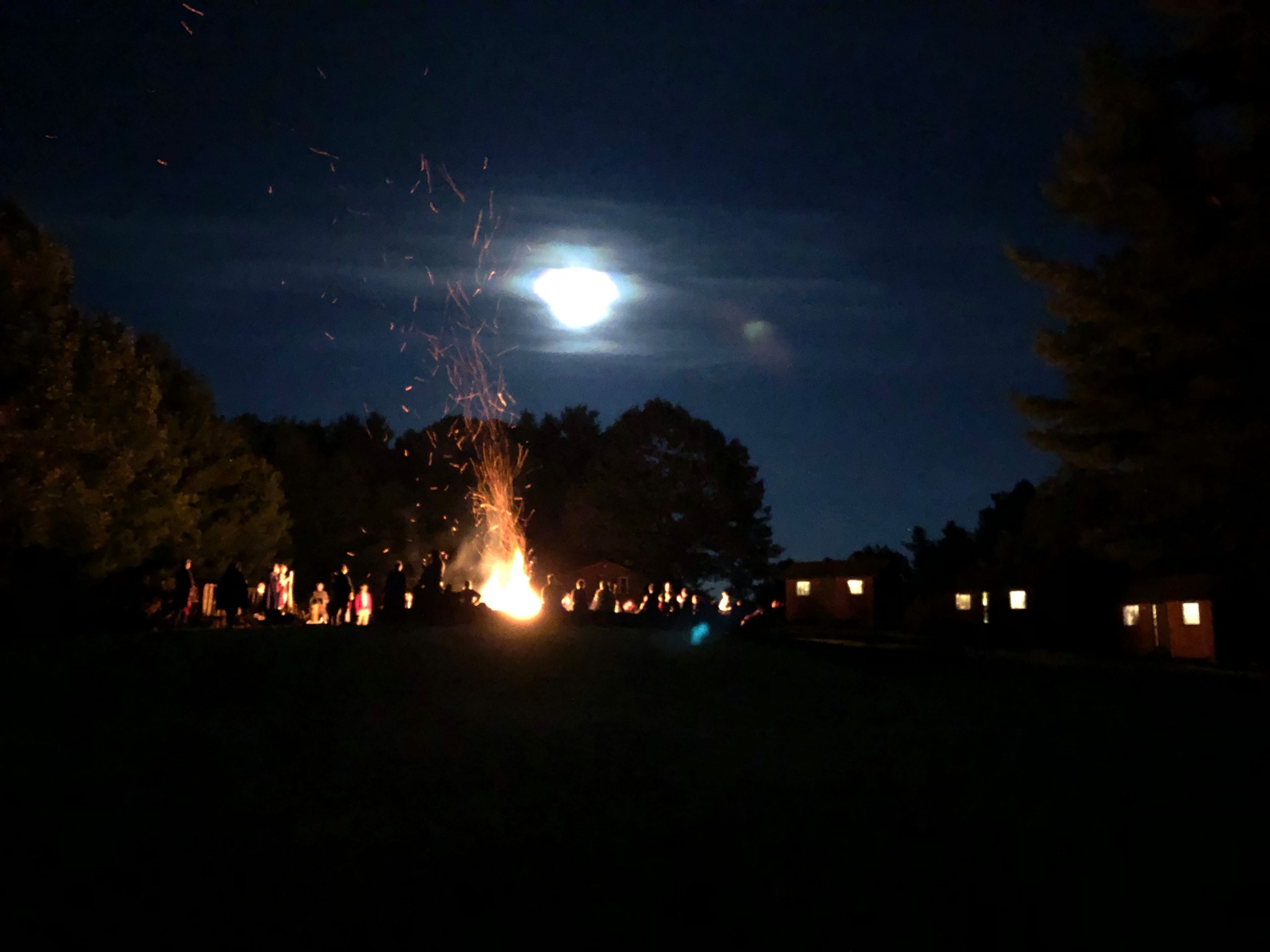
BAM Gathering, Full Moon, Sept. 2019
“What’s your moon?” Is it New, Full, Waxing, Waning? You can see the moon as a guide and also as a “map to manifestation”. What do each of its phases suggest to you?
With some preliminary answers to these two sets of questions, you’re already better prepared to proceed. Journal, do divinations, watch your dreams, doodle, pray, listen and watch the natural world holding your intent in your heart as ways to refine your preparation, and you’ll be rewarded with deepening insight and more possibilities that will come to you.
Moon Names
Different sources of lore will suggest a range of names and associations for each moon and month, depending on the tradition they draw from. One name for the April full moon just past is Pink Moon. Native American names can be evocative, and may help point you toward specific conditions and qualities present in your locale — if you live in North America. But Europe, Asia, Africa and Australia each have their own varied traditions and imagery that do the same thing. Images and stories give you material for your rites: they help you focus attention and emotion and imagination in the service of your ritual intent. They’re also fun!
Melody and Harmony
Just as important in a ritual as the words you choose are any musical instruments, dances, enactments, costumes, gestures. Or try an entire ritual without words. What can you do, rather than say, to perform your ritual? When I performed my Ovate self-initiation, by far the most significant components were flickering candlelight in my dark living-room, my ritual nakedness marked by charcoal runes on skin, and the silence. OBOD materials suggested a ritual. But it was the personal experience, including the details I just mentioned, that made mine memorable and transformative.
A Basic Script
Here’s a sample “barest-bones” mini-script you can elaborate with your own intent, setting, companions and creativity. Treat it as you would the grain of sand that becomes a pearl in an oyster — an irritant that can grow and take shape and become a thing of beauty. Don’t like part or all of it? That’s fine! Change it!
Full/new/dark Moon of (month name), I/we greet you here and now.
I/we bring (specific offering, intention, dedication, vow) as token(s) of my/our intent.
Bless/heal/enlighten (you, your gathered group, a project, an object, the coming day).
You could, for example, fit in non-verbal ritual elements before and after each spoken part. How will you signal your rite has begun? Bells, drums, horns, etc. each have distinctive voices to contribute. Lights, incense, candles, torches all have roles they can play. “Moon foods” — the ancient mangiare in bianco (literally, “to eat in white”) of Italy — comes to mind. White wine, pale fruit juices, bananas, nuts, pasta, pears, apples, beans, bread, other pastries, etc. can all serve — and be served at your rite! “Season to taste” in addition to being a cooking instruction is a wonderful piece of ritual advice.
A Local Lunar Calendar
Consider making a list of each moon for the current year — your own lunar calendar, with room for notes, pictures, additions, poems, etc. Note the dates of the moon phases each month, and also your local season. June in North America is sometimes called “Strawberry Moon” for the fruit coming into season then, but of course that doesn’t work in the Southern Hemisphere — it’s the middle of winter then!
Personalizing
What personal events and associations might you include in your rituals for each moon? May, for instance, is the Moon of my birth, and it’s also Beltane Moon, so any moon ritual with that moon will feel different to other moons, even if I used the “same” script each time. What’s the local weather during each moon? How might land and sky spirits be included? What other rites and celebrations happen where you live? Who do you want to invite to celebrate with you? If you’re typically “alone” for such things, what ancestors feel right to include? When will you walk/dance/play with your animal guide, guardian, etc?
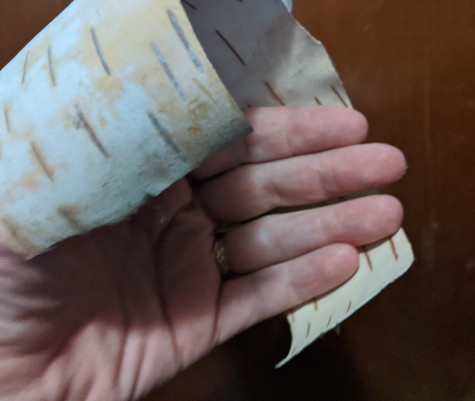
“backyard birch” bark for ritual writing
What props do you already have that can be included, or perhaps dedicated, in a rite? The quartz you picked up on a walk, the statue or bowl or cup that caught your eye in a shop or at a flea market or antique auction and now rests on a shelf? That gift from a relative or friend you’ve had for ages? A ring you’ve inherited from an aunt or grandmother?
The strips of birchbark from our backyard tree, in addition to providing great kindling, are excellent for writing during a ritual: ogham, runes, blessings, “give-aways” of things participants don’t want, commemorations (stitched/bound while still supple into a booklet). These strips can be burnt, composted, or saved as appropriate.
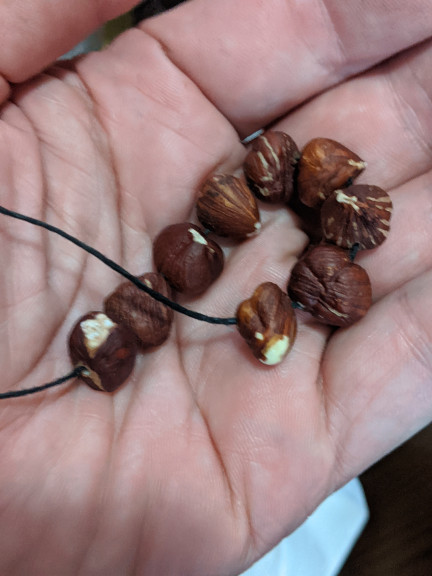
hazelnut necklace
Our Vermont seed-group, the Well of Segais, features the hazel among its mythic associations and symbols — the nut that feeds the Salmon of Wisdom, which some OBOD groves use to represent the Power or Guardian of the West and of Water. Ground symbols in objects and you make the ritual that much more accessible to the senses, imagination and memory. As a group gift, Mary Anna drilled hazelnuts and made up packets with thread for us each to make our own necklaces: “nine hazels of wisdom”. An appropriate and personal piece of ritual gear for a moon ritual!
/|\ /|\ /|\
I bless you in each of your moons,
your fullness and your dark nights.
I bless you in your changing faces,
in the pearl shadow of your twilight.
In between, when I dance or dream,
both or neither, I trade places
with tree, beast, spirit of the grove,
soon or late uncovering
another doorway to your sky.
“Thou met’st with things dying, I with things new-born” says the Shepherd in Shakespeare’s The Winter’s Tale. And his words seem a perfect description of spring. Not all is new growth. Much has died. Sometimes we remember our own dead most vividly when life returns to the world around us. We’re still here, but they will not share another spring with us, and sorrow is renewed along with the grass underfoot and the buds on the trees. A bittersweet time. A time of compost and ashes and dandelion greens in salads. A time of sunlight growing, of life rising in the spine like sap in trees. Spring, you old tonic.
Out of state and away from computers for several days, I return with a series of vivid impressions: visiting my now retired cousins in Madison, Wisconsin, seeing them on their third of an acre lot, the earth bursting with literally scores of varieties of flowers, everything up and blooming more than a month early. Their care over two decades in restoring an old and abused house to pristine condition (doing much of the dirtiest and hardest work themselves), the spaces full of lovely wood paneling and doors and moldings, and full as well of light on all sides from triple-paned windows. Above ten degrees outdoors and their furnace goes off, if they get any sun. A Druidic care for the space they live in, the house and grounds they beautify not only for themselves, but all who pass by and witness.
Longing for light. Opening blinds to a few wasps at the window, sluggish with morning cold. The hazy spring moon growing each night, that Pagan moon by which Christians reckon the date for Easter according to that strange formula of “first Sunday after the first full moon after the vernal equinox.” (A perfectly Pagan calculation, when you think about it at all, even considering that the early Church wished for Easter to follow Passover, itself subject to a combined lunar and solar calendar.) People outdoors worshiping the sun on their skin, sitting in sidewalk cafes, heads leaned back and eyes closed. Mild days and cool nights. Love of this old world, with all its pains and joys. Love renewed, spring’s gift, waiting to ripen in fruit and flower and heart.




 A Druid Way