Archive for the ‘magic’ Tag
[Part 2 | Part 3 | Part 4 | Part 5]
This is the first of a series on the powers of magic.
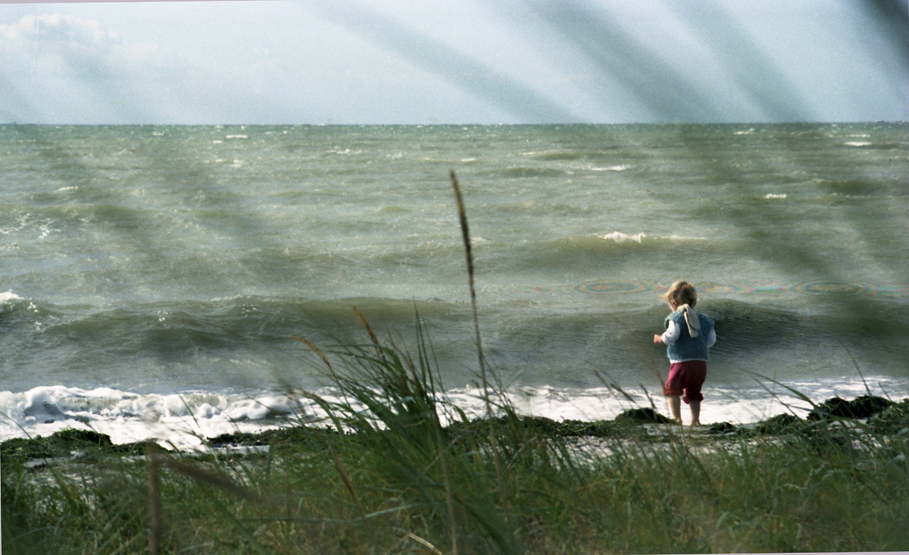
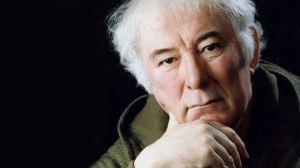 “All I know is a door into the dark,” says Seamus Heaney in the first line of his poem “The Forge.” In some way that’s where we all begin. At three, four, five years old, some things come into our world already bright, illuminated, shining, on fire even. The day is aflame with sun, the golden hours pass until nightfall, and then come darkness and sleep and dreaming. We wander through our early days, learning this world, so familiar-strange all at once. We grow inwardly too, discovering trust, betrayal, lying, love, fear, the pleasure of imagination, the difference between visible and invisible worlds. Which ones do people talk about, admit to themselves? Which ones do people around us ignore, or tell us don’t matter?
Much of our knowing is experiential during those years. We learn about the physical laws of our planet, the bumps and bruises and sometimes breaks of childhood a testament to the hard edges of this world. We learn some of its softnesses too: favorite foods, the touch of loved ones, the warm fur of pets, a dog’s nose meeting ours, the new air on the skin that spring and summer bring, the delight of rain and puddles and baths and fresh-laundered clothes.
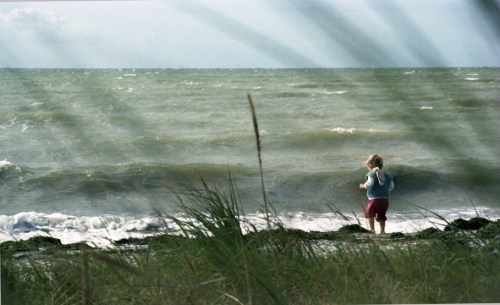 Then in some parts of the world comes another learning, one that typically fills much of our days for the next decade or so: a knowing about, the accumulation in school of facts and statistics and words and ideas, math and languages and art, science and history. Still some experiential learning comes through as a matter of course — Bunsen burners glowing, magnesium and potassium in chemistry doing their flaming and bubbling tricks mixed with other elements. The practice of basketball, baseball, volleyball, football and soccer, the sprints and catches and throws and spins and tricks, the correct forms and personal styles. Wrestling, dance, music, track and field, teaching the body to know beyond thought, to form and shape habits useful precisely when they become habit and no longer demand our full attention.
And other knowledge of the body, too: the awakening of sexuality, the chemical prods and prompts of hormones to stir the body into further change, the powers of attraction and desire, the experimentation with consciousness-altering that seems a universally human practice, whether “naturally” through exercise and pushing one’s physical limits, through chant, prayer, meditation, dance, song, music, or through “assisted alteration” with certain herbs, drugs, alcohol. Even into adulthood much of this knowledge rumbles and whispers just below the level of conscious thought much of the time. Without socially-approved times and places to discuss many of these experiences, we withhold them from daily conversation, we “fit in” and accommodate, we commit to being just like everyone around us, and the nudge of what feels like difference becomes part of the background hum of living, an itch we scratch haphazardly, or learn to tune out.
We forget how valuable this kind of knowing is, how it persists throughout our lives. This used to be wisdom of a kind we valued precisely because it took lived experience to acquire. You couldn’t rush it, couldn’t buy it or fake it, at least not without so much practice you almost recreated for yourself the original source experience anyway.
In a previous post on this blog, I noted:
Some kinds of knowledge are experiential and therefore in a different sense hidden or secret from anyone who hasn’t had the experience. Consider sex: there is no way to share such “carnal knowledge” – you simply have to experience it to know it. And thus Adam and Eve “know” each other in the Garden of Eden in order to conceive their children. Many languages routinely distinguish “knowing about” and “knowing” with different words, as for instance German kennen and wissen, French savoir and connaitre, Welsh gwybod and adnabod, Chinese hui/neng/zhidao. The kinds of experiential knowledge humans encounter in a typical lifetime are substantial and significant: first love, first death, first serious illness and so on.
Back to the poem I mentioned in the first line of this post. Reading it can be, in a small way, a re-initiation back into some experiences and kinds of knowing we may have forgotten or waylaid. It’s “just words,” but also — potentially — more.
The Forge
by Seamus Heaney
All I know is a door into the dark.
Outside, old axles and iron hoops rusting;
Inside, the hammered anvil’s short-pitched ring,
The unpredictable fantail of sparks
Or hiss when a new shoe toughens in water.
The anvil must be somewhere in the centre,
Horned as a unicorn, at one end and square,
Set there immoveable: an altar
Where he expends himself in shape and music.
Sometimes, leather-aproned, hairs in his nose,
He leans out on the jamb, recalls a clatter
Of hoofs where traffic is flashing in rows;
Then grunts and goes in, with a slam and flick
To beat real iron out, to work the bellows.
 Here’s one opportunity of our human life (there are others) — a door into darkness, a world inside us that is a forge, a place of shaping and molding, of hammering material into a desired form, a place of work and energy and transformation. The door leads to a place where we can find an altar, where we can “expend ourselves in shape and music” and “beat real iron out.” Sometimes it appears others stand there before us; at times, we stand alone, tools scattered about, not always sure of how to proceed, dimly aware, or not at all, of anything like an altar or metal or tools. But here lies a chance at the magnum opus, the “great work” many of us seek, that task finally worthy of all that we are and can do and dream of, a labor that is pleasure and work and art, all at once or at different times.
Even to know this in some small way, to imagine it or suspect it, is a start. The door into the dark may not stand open, but we discern the outlines of something like a door, and maybe grope towards a handle, a yielding to an inner call, something that answers to a hand on the doorknob, or shifts like a latch, clicks open. To know this much is a priceless beginning.
How magic can build on this beginning, and assist in self-making, will be the subject of the next post.
/|\ /|\ /|\
Images: Seamus Heaney; child at shore; forge.
Updated 3 July 2014

What follows are brief notes from a short talk I recently gave on magic.
Dion Fortune’s definition of magic: “the art and science of causing change in consciousness in accordance with will.”
“… most of us, most of the time, are content to use the imaginations of others to define the world around us, however poorly these may fit our own experiences and needs; most of us, most of the time, spend our lives reacting to feelings, whims and biological cravings rather than acting on the basis of conscious choice; most of us, most of the time, remember things so poorly that entire industries have come into existence to make up for the failures and inaccuracies of memory” (J. M. Greer, Circles of Power, 52).
We can, however, choose to imagine – & remember – ourselves differently. When we do so with focused attention, changes happen, both subjectively & objectively.
/|\ /|\ /|\
Magic stems from an experiential fact, an experimental goal, & an endlessly adaptable technique.
The fact is that each day we all experience many differing states of consciousness, moving from deep sleep to REM sleep to dream to waking, to daydream, to focused awareness & back again. We make these transitions naturally & usually effortlessly. They serve different purposes, & what we cannot do in one state, we can often do easily in another. The flying dream is not the focus on making a hole in one, nor is it the light trance of daydream, nor the careful math calculation.
The goal of magic is transformation – to enter focused states of awareness at will & through them to achieve insight & change.
The technique is the training & work of the imagination. This work typically involves the use of ritual, meditation, chant, visualization, concentration, props, images & group dynamics to catalyze transformations in awareness.
/|\ /|\ /|\
Magic is also “a set of methods for arranging awareness according to patterns.”
We live our lives according to patterns. Some patterns are limiting & may be unmasked as restrictive. Other patterns can help bring about transformation. “[T]he purpose of magical arts is to enable changes within the individual by which he or she may apprehend further methods [of magic & transformation] inwardly.”
“… [O]ur imagination is our powerhouse … certain images tap into the deeper levels of imaginative force within us; when these are combined with archetypal patterns they may have a permanent transformative effect.”
– R. J. Stewart, Living Magical Arts
/|\ /|\ /|\
Image source: sunset.
“there is an altar to a different god,” wrote the Portuguese poet Fernando Pessoa (1888-1935). Perhaps that’s some explanation for the often mercurial quality of being this strange thing we call the self, ourselves. We can’t easily know who we are for the simple reason that (often, at least) we aren’t just one thing — we consist of multiple selves. We’re not individuals so much as hives of all our pasts buzzing around together. Whether you subscribe to the reality of past lives or see it as a possibly useful metaphor, we’re the sum of all we’ve ever been, and that’s a lot of being. And with past lives (or the often active impulses to make alternate lives for ourselves within this one through the dangerous but tempting choices we face) we’ve known ourselves as thieves and priests, saints and villains, women and men, victims and aggressors, ordinary and extraordinary. When we’ve finally done it all, we’re ready to graduate, as a fully-experienced self, a composite unified after much struggle and suffering and delight. All of us, then, are still in school, the school of self-making.
Doesn’t it just feel like that, some days at least?! Even only as a metaphor, it can offer potent insight. The Great Work or magnum opus of magic, seen from such a perspective, is nothing more or less than to integrate this cluster of selves, bang and drag and cajole all the fragments into some kind of coherence, and make of the whole a new thing fit for service, because that’s what we’re best at, once we’ve assembled ourselves into a truly workable self: to give back to life, to serve an ideal larger than our own momentary whims and wishes, and in the giving, to find — paradoxically — our best and deepest fulfillment. “He who loses himself will find it gain,” said a Wise One with a recent birthday we may have noticed. We all learn the hard way, for the most part, because it’s the most profound learning. Certainly it sticks in a way that most book learning alone does not.
/|\ /|\ /|\
If you believe that everything should be “out in the open,” you’ll probably admit to a certain impatience with concealment and secrecy. We’ve heard the old saw: “If you’ve got nothing to hide, you’ve got nothing to fear” and up to a point we believe it. Particularly in the U.S., we equate openness with being “aboveboard” and honest. “Don’t beat around the bush.” “Say what you mean.” “Be upfront about it.” We admire “straight talk.”
The Freedom of Information Act helped make at least some government activities more transparent, and we often welcome “full disclosure” in a variety of situations. We still think of ours as an “Open Society,” and the current practice of large and anonymous campaign contributions from corporate sponsors has some American citizens up in arms. We’re wary of the con, and we tend to suspect anyone who doesn’t “tell it like it is.” We’ve got talk shows where people “spill it all,” and public figures starting at least with Jimmy Carter who began a confessional politics by admitting he had “lust in his heart.” But not all secrets are sinister. They do not automatically concern information anyone else needs to know. Each of us has some things that are innocently private. And in fact, well beyond this concession, secrecy can serve remarkable purposes that conspiracy theorists and even regular citizens rarely acknowledge.
Some secrets, of course, appear to be built into the stuff of the Cosmos. Robert Frost captures this in a brief two-line poem, “The Secret Sits”:
We dance round in a ring and suppose,
But the Secret sits in the middle and knows.
We circle the thing we’re after, all the while convinced it’s there, that something will answer to our seeking, but somehow we still persist in missing it. In spite of a couple of hundred years of scientific exploration, and prior to that, millennia of religious and spiritual investigation, existence and meaning and purpose often remain mysterious and not easily accessible. What matters most to us springs from sources and energies we can’t simply subject to laboratory scrutiny and then write up in learned journals and magazines. As some of the Wise have put it, “the eye sees, but cannot see itself” (at least not without a mirror). Something about the nature of consciousness blocks us from easily comprehending it.
In our search, we reduce matter to atoms (literally, “unsplittables”) and think we’ve arrived at the true building blocks of the universe, only to learn that atoms can indeed split, and that they’re composed of subatomic particles. Quantum physics further reveals that these particles are probabilities and exist only with the help of an observer. Space-time itself is generated by consciousness. We live in a “nesting doll” universe, worlds inside other worlds, an onion-like cosmos of endless layers. True secrets, it appears, can’t be told. They’re simply not part of the world of words. As the Tao Te Ching wryly has it, “The Way that can be talked about isn’t the real Way.” If that doesn’t have you pulling your hair out, it can at least cast you down into a terminal funk. Where can a person get a clear answer?
Serious seekers in every generation come to experiment with some form of solitude, and if they persist, they may discover some very good reasons that underlie the practice of removing themselves even briefly from consensus reality and the web of communication we’re all born into. This web helps us live with each other by building enough common ground that we can understand each other and cooperate in achieving common goals. But it also builds our entire world of consciousness in ways we may not always want to assent to. However, solitude by itself isn’t reasonable for most people as a lifestyle. As my mother liked to remind me, “You have to live in the real world.”
But this “real world” runs surpassingly deep and wide in its influence. Author, blogger and Druid J. M. Greer notes,
The small talk that fills up time at social gatherings is an obvious example. There might seem to be little point in chatting about the weather, say, or the less controversial aspects of politics, business, and daily life, but this sort of talk communicates something crucial. It says, in essence, “I live in the same world you do,” and the world in question is one defined by a particular map of reality, a particular way of looking at the universe of human experience.*
We need maps – there’s a reason we developed them. But they limit as much as they guide. We could even say that this is their genius and power – they guide by limiting, by reducing the “blooming buzzing confusion” of life to something more manageable. Advertizing does this by simplifying our desire for meaning and connection and significance into a desire for an object that will grant us these things. Trade one symbol – money or credit cards, paper or plastic – for another symbol, a status symbol, an object sold to us with a money-back promise to grant wishes like a genie’s lamp or the cintamani, the “wish-fulfilling” gem of the East. (If that’s not magic, and a questionable kind at best, I don’t know what is. How much more wonderful it would be – how much closer it would come to “true magic” — if it actually succeeded in quenching that original desire, which is merely sidetracked for a time, and will re-emerge, only to be distracted again, by another “new and improved”** model, spouse, diet, house, product or lifestyle. We need a remarkably small minimum of things to flourish and be happy. In a territory far beyond the blessed realm of that minimum, the market survives, yes, while the heart slowly dies.***)
Greer continues,
We thus live in an extraordinarily complex web of communication, one that expresses and reinforces specific ways of thinking about the world. This is not necessarily a problem, but it can easily become one whenever the presence and effects of the web are unnoticed. To absorb the web’s promptings without noticing them, after all, is also to absorb the web’s implied world-view without being aware of the process – and what we do not notice we usually cannot counteract.
The very common habit of passivity toward our own inner lives, a habit that is responsible for a very large portion of human misery, shows itself clearly here. It’s one thing to accept a map of the world as a useful convenience, one that can be replaced when it’s no longer useful, and quite another to accept it unthinkingly as the only map there is—or worse, to mistake the map for the world itself.*
A secret breaks the web. It remains something apart, the fragment that doesn’t fit. It’s the puzzle piece left over that doesn’t match the gap in the nearly-finished picture staring up at you, that one annoying bolt or washer or other component remaining after you’ve put together the “easy to assemble” appliance or device. It’s the hangnail, the sore thumb, the mosquito bite of awareness that something’s off-kilter, out of whack, out of step, no longer in synch. We have words for these things — we can name them, at least — because they happen to us frequently enough to break into the web. And we struggle to fix them as soon as we can, or barring that, ignore them as much as possible, that uncomfortable fact, that inconvenient discovery. As Churchill quipped, “Men occasionally stumble over the truth, but most of them pick themselves up and hurry off as if nothing happened.”
I’ll continue this topic in Part Two.
/|\ /|\ /|\
*Greer, John Michael. Inside a Magical Lodge, pp. 114-115. I reread this book about once a year, and its lucid style makes this pleasurable apart from its subject matter. In addition to being a “guided tour” of the workings of lodge dynamics (fraternal, magical and social) and group magical practice (with an example magical lodge that Greer examines in considerable detail), the book is a clear, demystifying meditation on group consciousness, secrecy, and the magical egregore or “group mind” at work in all human organizations, institutions and collectives, including families, churches, political parties, companies, clubs, sports teams — the scope is immense.
**As comedian Chris Rock says, “Which is it, new or improved?!”
***As a teacher at an expensive private school for students whose parents expect them to gain admission to the top colleges and universities in the country, I here acknowledge that I myself participate in another kind of wish-fulfilling enterprise marketed to a considerable degree to that now widely suspect 1%. In defense of the school, however, if not of myself, every year scholarship students are admitted solely on merit. They succeed out of all proportion to their numbers in earning top class rankings and coveted admission letters to the best schools.
 It’s no accident that this time of year turns us toward thoughts of resolutions. After the family gatherings and excess of the holidays — and let’s be honest, some excess and abandon can be fun, or would be, if our Puritan strain didn’t kick in, and kick us — we can feel slack and listless. We’ve crested the peak of seemingly endless sugar and fat in our holiday diet — unless New Year’s Eve is the bigger holiday for you, in which case you’re just getting in training. In the shadow of the sugar low, just combine these things with cloudy days, at least here in the northeast U.S., and you face a perfect storm of sloth and dejection and mild to severe loathing. At some point our usually inevitable American self-improvement gene then steps forward, and it’s off to fix ourselves.
Whenever we push happiness or improvement into the future, we can be in trouble. If it’s in the form of satisfaction with ourselves, twice the trouble. How many times have we started and quit some scheme of fix-up? Lose weight, get in shape, hold your temper with the left- or right-wing relative who always gets under your skin, forgive your neighbor, keep a diary, save more money each month, clean the basement or garage — paper for all the lists of vows and resolutions could keep Staples in business all by itself. And if you truly enjoy flogging yourself, you key in your list to your favorite electronic device, so you can torture yourself with it several times a day.
You should know I tend not to make many resolutions. Partly, my personal standards are lower, I’ll admit — and that makes things easier. I confess to a startling capacity for indolence. Both my wife and I have had years where we’re either flat out — busy, or flat out — in sloth. Partly as a result of that, I’m a pragmatist. No use flailing and contorting to begin something I won’t finish. Shorten the list, I tell myself. Throw it out altogether. Delete the to-do’s accumulating on your virtual or actual desktop. Be realistic. You’ll be happier not making yourself miserable with what you fail to accomplish. Or just keep it off the list in the first place. Guilt may be a Catholic specialty, but most Americans, regardless of religious ancestry or affiliation, have managed to add it to their personal repertoire of masochism and psychological waterboarding. Thus do I lower expectations. And I’m only exaggerating slightly. Low expectations let me rejoice in walking down a hallway and back — once — after my cancer surgery. Then twice. And so on. In three months I was jogging three miles a day. Which was not my intention, and would have seemed daunting at the outset. I just increased my distance a little each day. The gifts of fresh air and daily sunrise were more than half of my success.
Which brings me to magic.
Not a transition you saw coming, I imagine. Enough for at least a couple of readers to stop in disgust. We’ll ignore the fact that what gets called “magical thinking” is exactly what propels many of our resolutions to change. Such thinking is indeed unrealistic, because — to use the physical metaphor — we try to do the equivalent of the Boston Marathon without first taking up merely a short daily walk. Too often we simply crash and burn.
So let’s define magic as most actual practitioners do: the art of creating changes in consciousness in conformity with the will.
This isn’t the “will” of willpower, as if we could compel the universe to do anything it isn’t already inclined to do. That kind of will is the popular image of the witch or magician, however, muttering arcane mantras and spells, and perhaps waving a wand. It’s Harry Potter magic, which is why many practicing magicians found the Evangelical Christian hysteria (here’s a more balanced overview) over the book series and its supposed promotion of “Satanism” and “witchcraft” to be hysterical, as in funny. See how far you get waving a wand and shouting “Expelliarmus” or “Avada Kedavra.” (“Expecto Patronum”* might get you incrementally closer to achieving something, if only because it may lead you to focus on a positive.)
Actual — as opposed to Hollywood or popular — magic is a matter of discerning the patterns and tendencies of the natural world and its powers and forces, and then aligning oneself with them. Quite simply, any other approach is highly unlikely to succeed. As Druid and occult author J. M. Greer observes, if it “ignores the momentum and flow of natural patterns, it’s clumsy and wasteful of energy. It’s much like trying to cross a lake on a rowboat without paying attention to the winds and the currents. If you ignore these, you can put plenty of effort into rowing and make very little headway, or even end up further away from your goal than you started” (The Druid Magic Handbook, 18). Blindly asserting the will is rowing while oblivious to movements and energies of the larger world. Far from being supernatural, magic is thus deeply involved with the natural world.
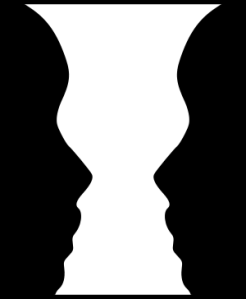 The will involved in magic is much better identified as intentionality, and it’s intentionality that helps our New Year’s resolutions actually succeed. Greer continues: “Real will is effortless. It corresponds, not to struggle and strain, but to what philosophers call ‘intentionality,’ the orientation of the mind that locates meaning in objects of experience” (20). He gives the example of choosing to look at a window, or through a window at something on the other side. The well-known image of faces or a vase offers a similar instance. It’s by intention that we shift our perception. Strain has nothing to do with it. You perceive the two dark faces in profile looking at each other, or you perceive a white vase on a black background. It’s hard to see both simultaneously. But intentionality lets you shift between them. It’s a choice.
One technique, therefore, for training the will or the intentionality, is to do something simple and comparatively effortless. Set yourself a ridiculously easy task, follow through on it, and record your results. The purpose of this training is to reveal and separate all our defeatist and negative self-sabotaging attitudes from an actual act of intentionality. For instance, five times during the day, stand up, turn three times in a circle and sit back down again. Record the date and time on each instance that you do this.
Now presumably nothing interfered with your success, except perhaps a mild feeling of embarrassment. But you set up an intention, and manifested it without strain. You simply did it. Yoda’s words are apropos here: “Do, or do not. There is no try.” The “trying” is the strain, the effort of will to do something you actually don’t want to do. Intentionality bypasses that. You simply do it because you decided to. This is a form of preliminary magical training: doing small, effortless, things you know you can achieve without strain, in order to gain confidence in intention.
Because intentionality is a choice, not a struggle, many aspects of our lives can come under its influence. Greer continues,
If you face a challenge with confidence, for example, you chances of success are much better than if you face the same challenge full of doubts and worries. Intentionality is the reason why. What the confident person sees as potential opportunities, the worried person sees as potential obstacles, and they are both right, because whether something is an opportunity or an obstacle usually depends on how you choose to approach it (Greer, 21)
— that is, on your intentionality.
We use a form of magic whenever we make a resolution — in this sense, we’re all magicians at work.
The difference between intentionality and ordinary ideas of willpower explains many of the failures that bedevil beginners. When you try to use magic to will the world into obedience [in the case of a resolution, you will yourself to change your own behaviors and habits — ADW], you set up an intentionality of conflict between yourself and the world … The harder you try to make the world obey, the more it fights back, because all your efforts reinforce the intentionality and amplify the conflict. Change your intentionality to one of moving in harmony with the world, and the conflict disappears (Greer, 21).
This is not unfamiliar territory to Christians, either, or shouldn’t be. Jesus says, “Agree with thine adversary quickly, while thou art in the way with him.” “Turn the other cheek,” and so on. In other words, don’t make additional and entirely unnecessary trouble for yourself. Don’t stand in your own way.
Because we often practice “black magic” on ourselves, sabotaging and short-circuiting our own best intentions with negative thinking and self-limiting behavior, and setting up conflicting, opposing intentionalities, we waste time and energy “rowing against the current.” Many beginning magicians
try to use magic to achieve financial prosperity, and it’s common for their efforts to backfire and leave them poorer than they started. Why? In many cases, their magic focuses on wanting what they don’t have. This sets up an intentionality of wanting and not having, and so they end up wanting money and not having it. As with so many things in life, the more energy they put into chasing something, the faster it runs away (Greer, 22).
Because Greer has such insightful and useful things to say about intentionality — and thus resolutions — I want to let him have (almost) the final word:
If you want to use magic to become prosperous, your intentionality has to focus on being prosperous, not on wanting to be prosperous. One effective approach starts with noticing the prosperity already in your life — if you have a roof over your head, three meals a day, and the leisure to read this book, after all, you have more prosperity than half the people on this planet — and letting the change in focus from wanting to having gently redefine your intentionality toward wealth. Another useful strategy focuses on seeing opportunities for abundance around you. This redefines your surroundings as a source of opportunity, and as [our life energy] follows intentionality, and shapes experience, opportunities appear (Greer, 22).
So to sum up, practice intentionality with actions that don’t haul negative habits of thinking along with them. Focus on having and being, rather than on wanting and lacking. Experiment. Use the power of choice to shift consciousness — to see the vase, the faces, or whatever your intentionality is. Repeat as needed.
/|\ /|\ /|\
Images: resolutions and faces/vase
Postscript: when I was searching for the first image, a list of resolutions, I came across pictures of computer screens, too — another meaning of resolution — the pixel resolution or clarity of image that a screen possesses. Likewise, my clarity in visualizing the goal — of having or being what I desire — is key to “keeping” my resolutions. Imagining what it is like being and having what I desire is halfway to my manifesting it. I already know something of what it feels like to succeed. (I’m using this strategy as I revise my nanowrimo draft.)
*”Expecto patronum” — (Latin, literally, “I await a patron/protector”) summons a familiar or symbolic representation of the self to protect one against negative energies, such as Dementors in the HP series. Harry’s patronus is a stag, as was his father’s. Of the three spells I cite above, this one is good defensive magic and actually works well against nightmares. The following is part of the entry from the Harry Potter wiki on the Patronum spell:
A Patronus is a kind of positive force, and for the wizard who can conjure one, it works something like a shield, with the Dementor feeding on it, rather than him. In order for it to work, you need to think of a memory. Not just any memory, a very happy memory, a very powerful memory… Allow it to fill you up… lose yourself in it… then speak the incantation “Expecto Patronum”.
-
—Remus Lupin teaching Harry Potter the Patronus Charm

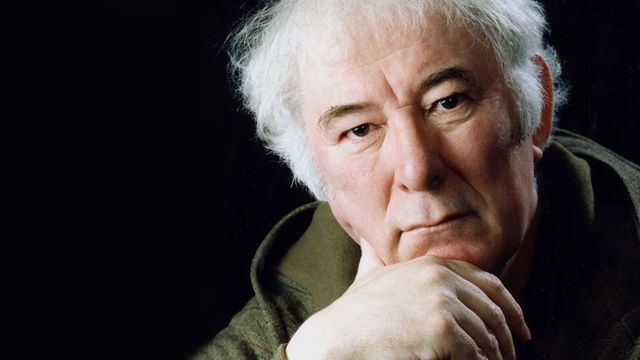 “All I know is a door into the dark,” says Seamus Heaney in the first line of his poem “The Forge.” In some way that’s where we all begin. At three, four, five years old, some things come into our world already bright, illuminated, shining, on fire even. The day is aflame with sun, the golden hours pass until nightfall, and then come darkness and sleep and dreaming. We wander through our early days, learning this world, so familiar-strange all at once. We grow inwardly too, discovering trust, betrayal, lying, love, fear, the pleasure of imagination, the difference between visible and invisible worlds. Which ones do people talk about, admit to themselves? Which ones do people around us ignore, or tell us don’t matter?
 Then in some parts of the world comes another learning, one that typically fills much of our days for the next decade or so: a knowing about, the accumulation in school of facts and statistics and words and ideas, math and languages and art, science and history. Still some experiential learning comes through as a matter of course — Bunsen burners glowing, magnesium and potassium in chemistry doing their flaming and bubbling tricks mixed with other elements. The practice of basketball, baseball, volleyball, football and soccer, the sprints and catches and throws and spins and tricks, the correct forms and personal styles. Wrestling, dance, music, track and field, teaching the body to know beyond thought, to form and shape habits useful precisely when they become habit and no longer demand our full attention.
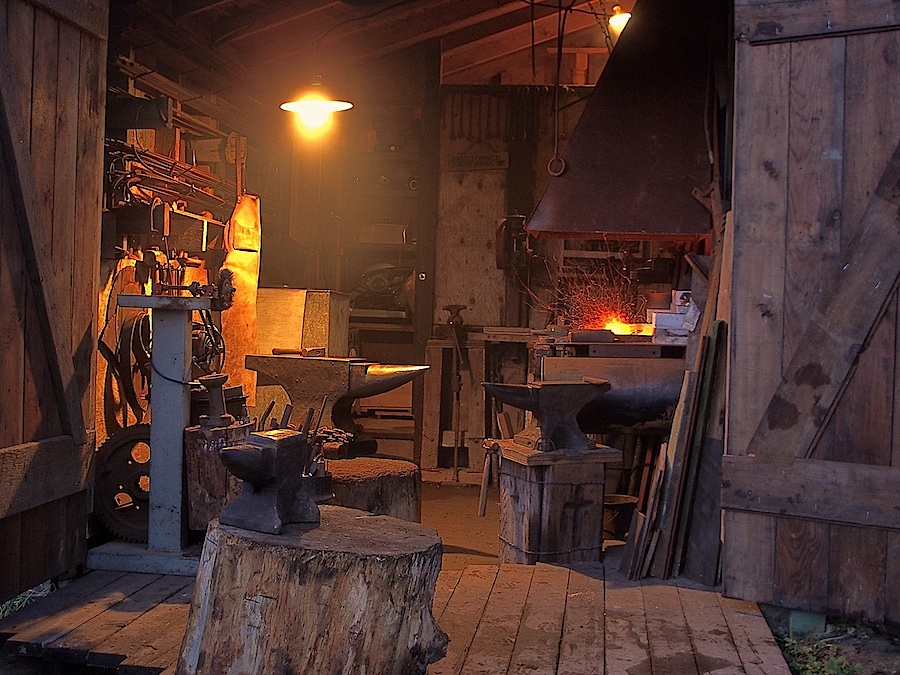 Here’s one opportunity of our human life (there are others) — a door into darkness, a world inside us that is a forge, a place of shaping and molding, of hammering material into a desired form, a place of work and energy and transformation. The door leads to a place where we can find an altar, where we can “expend ourselves in shape and music” and “beat real iron out.” Sometimes it appears others stand there before us; at times, we stand alone, tools scattered about, not always sure of how to proceed, dimly aware, or not at all, of anything like an altar or metal or tools. But here lies a chance at the magnum opus, the “great work” many of us seek, that task finally worthy of all that we are and can do and dream of, a labor that is pleasure and work and art, all at once or at different times.


 A Druid Way