Archive for the ‘initiation’ Tag
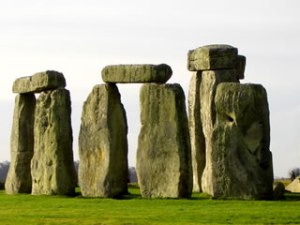
Selfless trilithons
Will Self’s June ’14 article in The Guardian (“Has English Heritage Ruined Stonehenge?“) has recently been (re)making the rounds on Facebook groups I frequent, and the author’s lively reportage offers generous “blog-bites” to quote (starting with that title), so it’s ready grist for the mill of A Druid Way.
In fact, if you just jump straight to his article, read it and — in the way of our Net-lives, surf on to the Next Interesting Thing (a NIT to pick, if there ever was one) — if you neglect to return here, I’ll not only not be hurt but will rest content that I’ve served one of my purposes.
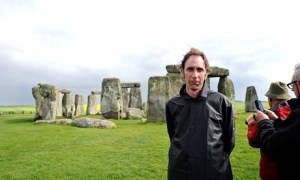
“Selfies with Trilithons”: Will Self visits Stonehenge. Image Mike Pitts, The Guardian.com
I admit to a fondness for titles that use questions.They successfully play on our inherent OCD, setting themselves up like an itch begging to be scratched. They’re Zen koans for the non-Zen types among us. You read them to find out the answer, or at least what the author thinks is the answer, and so you relieve the itch, even if the particular scratch the article provides ultimately irritates you further.
New, worse itch? No problem. The latest diet, scandal, must-see series, sex technique, disaster or investment opportunity all await you, just a click away, and many will use questions to draw you in. The “Top 10” list relies on a similar strategy: human experience boiled down to a concentrate. Just add water! Maybe at best our lives are indeed “selfies with trilithons” and everything else slips downhill from there. Or so a great part of the Western world’s surface culture would have you believe.
The article byline asks, “The summer solstice, King Arthur, the Holy Grail … Stonehenge is supposed to be a site of myths and mystery. But with timed tickets and a £27m visitor centre, does it herald a rampant commercialisation of our heritage?”
You’re being wholly reasonable if you guess Self’s answer is “yes.”
English Heritage earns decidedly mixed reviews here. It’s the U.K. organization that oversees such sites as Stonehenge, and for Self it serves a very mixed role as an institution whose “very raison d’etre consists in preventing the childish public from chipping away at stuff they don’t understand much – beyond the bare fact that it’s very old – so they can cart off a free souvenir, rather than shelling out for a Stonehenge snow globe in the superbly appointed new gift shop.”
“Stonehenge snow globe” works fine as an alternative title for this post.
Self’s wit attacks a range of easy targets besides English Heritage. It’s little surprise Druidry comes in for a smackdown, too. “As inventions of bogus deep-time traditions go, British druidism has to be one of the most enduringly successful.” Except that unlike Stonehenge, all modern forms of Druidry that expect to be taken seriously assert precisely the opposite. They’re comparatively new on the scene, and they dispense with bogusness. They’re no older than the Druid revival of the past few centuries because that’s their real origin story — and this revival coincides point-for-point with rediscovering and wondering about and valuing things like Stonehenge and Avebury and Newgrange. You know — those Neolithic things that have always lurked in the neighborhood and have been with us for a very long time. We just never paid them much attention.
Until we did.
[Even Reconstructionist Pagan groups — who point with some justifiable pride at archaeological and other scholarly evidence to back up their practices and who sometimes sniff disdainfully at groups like OBOD, which draw on both legend and myth and on Druid Revival writings — benefit in the end from the scientific investigations ultimately launched by those same enthusiasms and, yes, those initial misconceptions of the Revival.]
We like our monuments and religions old, though we want our gossip and news “live, local and late-breaking” and our technology to be version X.X + 1 — whatever’s one higher than last week’s version (unless it’s Windows). “Selfie with a trilithon” pretty much sums it up.
But if modern Druids are the philosophical and spiritual equivalent of “the childish public … chipping away at stuff they don’t understand much – beyond the bare fact that it’s very old,” then what is it that we “cart off” from it? A reflected glory from old things? A fine wild-goose-chase for the ego? The illusion of connection with something larger and more lasting? (“All this and more for twelve easy payments of just $39/month! Our representatives are standing by for your call now!”)
These are the surface manifestations of vital and unquenchable hungers that have wakened in large numbers of people, however much a passel of hucksters manages to package and market empty and pricey facsimiles of them. Self does concede that “in important ways the [P]agans and the archaeologists retain a common cause: both groups, after all, venerate the monument, even if it’s in radically different ways.”
Self also contrasts Stonehenge at present with ancient sites:

Midhowe broch
… in the Orkney islands, where I lived over the winter of 1993-4 – I’ve returned many times since – Neolithic remains can seem more significant than the contemporary built environment. A couple of miles from the house I stayed in on the island of Rousay, there’s the ruin of an iron age broch, or fortified dwelling, and beyond this there’s a Neolithic chamber tomb, Midhowe, that’s dated to the third millennium BCE. Midhowe is a large and complex structure, although by no means as obviously important as Stonehenge. It was fully excavated in the 1930s and 40s by Walter Grant (of the distilling family) who owned the Trumland estate on Rousay, which included this site and several other important tombs. Since the roof of Midhowe has long since gone, Grant covered up the exposed stonework with hangar-like structure, but the curious thing is that this doesn’t detract at all from its powerful and brooding atmosphere.
During my times in Orkney I’ve visited a great many of the Neolithic sites. I’ve sat in tombs, laid in them, dreamed in them, and tried to grasp the sort of mindset – whether individual or collective – that’s implied by buildings that took shape over thousands of years, and were built by people with life-spans far shorter than our own. I have felt the wonder – felt it most of all, because at Midhowe there is hardly any of the furniture and signage associated with the modern tourist attraction: no ticket office, no custodian, and only discreet information boards. Apart from in high season, you can visit Midhowe and most of the other great Orkney sites with the confident expectation that you’ll see scarcely another human being.
If, as Self notes, “archaeologists seem fairly convinced that implicit in the Stonehenge’s design is some form of ancestor worship; for us there can be no doubt: we revere the idea of their reverence, we are engaged in a degraded form of meta‑ancestor worship,” then we can also see, in our longing to (re)connect, a “degraded” form of magic. “I don’t want anything to do with magic,” we often say, as we unwittingly absorb endless hours of advertising and political language which constantly attempt to manipulate our desires and emotions with crude magical techniques. We let ourselves be “magicked” but refuse to learn how to practice any “defense against the Dark Arts” — or learn how to do magic well and for our benefit rather than someone else’s.
“No magic — that’s for kids,” we say, as our lives propel us willy-nilly along a path of magical initiation tailor-made for us out of the circumstances of our lives, our likes and dislikes, and our choices. Fate, or freedom? Yes! “When you come to a fork in the road, take it,” as Yogi Berra is reputed to have said.
“I don’t believe in magic,” we say, all the while daydreaming and planning, imagining and remembering — magical techniques in embryo, every one of them. Christian, atheist, Muslim, Pagan, SBNR, or “those who just don’t roll that way” — we all make our ways through these mortal lives which are also lives of manifestation and transformation, the essence of magic.
Author and practicing magician Josephine McCarthy, whose book “Magic of the North Gate” I reviewed here, notes that people react variously to the relative powerlessness that life in Western culture urges onto so many. But often a (paradoxically) powerful personal experience, an abrupt break with the past or the every-day world, sets some of them on a journey. In the first book of her Magical Knowledge series, McCarthy observes:
When a person chooses not to play a part in that circus, they look elsewhere. Some people begin … in search of their own power, some begin in search of knowledge, and some approach that path from a sense of deep instinct.
The beginning of the path … is very much about personal development, be it spiritual, intellectual or self-determination … This is the first rung of the ladder and has many dead ends woven into it … designed to trap and teach them a lesson that is needful for their development … The ‘dead ends’ … are often related to our relationship to power, glamour and ego. We all go through it in one form or another and most climb out of it with a very red face, ready to move on, lesson well learned. There is nothing wrong in making mistakes and doing silly things, it is all part of the learning process. The first rung teaches us about ourselves, our weaknesses and strengths, our true desires and fears, and the real extent of our ability to be honest with ourselves. Remember the words over the door to the temple: Man, know thyself.* The threshold of the temple must be crossed with the intention to be willing to look in the mirror with an open mind and see what is really there. (McCarthy, Magical Knowledge: Book 1, pgs. 30-31)
In the end you cannot study “men,” as C. S. Lewis once observed. “You can only get to know them, which is quite a different thing.” And current trends notwithstanding, we very much need each other’s compassion along the way, given the difficulties and joys of life. That’s an act of High Magic. Given how we all will face death, it’s fair to say we also deserve that compassion from each other. And death? Death is one more potential magical initiation.
/|\ /|\ /|\
Image: selfless trilithon; Midhowe broch.
*Translation of the sign over the Temple of Apollo in Delphi, Greece that read “gnothi seauton.” [Gno- related to English know, Latin cognitio, Greek gnosis. Seauton related to English and Greek auto- meaning “self.”]
McCarthy, Josephine. (2013). Magical Knowledge: Book 1 — Foundations. Oxford: Mandrake of Oxford.
Updated 9 August 2015
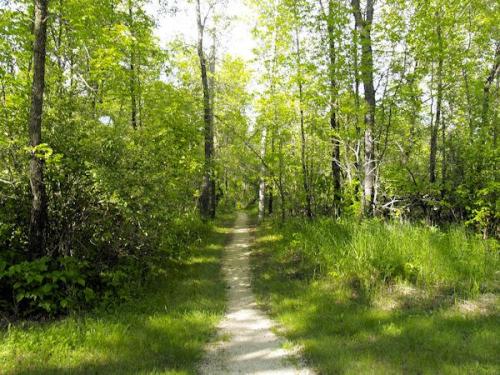
[This lovely image comes courtesy of mistressotdark. And in case you’re wondering: yes, the path sometimes IS this clear, lovely and straight. But we earn these glorious stretches during intervals when everything isn’t sweetness and light.]
Today’s post features an excerpt from Tommy Elf’s moving account of his Bardic journey, framed by his experiences at the first Gulf Coast Gathering in Louisiana this past weekend. His words dovetail with the previous post here about initiation — always a challenge, whether you’re journeying down a solitary path with its own obstacles and opportunities unique to your nature and history, or along a more public walk with Orders like OBOD.
Here are Tommy’s reflections:
Folks, I have been in my Bardic Grade studies for the last seven years. For those seven years, I believed that I could struggle through the material on my own. I rarely asked for help from my tutor/mentor, and stepped back and forth constantly as life had set into time requirements. At this gathering, I opted to have a Bardic Grade initiation – and I am glad that I did so. It has changed my perspective so much. I had the chance to talk with other Bardic Grade folks, as well as my fellow initiates, about their experiences. And I found out that I was not alone in those moments. Furthermore, one of the guests was Susan Jones, the Tutor Coordinator for OBOD. She held a session with all the Bardic Grade members to discuss pitfalls, and various other aspects concerning the course. Listening to other people discuss their experiences helped me to realize that our journeys may be unique to one another, but there are some aspects that are similar. For anyone currently in their Bardic Grade studies, I cannot stress how much help is actually available to you. You just have to reach out and grab it! There is your mentor/tutor, the discussion board, your own grove or study group (if one is near enough to you), as well as other folks within OBOD who are taking their Bardic grade or have already been through it.
Tommy’s openness here contrasts helpfully, I hope, with my own sometimes opaque references to my journey. There’s also a delightful symbolic resonance to his seven years in Druidry — at a crisis moment, the turn comes, and ways open before him. Seven it is. And now the challenge: what next? How do I incorporate this new thing into my life? How do I step into possibility, and not snuff it out by dragging along with me everything I DON’T need? What am I called to do? What CAN I do?
If time truly is what keeps everything from happening at once, and space is what keeps everything from happening here, we have ample reason to be grateful to both, pains though they both often are. Or more elegantly, as I’m fond of quoting Thoreau: “Time is the stream [we] go fishing in …”
/|\ /|\ /|\

Rook and partial eclipse, March 2015. Unretouched photo, Roger Brady, Kinsale College of Further Education, Kinsale, Co. Cork, Republic of Ireland
In this time of balanced energies, an image of bright and dark — rook and partial eclipse at the Spring Equinox.
This morning waking from dream, another image: a shining snake. A little poking around online brought up this fascinating connection from Greywolf’s blogpost for March 19, 2015 (bolded text is Greywolf’s):
The first Solar eclipse of 2015 happens with the New Moon in Pisces, joined by Mars and Ketu. Ketu is the tail of the celestial serpent, Rahu its head. Astrologically, they are the south and north nodes of the Moon. Eclipses occur when the serpent swallows the sun. This eclipse / New Moon will clarify and challenge our beliefs and spirituality, both Pisces themes. When Sun and Moon come together near the Node an eclipse results, producing a momentary disconnection and darkening our power source, the Sun. This literally leaves us feeling in the dark, and we may tempted to pursue the shadow side, or quick fix spiritual solutions, escaping into drug abuse or New Age fantasies. Be careful of such lazy, cynical options during the next 30 days. This eclipse happens in Uttara Bhadra Nakshatra, ruled by the God Ahi Bhudnya, the celestial serpent. This divine cosmic force is associated with clearing the last bits of dirt that are blocking the soul’s liberation.
I will accept this gratefully as divination, a clue to work with in the coming days, a time for (re)dedication.
Equinoxes are ideal times for initiation because of the access to energies they provide as the earth-moon-sun system shifts. A solar system triad!
While initiation can of course take place at any time, there is a formal and cosmic rightness to this twice-yearly period that can empower such rituals, as I know from experience.
Here is John Michael Greer on initiation. (You can read the full article online here — it forms part of a rough draft of his excellent book Inside a Magical Lodge.)
The idea that secrets will be revealed in an initiation creates a sense of expectancy, and can also give rise to a certain kind of fear; both of these are useful in the work of initiation.
The production of this receptive state forms the first phase of the initiatory process. Once it has been reached, the process of lodge initiation moves to a second phase, in which a set of carefully chosen images or events are experienced by the initiate, and then explained. These experiences and their explanations are heightened by the receptive state, and are intended to offer a new pattern for some portion of the initiate’s mental map of the world; the pattern may also be encoded, more subtly, in the underlying structure of the ritual itself. If the initiate accepts this new pattern — which does not always happen — the initiation has “taken.”
At this point, the process enters its third phase. The new initiate is given a set of conceptual, verbal and somatic triggers for the new pattern. Just as a memento from an emotionally charged event in the past can awaken not merely memories but states of emotion and consciousness, these triggers reinforce the new pattern every time they are used. They serve, in an important sense, as anchors for the initiation.
The three-phase process of initiation can be handled in various ways, and has been handled with various levels of effectiveness in the initiations used by different magical and fraternal orders. Like any other art, the art of initiation has its failures as well as its masterpieces. Making the situation more complex is the fact that most orders of both kinds use a series of initiations — the usual terms are “grades” or “degrees” — to carry out an extended program of transformation, each change building on the ones already made. In the fraternal orders, the goal of this program is typically nothing more profound (or more sinister) than basic personal maturity. In magical orders, by contrast, the possibilities for change are far greater.
/|\ /|\ /|\
[Updated 28 May 2020]
[Part 1 | Part 2 | Part 3]

Is either choice more than blind?
Do choices ever present themselves clearly to the self?
You summon your judges of hunch and experience and logic and passion, your own High Court. Finally they’ve assembled, all robed and solemn, but when it comes down to it, often the choice is no choice at all. Or all choices are equally bad. Or indifferent. Nothing to distinguish between them. Or both are good, better in fact than whatever you’ve got right now.
No wonder we resort to oracles and soothsayers, or follow a prophet who shows more than half a chance of being right. Or at least less wrong than everyone else. We must choose, but we can’t. Or the choice itself doesn’t matter. Or it matters supremely. Our lives in the balance. You get it. Familiar human territory. A deep intiation all its own. How many choices you’ve faced — a measure of how far you’re being stretched.
(We say to our young people, “Make good choices.” Sounds wise, but how many of us start out by telling ourselves, “Yes, this time I’m definitely gonna make a bad choice”? OK, one night here and there you decide to throw caution to the winds. You accept things may go wrong — part of the thrill, in fact, till that kind of thrill gets old. But an actual good choice: how is it you make one, exactly?)
I use a Robert Frost poem for my divination today. (What? You have a better oracle? Use it then — but do let us know your results six months or a year from now. That’s only fair.) Frost has served me well in the past, and besides, with a name like that, how can I refuse?! The name itself is a rune, an ogham, a sybil-whisper on my skin. Sounds like he must have chosen it as a stagey pseudonym, part of a poet’s verbal bling, though he didn’t.
Of course, Frost and his poems aren’t garbed in the ivy blessing of centuries, like the Mabinogion is, or maybe the Colloquy of the Two Sages. The old New England sage and his poems can be homely, earthbound, regional. Names matter, yes. And if names are attached to something old and venerable, aren’t a lot of us willing to trust that something, regardless of its actual track record? Safe, familiar.
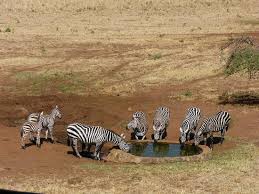 We troop to the old water hole, not because it has water right now at our need, but because it did in the past. Or so solemn voices among us say. But how many skeletons lie around the caked mud of the dried-up hole? And even now we crowd each other to stare and speculate when the water might return, bubbling up clear and fresh.
In “Two Tramps in Mud Time,” Frost writes about splitting wood. In the painful Vermont cold that stalks outside our windows right now, splitting wood and feeding our woodstove is about all I can manage. Set the log up, raise the axe, have at it. The rhythm gives you intervals to think in, and when the axe doesn’t hit a knot, and a single blow neatly drops and divides the wood, your bones and sinews know a rightness hard to find in other realms of living. The physical correlate to choosing, to making a good choice: you feel it.
How often the body knows and takes action before the mind can even begin to engage! How often reflex and instinct save our lives, sparking off the spinal cord before the slow processing of a choice can become a thought. We jump, duck, flinch, blink, dodge, twist, swerve, spin the wheel, slam the brakes — the body saves us so often we’re at a loss when the body itself fails, through sickness or injury or — eventually — death. Old Reptile Brain, we erect no altars to you, though you see us through more disasters averted than we can count. Here is your winter incense, your tribute, your prayers and offerings. Hot cocoa, stews and soups, curries, sauces, butter, wine, hearthstones warm to the touch, wool scarves, light and heat and familiar voices saying Come in, get warm.
Face a choice, and what does the body say? How is it that we know things “in our gut”? Can we “stomach” what we opt to do or not do? One guide for choice, right there. A spiritual barometer we often look past. Too homely, when we want glamour. But especially good at guiding us away from bad choices, if not always toward good ones. Go with your gut.
My choices can often look skewed even from the first moment I face them:
Out of the mud two strangers came
And caught me splitting wood in the yard,
And one of them put me off my aim
By hailing cheerily “Hit them hard!”
And the pause that choice may bring to me, if the spinal column hasn’t already intervened to propel me one way or another, as often as not muddies things rather than clarifying them. “Two tramps in mud time”: my choices.
Good blocks of oak it was I split,
As large around as the chopping block;
And every piece I squarely hit
Fell splinterless as a cloven rock.
The blows that a life of self-control
Spares to strike for the common good,
That day, giving a loose my soul,
I spent on the unimportant wood.
Getting and spending. Is my life only this log-splitting, this routine? It has its rightness and beauty — but right now I’m sick of them. Cabin-fever? Seasonal affective disorder? Hunger for the return of the Light? Sure. Have you felt it, the call to serve something more than this daily routine? Right now the power I might spend for any common good goes to splitting logs. At least it keeps me warm.
The sun was warm but the wind was chill.
You know how it is with an April day
When the sun is out and the wind is still,
You’re one month on in the middle of May.
But if you so much as dare to speak,
A cloud comes over the sunlit arch,
A wind comes off a frozen peak,
And you’re two months back in the middle of March.
Even before I choose, too often I sense the danger of choosing at all. Choice can stun us into inaction. Even thinking about it may throw everything into jeopardy — “if you so much as dare to speak.” But also, that’s just what the season does. One step forward, two back. (Right now, mid-February, I’ll take mid-March gladly.)
The time when most I loved my task
The two must make me love it more
By coming with what they came to ask.
You’d think I never had felt before
The weight of an ax-head poised aloft,
The grip of earth on outspread feet,
The life of muscles rocking soft
And smooth and moist in vernal heat.
Old love. There it is. “The time when I most loved my task” hits me when I see I must give it up. Or when it’s not mine anymore, but belongs to someone else. Or its shape has changed, and I must find it elsewhere, with few clues to guide me. Move along, move along. Oh, where? But no, that’s not yet the end of the story. (“Everything will be all right in the end … if it’s not all right, then it’s not yet the end,” says Sonny in The Best Exotic Marigold Hotel. Nope. Can’t manage sunny in the middle of winter. You ask too much.)
Out of the wood two hulking tramps
(From sleeping God knows where last night,
But not long since in the lumber camps).
They thought all chopping was theirs of right.
Men of the woods and lumberjacks,
The judged me by their appropriate tool.
Except as a fellow handled an ax
They had no way of knowing a fool.
 I long to “know a fool,” even if it turns out it’s me. I can take it. Know things for what they are — that’s half of choosing, right? Because if I can’t do that, how can I choose? Choices come, and everything I’m doing turns “theirs of right.” They claim it all, swamping my direction, my focus, my energy. So I turn to careful, linear logic. An “appropriate tool” for the moment?
Nothing on either side was said.
They knew they had but to stay their stay
And all their logic would fill my head:
As that I had no right to play
With what was another man’s work for gain.
My right might be love but theirs was need.
And where the two exist in twain
Theirs was the better right–agreed.
Here is the claim of need, stronger. After all, we pay attention — right has a price, right is a need. Spinal column says so. Gut may say so. You feel it, that need, creeping along nerves and veins, feathering your skin, the breath of something you can’t yet make out. But real. Hot real.
But yield who will to their separation,
My object in living is to unite
My avocation and my vocation
As my two eyes make one in sight.
That may be what I seek. Right now, though, I don’t even know. What am I yielding to? Separated, fractured, scattered, longing for two to be made one. Not sure I’m the one to achieve it. But worth achieving. We mate and strive to obliterate the division between us, if only for a brief interval. We choose and strive to make our choice the only thing worth doing. We live and strive to make a life worth more than the death that ends it. High stakes. Lower them, oh lower them any way I can.
In the last lines my oracle speaks more clearly. Not sure though if I can listen, if I can hear it.
Only where love and need are one,
And the work is play for mortal stakes,
Is the deed ever really done
For Heaven and the future’s sakes.
Love and need, two guides for choice. I can live with that. I do live with that. So do we all. Faces of the same thing?
This is the Initiation of Choice, sorting out need and love. Difficult initiation. Usually lifelong. We serve it as we struggle with it, and it opens, or delays us till we earn it.
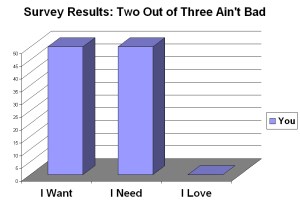 And want? Oh, love and need are enough to grapple with. Need and love will open a space to figure out want, which often takes third place. Probably should, if we’re honest. Though it rarely does, since we bundle need and want into a lump of trouble for ourselves. That old Meatloaf song: “Two Out of Three Ain’t Bad.” Ah, but which two?!
And two questions follow the initiation, which we answer as we can, from out of who we are: Can I love through the choice I need to make? Do I need what I’ve spent my life loving?
Those are the challenge questions of the initiation of choice. I serve my life by how I answer.
/|\ /|\ /|\
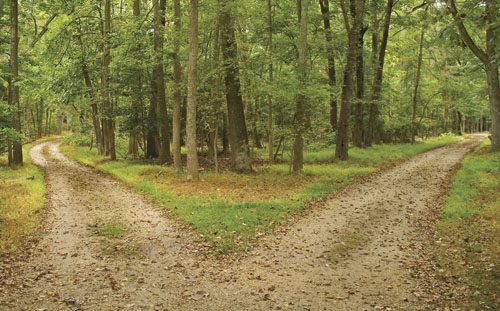
Images: choice — paths; carved in stone; two out of three.
 [Updated 28 May 2020]
[Part 1 | Part 2 | Part 3]
[For a previous series on this topic, go here.]
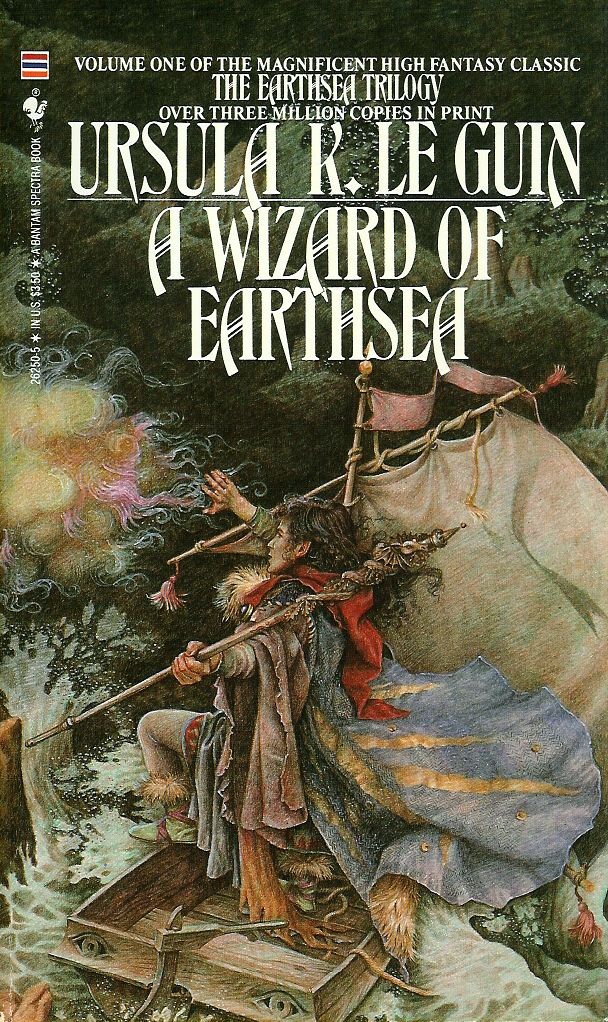
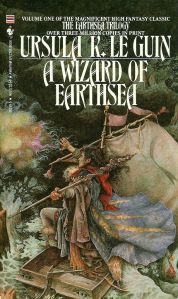
What I want to talk about here, others say well and beautifully, so this post will invoke quotation for these two potent magics. And in anticipation of what’s to come, if you haven’t given yourself the wise pleasure of reading Ursula LeGuin’s fantasy A Wizard of Earthsea, promise yourself you will soon — your library may well have its own copy or can get you one through interlibrary loan — a “magical familiar” as powerful as any in the pages of medieval grimoires.
A “young adult” fantasy, Wizard has as much to say about magical power as any book I know. If you haven’t read it, I’ve tried to avoid spoilers, and I feel I succeeded. And if you know of a book that teaches more than Wizard about these things, please send me the title!
Here’s more from J H Brennan as he continues to recount his first steps in magical training:
What actually attracted me to magic was not service but power. Nothing grandiose, of course. I had no burning ambition to rule the world or enslave hordes of beautiful women. (Well, maybe just one or two beautiful women…) But I was undoubtedly a prey to a disease which is becoming even more prevalent with the increasing complexity of modern society: a feeling of helplessness.
There are many reactions to such a feeling. Some people embrace political credos. Others get religion. A few (usually male) take to beating their spouses. I turned to magic, which seemed to me to be the ultimate antidote: for what is magic if not a secret system which promises control of damn near everything?
You will be desolate to learn it did not work. Although I spent some nine years in daily Qabalistic training and learned a great deal in the process, I remained Clark Kent: no amount of magical leaps into ritual phone boxes could turn me into Superman.
(J. H. Brennan, Foreword, The Ritual Magic Workbook, p. 4.)
If you’re honest, your first reaction to Brennan’s admission may well be, “Then why bother with magic?!”
In fact it’s a deeply legitimate response, tangled with helplessness. In so many peoples’ lives today — I’m thinking only of our own time — so much anger, pain, suffering, despair, all because we sense a deep truth about ourselves, but one that the world does much to discount, deny and distract us from: our spiritual selves are strong. LeGuin captures this wisdom at the outset, in the first chapter of A Wizard of Earthsea. Her mage hero Ged is still young, but even untrained, in a moment of crisis he draws on a profound truth about himself: “He … raged at his weakness, for he knew his strength” (A Wizard of Earthsea, Bantam Edition, 1975, p. 8).
Our detestable weakness never quite overwhelms that inner knowing, though we may well go under without a lifeline, without support, without confirmation, without some practice that sustains us, whether it has the label “spirituality” or not. Despair at not being able to get at our strength has destroyed many lives. It’s cruel, that despair. In our search for a door to the power in us that we dimly recognize, but which seems to elude us day after wretched day, we may clutch at a cause, as Brennan notes — politics, or religion, or magic — or, if we’re half-under already, at abusive behaviors that may not target others in our lives, but ourselves, though all abuse brings “collateral damage.” Which is double-talk for karma.
The appeal, the draw of power, is clear.
Ged’s teacher, a wizard named Ogion, tries to show Ged the realities he faces in a world where power can be used well or badly. After Ged encounters one who uses her power in a questionable way, and has had his own terrifying encounter with a dark spirit just before this conversation, Ogion admonishes him:
The powers she serves are not the powers I serve. I do not know her will, but I know she does not will me well. Ged, listen to me now. Have you never thought how danger must surround power as shadow does light? This sorcery is not a game we play for pleasure or for praise. Think of this: that every word, every act of our Art is said and is done either for good, or for evil. Before you speak or do, you must know the price that is to pay!
When we hear this, it’s too much. More evasion, more powerlessness! We’ve apprenticed ourselves to those who claim to know, and instead of — at last! — affording us even a little taste of power, they scold us for not knowing anything, and set us instead to memorizing, or visualizing, or some other repetitive task that smacks of elementary school drills. (For of course that’s where we are — in school, at a beginner’s level. Again. How long this time?!)
Predictably, Ged rebels. Note what motivates his response:
Driven by his shame, Ged cried, “How am I to know these things when you teach me nothing? Since I have lived with you I have done nothing, seen nothing–”
“Now you have seen something,” said the mage. “By the door, in the darkness, when I came in.”
We seek power, yet once we commit to a magical or spiritual path, often the first thing we meet is darkness. In ourselves. Distinctly not fun.
Ged was silent.
Ogion knelt down and built the fire on the hearth and lit it, for the house was cold.
There it is in plain words — Ogion demonstrates literally the “Path of the Hearth Fire” that is one of the magical and occult paths we can take. And he does it not in words but in actions LeGuin describes — the daily tasks of an “ordinary life” that can be done with magical awareness of their place and purpose, a responsibility that we can serve while we learn — a way that actually leads to our ideal “inner Hogwarts” without fleeing from the obligations of our “mundane” world which have far more to teach us than we know.
Then still kneeling [Ogion] said in his quiet voice, “Ged, my young falcon, you are not bound to me or to my service. You did not come to me but I to you. You are very young to make this choice, but I cannot make it for you. If you wish, I will send you to Roke Island, where all high arts are taught. Any craft you undertake to learn you will learn, for your power is great. Greater even than your pride, I hope. I would keep you here with me, for what I have is what you lack, but I will not keep you against your will. Now choose …”
(A Wizard of Earthsea, Bantam Edition 1975, pgs. 23-24.)
Power greater than pride: Ogion nails the issue. As J. H. Brennan notes, implicating many of us:
The problem with arrogance is that it is a quality for which I have a sneaking admiration. Consequently it plays a greater part in my character than it really should.
(J. H. Brennan, Foreword, The Ritual Magic Workbook, p. 4.)
There’s a whole book of wisdom to be unpacked from Ogion’s words, which deserve extended meditation. I’ll zero in on the last two: “Now choose.” How can we choose before we understand the consequences of choice? As Tolkien says (in talking about translation*), “We constantly need to know more than we do.”
Choice? That’s another post …
/|\ /|\ /|\
Images: A Wizard of Earthsea — cover.
*translating Beowulf. In J R R Tolkien (ed. Christopher Tolkien). Beowulf: A Translation and Commentary. New York: Houghton Mifflin Harcourt, 2014, pg. 191. For much more on this that you probably could EVER want to know, come to the International Medieval Congress in Kalamazoo, MI this May 2015, where I and many others will be delivering papers on Tolkien’s translation — and in my case, on his peculiar theories of “correct style” and how this intersects with his whole legendarium and the power of imagination.
[Updated 28 May 2020]
[Part 1 | Part 2 | Part 3]
During the year and a day of your training, you’ve studied, practiced, visualized, rehearsed, memorized, subjected yourself to physical and psychological tests and disciplines and — perhaps in spite of your own better judgment of your readiness — you’ve finally been chosen as a candidate for initiation.

The day of the ceremony arrives. You may be dressed in a particular ritual way, or you may have bathed and simply be wearing new clothes. Perhaps a single jewel or ring you now wear gives you something you find yourself toying with as you wait. Probably you’ve been given specific instructions to help prepare you and assist you in entering the desired state of consciousness. Or the absence of such instructions has the same effect.
You’re nervous, too, and the other members of the group who are participating in your initiation don’t do anything to dispel that nervousness. In fact, they may be sympathetic and kind to you, and their very kindness will only increase the mystery. What am I getting myself into? you ask yourself. This and other questions are good ones to ask — though they may have no answers.
In many occult and magical orders, potential new initiates face a challenge when they enter the ritual space where their initiation will take place. “What do you seek?” goes one variant of the verbal part of the challenge. Depending on what you’ve been taught or are expecting, the rumors you’ve heard, or the nature of the particular group you’re with, the question can catch you off guard. It’s meant to.
In an intro to an online magical training document by Dolores Ashcroft-Nowicki, J. H. Brennan relates his own experiences, and doubtless those of many other people, here (see pg. 4) . He comments wryly that, not surprisingly, why we seek is often a bigger determining factor in our experience than what.
We all do things for the best possible motives, of course; and nowhere more so than in the esoteric arts. It is relatively easy to discover that the only really acceptable excuse for magical study is embodied in the statement I desire to know in order to serve. That was the answer I was prompted to give to the ritual question during my own initiation. I dutifully gave it; and it was a lie.
What actually attracted me to magic was not service but power.
“I desire to know in order to serve” has its motivations all lined up for inspection. It’s a “good doggy” answer. It’s noble-sounding, and as the “really only acceptable excuse,” it’s comforting to give it and feel good about having such an answer to give. Because in this logical and scientific age of ours, don’t you need an excuse for something as wacky and bizarre as the study of magick — especially spelt with a -k — that doesn’t make you sound like a raving loony?!
So let’s reverse it. “I desire to serve in order to know.”
One of my teachers said this yesterday. It rang true to me because he demonstrates service in what he does, in how he listens to the people he meets, and in how he stills his own agendas and instead of what he thinks, he strives to hear what’s needed. He does these things with humility. And just as important, he models this for others, not as something he turns on to impress others and then drops once he’s “offstage,” but as something he’s continually practicing until it accompanies him, his words and his actions like a fragrance. And that makes you want to do the same.
A few months ago I encountered a goddess in contemplation. I heard her name, an epithet — Stormbringer — and a little more. The only way I can find out more about her is to serve her. Slowly I gain a clearer vision of who she is and why she is manifesting to me, now.
I can enlarge my understanding of service. I serve when I grow — a larger vision spreads its fermentation through human consciousness, because my actions emerge from what I hold in my heart and thoughts.
We serve when, rather than getting bogged down in irritation, anger and fear, we assume a playful approach to problems. Then the lightness of spiritual insight and creativity can lead us to solutions we might not have found on our own. And our playfulness, when it’s respectful of others, can help lighten their loads, too, and smile, if possible, or laugh. We serve in small things, done without thought for anything except the doing, and the doing well.
(OK. Got it. Dang — give you a soapbox and you just don’t let up, do you?)
I serve when I open myself to receive love from others , and find I must “enlarge my spirit to receive the gift,” as Ursula LeGuin describes it in her fantasy A Wizard of Earthsea.
 I serve when I ask to understand the causes underlying an issue or problem in my life, not just to remove the problem so I can get on with my agenda. (Often enough, my agenda is the problem. The apparent problem is a gift, to show me something I need to learn. Otherwise it wouldn’t keep coming back again. And again. Funny how much easier it is to see in other people’s lives.)
Difficult gift, what do you have to teach me? Can I enlarge my heart for you, too? Right now, when you come knocking again, when it’s really not convenient at all? Can I let my impatience dissolve and make my listening a gift to you?
We serve when we recognize ourselves in others, when we recognize others in ourselves, and see the Great Mystery, as the Lakota Sioux call it, the Wakan Tanka, in the eyes of those we meet every day.
We serve when we practice gratitude. A powerful practice I’ve proved to myself: keeping a gratitude journal, with daily entries. Just reading it over can jump start me out of depression and back into engaging my life. Gratitude grows and spreads to others its divine infection.
And so, in serving, what do I know that I didn’t before? Has knowing become less important, and service more?
Now, about power …
/|\ /|\ /|\
Images: guide and initiate; gift in hand.
It’s the end of the year, and like you may be, I’m taking a look back. If A Druid Way inspires or helps or informs others, I’m grateful. My intent is to be a witness to the journey – quite as quirky as yours is, I imagine – opinionated, cranky, full of starts and stops, false steps and helpful insights, along with the odd cul-de-sac, or three, where the unexpected rots, or blooms. That’s where I want to keep my focus.
That’s said, if others opt to read what you write (and why else do people blog, rather than keep a private journal?), you’re no longer talking only to yourself. Obsessing about how to increase your page views isn’t normally conducive to the flowering of intuition and creativity. But knowing what others find interesting can serve as a guide for future topics that may still have some juice in them.
Here, then, counting down to number 1, are the ten most popular posts since I started this blog over three years ago in October 2011.
10. Voices of Modern Druidry. “Druidry is a lively and growing phenomenon, so the following list is by its nature incomplete … Included in the roster of people below are references and links to several of the most visible and influential Druid organizations active today.”
9. DRL – A Druid Ritual Language, Part 1. “Many spiritual and religious traditions feature a special language used for ritual purposes … The heightened language characteristic of ritual, such as prayer and chant, can be a powerful shaper of consciousness.”
8. The Fires of May, Green Dragons and Talking Peas. “Ah, Fifth Month, you’ve arrived. In addition to providing striking images like this one, the May holiday of Beltane on or around May 1st is one of the four great fire festivals of the Celtic world and of revival Paganism. Along with Imbolc, Lunasa and Samhain, Beltane endures in many guises.”
7. Opening the Gates: A Review of McCarthy’s Magic of the North Gate. McCarthy’s book is “characteristically humble, wise, unexpectedly funny, and profound – qualities too often lacking in books on magic. Add to these its emphasis on being of service to the land, and it is altogether a valuable resource.”
6. The Four Powers – Know, Dare, Will, Keep Silent – Part One. “‘All I know is a door into the dark,’ says Seamus Heaney in the first line of his poem “The Forge.” In some way that’s where we all begin. At three, four, five years old, some things come into our world already bright, illuminated, shining, on fire even. The day is aflame with sun, the golden hours pass until nightfall, and then come darkness and sleep and dreaming. We wander through our early days, learning this world, so familiar-strange all at once. We grow inwardly too, discovering trust, betrayal, lying, love, fear, the pleasure of imagination, the difference between visible and invisible worlds. Which ones do people talk about, admit to themselves? Which ones do people around us ignore, or tell us don’t matter?”
5. East Coast Gathering 2012. A good Gathering or Festival “offers a chance for Druids to walk among friends, attend workshops, and” — in our case — “(re)connect with a beloved landscape in northeastern Pennsylvania.”
4. A Portable Altar, a Handful of Stones. “An altar is an important element of very many spiritualities around the world. It gives a structure to space, and orients the practitioner, the worshiper, the participant (and any observers) to objects, symbols and energies. It’s a spiritual signpost, a landmark for identifying and entering sacred space. It accomplishes this without words, simply by existing.”
3. About Initiation. “With energies flowing around us from so many end-of-year holidays and celebrations, it seemed fitting to think and write about initiation. It’s one more piece of a Religious Operating System (ROS), it’s an important key to Druidry and — most importantly — it’s something we all experience. For good reason, then, the subject cuts a large swath through spiritual, religious and magical thought and practice. As author Isaac Bashevis Singer opens his book The Chosen, ‘Beginnings are difficult times.’ That’s one reason New Year’s resolutions often end up on the cutting room floor of the film version of our lives. (Some ways to keep them alive and well and not merely part of the special extended version of our lives that may not see wide release into the “real” world will be the subject of a post upcoming in the next few days.)”
2. Shinto—Way of the Gods. “Almost two decades ago now, in the early 1990s, my wife and I lived for a year in Hikone, a medium-sized city in central Japan, about an hour’s train ride north of Kyoto. The city’s most visible claim to fame is Hikone Castle, a 380-year-old wooden fortress that dominates the downtown skyline. But the most enduring memory I took from Japan and have never forgotten is the profound impression of its many Shinto shrines — roughly 80,000 of them, according to various sources — that dot the landscape and invite the casual visitor as well as the reverent worshiper.”
1. Fake Druidry and OGRELD. “I’m a fake Druid. So is everyone else who names Druidry as the path they walk. And I’ve come to love it.”
Thank you, everyone, for reading and following, for your comments, for over 21,000 page views and 500 likes, and for the encouragement these give me to keep exploring. (Early) Happy New Year to you all!
/|\ /|\ /|\
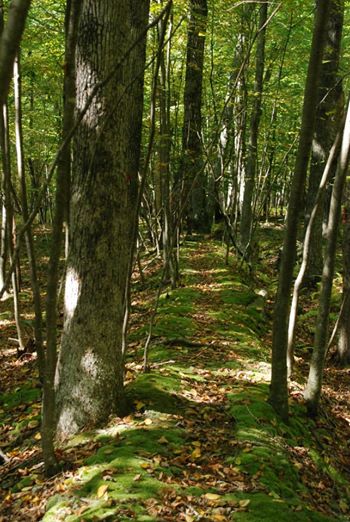
Camp Netimus path — photo courtesy of Carolyn Batz
[Here are reviews of ECG 12 and ECG 13.]
East Coast Gathering (ECG) ’14 just celebrated its fifth Alban Elfed/ autumn equinox in the wooded hills of NE Pennsylvania. Along with this year’s theme of “Connecting to the Goddess,” 114 people reconnected to each other and the land, the lovely land. New participants and old remarked on the kindness of place, the welcoming spirit of Netimus, a flourishing girls’ camp founded in 1930 that now plays host off-season to other groups, too.
[For another perspective on this year’s Gathering, visit and read John Beckett’s excellent blog “Under the Ancient Oaks.”]
After a wet summer in the Northeast, the camp showed richly green — mosses, lichens, leaves and light all caressing the gaze wherever you looked. And keeping to our tradition of inviting guests from the U.K., we welcomed Kristoffer Hughes of the Anglesey Druid Order and returning guests Penny and Arthur Billington, this time accompanied by their daughter Ursula, a mean fiddler with Ushti Baba (Youtube link).
For me what distinguished this year’s Gathering, my fourth, was the pure joy in so many people’s faces. And it just grew over the weekend. Over and around travel fatigue, colds, tricky schedules and stresses and waiting commitments — everything — they didn’t matter: the tribe was together again. To you all (from an interfaith week I participated in): “Thank you for the blessings that you bring. Thank you for the blessings that you are.”
/|\ /|\ /|\
Dana’s Goddess Shrine in a tent on our ritual field was also a wonderful addition and a focus for many of us.
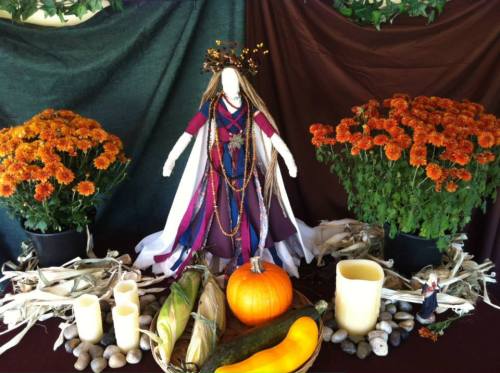
Goddess Shrine — photo courtesy of Nadia Chauvet
Natural offerings accumulated over the weekend — mosses, lichen-streaked stones, acorns, leaves, a small sun-bleached animal skull — were returned to Netimus, and the other items packed up for next time. A workshop I led, on making a Goddess Book, drew me back to the shrine several times for reflection and inspiration. (Here’s the link I mentioned at Camp to a video on making the “Nine-Fold Star of the Goddess” — seeing the steps in 3D should help make my hand-drawn images on the handout easier to read once you practice a few times. A series of divinations and meditations were to follow which I never got to in the workshop — though over-planning is usually better than under-planning. Material for a subsequent post!)
I continue to meditate on a surprising goddess experience during Penny’s workshop, which I may be able to write about in an upcoming post. One of the potencies of such gatherings of like-minded people is the spiritual crucible that can form and catalyze discoveries in ways not always easily accessible in solitary practice.
/|\ /|\ /|\
Our fire-keepers outdid themselves this year, building enormous pyres (one with an awen worked in wood) to provide the centerpiece of each evening’s gathering after supper, workshops and initiations had concluded.
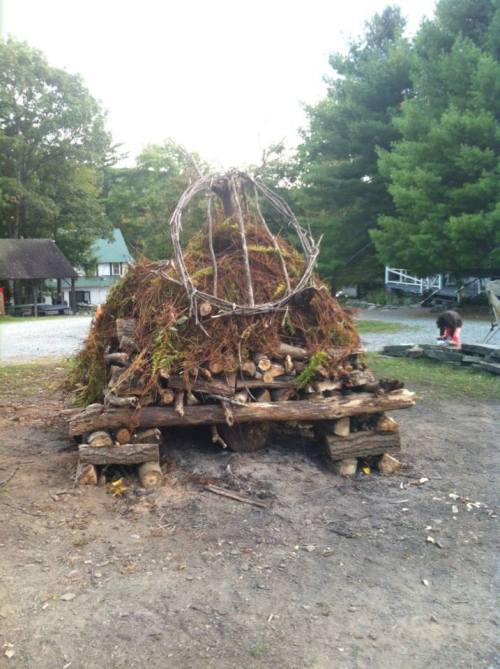
Awen bonfire ready — photo courtesy Nadia Chauvet

evening bonfire — photo courtesy John Beckett
As always it’s people who carry the spirit of Druidry. Here as they tour New York City, just prior to the camp, are Kristoffer, Renu, Ursula, Penny and Arthur.
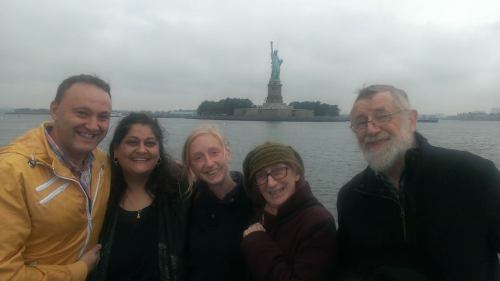
Renu with our UK guests in NY — photo courtesy Renu Aldritch
[Part One here]
And so the tale unfolds, its apparent focus on the actions of men. But what of Branwen, sister of Bran? She is not merely passive, an unwitting pawn in the hands of her brother, her family.
In her story a second and hidden teaching lies in plain sight, so to speak.
“She tames a starling and teaches it human speech,” goes one version. Such an innocent line. Does she achieve this before her mistreatment begins at the hands of her new husband, Matholwch king of Ireland? During? In either case, her deed stands as a marvel.
The -wen affix in Welsh is one way to form feminine names: Branwen, no less than Bran, is a leader, a bridge. A Raven. For if she tames the starling before she needs it so desperately, foresight and guidance are hers because she listened and acted on them. And if after, to her belong inspiration and determination and a singular courage. To win the trust of a wild creature, to teach it speech, even if it is mimicry, to impress on it the urgency of her plight, to teach or guide it where to fly to find Bran, and on finding him, to repeat the message — each is remarkable alone, to say nothing of all of them together, while being abused and degraded. This is the power of the animal in us, of Raven wisdom.
I do a quick internet search for “raven wisdom” and through a marvel worthy of the story, within seconds “A Bit about the Raven” appears among the links. What are some characteristics of Raven Wisdom, according to the site?
- Rebirth without fear
- Ability to tear down what needs to be rebuilt
- Renewal
- Ability to find light in darkness
- Courage of self-reflection
- Introspection
- Comfort with self
- Honoring ancestors
- Connection to the Crone
- Divination
- Change in consciousness
- New occurrences
- Eloquence
Each of these is apt and fitting, without forcing the issue. Deserving of meditation. Fear would rule you if it could. In Branwen’s case, with abuse and pain and betrayal at the hands of your husband, trapped in another country, all your blood kin, except for your child, across the sea, out of reach. Raven brings rebirth without fear. Branwen realizes the gift of self-possession, and “possessing” the self, a kind of paradox, she — we — have all that is needed.
I’d take a good Black Ops team any day, or barring that, a revolver, you think. And in the short term, these advantages would serve. But how well would they serve? Rescued, delivered, you return to your old life. No change, no growth to speak of, only new sorrow, and harrowing memory. A resolve not to be married off without your consent? Maybe it started as a love match, not just a political marriage. Who can say, from what the story itself offers?
 But if you “learn” from the experience, but do not also transform as a result, you learn not to trust your own judgment, not to trust the judgment of your family who supposedly love you, who launch you into such a disastrous marriage. Not to trust life to bring you home.
Raven offers more. It asks us about our own consciousness, about our attitudes to kinds of wisdom we may not (yet) value, or which we may even disdain or abuse, but which remain as gifts given before we can see and claim them as ours. Raven is nowadays ubiquitous as a Craft name, a Pagan nickname, or initiatory identity. Raven was the first degree of initiation among the devotees of Mithras. And Raven is the trickster and initiator par excellence among traditional peoples of many cultures.
For the story does not end merely in rescue …
Part Three coming soon.
/|\ /|\ /|\
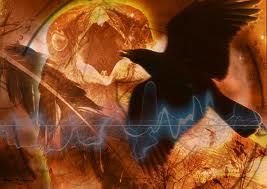
Image: Raven
Go to Part 1 | Part 2 | Part 3 | Part 4 | Part 5 | Part 6 If we long for transformation and seek initiation, we’re looking for it in a culture which, at least in North America, seems short of ready options. One alternative, however, remains open for most people, and that is pilgrimage. Spring stirs it in us. Feel it?  Start small: weekend out of town, morning walk to work, afternoon run around the block. I jog my neighborhood, making it by intention and action a ritual as well as exercise. I greet the morning sun with a line from the Odyssey that resonates for me: “All one brightening for gods and men.” As I round the first corner, I move from brisk walk to jog. Down the hill towards woods and swamp the town must have set aside as unbuildable or protected — no one has tried, at any rate. A blessing on the spirits there, blessings in return back at me. Past the front yard garden of a lovely retired couple, a plot no more than 60 or 70 square feet, that will bloom in another month or so with all manner of flowers, then grow into a climbing, sprawling wonder of vines and stalks and pods, with sunflowers towering golden above the rest. Past the small trim house of the Latino family who has done fine stonework on a retaining wall out front, though they still face snowmelt every winter from neighbors with lots uphill from them, so now I leap puddles gathered in the cracked sidewalk. Each one lush with billions of invisible lives, even in the coolness of early spring, paramecia and bacilli and rotifers. Past juniper and ash and aspen, past the 150-year-old copper beech the school has, thanks be to the Powers who helped, chosen to save and build around rather than over. Here are battles epic and acts heroic, if I only look. Across the main campus intersection, which at this hour is mostly empty, the students still on break. Hundreds making plans to return, my colleagues emerging to photocopy and staple, recharge iPad, dust off class text, take down old classroom posters and put up new ones. The lacrosse fields and baseball diamonds still spotted with nubbly snow. A car passes, the driver waving. I wave back, not recognizing either vehicle or person, but glance at the bumper to see if it’s stickered and marked as a school vehicle. This is my community, my tribe of work.
  Past the chapel, pines spindly and lopped from a hundred years of pruning and thinning, but still there in spite of a campaign to “open up” the campus. But the cut trees once shaded buildings in summer, and cooling bills rose after that. There is my myth, ogre in the far land, troll at the bridge, orc to dodge and trick and slay. Each time I run I tell myself another story, and the landscape holds up each one briefly, then settles it in, saying, “This too belongs, that one also seeks its home.” After about a mile, a turn and a steep hill, the houses shouldering each in miniature plateaus up the incline. I drop to a walk at top — I haven’t run this for a couple of weeks, since the last heavy snowfall, and my loss of wind and tone shows. The next mile flat, past the downtown, the post office and diner and banks. Thousands of lives, feet, hands, eyes seeing much of what I now see, ears hearing earlier sounds of horse and buggy, wagon and cart, and sounds that never change: children, wind, voices we hear from two worlds that are also one. Want bigger myths? Find larger stories to tell, meanings that invest your landscape. I start small, for practice, then turn my thoughts toward Derby, VT, home of my father’s ancestors, a small town north of here by some five hours. I’ve never been; I’m visiting this summer, to walk the graveyard where some of my ancestors are buried. Because at a “cabin-fever” dinner in southern Vermont last weekend, I chanced to hear (there are no chances; everything is chance) a story set in Derby that I took to heart, from Joan who taught there, years ago. Everything, they say, is connected. Not so much a matter of believing as finding out how it’s true. Now the name of the town has been kindled for me. I will visit. Pilgrim, says my life, look around.
/|\ /|\ /|\
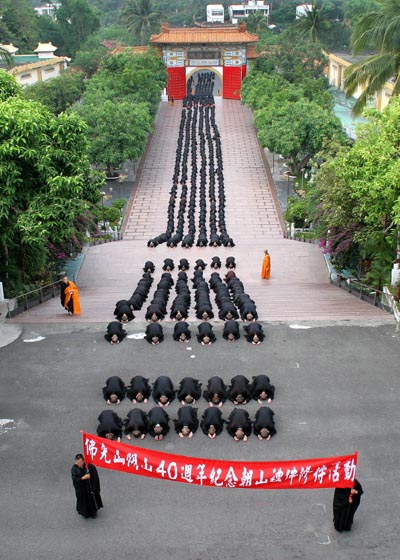
Images: Saint Helier, isle of Jersey; Fo Guang Shan; 2009 spring pilgrimage
Go to Part 1 | Part 2 | Part 3 | Part 4 | Part 5 | Part 6
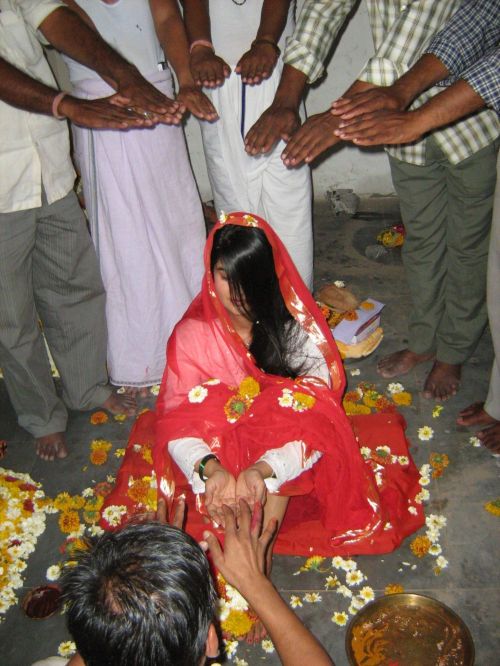 Much of what we can do with initiation consists of bringing the inner experience outward, establishing it in consciousness, so that we can begin to live in and from the new awareness. That can often mean we find ourselves expressing it through light, sound, color, form, in painting, drawing, photography, dance, music, writing, embroidery, etc. — some way to bring that inside stuff into this realm of touch and smell and contact and physical sensation. The correlation doesn’t need to be, won’t be, exact. Doesn’t matter. It’s a bridge to somewhere over the rainbow, where the sidewalk ends, where the path disappears into a pool of still water. Pick(le) your metaphor.

Believing, as the (transformed) saying goes, is seeing. We see it through, we manifest it, because we’ve seen it before, maybe via an inner sense that doesn’t always feel like sight but may come as some other way of knowing. Do we need to be told “what to look for and when” as the cartoon suggests? Only if we’re focused on proof rather than transformation. Only if we’re trying to see somebody else’s vision. Ours, however, is ours — it doesn’t require tricks. (True, it may sneak up on us, or we may be the ones doing the sneaking.) Others may well “believe” it when they see it in our lives, when they have something they can contact that reassures them we’re still grounded here. Even if — or especially when — we’re not, anymore. Or not like we were, exclusively. We’re not freaks (at least usually not obvious ones). But the life that flows through us when we complete the circuit and connect to both poles comes across to everyone. Each person is charged at least a little, whenever any one of us is. The democracy of spirit. The changes come, and with a measure of luck and grace and good weather, we survive this life again, and enough of our loved ones are still with us to carry on.
If it’s a difficult initiation — unwanted or unsought — we may resist the awareness. The divorce, the scary diagnosis, the death of a friend, the chronic pain. But even if it’s the events and timing of the outward initiation that seem to be the launch-pad, the dividing line between our old and new selves, almost always, in my experience, sign-posts and markers of the inner preparation and change have shown up beforehand. We just may not recognize them till later, if at all. Scant consolation when your life falls apart all around. And even less welcome are the well-meaning Others in your life who may let slip that they “saw that one coming a mile away.” (But could we listen, could we hear the warning? Nope. Absolutely not. Don’t want to, don’t tell me, I don’t want to hear it!) Sometimes deafness is protection, the only shield we have at the moment. Compassion for ourselves, for others in that moment, and after.
One of the reasons I maintain this blog is the opportunity it gives me to test and measure some part of my inner worlds against this outer one. After all, this is the world I live in with a physical body, and if I want to use here what I’ve experienced elsewhere and inwardly, it needs to be adapted to the dynamics of this world. This physical life is one pole of the circuit that is our existence. The other pole lies in our inner worlds, but that’s no reason either to discount it or to grant it a superiority over everything else that it doesn’t deserve. Who has explored “everything life has to offer”? I’ve been around for several decades, and I still feel like a rank beginner, like I’m only just starting to do more than scratch the surface. And yet at the same time as doors open, a strange-familiar welcome lies on the other side, like I’m returning to something I’ve always known but haven’t yet walked. Now (first time? second time?) I’m setting foot there.
 In the first branch of the Mabinogion, Pwyll prince of Dyfed encounters Arawn, Lord of the Otherworld, and the exchanges that develop between the two realms profit both of them. It’s a circuit both literal and figurative, as most things are: accessible to the metaphorical part of our minds, but also to our inner senses, if not our physical ones. And sometimes the division falls away and no longer separates the worlds. In the Western Tradition, Samhain or Hallowe’en celebrates just such a thinning of the veil. The Otherworld enters this one, or we journey there in dream or vision, and we become walkers in both worlds. Sometimes this world can then go transparent, and we see both worlds simultaneously, that old double vision that dissolves time and distance and the game of mortality. Then the veil falls again, easy concourse between the worlds slips away, and we resume to our regularly scheduled lives. Except not quite. We’ve changed.
As the old U.S. Emergency Broadcast System (now the EAS) used to say, more or less, “Had this been an actual emergency, you would have received instructions about what to do next,” except that instructions are already hard-wired in our hearts. Listen without listening, and all we get is static. The station has nothing more to say to us. No instructions. It seems like no one’s at the controls. No directions. If we can’t easily access them any longer, out of neglect or fear or ignorance, sometimes there’s a gap between learning about the “emergency” and “receiving instructions ” — a gap of hours, months, years, lives even. Where to go, what to do, how to go on, all become unknowable, impossible, lost to us. And so the ferment works in us, till we’re driven to find out, to quest for wisdom, to cry for vision. And what we ask for, we receive — eventually — as the Great Triad records: Ask and you will receive; seek and you will find; knock and it will open to you. Eventually. Patience, old teacher, maybe the earliest and longest lesson of all. Another face of that strange love that sometimes seems (dare we admit it?) built into things, that will not ever let us go.
Go to Part 1 | Part 2 | Part 3 | Part 4 | Part 5 | Part 6
Updated 15 March 2013
/|\ /|\ /|\
Images: mystical dancer initiation; proof; b&w figures
Go to Part 1 | Part 2 | Part 3 | Part 4 | Part 5 | Part 6
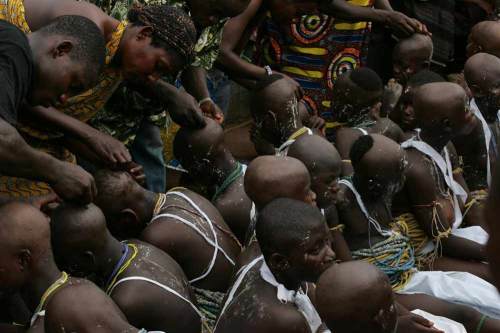 Many people share a hunger for meaningful actions and deeds, choices and moments, in their lives. We especially seem to long for meaning in the face of so many acts in our daily experience that, without the gift of some kind of transformation, can seem so deadly, vacuous and meaningless. We wait in lines, we reflexively check Facebook and email countless times a day, we make the same daily drive to work, we pay the same endless bills month to month, and talk with the same acquaintances who never seem to grow and move beyond their original assumptions and opinions — we tire and bore even ourselves with our own personalities and routines and habits …
The world is too much with us; late and soon,
Getting and spending, we lay waste our powers;
Little we see in Nature that is ours;
We have given our hearts away
as 19th century British poet William Wordsworth remarks in a sonnet named for the first line. That sensation and the force that drives it have only intensified in the intervening two centuries. Whatever stimulant of choice we turn to, we need increasing doses just to keep going: stronger energy drinks, more vivid cybersex, the overhyped fake violence of summer blockbusters, the brief but lovely bliss of cutting and piercing. And if you agree as I do with the adage that anyone who points out a problem is also challenged at least to begin to offer a solution, and not just complain about it, here goes another reflection on initiation. Site stats continue to identify this topic as one of the most popular over the past months — and there are good reasons for this.
How can we start to open up a way forward? In the 24 November 2009 post on his blog, The School of Myth, Martin Shaw identifies three common stages of initiation: severance, threshold, and return — a sacred triad all its own.
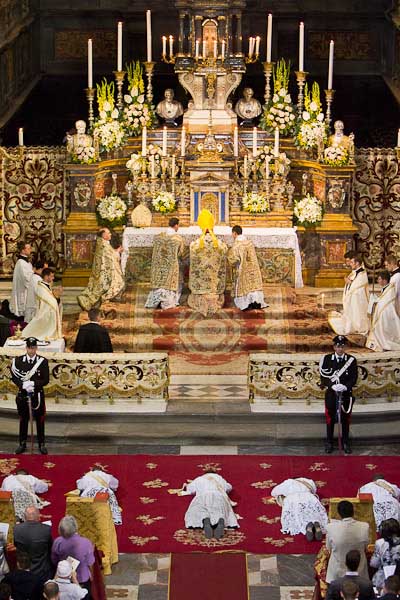
Shaw astutely diagnoses us: so often we’re addicted to severance, while never moving beyond it to the next stage of initiation. We know how to do this part; we’re severance experts. We endlessly cut ties, get divorced, quit jobs, abandon projects, dump friends, remaking ourselves any way we can, redecorating our homes, tatooing, starving and stuffing our bodies, changing styles, desperate for healing change, for “something more,” for the authentic, the genuine, the real, in a world that, whenever we touch it, feels increasingly plastic. Sometimes only pain feels anything like real. Once a core initial experience of initiation, the doorway, a “shock to the system” because it immersed us in something new, severance is now often the default setting of our lives.
Shaw then focuses on threshold, noting that
Any individual, deprived of certain staples and put into a ritually held disorientation, can open up to the time-honoured fruits of the experience. With Vision Quests, the focus is not on cultural costume or mythic inflation but a whittling away, a search for a certain ‘core’ of you. It is kept empty of any ethnic affectations, but seeks some universal ground of being that is ageless.
At some point in this period of liminality, perceptions of community are radically expanded; personal mirrors are held in moss and rock formations as well as the family and marketplace. The experience of separation from earth diminishes, it has information for you, you are related. This has huge implications in an era of climate change and global warming. It is from the edge of things that wisdom originates — the hope is that the edges of our imagination are porous enough for such dialogue to take place.
So this part of the process seems possible, viable, even crucial for re-negotiating (or re-membering) our relationship to wild nature. The emphasis has to be on the core spiritual and psychological opening initiation offers, rather than a self-conscious aping of cultural costume.
But it is return, Shaw observes, that has become for contemporary humans the hardest of the three stages.
Initiation is a process dependent on grief and focuses on a de-[s]cent, a pulling away, a going down. When we refuse to go down, we run the risk of anaesthetising ourselves. Cultural anaesthetics could be described as engendering a subtle trance, and so the shining and uncertain face of the returning initiate carries a kind of beauty that society is trying to defend itself from — the implications are simply too challenging.
Returnees from initiation threaten the status quo — they’ve seen what others refuse to acknowledge, they’ve confronted what others have no desire ever to face if they can possibly avoid it, because it will mean the end of their carefully constructed lives built on false foundations, on accommodating pain and suffering, on acclimating to misery. And no one wishes to support and nourish and sustain the awareness pouring out of the returnee, the new initiate with the “shining and uncertain face” — or even if they wished to help, they wouldn’t know how. The cultural mechanisms to feed the new initiates more of the kind of energized life they experienced at initiation, and especially the presence of older initiates who have themselves assimilated some of the lessons of their own initiations and can often help the most out of personal experience, are too often lacking.
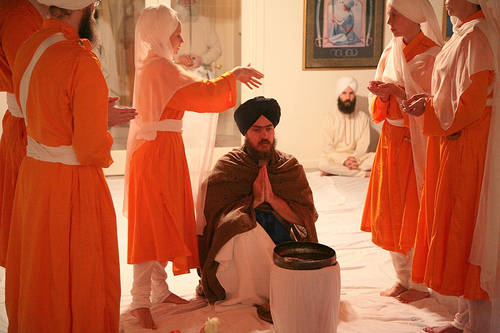 Hence the prevalence and popularity of workshops, retreats, weekends, camps — any means by which initiation can be fostered and even temporarily encouraged to continue its transformation as long as the special group consciousness persists which acknowledges and cherishes and values it. We have an abundance of gurus and guides, true and false, reliable and negligent, like James Ray whose inexperience and carelessness led to deaths of three clients in a sweat lodge during a 2009 retreat. The impulse to induce severance was certainly valid, but its form was too extreme and poorly managed.
One place to begin is to reflect on past initiations and more fully absorb their lessons. Keeping a journal, blog or some kind of record of experience and reflection over time proves invaluable in accomplishing this. Today is a good day to begin. We obsess over what we still need to learn and explore, and if we can’t see these things in our own lives, often we can detect them in others’ — and they in ours. As we become more familiar with the ongoing effects of past initiations, we’re more likely to discern new ones as we enter them — and they exist in abundance in everyone’s lives.
More in coming posts.
Go to Part 1 | Part 2 | Part 3 | Part 4 | Part 5 | Part 6
/|\ /|\ /|\
Images: Ghana initiation; Catholic ordination; Sikh Amrit Sanchar.
Compromises. They get bad press. In this time of American public life, compromise is among the worst of bad words. It’s true that we often seem weakest where we make one. That’s OK, as long as we aren’t blindsided by them, as long as our compromises aren’t destructive to us, as long as we can make them and live with them as conscious acts. But any one of those challenges can pierce us to the core.
As a case in point, I want to address a “local” issue that echoes everywhere. Last December, over a thousand residents in Vermont, New Hampshire and Massachusetts gathered to protest the continued operation of the Vermont Yankee (VY) Nuclear Plant beyond its original 40-year licensing period. There were over 130 arrests, though the protest remained orderly — both protesters and police had prepared months in advance.
As Vermont transplants rather than natives, my wife and I inherited the controversy when we settled here over a decade ago. So first, some details — as unbiased as I can make them, from sources on both sides. A Druid tries to find the multiple tertiaries or neglected alternatives between two opposed binaries, so bear with me here.
First, the pros: VY has been through $400 million of upgrades since it was first commissioned in 1972. These include a 2006 retrofit that allows the reactor to generate approximately 20% more energy than its original design specifies, obviating the need to build other plants or increase fossil fuel use. Vermont relies on the plant for about 30% of its current energy use, and when VY is down for refueling, increased consumption of gas and oil must make up the difference. Decommissioning the plant would require finding other (and mostly more expensive) energy sources to make up the shortfall. Published estimates put the pollution savings over the past four decades of operation at 50 million tons of carbon that VY’s nuclear capacity has avoided dumping into our atmosphere. That clean operation contributes heavily to keeping our famously pristine Vermont air famously pristine. Employment statistics put the number of jobs directly connected with the plant and its operation at around 650 people, and the impact on the state economy in the hundreds of millions of dollars. Obviously, shutting down the plant isn’t just a matter of pulling the plug.
Second, the cons: VY’s design closely resembles the Fukushima reactor in Japan that failed in the 2011 earthquake and subsequent tsunami. The 2006 upgrade that allows VY to generate approximately 20% more energy beyond its original design specs imposes unknown and unstudied stresses on a reactor structure deteriorating in spite of repairs — uncertainties the U.S. Nuclear Regulatory Commission (NRC) admits. The plant stores its spent fuel in containment tanks that are now already at 95% capacity, yet the scheduled recommissioning is for another 20 years. VY sits on the Connecticut River, whose waters ultimately empty into Long Island Sound. An accident to either the reactor or fuel containment pools would not only affect the immediate area of mostly small towns, but carry radiation and waste downstream directly into the middle of major centers of population like Springfield and Hartford, and numerous smaller towns like Greenfield, Deerfield, Northampton and Holyoke, MA, and Enfield, Middletown and Old Saybrook, CT. It would then spread into the Long Island Sound and quickly impact eastern Long Island. Tucking the spent rods and other waste away in “remote locations” like Yucca Mountain is no real solution, only a poor stop-gap measure.
Critics cite a string of mostly minor incidents at the plant over the years — small leaks, structural failures, and accidental discharges, as well as cover-ups, lies, bribery and arrogance in responses by the parent company Entergy, which runs eleven other nuclear plants around the country. Vermont governor Peter Shumlin openly says he wants VY shut down. Entergy’s own website for VY (at www.safecleanreliable.com) addresses safety, somewhat obliquely, with a list of emergency contact numbers and the statement: “The area approximately 10 miles around the Vermont Yankee is called the Emergency Planning Zone. Plans have been developed for warning and protecting people within this 10-mile area.” Within this 10 mile radius live approximately 35,000 people. Yet after the Fukushima reactor meltdown in Japan, the NRC recommended that Japan extend its emergency safety zone radius to 50 miles. The number of people within a 50 mile radius of VY is 1,500,000.
Here’s an aerial view of VY, courtesy of Entergy:

VY may well be shut down in some future election cycle, or it may face a spate of incidents that call into question its safety. It may even run safely (for a nuclear plant) until its all of its operating extensions expire. Until then, unless I and everyone else who benefits from the plant volunteer to cut our energy usage by that 30% that VY generates, and help subsidize a transfer to alternate sources of energy, can we justify our self-righteous claims to “shut it down” with no further personal sacrifice? What are we willing to give in order to get what we want?
Though some people deride our Druid rituals and mock our perspectives about the earth, what we do to the world we do to ourselves in very real ways. The facts can be disputed — the principle operates in full force as it always has. What goes around comes around: we know this, which is why such sayings have penetrated the common language and consciousness. We alive today are part of the world’s karma — our karma, the choices we make and actions we take every day. I turned on the oven to heat my lunch earlier today. Would I be willing to make do with a solar oven, or eat my meal cold, or … any of a number of alternatives?
A Wise One observed that in the last decade the entire world had the opportunity to accept a major initiation — a step forward in consciousness, based in large part on our accepting greater responsibility for our actions and their consequences. As a single aware corporate entity, the world consciousness refused this opportunity. (Was it majority vote?!) Individually we still all grow at our own paces, but we also take part in a world shaped by planetary consciousness as a whole, to which we each contribute a part. We can plainly see the results all around us right now, and whatever we may think of the ultimate causes, they began in human choices. As Gandalf observes (and why shouldn’t a decent movie Druid get his share of press?), if we regret the choices we see and the consequences of those choices which we know many will suffer, “so do all who live to see such times, but that is not for them to decide. … All we have to decide is what to do with the time that is given to us.” And that is enough for any film character, or four-dimensional beings like ourselves. Each life improved is a life improved, and within our circles we can accomplish much of value before we leave this world. It is not our task to redeem the planet. World-saviors appear in flesh and myth to do such tasks. (Unless you’re signing up for the job, in which case you should have been told where to go and what to do. Just don’t ask me.) The time that is given to us is enough to fill with the best that is in us right now — not in some imagined future “when we — or our people — have the power.” To leave the last words again to Gandalf: “[I]t is not our part to master all the tides of the world, but to do what is in us for the succour of those years wherein we are set, uprooting the evil in the fields that we know, so that those who live after may have clean earth to till. What weather they shall have is not ours to rule.”
/|\ /|\ /|\
Go to Part 1 | Part 2 | Part 3 | Part 4 | Part 5 | Part 6
 The circle of a dozen or so Druids in the grove ahead wait in silence as I approach with my guide. Half are dressed in ceremonial garb, and the chief Druid, in addition to her white robe, wears a circlet on her brow. Just below it, three streaks of white descend and splay outward — the three rays of awen*, spiritual illumination and inspiration. They stand out on her tanned skin.
 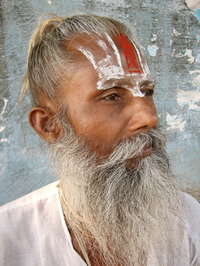 In that instant, other faces flash in my awareness — followers of Vishnu and Shiva, who wear similar ritual tilak, facial markings that identify them as devotees of their god. I know from prior experiences that I have lived past lives in India. Initiation often links us to previous openings of consciousness, a reminder of this long path we walk.
In the same instant, my awareness shifts again. What we do here feels immemorially ancient — the grove, the gathered initiates, the ritual challenge, the spiritual power invoked to seal the rite, the sense of kinship with these people. The circle also feels larger than the number I can see — many who are present come “without their skins on.” The form of the rite is endlessly variable, and yet always the same at heart: Will I accept this opportunity to grow? Even as awe runs its cat-feet up and down my spine, I think how many times I have no doubt answered with my life: “No. I am afraid. Other things matter more. Doing nothing is easier. I don’t like change.” But from these half-beginnings and false starts, and from the times I did inch forward, I have built up a reservoir of spiritual momentum that serves me now. I have grown since those times, willingly and unwillingly. I can do more now, because of what I did then. How much still remains to be seen. But I am newly initiate. I have begun … again.
We cannot readily live in this consciousness all the time without training and discipline. But it serves as a foretaste of what is possible. This is, after all, initiation — a beginning, an open door. How and whether I move forward depends on me.
“You are the best you’ve ever been,” a Wise One tells the disciples gathered to listen and question. I measure this against a nagging sense of having lost much of what I once knew, and could do. Is this an echo of wisdom and achievement I threw away sometime in the past, or an inkling of what lies ahead? If I’m the best now, with the crap I know I have hanging off me, what kind of schmuck was I, oh, say a thousand years ago, or ten lives into the past?! And so we introvert and let our weaknesses decide who we are, rather than knowing they are merely guidelines for where to bring the light, where to put conscious intention rather than unthinking reaction. If I can perceive them, I’m part-way to no longer letting them rule.
Go to Part 1 | Part 2 | Part 3 | Part 4 | Part 5 | Part 6
/|\ /|\ /|\
*Awen (ah-wehn), a Welsh word meaning “inspiration, illumination,” also serves in OBOD some of the same purposes that OM does for meditators in other traditions. As an echo of primordial sound, it is chanted in ceremonies and in private.
The three rays of awen are sometime represented thus: /|\ (I use a triple awen as a text divider and as part of this site’s design.) OBOD uses a three-rayed awen, topped with three dots, as a logo and symbol of the Order.
Image: tilak.
Go to Part 1 | Part 2 | Part 3 | Part 4 | Part 5 | Part 6
I speak for myself, of course. It’s all that any of us can do. But as I approach what is most deeply true for me, I find I can begin to speak true for others, too. Most of us have had such an experience, and it’s an instance of the deep connections between us that we often forget or discount. I’m adding this Part Two because the site stats say the earlier post on initiation continues to be popular.
/|\ /|\ /|\
Within us are secrets. Not because anyone hides some truths from us, but because we have not yet realized them. The truest initiations we experience seem ultimately to issue from this inner realm of consciousness where the secrets arise. Deeper than any ocean, our inner worlds are often completely unknown to us. “Man is ‘only’ an animal,” we hear. Sometimes that seems the deepest truth we can know. But animals also share in profound connections we have only begun to discover. We can’t escape quite so easily.
Our truest initiations issue from inside us. Sometimes these initiations come unsought. Or so we think. Maybe you go in to work on a day like any other, and yet you come home somehow different. Or you’re doing something physical that does not demand intellect and in that moment you realize a freedom or opening of consciousness. Sometimes it can arrive with a punch of dismay, particularly if you have closed yourself off from the changes on the move in your life. In its more dramatic forms initiation can bring with it a curious sense of vulnerability, or even brokenness — the brokenness of an egg that cracks as this new thing emerges, glistening, trembling. You are not the same, can never be the same again.
The German poet Rilke tries to catch something of this in his poem “Archaic Torso of Apollo.” He’d been blocking at writing the poems he desired, poems of greater depth and substance, instead of the often abstract work he’d composed until then, and his friend the sculptor Rodin sets him to studying animals. Rilke admires Rodin’s intensely physical forms and figures, and Rilke ends up writing about a classic figure of Apollo that is missing the head. Yet this headless torso still somehow looks at him, holds him with eyes that are not there. Initiation is both encounter, and its after-effects.
We cannot know his legendary head
with eyes like ripening fruit. And yet his torso
is still suffused with brilliance from inside,
like a lamp, in which his gaze, now turned to low,
gleams in all its power. Otherwise
the curved breast could not dazzle you so, nor could
a smile run through the placid hips and thighs
to that dark center where procreation flared.
I may witness something that is simply not there for others, but nonetheless it is profoundly present for me. Or I see something that is not for the head to decipher, interpret, judge and comment on. There’s nothing there for the intellect to grasp. In the poem, the head of the sculpture of Apollo is missing, and yet it sees me, and I see or know things not available to my head. I feel the gaze of the sculpture. I encounter a god. Or just a piece of stone someone shaped long ago into a human figure, that somehow crystallizes everything in my life for me right now. Or both.
The sensation of initiation can be as intensely felt and as physical as sexuality, “that dark center where procreation flared.” It hits you in your center, where you attach to your flesh, a mortal blow from a sword or a gesture that never reaches you, but which still leaves you dizzy, bleeding or gasping for breath. Or it comes nothing like this, but like an echo of all these things which have somehow already happened to you, and you didn’t know it at the time — it somehow skipped right past you. But now you’re left to pick up the pieces of this thing that used to be your life.
Otherwise this stone would seem defaced
beneath the translucent cascade of the shoulders
and would not glisten like a wild beast’s fur:
would not, from all the borders of itself,
burst like a star: for here there is no place
that does not see you. You must change your life.
You feel Rilke’s discovery in those last lines*, the urgency, the knowledge arriving from nowhere we can track. I have to change, and I’ve already changed. I know something with my body, in my gut, that my head may have a thousand opinions about. I may try to talk myself out of it, but I must change. Or die in some way. A little death of something I can’t afford to have die. There is no place in my life that does not see me, that feeling rises that I can’t escape, and yet I must escape. It’s part of what drives some people to therapy. Sometimes we fight change until our last breath, and it takes everything from us. Or we change without knowing it, until someone who knows us says, “You’ve changed. There’s something different about you. I can’t put my finger on it,” or they freak at the changes and accuse us, as if we did it specifically to spite them. “You’re not the person you used to be,” meaning you’re no longer part of the old energy dynamic that helps them be who they are, and now they must change too. Initiation ripples outward. John Donne says, “No man is an island, entire of itself. Each man is a piece of the continent, a part of the main.” Sometimes it’s my own initiation, sometime I’m feeling the ripples from somebody else’s. The earthquake is in the neighborhood, right down the street, in the next room, here — or across the ocean. But ripples in each case.
Sometimes we “catch” initiation from others, like a fire igniting. We encounter a shift in our awareness, and now we see something that was formerly obscure. It was there all along, nothing has changed, and yet … now we know something we didn’t before. This happens often enough in matters of love. The other person may have been with us all along, nothing has changed … and yet now we feel today something we didn’t feel yesterday. We know it as surely as we know our bones. We can feel the shift under our skin. The inner door is open. Do we walk through?
Go to Part 1 | Part 2 | Part 3 | Part 4 | Part 5 | Part 6
/|\ /|\ /|\
*Mitchell, Stephen, trans. The Selected Poetry of Rainer Maria Rilke (English and German edition). Vintage, 1989.

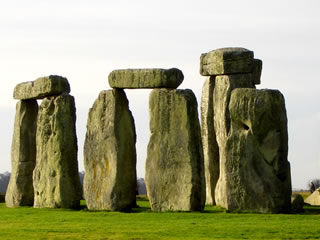
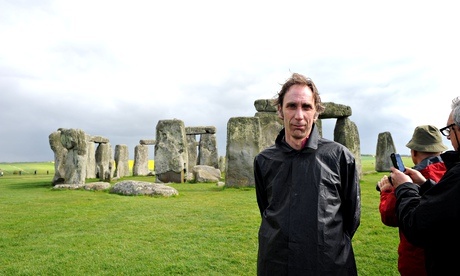
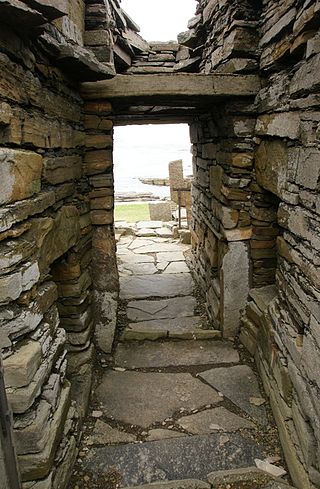
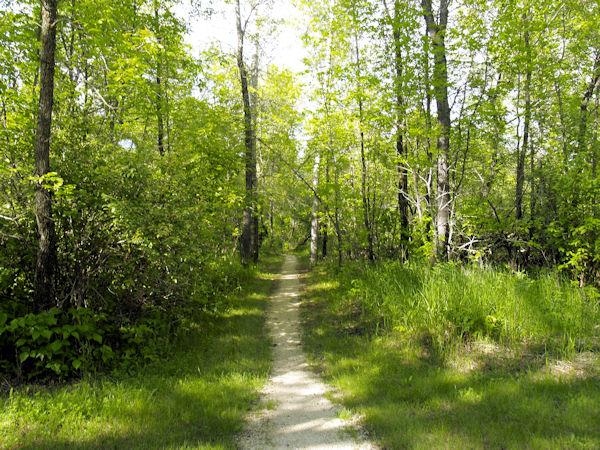

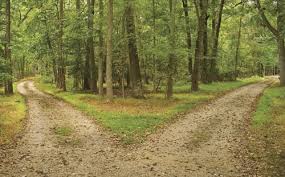
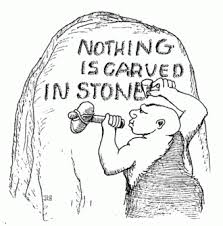

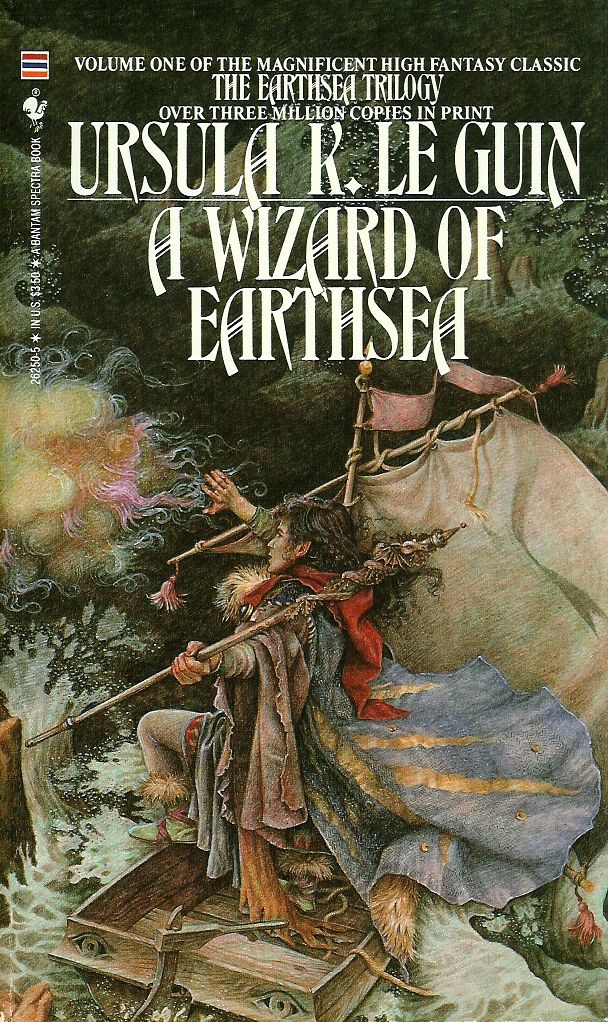

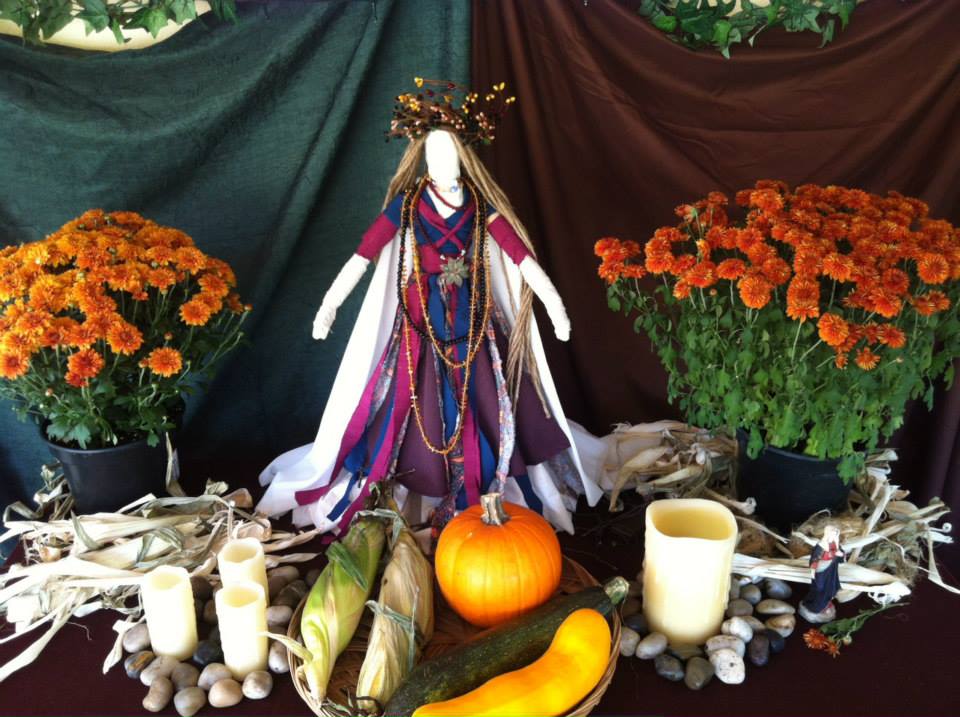
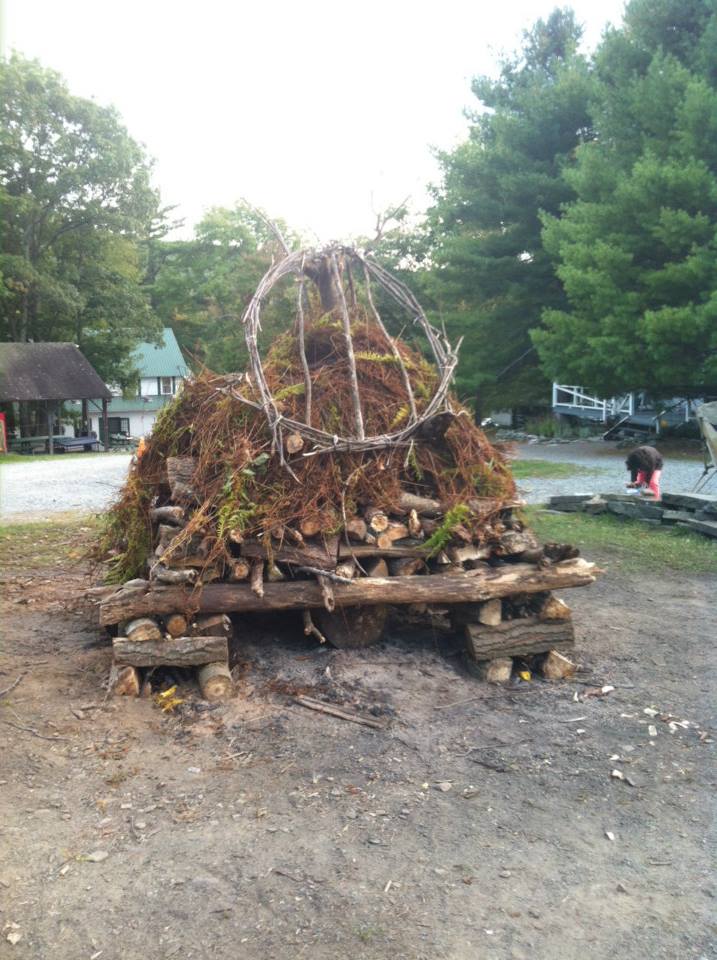
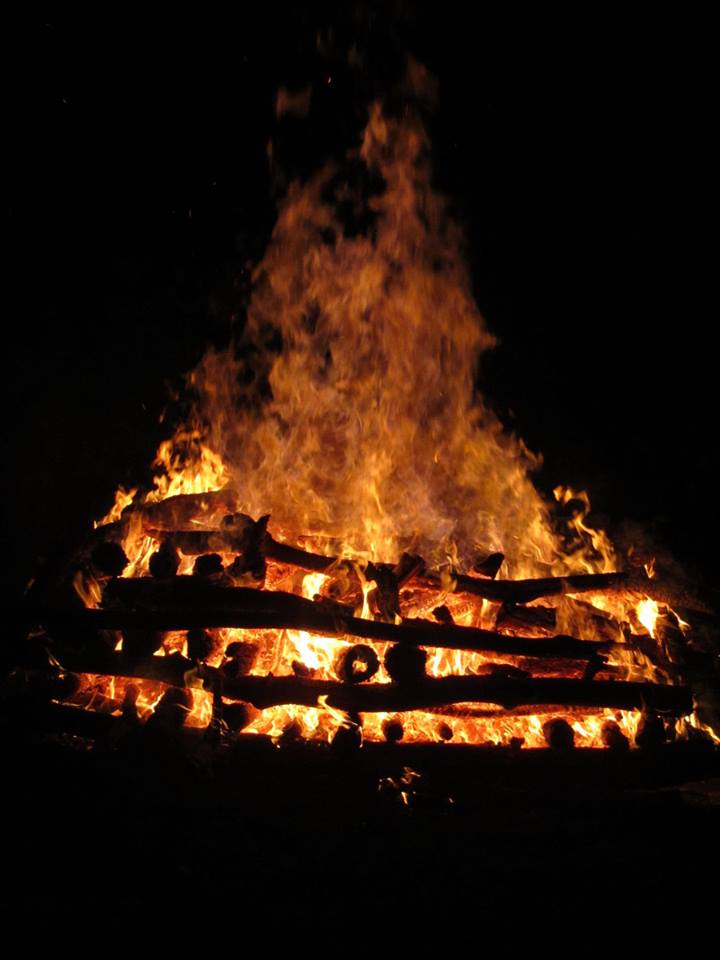
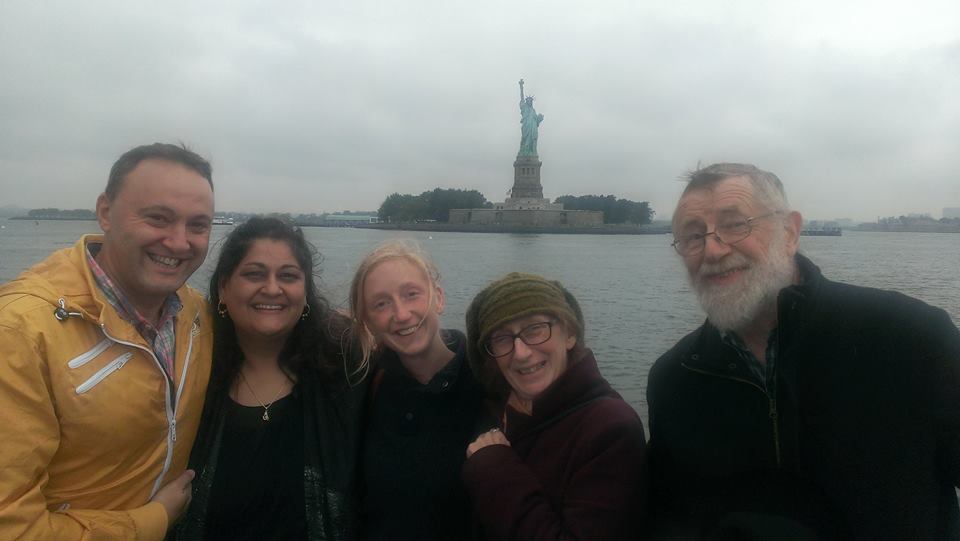


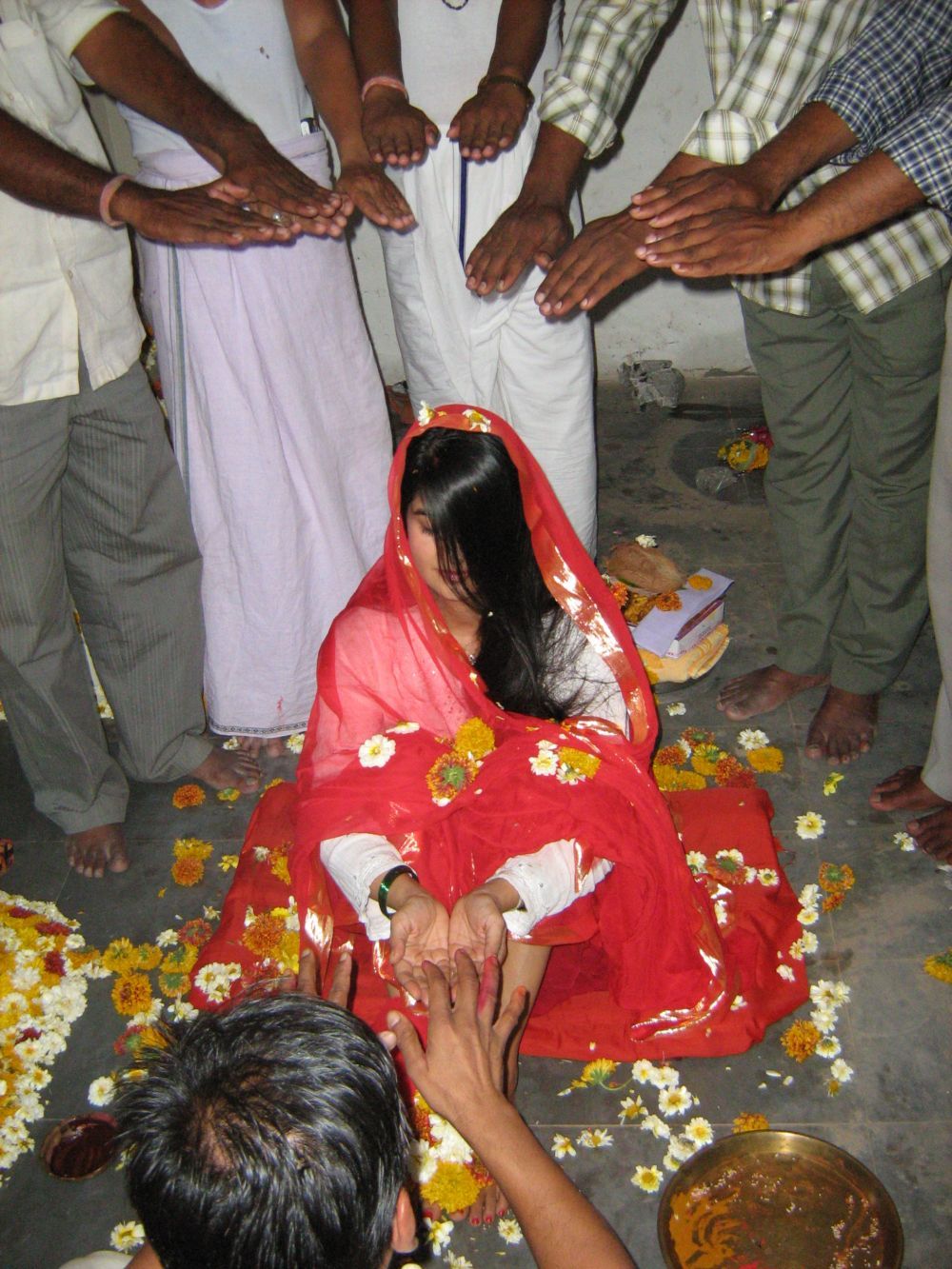




 A Druid Way