Archive for the ‘Druidry’ Tag
[Part 1 | Part 2 | Part 3 | Part 4 | Part 5 | Part 6 | Part 7 | Part 8 | Part 9]
Crying for vision, I step into the forest. Early twilight cloaks me, and mist cloaks everything else. A shiver stalks my spine. I feel something tread nearby with feet heavy as horses’ hooves, yet subtle and delicate as cloud. How it can be both I don’t know. Something breathes on my neck, though when I spin around I know nothing will show. Yet. I know I can freak myself out — I’ve done it lots of times. This is different. It is not fear, at least not fear as I know it. Instead it comes as joy and awe mixed, like the charge of touching the bark of a towering redwood a thousand years old, or the first glimpse of a landscape wholly remade by a night’s snow — beauty unlooked for, encounter with something awake and vital and ancient that I’m paying attention to at last.
How to explain it? Almost anyone listening would think I’m crazy, when all I can do is say “Look! Don’t you see them?!” as they dance and stalk and whirl themselves all around us both. And all the other person can do is shake his head at me, totally ignoring them as they gaze at him and size him up — perplexed, annoyed, amused, indifferent — depending on their natures. I shrug and turn back to them, watching, listening, enjoying and returning their welcome.
/|\ /|\ /|\
Updated 23 April 2015
When the phone call came, she was standing bent over the kitchen table, up to her elbows in pumpkin innards. A crop of volunteers had sprung up in a poorly-turned compost pile. She thanked Spirit for the gift, leaving wherever she harvested pumpkin a small bundle of dried thyme in exchange.
At the first ring, she looked down at her sticky hands, then out the window. A brief scatter of rain still sparkled on grass and leaves outside the kitchen window. Calls these days were almost always marketers. If it was Jack, she could call him back. They still needed to sort out a few things. But she would not rush the day, nor her mood, over answering the damn phone. She did pause at the third ring. Your worst arguments are with yourself, she remembered hearing. No, let the machine take it. She’d had it since high school, the black plastic housing cracked and duct-taped together. The sexless mechanical recording came on. She turned back to pale orange pulp and slimy seeds, slipped a couple into her mouth to chew, imagined them baked and salted. She waited, half expecting the caller to hang up.
The raspy voice on the machine straightened her back all by itself. Cassie, her father’s baritone said. And paused. Cigarette cough, the same. I want … I’d like to talk with you. She didn’t know how she felt. He’d kicked her out … eleven years ago, it was. They’d talked just twice since then. All that weekend’s worth of argument over a festival she’d been determined to attend. She couldn’t even remember its name.
No more of that Pagan crap in this house, he said, finally. I’m sick of it. You go and you don’t come back. They didn’t yell, at the end. Plenty beforehand. Fine with me, she said. She left about twenty minutes later. Didn’t even slam a door. And that was that. But you could have bottled the acid in the air and scoured steel with it.
I’m in Sacramento now. Oh, my number, it’s … She heard him stumble over it. I hope you’ll call back. Another long pause. As if he could hear her thinking, waiting. Not answering. Not wanting to. Cassie. The tug of her name again. Then a click and brief dial tone. She stared bleakly at the red digital 1 that appeared on the messages screen. How much of life was playback.
Outdoors the sky had darkened again, and her mood with it. She knew she needed to breathe and stand in the open air, to listen to something other than her own thoughts. Once outside, she knelt and rested her palms flat on the grass, to give her anger to the earth, not to carry it. Earth, take what I need no longer, teach through weakness what makes stronger. She breathed through the words, said them again, then a third time. She would call him back this evening. At nine, six o’clock his time. Sacramento. What was he doing there? Well, she could wait to find out.
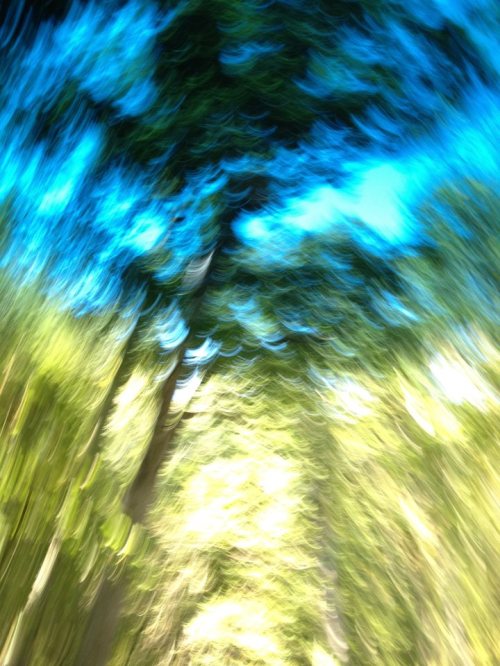 This unretouched image of trees and sky, courtesy of Druid Debbie Brodeur, was taken from a moving car. How much glory lies just behind the “ordinary.” Our eyes insist there’s “nothing new,” while all the time endless wonders dance past us. It’s possible to remember to “look again,” to re-vision things, even a few more times a day. Small steps, to see the world new again.
She was Druid. When she needed to know things, a way would open. She was learning to trust it. Sometimes an opening way asked for patience, and that took work, still. Waiting rarely looked hard when others did it, but she’d done enough herself to know better. A song made it easier, and when she listened a certain way, now and again songs came, tinkling on the air, or roaring out of someplace she didn’t know she’d gone to till she returned with a start, the phone ringing, or her cat Halfpint curled in her lap and kneading one thigh with paws tipped with needle claws. Often the words came later, the melody already running ahead of her, in and around her attention till she got a version down on paper or on her music program.
She was Druid, she knew. It was a long time coming, that knowledge. Sometimes she’d resisted, convinced she was done with paths, and seeking and god-stuff, anything like that. But through it all the gifts kept arriving. Hard ones, and easy ones too. Often enough it meant whatever the land gave her at the moment. For proof, all she had to do was look at her house, filled with stones, bird bones, animal skulls, pressed flowers, carved branches, vervain and basil and mint, garlic and St. John’s Wort and other herbs she was learning as she went. After Jack left with his secretary, she got the little ramshackle two-bedroom house and the six acres of pasture they’d planned to farm, and slowly the once-empty rooms filled with links to the green world outside the door. Inside, too. Spiders in the corners, mice in the walls, squirrels skittering across the tin roof, crows caucusing in the back yard.
Jack. One of the hard gifts. He left, and for a while the emptiness threatened to eat her alive. A big hole she had to stop looking into. No bottom, but walls dark with bitterness. So she stayed busy volunteering and running the food pantry and substituting at the local elementary school, until one day a boy complained about the smell of incense that seemed to follow her wherever she went. “Witch” was the real reason, she heard from a sympathetic colleague. Parents complaining about “that teacher.” Though when the principal called her in “for a little chat,” what he said was they just couldn’t rely on her to be on time. All she knew then was that her morning ritual had just cost her one needed source of income. Hard gift.
A month of therapy, and “you’re stuck in a box labelled ‘wife,'” until she knew she could give herself better advice, and cheaper. When the box is the whole world, then I’m Druid in a box, she thought. And thinking inside the box is a great place to start. Hardly anybody else is in here. They’re all outside, because that’s where they’ve been told they should be. That’s where the clever ones are, the ones who want to be ahead of the curve. Mostly people do what they’re told. But almost always something held her back from doing what everybody else did, shoved her or kicked her sideways. A kind of resistance, a suspicion, a compass set in her belly and spinning her some other way. Ahead of the curve? It was more than enough to be the curve, bird’s wing in the air, crescent moon, arc of water coursing over a falls. The backyard junipers and oaks and one old willow bowing at the sky.
Then it was October, her birth month, and in spite of turning 30 in a few more days, her mood lightened. She could feel a shift coming, something new trying to find her, a little blind, and maybe needing help. She could help it. Listen, she reminded herself. It was one thing she’d finally gotten good at.
To be continued …
One of the challenges for contemporary Druids is to reconnect with the land where we live and find old and new paths of harmony to walk on it.
Back in CT for the coming year, we won’t need right away most of the firewood we’ve carefully stacked in VT, except to warm the house during the occasional weekend jaunt back north to check on pipes and windows, and stay over for a night or two.
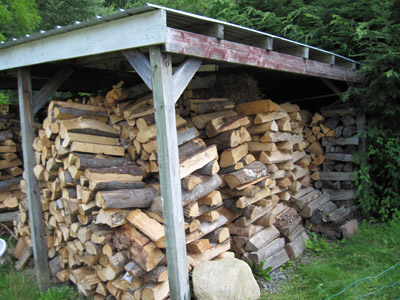 Seeing woodpiles, our own and others’, makes me realize how they’re among the treasures of the landscape, this long-inhabited place it’s our turn to live in and re-learn. Energy for the future. Trees cut locally (to limit the spread of arboreal pests) mean an opportunity for a new generation to leaf and grow. Once almost completely deforested in colonial times, both VT and NH are well-treed now. We get it, our green gold.
And we’ve held on as well, as much of the U.S. has, to the legacy of at least some of the old names and their stories: Ascutney, Memphremagog, Queechee, Maquam, Missisquoi, Sunapee, Ossipee, Winnipesaukee, Monadnock, Merrimack, Nubanusit, Contoocook … and my personal favorite, because my wife tells NH family stories about it, Skatutakee (pronounced skuh-TOO-tuh-kee). The names evoke for me a landscape of moose and bear, autumn fogs and spring mud, glacially fresh chill air and sky-blessed summer days, maple syrup and heirloom apples, blueberries and squash, small town greens and sheer church spires, seasonal tourist hordes and perfect frigid midwinter stillnesses. A marvelous locale to be all Druidy in.
But here in CT I’m drawn back into the local landscape too, the names of trees on campus, copper beech (fagus sylvatica) and charter oak and smaller ornamentals we just don’t see in VT. So I’ve resolved to “meet the locals,” and visit them in all four seasons, as we were reminded at the Gathering to do if we truly want to begin to know them well. My goal is to learn 25 new trees this year. (I’ll let you know how it goes in a future post.)
Digging for the future is putting down roots, knowing your place — not in the submissive way that the expression is used so often, but literally. How many of us have passed years of our lives and never known the trees who provide the oxygen we breathe, and shape the land we pass through and live in? I know it’s many times I’ve ignored them. But once the trees made themselves known to me, it seemed downright rude not to greet them every time I pass by, to cheer them on, if I’m walking to touch them, to cast my affection abroad, rather than hoard it tight in my heart. I dig for the future whenever I lay down a layer of my life that will become part of the contours of next year, or five years, ten years on. Excavation in reverse. Living fully now helps excavate what’s yet to come, brings it into view, lets it breathe and stretch and begin to grow towards its own good self. And trees? Trees were the first Druids.
/|\ /|\ /|\
Updated 26 Sept., 10:27 pm
After my father passed away in the winter of 2008, I wasn’t able to scatter his ashes the following spring as I’d planned. A cancer diagnosis laid me low soon after his final decline, and his childhood home in Niagara Falls in western NY state, as well as the farms he had owned and worked for decades, and where I grew up, were 450 miles from my wife’s and my home and jobs in CT. During my medical journey, we’d also bought a house in VT, and with follow-up radiation and a personal leave from our work, along with numerous loose ends to tie up, there’d simply been no good time. And the task and my intention, if not my father’s, deserved good time.
My dad had always been indifferent about the whole thing. Beyond asking to be cremated, he seemed to feel, perhaps from the many animal deaths and births that inevitably accrue in a lifetime of farming, that one more dead body was something to dispose of, but nothing worth much fuss. “Throw me on the manure spreader when you go out next, and toss me at the back of the cornfield,” he’d always say in his wry way, whenever I asked him one more time about his wishes. That was what we did with the occasional calf that died of pneumonia or scours. In six months, crows and time would eventually leave just whitening bones. But at the time of my dad’s death, we no longer owned the farm, and in any case, beyond a certain undeniable fitness to his request, a desire to make that one last gesture for the good of the land, as human fertilizer, there was the small matter of legality.)
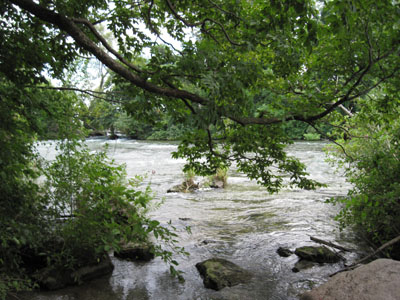
This summer a family reunion in Pittsburgh provided the opportunity to attend to this final matter. My wife and I drove there and back, and on the way out last Friday afternoon, after a slow cruise along Lakeshore Drive that hugs the south shore of Lake Ontario, we made our way to downtown Niagara Falls and then over the bridge onto Goat Island. So around 2:00 pm or so, you could have seen me squatting at the edge of the Niagara River, a few hundred yards above the Falls, on the second of the Three Sisters islands that cling to rocky outcrops in the rapids. The day was overcast but pleasant — typical of western NY, with its delightfully mellow lake-effect summers. Between my feet rested the heavy plastic bag of dad’s ashes, in the plain box the funeral home had provided.
I had nothing to say — no particular ceremony in mind. Words earlier, words around and after his death, words a week or so ago in a dream, but nothing now. This was for experiencing, not talking. Six years before, I’d returned my mother’s ashes to the Shellrock River in the small Iowa town of her childhood. That day, the easy meander of the river, the June sun on my back, the midday stillness, and the intermittent buzz of dragonflies skimming the water lent the moment a meditative calm. As my wife and two of my mother’s cousins watched, I slowly poured the powdery ashes into the river, and the water eddied and swirled as it bore them downstream. Watching the ash disperse downstream, I felt peace. Thus we can go home.
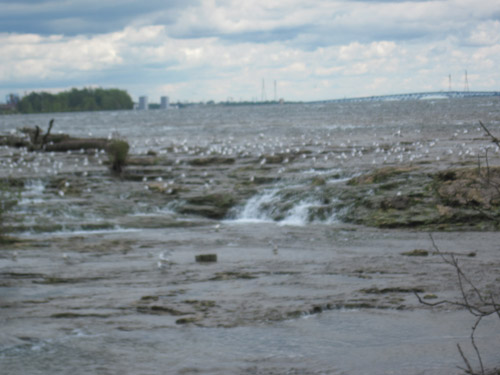
This day was different. A steady damp breeze rustled the leaves of the trees. On another treeless outcrop a short way upriver, the harsh voices of the flock of gulls were only intermittently inaudible over the tumble of water and the dull roar of the falls downriver.
I sat, heels in mud, watching the current on its endless course past and away. When I opened the bag of ashes, a sudden gust of wind caught some and dusted my left arm, which startled me, then made me smile. It was as if my father approved — that behind his gruffness, the elemental beauty of the spot, a family favorite, might matter after all. I brushed off my arm, and then poured the chalky ash into the spinning waters and watched it spread and then, eventually, the water cleared as it washed away.
/|\ /|\ /|\
[Part 1 | Part 2 | Part 3 | Part 4 | Part 5 | Part 6 | Part 7 | Part 8 | Part 9]
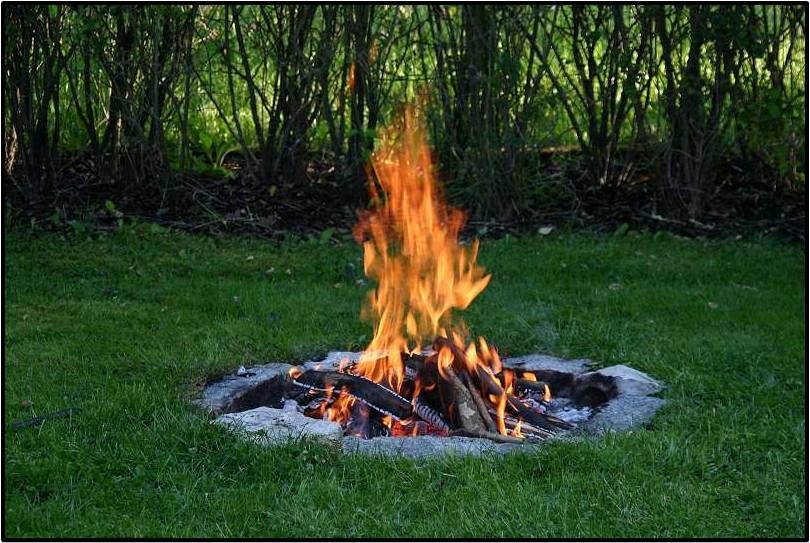
The day was fading into twilight, and I could feel the dew settle around us like a third party at this meeting. “What is your name, master?” I asked him. In a grassy spot near us I made a firepit, seeing and touching the rough gray stones, feeling their weight to make it real. Then I gathered a bundle of sticks and lit a fire, because now there was an evening chill in the air.
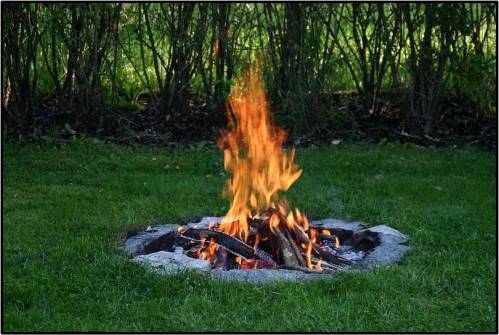
“I’ve been given many names. Some of them I even like,” he said in a wry tone, smiling at me.
Suddenly I knew his name. “Wadin Tohangu,” I said. “That’s an African name?”
He nodded.
“You’re an African Druid? Is there even such a thing?!”
He chuckled at my surprise. “I travel a lot. And you’re as much a Druid as I am.”
This wasn’t exactly the answer I expected. And I wondered what he meant.
“Yes, you may call me Wadin Tohangu. Call on me when you need help,” he said, “or if you wish to talk, as we are doing today.” He spoke English clearly and very well, but the way he said his name, with the slightest accent, set off echoes in my head. A familiar name. I knew it somehow. How?
“It’s a name you can use,” he said, as if in reply to my thoughts. He put his hands out toward the heat of the fire. “It’s as magical as you are.”
“Some days I don’t feel very magical,” I said, and paused. Time always seemed to pass differently in the grove, both slowly, and faster than I expected.
“That’s one key, of course. How you choose to feel,” Wadin answered. “Which things are your choices and which are simply given to you would be helpful to contemplate. We confuse those two quite often. And which to be grateful for, we misunderstand even more!”
“How much can we be grateful for?” I asked.
“That’s a question to answer by experimenting,” he replied. The pile of burning twigs and small branches shifted, settling. “Gratitude is another key.”
“Choices and gratitude,” I said, half to myself.
The dog started barking again somewhere in the distance. I swallowed a flash of annoyance. This was important — I wanted to hear everything Wadin was saying.
“Yes,” he said. “And a third point is attention, as we’ve seen.”
I looked at him.
“For you that dog is a most useful guide,” he said, laughing at my expression. “Why not find out his name, too?”
The darkening sky behind him showed several stars. He stood up. “Each moment offers what we need, both for itself, and for moving on to the next one. How else can time pass?” As I watched the firelight flicker on his face, he said, “Remember these things.”
I looked around at the grove one more time, and when I turned back, Wadin was gone. I stood up. Then I moved to touch the altar and said goodbye to the trees. The fire had died down to glowing embers. I stirred them with a stick, pushing them into the sand of the pit.
The dog was still barking. So I followed the sound back to my room, where it was coming in through a screened open window. I heard a car door slam at Jim’s place, and voices. Then everything was still again, except for crickets chirping in the dark. I turned on a light, and sat there quietly for few minutes, thinking about the experience, and writing it down in my journal.
/|\ /|\ /|\
Updated 23 April 2015
[Part 1 | Part 2 | Part 3 | Part 4 | Part 5 | Part 6 | Part 7 | Part 8 | Part 9]
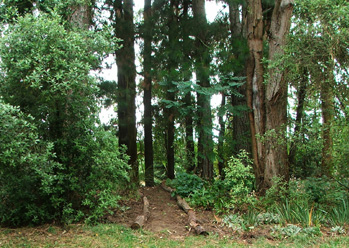
In the grove the Druid sits. In my grove, the one I’ve constructed in an inner world, via imaginal energies. With the tall slender trees of entrance standing on either side of the portal, a space between them wide enough for a single person to pass through. And he is welcome here, though I don’t remember inviting him. He is always welcome, a friend who will never presume.
Today he indulges me by wearing Druid robes — they make him familiar, with his dark brown skin, that homely, beautiful face I would know anywhere — and I relax into our conversation. I know him from somewhere else, too, someplace on the edge of awareness, a realm or time not quite pushing through to full consciousness. He does what he needs to in order to reach those under his guidance, and to put them at ease so that he can work with them. Awe or fear or worship is useless to him. Attention? That he can use.
His words issue from a place quiet and full of listening. I’ve come to trust him instinctively, the way wild animals do in the hands of those who love them with touch and gentleness, a welcome of care and compassion for a fellow being in the worlds. They know that touch, that presence, and their knowing has nothing of the talking human about it. It’s a language older than words.
He knows when to use words, too, and now he’s speaking about a past I’d forgotten. I remember it as he speaks, things I didn’t know I knew, things I have not needed to remember until now, because until now they would find no place in me to live, or have any value or significance. They would feel like they belonged to somebody else, foreign to me, alien, no more at home than a bird of the air caught in a small chamber, fluttering at the windows. What is it that stands between me and freedom, this transparent flat barrier I never knew was there, blocking me, hard as thought? But no, I have no wings, I’m not the bird. But for a moment, there …
The Druid turns to me, a look deep as evening in his gaze. “You are all you have ever been. Do you remember our first meeting, long ago?”
“It was a market,” I said. “And I remember. I was … I was drunk.”
“Sitting slumped against a wall. When I walked by, though, you spoke to me.”
“What was it I said? ‘Keep walking, don’t talk to me now. I don’t have anything left in this life for you.’ Something like that. I was embarrassed. I didn’t even know you.”
“Yet you gave me some fruit from your stand …
“Yes, I remember. A handful of marula.”
“Where were we?” he asked me softly.
“It was … West Africa. Africa was my home then.”
“Yes. What else do you remember?”
But somewhere in the distance a dog is barking. My focus falters, pulls me away from this place and back to my room in our Vermont house. The neighbor’s dog, Jim’s — barking as he always does, every afternoon, impatient for Jim to get home, release him from the chain and walk him, feed him, let him back into the house.
Damn, I think. It’s all gone, the vision’s gone.
But he’s still with me.
“Dogs bark on all the planes,” he’s saying. “They’ll bark, and then for a time they’ll be silent again. You can use them as a guide, or a distraction. Is there a dog barking near this grove?”
I listen. “No,” I say.
“Good. You’re back. Now, let’s continue …”
/|\ /|\ /|\
Image
Updated 23 April 2015
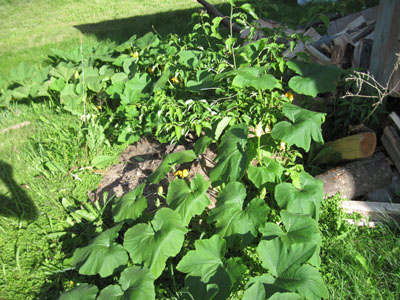 In early June my wife noticed a particularly vigorous shoot rising from an old compost pile beside our woodshed. The squash plant it eventually revealed itself to be has flourished joyfully, spreading in two directions, while the pitiful growths in one of our new raised beds refuse to be coaxed into thriving.
If life gives you lemons, you could make cleaning supplies, ant repellent, pickles, sore throat medicine, laundry whitener, stain remover, fruit preservative, copper cookware restorative, disinfectant — and if you insist, lemonade, too. The dead (cliche) comes to life when our attention lies elsewhere. Practice resurrection, and get used to it.
We hear a lot about growing where you’re planted, but what about everywhere else? The surprise that is our universe so often arrives with the unexpected, the new pattern, the shift, the change. Life does a one-off. It does what it is. (Isn’t that what you are, too — individual, unique, nothing else quite like you? The trouble comes when I or somebody else insists you should be like the rest of us. The universe never “conforms.” It’s simply itself. That’s our pattern too. We are where we come from.) We stand amazed at the burgeoning of vitality in places we doubted it could exist. If we have different plans, life may upset them. A young Christian couple I know, just married, decided they would leave conceiving a child “up to God.” A friend from their congregation remarked, with considerable glee, “They gave it to the Lord, and he gave it right back to them.” She got pregnant six weeks after the wedding.
In the mass of asphalt and concrete that is Route 91, like any superhighway, a few weeds have taken root on the meter-high divider between northbound and southbound lanes, a little way north of Hartford, Connecticut. They’re particularly visible because they happen to be growing just about at eye level as you drive by, and the highway department hasn’t yet set upon them with weedkiller. I give a silent cheer each time I pass, though I know my tax dollars support their eventual extinction. Still … Give them a few years and their roots will begin to split and break down the rigidity of man-made material into the beginnings of something more closely resembling soil. If there’s an “agenda” at work here, it isn’t always a “human” one, though humans are born into such a world, have grown and evolved within and through its shaping patterns, and have lived in it for millenia before they thought to try permanence on a scale the universe doesn’t really support.
Instead of worrying about “what the financial situation will support,” or what our many and often distinctly weird human institutions “demand,” why not ask what moves in harmony with the patterns of the universe? The main reason is we wouldn’t always like the answer. Sometimes we would. But we might find more balanced and sustainable ways of living that would approach “permanence,” which is just a weak version of natural equilibrium. Could we devise a “financial permaculture” that might not jolt us from crisis to crisis? Sure. Will we?
The Dao De Jing winks at us when it makes its observations:
Not exalting the gifted prevents quarreling.
Not collecting treasures prevents stealing.
Not seeing desirable things prevents
confusion of the heart.
The wise therefore rule by emptying hearts
and stuffing bellies, by weakening ambitions
And strengthening bones.
If men lack knowledge and desire, then clever
people will not try to interfere.
If nothing is done, then all will be well.
(Gia-Fu Fen translation)
“Doing nothing” isn’t exactly what Daoism teaches; it’s more along the lines of “unforced action,” or “going with the flow”: wu-wei in Chinese. And can we expect people to succeed by weakening their ambitions? I don’t know; have we ever tried it? In all this there’s a wink and a smile, too. As if that wise voice is saying, “I don’t always mean this literally, of course, but you get the idea …” And who knows?! “Emptying hearts (in a good way) and stuffing bellies” might just pay off. Fill our stomachs, not our heads …
Or take this advice, surely perfect for our U.S. political season:
To talk little is natural.
High winds do not last all morning.
I’ll let Ursula Le Guin’s version of Chap. 27 have the final say here, a kind of diagnosis of how we’ve “gone astray,” that peculiar human thing we can do that the rest of the natural world doesn’t:
Good walkers leave no tracks.
Good talkers don’t stammer.
Good counters don’t use their fingers.
The best door is unlocked and unopened.
The best knot is not in a rope and can’t be untied.
So wise souls are good at caring for people,
never turning their back on anyone.
They’re good at looking after things,
never turning their back on anything.
There’s a light hidden here.
Good people teach people who aren’t good yet;
the less good are the makings of the good.
Anyone who doesn’t respect a teacher or cherish a student
may be clever, but has gone astray.
There’s deep mystery here.
/|\ /|\ /|\
There are many free versions of the Dao De Jing online; the site from which I drew these few excerpts provides several reasonably reputable versions to sample. Sustained meditation on the text (get a couple of versions and let them talk across to each other) can ease stress and open up many doorways and paths. It’s one of my most beloved Druid written resources. Wikipedia’s entry for Tao Te Ching captures some of its qualities: “The written style is laconic … and encourages varied, even contradictory interpretations. The ideas are singular; the style poetic. The rhetorical style combines two major strategies: short, declarative statements and intentional contradictions. The first of these strategies creates memorable phrases, while the second forces us to create our own reconciliations of the supposed contradictions.” If you recall, resolution of supposed contradictions, or finding the tertiary that resolves the binary of “either-or,” is a technique and strategy of wisdom taught in several Druid paths.
 My wife has a designated daily mid-afternoon contemplation period at 2:00 pm. “I made a commitment,” she reminded me again this morning, when we were planning the day and I sweetly noted that her set time conflicted with other tasks that needed doing. While another time would probably serve her better (read “be less inconvenient for the people who live with her”!), I respected her response, because I know how precious an established positive habit is in transforming my own life.
One of the first discoveries almost anyone makes who sets out on a path of spiritual exploration is the apparent initial state of our individual inner worlds. If you make room for some down-time to relax and grab your recommended minimum daily requirement of silence and commune with yourself, you frequently get brought up short:
After an amazingly short time you will most likely feel bored. This teaches us one very useful thing. It gives us insight into the fact that if after ten minutes of being alone with ourselves we feel like that, it is no wonder that others should feel equally bored [with us]! (68)
These words* by Orthodox Christian monk, bishop, writer and spiritual director Anthony Bloom (1914-2003) strike home, for me at least. While boredom is a particularly American problem, it’s not unique to us. Others know it, but with our incessant desire for entertainment and stimulation, to be bored is the prime cause that drives us toward whatever is new. Even information about recent events we don’t yet know about, information which in a different world might actually be more useful to us, is called simply “news.” “What’s new?” we ask. Think about what really is “new.” Are you finding it at 6:00 pm nightly on your media source of choice?
Bloom continues his examination of boredom and the challenges of “inwardness” and stillness:
Why is this so? It is because we have so little to offer to our own selves as food for thought, for emotion and for life. If you watch your life carefully you will discover quite soon that we hardly ever live from within outwards; instead we respond to incitement, to excitement. In other words, we live by reflection, by reaction. Something happens and we respond, someone speaks and we answer. But when we are left without anything that stimulates us to think, speak or act, we realize that there is very little in us that will prompt us to action in any direction at all. This is really a very dramatic discovery. We are completely empty, we do not act from within ourselves but accept as our life a life which is actually fed in from outside; we are used to things happening which compel us to do other things. How seldom can we live simply by means of the depth and the richness we assume that there is within ourselves. (68)
Bloom doesn’t exaggerate about that emptiness in us, and yet of course there are indeed wonderful riches inside us all, just as we suspected. The difficulty I face in accessing them measures out for me how outward-directed I have become. How much I have to dig to regain one darkly shining edge of those inner worlds shows me where I have work cut out for me. (And that itself has become one of my spiritual exercises, rather than wasting time feeling guilty or making unlikely resolutions to do better. When you can’t do anything else, do laundry, or dishes. You’ll get something done that needs doing, ground yourself with a physical act, feel better about how you spent your minutes, and even carve out another space where you realize you can be both meditative and “productive” at the same time.)
As with so many things, balance is priceless. For everything else there may not necessarily be a spiritual MasterCard at hand, but you get the idea. As I’ve mentioned in previous posts (here and here, among others), the challenge of becoming cause in our lives, of living consciously and with intention, is a prime Druid discipline, as it is in almost every spiritual tradition in some form.
Bloom points out an opposite trap we can also fall into. Now that you’ve given yourself the delicious gift of downtime and reflection or meditation or contemplation, whatever you prefer to name it, “you will not be pulled out of it by the telephone, by a knock on the door, or by a sudden upsurge of energy that prompts you to do at once what you have left undone for the past ten years.” And you make another find, when “you discover that the world does not falter and that the whole world — if you can imagine it — can wait for five minutes while you are not busy with it. This is important, because we usually deceive ourselves, saying, ‘Well, I must do it: it is charity, it is duty, I cannot leave it undone.’ You can, because in moments of sheer laziness you will leave it undone for much longer than the five minutes you have chosen” (86-87).
Then at length the gifts of silence and inner discovery begin to open up. But the less I say about them here, the better. You already know what they are, from those rare precious moments when they already manifested to you. What is fleeting can eventually become an atmosphere that accompanies you and cloaks you. Such deep silence rings with a powerful intensity. If you’re fortunate, you’ve met someone who radiates this as a living presence. As the Bhagavad Gita says, “Even a little practice will free you …”
/|\ /|\ /|\
*Bloom, Anthony. Beginning to Pray. Ramsey, NJ: Paulist Press, 1970.
Image
Updated 4:31 pm 7/24/12
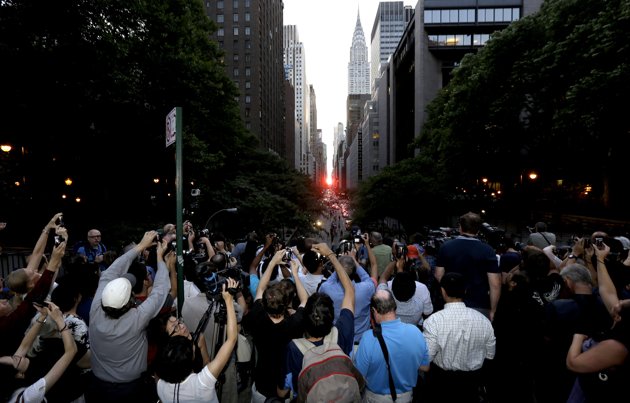
Our green world and ready contact with its natural rhythms can sometimes feel remote in urban settings. Because so many people live in one of the “mega-metro” areas on the planet, their appreciation of the natural world may often burn more brightly than it does for the small-towner who has lived all her life surrounded by cows and trees. With Tokyo, Seoul, Mexico City, New York and Mumbai heading the list at over 20 million souls each (counting their greater metro areas), it’s good to celebrate the green world particularly when it makes itself known among the girders and concrete. The first entry in my “Druid of the Day” series, just started, was a nod in that direction. Manhattanhenge is another one, and much larger:

If you follow Yahoo, you probably caught it. The caption for yesterday’s image reads “The sun sets during ‘Manhattanhenge’ on July 12, 2011 in New York City. The Manhattan Solstice is a semiannual occurrence in which the setting sun aligns west-east with the street grid of the city.” There’s a short sequence of similar images worth visiting.
We need such rhythms — to calibrate our biological clocks, to remind us how the world nourishes and sustains us, and how we need to remember it in our daily decisions — not out of piety for the Earth Mother (though nothing’s wrong with that, of course) but for the very real reason that this world is home. Whenever we can truly celebrate, our hearts open. And in a time when so much “news” doesn’t help us live better, stopping to enjoy the sun looking down the city streets is a good thing.

/|\ /|\ /|\
For those interested in astronomical details and explanations, Wikipedia’s entry for Manhattanhenge helps. The event occurs twice a year, in May and July, on either side of the planetary solstice, as the sun makes its (apparent) journey north and then south again after the solstice.
Compromises. They get bad press. In this time of American public life, compromise is among the worst of bad words. It’s true that we often seem weakest where we make one. That’s OK, as long as we aren’t blindsided by them, as long as our compromises aren’t destructive to us, as long as we can make them and live with them as conscious acts. But any one of those challenges can pierce us to the core.
As a case in point, I want to address a “local” issue that echoes everywhere. Last December, over a thousand residents in Vermont, New Hampshire and Massachusetts gathered to protest the continued operation of the Vermont Yankee (VY) Nuclear Plant beyond its original 40-year licensing period. There were over 130 arrests, though the protest remained orderly — both protesters and police had prepared months in advance.
As Vermont transplants rather than natives, my wife and I inherited the controversy when we settled here over a decade ago. So first, some details — as unbiased as I can make them, from sources on both sides. A Druid tries to find the multiple tertiaries or neglected alternatives between two opposed binaries, so bear with me here.
First, the pros: VY has been through $400 million of upgrades since it was first commissioned in 1972. These include a 2006 retrofit that allows the reactor to generate approximately 20% more energy than its original design specifies, obviating the need to build other plants or increase fossil fuel use. Vermont relies on the plant for about 30% of its current energy use, and when VY is down for refueling, increased consumption of gas and oil must make up the difference. Decommissioning the plant would require finding other (and mostly more expensive) energy sources to make up the shortfall. Published estimates put the pollution savings over the past four decades of operation at 50 million tons of carbon that VY’s nuclear capacity has avoided dumping into our atmosphere. That clean operation contributes heavily to keeping our famously pristine Vermont air famously pristine. Employment statistics put the number of jobs directly connected with the plant and its operation at around 650 people, and the impact on the state economy in the hundreds of millions of dollars. Obviously, shutting down the plant isn’t just a matter of pulling the plug.
Second, the cons: VY’s design closely resembles the Fukushima reactor in Japan that failed in the 2011 earthquake and subsequent tsunami. The 2006 upgrade that allows VY to generate approximately 20% more energy beyond its original design specs imposes unknown and unstudied stresses on a reactor structure deteriorating in spite of repairs — uncertainties the U.S. Nuclear Regulatory Commission (NRC) admits. The plant stores its spent fuel in containment tanks that are now already at 95% capacity, yet the scheduled recommissioning is for another 20 years. VY sits on the Connecticut River, whose waters ultimately empty into Long Island Sound. An accident to either the reactor or fuel containment pools would not only affect the immediate area of mostly small towns, but carry radiation and waste downstream directly into the middle of major centers of population like Springfield and Hartford, and numerous smaller towns like Greenfield, Deerfield, Northampton and Holyoke, MA, and Enfield, Middletown and Old Saybrook, CT. It would then spread into the Long Island Sound and quickly impact eastern Long Island. Tucking the spent rods and other waste away in “remote locations” like Yucca Mountain is no real solution, only a poor stop-gap measure.
Critics cite a string of mostly minor incidents at the plant over the years — small leaks, structural failures, and accidental discharges, as well as cover-ups, lies, bribery and arrogance in responses by the parent company Entergy, which runs eleven other nuclear plants around the country. Vermont governor Peter Shumlin openly says he wants VY shut down. Entergy’s own website for VY (at www.safecleanreliable.com) addresses safety, somewhat obliquely, with a list of emergency contact numbers and the statement: “The area approximately 10 miles around the Vermont Yankee is called the Emergency Planning Zone. Plans have been developed for warning and protecting people within this 10-mile area.” Within this 10 mile radius live approximately 35,000 people. Yet after the Fukushima reactor meltdown in Japan, the NRC recommended that Japan extend its emergency safety zone radius to 50 miles. The number of people within a 50 mile radius of VY is 1,500,000.
Here’s an aerial view of VY, courtesy of Entergy:
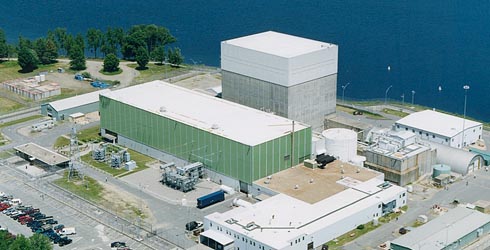
VY may well be shut down in some future election cycle, or it may face a spate of incidents that call into question its safety. It may even run safely (for a nuclear plant) until its all of its operating extensions expire. Until then, unless I and everyone else who benefits from the plant volunteer to cut our energy usage by that 30% that VY generates, and help subsidize a transfer to alternate sources of energy, can we justify our self-righteous claims to “shut it down” with no further personal sacrifice? What are we willing to give in order to get what we want?
Though some people deride our Druid rituals and mock our perspectives about the earth, what we do to the world we do to ourselves in very real ways. The facts can be disputed — the principle operates in full force as it always has. What goes around comes around: we know this, which is why such sayings have penetrated the common language and consciousness. We alive today are part of the world’s karma — our karma, the choices we make and actions we take every day. I turned on the oven to heat my lunch earlier today. Would I be willing to make do with a solar oven, or eat my meal cold, or … any of a number of alternatives?
A Wise One observed that in the last decade the entire world had the opportunity to accept a major initiation — a step forward in consciousness, based in large part on our accepting greater responsibility for our actions and their consequences. As a single aware corporate entity, the world consciousness refused this opportunity. (Was it majority vote?!) Individually we still all grow at our own paces, but we also take part in a world shaped by planetary consciousness as a whole, to which we each contribute a part. We can plainly see the results all around us right now, and whatever we may think of the ultimate causes, they began in human choices. As Gandalf observes (and why shouldn’t a decent movie Druid get his share of press?), if we regret the choices we see and the consequences of those choices which we know many will suffer, “so do all who live to see such times, but that is not for them to decide. … All we have to decide is what to do with the time that is given to us.” And that is enough for any film character, or four-dimensional beings like ourselves. Each life improved is a life improved, and within our circles we can accomplish much of value before we leave this world. It is not our task to redeem the planet. World-saviors appear in flesh and myth to do such tasks. (Unless you’re signing up for the job, in which case you should have been told where to go and what to do. Just don’t ask me.) The time that is given to us is enough to fill with the best that is in us right now — not in some imagined future “when we — or our people — have the power.” To leave the last words again to Gandalf: “[I]t is not our part to master all the tides of the world, but to do what is in us for the succour of those years wherein we are set, uprooting the evil in the fields that we know, so that those who live after may have clean earth to till. What weather they shall have is not ours to rule.”
/|\ /|\ /|\
Go to Part 1 | Part 2 | Part 3 | Part 4 | Part 5 | Part 6
 The circle of a dozen or so Druids in the grove ahead wait in silence as I approach with my guide. Half are dressed in ceremonial garb, and the chief Druid, in addition to her white robe, wears a circlet on her brow. Just below it, three streaks of white descend and splay outward — the three rays of awen*, spiritual illumination and inspiration. They stand out on her tanned skin.
 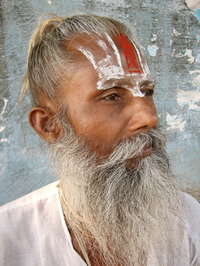 In that instant, other faces flash in my awareness — followers of Vishnu and Shiva, who wear similar ritual tilak, facial markings that identify them as devotees of their god. I know from prior experiences that I have lived past lives in India. Initiation often links us to previous openings of consciousness, a reminder of this long path we walk.
In the same instant, my awareness shifts again. What we do here feels immemorially ancient — the grove, the gathered initiates, the ritual challenge, the spiritual power invoked to seal the rite, the sense of kinship with these people. The circle also feels larger than the number I can see — many who are present come “without their skins on.” The form of the rite is endlessly variable, and yet always the same at heart: Will I accept this opportunity to grow? Even as awe runs its cat-feet up and down my spine, I think how many times I have no doubt answered with my life: “No. I am afraid. Other things matter more. Doing nothing is easier. I don’t like change.” But from these half-beginnings and false starts, and from the times I did inch forward, I have built up a reservoir of spiritual momentum that serves me now. I have grown since those times, willingly and unwillingly. I can do more now, because of what I did then. How much still remains to be seen. But I am newly initiate. I have begun … again.
We cannot readily live in this consciousness all the time without training and discipline. But it serves as a foretaste of what is possible. This is, after all, initiation — a beginning, an open door. How and whether I move forward depends on me.
“You are the best you’ve ever been,” a Wise One tells the disciples gathered to listen and question. I measure this against a nagging sense of having lost much of what I once knew, and could do. Is this an echo of wisdom and achievement I threw away sometime in the past, or an inkling of what lies ahead? If I’m the best now, with the crap I know I have hanging off me, what kind of schmuck was I, oh, say a thousand years ago, or ten lives into the past?! And so we introvert and let our weaknesses decide who we are, rather than knowing they are merely guidelines for where to bring the light, where to put conscious intention rather than unthinking reaction. If I can perceive them, I’m part-way to no longer letting them rule.
Go to Part 1 | Part 2 | Part 3 | Part 4 | Part 5 | Part 6
/|\ /|\ /|\
*Awen (ah-wehn), a Welsh word meaning “inspiration, illumination,” also serves in OBOD some of the same purposes that OM does for meditators in other traditions. As an echo of primordial sound, it is chanted in ceremonies and in private.
The three rays of awen are sometime represented thus: /|\ (I use a triple awen as a text divider and as part of this site’s design.) OBOD uses a three-rayed awen, topped with three dots, as a logo and symbol of the Order.
Image: tilak.
[Earth Mysteries 1 | 2 | 3 | 4 | 5 | 6 | 7]
So here we are at the last installment of this seven-parter. Indigestion and too much caffeine. No, not the series, though you may be thinking or feeling that, too. Looking back over earlier ones I realize each post has gotten more random than the preceding one. Not sure if I’ve done Greer a favor, writing about his seven keys — keys belonging to all of us — but doing it in such a way that they’re more “notes for a revolution” than anything like a review. You can’t just dump a bunch of principles by themselves on people and expect them to see how they fit, exactly. Which is what I’ve sorta done anyway. Inoculation by reading.
Like I said, they’re more notes for a revolution, so that when it comes, you’ll recognize the advance guard and maybe the sound of the explosions and know you’ve seen and heard something like this before, and maybe deal with it better or more inventively than your brother or neighbor out here panhandling and prospecting with the rest of us. “Look what I found! It’s a … well, I don’t have a name for it, but it might be useful at the weekly swap-and-steal.” Heaven consists of the spare parts of creation that didn’t get used elsewhere. We’re destined to mine the scrap heaps for the gold everyone’s tossed there by mistake.
Here goes with the last Law. (Of course it’s never the last law. There’s always another one, like yet another stray that won’t leave, moping around for scraps. Throw it a bone, or a filet. Watch what it does with it.)
“Everything that exists comes into being by a process of evolution. That process starts with adaptation to changing conditions and ends with the establishment of a steady state of balance with its surroundings, following a threefold rhythm of challenge, response and reintegration. Evolution is gradual rather than sudden, and it works by increasing diversity and accumulating possibilities, rather than following a predetermined line of development.”*
A shiver of awe and delight coursed through me when I first read this one. Maybe nobody knows where humanity is headed — it’s not something mapped out beforehand. “The wind blows where it wishes and you hear the sound of it, but do not know where it comes from and where it is going; so is everyone who is born of the Spirit,” says the Beloved Disciple in the eighth verse of his third chapter. (What, you didn’t know portions of the Bible are a Druid stealth device? Look twice before crossing.)
Sure, our DNA has something to say about it, and so do the causes we’re always setting in motion. These will shape our experience and our future. But they’re our causes. We can change. And we want to “accumulate possibilities” because these mean freedom. The dead-end singleness of conformity and bland homogeneity leave us hankering for the quaint, the queer, the mysterious, the odd, the doesn’t-fit, the original, the new, the surprising, the fresh. After all, we left Eden (some versions have us kicked out, but the result’s the same) and we’ve been on quest ever since. But “pave paradise and put up a parking lot”? Not what we really want, is it?
In “To Holderin,” the German poet Rilke writes to a compatriot:
Lingering, even among what’s most intimate,
is not our option. From fulfilled images
the spirit abruptly plunges towards ones to be filled:
there are no lakes until eternity. Here falling
is our best. From the mastered emotion we fall over
into the half-sensed, onward and onward …
We suspect so much more of reality than we let on. Or than it does. It’s not safe to do so, but it’s right, in the best senses of the word. Who ever wanted what is merely safe, when fuller life offers itself to us? Well, some people do, and often enough they get what they desire, and before long beg to be freed of it. Poetry means “making” in Greek, and we all make, we’re all makers, poets of our lives. Song is our native tongue, or could be. It’s that melody playing just beyond hearing that we’re always trying to capture, to get back to. That crashing sound? That’s just another person banging around the music room in the dark, trying to pound out a melody.
While we’re listening to Germans, here’s Martin Heidegger: “To be a poet in a destitute time means to attend, singing, to the trace of the fugitive gods. This is why the poet in the time of the world’s night utters the holy.” Cool, just so long as we know the holy really isn’t safe at all. No place to hide. Here’s Rilke again:
Here is the time for the sayable, here is its homeland.
Speak and bear witness. More than ever
the Things that we might experience are vanishing, for
what crowds them out and replaces them is an imageless act.
An act under a shell, which easily cracks open as soon as
the business inside outgrows it and seeks new limits.
Between the hammers our heart
endures, just as the tongue does
between the teeth and, despite that,
still is able to praise …
Sometimes you get the sense from Rilke, like from other madmen and seers, that you’ve always known what he means, that in fact you’ve done what he’s saying, even though you may not be able to say it yourself. But he manages to. We leave saying to the poets as if they’re somebody, but not us, who forgets you aren’t supposed to say these things, or that nobody expected you could say them. But you say them anyway. And get inconveniently booted to the curb by your neighbors, who take over “for your own good,” and after you comes flying what you thought was your life.
So you pick yourself up, brush off the worst of the dust, and keep going, without a life if you have to. Not as if nothing has happened, but as if everything has, and it keeps on happening. Who else do things happen to, but us? We’re mistaken if we think that disconcerting little factoid that reaches the news but which happens in “some other part of the world” — outer Don’t-bug-me, central I-don’t-care-yo! — isn’t our concern. Next week I’ll find refugees from there in my basement, peering up at me. My new psychic friends, walking my dreams, if I don’t see them actually fishing through my garbage, desperate for food or love or those pieces of my life I decided weren’t worth my time.
Oh, Druids are a little bit crazy, more so on certain days of the week than others, and most of all under certain phases of the moon. We’d cry if we weren’t laughing so hard, and sometime it sounds much the same. But the spirit lightens a little, and we see the outlines of a Friend where before was only a little mannikin of sadness or despair. We keep doing this for each other just often enough to go on, suspecting ourselves of the worse motives, and probably right to do so. But there’s a fire over the horizon, and singing, and the party’s going on without us. It’s the same fire in our heads.
Shapes move and stumble around the fire, vaguely familiar, so that after joining them it seems we know them, we left them years ago, but this is a reunion where we see everyone’s suffered and grown, though some have become knotty and twisted, like old trees. But there’s a few among us brave enough to hug them anyway, and bring them into the Dance. And so we dance, all night, the last stars twinkling when we finally stumble home to bed and a delicious, bone-weary sleep. And later, who knows what waking?
/|\ /|\ /|\
*Greer, John Michael. Mystery Teachings from the Living Earth. Weiser, 2012.
This will be a sentimental “cute doggie” story only in passing. Not because I’m averse to sentimentality (I’m often a “softie” as my wife reminds me), or because emotion is somehow automatically suspect (it’s not), but because sentimentality on its own can be a distraction when there’s some other and more valuable discovery I can usually make. Such a discovery may underlie the sentiment it raises like a flag waving, a blush at sudden emotional vulnerability. But the discovery itself often reaches much deeper than sentiment can take us. Let sentiment always claim first dibs on my attention and I may never make the discovery that so often seems to slip past right under my nose. It’s like, well … licking off the dressing and throwing out the salad. OK, imperfect metaphor, but you get the idea.
Sentiment deserves its proper place. That’s a lesson on its own, I’ve found — figuring out what that place is in all the various experiences of our lives — and worth its own post. But this is a story about animals as our teachers, a theme in Druidry (and elsewhere, of course) that never grows old, at least for me. And it’s a story about one particular furred teacher, in this case a dog. Often animals are some of our earliest and best teachers.
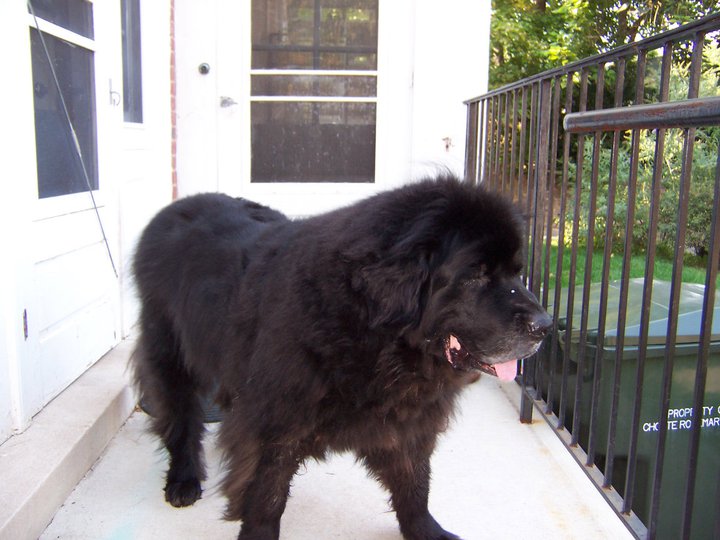
Some time ago, while my wife Sarah was slowly recovering from cancer surgery, the after-effects of follow-up radiation, and the side-effects of long-term use of an anti-seizure med, she fulfilled a two-decade dream of getting another Newfoundland. For those of you who don’t know them, the Newf is the more mischievous cousin of the St. Bernard, with whom it is sometimes confused. Both are the giants of the dog world. And both drool pretty much continually.
Sarah’s first Newf, her beloved and mellow Maggie, saw her through a rough time in her teens. But her second Newf, Spree, was entirely different in temperament. Strong-willed and stubborn, unlike Maggie in the latter’s eagerness to please, and formidably intelligent, where Maggie could be somewhat dim, Spree simply demanded much more from both of us. Leash-training, house-breaking, socialization — all were more involved than either of us had experienced with previous dogs. Spree’s first mission seemed to be to wrench Sarah out of a lingering mild post-op depression — by canine force, if necessary. “I am now your black-furred, drooling world,” she insisted. Lesson One: “There’s more to pay attention to. Watch (me)!” A second Lesson followed closely on that one: “You can still trust this physical body (to take care of me, for a start.) There are years of use left in it. Now move that fanny!”
Maggie had suffered from severe hip-displasia, a weakness in many large and large-boned breeds like Newfs that can leave them effectively crippled. Sarah was determined by any means in her power to avoid this with Spree, if she could. She researched bloodlines and ancestries, kennels and breeding practices. Finally she made her choice from a recently-born litter in Ohio, eight hundred miles from our home. On top of that, Sarah was prepared to cook from scratch all of Spree’s food for her first two years, while her bones grew and she matured. Spree did in fact end up with good bones, as a couple of tests demonstrated to everyone’s satisfaction, and she never suffered from displasia, but she had a number of food allergies that plagued her the rest of her life. The next Lesson didn’t seem to be only “Guess what? First problem down. Next?” It was more like “In the decade or so I am with you, I will stretch you and teach you to love more. And you’ll be starting with me. Ready?”
During all but the first of the eleven years Spree was with us, we lived in a dorm apartment at the boarding school where we worked. Most of the freshman girls in our dorm adored her — certainly she was a great conversation starter for any visitors. We put up a dog gate to protect the dog-phobic minority, an obstacle Spree despised.
It’s true that at 124 pounds she did outweigh many of the girls. (More than once, out and about on campus with her, we heard pedestrians near us exclaim, “Oh my God, is that a bear?!”) And on evenings when I was on dorm duty, Spree had her many fans among the girls who just had to pet that soft lush black fur before they could settle down to study hours. And during breaks they’d come back to visit — Spree of course, not me. One of the lessons here, which she seemed to express with a contented doggy gaze at me as she received the girls’ caresses which she took as her due, was “Remember the wisdom of the body. It is after all your life in this world. We all need touch to thrive. (I volunteer to demonstrate. Pet me.) Remember good food. (Feed me.) Remember exercise. (Walk me.)”
The last few months of her life, Spree dealt with bone cancer that started in her neck and shoulder and spread, weakening bone and aching more and more. We always knew Spree had a very high tolerance for pain. A score of incidents throughout her life had shown us that. Injuries that would set other dogs crying or yelping she would bear in silence, and keep on running, playing, eating — whatever was more interesting than pain. We learned to slow her down for her own good many times, to minimize further damage, to check just what had happened, to bandage and treat and clean her. In her final weeks, however, even on medication, her suffering continued to increase. It was winter, and she would ask to go outside several times a day to lie in the snow, her great coat keeping the rest of her warm enough, as she chilled and eased the hurt, rolling slowly in the snow, then lying on her back and side for half an hour or more at a time. The three shallow back steps to our small yard were eventually agony for her to climb either up or down, but she refused the sling we’d borrowed to help her. She cried out only once, in her last days, when it simply hurt too much. A Lesson: “I stayed longer than my kind usually can. [The average Newf life-span is roughly 8 years.] Make the most of what you’re given. You two are obviously slow learners on that score. Why else do you think I hung around this long?”

Spree in her final springtime, age 11
The last hour of her life, at the vet’s office, was on a snowy winter day (she loved the snow). Dazed from a liberal dose of morphine, but as a result now blissfully free of pain, she enthusiastically greeted the three of us, Sarah and me and a fellow Newfie owner, who came to say goodbye as she was euthanized. Several difficult lessons. “There will be pains and pain. Guaranteed. You can still do much. There will be hurt, but there’s no need to grant it more power over you than it must have.”
Spree greeted the vet who came to administer the euthanasia with her typical curiosity and people-love. A wagging tail, a nose pressed into the person’s thigh. The last seconds before she passed, she lay full-length and at ease. The vet had earlier inserted a catheter in her left paw to make both morphine and euthanasia easier to give, fuss-free. Spree nosed the syringe that held the dose as the vet pushed the plunger. “What is this?” Always she had explored her world first through her exquisite sense of smell. Near-sighted as she was her whole life, smell was her go-to sense. It is of course the chief sense for most dogs, but so much more so, almost obsessively so, in her case. Each shopping trip we brought into the house required a comprehensive smell-check, each item sniffed and investigated completely, regardless of whether it was (to a Newf) fit for food. In part, the Lessons here seemed to be “Sniff out whatever comes into your orbit. Find out its nature, whether it directly concerns you or not. And enjoy the physical senses. They also do not last, but each will tell you much about this life.” And yet another lesson: “Dying may suck, true. Death, however, does not deserve our fear. Pain does not last forever. Be curious about everything. Friends, isn’t that a better way?”
Animals teach wordlessly, and therefore often more effectively, through their nature as other spiritual beings who share the planet with us. Here I have interpreted into language some of that teaching as best I could, without excessive anthropomorphizing. I send gratitude for this fur-teacher in our lives. And I thank old wisdom-teacher William Blake for writing, “Everything that lives is holy, life delights in life.”
/|\ /|\ /|\






 A Druid Way