Happy Beltane! Go here for an enthusiastic if skewed view of the holiday, and here for The Edinburgh Reporter‘s take on this year’s celebration in Scotland’s capital tomorrow evening. As the Chair of the Beltane Fire Society says in the article:
Beltane is an event that cannot be described, it has to be felt, and that’s what makes it so special. We really want to reach out and welcome in the wider community this year, so come and share the beginnings of Summer with us.
Thornborough Henges, Yorkshire, England — site of modern Beltane festivals
If you’ve been following this series on some of the shared imaginal territory between Druidry and Christianity, and you find your hopes both raised and disappointed, this preamble is for you. Of all the themes, festival and holidays are probably the most self-explanatory. Instead of worrying too much about what I’m writing here, go find a good Beltane celebration. You’ll know more afterwards than anything I cover here.
But if you’re kind enough to have stayed and you’re still reading, let’s take a look at the nature of this theme. Now I have something of a handle on the weaknesses in my own understanding and writing ability. Let’s lay that aside for a moment. You and I both bring to this discussion — as we do to everything else — our personal histories of living in societies where Christianity still dominates the scene. After all, for centuries it’s ruled the roost. It’s been the default setting: our laws, values, art, music, vocabulary and ways of thinking all still draw so deeply from Christianity that we can suppose only naively that if we’ve “left the church” we’re “free” of it, and shaped no more by its perspectives and doctrines and worldview. [Yes, you may belong to the growing minority who grew up in a non-Christian household. Still, it’s pretty likely you celebrate Christmas in some way, and get some kind of Easter vacation without even asking.]
We assume, that is, if we no longer subscribe to a handful of Christian doctrines for spiritual guidance and practice, that we’re somehow “post-Christian”. You hear that everywhere. Yet we can acknowledge how much Classical civilization continues to mold the West — we never imagine we’re “post-Roman” or “post-Greek”. To offer the most trivial example, one of our generic insults is “Go to hell!” — a distinctly Christian destination, one that’s unlike to freeze over any time soon. (We can check back in after another 500 years — maybe by then a more clearly post-Christian West will have taken shape. One of the best ways to test this is to live for a time in a non-Christian part of the world. Much of Asia will do, but so will the Middle East, Africa, and parts of South America. Get back to me after that, if you take issue with what I claim about persistent Christian influence in the West. I had to live outside the U.S. for three years to see something of this.)
In a word, we’ve all got baggage. Nothing surprising in that. But if by chance we still long to salvage something from Christian practice that moves us still — if we refuse to throw out an imaginal and spiritual baby, however troubling its family tree, along with an often foul historic bathwater — and we’re walking a non-Christian path, the many links and themes like these past few posts have explored can call to us quite strongly. Parts of the Mass may move you, or you love the lights and cheer of Christmas, or the palm fronds and joy of Easter, or the quiet of candlelight services where words don’t fill your head and your heart has space to expand into the richness of silence.
We can use that fact of emotional and spiritual connection, use it for insight and growth and exploration.
How? Bear with me. I’m suggesting a few ways in what follows.
One of the delights of following a couple of blogs mining the same spiritual or religious vein is the interconnections they can weave over time. Obvious reasons for such common ground are shared experiences, comparable reading lists, current events, and so on. But sometimes you just end up in shared spaces, looking around and talking about what you’re experiencing, as if it’s in the air and water. (Which it is.)
I reviewed John Beckett’s new book in the last post, and John launches the interconnection this time, in his recent April 25th post “Why I Had To Make a Clean Break With Christianity“. If you follow his blog, you know that John has grappled with the lingering after-effects of membership in a fundamentalist church, and its mind-warping power on his worldview. He revisits that experience occasionally for hard-won, balanced insights anyone can use.
If you’re uncertain about the possibility of an rapprochement between Druidry or Paganism and Christianity, in other words, John’s got something to say you may find well worth your while.
There have always been, he notes, Christian groups with a wide range of practices:
Christianity was never a wholly new thing in any of its forms. It has mythical roots in Judaism, intellectual roots in Greek philosophy, and folklore roots in every land in which it was established. Some pagan beliefs and practices survived, but they were Christianized. They had to be –- in medieval and early modern Europe it was impossible to be anything other than a Christian (or possibly a Jew, in some places, at some times, for a while…).
These survivals and continuations include magic –- a lot of magic.
As a Pagan and Druid, John knows magic because he practices it, and from that practice he knows from the inside how pervasive magical practice actually is. If you’re human, in other words, you’ve both done magic yourself and had others practice it on you. The less conscious, and therefore weaker, the more random in its effects. But most Westerners have confronted one extremely common form of debased magic in advertising — the manipulation of emotion, desire, image, sound and verbal conjuring for a specific purpose: to sell you stuff. And though most of the more radical Protestant denominations have worked assiduously to purge their churches from any perceived taint of Catholic magic, it manages to creep back in unseen.
Magic doesn’t care what you believe – magic cares what you do. Work this magic properly and you’ll get results.
But I can’t do this magic. I had to make a clean break with Christianity and I can’t go back, not even to work magic with the aid of powerful spirits.
Wait, you’re saying. The title and theme of this post is Festivals and Holidays. What’s thatgot to do with magic, anyway? You’re always going on about magic. Enough already!
Well, “ritual is poetry in the world of acts“, wrote OBOD founder Ross Nichols. And poetry works with image and emotion. You see where this is going? Poetry is magical art, verbal magic. And rituals and festivals, if they’re potent and memorable, are stuffed with poetry and theater. There’s a reason that a wedding at a justice of the peace can be much less satisfying than a church or temple wedding, regardless of what you believe. (Because what you do is another matter.)
We long for ritual, even as we’ve managed to banish a bunch of it from our lives. So we pour it into wedding planners and other secular makeshifts that can deplete our bank accounts without delivering the goods. (“But do you really feel married to this man?” my mother-in-law asked my wife after our non-church wedding. Note: we had two weddings, secular and spiritual to cover all the bases. Neither one “churched”.)
So. Most of the “Great Eight” holidays of the Pagan Wheel of the Year have their Christian counterparts. We needn’t rehash old arguments about who “stole” whose holiday. If Druids, and Pagans generally, would like to find common ground with Christians, shared celebrations of holy days are one place to look.
Interestingly, of all the Eight, Beltane has perhaps the weakest Christian link. Yes, May 1st is the feast day of two apostles, James and Philip, in the Catholic church. In northern and central Europe Walpurgisnacht on April 30th, the eve of the festival of the eighth-century saint Walpurga, on May 1, came to be associated with witches. Beltane on the other hand was almost exclusively a Celtic holiday until it was claimed by neo-Pagans in the middle of the last century. Six months out from the start of winter at Samhain (“summer’s end”, the Celtic sam– cognate with the sum– of English “summer”), Beltane also fits the rhythms of the year-long cycle of seasonal celebrations, heralding the beginning of summer, of energy and fertility and well-being.
Whatever you do, wherever you are, try to find a way to celebrate the season.
There was the briefest mention of fire in the previous post, but much more about the other three elements. Why?
Deborah Lipp notes in her The Way of Four Spellbook (Llewellyn, 2006):
Fire has always been set apart from the other elements, because Fire alone has no natural home on the earth; Air has the sky, Water the sea, and Earth the land, but only Fire stands apart from geography. In nature, Fire is the outsider; it is out of control, and it conforms to no known rules (pg. 10).
Now Lipp’s observation both captures the nature of fire and also feeds our stereotypes about impulse, passion, strong feeling. How often we may long — or fear — to be out of control, fearless, spontaneous! Who hasn’t felt like an outsider at some point? Why would the Australian-inspired Outback Steakhouse restaurant chain opt for its advertising slogan “No rules. Just right”? Because there is indeed a rightness to fire — it can only flame up where there’s something to burn, after all. And most of us have been storing combustible material for a long time. How else to explain our explosions, outbursts, flares of temper? Even our language about these things draws on fire for metaphor.
Following the theme from the last post, we can speak of a fire baptism. You’re wholly in it when that happens. The full experience, nothing held back.
John the Baptist, Jesus’s precursor, explains to those asking, “I indeed baptize you in water … but he that cometh after me is mightier than I … he shall baptize you in the Holy Spirit and in fire”. We sense the power in fire, of all the elements closest in so many ways to Spirit. It can purify, transform, forge and anneal. Its extreme heat can also scorch, char, consume and destroy. Each element transforms its own way. “We didn’t start the fire”, sings Billy Joel. “It was always burning since the world’s been turning”. But he goes on: “We didn’t start the fire. No, we didn’t light it, but we tried to fight it”. And sometimes we even try to “fight fire with fire”. Yet we also long for fire to kindle cold hearts, to heat a flagging will, to spark the spirit deepest in us. We yearn to be fire.
“O! for a muse of fire”, cries Shakespeare’s Chorus in the first line of Henry V, “that would ascend the brightest heaven of invention”. We long to blaze, because we feel in fire something native and free. We are both it and other, too, as with all the elements. “Time is the substance from which I am made. Time is a river which carries me along, but I am the river; it is a tiger that devours me, but I am the tiger; it is a fire that consumes me, but I am the fire”, says Jose Luis Borges. The elements are natural sacraments, folds and garments for Spirit all around us. For fire, we light candles in so many traditions, for so many reasons, the flame cheering to the eye and heart.
I both am and am not fire. Self and other: the quest of our days, the distinction we cherish and also long to cast away. Pagan, Christian, Buddhist, Muslim, Jew, atheist, shaman, through all these experiences and intuitions we still ask ourselves, each other and the world: “What makes a good burn?”
/|\ /|\ /|\
Maybe the purest ritual Druids and Christians might share is one which seeks not to fill our ears with answers, but that gives us space and silence to listen to and ponder the questions. In some ways, the long, slow burn of Spirit in us is fire in its most potent form of all.
/|\ /|\ /|\
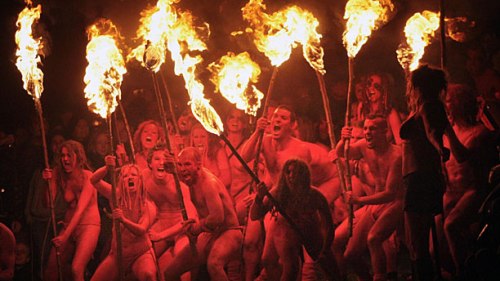
Beltane approaches, that festival of fire. The Edinburgh-based Beltane Fire Society celebrates 30 years this year of a dramatic festival of thousands, from 8:00 pm to 1:30 am. Here’s the “Drums of Beltane” subpage of the Society’s website. As the page notes,
Beltane may be known as a fire festival, but it may as well be considered to be a drum festival too. Drums are the beating heart of Beltane that create the rhythm of the festival, drive the procession forward, and soundtrack the changing seasons. They have been an integral part of Beltane since our tradition was first re-imagined on Calton Hill in 1988.
Looking for a fix of Beltane energy to get you launched? Here’s a video of the Drum Club which will be among the groups performing this year for the event. Just the first five minutes will give you a fine taste of Beltane fire in sound form. We can spark from anything, but sound and rhythm are powerful keys.
Could I be the Mage,
or might I be the Fool?
Should we learn to use our cards
like any kitchen tool?
When I search for wisdom,
when I peruse old lore,
do I seek just kicks and tricks
or something worth much more?
Is my quest a question,
things I already know,
or an “undiscovered country”
I rediscover as I grow?
/|\ /|\ /|\
If “playing the _____ – card” means to take (unfair) advantage of some given of our identities, what might it mean to play the Druid card? Well, it certainly gains us nothing with either the gods or local land spirits.
Druid-card Holder (DCH): “Hey! I’m a Druid!”
Land Wight (LW): “Welcome. Have you listened to the land, spent time hearing what it has to teach, growing a portion of your own food on it, and feeling how each season and its energies shape the lives of all the creatures on it, including you? Have you, in four words, lived where you live?”
DCH: Well, no …
LW: Go away and do not return until you learn reverence.
“I invoke you, goddess, for a change.”
Let me try again. If I live where I’ve lived, rather than almost anywhere else, I accept the gift of responsibility. Usually the word sounds heavy — something people try to flee rather than to welcome. But let me do my Bard word trick once more. I know I’ve often walked away from my response-ability, my ability to respond. I turn it off, drown it out, change channels, either because it’s painful or too demanding or or or. Third time’s the charm: find three or’s and I can successfully escape my ability to respond and maybe spend my whole life in someone else’s dream rather than one of my own. Success!
I often explore my own “weaknesses” because I find I learn more from them than from my strengths. (“Could that be one of their uses?! Hmm.”) We’re so accustomed to others being down on themselves that you may hear this as more of the same. No. I gain strength and insight from such cool, steady gaze. Don’t misunderstand. I’m as good at denial, deflection and depression as the next fellow. A 3-D life! A modern Western triad!
But what I want to get better at are the finely-tuned opportunities my weaknesses constantly point me toward. Lack something, and I sensitize myself to it everywhere around me. My lack magically energizes the thing to keep knocking at the door of my life. But rather than turning to my ability to respond, my responsibility, I do everything to reject the thing I said I wanted. But no worries, mate: it doesn’t actually vanish. It will keep knocking until I let it in. “Ask (I keep asking all the time) and it will be given to you; seek (we never really give up seeking, just take breaks for a day or a decade) and you will find; knock (oh, how it will knock back, friend!) and the door will be opened to you.”*
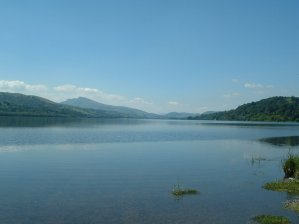
Bala Lake in Wales, where Gwion Bach begins his adventure of transformation
More and more it seems that rather than missed opportunities, there are only ones I keep rejecting. If I really do “miss” one, it will re-group and when necessary take another form in order to reappear down the road and insert itself into my life. Come around the next turn and — ah! There it is, possibly in a guise more difficult to ignore, less easy to escape at all.
My fate pursues me like yours does you, like Ceridwen pursues Gwion through all his transformations. I might even evade my fate for a life or two, come back in another body, gender, set of circumstances, with a “clean slate” so to speak. Except not really. My one life is with me, my responsibility sharpens, clarifies, till I can live it fully, because there’s nothing else I can do, even if I wanted to.
That’s one corner of my “Druid card” — at least, living where I’ve lived, as I understand it so far. What’s yours?
/|\ /|\ /|\
When I respond, link, connect, then I “beltane.” Let’s make it verb … Not to cheapen it, market it, no. To sanctify it. And you, my kin, my readers, when you last beltaned, what did you discover?
“Beltane is so much about the urge to connect, to blend and merge; to feel a part of something extraordinary; to at once lose one’s sense of self in that merging but also to paradoxically feel more absolutely and truly oneself because of it. In the desire to penetrate life’s mysteries, we need also to open ourselves to them, surrendering to the power of love that it may have the opportunity to transform us. Great things are born in us at such moments of union; this place of merging is where the tap root of our creativity feeds, without it we feel dry and disconnected. If that magical, alchemical moment of connection and merging were a colour, I suspect it might be perceived as many beautiful, vibrant shades but its foundation, I feel sure, would be the green of spring: ecstatically joyful – the irrepressible life and desire that leads us to love.” — Maria Ede-Weaving
Beltane’s nearly upon us, and Alison Lilly’s most recent blogpost “Holy Adoration: Fire as Prayer” catches the energy behind this fire festival. For it is after all the day of the Fires of the Celtic solar god Bel, as even a traditional source like the BBC calmly informs us on their website. Some seasons you’ve just had enough of the world, and most of all yourself as a tame fire, to paraphrase Alison. Do check out her blog. She evokes and invokes Beltane in a personal and poetic meditation.
You too may long to spark, flare, burn and roar. Heap the kindling of my life and ignite, you whisper — or shout. Beltane is here for you.
Part of the Bardic training of Druid groups like OBOD and others, and much of the initial work in the outer grades of the magical Order of the Golden Dawn focuses on exploring and balancing the elemental energies flowing in and around us. We don’t — normally — want to burn up or out. But a healthy conflagration may burn off the wintry torpor that clings to our mood and outlook. Beltane is tonic, purgative, exhiliration, ignition.
The symbolism of the four physical elements of earth, water, air and fire persists in the cultural and magical imagination of the West because they express important truths about human life. They serve as a powerful shorthand for a whole cluster of ideas, images, experiences and memories, and their presence in ritual and story, song and myth will endure as long as we inhabit the same worlds where they manifest.
Their existence as physical entities endows them with the further potential to serve as sacraments. As always, though we keep forgetting, reverence and engagement are our choice, an opportunity like any other that we may welcome or reject. Here, too, fire can kindle us to possibility and change.
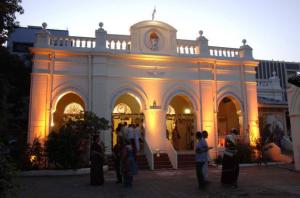
Fire Temple, Chennai, India
Further afield from Celtic-flavored European Druidry, fire is also central to the religious practice of Zoroastrians, the people popularly known as Parsis. Their Fire Temples offer just one more illustration of why reducing fire to an explanation like “rapid oxidation in an oxygen-rich environment like earth’s atmosphere” says nothing about our actual experience of fire, its light and warmth and flickering presence, and its long association in human consciousness with spiritual reality, energy and life. Anyone who’s experienced a good bonfire knows this to some degree. It’s our human art to extend these experiences and celebrate their effect as spiritual opportunities for transformation and joy.
Zoroastrian Sadeh Festival
Fire calls to ancestral human memory. Cultural practices and beliefs that center on it only endow it with additional significance and power. Druids may say as part of ritual “Let us pray with a good fire,” an invocation traceable to the worship of the Hindu Agni and a hymn in the Rig Veda (Bk. 1, 26). And Wendy Doniger in her translation* notes that “When Agni becomes the priest, his robes are both the flames and prayers.” Thousands of years of human experience with fire has not dulled its power.
/|\ /|\ /|\
Whether you’re part of an OBOD Beltane gathering that follows the traditional ritual, or some other group and ceremony, or you’re a solitary celebrating alone in your own way, may you too share that shiver of anticipation and delight as the day and the rite opens for you at the birth of summer. May you and the Sun both grow in strength. “By the power of star and stone, by the power of the land within and without, by all that is fair and free, we welcome you to this rite of Beltane …”
Once again we’re about a week out from the holiday, close enough it tugs pleasantly at awareness. Here in Vermont, in the northeast U.S. where I live, the last few days in the 70s F/20s C confirm that winter’s gone, though nights below freezing are still a possibility. I remind myself from now till June that it snowed on my May birthday the year I was born. Weather, life: stick around long enough and you find anything’s possible.
Outward from the merely personal to a group I practiced with the longest: students at the boarding school where I worked for 16 years. Our last and best effort was a truly elaborate Beltane. We devoted a lot of time to preparation, reserved a spot on the school’s Great Lawn (associated with the annual graduation picnic for the whole school community and parents), put up attractive color posters (see the image to the right), and even inspired our student president to spring for the cost of a whole roast pig.
Beyond our small group of eight, just three other people came.
We’d even begun forming a magic study group, devising our own sigil with input from each member, and generally carrying on in magically appropriate ways: sharing and describing our imaginative/astral visions until they took on a life of their own, balancing our elemental energies, ascertaining each member’s strengths and limits for later ritual work, and so on. To those who exclaim “What?! Are you insane?! Working magic with adolescents?! Nutter! Whackjob! Fool!” I reply only that we had multiple safeguards in place.
To the left is one version of our sigil, drawn with magic marker on a student’s sketchpad, which I share here — “Guard the Mysteries! Constantly reveal them!” — for the benefit of those curious about the lineage and origins of such things.
Some readers may cluck their tongues knowingly and go on to detect “influences.” To which I say only: That’s fine. But these kids didn’t “know” anything about the Golden Dawn or Euro-alchemy or similar things. Spend time in ritual and you too will find that valid images continually reconstitute themselves in the imagination. If I had the sketches each of them made to include here, the connections pointed to a shared experience out of which they crafted the sigil. The Cross, the Cup, the infinity symbol, an upsilon, the axial symmetry — as far as we were concerned, we were onto an experience and a realm worth exploring. Our truth against the world’s.
As for the sparse attendance at Beltane: each group forms around and operates on its own harmonic. We ate well, sent leftovers home with everyone, and chalked up our rather large budget shortfall to the frequent mismatch between inner and outer worlds. Our next fundraiser only just recouped the outlay; balance restored.
/|\ /|\ /|\
Beltane, like the other “Great Eight” festivals* of contemporary Druidry and Paganism generally, draws on a swirl of energies as democratic and mongrel and vital as you could wish for. Find a circle to celebrate with, or if you prefer or are gifted with solitary practice, get outdoors, invite the season, contemplate on images and energies alive and at work in your awareness. Bring them into some physical form to ground and manifest them in your world. We all need reminders to help us through those “difficult” days with humor and grace and even, spirits friendly and stars favorable, with gratitude. What better than something that’s come into your world through you?
/|\ /|\ /|\
*The “Great Eight” festivals of the Wheel of the Year
October 31 – November 2: Hallowe’en, Samhain/Samhuinn, All Hallows Eve, All Saints Day, All Souls Day, Todos Santos, Day of the Dead, Dia de Muertos.
December 20-22: Yule, Winter Solstice, Alban Arthan.
February 1-2: Imbolc, Oimelc, St. Brigid’s Day, Groundhog Day, Candlemas.
March 20-22: Spring Equinox, Ostara, Alban Eilir.
May 1: May Day, Beltane, Bealtainne, Walpurgis Night.
June 20-22: Summer Solstice, Midsummer, St. John’s Day, Litha, Alban Hefin.
August 1: Lughnasad/Lunasa, Lammas(tide).
September 20-22: Autumn Equinox, Alban Elfed, Mabon.
Bluets carpet our backyard lawn, an easy seduction into putting off the mowing I’ll need to do in another week. The air itself is a welcome. I no longer brace myself to step outside. Instead, I peel off an unnecessary extra layer and stand still, feeling my body sun itself in the coaxing warmth. Bumblebees chirm around the first blooms, goldfinches dart across the front yard, and our flock of five bluejay fledgelings from last year wintered over without a single loss and now sound a raucous reveille every morning.
In this last of a four-part series on Beltane, I want to look at our “found festivals” — how we also touch the sacred in the daily-ness of our lives. We don’t always have to go looking for it, as if it’s a reluctant correspondent or a standoffish acquaintance. When I attend to the season and listen to the planet around me, I touch the sacred without effort. The sacred encounter, like a handshake, is a two-part affair. How often do I extend my hand?
Susanne writes in a Druid Facebook group we both follow that finally in her northern location “the last bit of snow on the north side of the house melted away on Beltane day.” Gift of Beltane. Something to dance for.
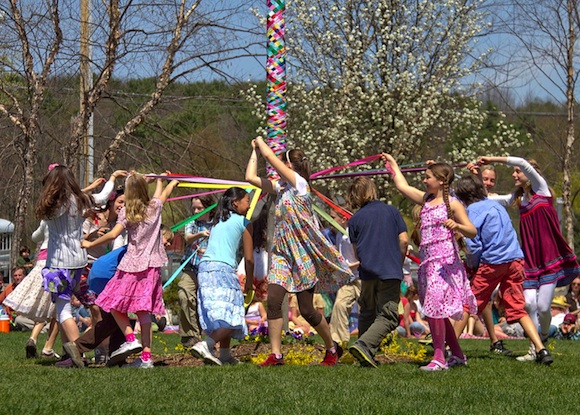
Rudolf Steiner school celebration in Great Barrington, MA
The ritual calendar of much modern Paganism meshes with the often milder climate of Western Europe where it originated. It doesn’t always fit as well in the northern U.S. or Canada, or other places that have adopted it. (So we tweak calendars and rituals and observances. Like all sensible recipes say, “Season to taste.”)
It’s a cycle that the medieval British poet Geoffrey Chaucer celebrates in the Canterbury Tales by singing (I’m paraphrasing lightly):
the showers of April have pierced the droughts of March to the root … the West Wind has breathed into the new growth in every thicket and field … the small birds make their melodies and sleep all night with open eyes …
A Vermonter like me looks at Beltane looming on May 1 and reads those lines of Chaucer’s and thinks, “About a month too early, Geoffrey.” Spring, not summer, begins at Beltane, though to feel the recent temperatures on your face you might well think Beltane is the start of summer indeed. Game of Thrones fans, never fear: Winter will come (again). But now … ah, now … Spring!
Susanne continues:
and even though they are a symbol of Imbolc, the snowdrops are blooming merrily followed closely by the daffodils. The peepers are peeping, the owls are hooting, the woodcocks are rasping ‘peent’ on the ground and twittering in flight.
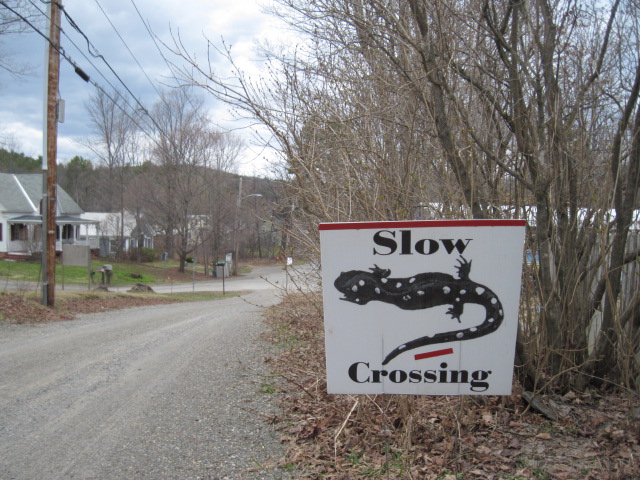
salamander crossing signs in our nearest town
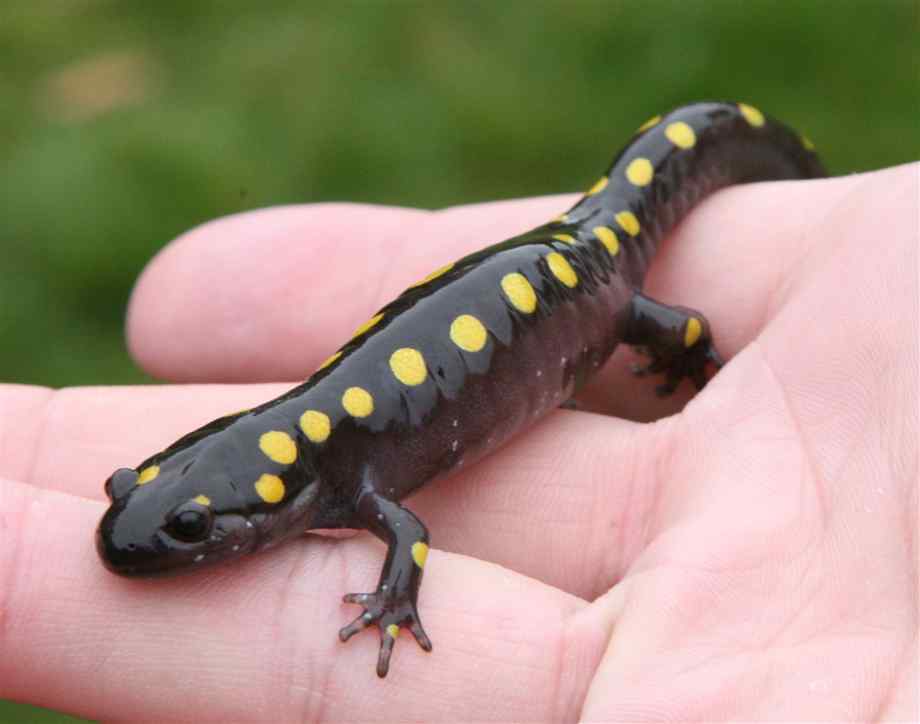
Late April and early May here in southern VT, and in your home area, too, means an annual migration of some sort. Here it’s spotted salamanders. After dark, volunteers with flashlights man the gullies and wet spots to escort the salamanders safely across roads, and slow the chance passing car to the pace of life.
Beltane finds Susanne with her hands in the earth, responding to the call of Spring:
The weekend was spent with Spring clean up, turning the soil and sowing the greens and peas in the garden. I was a bit disappointed in myself that I haven’t held a Beltane ritual but then I realized that this was the ritual…working with the soil, plants and spirits of the land, listening to my favorite songs …
On the second day of Beltane, the Old Gods said to me:
Dance round the fire, and then say what you truly long to be …
I always find Beltane lasts longer than a single day. This year I’m celebrating it over three days, from yesterday, the “official” May-Day, through tomorrow, with the Full Moon at its peak at 11:42 pm, Eastern Standard Time in the U.S. (that’s 03:42 Greenwich Time, May 4).
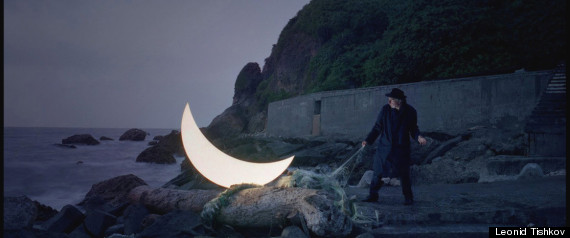
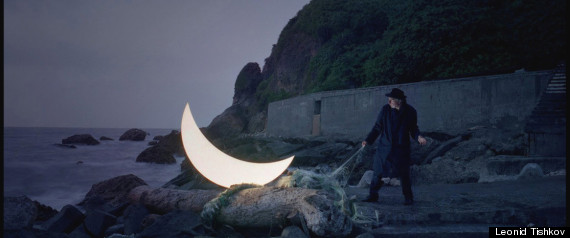
Do you carry a private moon with you? At times like these I feel I do. It’s tucked under my ribcage, trembling like a small forest creature that’s heard an owl: I have a lunar heart. Or in place of my mouth, a moon. No words, just white shadow wherever I turn to speak.
I do the original moonwalk, following shimmering paths visible at no other time. Or I hold out my hands and each palm glows with a hemisphere of unearthly light. I clap them together and the blow sparks new planets all up and down my spine.
Leonid Tishkov: “Private Moon”
Festival observances, like other rituals, can make us vulnerable to ourselves in powerful ways. Often we’re taught to leave dreams in childhood, as if adults don’t need to dream at all, let alone dream bigger than we ever dared as children.
Open myself to desire and dream, and longings I’ve shoved aside, sometimes for years, can rush back full-force. What I still dream and wish for are gifts my childhood has kept in store. Not just for the grown-up me, though it can feel that way. These gifts may have taken human or animal form, wandered homeless, raggedy and broken and weeping, or snarling, feral, wild things no child could understand. Things it runs from, things that hide under the bed, in the closet, that stretch and loom after the bedroom light gets turned off.
But the child also recognizes them as blood kindred, curls up with them each night, and each dawn they glimmer and vanish till the next twilight gathering. They reappear in that book you read and re-read till it fell apart in your hands, in the story no bedtime retelling could ever wear out. The childhood rituals that primed you for adult ones of deeper mystery: sex, death, creation.
What I do with them now are the gifts I give back to that younger self, some fulfilled, others still orphans. But I have brought them out and looked at them head on, and hugged them. I take them in even as I give them back. And in that circuit lies power.
Beltane pairs with Samhuinn across the ritual year, its opposite pole, and this Beltane-with-a-Scorpio-Moon I’m feeling it particularly strongly. No surprise, the astrologically-minded say:
The sun is now anchored in the sign of Taurus. Beltane occurs when it is precisely half way through the sturdy earth sign. The sign is symbolized by the fertile bull and, given its association with the fecundity of the springtime in the Northern hemisphere, Beltane in particular is a full-fledged celebration of life, creativity and the abundance of the upcoming summer season.
But, its polarity, Scorpio, is not.
Scorpio’s domain deals with matters that no one else wants to: the vile, the putrid, the petrifying, the intense, the rejected, the betrayed, the scorned, the scathing, the denied and the dead. Scorpio reminds us that we can repudiate anything for an eternity but that doesn’t mean it will be resolved, it doesn’t mean that it will be repaired, and it doesn’t mean that it will go away.
Ritual is one way to approach the difficult as well as the beautiful, to manage them in more bite-sized (ceremonial-sized) pieces. And sometimes, to discover the beautiful and the difficult, the deformed and the immensely powerful, amount to the same thing.
Beltane carries Samhuinn in its belly, or on its back. Or Samhuinn is Beltane turned inside-out. Both are fire-festivals, and fire does not always lie easily on the hearth. Sometimes it flames forth, blows past barriers and oppositions in its guise of wildfire.
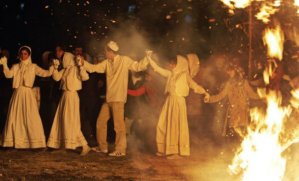
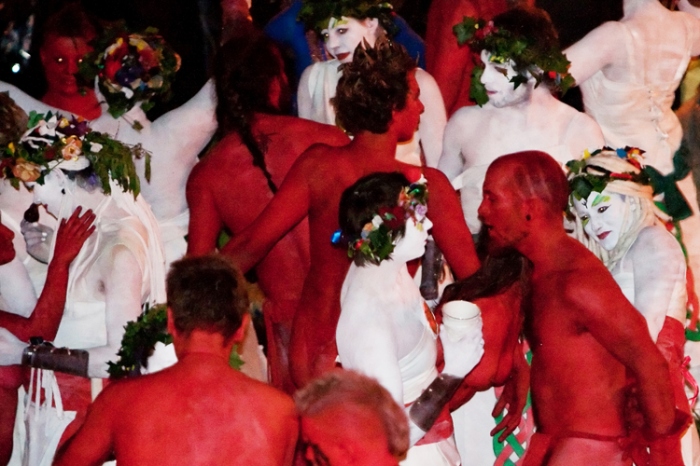
Here we are, about two weeks out from Beltane/May Day — or Samhuinn if you live Down Under in the Southern Hemisphere. And with a Full Moon on May 3, there’s a excellent gathering of “earth events” to work with, if you choose. Thanks to the annual Edinburgh Fire Festival, we once again have Beltane-ish images of the fire energy of this ancient Festival marking the start of Summer.
You may find like I do that Festival energies of the “Great Eight”* kick in at about this range — half a month or so in advance. A nudge, a hint, a restlessness that eases, a tickle that subsides, or shifts toward knowing, with a glance at the calendar. Ah! Here we are again!
For me, that’s regardless of whether I’m involved in any public gathering, or anticipating the time — because it’s never anything as rigid as one single day, but rather an elastic interval — on my own.
Yes, purists may insist on specifics, and calculate their moons and Festivals down to the hour, so as not to miss the supposed peak energies of the time. And if this gives you a psychological boost to know and do this that’s worth the fuss, go for it.
Below is Midnightblueowl’s marvelous painted “Wheel of the Year” (with Beltane at approximately 9 o’clock). With its colors and images, it captures something of the feeling of the Year as we walk it — a human cycle older than religions and civilizations. Or the cycle helped make us human, changing us as we began to notice and acknowledge and celebrate it. Try looking at it both ways, and see what comes of that.
Painted “Wheel of the Year” by Midnightblueowl. Licensed under CC BY-SA 3.0 via Wikimedia Commons
/|\ /|\ /|\
For today I take as divination the message below, which got promptly diverted to the spam folder: “This page decidedly has whole of the information I precious astir this dependent and didn’t make love who to ask.”
O crazy spam-scribe of the ethers, you stumbled onto one of the Great Paradoxes, best stated by William Blake, with his “infinity in the palm of your hand, eternity in an hour.” In that sense, yes: this page “decidedly has whole of the information” though it is also what it is, a finite thing. Like each of us, like the tools we use to connect to What Matters, like the sneaking suspicion that will not go away that there’s Something More. (Even if it’s just an explanation of what’s up with all these capital letters, anyway?)
And since Beltane’s approaching, there is indeed a “precious astir” at work as the energies swirl. Who or what is “dependent”?! The writer of the spam, not knowing “who to ask” and even acknowledging he “didn’t make love.” And all of us, dependent on the earth and each other.
I bless you, oh Visitor to this e-shrine, workshop, journal — the many-selfed thing that blogs can be and become. Who to ask? you inquire. Your inward Guide, always present and waiting for you where you are most true. Or the face of the Guide as it manifests again and again in your life — stranger at the market who smiles at you, bird that catches your eye, tune you find yourself humming.
How to get there, that place we all long for, that colors our thinking and follows and leads us in day- and night-dreams? Place that Festivals and holidays and time and pain and love and living all — sometimes — remind us of? Ah, you mean The Question! Love, gratitude, service — all things any of us can begin today; all things, it’s important to remember, we already do in some measure, or we would die. Too easy? Or you already know that? There’s also ritual — finite, imperfect ritual, our human dance. Mark, O Spirit, and hear us now, confirming this our sacred vow …
What’s your sacred vow? Don’t know yet? Got some work to do? Tune in to the next post for more.
*The “Great Eight” yearly festivals with their OBOD names: Imbolc, Alban Eilir/Spring Equinox, Bealteinne, Alban Hefin/Summer Solstice, Lughnasadh, Alban Elfed/Autumn Equinox, Samhuinn, Alban Arthan/Winter Solstice. Many alternate names exist, and almost every one has a Christian festival on or near it, too.
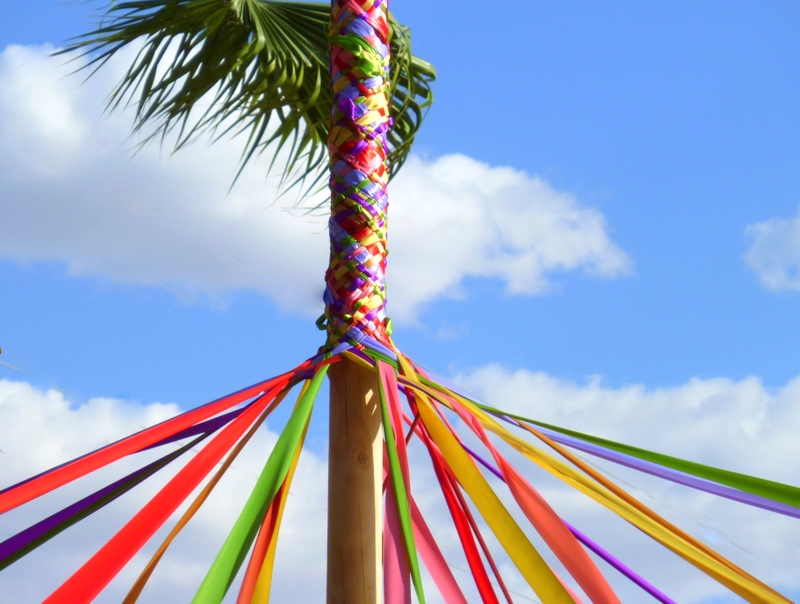
Ah, Fifth Month, you’ve arrived. In addition to providing striking images like this one, the May holiday of Beltane on or around May 1st is one of the four great fire festivals of the Celtic world and of revival Paganism. Along with Imbolc, Lunasa and Samhain, Beltane endures in many guises. The Beltane Fire Society of Edinburgh, Scotland has made its annual celebration a significant cultural event, with hundreds of participants and upwards of 10,000 spectators. Many communities celebrate May Day and its traditions like the Maypole and dancing (Morris Dancing in the U.K.). More generally, cultures worldwide have put the burgeoning of life in May — November if you live Down Under — into ritual form.
I’m partial to the month for several reasons, not least because my mother, brother and I were all born in May. It stands far enough away from other months with major holidays observed in North America to keep its own identity. No Thanksgiving-Christmas slalom to blunt the onset of winter with cheer and feasting and family gatherings. May greens and blossoms and flourishes happily on its own. It embraces college graduations and weddings (though it can’t compete with June for the latter). It’s finally safe here in VT to plant a garden in another week or two, with the last frosts retreating until September. At the school where I teach, students manage to keep Beltaine events alive even if they pass on other Revival or Pagan holidays.
The day’s associations with fertility appear in Arthurian lore with stories of Queen Guinevere’s riding out on May Day, or going a-Maying. In Collier’s painting above, the landscape hasn’t yet burst into full green, but the figures nearest Guinevere wear green, particularly the monk-like one at her bridle, who leads her horse. Guinevere’s affair with Lancelot eroticized everything around her — greened it in every sense of the word. Tennyson in his Idylls of the King says:
For thus it chanced one morn when all the court,
Green-suited, but with plumes that mocked the may,
Had been, their wont, a-maying and returned,
That Modred still in green, all ear and eye,
Climbed to the high top of the garden-wall
To spy some secret scandal if he might …
Of course, there are other far more subtle and insightful readings of the story, ones which have mythic power in illuminating perennial human challenges of relationship and energy. But what is it about green that runs so deep in European culture as an ambivalent color in its representation of force?
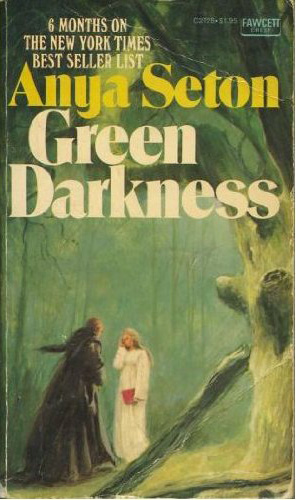
Anya Seton’s novel Green Darkness captures in its blend of Gothic secrecy, sexual obsession, reincarnation and the struggle toward psychic rebalancing the full spectrum of mixed-ness of green in both title and story. As well as the positive color of growth and life, it shows its alternate face in the greenness of envy, the eco-threat of “greenhouse effect,” the supernatural (and original) “green giant” in the famous medieval tale Sir Gawain and the Green Knight, the novel and subsequent 1973 film Soylent Green, and the ghostly, sometimes greenish, light of decay hovering over swamps and graveyards that has occasioned numerous world-wide ghost stories, legends and folk-explanations.
(Wikipedia blandly scientificizes the phenomenon thus: “The oxidation of phosphine and methane, produced by organic decay, can cause photon emissions. Since phosphine spontaneously ignites on contact with the oxygen in air, only small quantities of it would be needed to ignite the much more abundant methane to create ephemeral fires.”) And most recently, “bad” greenness showed up during this year’s Earth Day last month, which apparently provoked fears in some quarters of the day as evil and Pagan, and a determination to fight the “Green Dragon” of the environmental movement as un-Christian and insidious and horrible and generally wicked. Never mind that stewardship of the earth, the impetus behind Earth Day, is a specifically Biblical imperative (the Sierra Club publishes a good resource illustrating this). Ah, May. Ah, silliness and wisdom and human-ness.
We could let a Celt and a poet have (almost) the last word. Dylan Thomas catches the ambivalence in his poem whose title is also the first line:
The force that through the green fuse drives the flower
Drives my green age; that blasts the roots of trees
Is my destroyer.
And I am dumb to tell the crooked rose
My youth is bent by the same wintry fever.
The force that drives the water through the rocks
Drives my red blood; that dries the mouthing streams
Turns mine to wax.
And I am dumb to mouth unto my veins
How at the mountain spring the same mouth sucks.
The hand that whirls the water in the pool
Stirs the quicksand; that ropes the blowing wind
Hauls my shroud sail …
Yes, May is death and life both, as all seasons are. But something in the irrepressible-ness of May makes it particularly a “hinge month” in our year. The “green fuse” in us burns because it must in order for us to live at all, but our burning is our dying. OK, Dylan, we get it. Circle of life and all that. What the fearful seem to react to in May and Earth Day and things Pagan-seeming is the recognition that not everything is sweetness and light. The natural world, in spite of efforts of Disney and Company to the contrary, devours as well as births. Nature isn’t so much “red in tooth and claw” as it is green.
Yes, things bleed when we feed (or if you’re vegetarian, they’ll spill chlorophyll. Did you know peas apparently talk to each other?). And this lovely, appalling planet we live on is part of the deal. It’s what we do in the interim between the “green fuse” and the “dead end” that makes all the difference, the only difference there is to make. So here’s Seamus Heaney, another Celt and poet, who gives us one thing we can do about it: struggle to make sense, regardless of whether or not any exists to start with. In his poem “Digging,” he talks about writing, but it’s “about” our human striving in general that, for him, takes this particular form. It’s a poem of memory and meaning-making. We’re all digging as we go.
Digging
Between my finger and my thumb
The squat pen rests; as snug as a gun.
Under my window a clean rasping sound
When the spade sinks into gravelly ground:
My father, digging. I look down
Till his straining rump among the flowerbeds
Bends low, comes up twenty years away
Stooping in rhythm through potato drills
Where he was digging.
The coarse boot nestled on the lug, the shaft
Against the inside knee was levered firmly.
He rooted out tall tops, buried the bright edge deep
To scatter new potatoes that we picked
Loving their cool hardness in our hands.
By God, the old man could handle a spade,
Just like his old man.
My grandfather could cut more turf in a day
Than any other man on Toner’s bog.
Once I carried him milk in a bottle
Corked sloppily with paper. He straightened up
To drink it, then fell to right away
Nicking and slicing neatly, heaving sods
Over his shoulder, digging down and down
For the good turf. Digging.
The cold smell of potato mold, the squelch and slap
Of soggy peat, the curt cuts of an edge
Through living roots awaken in my head.
But I’ve no spade to follow men like them.
Between my finger and my thumb
The squat pen rests.
I’ll dig with it.


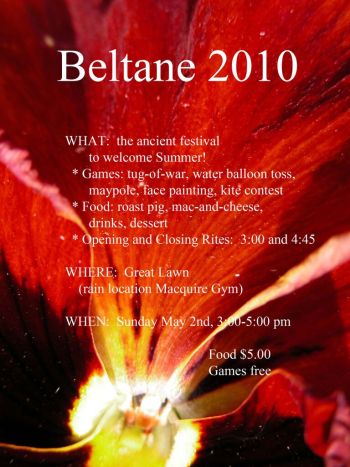 Outward from the merely personal to a group I practiced with the longest: students at the boarding school where I worked for 16 years. Our last and best effort was a truly elaborate Beltane. We devoted a lot of time to preparation, reserved a spot on the school’s Great Lawn (associated with the annual graduation picnic for the whole school community and parents), put up attractive color posters (see the image to the right), and even inspired our student president to spring for the cost of a whole roast pig.
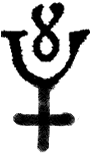 To the left is one version of our sigil, drawn with magic marker on a student’s sketchpad, which I share here — “Guard the Mysteries! Constantly reveal them!” — for the benefit of those curious about the lineage and origins of such things.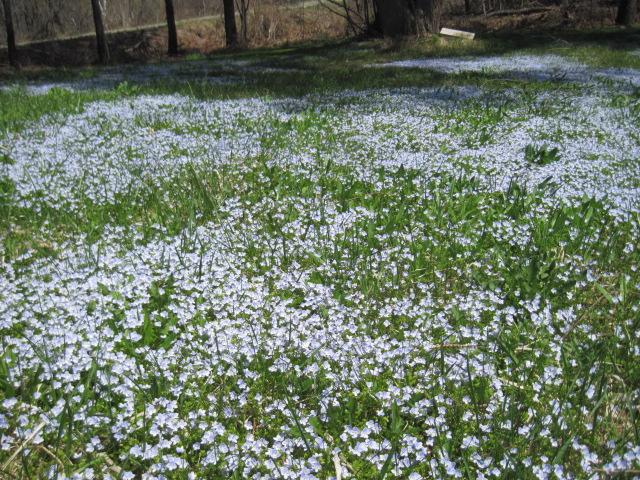





 A Druid Way


.jpg)

.jpg)