The inspirational email from OBOD for this week reads:
And above all, watch with glittering eyes the whole world around you because the greatest secrets are always hidden in the most unlikely places. Those who don’t believe in magic will never find it. — Roald Dahl
OK Roald, what are you saying? I’ll walk some of the way with you because of your magic. After all, it’s almost part of the definition that creative people have felt it, and pass along a hint of it, even as it slips between their fingers. But wait — belief comes first, and then magic? Seeing is believing, we’ve been told; believing is seeing. But what’s a glittering eye? Well, it seems it’s a useful technique.
Sometimes the world demands it of us — it’s the only option if we want to see at all.
On our return car trip from a Chicago wedding last weekend, we first drove north to Michigan’s Upper Peninsula — the UP, home of the “Yoopers” accustomed to delightfully cool summers and long, snowy* winters, nestled among three of the Great Lakes, Superior, Michigan and Huron. (For readers living in other lands, that’s the north central U.S.)
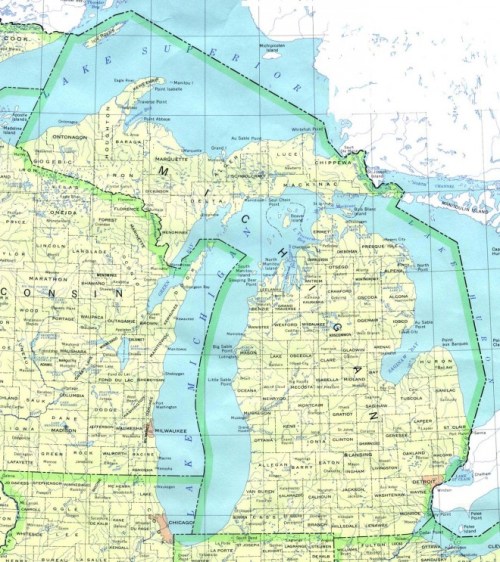
The UP is the area from Gogebic to Chippewa counties.
Here’s the morning sun on the water of Grand Island Harbor, Munising, on the south shore of Superior, where we stayed three nights ago.

The camera manages to capture what a normal human eye can’t look at directly. Only a “glittering eye” can see it — the sun demanded such an eye of anyone who wanted a look. Sometimes the whole world glitters and glimmers — too bright to look at any other way. At such moments it’s easier to admit even if only to oneself that gods must live in fire and shadow.
Or if you want some sort of equivalent in words, that impossible Bardic challenge, try this, courtesy of the 19th century poet Emily Dickinson:
Tell all the truth but tell it slant —
Success in Circuit lies
Too bright for our infirm Delight
The Truth’s superb surprise
As Lightning to the Children eased
With explanation kind
The Truth must dazzle gradually
Or every man be blind —
Oh Emily, we know some days how things do “dazzle us gradually” — the passing of time, each season’s gesture of beauty and change, the grace of a moment as it sashays or lumbers past us. Heartache, bittersweet — we can halfway name what it’s like to be alive. Whether or not we opt to honor these moments and seasons with ceremony or any kind of observance, the world’s ways tell their own truths, very far from headlines or gossip or what passes these days for “news.” The only really worthwhile news is always new, always the same, always old, too, and it begins just beyond our noses. An ancient story.
All it takes, sometimes, is a glittering eye, because the world glitters. Or sometimes an echoing ear, because the world also resounds and reverberates.
/|\ /|\ /|\
Image: Upper Peninsula.
For a recent (2013) low-key native’s and traveler’s reflection on the UP, go here.
*as much as 300 inches/7.5 meters, according to the article above.
Some things glow with it,
flame-keepers, hearths we return to
whenever the world dulls and grays,
whenever bodies earth themselves
too deeply, those mornings each of us
can count all two hundred and six bones
stacked here in our skeleton houses.
Some things touch and smolder,
some kindle, flare once, no more.
Others spark and ignite everything around them.
Fire says: be done with cataloging. I
will renew. In the end, leave everything
for a bright journey. Burn
slow and long.
 But what of activism? readers may rightly ask, especially after my last post.
One of the most evil perspectives — I use the word evil intentionally; a great peril of our times is that the force of the word has weakened to something almost laughable, even as the thing it names continues to spread, infect and damage our world in forms both subtle and painfully blatant, a truly demonic state of affairs — one of the most evil perspectives we cherish is that ecological awareness is somehow a luxury, or a liberal fantasy, just one option among other better and more profitable choices, or an idea whose time is past because it hasn’t produced “results.”
R. J. Stewart succinctly sums up the matter: our true selves and the land are one.
 Cause and effect really do still operate, however inconvenient we find them. But merely fighting polarized symptoms lines up more adversaries for us to attack, without ending the war.
For corporate greed like Nestle’s is just a symptom our modern world makes possible — other eras had and will have their own symptoms.
Yes, we can spend ourselves in noble battle, whatever our position, and if we push far enough, we can “prove” ourselves “right” — and bleed out in the process, kissing this incarnation goodbye. The particular forms that evil takes in this era conform to the lessons we need to learn at this stage of our consciousness.
In a sense, we create the lessons through our weaknesses and imbalances. How painful that continues to be for me to learn! So I want to uncover how to reduce such weakness, rather than spend a life lining up future adversaries that I create out of my ignorance and resistance to a set of lessons I refuse to learn. If indeed the world is a spiritual vessel that cannot be “improved” then what can be “done” with it? Do we even know yet? And how far are we willing to go to find out?
These questions seem to me far more vital than almost any others I’ve encountered. And I know that stance is luxury itself. I’ll admit right here: if I’m the one of those dying of thirst stemming from drought mixed with corporate greed, you who fight to put water back in my hands are my friends in ways a self-named Druid blogger sitting in hydrated Western comfort simply cannot be. So I readily accuse myself on that front, should you turn the focus that way.
But beyond mere easy outrage and less easy symptom-combat and triage, what can I learn and grow from and share? That seems more and more my dharma, the task I find keeps landing on my doorstep unsought.
I want to stare down the hardest questions, because I learn the most from them. But by this I don’t mean to set up tents and squat there in some new “Occupy Existence” movement. The existential is a starting point, not a garden to grow food in. I look at hard questions out of selfishness: I want the biggest bang for my buck out of this lifetime. No guarantees I get more than one (though available signs are promising). As John Beckett notes in a recent blogpost, who among us will lie on our deathbeds and lament most of all that we didn’t sign up for extended cable?!
/|\ /|\ /|\
Yesterday the second of three cords of firewood arrived. To get from this …
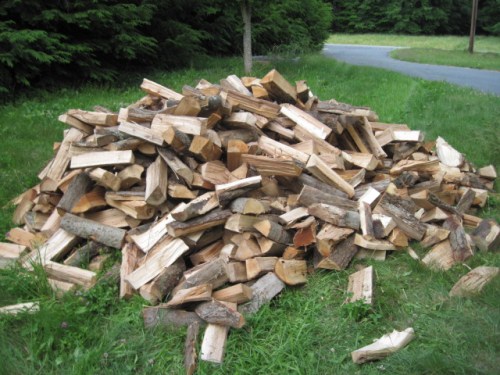
even to this modest beginning
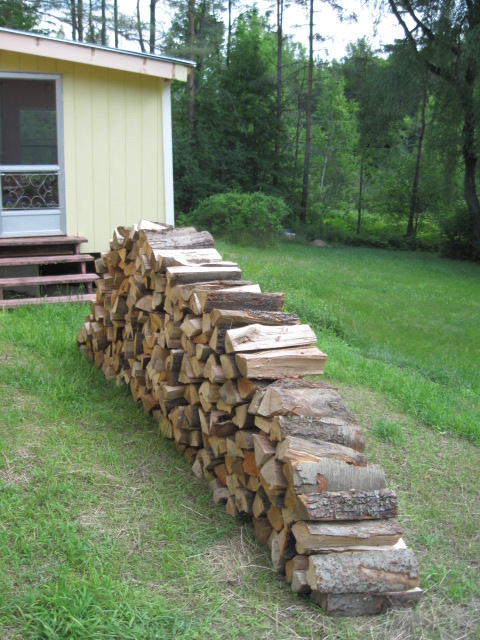
always seems a daunting task. But each year, piece by piece, we eventually get it done. Daily, daily, daily, a practice builds. When I find the right pace, the task itself becomes a kind of pleasure. if I listen, the task itself teaches me. I alternate which arm carries a bundle, and which arm steadies it. I feel each side getting a good workout. I stop when sunburn threatens or aching muscles bring me to the point of diminishing returns. The fatigue of needful effort feels good.
/|\ /|\ /|\
Images: Nestle water; Nestle chair.
— not just survival. That’s much of what I aim for with this blog. (You know almost as well as I do how I don’t always hit the target.)
Not tools for “social transformation” or “regime change” or advocating for somebody else’s large-scale fixes that may or may not ever reach me (or you) in anything like helpful ways. In U.S. terms, that means neither Trump nor Hillary will help more than they will hurt. (Only differently.) In U.K. terms, that means “to Brexit or not to Brexit” isn’t the question. Generally, that means binary choices often aren’t very useful ones.
Whoever “wins” won’t change what needs changing. (That ultimately lies with me. I win as I listen to what yearns to be heard most deeply.) Forces in motion that we launched decades ago, larger than politicians or parties or even empires, will see to changes. A wiser course, for me at least, is to work with forces that build, and learn to ride the ones that don’t, as skilfully as I can. Those aren’t up to a vote. They’re not democratic. If I want, I can put myself in agreement with their effects through anger or ignorance or blind acceptance. But I keep learning the hard way that none of those are profitable responses.
What’s the third — or at least a third — option? (There are always more than two options. If I don’t see them yet, right there is a place for me to work at listening and paying attention.)
Do the necessary work on myself and, as much as possible, avoid feeding energy to the rising political hysteria — of any flavor. “Chop wood, carry water” is a beginning. Yes, but also honor the trees as I do so. Bless the waters, waste less, thank more. In-form the heart, not out-form it. Love works better as a fountain, ever-flowing, than as a reservoir of “hold on to what you’ve got.” Turn down the volume on the shouting. Duck when necessary. Plant seeds for the long view. Share even modest harvests. Stay mindful of the Dao De Jing’s counsel: “Extremes do not last long.” And also: “This world is a spiritual vessel. It cannot be ‘improved.'” Or if you prefer, as humble recipes say, leaving it up to us in the end: flavor to taste.
So I keep bringing back my monkey-mind to focus here on what I can create and transform through awareness and co-operation, hoping to model in my limited way a version of what I see others I respect trying out in their lives and succeeding at.
When building, start small.
Start small, because in the end that’s the only place anything starts anyway. But watch for when I touch infinities in those grains of sand I garden in. Revel in eternities that spring from my hours.
Have you ever reached a limit to joy? Not happiness which — often — is superficial, and — often — not worth pursuing: peace to that old Declaration we claim to fancy and which offers such pursuit as one leg of a Founding-Fathers triad that provoked a 240-year-old Exit of our own.
No, I mean joy, a stranger to many, it seems. What Tolkien’s hobbit Pippin could perceive, in the middle of all-out war, in the Maia Gandalf:
Pippin glanced in some wonder at the face now close beside his own, for the sound of that laugh had been gay and merry. Yet in the wizard’s face he saw at first only lines of care and sorrow; though as he looked more intently he perceived that under all there was a great joy: a fountain of mirth enough to set a kingdom laughing, were it to gush forth.*
True kingdoms to you.
/|\ /|\ /|\
Tolkien, J. R. R. The Return of the King, Chapter 1, “Minas Tirith.”
In addition to whatever religious, ritual or secular calendars you may follow, you’ve probably begun to recognize and honor your own holy days. You know, the ones that fall between the official dates on the calendar that hangs on your wall or scrolls from your desktop. Some difficult, some joyful. It may be that you count your birthday or some other similar day among them. Hobbit-like, you may have come to enjoy gifting others rather than yourself on those days, with a feast, or outing, a picnic, perhaps in a back yard, garden, or favorite annual reunion campsite that has begun to take on numinous qualities, because your love has helped to make it so.
A valuable piece of wisdom there, in the transformation our love and our repeated attention can make of almost anything.
For me, my parents’ anniversary on the 26th of June plays that role. Long ago my father and mother set the tone, because they almost always made it a larger family event. A month later in July, my father’s sister celebrated her anniversary, and with a number of May family birthdays preceding it, the late June date falls squarely in the middle. The typically good weather here in New England, together with the first early garden produce (strawberries! asparagus!), make it a perfect candidate for a holiday gathering, a cookout or garden party. This year would have marked my parents’ 60th anniversary (they made it to 46), and for me the date’s taken on a “second solstice” quality. Cherish such days in your year. If you’re like me, such personal calendars subtly shift and re-form over time.
So yesterday a libation and some quiet reflection, a walk through my new Druid grove awaiting its formal consecration, and the working out of some light physical karma that has come to flag for me a potential shift in consciousness. “Pain is often the creator of awareness,” one of my teachers like to say, rather ruefully, and it’s proven true for me. When I wake up enough to know once again I’m in the hands of Spirit, minor pain and discomfort can open a chance for sharpening awareness quite effectively.
Outwardly, builders recently finished repairing the foundation and rear wall of our garage, a necessary dedication of resources if it wasn’t to fall down our sloping back yard.
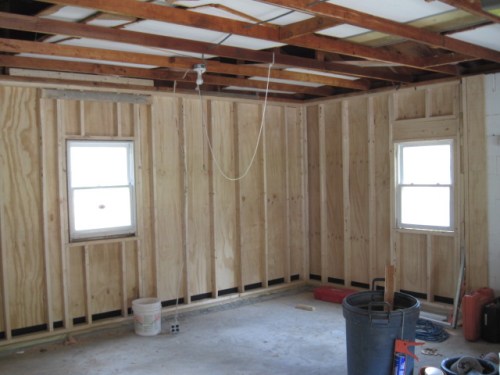
And just as true as the seemingly mystico-magical but quite practical saying “if you build it they will come,” if you’ve already come to a place, sometimes you have to (re)build it in some way to flourish there. And when you do, everything else re-equilibrates to the new harmonic you’ve established. Energy will flow first along the easiest channels it finds, and I’ve learned that often means right through the middle of any weakness, hole, or gap in my being and circumstances. I perform that service, I’m that easiest channel, a part of any dynamic I seek to transform, and the sooner I get that, the less wear and tear on the earth, water, air, and fire bodies that Spirit wears locally, in what I am pleased to call me, my life. No distinction, really, as I keep relearning. Jiji muge, the Zen Buddhists say. Between one thing and another is no separation.
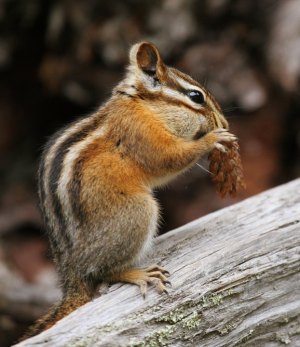
Tamias Minimus, aka chipmunk
So we must act mindfully and vigilantly at all times, they tell us. Nope. Not at all. Fat chance of that happening! snarks my inner brat. I don’t know about you, but I mess up all the time. That’s where the learning and growth is, the crack in the sidewalk where weeds finally push through, the shell the chick pecks open to move to the next stage, the new home the hermit crab must seek when it outgrows the old one.
Life’s what happens when you’re busy making other plans, John Lennon reminds us. Well, yes, and that’s a very good thing indeed, whispers the chipmunk, my inner guide for the month. (A mated pair lives beneath the roots of the evergreens that line our driveway.) Keep learning to listen, and you’ll plan wider.
/|\ /|\ /|\
Image: chipmunk (tamias minimus)
Over the past several days I’ve assembled the results of three forms of divination into what may seem a hodgepodge of craft but which serves the purposes I’ve felt called to work with. More about them in a minute. When even our choice of the means of divination we’ll use is itself potentially a matter for divination, we can quickly get lost in a hall of mirrors and never get out and actually do something. Turtles all the way down.
We’ll continue to make mistakes anyway, even with the best of divinatory insights. There’s small advantage in refraining from acting simply because our guidance is incomplete. It’s incomplete at the best of times. That’s not a weakness but the definition of the proper field for human action. The gods don’t want, need, or make puppets, after all. (Not most of ’em, anyway. Those that do, flee as fast as you can.) Deprive us humans of initiative and will and vision, and neither human nor divine sovereignty means much.
The first divination I already mentioned in the previous post: the turtle in our yard, crawling north. Near midsummer, a reminder of the North, of earth, of manifestation, of the vessel for all this heat and light — the realm of form. After I completed my work of mowing for the day, I spotted a fellow being on its own journey. End of story? No. Whatever we do individually, we’re also companions on the way all creatures follow, alive here in time and space. All things are themselves and signs. We, too, endlessly offer our existences as tokens, pointers, guides to others. Meaning is what we do. Our presences always carry a specific weight and effect.
One thing imprinted itself clearly in my awareness, a laugh at self. I’ve been turtle-slow to acknowledge this inner tug, this call for a grove, and to work with it. The turtle, blood warmed in solstice heat, vigorously crawled some five meters without pausing. Even I am faster than you these days, human.
The turtle or tortoise is absent from the Celtic-inspired Druid Animal Oracle, but it’s a living symbol among native peoples of North America. Turtle Island. Many tribal stories recount how turtle does its thing, swimming to the bottom and resurfacing. A guide, an opener of possibility. In the efforts of many spirit beings to create land for plant and animal life to dwell on, turtle carries on its back the earth that muskrat or duck or some other bearer brings up from the bottom. Carry the earth to us, for us, under us. Turtle carrier, guide, creature yourself, alive in this place, complete in your own being and purposes.
We could work out a new divination system following the shell markings of the turtle. The idea certainly isn’t new with me — it exists in various forms already. Anciently the Chinese oracle bones derived from turtle shells. But even as new tarot versions and re-workings of the runes and ogham make their ways into our awareness, so too does the power of all things to serve a dual potential as themselves and as symbols. We’re always ourselves, but linked as we are, we’re also more. We live and we signify.
A second divination: obstacles, multiple reversed runes, blocked energy. Taking the three divinations I performed as past, present and future, this second divination certainly outlines an accurate picture of the present. After-the-fact interpretative retrofitting of a divination? Sure … why not? Or take it as 1) existing causes, 2) materials, circumstances, contributing influences, and 3) consequences, results, practices to assist coming manifestations. Either way.
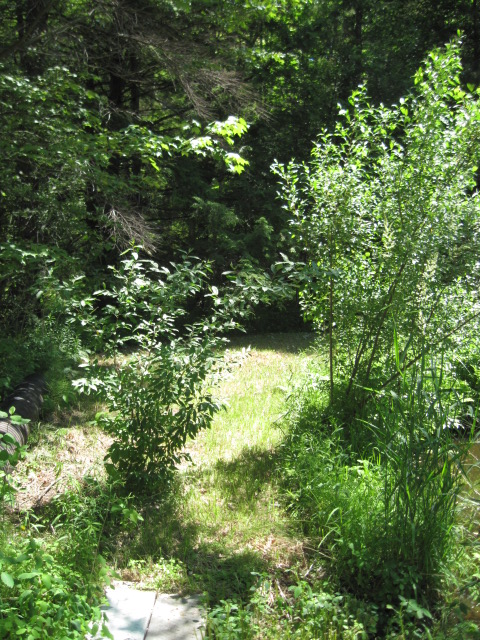
Entering my potential grove from the northwest, and facing east. What have I let grow to block my way?
I’ve worked most with the Arthurian Tarot, so it seemed prudent to turn to this for the third divination, because I seek insight into constructing a Druid grove.

Sovereignty
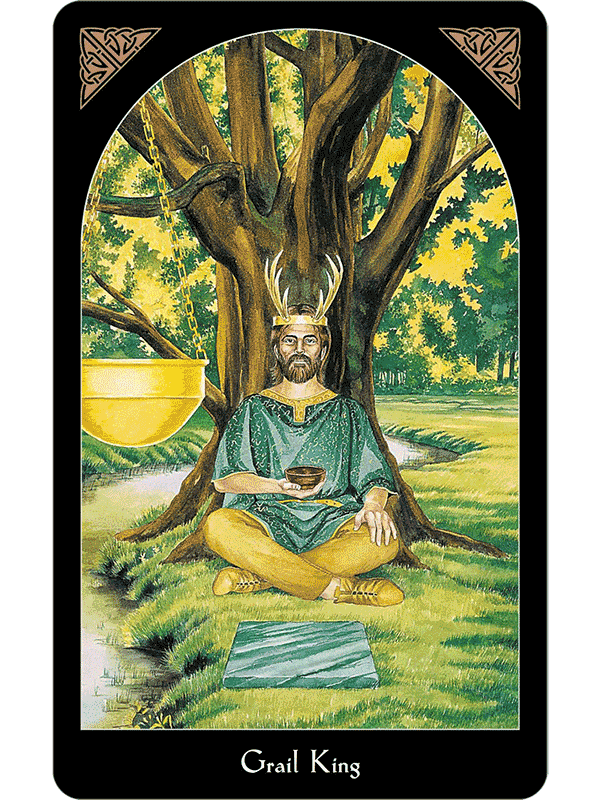
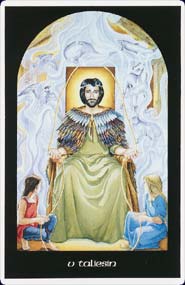
I enter my potential grove space from the northwest, improvising an invocation and pausing at each of the quarters and then the spirit center to lay face down a card I chose by touch and guidance from the deck. I circle a second time to each quarter and pick them up and view them. Here are my cards: North — the grail king; East — Arthur; South — the Spear Maiden; West — 2 of Spears; Spirit center — Taliesin.
/|\ /|\ /|\
Blending my two paths, dedicating each direction respectively, starting with the North, to word, thought, deed and feeling, all in the circle and presence of Sovereignty, of Spirit, I take the following reading:

Grail King
The Grail King, associated with the West, guards hidden mysteries, approachable through imagination, dream, feeling. Yet he shows up in the north, and also paired with words. He offers guidance to negotiate the path if I am alert. If I abandon a stubborn fixity and pay fluid attention to the earth, to my body, to our shared physicality, then needed energies will come for manifestation. I can help myself by writing the way, by wording my passage as I go, by welcoming, shaping, and passing along my share in the voice of awen.
Arthur, from the major arcana, occupies the traditional fourth Emperor position. The Matthews’ handbook* notes, “The primary feature of Arthur’s role is guardianship and defence of the land … His creative energy is fuelled by close Otherworld contact through the mediation of Sovereignty” (Matthews, pp. 29-30).
 In the realm of thought, Air and the East, he offers a gift of dynamic strength, along with a clear reminder of where strength derives. The Matthews further observe, “Whenever he attempts to depart from his kingly responsibilities … or live a life of his own, he comes to grief” (p. 30). Once we walk a certain distance along the path, we can no longer validly make a permanent retreat from human life, much as a hermit-like withdrawal still appeals to me — has, for much of this lifetime.
The Spear Maiden, signifier for the South, “shows the way through impossible situations by her daring, often by disguise or by shape-shifting” (Matthews, pg. 78). Again, I need not insist on a particular form, but allow it to remain supple, fluid. And take boldness for my approach, not this listless, hesitant, intermittently indulgent and slothlike state that’s dogged me for over a year. Boldness fuelled by Otherworld/Innerworld contact. The work of the OBOD Ovate grade, which I entered formally at the equinox last fall with initiation, but haven’t really yet engaged.
Spears again for the West, this time the 2 of Spears. A theme’s emerging. Matthews’ text says, “The skilled organization of resources leads to the achievement of desire; intuitive synthesis; dynamic drive” (Matthews, pg. 74). South in the West: intuition, yes, but propelled by the fires of the South.
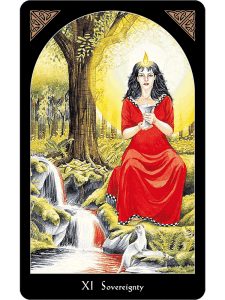
2nd image of Sovereignty as a major arcanum
Finally, the Spirit-center, under Sovereignty. A fitting place for Taliesin to appear, chief of Bards, initiatory model for Druids. He represents transformation “of the mundane into the spiritual,” a worthy goal for the making and purpose of a Druid’s grove. He is ready to aid the seeker in contacting “the living wisdom of the Otherworld … [B]y prophecy and far memory, he can instruct and guide … well able to represent images to the receptive mind and forge connections in the waiting heart” (Matthews, pg. 32).
/|\ /|\ /|\
Images: Sovereignty; Grail King; Arthur; 2nd image of Sovereignty; Taliesin.
Matthews, John and Caitlin. The Arthurian Tarot: A Hallowquest Handbook. London: Thorsons, 1995.
[ 1 | 2 | 3 | 4 | 5 | 6 | 7 | 8 | 9 | 10 | 11 | 12 | 13 | 14 | 15 | 16 | 17 | 18 | 19 | 20 | 21 | 22 | 23 | 24 | 25 | 26 | 27 | 28 | 29 | 30]
Solstice light, blessings and inspiration to you all! And to everyone Down Under at the official start of winter, may the Light grow within and without!
 With this post I finally complete the “Thirty Days of Druidry” series I began back in April. And ever as one cycle ends, another begins. We enter the dark half of the year with the greatest light and energy, a lesson in itself that things are never wholly as they appear, that each thing bears its apparent opposite in its bosom, as the Dao De Jing gently urges us to realize.
Beyond the binary surface of the polarities all around us lie multitudes of other relationships to explore. Water offers itself as a teacher: we’re either above or below the surface. But what about right at the face of the water? There we encounter surface tension, the point of contact, where air and water meet and the silver mirror may open in either direction to allow us entry. Or dancing. Water striders live at the boundary and let it support and sustain them. Air and water together allow for dancing as well as power. What other such natural meetings may we attend?
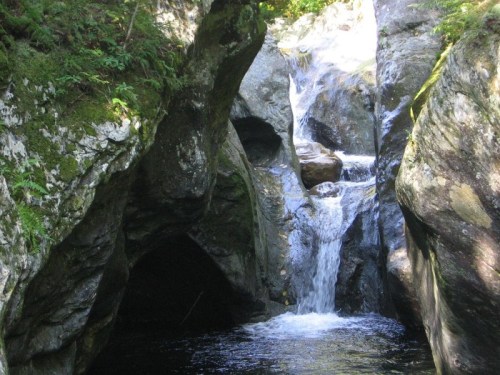
Texas Falls, Hancock, Addison County, Vermont
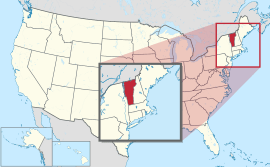 Here in Vermont in the NE part of the U.S., summer moved in weeks ago, with days in the high 80s and low 90s (27-31 C), and blessed nights in the 50s and 60s (13-17 C), perfect for sleeping. With open windows, birds wake us between 4:30 and 5:00 am, sometimes, it seems, just because they can. They’re out and about, so why shouldn’t the rest of the world be? Or in the middle of the night, the pair of owls that nest nearby rouse us with hunting calls under a moon full last night.
Sometimes life consists of what you can sleep through, and what grabs you drowsing and drags you back to consciousness. War, pestilence, earthquake, songbirds, rain on a standing-seam roof, gentle breathing of your bed-mate. De-crescendo. Wake, or sleep on?
The chimney sweep came this last Friday to brush and vacuum. Even with filters and professional care, for an hour after he left, a trace of ash and soot perfumed the air indoors. And we await delivery next week of the three cords of wood that will see us through to next summer. Bars of gold, sunlight stacked in tree-form. Solstice days.
/|\ /|\ /|\
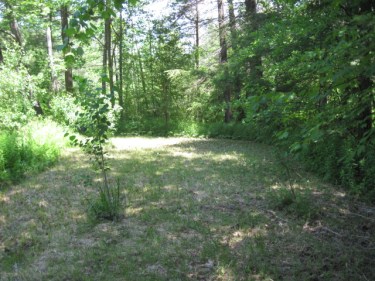
I ask for divination. Over the last weeks the nudge has come to build a small Druid circle in our back yard. It’s another liminal place. Leave it unmowed, and blackthorn and milkweed eagerly launch a takeover. Not sunny enough for a garden, though it gets about two hours of light mid-morning. But here, by 11:50 am at midsummer, it’s already mostly in shade. Here’s the space, looking north, our small pond to the left beyond the uncut grass.
The first divination came a few days past, as I was finishing mowing. A box turtle animated by the day’s heat, crawling north across our yard. As quick as I was to grab my camera, here it is at the treeline. Unhappy with my attempts to stage it in order to get a better picture, it’s nosed its way under leaves. A foot-long paint-stick lies next to it, to give a sense of scale.
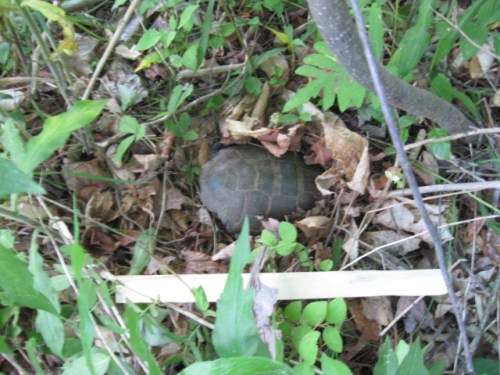
What does it “mean”? Divination benefits from context, and I’m going for three readings, a small but proven sampling of the currents of awen afoot.
Stay tuned.
/|\ /|\ /|\
Images: Texas Falls; Vermont;
[ 1 | 2 | 3 | 4 | 5 | 6 | 7 | 8 | 9 | 10 | 11 | 12 | 13 | 14 | 15 | 16 | 17 | 18 | 19 | 20 | 21 | 22 | 23 | 24 | 25 | 26 | 27 | 28 | 29 | 30]
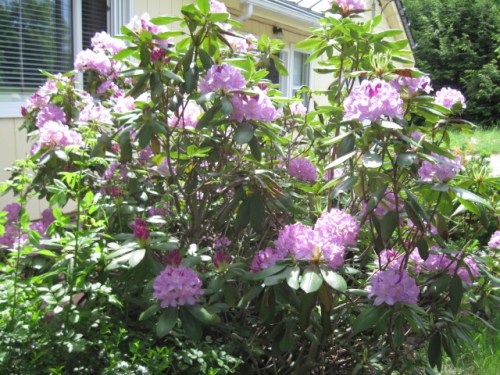
Rhododendron in bloom in our front yard, loud with bees
Since I laid out “Seven Shoulds” for Druids in the previous post, it’s only fair that I should account for how, and how well, I myself manage to do them. Here goes …
1–”Druids should have a practice.”
Ha! I laugh ruefully, because I follow two paths. Sometimes that seems double the challenge. Who needs it? I sometimes think.
But I find that if each day I can manage a practice from even one path, it “spills over” to the other path. They link — a topic for a whole book, I’m beginning to suspect.
I “get credit” on both paths, to put it crassly. Yes, practicing for “credit” means I’m pretty much scraping the bottom of the awen (inspiration) barrel, but sometimes ya gotta go with what you get. Not every day is Lucas Industrial Light and Magic. (If it was, I’d fry and blow away.)
Having a practice also means keeping the ball rolling, the flame burning, even and especially when you don’t feel like it. Then the gift comes, luck turns things around, chance plays things our way, and a god or two peers at me directly for a moment. Because of our efforts? Not always directly, like calculating a sum in math. The universe is more than a spreadsheet. But without the practice, it’s funny how whatever luck and chance and grace and gift I experience will begin to dwindle, dissipate and drain away.
The Galilean Teacher observed, “Those who have will be given more, and those who have little will lose the little they have.” At first encounter, this piece of gnomic wisdom sounded to me like some kind of nightmare economics. Punish the poor, reward the 1%, and all that. But when I look at it as an insight about gratitude — a practice all its own — it starts making a lot more sense. Unless we make room, there’s no space left in us for more. We have to give away to receive. It’s neither more blessed to receive or to give. Both are necessary for the cycle to operate at all.
If I blog or compose verse or do ritual, if I chant or contemplate or visualize, if I love one thing freely without reservation or thought of what’s in it for me, I’ve reached out to shake hands with Spirit. I find that “energy hand” is always held out to us, but unless I offer my half of the handshake and complete the circuit, nothing happens. “What’s the sound of one hand clapping?” goes the Zen koan. More often for me it’s “What’s the greeting of one hand offered?” Pure potential, till I do my part.
2–”Druids should be able to talk about Druidry.”
If inspiration fails, I fall back on John Michael Greer’s fine lines to prompt me into my own “elevator speech”: “Druidry means following a spiritual path rooted in the green Earth. It means embracing an experiential approach to religious questions, one that abandons rigid belief systems in favor of inner development and individual contact with the realms of nature and spirit” (1).
Of course, trot that out verbatim in reply to most casual inquiries, and you’ll probably shut people down rather than open up a conversation. I’m a book addict myself, but I don’t need to talk like one.
So here’s a more conversational version. “For me, Druidry means walking a spiritual path that’s based in the earth’s own rhythms. I try to take an experiential approach to questions big and small. That means I value inner growth and personal contact with nature and spirit.” I find something like that offers plenty of handles if anyone wants something to grab onto. It also has the Druidic virtue of consisting of three sentences.
3–”Druids should show their love of the earth.”
Sometimes this can be more far reaching than just what we ourselves do. Our choices reach more widely than that. Who we interact with also has consequences. We had a builder in recently to rescue our garage, which for every one of the eight years we’ve lived here has been sliding another half-inch down the slope of our back yard.
It took us a fair while to find him. Referrals and ads and word-of-mouth turned up people we eventually chose not to work with. But this fellow was different. Just one proof among several: his attention to reseeding the lawn and cleaning up construction waste after he’d completed the repairs helped us show our love of the earth through our choices of our interactions with others. We didn’t see or know this fully until after the fact, of course. But it was confirmation — the sign we needed. Some days it’s all we get to urge us to keep on keeping on.
I chose this example rather than any other because it was subtle in coming, though just as important as recycling or using less or any of the other things we try to do to “live lightly.” Druidry need not always “speak aloud” to have effects and consequences. Ripples spread outward, hit the far shore, and return. “What you do comes back to you.”
4–”Druids should keep learning.”
Many Druids made this a habit long ago. They have another book or five ready when they’re done with the current one. That’s me. It’s a competition, I’ve come to believe, who will win, my wife or me. She’s a weaver and has baskets and boxes of thread, heddles, wrenches, loom-parts, table-looms, tapestry manuals, and two car-sized looms, all striving for space with my shelves of language books, histories, Druidry and magic texts, boxes of novel and poem drafts, newspaper clippings, letters, and more.
But as J M Greer notes, “Druidry isn’t primarily an intellectual path.” Thank goodness! I’m saved from the limits of intellect, however well I’ve trained and domesticated it! Greer continues: “Its core is experiential and best reached through the practice of nature awareness, seasonal celebration, and meditation” (2).
Druids find themselves encountering people to learn from, the aging carpenter or herbalist or gardener who’d love for an apprentice willing to put in the hard work. So then we happen along and appreciate them and “apprentice for a moment” if not a decade. They’re often self-educated, regardless of what level of school they’ve completed. They seek out people to learn from, and recognize and honor the same impulse in others. Druidry, among all the other things it is, proves itself a wisdom path.
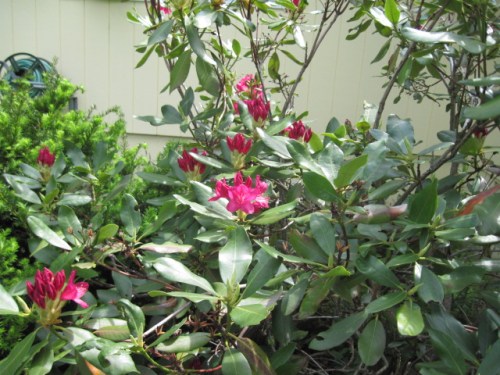
Companion rhododendron in rose, always blooming a week later
5–”Druids should respect their own needs.”
Oh! This is sometimes so large it’s like the air we breathe all our lives, easy to forget. Rather than scold ourselves for lapses, failings and limitations, celebrate what we have done. “More than before” is a goal I take as a mantra. Even two steps backwards gains me some insight, however painfully won, if I look and listen for it. And it gains me compassion for myself and others in our humanness– no small thing. As a Wise One once remarked, who would you rather have around you, someone right or someone loving?
Some six years out from cancer surgery and radiation treatment and I still don’t have the energy I once did. I’m also that much older. But I can rage against and mourn new physical limits, or I can find work-arounds for what I need to do, and set clearer priorities for what really matters, so as not to squander what I do have. Sure, it’s still a work in progress. But I find I can detect small-minded attitudes and deep-seated prejudices in myself more quickly, and do the daily work of limiting their influence and filling their space with more positive thoughts and actions. That’s a gain.
Ever danced your anger? All emotions are energy responses. But I don’t need to sit and stew in them. I can use them to propel myself to new places and spaces and states. It’s an older-person magic, perhaps, or maybe just one I’ve been a long time in realizing and appreciating and practicing.
6–”Druids should serve something greater than themselves.”
Looking back at the list I included — “a person, a spirit or god, a relationship, a practice, a community, a cause, an ideal, an institution, a way of life, a language” — I realize I’ve served all of ’em at some point. Some people stick with one their whole lives. It becomes their practice.
Right now, underemployed as I like to say, I’m more of a homebody than I’ve been, and consequently around the house more. If I find myself sparked to annoyance or anger at my wife for some petty thing, as can happen in the best of relationships, I try to remember to serve her, to serve the relationship. Again, can I use my anger, rather than just seethe? Can I remember to bless my anger, transform its energy and spend it to uncover an underlying issue? What’s the pattern I’ve been feeding? Do I want or need to keep feeding it? Serve myself in this way, in the deepest sense, and I serve others, and vice versa. No difference. To paraphrase, all things work together for good for those who love something that lifts them out of smallness and limitation.
7–”Druids should listen more than they talk — and we talk a lot!”
I’ve certainly demonstrated that here in this post, to say nothing of this whole blog.
Fortunately, one of my go-to practices is listening. Do I do it enough? Wrong question. “Some — any — is more than before.” Both paths I follow commend practices focused on sound as a steady daily method of re-tuning, so that Spirit can reach me through every barrier I may erect against it. Chanting awen, listening to music that opens me, finding literal in-spiration — ways to breathe in what is needed in the moment — letting the song roll through me and back out to others in quiet daily interactions — these are the practices I keep returning to. Listen for the music, whispers my life.
The Great Song keeps singing, blessedly, through my intermittent disregard and obliviousness, till I remember to listen again, and join in.
/|\ /|\ /|\
- Greer, John Michael. The Druidry Handbook, qtd. in Carr-Gomm, Philip. What Do Druids Believe? London: Granta Books, 2006, p. 34.
- Greer, The Druidry Handbook., p. 4.
[ 1 | 2 | 3 | 4 | 5 | 6 | 7 | 8 | 9 | 10 | 11 | 12 | 13 | 14 | 15 | 16 | 17 | 18 | 19 | 20 | 21 | 22 | 23 | 24 | 25 | 26 | 27 | 28 | 29 | 30]
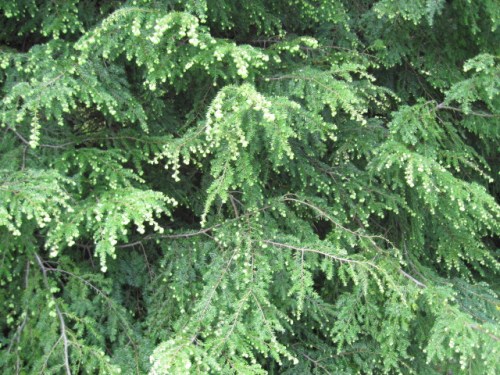
New growth on the tips of our south boundary pines
[Thirty Days of Druidry 28]
“Should” is such a polarizing word. I write it here as a reminder most of all to myself. “Who are you to tell us what to do?!” Well, what difference does that make? If my suggestions are good, follow them. If they’re not, don’t. In the end, “who I am” really doesn’t matter much, does it? I’m not putting it out there as a distraction, so why let it be one for you? A road sign on a road you’re not travelling doesn’t apply to you, does it?
Besides, if my suggestions are good, you’re probably already practicing them in your own way.
(The next post will account for how well I follow my own advice.)
OK, here goes:
1–Druids should have a practice. I’m not saying what that is or should be, only that we each need one. Finding one we can stick with and make our own can be a deal of work. But without a practice, we lose focus, we fail to hear the hints — from others, from the green world, from dreams, from study and learning, from the nudge that comes in the shower or taking out the trash — that help keep us in balance. Otherwise, how are we more than armchair or coffee-table druids?
2–Druids should be able to talk about Druidry. Not proselytize. Not necessarily give interviews, record podcasts or lead workshops, unless that’s our thing. But if someone asks, a door is opening, and we can have an “elevator speech” ready. You know, an account of what we do, and how it makes a difference in our lives. One or two sentences can be enough. Otherwise, if we can’t manage that much, why are we doing what we do?
3–Druids should show their love of the earth. How we each do that is part of our own unique practice. Like all things, we have our birth and our bloom, our fruit and our fallow time. Otherwise, how do our lives build and contribute to this world we say we love?
4–Druids should keep learning. Neither we nor the world stands still, and much is stirring in many fields of learning that can enrich our practice, our knowledge, our awareness and our ability to work with the energies of the world for good. Otherwise, how else do we honor what we have been given?
5–Druids should respect their own needs. Our existences are such complex systems, and it becomes very difficult to fulfill the potential of our lives if pain, anger, illness, injury, or weakness overtakes us. It can be equally difficult to do more than we’re already doing if we have lives we live fully, without adding more than enough and driving us to a tipping point of imbalance. We should seek to know ourselves well enough to respect our own boundaries and limits, while asking which ones deserve to be there as supports, corner posts, roof-beams and garden fences, and which ones we can wisely transcend and grow beyond. Otherwise, how can we respect the same needs in others?
6–Druids should serve something greater than themselves. It may be a person, a spirit or god, a relationship, a practice, a community, a cause, an ideal, an institution, a way of life, a language — the possibilities are great. Otherwise, how do we give back and complete our half of the cycle?
7–Druids should listen more than they talk — and we talk a lot! By listening, we can hear music others miss, find beauty that others pass by, celebrate wonders that many children know but adults are coaxed to forget. Otherwise, how can we add our voices to the Great Song that sings each dawn, noon and sunset?
There’s my list. Anything you would delete, change, substitute? What “shoulds” do you follow on your own path?
[ 1 | 2 | 3 | 4 | 5 | 6 | 7 | 8 | 9 | 10 | 11 | 12 | 13 | 14 | 15 | 16 | 17 | 18 | 19 | 20 | 21 | 22 | 23 | 24 | 25 | 26 | 27 | 28 | 29 | 30]
In a recent NY Times article (“The Danger of a Single Story,” April 19, 2016), conservative columnist David Brooks writes,
As in life generally, every policy has the vices of its virtues. Aggressive policing cuts crime but increases brutality. There is no escape from trade-offs and tragic situations. The only way forward is to elect people who are capable of holding opposing stories in their heads at the same time, and to reject those who can’t.
There, right in our faces, the challenges of a “single story”: even as he strives to diagnose the dangers of binary thinking, Brooks beautifully illustrates it: “the only way forward.”
There are, of course, nearly an infinite number of ways forward. (The larger the group you look at, the fewer the ways. So look smaller, instead. We each of us will make, are making right now, our own ways forward, different from everyone else because we’re different. This post, this blog, is my set of ways. They don’t negate yours. Both-and, not either-or.)
Right now, more than in the past, we face difficulty identifying what “forward” looks like. Oh, there’s always a raucous chorus of voices who will tell you their versions. Mostly we suspect it’s “not what we have right now.” But that’s not at all the same thing as some kind of straight-jacket on reality that drops us into one kind of cosmic “only,” a limited-time offer from the gods.
[Pause for Druid meditation on the rhododendron almost ready to bloom, on the crab apple already loud with bees.]
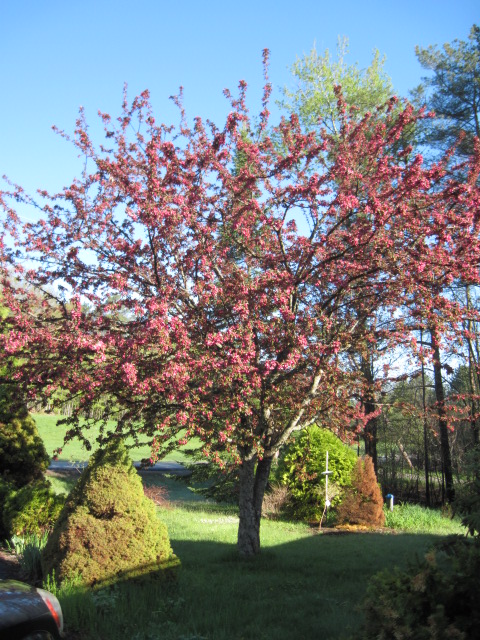
Back again. Readers of this blog know I work mostly in the personal as opposed to the political. And I’ll continue to insist they’re two distinct things. Of course they frequently intersect. Don’t most things in our universe?
Partly that’s a matter of scale. We’re beginning to realize, painfully, that we can only effectively know the local and personal. I can and do pretend from time to time to have wisdom about things outside my experience. (Sometimes I even get away with it.) Prophets and Wayshowers manage to pull it off with panache, and get others to buy in.
But as soon as I can, I’m taking this discussion out of the abstract and into the individual. Name a policy and I’ll show how it erases the unique, the personal, the distinctive. Policy tends to exemplify the tyranny of abstract, one-size-fits-all thinking. Draw a line in the sand and that line starts to matter more than people do, regardless of which side of the line they’re on. Is that ever right, we ask? And our answer determines our experience. There’s no such thing as free will — because we will it so.
[Pause for second Druid meditation, on appearances and other realities. Not just one reality. Boring. Not even just two. Almost as boring. Multiple, endless. Now we’re talkin’.]
I want to hold multiple stories in my head, not just one, even though I’m not running for office or proclaiming my way forward as the ONLY, as if all other options, all other universes, are BAAAAAD. No, I want to hold multiple stories because they’re beautiful, and beautifully true, together or separately, at one time or another. Each one a drop of dew, mirroring the blades of grass nearby, but also the sky. Dreamer, you cry. At the risk of riding on Lennon’s coattails, “you say I’m a dreamer, but …” We’re not there yet. That’s one thing dreaming’s for.
Fall in love with the universe, I hear, as both command and prayer, fall in love with it, and you don’t seek policies, you seek the beating heart of each thing, to know it better, to celebrate with it in its own way, orgy or restraint, sowing or boundary. Yes, as I plant my garden and keep out the rabbits and squirrels, and sweat a little in order to live here at all, I can celebrate at the same time. No single story for me. Work and rejoice. They’re not opposites. Things together. The universe, I find, is a marrying kind of place, for worse, and for better.
[ 1 | 2 | 3 | 4 | 5 | 6 | 7 | 8 | 9 | 10 | 11 | 12 | 13 | 14 | 15 | 16 | 17 | 18 | 19 | 20 | 21 | 22 | 23 | 24 | 25 | 26 | 27 | 28 | 29 | 30]
For my birthday earlier this month, my father in law sent along a card with a cover picture of the four (five) characters from The Wizard of Oz. In the cartoon bubbles above each one are their familiar goals: a heart, some courage, a brain, a home — and Toto as a stealth fifth character gets his say, too: “Maybe a chew toy?”
Druidry has grown sufficiently into its potential that it has a green and beating heart. As for courage, many Druids do try to “walk their talk” as far as they can, at least keeping the two yoked together and pulling in the same general direction. Not all of us, and maybe not even a majority of us at any one time. But any is more than none, enough for a start, more than before. Step forward, live one’s values openly, whatever others may think of them, or quietly (still matters): against fracking, for preservation, against excess (except maybe during festivals, when mead and love-making and all-night drum circles get to play their vital parts in making Druidry just slightly less than completely respectable).
And against dogmatic certainty, if we can, allowing for enough skepticism that we swallow fewer baited hooks. Small successes: a river cleaned and reclaimed, legislation to preserve rather than consume (or at least consume and restore, replant, restock, re-establish). Is it enough, against the slide and careen of our times? We may not be able to know right now. Maybe our current pessimism is part of a useful course-correction, long in coming.
But it counts for something — all things have their weight and presence. The planet’s learning and growing too, a hive of beings that, if they soil their home, will nevertheless still die and be remade in some form, if only as atoms that were Christ and Hitler too, to work out all the consequences, bad and good together. If not me as me, some of my kin will be here in years to come. (Does it matter in one sense if I have been here before? I’m here now.)
A keen-edged kind of justice: the physical world doesn’t appear to do mercy, unless you count cosmic balance as a kind of far-seeing compassion, impersonal in its workings. The gods and spirits, I notice, do sometimes save, but not us from ourselves when we walk away from their counsel.
Brains, too, haven’t been lacking since Druidry’s earliest days, admittedly along with sometimes generous portions of looneyness. The Revival brought out themes and practices many Druid groups like OBOD still draw from, and the more purist Celtic Reconstructionists have increasingly founded their practices on what can be recovered from the past and from mostly careful and informed deduction.
As for a home, well, here we are. Living in and on it, nourished by it, drinking from it, giving back to it what we choose to give to future generations — to our future selves if you hold deeply to full-on recycling.
Which leaves the chew-toy. What things might correspond to that? The tides of current fashion and flaming opinion, sure. Scandal and media obsession, the so-called Witch Wars, the poly-, duo-, mono- and a- theist speculations that usually lead no further, sometimes, than mild clarification or further obfuscation. One or two or ten people finally turned toward practice rather than pontification. A slight deviation away from head-stuff, into things heads deal less well with, but other parts of us say home, home, I’m in native inner country here.
A seemingly casual and causal sidestep into worlds where those old questions get traded for quietly larger and equally old ones. The slant of sunlight at dawn. Dew on bare feet, now that summer’s nearing. Trill of birdsong. Instinct to breathe in the chi, prana, nwyfre, elan, vital energy alive and pulsing all around. Breathing it out as I live my life. A nudge, maybe no more, to serve in some specific way in my neighborhood: an old backyard dump to be cleaned up, a gathering to organize or attend, a seemingly chance conversation that changes the paths of the participants, infinitesimally, modestly, significantly. A move around or out-of-state. A relationship ending, a relationship beginning. A season to plant, to harvest, an injury healed, a new wrinkle, scar, perspective, discovery, wonderment.
What I chew on comes second. Remember, I say to myself, remember that sequence, that priority. My jaws don’t have to be the strongest thing about me.
[ 1 | 2 | 3 | 4 | 5 | 6 | 7 | 8 | 9 | 10 | 11 | 12 | 13 | 14 | 15 | 16 | 17 | 18 | 19 | 20 | 21 | 22 | 23 | 24 | 25 | 26 | 27 | 28 | 29 | 30]
[Talach is the Druid name of a member of the Order of the Green Companions. Because of his support for this blog and its reaching 300 posts today, this guest post is an opportunity for him to share insight on an interesting situation presented to him. We have permission from the person identified below as M. to print this email exchange, with minimal editing to protect privacy.]
Dear Talach,
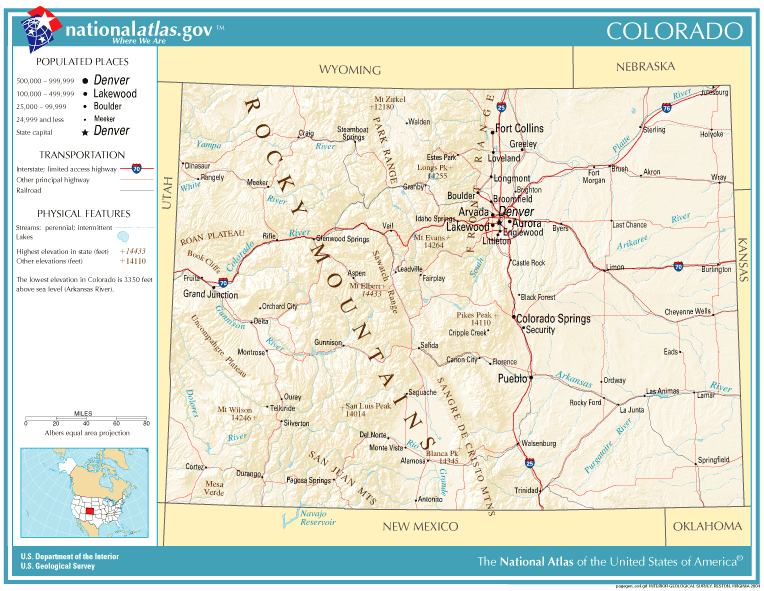
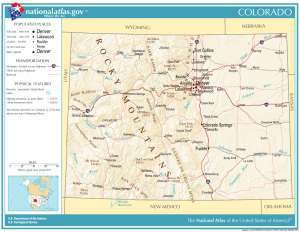 When you spoke after our Beltane ritual about ritual and non-ritual realities, I felt you might understand this problem I’m struggling with and maybe help. My partner and I are both Pagans, I’m a Druid and he’s pretty definitely a solitary Witch, so he doesn’t come to our gatherings. That’s fine. Recently we’ve been talking a lot and fighting a lot about the gods. He’s had some profound experiences with the Lord and Lady and as a result of their guidance he says he wants to make some BIG changes in our life together. Move out of state, off the grid, become self-sufficient, open our relationship, begin teaching and accepting students, etc. etc. There’s a group in Colorado he’s been talking with and he’s pretty focused on them. He met a couple members at a festival last summer.
I love this man, but and it’s a MAJOR but, I haven’t got any confirmation of this even after several months of divination and meditation and ritual. We’ve had some major blow-ups during this time. Part of our fighting comes because he says I don’t work with the gods because I don’t believe in them. He’s right about that last part. I don’t believe. All honor to Brighid and Lugh and the goddess at rituals and as forms of power to work with. But I’ve never experienced them as REAL outside of rituals. I want to hold on to this person and relationship if we can make it work. But my partner wants to make these changes NOW, at the latest definitely before midsummer. Where do we go from here?
M.
Dear M.,
Thanks for your note. You’re dealing several challenges here. Your partner wants changes you’re clearly not sure about. You’re facing a deadline. And part of the decision has been made to hinge on your awareness of the gods who speak to your partner about these changes but not to you.
What’s the most important issue here? It sounds like for you it’s your relationship. Is that true for your partner, too? What’s between you and the gods, or whether life is better somewhere else than where you are, are separate things to consider. You don’t say anything about jobs or housing or other assets, which are a big factor for you yourself, here and now, not just in Colorado or other place you or he may go, alone or with a partner.
So you can ask yourself a hard question, M., and if you do, be ready for the answer: is your relationship important enough for both of you to make it the center of any decision? This is separate from the gods or any deadline. If you and your partner can’t agree on that, you need to work through that, apart from Colorado or your openness to divine guidance. If you’re still both committed to each other and you both have some flexibility, could you try out the Colorado possibility for just a few months to see how it might fit you both?
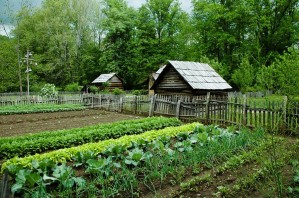 Of course you may not be able to just pick up and leave. Your partner is asking for many changes, not just one, and with a deadline. Why the rush? Why midsummer? If it’s just to get a big garden going, can you do that where you already are? Try becoming more self-sufficient now, apart from the Colorado decision. If neither of you have spent much time growing and preserving your own food, that’s also something to try out close to home first, if you can. That’s a big enough change by itself. Pots and window boxes can help you grow a fair bit even if you don’t have much or any garden space. I urge smaller steps if you can, to make any changes easier to look at and consider and work with one by one.
Blessings to you both, M.
Talach
/|\ /|\ /|\
IMAGES: Colorado map; gardening.
[ 1 | 2 | 3 | 4 | 5 | 6 | 7 | 8 | 9 | 10 | 11 | 12 | 13 | 14 | 15 | 16 | 17 | 18 | 19 | 20 | 21 | 22 | 23 | 24 | 25 | 26 | 27 | 28 | 29 | 30]
Could I be the Mage,
or might I be the Fool?
Should we learn to use our cards
like any kitchen tool?
When I search for wisdom,
when I peruse old lore,
do I seek just kicks and tricks
or something worth much more?
Is my quest a question,
things I already know,
or an “undiscovered country”
I rediscover as I grow?
/|\ /|\ /|\
If “playing the _____ – card” means to take (unfair) advantage of some given of our identities, what might it mean to play the Druid card? Well, it certainly gains us nothing with either the gods or local land spirits.
Druid-card Holder (DCH): “Hey! I’m a Druid!”
Land Wight (LW): “Welcome. Have you listened to the land, spent time hearing what it has to teach, growing a portion of your own food on it, and feeling how each season and its energies shape the lives of all the creatures on it, including you? Have you, in four words, lived where you live?”
DCH: Well, no …
LW: Go away and do not return until you learn reverence.
“I invoke you, goddess, for a change.”
Let me try again. If I live where I’ve lived, rather than almost anywhere else, I accept the gift of responsibility. Usually the word sounds heavy — something people try to flee rather than to welcome. But let me do my Bard word trick once more. I know I’ve often walked away from my response-ability, my ability to respond. I turn it off, drown it out, change channels, either because it’s painful or too demanding or or or. Third time’s the charm: find three or’s and I can successfully escape my ability to respond and maybe spend my whole life in someone else’s dream rather than one of my own. Success!
I often explore my own “weaknesses” because I find I learn more from them than from my strengths. (“Could that be one of their uses?! Hmm.”) We’re so accustomed to others being down on themselves that you may hear this as more of the same. No. I gain strength and insight from such cool, steady gaze. Don’t misunderstand. I’m as good at denial, deflection and depression as the next fellow. A 3-D life! A modern Western triad!
But what I want to get better at are the finely-tuned opportunities my weaknesses constantly point me toward. Lack something, and I sensitize myself to it everywhere around me. My lack magically energizes the thing to keep knocking at the door of my life. But rather than turning to my ability to respond, my responsibility, I do everything to reject the thing I said I wanted. But no worries, mate: it doesn’t actually vanish. It will keep knocking until I let it in. “Ask (I keep asking all the time) and it will be given to you; seek (we never really give up seeking, just take breaks for a day or a decade) and you will find; knock (oh, how it will knock back, friend!) and the door will be opened to you.”*
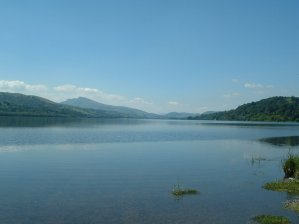
Bala Lake in Wales, where Gwion Bach begins his adventure of transformation
More and more it seems that rather than missed opportunities, there are only ones I keep rejecting. If I really do “miss” one, it will re-group and when necessary take another form in order to reappear down the road and insert itself into my life. Come around the next turn and — ah! There it is, possibly in a guise more difficult to ignore, less easy to escape at all.
My fate pursues me like yours does you, like Ceridwen pursues Gwion through all his transformations. I might even evade my fate for a life or two, come back in another body, gender, set of circumstances, with a “clean slate” so to speak. Except not really. My one life is with me, my responsibility sharpens, clarifies, till I can live it fully, because there’s nothing else I can do, even if I wanted to.
That’s one corner of my “Druid card” — at least, living where I’ve lived, as I understand it so far. What’s yours?
/|\ /|\ /|\
When I respond, link, connect, then I “beltane.” Let’s make it verb … Not to cheapen it, market it, no. To sanctify it. And you, my kin, my readers, when you last beltaned, what did you discover?
“Beltane is so much about the urge to connect, to blend and merge; to feel a part of something extraordinary; to at once lose one’s sense of self in that merging but also to paradoxically feel more absolutely and truly oneself because of it. In the desire to penetrate life’s mysteries, we need also to open ourselves to them, surrendering to the power of love that it may have the opportunity to transform us. Great things are born in us at such moments of union; this place of merging is where the tap root of our creativity feeds, without it we feel dry and disconnected. If that magical, alchemical moment of connection and merging were a colour, I suspect it might be perceived as many beautiful, vibrant shades but its foundation, I feel sure, would be the green of spring: ecstatically joyful – the irrepressible life and desire that leads us to love.” — Maria Ede-Weaving
/|\ /|\ /|\
IMAGES: Ceridwen Centre logo; Bala Lake.
*Matthew 7:7 — an excellent Druidic number!
Updated 9 May 2016
[ 1 | 2 | 3 | 4 | 5 | 6 | 7 | 8 | 9 | 10 | 11 | 12 | 13 | 14 | 15 | 16 | 17 | 18 | 19 | 20 | 21 | 22 | 23 | 24 | 25 | 26 | 27 | 28 | 29 | 30]
Beltane’s nearly upon us, and Alison Lilly’s most recent blogpost “Holy Adoration: Fire as Prayer” catches the energy behind this fire festival. For it is after all the day of the Fires of the Celtic solar god Bel, as even a traditional source like the BBC calmly informs us on their website. Some seasons you’ve just had enough of the world, and most of all yourself as a tame fire, to paraphrase Alison. Do check out her blog. She evokes and invokes Beltane in a personal and poetic meditation.
You too may long to spark, flare, burn and roar. Heap the kindling of my life and ignite, you whisper — or shout. Beltane is here for you.
Part of the Bardic training of Druid groups like OBOD and others, and much of the initial work in the outer grades of the magical Order of the Golden Dawn focuses on exploring and balancing the elemental energies flowing in and around us. We don’t — normally — want to burn up or out. But a healthy conflagration may burn off the wintry torpor that clings to our mood and outlook. Beltane is tonic, purgative, exhiliration, ignition.
The symbolism of the four physical elements of earth, water, air and fire persists in the cultural and magical imagination of the West because they express important truths about human life. They serve as a powerful shorthand for a whole cluster of ideas, images, experiences and memories, and their presence in ritual and story, song and myth will endure as long as we inhabit the same worlds where they manifest.
Their existence as physical entities endows them with the further potential to serve as sacraments. As always, though we keep forgetting, reverence and engagement are our choice, an opportunity like any other that we may welcome or reject. Here, too, fire can kindle us to possibility and change.
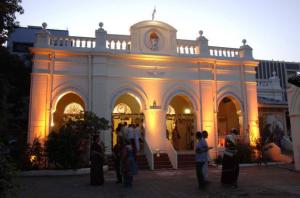
Fire Temple, Chennai, India
Further afield from Celtic-flavored European Druidry, fire is also central to the religious practice of Zoroastrians, the people popularly known as Parsis. Their Fire Temples offer just one more illustration of why reducing fire to an explanation like “rapid oxidation in an oxygen-rich environment like earth’s atmosphere” says nothing about our actual experience of fire, its light and warmth and flickering presence, and its long association in human consciousness with spiritual reality, energy and life. Anyone who’s experienced a good bonfire knows this to some degree. It’s our human art to extend these experiences and celebrate their effect as spiritual opportunities for transformation and joy.
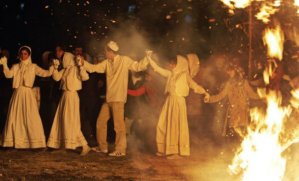
Zoroastrian Sadeh Festival
Fire calls to ancestral human memory. Cultural practices and beliefs that center on it only endow it with additional significance and power. Druids may say as part of ritual “Let us pray with a good fire,” an invocation traceable to the worship of the Hindu Agni and a hymn in the Rig Veda (Bk. 1, 26). And Wendy Doniger in her translation* notes that “When Agni becomes the priest, his robes are both the flames and prayers.” Thousands of years of human experience with fire has not dulled its power.
/|\ /|\ /|\
Whether you’re part of an OBOD Beltane gathering that follows the traditional ritual, or some other group and ceremony, or you’re a solitary celebrating alone in your own way, may you too share that shiver of anticipation and delight as the day and the rite opens for you at the birth of summer. May you and the Sun both grow in strength. “By the power of star and stone, by the power of the land within and without, by all that is fair and free, we welcome you to this rite of Beltane …”
/|\ /|\ /|\
IMAGES: Fire Temple in Chennai, India; Sadeh Festival;
*Doniger, Wendy. The Rig Veda: An Anthology. One Hundred Eight Hymns, Selected, Translated and Annotated. Penguin Books, 1981, pg. 100.
[ 1 | 2 | 3 | 4 | 5 | 6 | 7 | 8 | 9 | 10 | 11 | 12 | 13 | 14 | 15 | 16 | 17 | 18 | 19 | 20 | 21 | 22 | 23 | 24 | 25 | 26 | 27 | 28 | 29 | 30]
In her comment on # 16 in this series, Lorna Smithers writes:
Yes, I’d agree the ‘greater wisdom’ does come from walking through uncharted wildernesses. Often the signposts left by other folk help but it’s rare to find them in the books on how to [do] Druidry/Paganism or of self-professed gurus but more often from poets, philosophers, bloggers, often those who don’t know too much about Druid/Pagan religion but do know about the journey, getting lost, plumbing the deep … Anybody teaching basic writing will share the rule ‘show not tell’. And it’s always showings rather than tellings that have guided me.
I’ll venture some tellings here, if only because I’m re-reading Dion Fortune’s The Training and Work of an Initiate*, and Fortune addresses this topic. (Don’t we all read things to confirm what we already suspect? The awen stalks and finds us in spite of our circumstances and resistances.) Like many of us, Lorna’s learned her path largely by walking it herself, not always an easy or comfortable journey. For her as Bard and awenydd, showings are a kind of native territory.
Fortune tackles the “default setting” of human consciousness (allow for 1930s pronouns and gender reference):
The great majority of our fellow-men are willing to take the world as they find it, and so long as it does not treat them too hardly, they are content.
Given current world events and the growing sense of dis-ease issuing from so many directions, you’d not be wrong if you conclude that fewer people today remain content to “take the world as they find it.”
Fortune continues:
Others, however, question what lies beyond the world as they see it, and until they learnt the answer to this question, suffer from the divine discontent which has for ever urged men to “seek beyond the skyline, where the strange roads go down.”
This is our given: the itch, the pain, the hunger that won’t go away merely because parents, partners, politicians or our own painful (un)common sense tells us to ignore the raw nerve of our discontent. “Times like these” can indeed serve as a fine prod to awakening that discontent in more of us. All this we know — too well.
Most men are also inclined to take for granted the inevitableness of suffering, and unless they are brought into personal contact with some flagrant case, or are themselves victims, they offer no protest.
We also know, or suspect, that we’ve been able to afford such complacency thus far because for so many, comparative physical prosperity, ease and stability in the West have sheltered us from many the worst forms of suffering commonplace elsewhere in the world. (As compensation, we may corner the market on psychic suffering and all the secondary physical fallout it can generate.)
But even in the West this has never been true for all (our temporary exemption has expired), and it’s no longer true for increasing numbers of people. Glib proverbs like “The world is a school where the sleeping are woken up,” however true they might be, offer little comfort or guidance at such times. “Everything happens for a reason” doesn’t offer squat beyond pop psychology. (I want strategies, techniques, tools to use!) Cracks in the dike are starting to show everywhere — cracks that government spending on physical infrastructure, however necessary, will not alleviate.
But Fortune goes on to describe the experience of those who’ve launched themselves on a spiritual quest. You make a start and immediately you’re no longer in “lands we know.” Your footing yields, the path twists and dips and disappears most disconcertingly. Friends are usually no help. One or two may be on their own quests, but it’s rare that you can travel together — or that a companion can offer much assistance if you do.
At times, just to add to your trouble, you feel the golden chance slipping past, or sense the outlines of an open door that’s still invisible in front of you. Somehow you know, maddeningly, that it stands there waiting for you nevertheless. That it might be slowly closing. That now’s the time to go through — if only you could. But such convictions help not at all. Instead, with each subtle opportunity here — passing — gone — they increase the torment.
Fortune gets her finger on the pulse:
It is true that, although glorious glimpses are caught by the intuition unaided by the intellect, much more is lost from sheer inability on the part of the student to grasp the significance of his opportunity. Infinite things can be perceived by the spiritual intuition, but unless the intellect be fitted to cooperate, these things can seldom be rendered of practical avail for the solution of world-problems. The mystic has his moments of ecstatic emotion during which he reaches great heights, but he is seldom able to bring back water from the wells of life for those he has left behind. It is only when each vehicle of consciousness in man is in perfect correlation that the current of inspiration can flow through him and be translated into manifestation in the physical world in which we are living today; and while a man can learn great things and store them in his subconscious mind, it is only during the life in which he has learnt to correlate his vehicles so that he can bring the spiritual through into manifestation, that he can be of service to his fellow men (Fortune, p. 20).
There’s plenty here to unwrap. I read “only when each vehicle of consciousness is in perfect correlation” and I think, “Well, screw it! That’s never happening! Diagnose the problem but then calmly tell me why the solution will always be out of reach! ‘Perfect correlation’?! Are you f***ing kidding me?!”
But we can cut ourselves some slack. As Lorna notes above, we already receive an immense outpouring of “water from the wells of life” from poets and singers, philosophers and bards who do know about the journey and about getting lost. Many already “serve their fellow men” in ways that may be deeply imperfect but still arrive and feed that hunger, ways just as deeply welcome and needed. Lacking any perfect channel, I’ll take all the blessedly imperfect ones around me as my models. Neither I nor anyone else needs to be “perfect” to make a start, or achieve things of value. False prerequisite number 1!
Our goal is flow, however small the trickle at the outset, so that “the current of inspiration can flow through all of us and be translated into manifestation in the physical world in which we are living today.” And we’re already flowing. Without a flow of life energy through us, we wouldn’t even be here. We’re already flowing. Blood in our veins, breath in our lungs, food and sunlight transforming each day into physical life in us. The challenge isn’t to start, but to open the channels just a little wider as we live each day. As so many sources have urged us, a regular practice — ritual, spiritual exercise, chant, prayer, artistic practice, gardening, cooking — acts done consciously and joyously — is one proven method. Miss a day or two here and there? Don’t beat yourself up about it. Keep at it. My own strategy, as I mentioned in a recent post: fail again and again, fail well, fail confidently, until I no longer notice failure, until I don’t fail any more.
Another method is service: “… it is only during the life in which he has learnt to correlate his vehicles so that he can bring the spiritual through into manifestation, that he can be of service to his fellow men.” Fortune assumes multiples lives here, a process of spiritual evolution as we learn through life after life how to “correlate” or harmonize our modes of awareness and action.
Fortune urges us to service out of compassion:
I would urge them, if they need any spur to this effort, to remember how much it would have meant to them, when they themselves stood upon that self-same step, had the help which it will be in their power to give been available. No effort after development is wasted, even if he who strives seems to lose sight of his goal and turn aside. It is the passage of many feet that widens the path for the multitude; we, in our day, will never have to face such trials as did those initiates who broke the way for us (Fortune, pp. 20-21).
We are always initiates, always beginning a new arm of the spirals of our journeys, even as old cycles come to fruition and close. Remembering may not always come to aid us. To let words from Lorna’s site close this post, here’s wonderfully sage advice, a quotation from poet Charlotte Hussey: “Imagine if you can’t remember.” Dreamers, all of us, imagine next.
/|\ /|\ /|\
*Fortune, Dion. The Training and Work of an Initiate. York Beach, ME: Samuel Weiser, 2000. [Originally published 1930, Rider and Co.]


 A Druid Way






.svg)


.jpg)