“And some of the Pharisees from among the multitude said unto him, Master, rebuke thy disciples. And he answered and said unto them, I tell you that, if these should hold their peace, the stones would immediately cry out.” (Luke 19:39-40)
What shall we do till the stones start to speak,
or whom can we turn to and trust in these days?
Can we hear even echoes of truths that we seek,
catch mere flickers of fire to illumine our ways?
The stones broadcast secrets we now scarcely hear —
the earth bears true witness, though leaders stay mute,
to remind us of love that is stronger than fear.
Goal and path rise within us — there’s no other route.
The animals know much — in each neighboring eye
is the ghost of the knowledge hard-won from their days:
make the most of each moment, for this body will die —
tomorrow’s new compost, though it shouldn’t amaze
us when walls turn to doors: we walk through them to find
the doors of our hearts were more narrow by far.
Trust the paint-box you’re given, though your dear ones are blind,
though your culture berates you, fear sets up a bar.
We must watch as we journey, be mindful of stones
that mumble or shout, rousing sleepers to wake.
Learn to feel the right path in the set of our bones,
trust the deep self to know the next step to take.
There are many kinds of freedom. I do not wish to speak about all of them, or to give the impression that all of them reduce to one type. There is political liberty, or the freedom from coercion by public power. There is the political freedom of enfranchisement, or the distribution of public power through the vote. There is freedom as independence, or freedom from the power and opinions of others, which tends to reinforce and isolate individuality. There is freedom from pain, hunger, cold, illness, violence, and ignorance: a freedom that can only be purchased by institutions that limit independence and liberty. There is the freedom to enjoy one’s time or friends in peace, which requires cooperation more than independence for, as James Branch Cabell said, you can live at peace only as long as your neighbor chooses. There are freedoms, then, that individuals claim against communities and freedoms that only communities can create for their members.
These are freedoms of the body, and they’re vital. Without them, our lives reduce to an animal struggle, below the level of anything one calls civilization. Think of films like The Road or any of a growing number of post-apocalypse films and novels over the past century. Without some basic physical freedoms, it’s true, we’re too occupied with survival to accomplish much else. They’re some version of “life, liberty and the pursuit of happiness.” But they’re also necessary without being sufficient. There are further freedoms we eventually learn we need with an almost instinctive bodily hunger. Without them we’re malnourished.
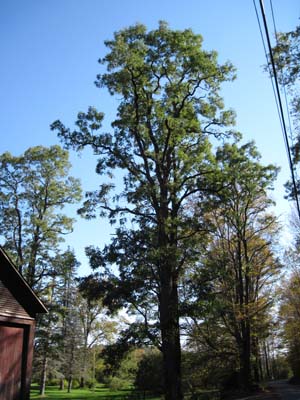
A neighborhood elm — free in autumn
Suber goes on to make an important observation about kinds of freedom from a different perspective, one sometimes downplayed or ignored in current discussion of rights and freedoms.
“A distinction first made explicit by Kant is that between positive and negative freedom. Negative freedom is freedom from —from coercion, constraint, compulsion. Positive freedom is freedom to —to guide oneself from within without taking one’s rule from outside, to be one’s own master and legislator.”
Negative freedom is the kind of freedom many people seem to mean, if they talk about freedom at all. It’s the kind of freedom that libertarians typically build their platforms around. However, one kind doesn’t automatically guarantee the other will arrive with the burgers and the beer, so we can all party. As Suber notes,
“Kierkegaard seems to have been the first to notice that one can attain negative without positive freedom. One can cut oneself loose from enslaving influences and yet have developed no internal or home-grown sources of guidance at all. Kierkegaard in fact finds this state, beyond negative freedom and short of positive freedom, to be a recurring predicament for human beings in the modern world. He calls it hovering, to be free from everything, hence to have no basis for the choices one is then free to make; to be independent but empty.”
“A basis for the choices one is free to make.” Now we’re getting a little closer to what freedom is for. And I’m setting the stage for one kind of freedom we’ve neglected so far and Suber at first seems to leave out. This is spiritual freedom. The word “spiritual” gets bitch-slapped around a lot, so let me explain what I mean here. When people are centered on “a path with heart,” they can endure remarkable physical setbacks and obstacles and still achieve their goals, or die trying without feeling they have failed. Throw them in jail, torture them, exile them, they just keep rolling and rising back up, like the old 70s “weebles wobble but they won’t fall down” ads. Think Gandhi, think Aung San Suu Kyi in Myanmar, think any number of freedom fighters, rebels (whether we like their politics or not), ornery patriots, and similar cussedly independent folks. There’s an integrity to their choices we can admire, even if the choices themselves happen to be abhorrent to us.
Yes, we can call to mind great spiritual heroes — some of them end up as founders of religions – but we have examples closer to home. Most of us know, or know about, people who are “survivors.” They get ill, they go broke, their families desert them, business goes bad, marriages fail, kids land in jail — but they bounce back. They have what an older generation called “inner resources.” We don’t hear about those kinds of resources much, maybe because we don’t have them much in evidence. But the seeds of them are still in us (and seem to emerge most often in hardship). The rest of the time they just make us restless, usually because we’re often living less than authentically. Face it, I get lazy when my life is easy. I want things to stay the same, which they almost always resolutely, infuriatingly, refuse to do. Like they’re refusing to do right now in the West, not to mention many other parts of the world.
What is needed, then, is the judgment to decide what to do with the freedoms we already have, and Suber proceeds to examine what that kind of judgment looks like.
A surprising test for freedom of judgment, in fact, is whether complexity overpowers, intimidates, and defeats us, or challenges, arouses, and incites us to comprehend it. In our spiritual apprenticeship complexity prevents us from feeling our power or wanting to control our own fate. We are happy to learn more first. Freedom before this point is merely self-assertion without the foundation of judgment needed for making choices. But as Hobbes said, if he spent his life reading books by other people, he’d never know more than they did. When we emerge from this dependency into our own freedom it is because we are ready to direct ourselves and make the decisions that this requires.
Bald Eagle — flight as freedom
So are we really free in the U.S. right now? Ignore for a moment whatever your local conspiracy theorist or naysayer or grumpy partisan has to say. The vast majority of Americans have food and shelter. Most of us have a car, won’t get stopped at state borders, and so have freedom of movement (if we can afford the gas). We have freedom from pain and suffering to a larger degree than any other time in history, with all the painkillers and routine buffers from the hard corners of reality that our heated and air-conditioned and work-saving-device-crammed houses and cars and buses and planes can provide. Most Americans live better and longer than medieval kings and queens, with a vast array of entertainments at our command.
Are we free? Material things are enjoyable — you don’t see me volunteering to give mine up just yet — but they can’t help us “emerge from this dependency into our own freedom … because we are ready to direct ourselves and make the decisions that this requires.” When our things get threatened, we complain out of a supposed “freedom” that is “merely self-assertion without the foundation of judgment needed for making choices.” We have the freedom to complain and criticize. But where is the judgment for the choices and changes we need to make?
There is one more factor I want to consider. I mentioned Aung San Suu Kyi earlier, the Myanmar freedom fighter and legally elected official confined to house arrest for years. One of her most famous speeches is her “Freedom From Fear” speech, which begins: “It is not power that corrupts but fear. Fear of losing power corrupts those who wield it and fear of the scourge of power corrupts those who are subject to it.” This is one of the last great “unfreedoms” we face. Think how much fear there is in headlines, on talk shows, in the news, in people’s faces. Suber observes:
The larger kinds of unfreedom abroad in the world and within … are not affected in the slightest until people who recognize them as unfreedom rouse themselves to challenge them.
Religions aren’t always up to the job of helping people wake up and “recognize unfreedoms,” either. I’m including Druidry here along with the rest. One problem with Christianity (to pick on a religion I know and which has had longer to make an impact) is that it has defined freedom theologically and thus very narrowly. That is, until I am saved, I am a slave to sin and subject to its penalties of wasted chances and dissatisfaction and emptiness, and ultimately to damnation. After I am saved by the substitutionary atonement of Christ, who died in my place and paid the price for sin that otherwise I would have had to pay myself, I am free from the penalties of sin, and therefore able to go to heaven at death. But I am no more free immediately after salvation than I was before from the responsibility of judgment, and the consequences of my own and others’ bad and good judgments. My dissatisfaction with Christianity isn’t that it doesn’t save people; it’s that it seems to transform too few of them into better versions of themselves. Where’s the “new creature” promised in the New Testament? A saved jackass or a damned jackass is still a jackass. Salvation may get you to heaven, but we have to live with you till then.
To offer you any kind of definitive “answer” to what freedom is for is to promote an unfreedom. I’m working closer to my own answers, but you need to find your own. Suber acknowledges this:
To take one’s judgments from others is exactly the unfreedom to be avoided. To negate the judgments of others, without more, takes one just as directly to dependency and enslavement, though by a path that is one step longer. To judge by standards that one finds inescapable is still bad faith, for one has chosen to adhere to them, and is not taking responsibility for that choice. To recognize that we are responsible for all our judgments, including our standards of judgment, is the beginning of positive freedom and self-direction. Then we will recognize that all the noisy certitudes of the world are not primarily candidates for truth but appeals to our judgment.
That is, all these supposed “certitudes” are jumping up and down, waving flags, cheering and whistling and shouting and saying to us, “Here I am. What do you think?” rather than “Here I am. Do what I tell you.”
For me, more and more I find as the years pass, freedom is for loving more. Nothing else matches up, noting else offers the challenge and delight and fulfillment. It’s life-long. I’m most loving of myself and others when I’m free, and — paradoxically? — I’m most free when I’m loving. What’s freedom for in your life?
A singe grosbeak inspects our feeder, and as I look out through the living room picture window at the bird plumped against the cold, there’s a reflection in the glass of flames from the woodstove inside. In its orange vigor, my fire faces west, Druidically inappropriate, but very welcome on this grade A gray day.
In the northern U.S. that’s an image of this time of year: reflections, of heat inside, of life still proceeding outdoors and in, of the time of year itself.
The interval between Thanksgiving and the December holidays can be a delicious space, a “meanwhile” or middle-time for re-tooling and starting to close up shop on the current year. To feel that it’s often too busy, or merely filled with worsening weather forecasts, as though that is all it has to offer, is to miss something profoundly meditative about these days. What’s the opposite of miss? Attend, intercept, catch, be there. Whatever it is, that’s what I want to do.
There is as well in November and early December a late-autumnal melancholy, it’s true. The peak of Thanksgiving has passed, and some may see the next months as a pretty solid trudge through the valleys (in our boots, scarves and gloves, and hauling snow-shovels) until the climb to the next holiday.
So when I can take a look from this end of the year at a season at the other side of summer, I do. Off to that start of spring transience which mirrors something in us now as well. I followed a link from an article in today’s NY Times and there on the page was the sudden pure pleasure of “Sakura Park,” a poem by the late Rachel Wetzsteon (pronounced “wet-stone”). Take a visit to late spring, six months ago, or six months to come. The cherry trees (the sakura of the title) are in bloom …
Sakura Park
The park admits the wind,
the petals lift and scatter
like versions of myself I was on the verge
of becoming; and ten years on
and ten blocks down I still can’t tell
whether this dispersal resembles
a fist unclenching or waving goodbye.
But the petals scatter faster,
seeking the rose, the cigarette vendor,
and at least I’ve got by pumping heart
some rules of conduct: refuse to choose
between turning pages and turning heads
though the stubborn dine alone. Get over
“getting over”: dark clouds don’t fade
but drift with ever deeper colors.
Give up on rooted happiness
(the stolid trees on fire!) and sweet reprieve
(a poor park but my own) will follow.
There is still a chance the empty gazebo
will draw crowds from the greater world.
And meanwhile, meanwhile’s far from nothing:
the humming moment, the rustle of cherry trees.
Yes, that’s a poet for you — insisting on a connection between cherry petals and the growth of self, when all the cherry need do is be a self beautifully ready to attract bees, produce fruit and fulfill its cherry-tree-ness.
And yes, there’s a whiff of early middle-aged cynicism creeping in here (Wetzsteon died at 42), the dry rot that afflicts so many who tell themselves to be content with meanwhiles. “Give up on rooted happiness!” she urges. There is still green chance and raw luck and sweet grace in the world, but until they salvage something greater than what’s at hand, be content with meanwhiles, the poet advises, the “far from nothing” moments that hum with possibility even now. So it’s back to trees, where maybe we should have remained.
Too often we are literally “self-important.” We worry about the self like a barefoot child abandoned in a parking lot, or an opened can of tuna that will spoil unless we eat or cook or refrigerate it. The cherry tree sends out blossoms unworried about November. Not because November won’t come, but because it’s not November when it’s April. And when November comes, the tree will be a cherry in November, awaiting the next humming moment.
And yes, if I meditate among the swaying branches and crackling leaves this time of year (trying to fluff myself against the cold like an outsized bird, so I can sit or kneel a few minutes without shivering and breaking my focus), the “stolid tree on fire” matters more than it did before, and my own concerns matter less. Restoration that we seek, visit all who long for it. Find it in the silent witnesses of trees. We who listen for “a voice that will save us” forget what burns in front of us, the fire in the stove in the living room, this day passing with us into “later” and darkness and tomorrow, the trees wintering, summering and wintering again, the air itself, with its metallic crispness on the tongue and in the nose, the fire that burns in all things.
/|\ /|\ /|\
The 50,000-word deadline this Wednesday 11/30 at midnight looms before us “wrimos,” and I’m finally within range. Woo-hah! The Nanowrimo site obligingly lets participants grab icons of progress — anything to keep us writing. Much of what I’m drafting now is detail, filling in missing scenes, background, snatches of dialog with disembodied characters, pieces of Harhanu physiology and psychology — and I suppose, not surprisingly, a brand-new and potentially primary character — because of course what I expressly did not need at this point is a strong new presence telling me “when you are done, you are not done, for I have more” — to paraphrase Omar Khayyam in his Rubaiyat. He already has a name (Tehengin) which he obligingly repeated to me till I got it right. But, probably, I do need him — in some way which I’m sure he’ll inform me about. In detail.
So anyway, here I dance at 44212 words, taking a break to blog, before I return to dance some more. Wish me well in this home stretch.
With so much attention to freedom these days, both freedom from and freedom to (they can feel like — and amount to — very different things), it’s strange there’s so little discussion of what to do with it once we get it. We’re supposed to know intuitively, like eating or breathing. Let me “do my own thing,” “don’t fence me in,” “don’t tread on me,” “a man’s home is his castle,” “do what you want,” and countless other phrases and proverbs and old saws and aphorisms to capture that sense of a supposedly “inalienable right” to do — what? Along with life and the often asymptotic* happiness we’re supposedly in pursuit of, this third leg of the American Independence tripod got declared and delivered to us and we haven’t done a paternity test to see whether it’s our baby. Liberty. As in “see Statue of.” As in Patrick Henry, who gave himself and his audience only two choices (“liberty or death”), proving he was definitely not a true American, because as we all know, Americans love their choices. “Have it your way,” goes the old Burger King advertizing jingle. OK, my way. But once I get it, how do I know I have it? Is it like a lottery ticket — changing in value by the day, and up to me to claim it if I won it? And then what? What’s freedom for?
More to come in Part II.
*An asymptote, if the Wikipedia definition above doesn’t do it for you, is a curve that keeps edging ever closer to a line, but never actually arrives. (Unless you want to count infinity.) Think of it as a geometric tease.
/|\ /|\ /|\
Passing the halfway mark of 25,000 words a couple of days ago felt as big this year as reaching 10K last year did — a milestone. Inevitably I’ve fallen behind — this time by about 5000 words. Got nothing written at all on Monday, and Tuesday was little better. Today’s quota is 30K. I’ve gotten down 3000 words so far, in a burst of catching up, and hope for another few hundred by day’s end, which will bring me within striking distance. I’m at 28,125 as I write this. (Yes, my break from writing a novel is writing a blog entry.) Definitely some interesting material has come through. I’ve put my poor succubus Alza in a number of implausible, erotic, challenging, historical and dangerous situations, just to see what sticks.
I’ve also found out that in order for an important historical meeting to occur, she needs to be about a century older than I’d made her. Not sure how she feels about that. Will no doubt find out. And I’ve gotten down a description of her original appearance that she has just discovered, the “face she had before she was born,” as the Zen masters like to say — before she shape-shifted the first time in her life among humans. That discovery seems to give her a stability and sense of self nothing else has. Here’s a striking image I found online and used for inspiration as Alza. It comes, both appropriately and ironically at once, from an Australian evangelical website, in the form of a pamphlet providing counsel to victims of Incubi and Succubi.
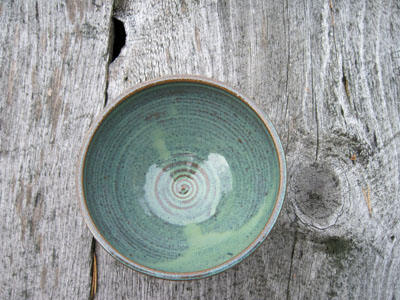
A spiral differs from a circle. There’s motion in it, and change. The track or trail of movement is itself motionless. (Well, comparatively: the boat’s wake dissolves in ripples, the jet trail fades, but some time after, at least; the jet’s long gone.) It records the journey. But journey in a spiral is not repetition. It’s recognition, re-encounter from a fresh perspective. History, planetary or personal, doesn’t repeat itself, but it does often spiral.
[Originally when I took the photo I was simply looking for a background that would contrast with the bowl. Only later after I’d uploaded the photo did I realize that the grain of the wood holds at least as much interest as the spiral design of the bowl. Talk about not seeing the obvious.]
You may remember the chorus in Joni Mitchell’s lovely song “The Circle Game”:
And the seasons they go round and round
and the painted ponies goes up and down
We’re captive on the carousel of time
We can’t return we can only look behind
from where we came
and go round and round and round
in the circle game.
Joni, it’s lovely, and it’s easy to be seduced by the beauty of your song, but you’re wrong. Or at least, you’re right only about one choice among many. It’s a game, and therefore we’re no more captive than any player is who agrees to the rules in order to play at all.
We can choose to play the game this way and be participants in time. That’s the only way to live in a material world anyway, from what I’ve seen: in time. Once we release the drive to “get ahead” or “win the race,” we can begin to jump through time, from moment to moment, recognizing “infinity in a grain of sand, and eternity in an hour,” as William Blake has it. Time is illusion, yes — but in the sense of play (Latin ludere, lusus, illusio = in+ lusio — “in the game”): a set of rules to make sense or pattern out of the flow of experience, which is e-lusive. We need “before” and “after” in order to begin (or return) to experience “now.” The moment of illusion, of play, then broadens and deepens.
“Time is the stream I go fishing in,” says Thoreau. I use this as a mantra when I get stressed about deadlines, minutes ticking, the illusion gaining hold in a way that’s no longer a game, no longer pleasant to be playing. There’s nothing wrong or cruel about time, once we let go the fear that comes with clinging to any particular moment — of resisting the play because life is supposedly such a serious thing. “Eternity is in love with the productions of time,” Blake says in another poem.
These “long lessons” are ones I keep learning. Most of us do — most of us are slow learners — earth’s a place for those with “special needs.”
To live any other way is to suffer needlessly — never my favorite thing to do, anyway — and to be trapped in regret and loss. We’ll all have a taste of these if we live long enough, as part of the balance that comes with fullness of life — why seek out more, and worse, elevate them to a kind of icon of authenticity? “I’m not human unless I make a fetish of my suffering,” some people seem to say. “I AM my suffering,” say others.
The Circle Game goes best when we treat it as a game, as a shape of experience. But it’s not the ONLY one. We hear of people being “lost in the past.” How about seeing what it’s like to lose yourself in the present? Nowhere is now here, to make a linguistic jest with wisdom at its core.
Robert Frost was on to it in “Birches.”
I’d like to get away from earth awhile
And then come to it and begin over.
May no fate willfully misunderstand me
And half grant what I wish and snatch me away
Not to return. Earth’s the right place for love:
I don’t know where it’s likely to go better.
If I don’t experience it on this curve of the spiral, it won’t be there for me the next time to “come to and begin over” in that “can-be-delightful” encounter of the “familiar-new” that often flavors our experiences. I cheat myself of so much joy, thinking there’s someplace “where it’s likely to go better.” Now, here, is when and where it’s at.
As editor of a collection of essays, The Rebirth of Druidry, OBOD‘s Chosen Chief Philip Carr-Gomm attempts to characterize something of the appeal of the spirit of Druidry in human terms. I quote his article at length because in its effect it is all of a piece, and because it provides a suitable introduction to some things I want to say about the Goddess:
Druidry is the perfect lover. You fall in love with her so easily because she is so romantic. She whispers to you of the magic and mystery of the turning stars and seasons. She loves trees and Nature above all things, and you yearn for these too. She tells you stories of Gods and Goddesses, the Otherworld and fairies, dragons and giants. She promises secret lore — of sacred trees and animals, of herbs and plants. She points deep into the past, and ahead towards a future which is lived in harmony with the natural world. But just when you are convinced you will marry her, because she is so beautiful, so tantalizing, so romantic, she turns around and there she is, with rotten teeth and hideous face, cackling and shrieking at your naivety. And she disappears, leaving you with just her tattered cloak, made up of a few strands: some lines from the classical authors, whose accounts are probably inaccurate anyway, a few inferences drawn from linguistic and archaeological research, which could be wrong, with the rest of the cloth woven from material written from the eighteenth century onwards, replete with speculation, forgery and fantasy.
You feel a fool. You don’t tell your friends about your lover. You feel tricked and defrauded, and decide to follow something more authentic, more established, more substantial — like Buddhism, or Christianity, or Sufism, or Taoism — something serious. But then you go out walking. You follow the old trackways, you come to the old places. You see the chalk gods and stone circles. You pause and open yourself to the Land, and there She is again. But this time she is even more enchanting because you can see that she is not just a beautiful woman, full of romance and seduction, you can see that she is also a wise woman, who will provoke as well as seduce you, who will make you think as well as make you feel. And then you suddenly know why she has been the object of fascination for so many through the ages. She is the Muse, the Goddess behind Druidry, the bestower of Awen, of inspiration.
Obviously the imagery here from a male author conveys part of how a man may first encounter the “Goddess behind Druidry”; it may not appeal to women, who find their own powerful ways of connecting with Her. In mythic terms, however, this account very much reflects the changeability of the Goddess — what has inaccurately been called her fickleness, and which has caused many accustomed to meeting deity in a single, invariant form to confuse variety with unreliability or untrustworthiness. Westerners in particular have largely been cut off from experience with aspectual deity, which the Goddess so clearly manifests. Rather than manifesting a loving and compassionate presence, “[t]he deity may appear in wrathful or challenging forms, but these should not be considered hostile. She is the kernel of truth at the heart of everything, and if she appears in challenging forms to you, look more deeply, considering why this may be so,” suggests Caitlin Matthews in her slim but potent book, The Elements of the Goddess. “Many of those who venerate the Goddess are unhappy with her supposedly dark aspects because they associate ‘dark’ with ‘evil.’ In order to save her child about to do something dangerous or silly, a mother will get angry, shout or scream, but this doesn’t mean to say she loves her child any less.”
My first encounter with the Goddess came unbidden, unsought, when I was 25. (You need to know: I’m not especially sensitive or psychic. Friends who are say anyone who wants to reach me has to raise quite a ruckus to get my attention. If you’d asked me then I’d say — still would probably, even today — that half of what people experience in such situations is imagination. But now by “imagination” I mean something considerably larger and more potent than I did then. More about that later.) It was a frosty autumn day, and I was wandering the fields and scattered woods of a farm my father had recently bought in western New York, south of Rochester. I paused in a swampy grove of trees, with several fallen and decaying trunks to sit on. A mood or atmosphere of autumn pervaded the place, almost palpable. The air lay perfectly still. The musty-sweet smell of dried dead leaves filled the air, along with a tang of rot and manure from a nearby field, and a hint of woodsmoke. Over the hills from a distance came the faint roar of some town maintenance vehicle — they were always patching roads in the area. But distant sounds simply deepened the stillness by contrast. As this meditative silence spread and enveloped me, I became aware of a presence that filled the grove and towered over me, fifty, sixty feet tall. Immense. One face of the Goddess. Conscious encounter. Her.
She didn’t knock me on my ass, though that might have been useful too, given how dense I can be. But though I describe it here in mild enough terms, the experience was unforgettable, not for any one detail, but for its undeniable — and familiar — quality. This was someone I knew. Not someone or something alien, or to be feared, or a matter of belief, any more than I need to believe in the tree-trunk I sat on. It was like finding a limb which, when you found it, you knew had always been a part of you all along. You just hadn’t been aware of it. As if it had been asleep, but for its waking you finally twitched a muscle in it, and in feeling it respond you felt it.
So what’s the big deal, you say? “He met the Goddess, in some ways it was an anticlimax though also somehow memorable, he got over it, it was years ago. So?”
A year later I was in the throes of my first love affair (can anyone say “late bloomer”?), a tumultuous relationship in which I did get knocked on my ass. Among all the other things this Goddess encounter was, it was preparation, or warning. I needed greater emotional experience, insight, maturity. I was about to get it.
In between the divine and human realms is an archetypal one — a place, often, of dream and vision, and the idealized images of Others for men and women which “haunt our imagination and often make our love-lives incredibly tortuous until we realize that these daimons will never become physical realities. They are messengers between the divine realms and the human levels of our experience” (Matthews, 13). This was part of what I needed to learn firsthand. No book knowledge this time. It was an initiation of its own.
So this fall at OBOD’s East Coast Gathering, in a meditation involving an encounter with the Goddess in her guise as Cerridwen, I felt a surge of panic — again. “Cerridwen is bad. She tricked Gwion Bach in the old Welsh tale.” But it was old programming. Incomplete knowledge. Fear of that “fickleness” I mentioned earlier. “The old, outworn, dualistic concept of the Goddess as cruel and capricious must be viewed for what it is: a reflection of our shadow-side, a terrible polarization of social responsibility with which women have been burdened as a sex” (Matthews, 24). But now I had more tools to begin to deal with it. At Samhain I did specific work with the Goddess. I needed to. Is it any wonder I also spent 15 years working in a freshman girls dorm as a house parent? Training up close and personal. “The Goddess stands at the heart of life, death and further existence and she will assume the forms which are most appropriate in her dealings with our world” (Matthews, 24). Or as a teacher in the other path I follow related, when he talked about his own experiences with inner and outer realities, “They had to get me to stop bowing every time they appeared, so they could actually work with me and get some work out of me.”
Matthews continues, in ways particularly useful for a male bard like me. “Men experience the Goddess through their creative side. She makes manifest their ideas by animating their dormant creativity. There is a strong sense of ebb and flow about these energies which give men an experience of the cyclical nature of the feminine menstrual cycle. This kind of relationship is rarely recognized for what it is, yet all men can discover and welcome this experience. Although the effect of a Goddess upon a man is less immediately physical than in a woman, it is nonetheless potent” (15).
There is much misunderstanding of gender and sexuality, and what constitutes the self and its connection to the world, perhaps nowhere more so than in the West, with its addiction to pornography, its fear of homosexuality, its violence against women, and its frequent indifference to children. I’ll let Matthews have her last word here. “Every human being is a child of the Goddess … The way of the Goddess is one of natural law and natural wisdom … It is primarily the people of the West who are orphans of the Goddess. The social and political reasons for this desolation have been documented in many books … Both women and men need to find their Mother, relating to her and her creation in fresh and balanced ways, for every one of us needs to drink of her wisdom and realign ourselves with her natural laws.” This is not a matter of belief but of incarnation — our own — to live fully, gratefully and passionately in this world, until we leave it.
/|\ /|\ /|\
Nano update time. Is it any wonder, in light of this post, that I’m writing about a succubus?! And sympathetically — as a main character?! Must be some sort of assignment from the Goddess. Further training. God knows if it’s publishable. (Goddess may know, but if she does, she ain’t tellin’.) Reached 17,804 words: over 1/3 of the way there. Need to hit 20,000 today to be fully caught up, including today’s work. Should be able to do it. Major scene yesterday, in which Alza connected with the man she needs for her magical work, showed him her nature in a brief feed and reversal of energies to restore him, bypassing the mental level altogether, where the idea of a succubus would have completely flipped him, and left him with a medallion magically linked to her — ongoing physical contact to reinforce the dynamic. The resulting reactions when he deals mentally and emotionally with what he already knows will be interesting to capture, but the heavy lifting for that scene is done.
I’d been including more fire imagery in description and action, since Alza’s succubus nature seemed increasingly to resemble that of a fire demon. And then, as a break yesterday, doing some research on demons and succubi in other cultures, I happened on this quotation from the Qur’an: “And the jinn, We created aforetime from the smokeless flame of fire” (Al-Hijr, 15:27). And in an email yesterday from the university where I’m taking a seminar, advertising a weekend workshop for men: “FRIDAY, 11/11/11 – SUNDAY, 11/13/11 – ON THE EDGE OF FIRE: A MEN’S SPIRITUALITY RETREAT.” Right between the eyes — the kind of serendipity and synchronicity and happy accident one hopes for in writing. So I’m on some kind of track. I’m just still discovering what it is. And that’s much of the deep pleasure of this verbal marathon.
“We are many sets of eyes staring out at each other from the same living body” — Freeman House, Totem Salmon
We are many sets of eyes, staring out
at each other from the same living body.
We are ears listening to each other
across valleys of skin.
Heat of the other’s blood
warming the air we breathe,
air that filled the other’s lungs
not long before, and will again,
ruffling our hair, rippling this field
of frost-gray grass.
We touch earth that touches each other,
life-print curling at our fingertips and lips,
world (a piece of it) digesting in our bellies,
swept along in blood and spit,
spice of it in our marrow,
essential you in everything
I eat and love and do,
essential me in you.
/|\ /|\ /|\
So there’s a poem provoked (I say “provoked” rather than “inspired” because that’s the sensation — I encounter a piece of language not my own that becomes the grain around which oyster tries to form a pearl. It won’t let go until I respond, and try to shape the sensation into something in words.)
Nano update: I’m catching up at 13,527 words and counting, but still a little more behind than I’d like. We’ll see what 2 and 1/2 cups of coffee this morning helps me accomplish. I don’t usually drink it, since I’m hypersensitive to caffeine and it keeps me up most of the night following the day I drink it, but I was cold this morning, and the smell! … well, anyway, I’m caffeinated and writing.
Found an interesting passage in a medieval author yesterday, Walter de Mapis. (If you’re gonna procrastinate, I say, why not procrastinate tangentially? I researched historical refs to succubi.) So now I know something about rumors surrounding Pope Silvester. The pontiff flourished around the year 1000, and his legacy includes the story of a certain succubus, who was said to give him advice, and who was reputed to be his lover. Supposedly he repented on his deathbed. Traitor. I’m expecting my succubus main character Alza will have something to say about that. Who knows — maybe she was there. Maybe she was the succubus …
Just discovered she has a mantra or prayer or verbal talisman she recites frequently. Maria, one of her worshippers (from her “cult” phase), overheard her this morning talking quietly to herself, and asked about it. Here are the words Alza said (part of the charm is to speak about oneself in third person):
Alzakh ne utayal gashem muk dafa.
May Alzakh grow in this surrounding fire,
may Fire know her for its own,
may Fire fill her in all she does,
burning away what blocks her,
burning toward what is native to her,
what is or will become or has been Fire,
time the Fire that moves all things into being.
Always fun to get a piece of the original in Harhanu. You need to know: among my other odd hobbies is conlanging. So I hear bits of languages, like I imagine musicians and songwriters hear snatches of songs and musical phrases. Here are the italicized words phonetically, as I heard them from Alza’s mouth: ahl-zahkh NEH oo-tah-YAHL gah-SHEM mook dah-FAH. [Literally, Alza this surrounding fire-in grow-imperative.]
Alza’s name in Harhanu is actually Alzakh, with the kh the raspy sound in loch and Bach — a voiceless velar fricative, to be all linguistic-y and precise about it. Alza’s name got truncated over the years, to match what people thought they heard, or thought it should be. Much as men around Alza imagine the woman they want, which she can then use to seduce them. Most men are, frankly, pretty seducible, she learns. So that part’s easy.
You want Druidry? Find it here, or go bother somebody else. (Now maybe you have some idea why I don’t overdo the caffeine. It makes me all cranky-creative and snarky and stuff.)
“Don’t get me wrong, I like your reality; it’s way more interesting than mine. It’s just that mine seems to be the one everyone else is in.” Courtesy of ivebecomemyparents.com
When I was in my teens, conversations with my mother about the future usually ended with her saying, “You have to live in the real world.” This usually amused me, and sometimes annoyed me. How little I knew at the time that her statement was loaded, that stuff was hanging off it and dripping into the reality overflow collection vat at the bottom of the psychic stairs.
1) She never once claimed that she lived in a real world. But I had to. Why was this? The question isn’t as naive as it sounds. And how could she tell I wasn’t already in the — or a — real world? “It takes one to know one,” as we used to say. What was the give-away, I wonder?
2) Where did the compulsion to live in a real world come from? Only from parents? “You have to live there.” Funny — if I hadn’t been living there, then I’d already disproved such a claim. I didn’t have to live there, which was clear because I’d been living someplace else. But she wanted me too. Probably “for my own good,” which is along the lines of “this hurts me more than it hurts you.” (To their credit, my parents never said that to me.)
3) What is a real world? How do you tell the difference between a real and an unreal world? Is there more than one world, as this statement implies? Sure seems like it. Then what’s the other world like? How did she know? And how did she decide or discover that this one is more real? Simple majority vote? “We live in this world, you — a single person — live in that one. We win.”
4) Is it a whole world? (Sometimes life seems like jumping from one to another of a subset of all possible worlds.) There could be and probably are worlds far better, worse, uglier, stranger and more comfortable than this one. Then again, maybe not.
It feels like we do live in several worlds, all of them real on their own terms. Like we shift worlds all day long, moving from one to another with such ease we forget, we don’t notice, we assume reality is unitive and discrete, rather than a series of interpenetrating planes and grades and places. Waking. Fully awake. Deeply focused. Spacing in front of a video. Lost in music. Making love. Eating. Daydreaming. Sleeping. Dreaming. Tell me those are all identical states of consciousness, identical worlds! I’ve had flying dreams, felt the wind rushing by around me. Last I looked, trying to fly in this world lands you six feet under, or heavily medicated.
Judy Cannato in her book Radical Amazement observes that it’s always time for transformation. To delay just makes the need for change more imperative and harder to ignore (though we’re pretty good at that). Our widespread sense of dis-ease and general “stuckness” and malaise and dis-spiritedness arise from discernible causes and have discernible solutions:
Our attitudes and behaviors are rooted in a way of thinking that is no longer reflective of the real. So much of the time we are stuck in the dualistic, hierarchical, either-or thinking that has created the very problems that threaten us. We are not mechanisms with separate parts, but interconnected holons that are mutually dependent. Yet far too often we cling to the individualism and dysfunctional systems that have “parented” us, molding obedient offspring carrying on the “family” tradition in a way that continues to devastate all life, others’ as well as our own. Shifting to a new paradigm takes commitment and hard work. It requires gut-wrenching honesty and the willingness to give up fear-filled control. We al know what a difficult undertaking this is, but we are capable of the challenge and perhaps more ready than we think. (14)
For me one key here is that this is inner work as much as anything else. I can start it, and I can start working on myself. In fact, that’s the only place any of us will find a lasting and satisfying solution. “Be the change you wish to see in the world” is not wishful thinking or unrealistic. It’s in the copy of Life: An Owner’s Manual that was tied to my umbilical cord when I dropped in, a little over five decades ago. Have you checked your copy recently?
/|\ /|\ /|\
Nanorimo update! Speaking of real and unreal: I’ve cleared 11,000 words — over one fifth of the way there! With 2800 words today, I’m catching up, but today’s goal is 13336, so I need to get another thousand down by day’s end to be in the ballpark and be able to catch up in another day or so. I now find myself writing some semi-detached scenes — backstory for my FMC — Nano-speak, I learned, for “female main character.”
Her name is Alza, and she’s a Harhanu — a succubus. Why a succubus? I’m finding out as I write, and I’ll let you know if I arrive at a definitive answer. Right now, though, it seems to have something to do with desire and empathy and our capacity for both deluding ourselves into disaster and enchanting ourselves into freedom and discovery. Oh, and she’s 947 years old. But she can be really hot when she chooses. Like when she’s hungry. Her most recent feed was from a German tourist named Konstant. He’s one of two humans who know her real nature. Their relationship is reciprocal. Sort of. Do I believe in succubi? I do when I’m writing Alza’s voice, when she’s draining a victim, when she searches like we all do for meaning and purpose. In some ways she’s the most human of my characters. Which may be a problem I’ll need to work on.
That number (of people who know her) is about to change. She’s made an entirely accidental (hah! so she thinks!) connection with a younger man (everyone is younger when you’re 947) named Nick who she’s discovering is crucial to her plans for living. And dying. Both of which she’s seriously considering. She’s also seduced a priest or two in her long life, and once allowed a cult to form around her. Now she’s more interested in laughing at Cosmo and Playboy and figuring out why one human should so dominate her thoughts when she’s used to doing the dominating. Or at least getting what she wants. Which is what men think they’re getting from her. OK, some of this is pretty self-indulgent. It’s also indicative of the space you get into when you’ve been writing all day!
So how does this connect with Druidry? Who knows?! I started writing on Nov. 1 with the small cluster of ideas that came to me, about three days before Nanowrimo began. You go with what you get. Years ago I started a historical novel set in Pre-Roman Etruria. But that’s not what came calling this time, saying “write me!” Hence, my current work.
Sunlit November trees.
A scarf of woodsmoke curls between the mountains.
Look long enough at beauty, someone says.
You’ll begin to see more things as they are.
/|\ /|\ /|\
So, Nano writing update: was out of town at a conference yesterday, and got no writing done. That means today’s a triple push: tomorrow I have a class, a car appointment, and a (late) Samhain celebration with a friend, so there’ll be less time to write. And catch up from yesterday, along with today’s 1667 words.
I’m grateful they keep coming. You know a story is launched — and this says nothing about its quality, only about whether it’s alive for the author, at least — when characters invade your dreams and begin telling you stuff about themselves. And while exercising this morning on our secondhand treadmill in our breezeway (45 degrees, but warmer than outside), I got another piece of plot. Rather, more a set of questions to ask (and answer), and a couple of flashes of image-ideas. By the end of today, I should be at least at the 10,000 word mark if I’m to stay on track.
My main character has retreated to her house in Santa Fe to take stock. (Why Santa Fe? I’ve no idea. Never been there. Would like to, yes. Have to do some research, to see how I might use the locale.) Now to avoid merely lengthy exposition and instead make things happen. I might be able to get away with some flashback, dramatize bits of the past that are now relevant. I keep picking up the stray question here and there that won’t let go, and it generates backstory — in some cases, gobs of backstory. But no stopping to worry about whether the story should begin somewhere else. That’s for a revision. Right now the point is to keep going, keep seeing new pieces I wouldn’t encounter any other way. In that way it’s like any creative process. The road rises to meet your feet as you keep walking.
Maybe you’ve had the dream version: you’re dreaming, you come to a cliff, you’re aware enough to say, “It’s a dream — I can jump and nothing will happen! Woo-hoo!” So you toss yourself in complete abandon, enjoying the thrill of that reckless plunge you would never take awake, but just as the cliff edge spins away above and behind you, you terrify yourself by asking: what if it’s NOT a dream?!
With luck, at this point, you don’t wake yourself up, heart pounding, breathing hard. Instead, you watch to see how you will land, and where, whether you will sprout wings and fly someplace else, etc. In other words, you’re hungry to know what will happen next?!Don’t let me wake up yet!
In her blog, Alison Leigh Lily writes beautifully about the human body as a holy thing, an altar:
So, too, my body is the altar in the nemeton [sacred grove–ADW] of my soul — that small, solid piece of world that settles down like a stone into my awareness. And that awareness in turn is carved by the spiraling torrents of the sacred world, the sun that crafts the seasons out of mud and wind, the moon that pushes the sea to its extremes, the stars that draw the eye into the great distances that yawn open between us, the deer, the jay, the badger, the rustling oak and every being and body that dances through its longing, hunger, fear, curiosity and sleep. All these things turn about the sculpted edge of my nemeton, the sanctuary my soul has made of itself, the self that calls itself “I” and reaches out into the world to touch the chaos that has given birth to it. Sitting in the center of that nemeton is my body, all surface, the appearance of skin and hair and angles and soft curves of fat and loose muscle. Like a ladder that reaches into the dark. A spine, a wellspring, a single tree, a tongue of flame. My body is the altar around which my spirit gathers itself into stillness. Not a temple, but only a simple, useful table where I sit down to do my work.
And some of the work we are called to do is to recognize that altar. In the Bible I read, “I will go up into the altar of God” — introibo ad altare dei in Latin. I use it as a mantra, a chant, to be mindful of the altar as a place to ascend to. For it feels like we do actually rise up, into the body, out of thought, out of waking, out of the distractions and worries and daily obsessions, the small news that passes for important events that other people call “headlines,” but which are mostly just footnotes — out of the image and into the reality, into this body that is part of the world, not a thought or an idea or a remove from the thing itself, but the place where we experience a universe.
I strive to occupy this body, this world, as fully as I can, to be fully incarnate. Not to forsake this great, unheralded, impossibly large opportunity to know, to dare, to will and to be silent, to listen for the voices of the Others who move all around me, chickadee at the feeder, crows scavenging a dead squirrel on the road early this morning as my wife and I drove through the dark and the fog to her weaving apprenticeship.
And Tom, who introduced himself yesterday afternoon — a neighbor, out chopping wood. He paused from his work and called to my wife and me, walking slowly over to where we were unloading our car. “It’s something I can still do, and it needs doing,” he said to us, as he stood before us, dressed in blue sweat pants, a gray sweatshirt, a blue hoodie, pieces of leaves and bark plastered to this clothes. “I was just recovering from knee surgery when I had a stroke. And I was recovering from the stroke when I lost my job. But I can still chop wood, as long as I don’t have to bend my legs too much.” So I touch that friendliness, and something of the spirit in him, that brought him to our doorstep to chat in the fading afternoon light of a day in early November. Is any song more wonderful?
“Sanctuary my soul has made of itself,” Alison says — a poem, a song, a prayer for this life, this world.
“Prayer is about being hopeful,” says Sister Alice Martin. “It is not a phone call to God’s hotline. It’s not about waiting around for an answer you like, especially since sometimes the answer you’re going to get is NO!” And she continues, “If you are going to pray, then don’t worry. And if you are going to worry, then don’t bother praying. You can’t be doing both.” I know which one I want to choose, often as I can, prayer at this altar of my body.
On other blogs, I’ve also looked at practices and perspectives found in many places, Druidry among them, that are forming part of new-old ways of living on earth. The video below captures something of what I’ve found in Druidry. It’s got a nice flute solo and some good nature images. How were you planning to spend the next two and a half minutes, anyway?!
That presence in forest, grove or single tree is something kindred to me, so I walk under the branches, and touch the bark and speak with them, and listen. Their slow gestures move in the air above me. And the silence rings in my hearing. Druids and trees — that was something I understood right away. In childhood my closest friends were trees. What is it about them?
The German poet Rilke captures a piece of it in one of his Sonnets to Orpheus:
A tree ascended there. Oh pure transcendence!
Oh Orpheus sings! Oh tall tree in the ear!
And all things hushed. Yet even in that silence
a new beginning, beckoning, change appeared.
Creatures of stillness crowded from the bright
unbound forest, out of their lairs and nests;
and it was not from any dullness, not
from fear, that they were so quiet in themselves,
but from just listening. Bellow, roar, shriek
seemed small inside their hearts. And where there had been
at most a makeshift hut to receive the music,
a shelter nailed up out of their darkest longing,
with an entryway that shuddered in the wind —
you built a temple deep inside their hearing.
Trees get me to go “quiet in myself,” so that silence is not absence of speech, but a positive space that allows the stillness to unfold and open up and include the listener in it. From it rises the “tall tree in the ear.”
Orpheus, the “you” of the last line, is a musician, a listener who hears the space between notes. He knows sound and silence blend to make possible the third thing of music. Wisdom speech, as opposed to chat and gossip, possesses that same character, emerging out of the silence which makes it possible, and bearing the imprint of its quality.
Such communion is a powerful tool. The rough “shelters” we construct out of our animal longings point us toward knowing these things, toward recognizing and gathering in the temple we can find “inside our hearing.”





 A Druid Way
