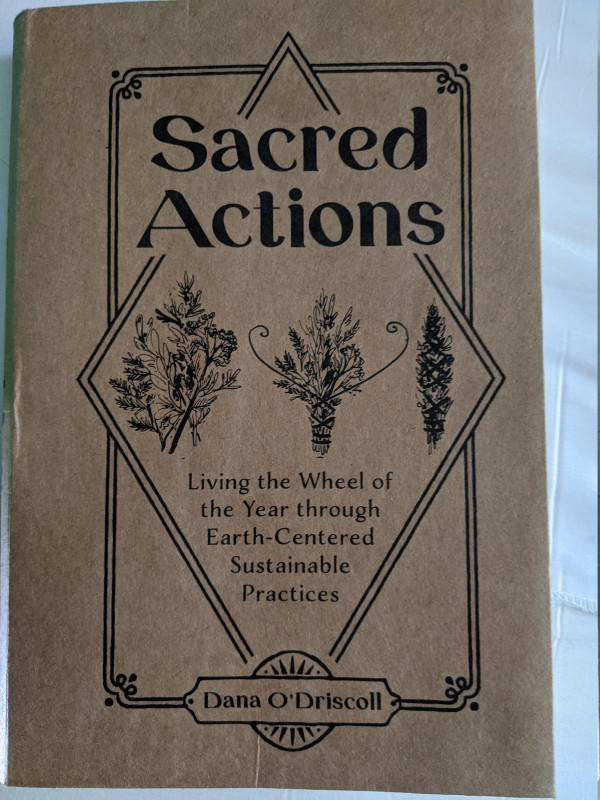
Dana O’Driscoll’s new book Sacred Actions (Atglen, PA: Redfeather, 2021) offers its own best “short take” in its apt subtitle: “Living the Wheel of the Year through Earth-Centered Sustainable Practices”.
[You can hear an interview with Dana on Druidcast episode 171, beginning around the 10:50 mark.]
Even if you’re not familiar with O’Driscoll’s wonderful blog, you’ll quickly recognize that this is an earned book. The author has lived everything she writes about (with her blog as a practicum for those wanting more), the book is rich in anecdote, and in turn that means you can test and try out everything and adapt it to your own life and circumstances. Here there’s no fluff or filler — the feel of the book is workshop — you want to get your hands dirty doing at least some of these things right now. Yesterday we picked strawberries at our local CSA (still massaging our backs this morning), and we enjoyed the first fruits of the season knowing how they grew, and who planted them, half a dozen miles from where we live. Eating strawberry shortcake: sacred action!
Druidry and Pagan practice more widely take many forms — that is one of their strengths. At the core of these life-ways, however, is a practice. While it’s possible to be an armchair Pagan or Druid, sacred action characterizes Druidry and Paganism at their best and most alive. Action, practice, doing all draw us into fuller life with the earth, air and water all around us. (We supply the fire, or not, through our choices.)
A poem I read years ago that I can’t track down now has as its last line “what it is you spent your life loving”. O’Driscoll’s book sends ripples of dissatisfaction through me — in a good way, because you journey with the author asking yourself that question and examining the effects of your answers all around you. The very good news is how many of these sacred actions are things I can begin today. Alternative ways to compost, to approach garden layout, to engage with the community, they’re here, along with so much else: ritual, recipe, reflection. But more significantly, this is a book that helps you find places for other how-to’s you’ve amassed by providing a view from the Tower, from the treetops, from the mountain. I keep being struck at how comprehensive the vision of the book is. O’Driscoll’s reach and grasp, appropriate to the Archdruid of AODA, are wide.
We’re a few days out from summer solstice (winter for folks down under) — both very apt times to think about food, its scarcity and abundance. O’Driscoll’s chapter 5 is “Summer Solstice: Food and Nourishment”. The middle class in the West has grown so accustomed to “what I want when I want it” that we’ve often lost touch with the seasonal cycles, and how mindfully the abundance of one season can be stored, preserved and cherished to feed us through other seasons. It’s a deep satisfaction to eat the ample summer and especially autumnal foods of pumpkins, squash, potatoes, and nuts through the winter, their nutrient riches beautifully aligning with our hunger for calories against the cold. That this is also spiritual act matters just as much. Home preservation of foods, an art within living memory of our parents and grandparents, if not a part of our own lives, is a particular skill that we can revive and benefit from, when foods are abundant, and store against times of scarcity.
One of O’Driscoll’s signal achievements in this book is to remind us practically and repeatedly and inspiringly how we already embody the sacred in what we do each day. We are called and re-called to our sacred human task of mediation. The opening paragraph of the Introduction is a declaration:
Every human being has an innate understanding of the sacred: it’s that feeling of reverence that we get when we enter an old-growth forest, it’s the wonder we feel when viewing a fresh snowfall, and it’s the magic of the amazing Milky Way in the night sky. And those of us drawn to Earth-based and pagan paths are drawn to building and establishing that sacred connection. Our sense of the sacred emerges through interaction between ourselves and our surroundings. It is through the combining of human reverence and thoughtful action with the outer energies of the land that the sacred is awakened. Another way we might think about the sacred is that it occurs when humans are living in harmony and balance with the living Earth, rather than living removed from it (pg. 12).
The sacred is what we do, as well as what we invite and welcome, throughout our lives. How much is up to us.
O’Driscoll’s first chapter launches us with “The Winter Solstice: The Ethics of Care”. In an earth-centered book, we might find that an odd season to begin. Why not with spring, or Samhain / Samhuinne, the traditional Celtic end of the old year and start of the new? North or south, solstice feels like an extreme — and that is the part of its character O’Driscoll wants to engage:
We begin our journey at the darkest point of the year … at the point when the light returned to the world, we are hoping, working, praying, believing, and enacting a better tomorrow. This is the energy of the winter solstice: the time when at the moment of utmost darkness, the light glimmers with the promise to return. The light of our sacred action is what I call the ethics of care … Most of today’s problems are rooted in a lack of care, compassion and connection for ourselves, for others and for the living Earth and all of her inhabitants (pg. 27).
With a wise spiritual diagnosis in hand, doors open. I can work in the smallest parts of my life, knowing I needn’t wait for the Powers That Be to “do something”. O’Driscoll notes, “When doing any work in the community, I have found it to be very forthcoming about where you are in your own lifestyle shifts. I talk about my struggles at various points with areas I am still working to change” (pg. 194). Or one of the Wise observes, “To volunteer from a position of strength is not to know what holiness is all about”.
O’Driscoll’s conclusion follows from the rest of the book: “we need people to do what they can, using the best aspects of their own contexts to make it happen” (pg. 232). “The important thing is starting the journey and making the decision to walk it each day”.
[This is an early version of what is becoming a page on Ritual, a link from the header menu above.]
From small rituals like shaking hands vs. bowing, or saying your culture’s equivalents of “please” and “thank you,” to family traditions at the holidays, and outward to public ceremonies like reunions, annual festivals, weddings, funerals, ship-launchings, inaugurations, dedications, etc., ritual pervades all human cultures.
Even animals exhibit ritualized behavior, if we count courtship displays, and dominance/submission behavior in pack and herd animals. What is instinctive in animals becomes conscious among humans, and though anthropologists and psychologists have developed a range of explanatory theories, none captures all the richness, variety and potential power of ritual.
Whenever I catch myself thinking “empty ritual,” I realize I’m what’s missing. Ritual is simply a form, like a recipe or dance move or martial arts kata. And like a kata, it’s “a routine or pattern of behavior that is practiced to various levels of mastery,” as the Wikipedia entry for kata puts it.
So if my heart isn’t in it, if the pattern-making doesn’t hold my attention, if it doesn’t carry significance to me, it will naturally feel empty to me — because I haven’t filled it with my dedication, my energy and imagination, my preparation, my sense of participating in something larger than myself. The essential component is me. If we want meaningful rituals, it’s up to us to create them.
Families and friends develop rituals to celebrate their relationship — you may have our own examples of a favorite gathering-place, in-group slang and allusions to past shared events opaque to outsiders, and so on. Humans are meaning-seekers and pattern-makers. Ritual is one expression of how human consciousness works.
/|\ THE WHEEL OF THE YEAR
Ritual is simply another tool, and Druidry as an earth-centered spirituality includes the ritual celebration of the seasons. The eight-fold seasonal cycle common to Wicca and Druidry and many Pagans generally is a modern conception. It appears to be the happy result of a collaboration, or at least of mutual influence, between Gerald Gardner and Ross Nichols. In the middle of the last century they were inspired to merge the four Fire Festivals of the Celts of early February, May, August and November with the equinoxes and solstices. The names we give the holidays may vary, but roughly every six weeks you can find a festival marking the turning of the Wheel of the Year.*
Ritual can be magically simple, and needn’t take place only on one of the “Great Eights.” Ritual needs nothing more than you and your intention. You visit a favorite meadow or grove or stone outcropping, and you whisper to yourself a favorite poem, maybe even a verse — simplicity itself — like “This is my rock” by David McCord:
This is my rock
and here I run
to steal the secret of the sun;
This is my rock,
and here come I
before the night has swept the sky;
This is my rock,
this is the place
I meet the evening face to face.
/|\ /|\ /|\
*The Wheel of the Year
October 31 – November 2: Hallowe’en, Samhain/Samhuinn, All Hallows Eve, All Saints Day, All Souls Day, Todos Santos, Day of the Dead, Dia de Muertos.
December 20-22: Yule, Winter Solstice, Alban Arthan.
February 1-2: Imbolc, Oimelc, St. Brigid’s Day, Groundhog Day, Candlemas.
March 20-22: Spring Equinox, Ostara, Alban Eilir.
May 1: May Day, Beltane, Bealtainne, Walpurgis Night.
June 20-22: Summer Solstice, Midsummer, St. John’s Day, Litha, Alban Hefin.
August 1: Lughnasad/Lunasa, Lammas(tide).
September 20-22: Autumn Equinox, Alban Elfed, Mabon.
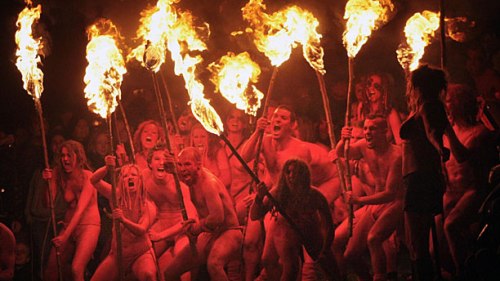
Here we are, about two weeks out from Beltane/May Day — or Samhuinn if you live Down Under in the Southern Hemisphere. And with a Full Moon on May 3, there’s a excellent gathering of “earth events” to work with, if you choose. Thanks to the annual Edinburgh Fire Festival, we once again have Beltane-ish images of the fire energy of this ancient Festival marking the start of Summer.
You may find like I do that Festival energies of the “Great Eight”* kick in at about this range — half a month or so in advance. A nudge, a hint, a restlessness that eases, a tickle that subsides, or shifts toward knowing, with a glance at the calendar. Ah! Here we are again!
For me, that’s regardless of whether I’m involved in any public gathering, or anticipating the time — because it’s never anything as rigid as one single day, but rather an elastic interval — on my own.
Yes, purists may insist on specifics, and calculate their moons and Festivals down to the hour, so as not to miss the supposed peak energies of the time. And if this gives you a psychological boost to know and do this that’s worth the fuss, go for it.
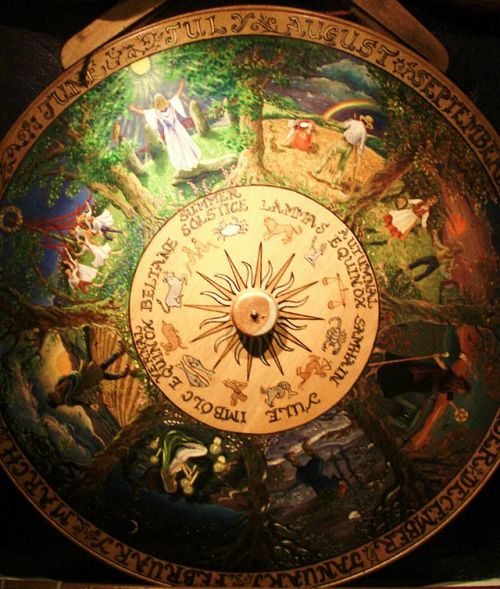
Below is Midnightblueowl’s marvelous painted “Wheel of the Year” (with Beltane at approximately 9 o’clock). With its colors and images, it captures something of the feeling of the Year as we walk it — a human cycle older than religions and civilizations. Or the cycle helped make us human, changing us as we began to notice and acknowledge and celebrate it. Try looking at it both ways, and see what comes of that.
Painted “Wheel of the Year” by Midnightblueowl. Licensed under CC BY-SA 3.0 via Wikimedia Commons
/|\ /|\ /|\
For today I take as divination the message below, which got promptly diverted to the spam folder: “This page decidedly has whole of the information I precious astir this dependent and didn’t make love who to ask.”
O crazy spam-scribe of the ethers, you stumbled onto one of the Great Paradoxes, best stated by William Blake, with his “infinity in the palm of your hand, eternity in an hour.” In that sense, yes: this page “decidedly has whole of the information” though it is also what it is, a finite thing. Like each of us, like the tools we use to connect to What Matters, like the sneaking suspicion that will not go away that there’s Something More. (Even if it’s just an explanation of what’s up with all these capital letters, anyway?)
And since Beltane’s approaching, there is indeed a “precious astir” at work as the energies swirl. Who or what is “dependent”?! The writer of the spam, not knowing “who to ask” and even acknowledging he “didn’t make love.” And all of us, dependent on the earth and each other.
I bless you, oh Visitor to this e-shrine, workshop, journal — the many-selfed thing that blogs can be and become. Who to ask? you inquire. Your inward Guide, always present and waiting for you where you are most true. Or the face of the Guide as it manifests again and again in your life — stranger at the market who smiles at you, bird that catches your eye, tune you find yourself humming.
How to get there, that place we all long for, that colors our thinking and follows and leads us in day- and night-dreams? Place that Festivals and holidays and time and pain and love and living all — sometimes — remind us of? Ah, you mean The Question! Love, gratitude, service — all things any of us can begin today; all things, it’s important to remember, we already do in some measure, or we would die. Too easy? Or you already know that? There’s also ritual — finite, imperfect ritual, our human dance. Mark, O Spirit, and hear us now, confirming this our sacred vow …
What’s your sacred vow? Don’t know yet? Got some work to do? Tune in to the next post for more.
*The “Great Eight” yearly festivals with their OBOD names: Imbolc, Alban Eilir/Spring Equinox, Bealteinne, Alban Hefin/Summer Solstice, Lughnasadh, Alban Elfed/Autumn Equinox, Samhuinn, Alban Arthan/Winter Solstice. Many alternate names exist, and almost every one has a Christian festival on or near it, too.



 A Druid Way

