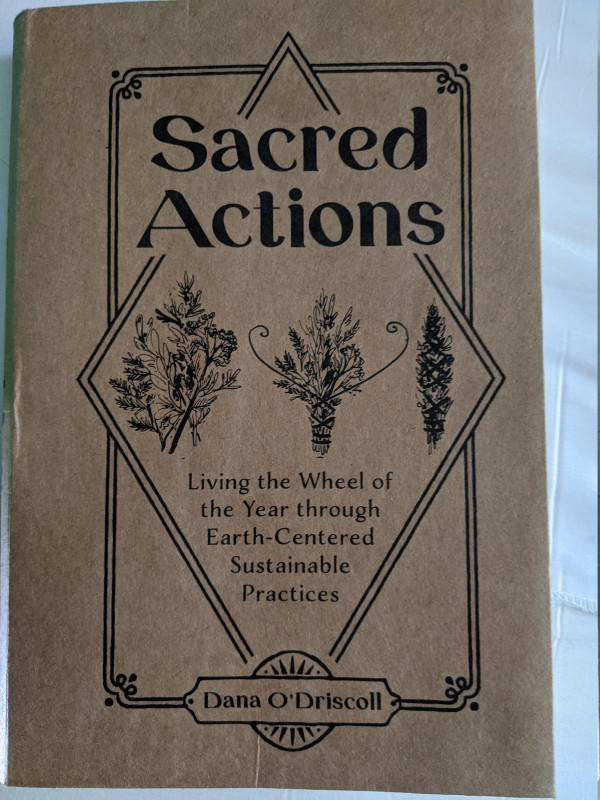
Dana O’Driscoll’s new book Sacred Actions (Atglen, PA: Redfeather, 2021) offers its own best “short take” in its apt subtitle: “Living the Wheel of the Year through Earth-Centered Sustainable Practices”.
[You can hear an interview with Dana on Druidcast episode 171, beginning around the 10:50 mark.]
Even if you’re not familiar with O’Driscoll’s wonderful blog, you’ll quickly recognize that this is an earned book. The author has lived everything she writes about (with her blog as a practicum for those wanting more), the book is rich in anecdote, and in turn that means you can test and try out everything and adapt it to your own life and circumstances. Here there’s no fluff or filler — the feel of the book is workshop — you want to get your hands dirty doing at least some of these things right now. Yesterday we picked strawberries at our local CSA (still massaging our backs this morning), and we enjoyed the first fruits of the season knowing how they grew, and who planted them, half a dozen miles from where we live. Eating strawberry shortcake: sacred action!
Druidry and Pagan practice more widely take many forms — that is one of their strengths. At the core of these life-ways, however, is a practice. While it’s possible to be an armchair Pagan or Druid, sacred action characterizes Druidry and Paganism at their best and most alive. Action, practice, doing all draw us into fuller life with the earth, air and water all around us. (We supply the fire, or not, through our choices.)
A poem I read years ago that I can’t track down now has as its last line “what it is you spent your life loving”. O’Driscoll’s book sends ripples of dissatisfaction through me — in a good way, because you journey with the author asking yourself that question and examining the effects of your answers all around you. The very good news is how many of these sacred actions are things I can begin today. Alternative ways to compost, to approach garden layout, to engage with the community, they’re here, along with so much else: ritual, recipe, reflection. But more significantly, this is a book that helps you find places for other how-to’s you’ve amassed by providing a view from the Tower, from the treetops, from the mountain. I keep being struck at how comprehensive the vision of the book is. O’Driscoll’s reach and grasp, appropriate to the Archdruid of AODA, are wide.
We’re a few days out from summer solstice (winter for folks down under) — both very apt times to think about food, its scarcity and abundance. O’Driscoll’s chapter 5 is “Summer Solstice: Food and Nourishment”. The middle class in the West has grown so accustomed to “what I want when I want it” that we’ve often lost touch with the seasonal cycles, and how mindfully the abundance of one season can be stored, preserved and cherished to feed us through other seasons. It’s a deep satisfaction to eat the ample summer and especially autumnal foods of pumpkins, squash, potatoes, and nuts through the winter, their nutrient riches beautifully aligning with our hunger for calories against the cold. That this is also spiritual act matters just as much. Home preservation of foods, an art within living memory of our parents and grandparents, if not a part of our own lives, is a particular skill that we can revive and benefit from, when foods are abundant, and store against times of scarcity.
One of O’Driscoll’s signal achievements in this book is to remind us practically and repeatedly and inspiringly how we already embody the sacred in what we do each day. We are called and re-called to our sacred human task of mediation. The opening paragraph of the Introduction is a declaration:
Every human being has an innate understanding of the sacred: it’s that feeling of reverence that we get when we enter an old-growth forest, it’s the wonder we feel when viewing a fresh snowfall, and it’s the magic of the amazing Milky Way in the night sky. And those of us drawn to Earth-based and pagan paths are drawn to building and establishing that sacred connection. Our sense of the sacred emerges through interaction between ourselves and our surroundings. It is through the combining of human reverence and thoughtful action with the outer energies of the land that the sacred is awakened. Another way we might think about the sacred is that it occurs when humans are living in harmony and balance with the living Earth, rather than living removed from it (pg. 12).
The sacred is what we do, as well as what we invite and welcome, throughout our lives. How much is up to us.
O’Driscoll’s first chapter launches us with “The Winter Solstice: The Ethics of Care”. In an earth-centered book, we might find that an odd season to begin. Why not with spring, or Samhain / Samhuinne, the traditional Celtic end of the old year and start of the new? North or south, solstice feels like an extreme — and that is the part of its character O’Driscoll wants to engage:
We begin our journey at the darkest point of the year … at the point when the light returned to the world, we are hoping, working, praying, believing, and enacting a better tomorrow. This is the energy of the winter solstice: the time when at the moment of utmost darkness, the light glimmers with the promise to return. The light of our sacred action is what I call the ethics of care … Most of today’s problems are rooted in a lack of care, compassion and connection for ourselves, for others and for the living Earth and all of her inhabitants (pg. 27).
With a wise spiritual diagnosis in hand, doors open. I can work in the smallest parts of my life, knowing I needn’t wait for the Powers That Be to “do something”. O’Driscoll notes, “When doing any work in the community, I have found it to be very forthcoming about where you are in your own lifestyle shifts. I talk about my struggles at various points with areas I am still working to change” (pg. 194). Or one of the Wise observes, “To volunteer from a position of strength is not to know what holiness is all about”.
O’Driscoll’s conclusion follows from the rest of the book: “we need people to do what they can, using the best aspects of their own contexts to make it happen” (pg. 232). “The important thing is starting the journey and making the decision to walk it each day”.
We don’t have to “go anywhere” to contact the sacred.
“Everything that lives is holy”, William Blake declares. Fine, Billy, but how do I reconnect when I’m just not feeling it? In my better moments I may know it’s all holy, but I’m kinda down right now, dude, and I could use some help.
Druidry, after all, delights in “doing something” as a spiritual solution to many problems. Christianity may stereotypically insist “Ye must be born again!” as a prerequisite before anything else can happen, while Druidry as stereotypically suggests “Let’s go for a walk in the green world”.
What if neither of these is a viable option at the moment? Suicide hotlines get callers who’ve often tried every option they can lay hands on, and they’re still suicidal in part for that very reason: nothing’s working. And even those of us not in crisis at the moment can feel overwhelmed by events beyond our control.
If we step even one pace beyond the stereotypes, we find in counsel like “Be still and know that I am God” a place where Druidry and Christianity can draw closer. Something happens in stillness that all our elevator music and muzak and noise and ranting and partisanship try to overwhelm but cannot silence, because it is already silent. What is it?
In a post from Oct 2017 I wrote:
“The practice of sacramental spirituality can be pursued apart from the various pathologies of political religion”, notes John Michael Greer in his essay “The Gnostic Celtic Church“. In sacrament rather than creed lies one potent meeting-place for Druid and Christian.
What to do when one of our most human, instinctive and immediate responses — to touch each other in comfort with a hug, a hand on a shoulder — are actions dangerous to our health?
If the sacrament of touch is denied us, what other modes does spirit have?
The Sacrament of Hearing
“The Voice of the Beloved sustains us”. Whether it’s a telephone call to or from that particular person, or a special video, or piece of music, sound can carry us into spirit. The human capacity for memes and mantras and ear-worms is one we can use to our advantage. Set up what I actually want running through my inner worlds, and I’m halfway home.
And — paradox alert, because that’s much of human experience — in the sacrament of hearing, of listening, we may hear what is singing behind the silence …
Kaisenkaku Asamushi Onsen in Aomori prefecture, northern Japan / Wikipedia /
The Sacrament of Washing
Taking a bath or shower, and visualizing the gunk leaving our bodies down the drain and away can be a spiritual practice. Many traditions urge sacred bathing. (Besides, in lockdown we can let ourselves get pretty grody.)
A Hindu turns if possible to Mother Ganges, Catholics visit holy sites dedicated to manifestations of Mary, it’s a lovely Japanese custom to visit an onsen, and followers of Shinto and plenty of non-religious people as well find hot springs, saunas and mineral pools to be restorative.
The Sacrament of Blessing
Seven words make up a lovely blessing some of my friends use often: “Bless this day and those I serve”. If I live by myself, I’m one of the people I serve. Let’s remember to bless ourselves. We need it. Pets or other animals, and houseplants, may rely on me for food and shelter and affection, so I can add them to those I bless. Outward to friends, neighbors …
What else can I bless? Asking that question thoughtfully can open many doors.
The Sacrament of Prayer
Prayer has long been a potent sacrament in the lives of many. The words and sounds can help restore our connections to spirit, partly because they’ve done so in the past. Like a spiritual battery, they’ve accumulated a charge. We jump-start more often than we realize.
The words of the Druid’s Prayer, or of a song or poem not “officially recognized” as a prayer may turn out to be your prayer. Sometimes we need something even more compact — just a few words from a longer form, a sacred name, a whisper — or a shout. If you’re alone, that’s easier. Try it, and note the power of prayer at the top of our lungs.
One simple prayer available to everyone is simply breathing. We hear in the Gospel of John: “The wind blows wherever it wants. Just as you can hear the wind but can’t tell where it comes from or where it is going, so you can’t explain how people are born of the Spirit”. Experiencing the spirit in our own breathing is a doorway for some. It’s there — sacrament in the life action of our bodies.
You may see in several of the above sacraments how touch has managed to find its way to us. Hearing involves sound waves touching my ears, bathing makes me intimate with water, and so on.
The Sacrament of Cooking and Eating
Some of our most common acts are sacramental in potential, and we can activate them by according them the respect they’ve earned in our lives. Food and drink keep these bodies alive and moving. Preparing food has often been a holy activity, at least around our holy-days, if not every day. Combine eating with blessing, as many do, and I can heighten my awareness of spirit-in-substance. A blessing on the incarnate spirit which sustains us.
The Sacrament of the Image and Object
Photographs, statues, objects collected from a walk or a ritual or as gifts from another — all these things bear a power to tend us. They can evoke memory, their physical substance is imbued with all the times we’ve handled them before (touch seeks us out, once again!), and they have a power to shift our attention to specific places and times.
The Sacrament of Ritual
I talk a lot about ritual here, because we all do ritual constantly. Each of the sacraments above is a ritual, or has ritual elements in it. Part of the sacrament of ritual is to recognize how many things can become rituals — and more importantly, how much of their already-existent ritual power helps shape and influence and move our lives.
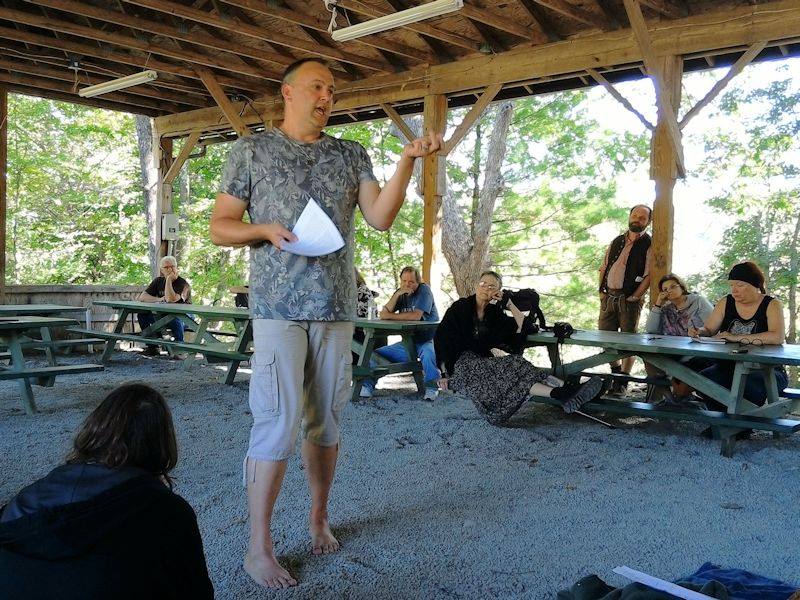
A barefoot Kris Hughes, recreating Iolo Morganwg’s simple summer solstice ritual on Primrose Hill in 1792, at East Coast Gathering 2015. Photo courtesy of Dana Wiyninger.
A friend of mine makes a ritual out of starting to write. He lights a candle, or some incense, and invites the muse of the moment to his writing project. A few other friends explore the meditative and sacramental power that wood-carving and weaving and knitting have, as well as enjoying their concrete manifestation, resulting in useful objects and garments.
May you find and feed your lives with sacraments that mean and matter to you.
Like so many truths, the title for this post is both a truism and a guide.
Want to perceive something? Set it in high contrast to something — often, anything — else. Human consciousness, biologists tell us, is built to detect patterns and contrasts. Among other things, consciousness is a sophisticated survival mechanism. What stands out from the background may be friend, food or foe. That’s one good reason why we won’t be color-blind any time soon, any more than we typically ignore hair or eye color, gender or height or clothing. These are all vital signals that convey information too useful to ignore.
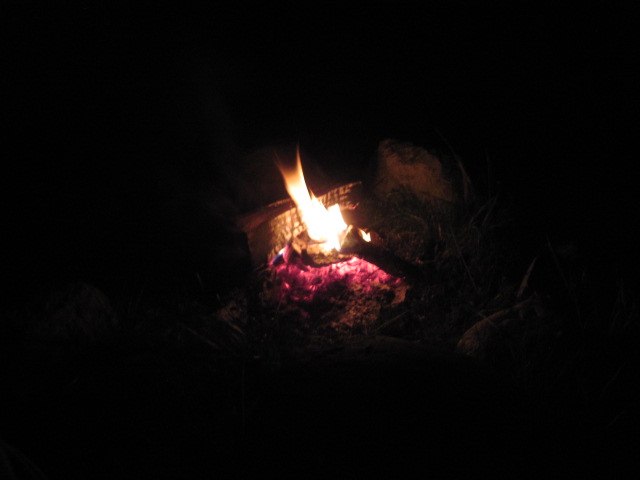
Fire, full moon, night, autumn — as my wife said, after we’d sat for an hour talking and fire-gazing, “It’s very grounding.”
Why not “ground and center” with fire? Oh, I know the reasons: earth helps neutralize imbalances, reconnects us to our physicality when we may be lost in thought or feeling, and so on. Earth’s a great insulator. It helps deaden psychic forces, just like eating meat does after intense ritual or magic or a nightmare. Ground and center, that basic of Pagan practice, one that renews itself as we walk our paths.
But sometimes if I’m too grounded, neutralized and banked and bermed, I need fire. The centering’s still crucial — focus is part of our struggle in this age of so many distractions. In this case, it’s “spark and center”. (With water or air, then, it can be “bathe and center”, or “breathe and center”.)
Kindle me to action, don’t drug me to inertia. In our age of rampant anti-depressants and opioids, you might say we need new prescriptions if we’re to flourish and thrive as the gods invite us to do.
And by “kindle” I don’t mean “prod me to outrage”. That’s a “flash in the pan”. I’m going for a slow burn, the kind that makes good stews and soups, that’s perfect for barbecue so tender the meat falls off the bone, and the ashes keep warm for hours after the flames have died down.
That’s also the kind of kindling that keeps me warm through winter. In this counterspell to our times, I turn us counterclockwise, from West in the last post to South and Fire. As we edge toward Winter in the northern hemisphere, I evoke Summer in us. After all, my preparations of food preservation and stacking firewood and insulating and covering and closing all aim to shelter the sacred fire within.
It takes sacred fire to understand sacred fire, so I lit one last night. Like any dedicated practice, and like all good ritual, action and prayer embody each other.
In these times, the sacred shines all the more brightly by contrast.
Solstice blessings to everyone! What are they? Read on!
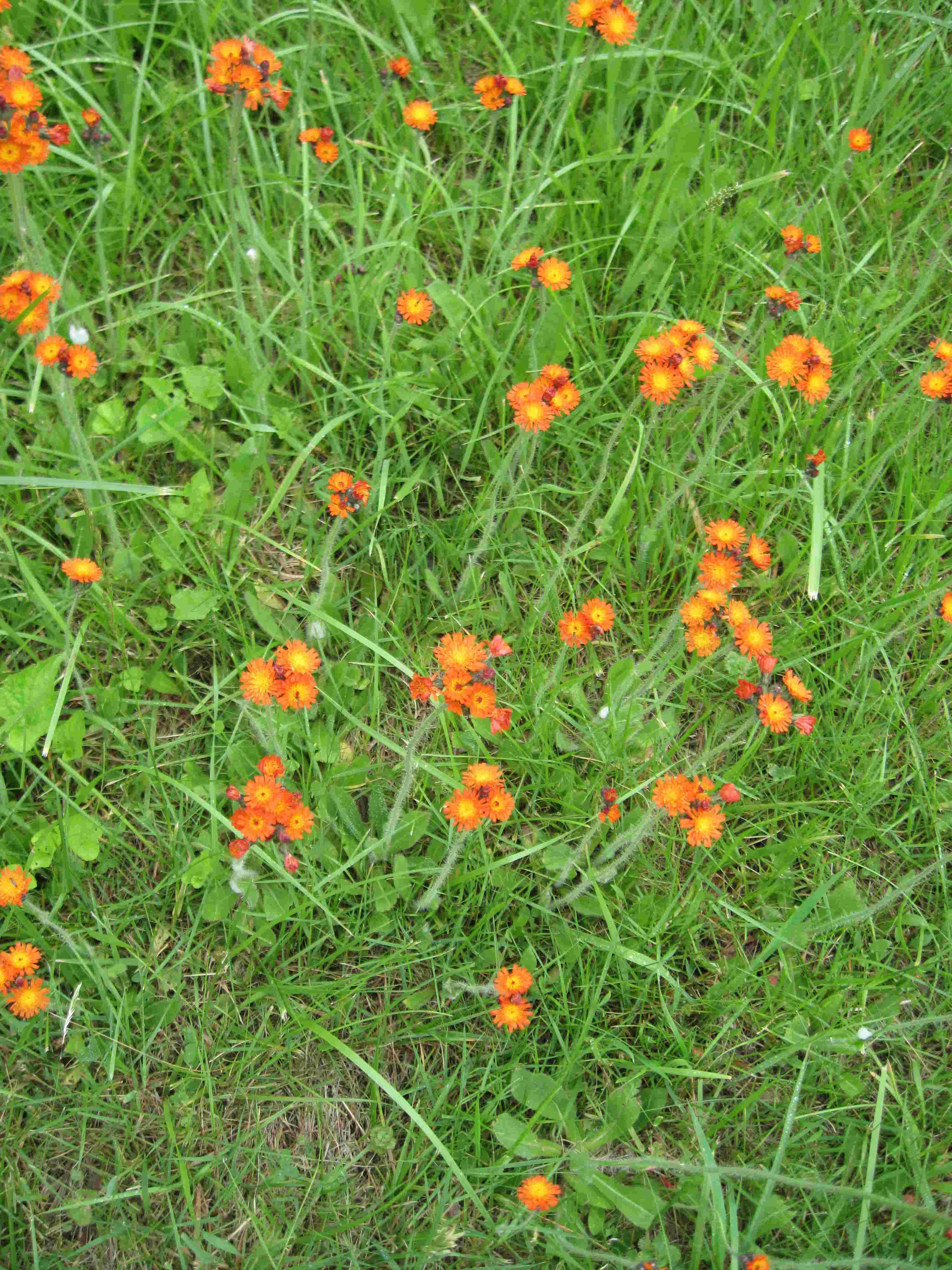
devil’s paintbrush, 21 June 2017
Solstice time is sacred time. That picnic or party you’re holding on the Solstice, alone or with friends, is just as sacred as my Druid ritual, or the monk or nun at prayer, if you’re comparing (un)conventional symbols and images.
As much as anything, I’m found, the sacred is a habit. It’s not only a habit, of course. But a desire to experience the sacred, and the placing of yourself in spaces where experience of the sacred can happen, help it along.
The front lawn I’ve resisted mowing for two weeks now flares with devil’s paintbrush (Pilosella aurantiaca), a weed here in the U.S., though protected in parts of Europe. Also called fox-and-cubs, orange hawkweed, and other names, for me it’s been a harbinger of high summer since I was in my mid single digits, just old enough to ask and remember its name.
I sit on the lawn and begin to count other plant species nearby. Quickly the number extends beyond my skill to name. The first wild strawberries of a few posts ago yield their lovely tartness when I reach for a few to taste. Clover is spreading over the north lawn, and I welcome it, since both bumble- and honey-bees love it, and it crowds out weeds and nitrogenizes the soil. When I was a boy we re-seeded our pastures every few years with clover because it’s such good food for cows and other grazing animals.
The sacred is a kind of love. It feels always new. Sitting on the lawn I forget everything else as I look around, breathe, listen, and feel the warm earth beneath me. Six months from now the ground here may be frozen, perhaps covered in snow, but that will not negate the marvel of earth underfoot, air in the lungs, the sky always changing overhead. Who has not longed for and known the kiss of the beloved? With these bodies and senses we greet the world each day.
The sacred is a celebration. Cultures throughout human history set aside days and places to witness and commemorate seedtime and harvest, greatest light and deepest dark. The solstices and equinoxes are human events as much as astronomical ones, and predate any written scripture by thousands of years. We likewise mark births and deaths, and we make vows and promises to uphold our marriages, friendships, communities and nations.
Moses (ever tried a desert solstice celebration?!) gets to say it in Deuteronomy 30, that what we seek
isn’t too difficult for you or beyond your reach. It’s not up in heaven, so that you have to ask, “Who’ll ascend into heaven to get it and proclaim it to us so we may do it?” Nor is it beyond the sea, so that you have to ask, “Who’ll cross the sea to get it and proclaim it to us so we may do it?” No, the word is very near you; it’s in your mouth and in your heart so you may obey it.
Oh, hear talk of “obeying” and perhaps you resist. I know I often do. Too many times we’ve been ruinously misled by over-trust and heedless obedience. (Republican or Democrat, or whatever the party platform, it hasn’t let up yet.)
As author Peter Beagle describes it, “We are raised to honor all the wrong explorers and discoverers—thieves planting flags, murderers carrying crosses. Let us at last praise the colonizers of dreams” (“Introduction”, The Tolkien Reader). What we can rightly obey shares an affinity with dream. It’s what resounds in us most deeply, if we turn off the jangle of the other voices. Rightly, if not always safely. The sacred is no more “safe” than love is. Both can lead very far from where we thought our lives would go. But the “wrong” voices? What is mass culture but a form of consciously-accepted schizophrenia, if we end up listening to every voice except the first one, the original?
For any authority the sacred wields is not a “command” so much as the first law of our being. To “disobey” it, or attempt to deny or ignore the sacred, is like trying to live outside our own skins. A human without the sacred is exactly that — something eviscerated, no longer alive. We use the sacred itself when we deny it — we employ energies on loan to us even as we refuse them or cast them aside. What else will we do with them?
A habit, a love, a celebration. These are among the keys to the temple. “In every generation” (can’t you hear the movie trailer voiceover for that summer blockbuster, as it proclaims the words?!) whether we throw the keys in the grass, or take them up, use them to open marvels, and pass them along to those who come after us, the temple — oh blessedly and forever! — the temple always awaits.
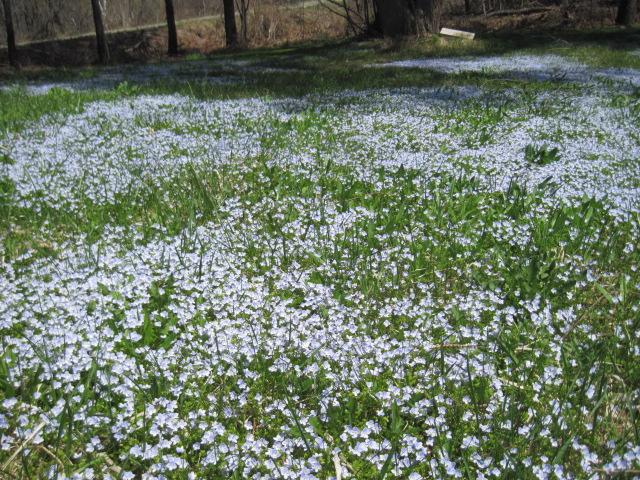
Bluets carpet our backyard lawn, an easy seduction into putting off the mowing I’ll need to do in another week. The air itself is a welcome. I no longer brace myself to step outside. Instead, I peel off an unnecessary extra layer and stand still, feeling my body sun itself in the coaxing warmth. Bumblebees chirm around the first blooms, goldfinches dart across the front yard, and our flock of five bluejay fledgelings from last year wintered over without a single loss and now sound a raucous reveille every morning.
In this last of a four-part series on Beltane, I want to look at our “found festivals” — how we also touch the sacred in the daily-ness of our lives. We don’t always have to go looking for it, as if it’s a reluctant correspondent or a standoffish acquaintance. When I attend to the season and listen to the planet around me, I touch the sacred without effort. The sacred encounter, like a handshake, is a two-part affair. How often do I extend my hand?
Susanne writes in a Druid Facebook group we both follow that finally in her northern location “the last bit of snow on the north side of the house melted away on Beltane day.” Gift of Beltane. Something to dance for.
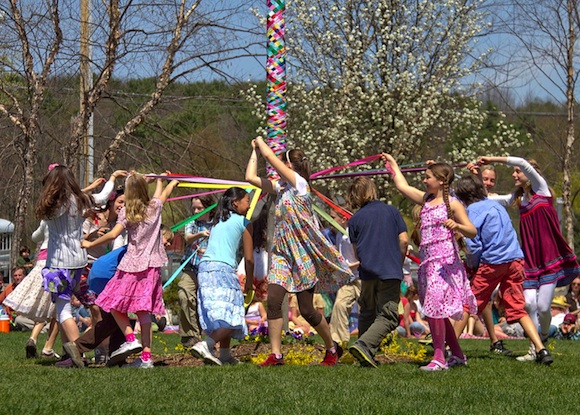
Rudolf Steiner school celebration in Great Barrington, MA
The ritual calendar of much modern Paganism meshes with the often milder climate of Western Europe where it originated. It doesn’t always fit as well in the northern U.S. or Canada, or other places that have adopted it. (So we tweak calendars and rituals and observances. Like all sensible recipes say, “Season to taste.”)
It’s a cycle that the medieval British poet Geoffrey Chaucer celebrates in the Canterbury Tales by singing (I’m paraphrasing lightly):
the showers of April have pierced the droughts of March to the root … the West Wind has breathed into the new growth in every thicket and field … the small birds make their melodies and sleep all night with open eyes …
A Vermonter like me looks at Beltane looming on May 1 and reads those lines of Chaucer’s and thinks, “About a month too early, Geoffrey.” Spring, not summer, begins at Beltane, though to feel the recent temperatures on your face you might well think Beltane is the start of summer indeed. Game of Thrones fans, never fear: Winter will come (again). But now … ah, now … Spring!
Susanne continues:
and even though they are a symbol of Imbolc, the snowdrops are blooming merrily followed closely by the daffodils. The peepers are peeping, the owls are hooting, the woodcocks are rasping ‘peent’ on the ground and twittering in flight.
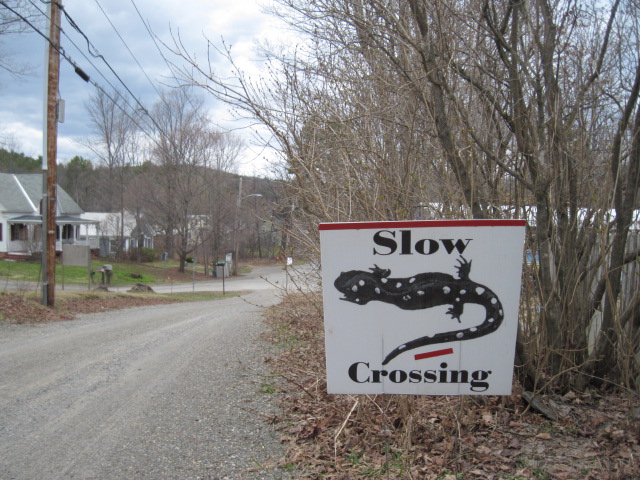
salamander crossing signs in our nearest town
Late April and early May here in southern VT, and in your home area, too, means an annual migration of some sort. Here it’s spotted salamanders. After dark, volunteers with flashlights man the gullies and wet spots to escort the salamanders safely across roads, and slow the chance passing car to the pace of life.
Beltane finds Susanne with her hands in the earth, responding to the call of Spring:
The weekend was spent with Spring clean up, turning the soil and sowing the greens and peas in the garden. I was a bit disappointed in myself that I haven’t held a Beltane ritual but then I realized that this was the ritual…working with the soil, plants and spirits of the land, listening to my favorite songs …





 A Druid Way


.jpg)