One of my best teachers is in fact a high school teacher and an administrator, and — out of long personal experience — no fan of committees and their guidelines. “Is it a guideline, or a line to my guide?” he likes to ask. Does it get born and die on the page, like most administrator-ese, or is it a living thing, helping me connect to what matters?
A case in point is the funny little post “Pillbug“, about — among other things — the experience of connecting with an animal guide. I first wrote it in March 2017, and it went the way of many of my posts, with a brief flurry of interest when I posted it, and then the usual precipitous disappearance into the group anonymity of most other posts here. But a few of you must be reading backwards, or telling each other about that particular post, or both. Because around 5 months ago, Pillbug started enjoying a second life, with several hundred views, more than after it was first published here. Why? (Take a look at it, if you haven’t already.)
I know the subject of guides and other non-human — or often non-physical — helpers keeps on rising into our group awareness. A blogpost, a forum question, and we’re off again.
The topic’s a perennial favorite, and in our skeptical age we often psych ourselves either into complete rejection of such things, or else we run whole hog in the opposite direction, with uncritical acceptance of our more interesting experiences. No halfway for us!
John Beckett’s current post, “Run Rabbit Run — An Augury For One” takes up the subject as well. He approaches many of the same issues I have [see here, here, and here, among others] — no surprise, because we’re all walking a path, and our paths constantly intersect — an opportunity for rich exploration, if we only see and take it, rather than being affronted by difference, challenge, change, otherness. You might find his perceptions a useful counterpoint to other things on the subject you’ve encountered. If so, tell him! Leave a comment on his blog. Help him keep writing his useful guide, based on his experiences.
As I wrote elsewhere, paraphrasing Mara Freeman:
Every thing that exists expresses itself. How else do we know it except through its expressions? If I arbitrarily rule out any non-physical expression from my interest or attention — and here we can include emotion, hunch, imagination, intuition, gut feeling, creative impulse, dream, memory, love — I merely impoverish myself. Why on the deep earth or in the starry heavens would I want to do that?!
So much of our training — maybe all of it — is training in listening, in paying attention. Often we’ve learned the lesson by school age, where teachers call us back from daydream to “pay attention” — and we are, just not to them!
As I look over these notes, several points stand out. (I’ll put them in first person and speak only for myself, not to presume too much about who you are, or what your experience may be.) First, to my mind, is the desire (I don’t know how else to put it) of the Other — Spirit or spirits, guides, deities, totems — to connect with me. Second I must concede my own obliviousness. I ask for help, or a “sign,” but even when it lies down in front of me and trips me up, I STILL manage to ignore it.
Next is the likelihood that once I start looking, coincidences begin stacking up until it’s clear there’s more than coincidence going on. Common themes emerge. The animal I seek is also seeking me — in dreams, “accidents,” images, unaccountable emotional reactions to seemingly “unimportant” things -– in all the different ways it can reach me, in case one or more channels of communication are blocked (usually on my end).
Animal images in poems also cry and echo for the nerd-Bard that I am. We repress the animal guides in and around us, so that like other repressed things, they eventually spring, animal-like, into our psyches elsewhere, in sometimes strange and nightmarish images, in art, dream, eventually, even, in national obsessions and pathologies. If they pool and accumulate enough cultural energy, they manifest in personal and societal outward circumstances, in political and cultural movements, in wars and other conflicts. Think of W. B. Yeats’ apocalyptic poem “The Second Coming,” which famously ends “what rough beast, its hour come round at last,/Slouches towards Bethlehem to be born?”
Or consider Philip Levine’s “Animals are Passing from Our Lives” in the voice of a pig approaching its slaughter. Apocalyptic and angry poems like these, like most art, aren’t “about” only one thing. Run them to earth and they keep meaning something more. We use animals (animals use us!) to communicate what we sometimes cannot say directly. Among all the other things they do, animals help us express that deep love, that bitter grief, anger and darkness, comfort and healing, that simply may not be able to manifest in any other way.
There’s a fine Old English proverb (from the collection of 46 Durham Proverbs, if you’d like to know) that I keep encountering: Ciggendra gehwilc wile þæt hine man gehere. “Everyone that cries out wants to be heard”, as I render it here. Literally, “Of-the-criers, each wishes that him someone hears”. I know that I want to be heard. Who doesn’t, after all?
Or to take a somewhat different context, “Only connect,” says a character in E. M. Forster’s Howard’s End. “Only connect! That was the whole of her sermon. Only connect the prose and the passion, and both will be exalted, and human love will be seen at its height. Live in fragments no longer”. The prose of our daily lives, the passion of those moments when we’re lifted out of ourselves and we say this! This is what I’ve wanted!
“And the fire and the rose (or camellia) are one” — T. S. Eliot
Yes, we live in fragments. The commonest complaint in the West is often, ultimately, loneliness — loss of connection, fragmenting of our bonds with the cosmos, to the point where we sometimes feel like an abandoned “bag of skin”. But when I think how the whole rest of the universe is talking, that’s a lot of hearing that things ask of us. Am I myself talking too much to hear them? Can I pare back my chatter, save my speech even a little more for what matters, fast a little from running at the mouth, and begin to attend to all the other things that are talking too?
And rather than waiting on someone else to connect with me, can I be the connector? Isn’t that one thing that Druidry calls us to do? It gives us tools to help us do what we’re made to do — and it launches us into a talking world to listen at least as much as to talk.
The prayer of St. Francis might just have something to say to this:
O Master, let me not seek as much
to be consoled as to console,
to be understood as to understand,
to be loved as to love,
for it is in giving that one receives,
it is in self-forgetting that one finds,
it is in pardoning that one is pardoned,
it is in dying that one is raised to eternal life.
If I want to experience eternal life in this moment (the only place in this busy, brief, uncertain and intense mortality where I can), I’ve got a guide here. This isn’t just “Christian” morality, as though there can be different kinds of morality. The uni-verse is a “one-turning” and it is what it does, it does what it is. St. Francis’s words aren’t something to believe, but to try out. Quite simply, do they work? Is he offering a powerful spiritual tool here, equivalent to burning cedar, invoking the Elements, divining for job opportunities, working magic to heal? (The modern neo-Pagan movement has delved and mined and workshopped and practiced every spiritual tradition on the planet except the one the West has known for two thousand years. How have I been depriving myself of wisdom in my backyard, along with the moles and bull hornets, the woodchucks and clover and hemlocks?)
In this post so far I’ve come at the matter of guides obliquely, which I find is my default way of feeling my path into understanding. I’ve left clues and approaches, words and feelings, tangents and directions to explore.
I could chart it and number it and lay it out — and ask if you’d like me to do so in a subsequent post, and I will — but then, without great care on my part, it can slide perilously close to the administrator-ese my teacher so dislikes. Read the posts, including John’s, ask your own questions as clearly as you can, and see if I or John or the grass and rain and birds out your window have something to say to you that you might want to listen to. And listen to yourself most of all, that deep self, not the selfie-Facebook-chatty self, but the one who’s been deep within you since you arrived here, however many years ago that was, the one that whispers in dream and awake, that knows where you’re going before you arrive, and has something worthwhile to say on the way to every destination.
And may you know the blessings scattered all along your path, the one you are walking right now, and recognize them and share them and find in that sharing the solace and heart’s healing we all seek.
1 — First of all, you, my readers. Forget superficial social-media “likes” (though on occasion it’s true they’re heartening to receive). Many of the most-read posts here are curiously “liked” the least, or not at all — from which I conclude you’re too busy reading and thinking about them to worry overmuch about “liking” them, thank the gods.
Older posts I haven’t referenced in years still get “views” — some of you are either referring friends to them, or systematically reading backwards and sifting through all the wordage here for anything that has value for you. Knowing how, with a little persistence, I can find a window into something of value in the odd or throw-away reference or turn of phrase in my all varied reading on- and off-line, it’s good to know some of you do the same.
2 — Further, you come from all over — from 102 nations, if I can trust WordPress site analytics. That means that important ideas I grapple with here, and get wrong as well as right, are reaching a wide readership, and provoking reflection. Not surprisingly, the U.S. and the U.K. are the most frequent source of readers, but other nations both expected and more surprising appear on this July’s roster of “Top 20” sources of page views — Turkey, the Philippines, Hong Kong, Japan (Germany and India also normally both feature among the Top 10 when I look at rosters for whole years but for whatever reason didn’t make it last month; Hong Kong isn’t a separate nation — why WordPress treats it as one is interesting to contemplate):
3 — Our much-abused, misunderstood, but still persistent human instinct for the spiritually real, the true, the valid, the potent. To choose just one topic, if your sustained interest in a cluster of posts on Druidry and Christianity on this blog is any indication at all, we sense an intersection there that deserves our attention and exploration. Powerful stuff (a highly technical term) still flows into our worlds and consciousnesses from both traditions and practices, and particularly from their cultural-symbolic-magic conjunction. The Grail, we can say, has never ceased to nourish us.
4 — Our hunger for new — and newly-revitalized — spiritual and pragmatic forms into which we can pour our hopes, dreams, emotions, energies, practices and magic. Rituals, perspectives, prayers, songs, communities — these forms take a multitude of shapes, but any vaunted “decline” in religion that our media love to examine from time to time is very far from the lived experience of many people — we still long to re-link to the numinous, the sacred, the holy, the universal, as much right now as we ever did. Maybe more.
5 — How writing for an audience has helped shape both my writer’s craft and my spiritual practice. What I share, and what I keep private, have shifted over time. You’ve tolerated my moods, my humours, my obsessions, my sometimes narrow or limited perspectives, and you still keep coming back. Sounding my experiences and trying to understand them out loud has given me insight into what can and should be shared, and what shouldn’t or can’t. In this, our deeply confessional era in the West, silence is even more golden — as one of the old “Four Powers”* of the Magus (or of the Sphinx), it retains its place and purpose.
*”to know, to dare, to will, to keep silent” — in Latin: noscere, audere, velle, tacere.
The British futurist and scientist James Lovelock, of Gaia hypothesis fame, just turned 100 on July 26th. He’s also out with a slender new book (Novacene: The Coming Age of Hyperintelligence) on how to handle the climate crisis and global warming.
His four principal ideas, unfortunately, turn out to be deeply impractical. Because I don’t like to criticize without pointing out alternatives, you can find these here as well. As wiser heads have pointed out, our problems have swollen into a predicament, with no quick or painless fix.
If you have a subscription to the Economist, you can read the whole article there (non-subscribers get just a taste), or else watch this 7:46 Youtube video, with substantially the same material:
Lovelock’s four ideas are these, with the approximate point in the video where they are introduced in parentheses:
1–Retreat to megacities (2:02) before the collapse of already endangered ecosystems.
Where and how food production and transport will take place is rather vague. Won’t many have to remain on farms outside the cities in order to feed the rest of us?
Financially, too, this just isn’t feasible for the vast majority of people not already living in cities. Who will fund the enormous housing projects needed? And given that many of our largest cities are substantially overburdened already, even a well-planned expansion doesn’t augur well for livable conditions. And what of the large numbers who like rural life and would balk at relocation?
Yes, millions will be forced inland from coastal and low-lying regions as the oceans continue their rise. As many have already perceived, the great majority of people who will suffer the most are poor and lack political clout.
Better than a retreat to megacities (though some may certainly opt for inland urban destinations), a planned series of evacuations and relocations are starting to happen, albeit in a piecemeal fashion. This most likely will continue haphazardly, and mostly under duress. We’re just beginning to realize the costs, and we’re most reluctant to pay where we have played so heedlessly.
[You can download a free PDF of The Limits to Growth, the 1970 publication of the Club of Rome, which continues to prove largely accurate in its projection of consequences we’ve known for decades but dawdled in acting on. The publication also ends on a note of hope (with identifiably 1970s pronouns), which we’ve also long known: “Man can create a society in which he can live indefinitely on earth if he imposes limits on himself and his production of material goods to achieve a state of global equilibrium with population and production in carefully selected balance”.]
Already taxpayers — at least in the U.S. — partially subsidize rebuilding costs for many who choose to live in dangerous coastal areas, ignoring for now the increasingly violent weather and the inevitable storms and flooding which will ultimately make rebuilding (at still further taxpayer expense) no longer feasible. I include my father- and sister- and brother-in-law in this category: all of them live on Ft. Myers Beach, Florida, and they already pay more each year in flood insurance that I ever did in annual rent for an apartment.
Changing such uneven tax structures would free up needed resources and allow some of the coastal regions to be returned to original conditions that minimized both flooding and coastal erosion, thereby also providing needed habitat for wildlife, and parks for human visitors within limits. The political will to make this happen, however, hasn’t yet appeared.
2—Use nuclear energy along with renewables, eliminating fossil fuel use (3:02).
Nuclear power has never solved its original issues of how to handle spent fuel – or managed a work-around for the massive subsidies it requires simply to start generating power.
Nor will the powerful petroleum industry calmly yield its immensely profitable enterprise without either enforced governmental intervention, or massive subsidies beyond what it already receives.
The immense fossil fuel transportation system, even with worldwide support, would take at least a couple of decades to change over, and at vast expense. Who will pay for that, and for the retrofitting of the millions of households that burn fossil fuels and would need conversion to electricity?
Carbon taxes, continued investment in renewables, and a gradual reduction in fossil fuel dependency and consumption, are somewhat more likely to actually happen and make a difference. They won’t happen quickly enough to stave off widespread problems. The oceans will rise and coastal regions will flood. More species will be lost. Climates will keep changing. Still, late is better than never.
3—Artificially control the earth’s temperature (4:08).
Lovelock proposes artificially shading the earth’s atmosphere with particulates to block solar gain and help cool the earth a few degrees — similar to what happened geologically when Mount Pinatubo erupted in 1991. While we may have the technology already to accomplish this, does anyone think Russia or the U.S. would trust each other to proceed with such a plan, given current tensions?
And how much darkening is enough? Who will underwrite such a large space program? And where will we acquire sufficient non-toxic materials to disperse? Pinatubo discharged vast quantity of harmful ejecta into the air and onto the earth. Do we know how to compensate for the nearly inevitable human error and miscalculation here? Who will be in charge, and oversee such a vast plan from start to finish? And who will pay for any follow-up rebalancing if and when the plan is less than wholly successful?
The planet’s climate will worsen. That’s nearly a given. Whatever we do to ease the worst of the consequences won’t be fairly distributed around the globe. The chances are again very high that the poor will suffer the most. And in turn, political unrest and international conflict will abound. Anticipating problems — planning for this in concrete and doable terms — will go a long way to easing it. Again, however, the political will may well be lacking until we reach crisis point. The expenses of prevention have all too rarely been a governmental priority. That’s why individual action will begin to make a difference.
4—Let AI take over (5:28)
Whose artificial intelligence? If Equifax data breaches and Facebook and Google snooping and data collection have taught us anything, we don’t want ever more anonymous programmers “running everything”. The world of speculative fiction has also long ago addressed this issue: AI could quite justifiably write off humans as an evolutionary dead-end, and take matters into their own hands with an AI-backed Final Solution: the planet would in many ways be much better off without homo non sapiens.
Even Lovelock doesn’t sound particularly hopeful about the future. As he remarks at the end of the Youtube video, “Do I think humans can be saved from the numerous threats that exist in the cosmos? I don’t know. I hope so”.
Fortunately, many tools already currently available, including a range of spiritualities, along with the resilience human beings have long shown in the worst situations, mean that it is not “The End”. It IS, of course, the beginning of Interesting Times, a real-time, up-close-and-personal illustration of that famous Chinese curse.
/|\ /|\ /|\
Metaphysical addendum and caveat: if you’re not a fan of belief in reincarnation, or if you’re still in denial that what goes around comes around, stop reading and return to your regularly scheduled program.
Since you’re still here, it’s worth noting that according to certain occult beliefs, the planet as a whole has already refused the causal initiation once — you know, the one where we accept responsibility for actions and their consequences, and attempt to learn from our mistakes. Like most forms of tough love, the lesson hasn’t gone away simply because we didn’t care for it, and the consequences will still come due, and in even harsher forms, because of that first refusal.
What to do in one of our coming futures, “when the rubble stops bouncing”, as J. M. Greer likes to put it, is the subject of a growing number of blogs, books and teachings. [If you valued Greer’s Archdruid Report and its unblinking look at our present ecological and political realities, along with many subtle but invaluable tips for actually flourishing through it all, you might appreciate and find merit in his new site Ecosophia and his current article there, with over 400 insightful reader comments, and Greer’s sane and wise responses to them: “The Next Twilight of Environmentalism“.]
Blessedly, marvelously, hearteningly, most of the readers of this blog are actually already practicing life-ways that will serve us all well in the days ahead. After all, we need lived examples of alternatives to the madness around us from people who haven’t yielded to despair, who know that our ancestors weathered personal hardships, climate change, plague, famine and war to give birth to us, just as we will to future generations. Some of us, and some of our descendants, will survive to be teachers and preservers of the best of our contemporary wisdom.
What you are going through today is training for tomorrow. You need today to reach tomorrow, says my teacher.
OK, I say to myself. I’ve got today. Heavy headlines. Death. Hate speech. Unrest. Fear. And even seeing the “big picture” can offer little comfort sometimes. Week, day, year? It’s been a hard couple of centuries.
A few years ago, the late Toni Morrison ended an essay for The Nation like this:
This is precisely the time when artists go to work …
I know the world is bruised and bleeding, and though it is important not to ignore its pain, it is also critical to refuse to succumb to its malevolence. Like failure, chaos contains information that can lead to knowledge—even wisdom. Like art.
Information that can lead to knowledge–even wisdom. I’m so there. It’s a Druid thing, reads the t-shirt I imagine myself wearing this morning. (After all, can you accomplish anything without the right t-shirt?) But what is this “information” that I get from failure and chaos? I’d really like to know.
A first step is a “refusal to succumb”. (And one secret: even if I think I’ve succumbed, I can stop. If I find that’s hard, well, that’s my “work of today” that will get me to tomorrow.)
It’s good and right to grieve — that’s not the same thing as succumbing. Maybe because we often censor our grief — “it’s just not American!” — we don’t grieve well — we refuse the difficult work of grief. Grief blocked can feel like succumbing. Sometimes we spend our energy blocking grief and have little left over for much of anything else.
Make a plan to turn negative energy to advantage, says my teacher. At this level of creative imagination, you’re in a condition of survival. The lesson of these worlds is to develop your ability to ride the crests of life.
If there was ever an art, it’s riding the crests of life, I tell myself. Isn’t that what all my vaunted talk of “spiritual tools” is about?! Be not simply good, but good for something, says my go-to guy Thoreau. On this blog, among other things I do, I want to be good for something. Most of all for myself, because if it doesn’t work for me, I have no business offering it to anybody else.
But sometimes I hear spiritual counsel like “Make a plan to turn negative energy to advantage” and I feel like I’m already succumbing. It feels like too much work.
Where am I grieving failure and chaos? After large-scale events like the recent white supremacist massacres in the States, we see people earthing their grief in flowers, pictures of the dead, and other rituals of grief. Grieve, yes. But also leave some energy for making that plan.
The creative part, the part where we “artists go to work” — and that means all of us, not just those wearing a hat or a self-label that says “artist” — means there isn’t any one plan that fits everybody. Teasing apart the question above — where am I grieving failure and chaos? — that’s part of my plan. It may or may not work for you.
I heard myself talking with my wife this morning over breakfast, still processing some less than ideal aspects of my last two jobs — I still carry anger about how I was treated, for one thing. I’m also still grieving other personal failure and chaos, even as my country reels and deals with its much bigger public versions. New grief can spark older griefs.
As a writer, much of my plan circles around writing. It’s one of my principal tools — a way to ground and earth my life sufficiently that I can take a look at it, celebrate the victories, and with any luck, and through the gift of the gods and the blessings of the ancestors, turn negative energy to advantage.
Because we’re all spiritual transformers — it’s our human specialty. That’s how we all survive, how we’re still here at all. So much flows through us, and we parcel it out to the different elements and to combinations of elements. Some of us ground it in particular forms — our families, jobs, talents, relationships, community service. Some of us let it inspire new ideas and thoughts, which we may or may not later ground and earth in forms and shapes and things. Someone else may pick them up and run with them. And so on. (We haven’t even gotten to fire or water yet.) The point is that a plan taps our unique identities, situations, talents and strengths and amplifies them. We don’t have to do it all. We do have our part, our portion, that no one else can do.
Just where am I sending energy? And how much?
There is usually a struggle when we move to a larger state of awareness, and that is natural, says my teacher. Often we swallow the belief that we’re doing it wrong if it doesn’t come effortlessly, if our growth doesn’t move forward like a hot knife through butter. We feel like frauds even as we hide the hassle, when sometimes that’s one of the more valuable gifts we can offer others — let them see that our achievements cost us something.
If you’re a certain age — if like me you had parents who came of age during World War II and the Depression, you probably heard variations on there’s no such thing as a free lunch. Lost in all that well-meant advice is the point that there is a lunch, and a breakfast and dinner, and feasts and fests besides. Yes, they come with a cost, but they do exist.
It’s gonna cost you, leers the gangster figure or Mob boss, the loan shark, the street dealer, the manipulative partner or blackmailer. We hear the words with a sinking heart, feeling for our heroine or hero. Don’t do it! we may be tempted to shout at the screen. Run away now! Get out while you still can!
In the movie of our own lives, we may have learned half the lesson so well we forget the other half. Nothing kills the Awen-Song from the Deep.
Where and when and how we sing, though, and who we’re singing to — that’s up to us.
/|\ /|\ /|\
For an example of another’s response and plan, here’s a link to John Beckett’s blogpost.
I mention “spiritual tools” a lot here, and since my wife recently organized, according to her own criteria, my basement hand-tools as she searched for the particular item she needed in the disarray that table-top had become, I’m minded to do the same here. Every tool-kit accumulates items seldom-used, well-worn, taking up space, or simply unidentifiable. Even more so, if it’s a spiritual tool-kit. Add to that the spare parts, left-over washers, bolts, rods, screws, assembly wrenches and bent nails, broken drill-bits and reminders-to-replace-by-holding-on-to-the-old-item-until-you-do.
Tool-kits are often idiosyncratic, at least partly inherited, and with at least some overlap and mismatch, similar to metric-imperial conversion. Beliefs about a tool’s suitability, applicability or even legitimacy can dog the tool-kit user. And each of us makes use of some things no one else might consider — or be able to use as — a tool.
What do I mean by, and what do I include among, my “spiritual tools”? Why do they belong in my kit? How do I know which ones to use, and when? Wow, you’re asking some good questions today! (That’s how it can feel, when you’ve been blogging a while.)
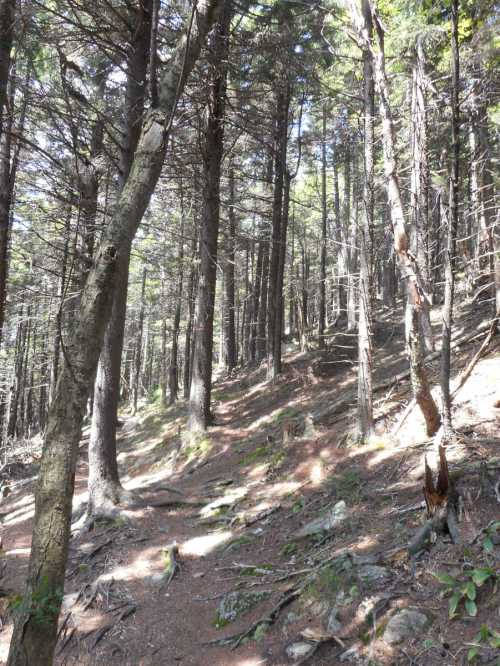
pine slope, Mt. Ascutney State Park
Divination, prayer, fasting, trance and other non-ordinary consciousness work, ritual, magic, chant, sacred names and words, writing/recording/journaling, drumming and rhythmic inputs. Dreamwork, visualization, herbs, yoga and similar practices, meditation and contemplation, dance and sacred movement, mandala and sacred images. But also rehearsal, repetition, expectation, staging, music, group consciousness, affirmations, pilgrimage, non-human allies, earth energies and power sites, crystals and other helpers. Quite an assemblage of items. And probably still a few missing from the list.
Though some tools have gone in and out of fashion over time and in different cultures, and some have been intermittently mocked, proscribed, and even feared as the domain and practice of “evil forces”, however understood, by some religious and spiritual groups, nearly all of them have also been in use at some point in virtually every spiritual tradition on the planet. And rightly so — they’ve proven their value and efficacy countless times over millennia. Some even have “approved” and “non-approved” versions in particular traditions, depending on their perceived origins or source of their energies. It can be useful here to contemplate a powerful question old enough it has an ancient Latin version: cui bono? — who benefits from such official approval, and disapproval? Who may use which tools, when, and why?
Because spiritual tools reflect the complexities and blending of states of human consciousness and awareness — that we shift from one state of consciousness to others all day long, generally without being aware of it, or doing so consciously; that we have often unconscious, preferred states; and that we often confuse states with each other, and insist we’re in one even as we’re in another — it can be helpful to examine spiritual tools according to the part that each of the Elements plays in their make-up and use.
Consider this, then, a first approach to a very large topic!
EARTH
Tools which have an Earth component don’t forget the body. Many of the great world religions attempt to leave the body behind: forms of yoga and prayer which aim at stilling the body so one can attend to inner worlds; ascetic practices to dull or smother physical demands for food, sex and sensual stimulation; social rules to curtail sexual activity outside prescribed forms and relationships in order to maximize closely-defined forms of purity or dedication, and so on.
One of the potential strengths of Pagan practice is its acknowledgment of what the body can contribute to a spiritual path: we’ve barely begun to plumb our instincts, inherited DNA and animal wisdom. Even more, we sometimes resent the physical limitations that this “too too solid flesh” imposes on our lives, forgetting that part of the great magic of Earth is to hold results in one form long enough for us to understand what we’re doing and how we’re doing it. Unlike the Astral plane, where things can quickly shift and dissolve again, Earth brings consequences back for us to look at over time — a superlative teacher, when this is the kind of training we need (and it is). Children start with wooden blocks, before they’re given the keys to the family car. As Shakespeare has Hamlet say about the theater, Earth is also vast stage that “holds the mirror up to nature: to show virtue her feature, scorn her own image, and the very age and body of the time his form and pressure”.
Earth, in short, gives great feedback.
The body-as-Earth can be a wonderful ally, a base of operations, a means of connecting and offering and receiving animal comfort from others when no other connection is open to us. Our senses are exquisitely tuned to the vibrations of this planet, and Earth magic abounds every moment of our lives.
The body also needs care — it’s one of the first places we can learn and show responsibility. The body-as-Earth teaches us both how important and also how transient the physical world is, and through its pains and pleasures, it youth and aging, its limits and its possibilities, helps us distinguish between what the Anglo-Saxons called this “bone-house” (banhus) and the tenant who lives for a time in this bone-house. Lif is læne — earthly life is transitory, on loan. The body isn’t all of what we are by any means, though the apparent world may urge on us that limited perspective — because of the very groundedness of Earth.
But solidity and inertia also make of the body a ready shelter when we haven’t yet mastered the potent energies of emotion and thought. Wake from a nightmare, and it’s deeply comforting to re-enter this safe, solid physical body, feel your pounding heart slowly ease, and sense your adrenalin step down, step down, back to normal. Sleep, rest, relaxation or vigorous exercise can all ground us quite effectively, as does a heavy meal — they give the body its due. That it has a due, that the body makes claims we might wisely acknowledge among other Elemental claims, leads to Part 2 — Air.
Our Vermont seed group, the Well of Segais, met for Lunasa yesterday at Mt. Ascutney State Park. And Down Under, it’s Imbolc, the feast of Brighid — a parallel deserving meditation on its linkages and subtle connections.
Ascutney summit parking lot — looking south
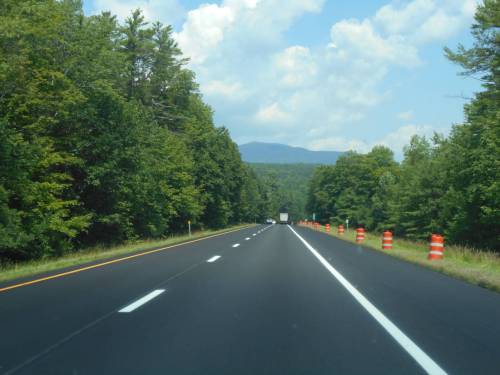
The haze of August already lies on our hills. Here’s a shot from the car as I drove north along Rt. 91 toward the park. In a state of so many hills and higher peaks, Ascutney doesn’t immediately claim particular status. (At 3130 feet/954 meters, it’s the second-highest peak in our county.) But begin the ascent to the summit, and if the pitch of the climb doesn’t clue you in, you pass into cooler air about halfway up — a most welcome change in the heat of the last several weeks.
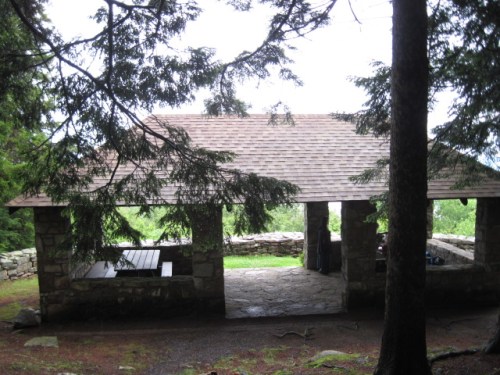
We held a quiet, meditative ritual in what has become our favorite location, in a grove next to a pavilion overlooking a valley to the north. A couple arrived midway through our ritual, and settled into the pavilion to talk quietly, just as we were saying “each person here is a blessing”.
Lugh swims into my awareness this time of year, around his harvest festival — I honor him as I would a majestic tree. “Believe” in Lugh? Standing under the branches of a tree, belief in that tree is a strange thing to concern oneself with. Instead, I prefer to inhale the scents of the grove around me, noting the evergreen cones on the ground, feeling the shade against the summer sun, hearing the birds in the branches.
A sometimes-frantic concern with what one believes, or should believe, belongs to other paths — it needn’t trouble Druids, unless they find value in it. There is much more to explore that meets us halfway, rather than folding our thought into shapes that may or may not have any connection to what is already all around us, shapes prescribed by those who came before us, because they arose from their lives, experiences which need to be tested, along with other such legacies, for their applicability to us today.
The “apparent world fades”, whispers the ritual. “With the blessings of earth, sea and sky”, we “cast aside all disturbing thoughts” and attend more carefully and lovingly to what is going on all around us. (Billboards proclaim, “God is still speaking”. Druids strive to keep listening.)
Belief can be a useful tool, and indeed it does shape our experiences, along with much else. But it is so often subject to change, to distortion, and to incomplete knowledge — as exhibit A, witness the political landscapes these days in so many nations. Wisdom, though harder to gain, has proven more trustworthy as an aid to living my life. (Discerning the difference between them, and living from it — ah, there’s a journey worth anyone’s dedication. Let’s meet there!)
/|\ /|\ /|\
What Lugh has to say to me, or I to him, may manifest in ritual, or before, or afterward, in my interactions with those I celebrate with, meet at the park entrance, on the road, at the gas station on the way home. Meanwhile, festival communion is our ritual, a priming for honing the attention, for honoring the day and its gifts and our lives.
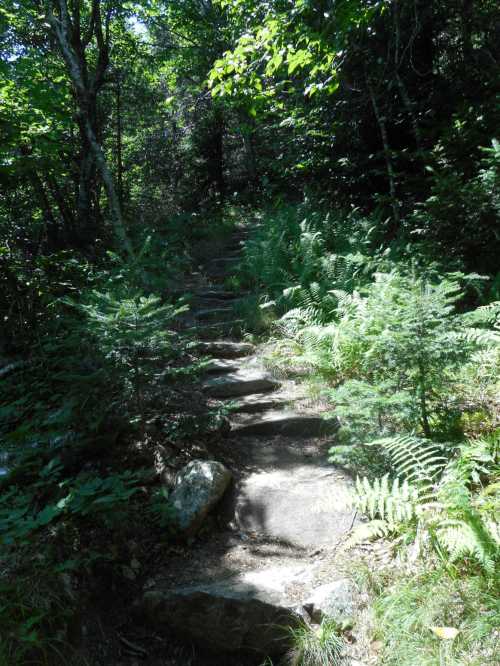
Steps on .7 mile/1100 meter footpath to the Ascutney summit
In Vermont, Mt. Ascutney seems a fitting place to honor Lugh and his festival, a place of heights and vistas, a place of green quiet and perspectives, in keeping with his attributes as a storm god and warrior, with links to Mercury and Apollo.
Lugh “has several magical possessions,” notes the Wikipedia entry. “He wields an unstoppable fiery spear, a sling stone, and a hound named Failinis. He is said to have invented fidchell (a Gaelic equivalent of chess), ball games, and horse racing”. His Welsh counterpart is Lleu Llaw Gyffes, the “fair-haired one with the skillful hand”. In Welsh tradition, from his mother Arianrhod he receives a tynged, the Welsh equivalent of a geis, an obligation or prohibition, a taboo linked to one’s destiny. His story, along with Blodeuwedd, comprises the second and third branches of the Mabinogi.
All these details suggest directions for possible Lunasa rituals and activities.
/|\ /|\ /|\
I arrived early before our ritual gathering, partly to check on locations and partly to re-visit the “sleeping dragon” stone along the footpath to the summit.
True, without that near-horizontal gouge suggesting a closed eye, the stone might not evoke the name I give it. But as far as I can tell, the gouge is natural, a result of the stones tumbling about each other that make up the summit and its paths.
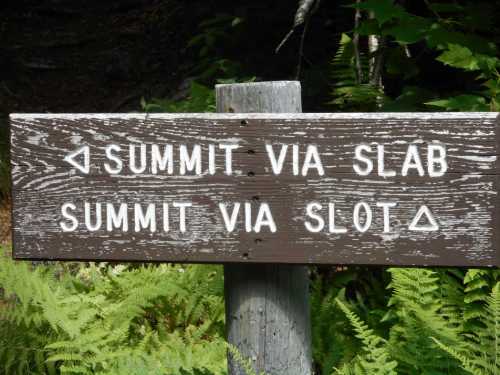
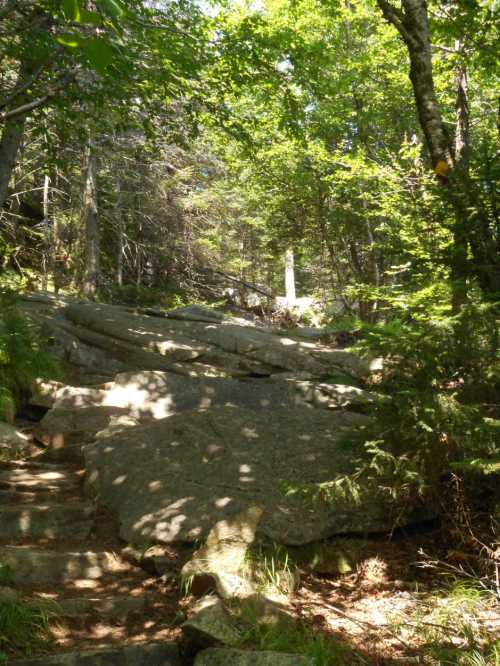
Below is the “slab” indicated by the sign above — the camera foreshortens the dimensions of the sheet of broken stone that extends over 100 feet/30 meters up the mountain.
Sometimes a place with dimensions of its own, not immediately convenient for humans, is a helpful reminder and subject of meditation. The slab, like the slot, requires effort to navigate successfully.
/|\ /|\ /|\
I’ll close with this meditation, plain water after the potent mead of ritual. VT poet Charles Butterfield writes in his poem “Matins” of the natural world:
it is enough to know
here is something
that does not require
your presence
but of which nevertheless
your presence is a part.
I’m looking more closely at some spiritual criteria I mentioned in the previous post. First, I’ll repeat the quotation I want to dig into and expand on, from my own experience. J. M. Greer notes:
… consciousness has a surface and a depth. The surface is accessible to each of us, but the depth is not. To cause lasting changes in consciousness that can have magical effects on one’s own life and that of others, the depth must be reached, and to reach down past the surface, ordinary thinking and willing are not enough (J. M. Greer, Mystery Teachings from the Living Earth, Weiser Books, 2012, pg. 88).
This profound observation, I asserted, rewards extended meditation and experimentation. It lays out its claims in clear terms.
Of course, if I’ve never accessed the Depth, I can’t say much of value about it either way. Fortunately, all of us do access the Depth, and we do so with considerable regularity — in dreams, if in no other way.
I capitalize Depth, because my working hypothesis, shaped over decades of creative writing, teaching, and sometimes humbling spiritual experience, is that the “Depth” Greer’s talking about is the same “Deep” that Taliesin names when he chants “The Awen I sing, from the Deep I bring it”.
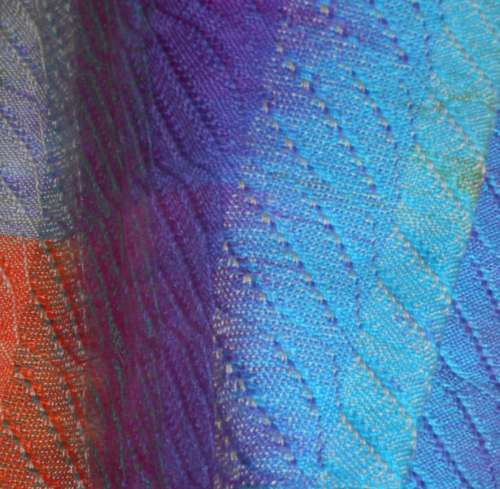
Northampton, MA weaving show, July ’19
[T]he depth must be reached, and to reach down past the surface, ordinary thinking and willing are not enough. The creativity all of us have accessed at some point in our lives — the hunch that pays off, the gut instinct, the inner voice, the Song that will not let us go till we bring more of it into our lives — is evidence, to me anyway, that the Deep is also striving to make contact with us. Or to put it in the 60s terms of Leonard Cohen’s poem, God(dess) is alive, magic is afoot. Magic is alive, god(dess) is afoot.
And here are the four questions I asked myself, also from the previous post:
(1) Is this true in my life right now?
Absolutely. Every time I sit for contemplation, every time the “apparent world” recedes even a little, I sense and rediscover yet again the difference between the surface and the depth. I may not always be able to “bring from the Deep” what I need in the moment, at least consciously, but the effort to approach the shore, stand at the water’s edge, even just to get my toes wet, adds to the reservoir, strengthens the links I’ve been building to the Deep. It also increases the number of access points available to me to experience such things again.
But skip a period of contemplation and I’m subtly off my game for that day. I tense up driving on the interstate, I’m less patient with other drivers as well as myself — I “drive stupid” — and options also start closing off when I face any kind of obstacle, challenge, delay, barrier, whether it’s a stretch of road work slow-down, and I’m already late for an appointment, or it’s a project where listening is the largest part of my task, tuning in to what matters, being my best self, catching the wave.
But even the act of regaining lost ground, after eventually catching myself in such situations, can be a blessing. The return just feels so damn good. It keeps me alert, widens the path a little more, restores me to gratitude again. (Will I forget, ignore, deny the need, the hints, to stay open and connected? Probably, though that feels unutterably foolish right then.)
To say it another way, it re-opens magical doors I shut myself.
In Greer’s words, you cause lasting changes in consciousness that can have magical effects on one’s own life and that of others. You can, if it clarifies things for you, replace “magical” with “positive”. And if you think positive changes in others don’t have ripple effects on everyone they come in contact with, you just haven’t been paying attention. Sometimes you have been that person for others. And sometimes they’ve told you so.
We’re each a tributary to the Deep for others.
(2) In what ways?
That’s such a curious question to answer. Over time, I begin to wonder in what ways not?
To give a kind of answer advertisers would hone in on, If I’m balanced, positive, listening to my partner, sex is often better. More widely, I find I more often choose foods I need, rather than merely what tastes good. I sleep better. With more energy, I feel more like exercising, which feeds into the whole loop. I’m more fun to be around. I dream more interestingly, I create more magically. More little things go right. (I don’t have to mash a finger while hammering nails, or gash myself slicing vegetables.) The world doesn’t have to knock at a closed consciousness to bring (shock?) me back to harmony with it.
Northampton, MA weaving show, July ’19
(3) How often have I reached any kind of depth in my own consciousness? How did I do that?
I stepped away to listen to a phone message that turned out to be from a telemarketer, deleted it, and came back, thinking for about half an hour as I try to answer this question.
We love to label — it’s a prime way to make sense of a crazy world — though we also resent others’ haphazard labels applied to us. If I label, and count up the “most memorable” experiences of depth — which aren’t always the most profound, sometimes just the most flashy and attention-grabbing — how many more worthy instances have faded from memory? — I’d certainly include these from the first half of my life, ones I still recall:
I’m 6, and I realize I have a recurring dream of falling into water and drowning. The dream doesn’t come every night, but it’s certainly familiar. I can only relax, and finally fall asleep, if I let myself stop struggling. I’m both dying, and watching myself die. It was so strange. I never told anyone till decades later.
I’m 8, and see a wind-spirit in a field. I have almost no reaction at the time, only later. It is so outside my experience till then that I have no way to understand it. Only to remember it.
At 11, in late November, I’m crying beside my father’s unconscious body by the side of our farm road, after a speeding car had struck him. The walls of my world shift.
At 15, bringing in our herd of cows for evening milking, I have a vision of a girl I know, and yearn to reconnect with somehow, though I’ve never met her in this life. What does that even mean? I didn’t know.
I’m 19, and I’ve just receive the letter that alerts me to prepare for initiation onto the other spiritual path I practice. I sit alone for hours, hearing … what is it? I’m so lifted out of myself.
I’m 20, and one weekend a late-night discussion with a dorm-mate who is psychic leads to him bringing me with him onto the lower astral plane. I still don’t know how, though suggestion and night-time consciousness play their parts, surely. I see beings that normally inhabit only nightmares. I am fully awake, and can’t sleep for hours after that.
At 21, when I have an out-of-body experience while dancing with an order of Helveti-Jerrahi dervishes visiting the University of Rochester campus.
At 24, when I encounter a goddess in a grove near my father’s new farm in western New York state. She towers over me. What does she want — if anything? I’ve been wandering outdoors all day.
I’m struck as I excavate memory that while some of these experiences of non-ordinary consciousness are in some senses unsolicited, in that I wasn’t specifically working to enter them, each nevertheless has a setting, a stage for the experience, a state of consciousness prepared for wider possibilities than are customary with us. And that, from the perspective of today, seems in large part their purpose, or their impact, anyway: to signal that “wider possibilities than are customary with us” are possible.
The “hows” of many of my later experiences are more conscious. I’d taken on a spiritual practice by then. They are, as far as I can determine, also more shaped or comprehensible in terms of those practices — the practices themselves provide a frame or context to understand what the practices have catalyzed in consciousness.
(4) And what lasting changes have I brought about when I did so?
This is another question that really deserves my extended reflection over time. One of the most interesting changes I’ll note right now is increased elasticity: what this universe can do seems limitless, or at least my consciousness of that is greatly broadened, which is much the same thing. The context, the intent, the need and the available imaginative or magical reservoir make all the difference in what actually happens.
Another change is a sense of profound spiritual purpose. I know I got stuff to do, but I’m also being used for tasks and larger goals I often don’t know about until later, if at all. In Druid-Christian terms, “All things work together for good to them that love God, to them that are called according to his purpose” (Rom. 8:28). This insight and the purposes, I’d assert, are both larger, and simply apply far more comprehensively, than most of us are prepared to accept.
If you happened to notice a couple of recent comments (or not), you know that people are looking for help of all kinds, and sometimes reach out for specifically magical aid.
In this post I want look again at how I view and use magic, because such scrutiny is useful most of all to me, in order to clarify for myself what in the world it is I think I’m doing. And maybe secondarily such introspection will be useful to you, too, if you’re looking at your own practices and beliefs. It’s useful to have something to push against.
I’ve written about magic in numerous posts (for instance, here), and also on a main page. Much of my practice rests on whatever builds up spiritual stamina and a positive vibration over time, which I’ve found is one of the best uses of magic as a long-term “tool for living”. Such a practice lends itself to uncovering creative solutions, keeping the awareness open and flexible and curious (which is a major reason I urge a regular practice on you, my readers).
It’s also a radical act in this time of fear and emotional manipulation on all sides.
As a fix for specific trouble, without that accumulating magical pool to draw from, I find magic less helpful. Or to change metaphors, if I keep the battery charged, its energy stands ready at need. Without that reserve, though, I’m often better off with other tools. If I’ve neglected to maintain my reservoir as best I can, I don’t need to beat myself up about it. I do need to turn to other strategies, however, to deal with the matter at hand. Then perhaps I can take the broad hint of my life experience and attend to replenishing my spiritual account. This goes double if I’m helping others.
Some practitioners are skilled at assisting others through magical means without both taking on karma and also not accomplishing what they originally set out to do, which is offering assistance. As the person making the request notes, the issue is sensitive. So carelessly-handled energy, however abundant, isn’t what’s called for. Who pours water on an oil fire?
As J. M. Greer notes, with the wisdom of earned experience:
… consciousness has a surface and a depth. The surface is accessible to each of us, but the depth is not. To cause lasting changes in consciousness that can have magical effects on one’s own life and that of others, the depth must be reached, and to reach down past the surface, ordinary thinking and willing are not enough (J. M. Greer, Mystery Teachings from the Living Earth, Weiser Books, 2012, pg. 88).
This profound observation rewards extended meditation and experimentation. It lays out its claims in clear terms. Is it true in my life right now? In what ways? How often have I reached any kind of depth in my own consciousness? How did I do that? And what lasting changes have I brought about when I did so? The terms Greer sets forth aren’t merely subjects for debate or argumentation, but of demonstration and proof. Ultimately they aren’t merely matters of opinion, however much we may think everything is these days.
(What good is my opinion, if it’s ill-founded or useless? But it’s mine! counts for very little, when trouble has laid waste to my life. Come the earthquake, flood, conflagration or tornado, inward or outward, and I have bigger things to worry about than my opinion.)
Until I can answer those questions to my own satisfaction, and also give an account of them to anyone who may ask me for help, I have no right to pretend I can help. (Your mileage, as they say, may differ.)
So what good is your “magic”, if it can’t help others? I can hear some of you asking.
It can help others. But it’s decidedly not M.O.D., “Magic On Demand”.
I need to meet the other person, to sound out their concerns and situation, before I barge into it, waving my possibly awesome magical tools. A second or even third sounding isn’t out of order. True, the law of love trumps all other spiritual laws. If I’m acting out of love, for the good of the whole, most of my actions will be right.
Most?! I now hear some of you say. Well, there are no guarantees. At least, not in the cosmos as I know it. You may live in a different one.
One of the most powerful magical tools in such situations is the use of blessing. Before I rally vast forces, brandish my mighty arsenal, and strike down imagined enemies, my own or someone else’s, let me bless the situation first. More than the elemental weapons at my command (and they are real, though they mostly operate on non-physical planes), let me begin — and end — in love.
(There’s possibly even a good reason why a certain well-known god recommends this spiritual tool above all: it’s simply the best — the most potent, and with the least blowback. The Galilean Master says, “But to those of you who will listen, I say: Love your enemies, do good to those who hate you, bless those who curse you, pray for those who mistreat you. If someone strikes you on one cheek, turn to him the other also. And if someone takes your cloak, do not withhold your tunic as well” (Luke 6:27-29, Berean Study Bible). Hint: he’s not taking a passivist approach. He’s not even necessarily indulging in the hyperbole he frequently deploys to underline his point. He’s offering a powerful spiritual technique. Not the sole technique, but a very good place to start. “Love casts out fear”, the most potent magic worked against us — today as much as ever.)
Blessing is one way to fast from ego. Bingo!! says my spiritual crap detector. A truth I can use right now.
/|\ /|\ /|\
Warning — SPOILER ALERT!! — the season-finale fan-made clip below from the Netflix series A Discovery of Witches shows the heroine Diana turning to elemental weapons at need. We may well use them on the astral plane, and the results may indeed be as pyrotechnic there as CGI renders them here.
But they also come with CAUTION labels. And we need to know these first, if we want to come out of the situation whole, and in a better position than when we started. If you don’t believe me, well, go find out for yourself. Then you’ll know. As I’ve said, it’s not a matter of opinion but of demonstration. Get proof — accept no substitutes.
(If you want to see Diana’s fire-bow and arrow in action, fast forward to around the 2:20 mark.)
One of my take-aways: what a powerful visualization Diana’s firebow is for dispelling limiting mental constructs! Try it out, especially if you’re a visual person!
To sum up, here’s my magical process in such situations. Discern. Fast. Bless. Visualize. Repeat as needed. D.F.B.V.R.
In New England after the Solstice you feel the change: summer has — finally — settled in. No more chance of frost, it’s safe to leave the screened windows open at night for a breeze, and the fireflies are wrapping up their brilliant night-time light-shows.
We’re about three weeks away from the next of the “Great Eight” seasonal festivals. Even the name Lu(gh)nasa(sh) can feel like high summer — it drops the unnecessary weight of extra clothing (or letters in this case, with the Irish spelling reform around the middle of the last century). One advantage of the older spelling, of course, is its reminder of the god Lugh associated with the day — the name means the Assembly of Lugh.
The Celtic group Lunasa gains from its name as a celebration, a demonstration of excellence that was part of the original festival’s funeral games and competitions. The god Lugh mourned the death of his mother Tailtiu, and so established the Tailteann Games in her honor and memory. Historically the festival also celebrated the first fruits of the harvest — it’s the first of three harvest events, moving through the Autumn Equinox and concluding at Samhain.
You can find some of my previous posts on Lunasa here: 26 July ’18 “Fog-weaving with Lugh”| 23 Aug. ’17 including Dennis King’s Poem “Grace”| 5 Aug. ’17 on a small rite for Lunasa | 1 Aug ’13 including my poem “Assembly of Lugh”.
Oak, shade my path. I welcome your wisdom.
Birch, green my way. I call on your courage.
Hemlock, heal my heart. I fast under your foliage.
Pine, scent my dreaming. I gather your gifts.
Tree companions all, I seek the shelter of your boughs.
May my days make return for your abundance.
/|\ /|\ /|\
I’m still working on and tweaking and listening to this prayer, as I say it out under the trees. I suspect we’re composing it together.
I invite you to try out this prayer — really out — outdoors, and to post your experiences, revisions, smoother versions, and so on.
“isn’t to make Druids”, a fellow Druid remarked to me over the Solstice weekend at our Vermont Gathering.
Huh. I thought. Right! As soon as you say it …
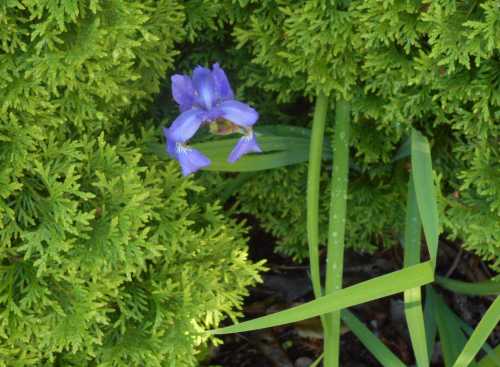
strayed iris along our driveway
Druidry’s a practice to re-connect with Spirit. Whataspect of Spirit you reconnect with, how you reconnect, why, and what you call yourself — these matters circle round the rim of the practice, however helpful or significant they may be. They’re not the hub, like the practice of connection is. (A wheel, of course, is more than its hub.)
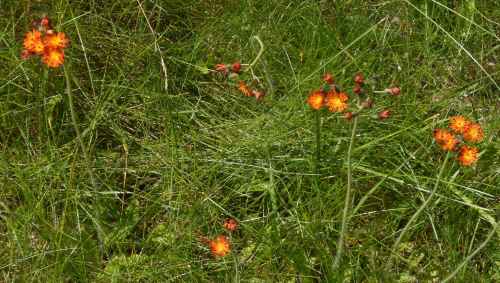
devil’s paintbrush (Hieracium aurantiacum; Pilosella aurantiaca) aka orange hawkweed — one of my favorite “unplanted flowers”. They set the lawn on fire!
The metaphors that bubble up when we try to talk about a practice matter, too. Circle, spiral, wheel. The patterns of the oldest games we play as children, the deepest truths of existence we perceive.
When you’re reconnecting, the tree-wisdom that is one probable etymology of the word Druid is at work in your life.
How does it manifest?
For me, it takes increasingly specific forms that become my practice by themselves. I know something larger than me and my hopes, fears and dreams. I find I want to honor it, and strive to live in harmony with it. The more I give it my love and attention, the more numerous my encounters. I slowly discover how interactions and exchanges with it are mutually beneficial. I work to bring more of my life into a dance with its rhythms.
/|\ /|\ /|\
Part of my particular how of connecting and manifesting lies in where I find myself, as does yours, if you’re seeking to connect.
I bless the previous owner, as you know from previous posts, for the Rowan in our front yard, and also for the row of three old blueberry bushes in the back. We’re letting blackberries grow up near them. Both like the acidic soil we try to provide with pine needle mulch, and after the spate of bitter weather this past January, we’re seeing some die-back among them and the rhododendrons out front. As if to compensate, this has been a particularly wet year, and a warm one, once it got going.
Blessings on Europe, and a request to Spirit to temper the heat burning there. Balance, balance.
Everything wants to make a gift of itself to you, came the insight one morning some years ago.
Sh*t! I remember thinking. Really?!
But the message wasn’t done yet. Reject it and the gift often comes harder, more insistent and difficult, in less easy forms.
All right, I think. Well, no. A little right. This will take some getting used to.
Everything?!
Difficult gifts … I’ll tell you mine if you tell me yours.
/|\ /|\ /|\
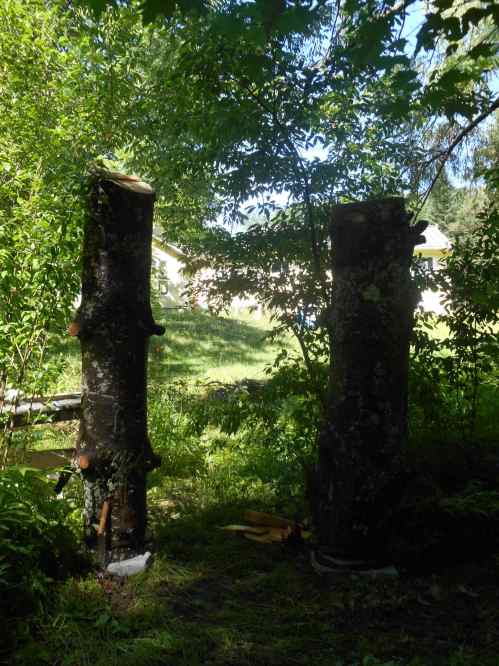
Yesterday was too rainy, so it wasn’t until this morning I finally thought to get a shot of the two pine trunks I rolled from where our friend and neighbor Chris helped to cut them into manageable lengths with his chainsaw in May.
For a month they lay there, too heavy to move.
So thank-yous to all of you who contributed Solstice energy to our recent Vermont Weekend and helped me raise these “Alban Gates”!!
After meditating and listening for a bit about where I should set them, I raised them as gateposts for my backyard grove over the weekend. They now sit on stone footers, with wedges to steady them. I’ll be adding some side supports and possibly a lintel post later.
Below is a pic of them, looking west towards our house. The slightly larger left trunk is about my height, to give a sense of scale. Thank Spirit they’re pine. They won’t last as long, but I wouldn’t have been able to lift and set them in place if they were as heavy as oak, or the cherry of our recent Solstice bonfire.
I’m still listening about when to dedicate them. Lunasa, or the next full moon, maybe.
Solstice energy to raise and open the “Alban Gates”! Facing west toward house.
Same pillars, facing east — with the mystery of light on leaves
/|\ /|\ /|\
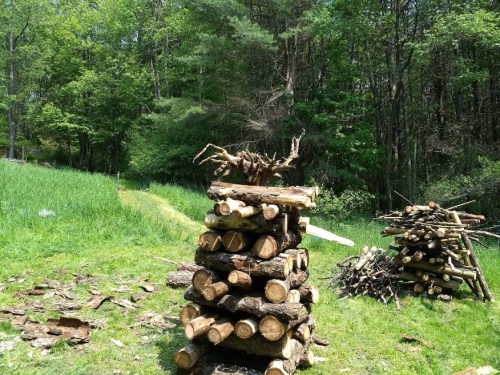
“Wood-month” is upon us. Or at least on many Vermonters. Everywhere, a store of winter fuel dropped off on roadsides, yards, driveways, ready for the work of stacking. Sweat equity for stacking makes up the significant difference between cost per cord and cost per gallon of fuel oil. As long as I can, I’ll sweat instead. I’m still more cheap than lazy at this point. Of course, I can virtuously claim to be a little “greener” as well.
We manifest here by applying effort. It’s one of our special abilities. Spirit (and other beings without physical bodies) need incarnate beings to achieve such things, and humans are especially good at this, at building and shaping and moving stuff around. Part of why we’re here is to learn to do it more wisely, at need and not merely at whim.
The Southern Vermont Summer Solstice plans finally all came together this weekend, with about 20 people from Massachusetts, New Hampshire and Vermont groves and seed groups gathering to celebrate the Solstice and camp on the land of our host BW.
Potluck, Friday evening 21 June 2019. Photo courtesy FH.
“Friday evening ease”, 21 June 2019, BW’s house.
After dinner Friday, we drove to Putney Mountain to see the sunset of the longest day and watch the stars come out. A marvelous breeze kept the bugs off.
Solstice sunset Friday 21 June 2019 on Putney Mountain. Photo courtesy FH.
The next day we drove and hiked to the Putney Stone Chambers, which I also wrote about here last September.
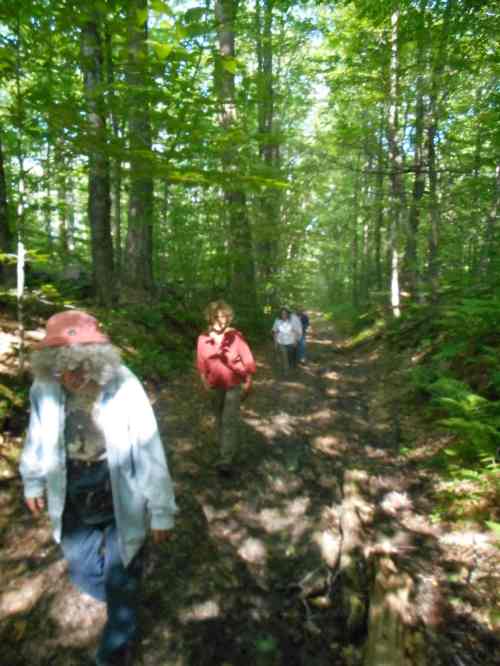
Saturday afternoon 22 June 2019 hike to the Putney Stone Chambers
The walk to the most impressive of the chambers follows a Class 4 road.
mossy stone on hike
Recent rains have kept the mosses and ferns green.
Investigating a smaller stone chamber. Photo courtesy FH
“Rebirth from the earth”
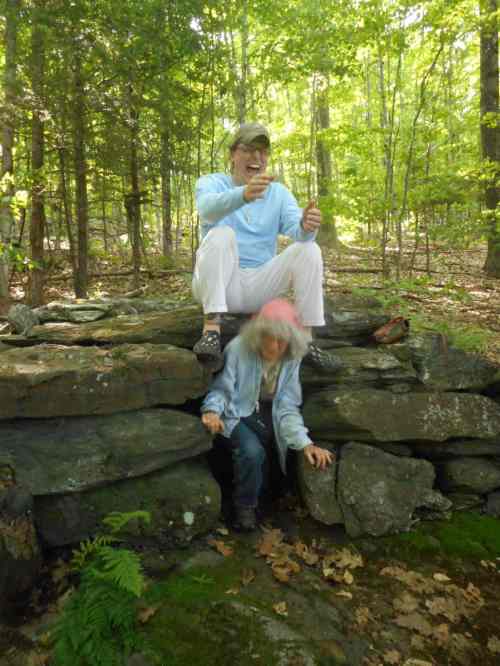
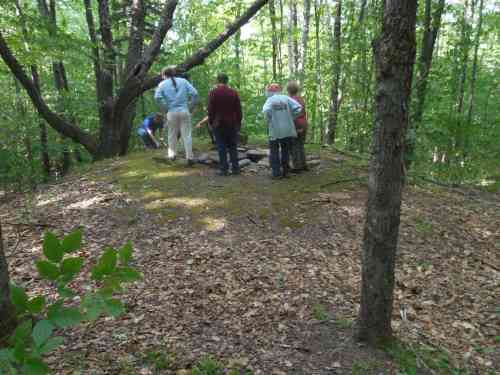
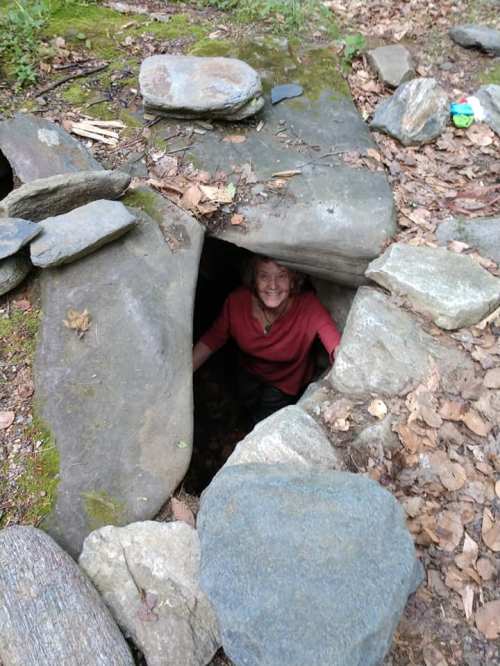
We nicknamed the largest chamber the kiva, after a similar design in the American southwest.
Gathered at the “kiva” entrance
Entrance to the “kiva” — BW is standing showing depth of chamber. Photo courtesy FH
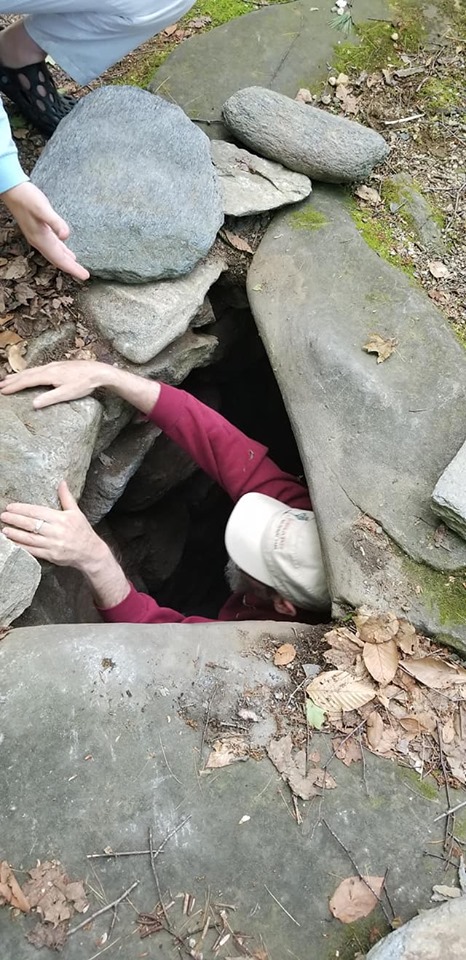
“Into the kiva — 1”
SF in kiva — photo courtesy BB.
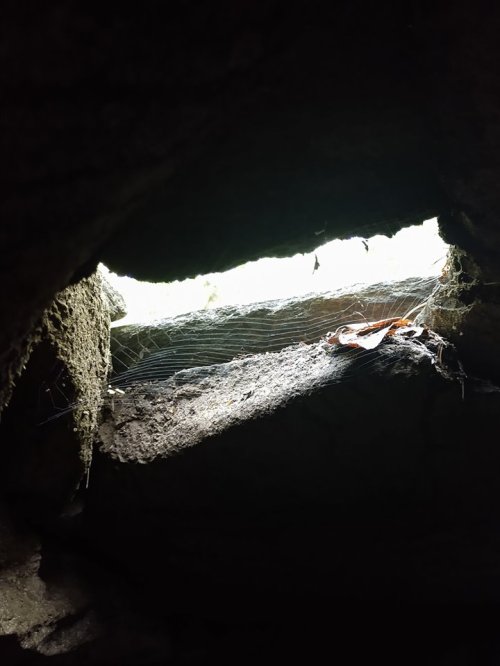
Spiderweb over kiva vent hole — view from inside — photo courtesy GN
“Druid at ease” — MH in a tree near the kiva. Saturday 22 June 2019
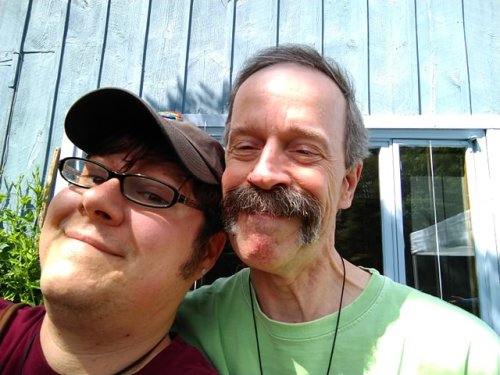
Mugging for the selfie — BB (left) and me (right)
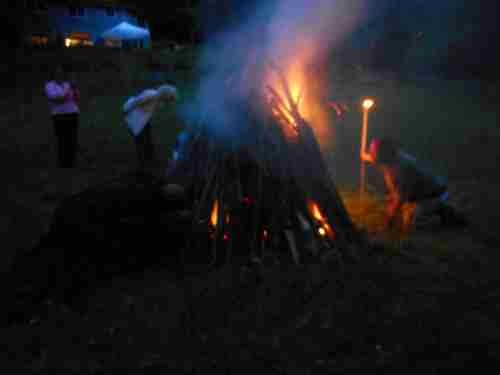
“Ignition” — bonfire Saturday evening 22 June 2019 after ritual. AB is blowing the sparks to flame.
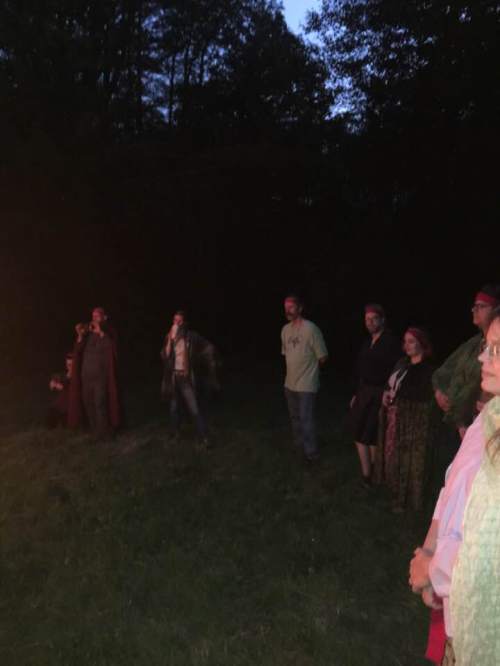
Shortly after ritual, as we watch the bonfire light. We’re still wearing red headbands from the rite. Photo courtesy CG.
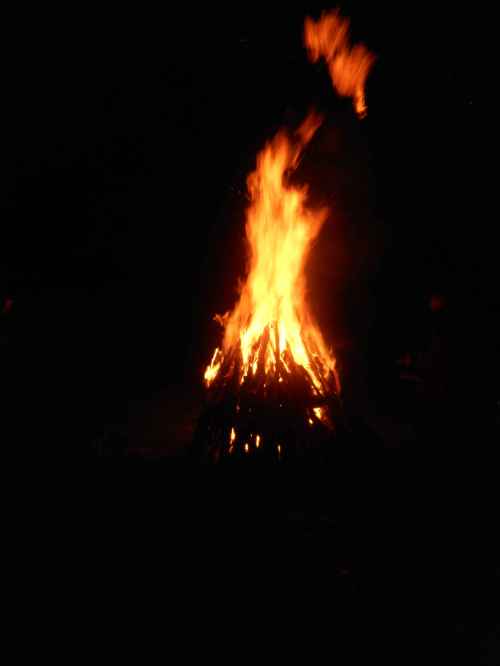
Young fire. Saturday 22 June 2019
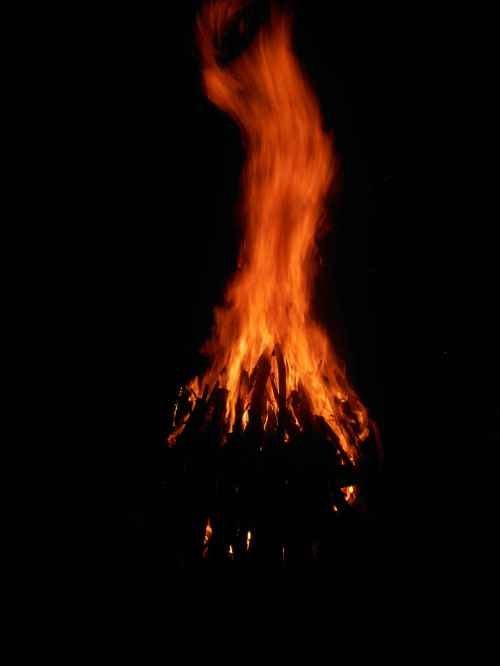
Young fire, Saturday 22 June 2019. Figure within flames?
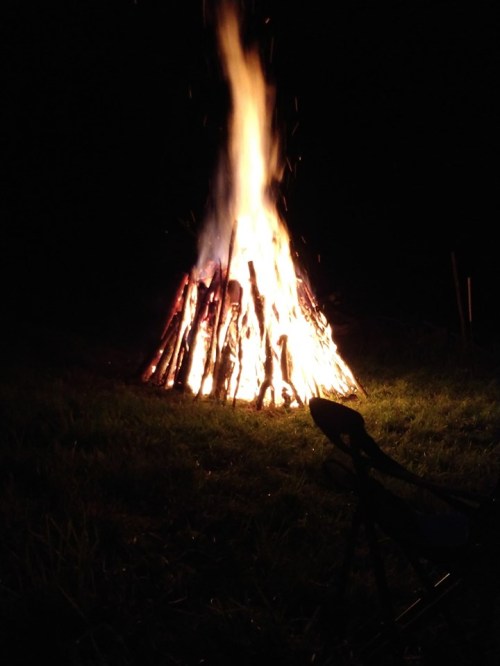
Bonfire in full burn Saturday 22 June 2019. Photo courtesy CG
Moon at sunrise this morning, Sunday 23 June 2019. Photo courtesy BW.
We closed the weekend this Sunday morning with offerings of cedar boughs and whiskey around a small fire, as we gave thanks for the weekend and the community we share.
Basket of cedar and whiskey bottle. Sunday morning 23 June 2019. Photo courtesy BB.
Happy Solstices! — Summer in the Northern, Winter in the Southern Hemisphere.
Here is “Eagle Poem” by Joy Harjo, which we’ll be sharing tonight at the opening potluck supper of our Solstice weekend gathering here in Southern Vermont.
To pray you open your whole self
To sky, to earth, to sun, to moon
To one whole voice that is you.
And know there is more
That you can’t see, can’t hear
Can’t know except in moments
Steadily growing, and in languages
That aren’t always sound but other
Circles of motion.
Like eagle that Sunday morning
Over Salt River. Circles in blue sky
In wind, swept our hearts clean
With sacred wings.
We see you, see ourselves and know
That we must take the utmost care
And kindness in all things.
Breathe in, knowing we are made of
All this, and breathe, knowing
We are truly blessed because we
Were born, and die soon, within a
True circle of motion,
Like eagle rounding out the morning
Inside us.
We pray that it will be done
In beauty.
In beauty.
One breath follows another. You’re doing it right. Keep going!
The air kisses you as soon as you step outdoors. No judgment!
Sun, stars, clouds, moon, rain, snow — they each greet you in their seasons. They’re with you, doing what they are, just like you do.
Fur companions in your life, their moist noses and soft, warm coats, a blessing. What I do is me*, they remind us. You do you. No one else can.
Trees do it every day, breathing out what we breathe in, breathing in what we breathe out. It’s a prayer-song — you may have already heard versions of it. If not, make one up right now. You can hum it to yourself around the trees, setting a tune, letting them know you know, telling them they’re doing it right. They know, but it’s good when we do, too, and we say so.
“No one knows what will rise, when the pond is working” — Linda Allardt
Solstice, greatest of all the Feasts of Fire, beloved of the Faerie Folk …
I don’t know about you, but I hear that and I’m there. It’s a line from OBOD ritual, and we’ll be saying it this weekend at our Alban Hefin/solstice celebration.
I whisper it now to myself, this word-charm, along with that earlier line about breathing, and I listen to the rhythm, the music, as I speak the syllables:
Greatest of all the Feasts of Fire, beloved of the Faerie Folk …
We breathe in what you breathe out, we breathe out what you breathe in …
And I imagine singing this as a round at our ritual.
Druidry, writes Philip Carr-Gomm in his foreword to Nuinn’s (Ross Nichols) Book of Druidry,
is a way of working with the natural world, and is not a dogma or religion … Druidry honours, above all, the freedom of the individual to follow their own path through life, offering only guides and suggestions, schemes of understanding, methods of celebration and mythical ideas — which can be used or not as the practitioner sees fit (pg. 14).
You could just stop there, and run with that, because this post eventually descends into a rant. Or irascible prayer. OK, you were warned.
clover overtaking weeds — no mowing needed! (but woodchucks love it)
<begin rant>
The word “honours” matters in the quote above. Not “grants” or “permits” freedom. Druidry recognizes something that’s already there. Druidry says Pay attention, so you can recognize these things, too.
Freedom, guides, suggestions, schemes, methods, celebrations, myths. These are the “seven paths in freedom” I want to look at in this post. Don’t worry, it’s not really a numbered list. A different Song is playing. The Song matters more than any list.
Freedom, that much abused and misunderstood word, is an actual thing we can experience and live from, not merely a “concept” or an “idea”, though it’s these things, too. It’s not only “in my head”. Freedom, like any song, comes first, then we have thoughts about it. It’s a gift, just like our lives. A melody at the heart of things. And like our lives, we can end our own freedom in so many ways. Turn off the music. (At least temporarily, though the Spiral remains, all the way down into our DNA.) If you need to be reminded how, just read the headlines. It’s practically multiple-choice at this point. Fifty ways to leave your lover, sings Paul Simon. Shedding your skin, walking on the other side, is a really good option at this point. We do it every night in dream. How about while awake?
A free person gives freedom to those nearby. Freedom spreads, like air, fragrance, sound, waves. We all know others who take from us when we’re around them, just like we know people who give, who make space, and work not to impose their limitations on us. Sometimes we read of the “torch of freedom” — and though cynicism is a popular defensive shield these days, that’s a live metaphor for the sense of kindling and expansion we feel in the presence of a free person. May we meet — and be — such people!
Don’t want to, or can’t, join a Druid Order? You’re a Druid from the day you accept your freedom, and act from it. An Order’s just a form, a guide, a suggestion, to try or not.
If we act from freedom, we discover everything is a guide, a suggestion. The old challenge, Everything is permitted, provided you can accept responsibility for what you do, is a rich seed for meditation. How far can I go toward testing it?! Not Is it true? but How is it true?When is it true? In what ways is it true? These tests, and their results, work much more creatively and productively, at least for me, than a simple “yes/no” Is it true? Because I’ve found pretty much everything is both not true, and true, depending. So that question’s off the list, until I can come back to it on a higher spiral, when it may turn out useful once again, after I manage to learn a few more things. Consciousness makes all the difference: it’s the “depending”.
Druidry offers some things to try out. (Now I’m imagining that as my quick seven-word answer to anybody who asks “So what is Druidry?”!)
Ground a practice in the things of my world: air, water, fire, earth. Not just ritual, though that too. Expand my rituals. Thinking, this morning, while I wash two-days-dried dirty dishes in warm water: air/thought, water (obvious!), fire/heat of the water, of my blood, of the sunlight streaming through the kitchen window; earth of my bones and flesh, of the food scraps on the plates and pots and silverware, of the sink and walls and world all around.
Brother Lawrence wrote a wonderful classic, Practicing the Presence of God. You almost don’t need to read it, the title says so much. If you do read through, be patient with it and yourself — you’ll need to do some digging to excavate the gold, given the change of cultural understandings.
It’s a practice, not a one-time deal. You get better.
Listen to other beings. The white ants that come every summer to our kitchen have more to teach me than the last book I read, whatever it was. Practice asking good questions. I’ve spent at least four decades on that one, and no sign of stopping yet. You know — magic in, magic out. Or the opposite.
“My God is bigger”, said a Christian to an author friend of mine. “Maybe that’s because your need is bigger”, said the friend.
An infinite abyss separates any two moments in time, in eternity, says one of the Wise. I practice resting there, feeling the lightness of spirit, of creative fire, of the awen as it flows. I set my hand on a blank journal page, a computer screen blog post, and enter that abyss. If like me you flash on vertigo for a moment, know too how weightless is fire, always rising up, climbing the spirals we all walk. If a child falls in a dream, the Senoi people of Malaysia encourage the child to fall, and not wake up to escape the dream. “They taught the children to fall, knowing they wouldn’t be hurt, and to climb, to travel, or fly to unknown places, to unknown cultures, to learn new things. If they woke up instead, they would be advised not to escape from such dreams the next time they occurred”, write Stewart and Garfield in their 1972 book Creative Dreaming. Easier on everybody than the wrenching costs of the rising suicide rates in the U.S. and elsewhere.
Schemes of understanding, patterns, webs, networks, interconnections, links, circuits. Our “marvels of modern technology” work (when they work) by building with earth — metal, glass, rare earth elements. Technology grounds these sometimes abstract, intellectual facets of elemental Air and manifests them, re-alizes them, makes them what Latin calls res — things. Ground and center, counsels beginning practice, again and again and again. I always need to earth what’s goin’ down.
Heirs though we are of two thousand years of Christianized thinking, somehow we’re still more Gnostic than Christian, eager to flee this world, constantly forgetting the god at the heart of Christianity who incarnated, became flesh, manifested, took on a body, got as earthy as anybody can, and died that way too. Eucharist, literally thanksgiving — this is my body, this is my blood. The Things of Earth are holy, divine.
Pilgrim on earth, thy home is heaven. Stranger, thou art the guest of God(s).
And yes, William Carlos Williams, you turn out to be right on both counts: “It’s difficult to get the news from poems, but men die miserably every day for lack of what is found there”. You write about a fracking flower [short / long] and stake us through the heart. Bards, tell us how it is, how it can be. Now take out the comma. Bards tell us how it is, how it can be. I’m still practicing as I listen harder.
Or another take, if you like or need it: “Earth’s crammed with heaven” , says Elizabeth Barrett Browning. “And every common bush afire with God;/But only he who sees, takes off his shoes./The rest sit around and pluck blackberries,/And daub their natural faces unaware …” Another practice, taking off my shoes, and walking through the grass.
And that’s fine, too, says Druidry. The Spiral always waits. No one’s reached the end yet … There are always rest-points. We need ’em.
Methods, celebrations, myths. Five, six and seven, if you’re counting. J. M. Greer says one key is “embracing an experiential approach to religious questions, one that abandons rigid belief systems in favor of inner development and individual contact with the realms of nature and spirit”.
Everything’s political? Nope — everything’s spiritual. Or mythical, if you prefer. Politics wants the power and energy, but without bothering about the spirit that powers them. (Zeus tried all that out long ago, and look where it got him!) Things of this world? Sure! But just know where they come from. Get the order right. That’s why we keep screwing ourselves over with men (and it’s still mostly men) of power. Give the women a chance to mess things up, too!
They can’t give us what we really want. But we keep handing politicians our freedom anyway, as if they knew better what to do with it than we do. Reclaiming, Starhawk calls her Witchcraft tradition. Get it back! Don’t give it away again!
<end rant>
/|\ /|\ /|\
Fallen pine, cut into lengths: edging for more raised beds? Gateposts for my backyard grove?
Solstices.
Just as at the Winter Solstice we celebrate the shortest day and longest night, knowing that light will grow again, so at the Summer Solstice we celebrate the longest day and shortest night, knowing that daylight will now shorten. Here is a teaching of paradox: each peak, dark or light, contains the seeds of its own change. And as Taoist tradition teaches, “When Yang peaks, it shifts to Yin; when Yin peaks, it shifts to Yang.” — adapted from OBOD publications.
I begin again. A couple of deep breaths, to center myself. Then the awen, or another sacred word. Open the inner doorways.
Get out in the sun, advises the OBOD ritual booklet for Summer Solstice. Sit in a shadow. I love these two apparent contradictories, side by side! So perfect! Harvest your garlic. Sunburned, shaded, garlicked, I proceed.
Having neglected to grow either St. John’s Wort or Vervain for our Solstice rite next weekend, I’m on the lookout for them along the road, in fields nearby, or at a farmers’ market. We’re naming the local landscape and its creatures in our Solstice ritual script, listening between the words for their other names, ones they may not tell everyone. Indian Place Names of New England, in a hodgepodge of less-than-complete formatting for online viewing, gives one Native American name for our local Vermont region: Kawassentekwa “barren spot along the (Connecticut) River”! One more way to laugh, to stay humble, to see and work for possibility where, outwardly, things look bare.
Apparent world, crazy uncle at the door, we hug you and invite you in to join us at the Festival table. Meet the others here!



















 A Druid Way