How might I incorporate insights from the recent “Cruce Celtica” post into my practice?
(As with other posts here, if you’re still working through negative associations and experiences with Christianity, you’re better off just passing by this post. No need to irritate or anger your emotional body. Your other bodies will thank you.)
ONE
Make the sign of the cross as a way to call the Four Directions. After all, that’s what much Druid ritual does already: the opening rite of the standard OBOD format moves us from North to South, from West to East. Depending on where you’re facing, crossing yourself, that’s forehead to heart, left shoulder to right shoulder. Much Hermetic magic also relies on such gestural associations, symbolism and visualizations with Medieval and Biblical symbolism.
TWO
Visualize the presence of spirit in nature, Hebrew immanu-‘el “with-us God”, Emmanuel, in each of the Four Quarters. If you’d like a more Druid focus, use a set of common associations: for instance, bear of the North, hawk of the east, stag of the south, salmon of the West.
For a more Christian focus, try the Four Evangelists (or Archangels), or their ancient symbols: an angel for Saint Matthew, a lion for Saint Mark, an ox for Saint Luke and an eagle for Saint John. These symbols come from the first chapter of Ezekiel, appearing again in the fourth chapter of Revelation. The early Church Fathers interpreted, explored and developed them further.
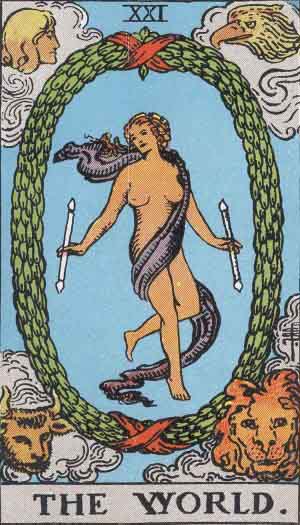
In the Tarot, the World card depicts these four, one in each corner disposed around the central human figure. This card might serve as a meditation focus.
A more explicitly Christian opening could use “The earth is the Lord’s and the fullness thereof” from Psalm 24.
Spirit fills the worlds, and everything in them.
THREE
These gestures, visualizations and forms could serve for a house blessing, one for each of the four corners (that’s assuming you’re not living in a geodesic dome, or a yurt, or some other non-four-sided dwelling!). Looking for a particular verse that’s more appropriate? Consider Psalm 127: “Except the Lord build the house …” Or Psalm 118: “The stone which the builders rejected has become the cornerstone …”
FOUR
These forms also offer themes for portions of an hour (15 minutes each) or a day (6 hours each). Or for a month’s worth of workings, ritual, blessings, meditations, etc. Try them out as a preliminary shape or container for prayer, meditation, ritual,
FIVE
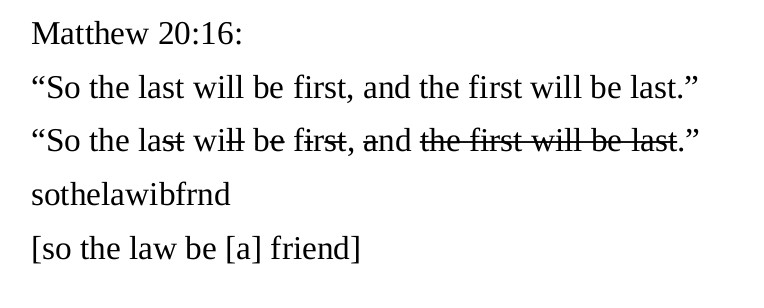
From a favorite verse in each of the four Gospels, make a directional sigil. Here’s Matthew 20:16 for an example.
First, cross out any repeated letters …
In the making of the sigil, you may sometimes “find” a second “hidden” verse — here, “so the law be a friend” suggests itself fairly transparently — which can spark further meditation. What law? How a “friend”?
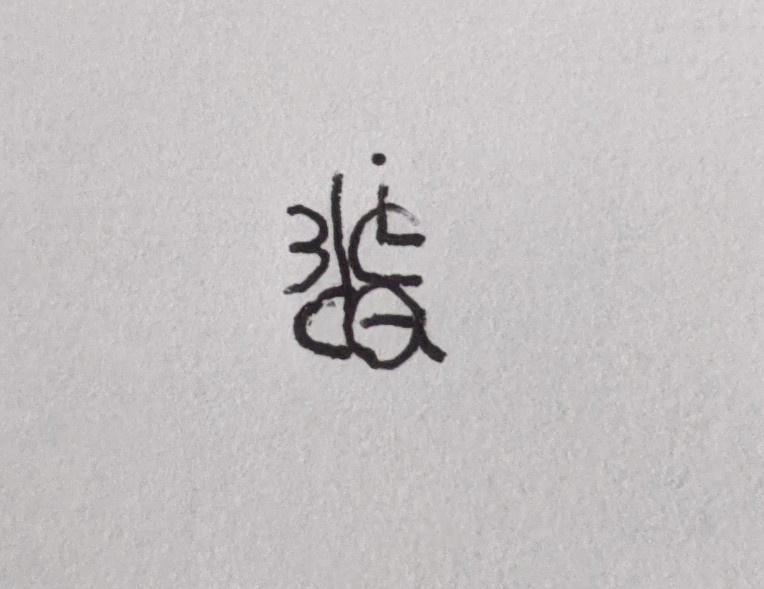
Then make the sigil. Freehand is often best. Let the shapes of both lower and upper case blend. After all, you’re doing this for you, not for anyone else. The making of a sigil can be a meditative and ritual act. Here’s my freehand sigil of the 14 letters s-o-t-h-e-l-a-w-i-b-f-r-n-d.
SIX
Once you have the sigil, you can use it in a wide variety of ways. Again, the making of sigils is itself a magical and blessed act — or it can be. The resulting sigil may be a focus for meditation, a tattoo, a ritual object to place in an appropriate place, a mark to consecrate another object, etc. Write it with safe vegetable inks on skin and it can be licked off and swallowed. Or ground up and incorporated into an oil for anointing. Or kept in a pendant as a charm. And so on.
If your first reaction to any of these suggestions is surprise, suspicion, repugnance, disgust, etc., ask yourself why. Nothing in any of these acts is inherently different than decorating a birthday cake, signing a name, initialing a form, writing shorthand, etc. Most of us have swallowed pills, capsules, etc. with trademarks on them. Why not hallow, bless, consecrate, sanctify?
SEVEN
I invite you to try out and experiment with further uses yourself. In such exploration you may find inspiration from doing one or more of the foregoing as a starting point — a priming of the pump — as with the found verse, or the final appearance of the sigil, the original verse or other piece of language that you sigilized, and so on. Any of these are things you could do with children, too. They are ways to materialize, concretize, manifest, make palpable, things which can otherwise seem too abstruse, ethereal, incorporeal, transient.
Part of our magic as makers — Tolkien’s “we make still by the law in which we’re made” — is to bring spirit into forms we can experience and apprehend more immediately and readily than before.
I’ve been clearing out old papers, pictures, magazines, clippings, etc. from over a decade ago. Partly it’s self-quarantine work. Among the items I’m saving are these three, which deserve a post — partly because I have so little recollection of them that it’s like coming on them as new things. So I can be more objective, and maybe even say something useful about them. And also because it’s clear they retain value and efficacy.
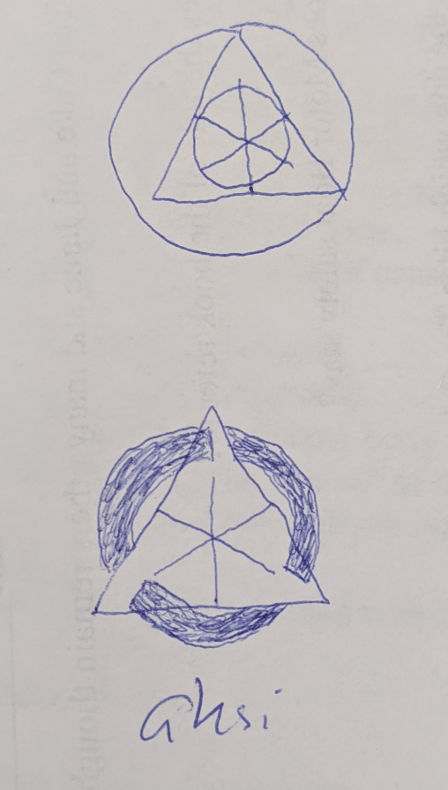
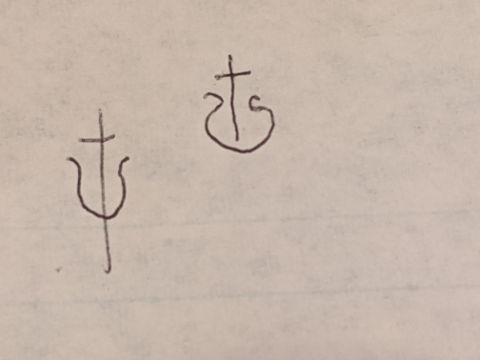
First is a symbol, a quick and then a more elaborated version, to follow up on my post about sigils. It shows one way to work with a symbol, help it come into focus. There’s a definite change and clarification of energy in the second version.
I don’t recall for sure what I was aiming for — the word aksi under the second symbol is the Sanskrit word for “eye” and a good hint. So a stylized eye, a symbol for magical awareness and perception? Was I still working with my group at the time on symbols and logos?
I know I was using a homemade journal personalized with individual pages portraying my own sigil. Building associations with an image, as with a mantra or chant, helps “trigger” us — in a positive way. Doing this work with intention in a group, creating an egregore, grounds such chosen triggers much more powerfully. (For more info on egregores, see Mark Stavish’s Egregores: The Occult Entities That Watch Over Human Destiny. Inner Traditions, 2018.) Using more of the human psychological apparatus to our advantage like this is one further way to live more fully and consciously and richly, rather than at the whim of what Google and Amazon and “influencers”, the stock market or the Party or any Current Government want us to think and do and feel.
Hamlet confronts his former friends Rosencrantz and Guildenstern (Act 3, scene ii) after he discovers they have been informing against him to the King. By way of comparison he asks Guildenstern to play on a recorder he has obtained from the musicians who have just performed. “I have not the skill”, replies Guildenstern. And Hamlet nails them both to the floor with his next words:
Why, look you now, how unworthy a thing you
make of me! You would play upon me. You
would seem to know my stops. You would pluck
out the heart of my mystery. You would sound
me from my lowest note to the top of my
compass. And there is much music, excellent
voice, in this little organ, yet cannot you make it
speak. ‘Sblood, do you think I am easier to be
played on than a pipe? Call me what instrument
you will, though you can fret me, yet you cannot
play upon me.
Let this be our reply to those who would use us, squeezing from us whatever they can for their own benefit, then abandoning us when we have nothing more to give.
For the difference between your own will and another’s starts small, but soon enough with practice you can wedge your foot in doors you weren’t even aware of before. And then you can open them wider, and walk through. And you can shut other doors that do not lead to your best life.
What kind of doors? The email below details some of what was on my mind that January (email shows American order of month-date-year).
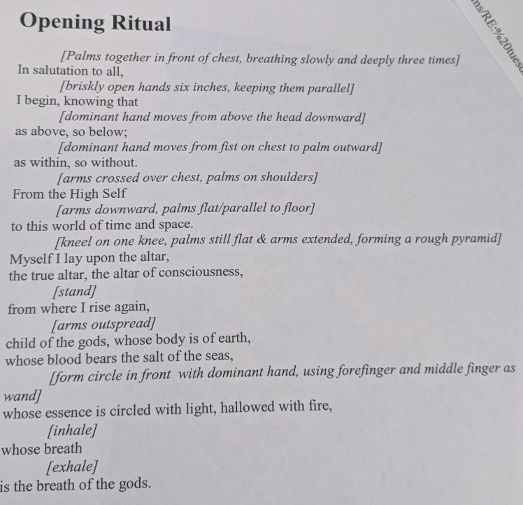
Finally, this “Opening Ritual” — who was this for? Besides being my practice that spring, I don’t recall. Did I do it as well with my magic group at the time?
I offer this to you as a short practice for this time. If as you try it out you find it helpful, adapt it to your use. It can help clear the way for prayer, for ritual, as well as serving as forms of these things on its own.
/|\ /|\ /|\
I’ve added a page of books and links on Druidry, as a stable reference I’ll revise over time. With more material appearing all the time, it’s helpful to refer inquirers to titles and websites I’ve found helpful and to update the document over time.
Heartfelt thank-yous to you, my readers, for bringing page views to 90,000. I’m making a point of posting more regularly during these difficult times.
While this blog seems to be passing through a prolonged dry-spell with few comments, I draw encouragement from a steady international readership that averages about 50 visits a day. If what I write helps, encourages or just entertains you, please leave even a brief comment so I know I should keep doing what I’m doing. Your reaching out really matters and makes a difference!
/|\ /|\ /|\
Watching for seals. No, not the sea-going mammals this time — the marks, glyphs, signs and symbols that we both make ourselves and also perceive in the natural world.
Tabloids regale us endlessly with pop-culture versions of this — for example, the face of Jesus burnt onto a piece of toast. Equivalent perceptions occur in other cultures with equivalent cultural icons (e.g., Buddha in the sky). Even normally restrained scientists have been known to join in: a 2019 article in Popular Mechanics gushes about the “real face” of Jesus, with this tagline “Advances in forensic science reveal the most famous face in history”. Feel the tug of that headline?
We ask “But is it real?” all the time, of a great number of things, many of which can’t (or shouldn’t) answer.
MAGUS banner featuring the Gathering logo
Psychology explains these phenomena as instances of pareidolia — if you see the word “idol” within the word, that’s not a mistake. Pareidolia is, to borrow a rhyme, “seeing faces in unusual places”. You might find this article on the topic from LiveScience interesting. Our human tendency to detect patterns in seemingly random visual inputs is what makes the Rorschach inkplot test possible. It’s also part of a complex human survival skill with multiple consequences.
The ability to attend to a pattern, to give it a meaning, empowers signs and sigils, but of course also makes written language possible. The shapes of the 26 squiggles of the English alphabet have little to no inherent meaning (you might argue that the S is vaguely snake-like, and snakes hiss — hence, the s-sound), but humans can detect and assign meanings to a wide variety of phenomena.
An effective sigil or seal can be created as a doorway to memory, to specific states of awareness, to understandings that may not stay with us while we’re dusting the shelves, changing a diaper, emailing the boss, or cooking a meal. But we can shift consciousness at will with the aid of a seal or sigil and know and do things otherwise beyond our capacity. Our schoolteachers know the value of holding a student’s focus and attention — these make all the difference!
doodles for Druidry and Christianity logo — cross and grail
Christians wear crosses, Jews the Star of David, and followers of other traditions their own meaningful symbols. We also doodle both new and repeated shapes and signs, and we can expand on this human tendency and engage with a whole symbolic language if we choose.
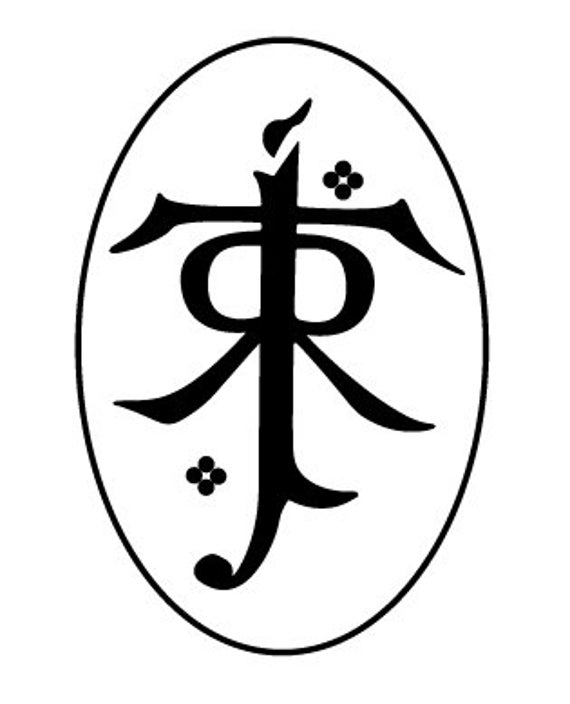
Tolkien’s initials as logo
Books on sigil making and sigil magic — the conscious seeking, design and use of signs and shapes to change consciousness — can of course assist. But the ability already lies in each of us — a birthright.
Tolkien invented a sigil from the initials of his name (JRRT) that now appears on his books and has become a trademark of the Tolkien Estate. Companies and organizations know that a distinctive and readily recognizable logo is often a key component to visibility and reputation and success.
To point to just one immediate use of sigils anyone can put into practice today, in these times of distraction and seduction by social media, and by fear and anxiety, our corresponding ability to attend to what we choose, rather than an advertising campaign or a news outlet or political party, is a priceless human gift.
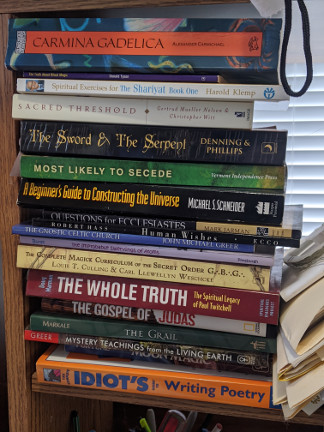
publisher logos on book spines — Pagans know the Llewellyn moon!
Place a meaningful sigil where I can see it during my day, write, paint or carve it on objects I use regularly, or sit with it in meditation, and I have a ready tool for shaping consciousness, guiding it toward my own purposes and desires, and focusing the energies that come through it into channels and actions that help, uplift and empower me.
And Josephine McCarthy, to choose just one author whose books are on my shelves, knows the value of a sigil as a distinctive cover for a book.
May signs point to good things for you!
/|\ /|\ /|\
Images: Magic of the North Gate cover; Wikipedia for JRRT logo.




 A Druid Way