Archive for the ‘ritual’ Category
Druidry, writes Philip Carr-Gomm in his foreword to Nuinn’s (Ross Nichols) Book of Druidry,
is a way of working with the natural world, and is not a dogma or religion … Druidry honours, above all, the freedom of the individual to follow their own path through life, offering only guides and suggestions, schemes of understanding, methods of celebration and mythical ideas — which can be used or not as the practitioner sees fit (pg. 14).
You could just stop there, and run with that, because this post eventually descends into a rant. Or irascible prayer. OK, you were warned.

clover overtaking weeds — no mowing needed! (but woodchucks love it)
<begin rant>
The word “honours” matters in the quote above. Not “grants” or “permits” freedom. Druidry recognizes something that’s already there. Druidry says Pay attention, so you can recognize these things, too.
Freedom, guides, suggestions, schemes, methods, celebrations, myths. These are the “seven paths in freedom” I want to look at in this post. Don’t worry, it’s not really a numbered list. A different Song is playing. The Song matters more than any list.
Freedom, that much abused and misunderstood word, is an actual thing we can experience and live from, not merely a “concept” or an “idea”, though it’s these things, too. It’s not only “in my head”. Freedom, like any song, comes first, then we have thoughts about it. It’s a gift, just like our lives. A melody at the heart of things. And like our lives, we can end our own freedom in so many ways. Turn off the music. (At least temporarily, though the Spiral remains, all the way down into our DNA.) If you need to be reminded how, just read the headlines. It’s practically multiple-choice at this point. Fifty ways to leave your lover, sings Paul Simon. Shedding your skin, walking on the other side, is a really good option at this point. We do it every night in dream. How about while awake?
A free person gives freedom to those nearby. Freedom spreads, like air, fragrance, sound, waves. We all know others who take from us when we’re around them, just like we know people who give, who make space, and work not to impose their limitations on us. Sometimes we read of the “torch of freedom” — and though cynicism is a popular defensive shield these days, that’s a live metaphor for the sense of kindling and expansion we feel in the presence of a free person. May we meet — and be — such people!
Don’t want to, or can’t, join a Druid Order? You’re a Druid from the day you accept your freedom, and act from it. An Order’s just a form, a guide, a suggestion, to try or not.
If we act from freedom, we discover everything is a guide, a suggestion. The old challenge, Everything is permitted, provided you can accept responsibility for what you do, is a rich seed for meditation. How far can I go toward testing it?! Not Is it true? but How is it true? When is it true? In what ways is it true? These tests, and their results, work much more creatively and productively, at least for me, than a simple “yes/no” Is it true? Because I’ve found pretty much everything is both not true, and true, depending. So that question’s off the list, until I can come back to it on a higher spiral, when it may turn out useful once again, after I manage to learn a few more things. Consciousness makes all the difference: it’s the “depending”.
Druidry offers some things to try out. (Now I’m imagining that as my quick seven-word answer to anybody who asks “So what is Druidry?”!)
Ground a practice in the things of my world: air, water, fire, earth. Not just ritual, though that too. Expand my rituals. Thinking, this morning, while I wash two-days-dried dirty dishes in warm water: air/thought, water (obvious!), fire/heat of the water, of my blood, of the sunlight streaming through the kitchen window; earth of my bones and flesh, of the food scraps on the plates and pots and silverware, of the sink and walls and world all around.
Brother Lawrence wrote a wonderful classic, Practicing the Presence of God. You almost don’t need to read it, the title says so much. If you do read through, be patient with it and yourself — you’ll need to do some digging to excavate the gold, given the change of cultural understandings.
It’s a practice, not a one-time deal. You get better.
Listen to other beings. The white ants that come every summer to our kitchen have more to teach me than the last book I read, whatever it was. Practice asking good questions. I’ve spent at least four decades on that one, and no sign of stopping yet. You know — magic in, magic out. Or the opposite.
“My God is bigger”, said a Christian to an author friend of mine. “Maybe that’s because your need is bigger”, said the friend.
An infinite abyss separates any two moments in time, in eternity, says one of the Wise. I practice resting there, feeling the lightness of spirit, of creative fire, of the awen as it flows. I set my hand on a blank journal page, a computer screen blog post, and enter that abyss. If like me you flash on vertigo for a moment, know too how weightless is fire, always rising up, climbing the spirals we all walk. If a child falls in a dream, the Senoi people of Malaysia encourage the child to fall, and not wake up to escape the dream. “They taught the children to fall, knowing they wouldn’t be hurt, and to climb, to travel, or fly to unknown places, to unknown cultures, to learn new things. If they woke up instead, they would be advised not to escape from such dreams the next time they occurred”, write Stewart and Garfield in their 1972 book Creative Dreaming. Easier on everybody than the wrenching costs of the rising suicide rates in the U.S. and elsewhere.
Schemes of understanding, patterns, webs, networks, interconnections, links, circuits. Our “marvels of modern technology” work (when they work) by building with earth — metal, glass, rare earth elements. Technology grounds these sometimes abstract, intellectual facets of elemental Air and manifests them, re-alizes them, makes them what Latin calls res — things. Ground and center, counsels beginning practice, again and again and again. I always need to earth what’s goin’ down.
Heirs though we are of two thousand years of Christianized thinking, somehow we’re still more Gnostic than Christian, eager to flee this world, constantly forgetting the god at the heart of Christianity who incarnated, became flesh, manifested, took on a body, got as earthy as anybody can, and died that way too. Eucharist, literally thanksgiving — this is my body, this is my blood. The Things of Earth are holy, divine.
Pilgrim on earth, thy home is heaven. Stranger, thou art the guest of God(s).
And yes, William Carlos Williams, you turn out to be right on both counts: “It’s difficult to get the news from poems, but men die miserably every day for lack of what is found there”. You write about a fracking flower [short / long] and stake us through the heart. Bards, tell us how it is, how it can be. Now take out the comma. Bards tell us how it is, how it can be. I’m still practicing as I listen harder.
Or another take, if you like or need it: “Earth’s crammed with heaven” , says Elizabeth Barrett Browning. “And every common bush afire with God;/But only he who sees, takes off his shoes./The rest sit around and pluck blackberries,/And daub their natural faces unaware …” Another practice, taking off my shoes, and walking through the grass.
And that’s fine, too, says Druidry. The Spiral always waits. No one’s reached the end yet … There are always rest-points. We need ’em.
Methods, celebrations, myths. Five, six and seven, if you’re counting. J. M. Greer says one key is “embracing an experiential approach to religious questions, one that abandons rigid belief systems in favor of inner development and individual contact with the realms of nature and spirit”.
Everything’s political? Nope — everything’s spiritual. Or mythical, if you prefer. Politics wants the power and energy, but without bothering about the spirit that powers them. (Zeus tried all that out long ago, and look where it got him!) Things of this world? Sure! But just know where they come from. Get the order right. That’s why we keep screwing ourselves over with men (and it’s still mostly men) of power. Give the women a chance to mess things up, too!
They can’t give us what we really want. But we keep handing politicians our freedom anyway, as if they knew better what to do with it than we do. Reclaiming, Starhawk calls her Witchcraft tradition. Get it back! Don’t give it away again!
<end rant>
/|\ /|\ /|\

Fallen pine, cut into lengths: edging for more raised beds? Gateposts for my backyard grove?
Solstices.
Just as at the Winter Solstice we celebrate the shortest day and longest night, knowing that light will grow again, so at the Summer Solstice we celebrate the longest day and shortest night, knowing that daylight will now shorten. Here is a teaching of paradox: each peak, dark or light, contains the seeds of its own change. And as Taoist tradition teaches, “When Yang peaks, it shifts to Yin; when Yin peaks, it shifts to Yang.” — adapted from OBOD publications.
I begin again. A couple of deep breaths, to center myself. Then the awen, or another sacred word. Open the inner doorways.
Get out in the sun, advises the OBOD ritual booklet for Summer Solstice. Sit in a shadow. I love these two apparent contradictories, side by side! So perfect! Harvest your garlic. Sunburned, shaded, garlicked, I proceed.
Having neglected to grow either St. John’s Wort or Vervain for our Solstice rite next weekend, I’m on the lookout for them along the road, in fields nearby, or at a farmers’ market. We’re naming the local landscape and its creatures in our Solstice ritual script, listening between the words for their other names, ones they may not tell everyone. Indian Place Names of New England, in a hodgepodge of less-than-complete formatting for online viewing, gives one Native American name for our local Vermont region: Kawassentekwa “barren spot along the (Connecticut) River”! One more way to laugh, to stay humble, to see and work for possibility where, outwardly, things look bare.
Apparent world, crazy uncle at the door, we hug you and invite you in to join us at the Festival table. Meet the others here!
/|\ /|\ /|\
[Updated 5 August 2020]
See also my post Moon Ritual Scrapbook with a basic moon ritual.

Full Moon, May 18, 2019 @ MAGUS Gathering. Photo courtesy Marianne Gainey.
With last night’s May full moon, and searches from this blog for the words “full moon ritual”, it feels like time to talk a little more about ritual. Google “ritual design” and you’ll find many helpful sites. John Beckett’s helpful A Pagan Ritual Outline derives from his own long experience.
Ritual is at heart a form to focus awareness, like a melody focuses sound, like a kata or “form” focuses movement in the martial arts.
OBOD founder Ross Nichols observed that “Ritual is poetry in the world of acts”. That is, it’s distinguishable from other actions we do by its intent, its shape and form, and often by care for its appeal to the senses. Poetry and song rely on rhyme, rhythm, melody, harmony, counterpoint, emotion, symmetry, repetition and variation (chorus and new verse). It’s no surprise that effective and memorable ritual draws on the same components. Theater also underlies ritual with gesture, movement, surprise, audience participation, intonation, staging, lighting, costume, etc.
The full moon, by its shape, suggests completion of a cycle, a high point or climax in a developing change, a major turn in a process (you can’t get fuller until you empty again). More imaginatively, it can also suggest an open eye, a womb, a mirror of the sun, and so on. These and many other associations and symbolic patterns can feed into a moon ritual. (Take a moment and write down your associations for the sliver of new moon, and you’ll be on your way to a new moon ritual.)
It helps to work with an outline or script — not as something prescribed, or to be rigidly followed without thought, but from a sense of flow and sequence. Even “spontaneous” ritual, especially for solitaries, often flows from a sense of rightness at the moment. In neither case do you need something written down to read from or use as a guide. But if that helps, or makes a big difference in quality, why not use it? Think of a favorite song you know by heart. Is knowing it so well a weakness?

Li Bai (Wikipedia/public domain)
A few lines of the famous poem by Tang dynasty poet Li Bai (701-762), rendered more or less as “Drinking Alone with the Moon”, offer us a ritual moment:
Among flowers sits the jug of wine.
I pour alone, no other friend nearby.
I lift the cup to invite the moon
and with my shadow we make three.
(That’s my plain rendering. You can read multiple and more poetic versions of the whole poem here. The Chinese words: hua1 jian1 yi1 hu2 jiu3/du2 zhuo2 wu1 xiangqin1/ju3 bei1 yao1 ming2 yue4/dui4 ying3 cheng2 san1 ren2.)
Sometimes simplest is best. The experience of the moon shining through the flowers onto the wine, the solitary drinker, the cup, and the whole evening all around participate in the ritual just as much as the few words the speaker says to welcome the moon. Yet the ritual wouldn’t be complete without the words, because they’re called for. How does the solitary drinker “know what to say”? What fits the moment. And being alone (and possibly already a little mellowed with wine) helps shape what fits the moment. The moon is both familiar and wholly new in the moment, as are the feelings and thoughts of the drinker. A poem becomes a ritual. A ritual becomes a poem.
“Bigger” rituals work the same way. And planning and preparation can be just as effective in providing a form for rituals where gods speak, fire falls from the heavens, and the Earth Mother whispers her deepest secrets to gathered mortals.
In a Druid triad of ritual, three things happen: you open the door to the ritual, the heart of the rite takes place, and then you close the door. In Li Bai’s poem of informal ritual, the wine, moon, cup, speaker, flowers and moment each play their parts to open the door. The moon is present, and the flowers and wine and place. The speaker feels the moment, says the words, drinks, and the moment passes. The poem-as-script (re-)establishes the moment, records it, and closes it when the poem ends. Or think poem-as-ritual-photo. It’s not actually the speaker performing the ritual, but it records some part of it.
Let’s expand on the Druid triad of ritual. Below are twelve components to consider as you develop a ritual:
1–INTENTION — why are you performing the ritual? The whole ritual follows from this. A clear intention, large or small, leads to effective and enjoyable ritual.
2–MATERIALS NEEDED — cycle back here to add to your list as you develop the ritual. “Keep it simple” is a good principle. Ritual stuff isn’t the main event. But lacking the one or two things you DO need in the middle of the ritual, once the script grows to include them, is a real downer. That ritual knife, candle, bell, bowl of water, smudge stick now needs to be there. Do you need ritual clothing, body marking, etc.? Make sure it gets on the list.
3–PARTICIPANTS and ROLES — how many does the ritual need? Again, cycle back to update your “cast of characters” as your ritual plans develop. In the event of missing participants, how can you double up on roles?
Is there something for guests to do who aren’t speaking or performing major ritual actions? Can there be? Do participants — or visitors — need to prepare in advance in some way? Learn a short chant by heart? A melody? A ritual gesture? Vigils, fasts, prayer, meditation, questing, etc. can help participants bring their full ritual selves to the rite from the beginning.
4–PLACE and TIME — flexibility is key, especially if weather, reservations, or schedules have other ideas for your ritual. Pre-planned alternative locations in case of rain, etc., announced in advance, keep crowd control, confusion and disappointment to a minimum. Is accessibility an issue for any participants or visitors?
5–RITUAL HOUSEKEEPING — “Please turn off your cell phones!” Run through any details guests need to know. “This is what we’ll be doing. Don’t break the circle, or cut yourself a door in it, or ask a ritual celebrant to do so for you. Restrooms are at the end of the hall, or 20 miles away; find a tree. That’s north, so this is west.”
6–FORMAL OPENING — some combination and sequence of purification, grounding, centering, welcoming, proclaiming ritual intent, honoring and inviting Others to be present. Bells, singing bowls, incense, water, fire, salt, chant, drums, etc. all can help. Casting a circle, establishing sacred space, erecting or acknowledging altars, redefining the status of participants, the place, objects nearby or some combination of these may be appropriate. Choose who does these things, and why, and how others can take part. Less talk is usually better. So is simplicity.
7–The MAIN RITE — what you’ve gathered to do. Re-enacting a myth; marking the changed status of a participant through initiation, etc.; celebrating the season, a date, festival, harvest, planting, boat-launch, new home, new family member, etc. Healing, defending, strengthening, commemorating, blessing, gifting. Where you do the stuff specific to your tradition, practice, gods, calendar, and so on.

MAGUS 2019 Maypole!
8–FEAST, ritual meal, distribution of ritual objects, etc. — a piece of maypole ribbon, a slice of apple (showing the star), a drink, a stave of ritual significance, a card or picture, stone, sea-shell, etc.
9–READINGS, Music, Poetry, Blessings, Prayers — this important portion of a ritual can accompany the Feast, etc. to help sustain the ritual energy, hold focus, minimize side chatter, etc. It also gives everyone present a chance to contribute personal requests, blessings, songs, etc.
10–CLOSING — reverse what you did for the opening: thank Others you invited, uncast the circle, return ritual elements to their original places, desanctify what needs desanctifying, take down the altar. Ring the bell, beat the drum formally, close the ritual. Re-establish the world before the ritual began. Again, simple is good.
11–ANNOUNCEMENTS — upcoming events, requests for help with clean-up, calendars, thanking visitors, etc.
12–CLEAN-UP — leave the ritual space as pristine — or more so — than when you arrived. Make this a ritual act of service and gratitude.
Conversation following the rite can be an opportunity for formal teaching, Q-and-A, casual discussion, ritual debriefing and a post-mortem “how did it go?”, planning for another event, a meal at a favorite restaurant (which can be announced on Meet-up, etc., as an outreach tool).
Were you expecting a script for a specific ritual here? No need — you know enough to develop one of your own better suited to you, your situation, your practice and your intention. And after a few run-throughs, you’ll be on your way to developing your own ritual design “best practices”.
/|\ /|\ /|\
Looking for more detail? Check out Isaac Bonewits’ excellent Neopagan Rites: A Guide to Creating Public Rituals that Work (Llewellyn, 2007), available used for just a couple of dollars.

photo courtesy Srinivas Ananda
Here’s a set of lively images from just a couple days ago of Edinburgh’s Beltane Fire Society’s 2019 celebration. Twice a year, at Beltane and Samhain, the Society stages an event featuring fire, drumming and dancers drawing upwards of 10,000 spectators.
Past posts on this blog may help provide inspiration for your own observances and practice.
• Two recent posts on Beltane 2019 — my own local Druid group’s ritual and a reflection on Beltane north and Samhain south.
• What is it with fire and Beltane? Well, the name Beltane itself, according to some etymologies, means the “Fires of Bel”.
• In my “30 Days of Druidry” series, I take up Beltane again — the ancient Celtic fire festivals of Beltane and Samhain still live in many forms today. A local example — a group of Morris dancers (article, pix and short amateur video) braved a chilly May 1st morning yesterday on nearby Putney Mountain, VT, to “bring in the May”.
• In 2015 I wrote this series of posts on “touching the sacred” — something we can often do most easily through fire and fire festivals. No surprise that cultures around the world have for millennia recognized fire as a sacred metaphor and vehicle. Let me take you there, says fire (and also Led Zeppelin’s vocalist Robert Plant, especially in “Kashmir”. Lack direct access to transformative fire? A shaman like Plant can help!).
• “The Fires of May, Green Dragons and Talking Peas” assembles the words of bards and a set of images to suggest to ear and eye what it is we seek and thrive from when we find it.
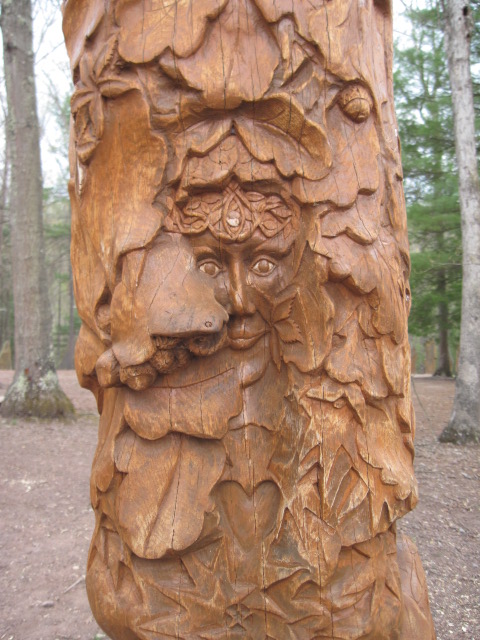
wooden totem at Four Quarters Sanctuary, PA
• Want to experience a taste of a larger Beltane Gathering? Here are posts from 2018 and 2017 on the first two years of the Mid-Atlantic Gathering.
/|\ /|\ /|\
Beltane yesterday, with our Vermont OBOD Seed Group, the Well of Segais, was a windy, sunny welcome to spring in the north half of the state. With many dirt roads washing out after all the recent heavy rains, members scrambled to reach hardtop roads, scouted for accessible ritual locations, and found this marvelous, recently-constructed stone circle in a municipal park overlooking Route 2.

A short walk over this preserved covered bridge, and across a boggy meadow, took us up a hill to the circle.
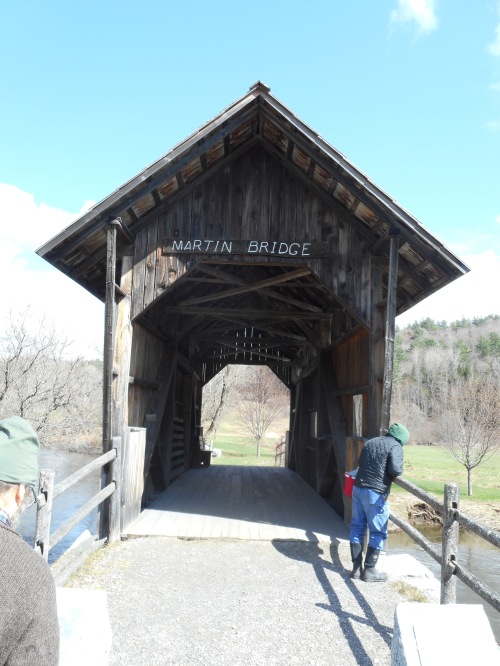
Between the initial location-scouting and our arrival yesterday, someone had found and placed a striking large quartz rock on the central stone. With some careful shifting on our part, it settled into place upright, serving as a stable windbreak. With five of us, we had just enough members to fill the ritual roles — and to reach out hands to form a ritual circle around the central stone!

Just as Imbolc for Vermonters often marks the start of “sugaring” — maple syrup season (or at least a midwinter thaw) — so Beltane celebrates the first leaves appearing on the trees, the first brave daffodils often pushing through the last of the snow, and the onset of “mud-” and then “stick-” season, two short but memorable intervals sandwiched between the long Vermont winter and the often wet spring.

Calendula –Wikipedia Creative Commons
A group member brought calendula seeds as a ritual gift for all to plant. An “all-arounder”, the calendula is a member of the marigold family, bringing color, medicine, edible blooms, dye, tea, and other uses. Technically an annual, the plant can reseed itself and become effectively a perennial, if you don’t deadhead the flowers and if you allow it to mature into its seed-bearing form.
Looking to welcome the moon along with Beltane? Wait till May 4, and you can work with the New Moon, as Mystic River Grove in Massachusetts will do this year.
“Within me the powers of Sun and Moon. With my right hand (or wand) I father the Child, with my left (or chalice) I mother it. Within me lives the alchemy of this union. Let the magical child of my creative nature blossom and thrive in the inner and outer worlds” (adapted from OBOD ritual).
Beltane blessings to all!
/|\ /|\ /|\
[Part 1 | Part 2 | Part 3 | Part 4 | Part 5 | Part 6| Part 7]
INTERLUDE
Druids have grappled with Christianity since it first arrived in Europe. While today we might take St. Augustine at his word (“that which is known as the Christian religion existed among the ancients, and never did not exist”*), exploring it in new and creative ways (tell me yours and I’ll tell you mine!), most people throughout Christian history have understood the assertion as narrowly as possible. That is, Christ started a new religion focused on belief in the divine power of his sacrificial death and resurrection, which saves the believer. Pairing this with a transformation in awareness, the convert takes on a new life in Christ.
For many, however, Jesus Christ, or least the religion that bears his name, is problematic at best. (To choose just one among myriad issues to explore, note that neither Druids nor non-Druids use the name Taliesin, for instance, as a “swear-word”!) Many non-Christians today have suffered from unloving and aggressive evangelism, family harassment, workplace tension, physical threats and social ostracism, whether they practice a non-Christian spirituality or simply remain “outside” the Christian church.
I’m addressing this series of posts, then, primarily to a vast “excluded middle” — neither the “born-again” believer nor the scarred (and possible tarred and feathered) “heretic”, but the people awake to the “magical and generous” possibilities all around us, because you’ve already experienced them, and they answer a deep hunger in you like nothing else can.
Or as Krista comments:
Dean, I’m always especially interested when you write on this particular topic. Having been raised in the Christian Faith, and having had no quarrel with the Christianity of my youth, my own Druid practice always has something of a Christian flavor to it even though I no longer consider myself a Christian. But I don’t consider myself Pagan either. Always was a bit of a square peg. So throughout my Druid journey I’ve become very comfortable blending and assimilating and it works quite well in my private practice. It’s a bit more challenging in community practice, but I’m working on it and I adapt when it’s called for. I think it would do the Druid community a world of good to acknowledge, and have more discussion about, different Druid perspectives rather than focusing almost exclusively on the Pagan perspective. Thanks for taking it on!
One less-than-flattering label for this is syncretism. But religions and spiritualities, just like most human cultures, thrive by cross-pollination, as careful study of them across time will bear out. Similarly, in our genetics we’re mongrels, hybrids, blends, mixes. (Our sometimes uncomfortable surprise at recent DNA test-results illustrates one aspect of this.) Our current sensitivity to “cultural appropriation” is our heightened awareness of the violence behind forcible mis-appropriations. Or as John Beckett puts it bluntly in his The Path of Paganism, “Always credit your sources, never pretend to be something you’re not, and steal from the best”. It’s the lack of credit, the pretense, and the poor selection that make up most of our problems with shoddy cultural (mis)appropriation. The “weekend guru” offering workshops, intensives and retreats, and cashing in on an inferior grab of unacknowledged and imperfectly-mastered practices from another culture currently perceived as somehow more “authentic” or “powerful”, gives all borrowing and mixing a bad name.
[Lest you take issue with the possibly glib tone of John’s “triad of appropriation” above, let’s hear him at greater length from a recent post:
Are you being respectful to the traditions and cultures you’re drawing from, or are you grabbing whatever looks shiny to you? Are you working with them as whole systems, or as mix and match entrees on a spiritual buffet? And as a polytheist, my biggest concern: are you treating the Gods as holy powers and as persons with whom we can form relationships, or as objects to be used where and how you see fit?]
/|\ /|\ /|\
Another under-explored overlap is Druid and Hindu practice | another link | a third link | which offers some very provocative insights into cultural similarity and preservation of ancient traditions over long periods of time, and at “opposite ends” of the Indo-European area of cultural and linguistic origins and influence. Everything from archetypal themes in stories, to names of gods, music and musical instruments, and spiritual practices, show common ground in the cultures of Celts and the peoples of the Indian subcontinent.
And so I write these posts partly in the spirit of “doing the Druid community a world of good to acknowledge, and have more discussion about, different Druid perspectives rather than focusing almost exclusively on the Pagan perspective”. And as always, I’m exploring my own practices and perspectives as I go — one of the chief benefits of blogging.
The EMPRESS
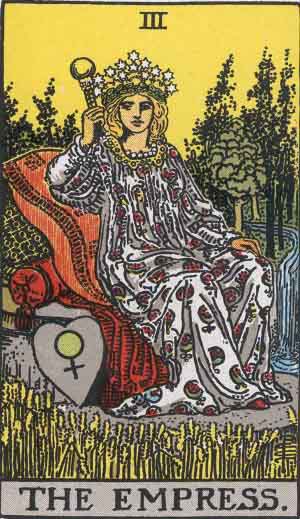 The Empress of the traditional deck, with her 12-star crown and sceptre, and the astronomical symbol of Venus next to her chair or throne, is another goddess figure. As an aspect or representation of the energies along the journey of the Fool or Seeker, she grounds us in the earth. The wheat growing at her feet, the waterfall to her left, the forest behind her, all place her “in the world” of both fruitfulness and change. Whether as Mother Earth, or Mary, or another goddess, or a living but impersonal archetype, or the fertile and fruitful energies within us, the Empress is a potent force and presence.
As Caitlin and John Matthews describe Guinevere in their version** of this card, as “the Empress of Logres (the Inner Britain), she creates the conditions for growth, establishing peace and contentment. She spins a thread of inner concord which is woven into the fabric of the land and its people. She imparts sensitivity to nature and harmonious awareness of all life” (The Arthurian Tarot. Thorsons, 1995, pg. 28).
What is the “thread of concord” between you and the land where you live? Only you can answer that: it can become a practice first to find out, and then to honor it in ways that you work out between you and the land. A grounding exercise of weaving or braiding a thread to carry with you as a reminder may help incarnate this awareness. Ritual can serve our need here, as in so many places.
What are the “conditions for growth” for whatever you wish to bring into your life? How can you begin to work them into your day to day work and awareness, so that they can manifest what you need? How can you serve others who are doing the same? Asking the questions can help the chance manifest, if I’m paying attention. If not, then next time around.
Archetypes, it should be said, aren’t something to “believe in”, and even less something to “worship” — though you certainly can if you choose to. (Let us know how it goes — you may discover something valuable to share.) Instead, and probably a better use of our energies and attention and time, they’re something to work with to see what they can help us do and understand about our lives.
The EMPEROR
 The Emperor in the traditional deck hews to traditional symbols and representations of patriarchal power: beard, crown, scepter, throne, armor, harsh and rather sterile landscape, rams’ horns adorning the throne’s arms and back. (It can be helpful for such reasons to consult other decks for different images and symbolism.) The fact that we’re experiencing the negative effects of imbalanced masculine energies in our lives simply tells us a piece of what needs healing and re-balancing. Scan most headlines and you realize many people haven’t a clue about how to begin to do this — itself a measure of how out of balance the energies have become for many. We’ve often jettisoned outmoded forms of spirituality, true — but neglected to replace them.
The Emperor’s number 4 is also represents the fullness of the human world, four-square in its founding on the four physical elements, before we shift our awareness to spiritual realities within and beyond them. The Pagan and Christian star alike points to the five-fold nature of all things, both physical and non-physical — a vital reminder of how the cosmos is constituted, which we overlook, and have overlooked, to our peril.
The spiritual, you might say, is what the physical *is* under its mask. Or to say it another way, the spiritual is always clear and apparent; it’s the physical that’s the mystery, the cloak, the concealer, the mist-filled branching off the path. We have simply forgotten to work our polarity magic, to walk a spiritual path of stewardship, to put it in Christian terms — we’ve thrown our planet out of balance over time, and now must spend at least as much time over the coming decades and centuries working to bring it back into balance and harmony.
The HIEROPHANT
 The figure in the traditional deck of the Hierophant, the “one who shows the holy”, may bring further associations of institutional authority and entrenched structures and imbalances.
Some decks re-order these first few cards, change their genders and assign them different symbolism, in an attempt to represent one or another version of a more balanced set of images. In the Matthews’ Arthurian deck the card depicts the bard Taliesin, the poet-as-way-shower-of-the-holy, especially of ways that stand outside formal structures and institutions. Today we find our bards and prophets among artists and performers, actors and politicians.
(Check out fansites and Facebook, Twitter and other social media, if you want to know how much the words and music and performances of artists matter to so many, if you don’t already have a deep appreciation for the power wielded by a multitude of visions and their visionaries. Again and again, people post how a performance or a lyric saved their lives, brought them down from suicide, changed their outlooks, gave them strength and courage and a vision to persevere through often impossible circumstances.)
Like the Hierophant, Taliesin is a guardian of tradition. We know all too well the dangers of distorted and abusive holders of traditional authority and power. Seemingly every other day, headlines trumpet the fall of another person — often a man — from a position of trust, authority and power. Such things have given tradition a bad name — except, again, in our modern reverence for everyone else’s traditions except our own. Traditional holders of wisdom, Native American or Tibetan or Mayan, still retain something of the original value that a tradition is meant to preserve.
For the other and often neglected face of tradition is that conserving function. We may conceive of tradition as “guarding from”, but more as “guarding for”. In his Elves, more than in any other expression in his fantasy works, Tolkien captures the sense both of preserving much wisdom and beauty through time, and of pervasive sadness at its seemingly inevitable loss. To cite just one example, even among the more hopeful, Gandalf addresses Aragorn in Book 6, Chapter 5 of The Lord of the Rings:
This is your realm, and the heart of the greater realm that shall be. The Third Age of the world is ended, and the new age is begun; and it is your task to order its beginning and to preserve what may be preserved. For though much has been saved, much must now pass away.
Our contemporary sense of loss and disorientation at our crumbling institutions, corrupt as some of them have become, is also an opportunity to reconnect with legitimate traditions, many preserved inwardly by their keepers, where we can recover them through vision, gratitude, ritual, and readiness and humility to ask for guidance. Taliesin, in the Matthews’ rendering, is one such preserver or conservator. He “sits in a firelit hall. He tells the story of his initiatory transformations to two children who sit at his feet listening intently. The golden links of tradition pass from his hands to theirs” (The Arthurian Tarot, pg. 30).
And our efforts in this quest (“lest any man should boast” as Christian scripture says [Ephes 2:9] of “works”, which by themselves can never be the only component of a quest) are part of our purification, our testing, a step along the path, not the sole key to growth. We are each one being in a cosmos of other beings, each with intentions and purposes, some which can align with ours. The hand of tradition, the wisdom of the Ancestors, the spiritual reality of the worlds, reaches out to grasp ours when we show we are ready.
/|\ /|\ /|\
*Augustine of Hippo. The Retractions, ed. Roy Joseph Deferrari, trans. Mary Inez Bogan. Vol. 60, The Fathers of the Church (Washington, DC: The Catholic University of America Press, 1968), 52. [Book 1, Chapter 12, article 3.]
**Here are the names of the cards in the Matthews’ Arthurian deck: (0) The Seeker, (1) Merlin, (2) Lady of the Lake, (3) Guinevere, (4) Arthur, (5) Taliesin, (6) The White Hart, (7) Prydwen, (8) Gawain, (9) The Grail Hermit, (10) The Round Table, (11) Sovereignty, (12) The Wounded King, (13) The Washer at the Ford, (14) The Cauldron, (15) The Green Knight, (16) The Spiral Tower, (17) The Star, (18) The Moon, (19) The Sun, (20) The Sleeping Lord, and (21) The Flowering of Logres.
A series of recent comments here has been helpful to me, even as I try to gauge how to approach these posts, and how far and where to take them.
I had breakfast with a Druid friend this morning, a short while before he’ll be off for an extended cross-country skiing trip, far from regular tourist routes, hiking in and out, and camping and staying in trail-side shelters. I value him in part because he’s a good listener, and as a consistent character trait, he seeks to find balance in his own reactions to his daily inner and outer life, even as he shares them with others. It makes for some priceless insights, if I shut up to catch them.
Such reflection is a gift, something to cherish and encourage in others. I try to listen here in the same spirit, when you comment in posts about what’s going on in your worlds and experiences. Often of course I don’t not know enough of your circumstances to comment usefully, but I keep listening partly for that very reason. Who knows the whole story, even of our own lives? (The late ABC commentator Paul Harvey called his popular broadcast The Rest of the Story. We keep paying attention, if we’re wise, because the story hasn’t ended yet by any means, and we’re all part of it, telling our piece as we live it. And if you suspect reincarnation is an accurate aspect of the story, its chapters can grow quite lengthy indeed.) Listening, patience, gratitude: a triad cutting across all traditions, proven countless times over and over in its profound power.

Krista writes:
Dean, I’m always especially interested when you write on this particular topic. Having been raised in the Christian Faith, and having had no quarrel with the Christianity of my youth, my own Druid practice always has something of a Christian flavor to it even though I no longer consider myself a Christian. But I don’t consider myself Pagan either. Always was a bit of a square peg. So throughout my Druid journey I’ve become very comfortable blending and assimilating and it works quite well in my private practice. It’s a bit more challenging in community practice, but I’m working on it and I adapt when it’s called for. I think it would do the Druid community a world of good to acknowledge, and have more discussion about, different Druid perspectives rather than focusing almost exclusively on the Pagan perspective. Thanks for taking it on!
How many of us hear even a part of our own experiences in what Krista shares here? Neither Christian or Pagan. It’s a perspective and an experience I suspect is more common than we recognize. “Square-pegged-ness” could probably define a number of us, and in fact much contemporary spiritual practice across traditions echoes this sense of having to find and tread our own paths. Because what price “purity” of belief or practice strictly within the confines of one tradition or school, church or community, if spiritually we’re suffocating or starving there? It can take a deal of work just to recognize such a priority, and honor such a spiritual imperative.
The influx of the divine that swirled and took shape in and around Christianity still has valid things to teach us, even as individual churches and whole communions and major denominations struggle to find their way. The existence today of over 20,000 Protestant denominations, to say nothing of other Christian traditions, testifies to the difficulty of satisfying the questing individual soul with system and conformity, doctrine and creed.
Group practice and community often mean more to many people than words of affirmation recited at a particular portion of the weekly service, though they may describe much of value, too. But the flame that burns at the heart of what is called Christianity does not appear to keep itself neatly smouldering within any bounds set by humans, any more than it does in other spiritualities. If it did, how much would it really be worth? Instead, it kindles and warms anyone who brushes up against it for any length of time. Inconveniently so, dynamically so, wonderfully and provocatively and endlessly “inspiritingly” so.
What other perspectives or flavors of Druidry do we often overlook, besides the Christian one(s)?
Until we can begin to answer that question adequately, I’m borrowing, for the space of a quotation anyway, some monotheistic but non-Christian flavor from Tolkien’s Silmarillion, hearing in it an echo of Druidic awen, and a further gift of the elemental fire that kindles us all:
Then the themes of Ilúvatar shall be played aright, and take Being in the moment of their utterance, for all shall then understand fully his intent in their part, and each shall know the comprehension of each, and Ilúvatar shall give to their thoughts the secret fire, being well pleased.
And disabledhikernh writes:
Thank you for this post. I am hard pressed to find other Druid Christians, so I have felt kind of isolated as such. Now I don’t 🙂
Isolation, that challenge to solitaries — and how many of us are solitary, even if we enjoy a local community of others, before and after we gather with them? The anvil of solitude can forge us spiritually in ways nothing else can, though the costs can be correspondingly high.
(One of my spiritual practices, for what it’s worth, found in other interesting places, too: If this experience is happening for me rather than only to me, what can I take from it? Where can I travel with it? What doors does it open, and not just close? What beauties glow behind the doors? What deities flare and bloom there? How far, I whisper to myself, half in fear, half in wonder, how far can I really go?)
Steve has been sharing something of his journey in previous comments, and writes:
This series of posts is proving to be a thoughtful and thought provoking treatment of what is a “delicate” subject in many circles. When I first encountered some of your earlier posts on the intersection of druidry and christianity I admit to taking a very cautious approach, almost an attitude of “this is too good to be true”. With time to read and think about what you are saying it seems more likely that you are speaking from hard won, first hand experience. Thank you for doing this.
“Delicate” is apt. Steve’s caution here sounds at least as hard-won — and needful — as any experience of mine, and vice-versa. My caution in how definitively I assert something, how deep I dig, how far I push, what I ask that I can’t answer, is ongoing. Rather than encounter walls, or provoke readers unnecessarily with observations I can’t back up from experience, I want to explore respectfully — mostly so I miss as little as possible of value as I go.
One of the most startling overlaps or intersections of traditions for me happened during an initiation. I still don’t know altogether what it “means”, though it was over five years ago now. In a clear inner encounter, all the more unexpected because I hadn’t opened a Bible in many years, I saw how
out of his mouth came a sharp two-edged sword; and his face was like the sun shining in its strength (Revelation 1:20).
Rather than “meaning” anything at first, the experience shaped me within its own context, just like other profound experiences, whether of pain or joy, grief or wonder, which we analyze only later, and put labels on, as we “process” them, seeking to incorporate or reject them, expanding or contracting them to “fit” what we can accept at the time. At the time, this experience confirmed for me the energy and love behind the initiation, flagging it as powerfully memorable.

Milan’s bosco verticale — vertical forest, completed in 2018*.
(After a car accident over three decades ago now, I surveyed the overturned and totaled car I’d been driving, walked gingerly over a puddle of broken glass to retrieve my wallet, flung from the dash out the window by the impact, massaged a sore neck that was my only physical outcome of the event, and marveled in gratitude that no one had been hurt. Anything the accident “meant” came only later: Insurance claims. My sometimes-psychic brother, agitated all morning before my phone call home to explain what happened and ask to be picked up. The eventual replacement of the car. The job interview I was returning from, the mantra I’d been chanting, my mindset, the weather, the other driver, and so on.)
Part of the gift of the initiation experience is that I was largely able to let go of what it “meant” at first and focus on accepting its effects on my awareness. What it “meant” and “means” has continued to unfold, though not necessarily along “orthodox” lines. And that no doubt drives some of what I write here. Images and metaphors as divine “transparencies” or hierophanies, ways to connect to the limitless, ways it “shines through”, are part of our spiritual furniture, and part of my bias or individuality or inner architecture. They may or may not be yours, but you have yours.
May you find and explore them richly.
/|\ /|\ /|\
IMAGE: urban trees — public domain; Bosco Verticale — Milan, Italy’s “vertical forest”.
*For more info and pictures of the Vertical Forest, see this article.
Slip away to the wilderness and pray.
I bless and consecrate you with water … with spirit, and with fire.
/|\ /|\ /|\
How often we’re put off by language — or drawn in and inspired, and for mostly the same reasons. The first piece of wise Druid counsel above comes, in fact, from Luke 5:16, describing what Jesus often did. Seems like a piece of uncommon good sense these days for anyone to practice, a sacred intention to add to our hours.
Another version* puts it like this: “Jesus often went away to other places to be alone so that he could pray”. Does that feel like anything most of us need to do regularly, to get off by ourselves so we can hear ourselves and our awen speak, and not merely listen to the strident echoes of the “24-hour news cycle”? Hear what life is constantly saying to the chakras and energy centers of our being**.
The second line above comes from Matthew 3:11-12, where John the Initiating Chief (Christians may know him as John the Baptist) names the powers he and Jesus invoke when blessing and hallowing others who seek out that particular ritual. Water, spirit, fire. What is baptism but blessing — literally, dipping in water and other holy substances or elements? A baptism in an initiation, and vice versa, symbolized by elements that have always been holy worldwide: water and fire, and spirit that animates them all. Call them elemental sacraments as I have, if that brings them into closer kinship and familiarity and comfort.
/|\ /|\ /|\
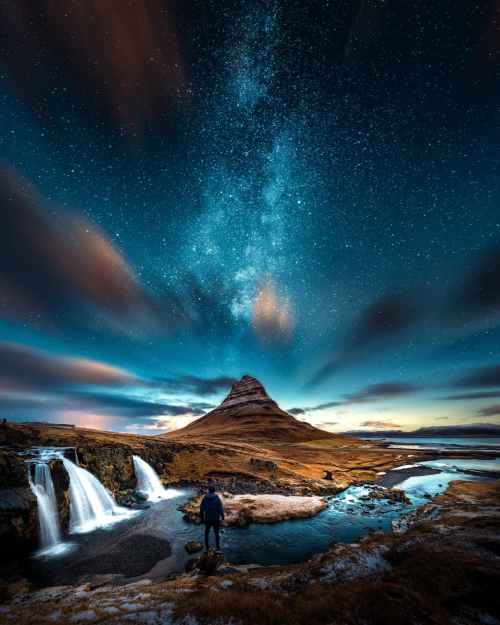
One of my teachers observed that just as we can choose to go through initiations organized and conducted by others, we can initiate intentions and directions in our own lives. An actual ritual can help to impress this on the mind and senses, reifying it, to use technical language — making it “thingly”, bringing it through “right down to the physical”.
So I find my own ways of slipping away into wilderness to pray, listen to the trees, sing the awen, and prepare.
And initiation? Many have long looked at the Biblical Book of Revelation as a guide to our inner spiritual architecture, with the seven churches it describes in detail as the varying focus and health of our seven inner energy centers, typified in various traditions as chakras or by other names, the spiritual eye among them, along with the halos on pictures of saints, the sacred heart, the gut instinct, and so on — yet another piece of the philosophia perennis, the Perennial Wisdom we cloak with our regional robes, names and forms, then “name and claim” as the Sole Truth of the cosmos (which we just so happen to be in exclusive possession of).
So you have a vision, and it’s natural to be told to get it down in words before it fades:
Write, therefore, what you have seen, what is now and what will take place later. The mystery of the seven stars that you saw in my right hand and of the seven golden candles is this: The seven stars are the messengers of the seven Gatherings, and the seven candles are the seven Gatherings. (Revelation 1:20).
Then you work to initiate your vision, with the Messengers (Instant or otherwise), and the Light sources you find at hand, LED, spiritual, human. A little paraphrase that I assert does no injustice to the original, and we’re on Druid territory. And why not vice versa? Rework a Druid ritual in Christian terms, and see what you may discover.
We can initiate or baptize our complete body, energies centers all working together, to (re)call it to its holy purpose as an Ancestor-in-the-Making, a Walker-between-the-Worlds, a Holy One. If the world around us, or some other world we’ve walked in lately, seems sacred or holy, or some other ideal summons us, we can “level ourselves up”, to use the language of gamers — shift energy and consciousness, so that we mirror and embody — incarnate — that holiness, rather than working against it.
So I choose the time of ritual with care, honoring the harmonics of the planets and stars, the tides of earth and our lives. Three days, or maybe seven, beforehand, I slip away to the wilderness and pray. As part of my ritual — perhaps the core of initiation, or perhaps other words come — I say, “I bless and consecrate you with water … with spirit, and with fire”.
And perhaps I close with some version of the blessings from recent posts, drinking what seems right to drink, making an offering from that drink to whoever it feels right to honor at the moment of the rite:
I now invoke the mystery of communion, that common unity that unites all beings throughout the worlds. All beings spring from the One; by One are they sustained, and in One do they find their rest. One the hidden glory rising through the realms of Abred; One the manifest glory rejoicing in the realms of Gwynfydd; One the unsearchable glory beyond all created being in Ceugant; and these three are resumed in One.
May the blessing of the Uncreated One, of the Creative Word and of the Spirit that is the Inspirer be with us always …
/|\ /|\ /|\
*Easy-to-Read Version, 2006, Bible League International.
**Whoever has ears, let them hear what the Spirit says to the churches (Rev. 2:29).
In the previous post I looked at the beginnings of a Druid-Christian ritual, letting the two traditions talk to each other through their images, rather than drawing on theology or metaphysics. (Druids and Pagans generally do have theologies — many of us just haven’t explored them in great depth or gotten them down in writing yet. Practice usually is more interesting, anyway.)
Name a purpose, and we can draft a Druid-Christian rite for it. Want a wedding, or a blessing, or an initiation? Both traditions have rich materials to draw on. Among other references and resources, Isaac Bonewits discusses ritual design at length in his book Neopagan Rites: A Guide to Creating Public Rituals that Work. Note Isaac’s focus on public: I use private Druid-Christian rituals that might not appeal to others, given our different histories and experiences with religions.

Shansui, the Chinese word for landscape: “mountains (and) water”
Already tired from too much thinking? Use the image above. Enter the scene. Walk that beach. Feel the warm, wet sand between your toes. Feel the wind play through your hair. Listen to the awen of the waves, calling. Salt air, seagulls.
Looking for a calendar, a whole set of practices and observances? The Pagan festival year lines up quite well with classical Christianity, for reasons that have been thoroughly (endlessly) explored and documented. Who knows how many Pagans sit in pews with Christian relatives at Yule and Easter, knowing other names, and sensing both kindred and at times estranged presences and energies?
For foundations for daily practice, one need look no further than the example of J M Greer’s The Gnostic Celtic Church, where Greer notes:
… personal religious experience is the goal that is set before each aspirant and the sole basis on which questions of a religious nature can be answered.
Greer also asserts as a piece of (Universalist) belief:
… that communion with spiritual realities is open to every being without exception, and that all beings — again, without exception — will eventually enter into harmony with the Divine.
What do I want and need? Do I even know? How can I find out?
The world’s spiritual traditions offer hundreds of variations on practices to answer just such questions. It’s good to check in from time to time, asking such things, living with the questions till they bud and leaf into answers, or into more beautiful questions.
As Mary Oliver sings, “So many questions more beautiful than answers …”
We change, and our practices need to keep up. Singing the awen, or other sacred word, is one tested and proven practice most traditions put forth for those seeking a new path, or a new branching along a path we know already. I sing till things clarify. Often for me this may take weeks, or months even … “Patience”, says one of the Wise. “Is not this our greatest practice?”
(But I just want to get to patience NOW …)
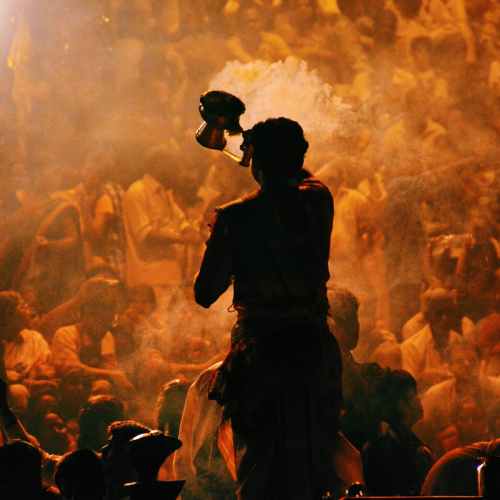
Smudge the whole cosmos, if necessary
Greer outlines practices for those interested in exploring a “Gnostic, Universalist, and Pelagian” Druidry. The ceremonies, rituals and meditations include the Hermitage of the Heart, the Sphere of Protection, the Calling of the Elements, the Sphere of Light, a Solitary Grove Ceremony (all but the first deriving from Druid AODA practice), and a Communion Ceremony that ritualizes the “Doctrine of the One”:
I now invoke the mystery of communion, that common unity that unites all beings throughout the worlds. All beings spring from the One; by One are they sustained, and in One do they find their rest. One the hidden glory rising through the realms of Abred; One the manifest glory rejoicing in the realms of Gwynfydd; One the unsearchable glory beyond all created being in Ceugant; and these three are resumed in One. (Extend your hands over the altar in blessing. Say …)
If you tried out Greer’s prayer above, who or what did you bless? If you didn’t, why not try it now? Say the words aloud …
Looking for a short form? Abred (AH-bred), Gwynfydd (GWEEN-veeth), Ceugant (KAY-gant).
/|\ /|\ /|\
I’ve looked before at these lovely Welsh names for the levels of being according to Celtic lore:
With the love of triads and threes that marks so much of Celtic art and story, it’s no surprise that the Celtic conception of our spiritual journeys should mirror this same triplicity. From the starting point of Annwn, the Celtic Otherworld, we move forth and back through three states of manifestation and consciousness, in a kind of dance that sees us revisiting old lessons until we’ve fully mastered the material, spiralling through different forms and perspectives.
Most of us hang out for a considerable time in this present world of Abred, this place of testing and proving. From here we proceed to Gwynfyd, a world of liberty and freedom beyond the pale shadows of these forces in our present world. Back and forth between Abred and Gwynfyd, with dips into Annwn here and there. And last comes Ceugant, an unbounded, infinite realm. By definition, no end point, but a new beginning. The horizon recedes.
/|\ /|\ /|\
And lest someone coming to the beginnings of Druid-Christian practice from the Christian side wonders how to begin with all of this stuff, consider this.
Nicholas Whitehead opens his curious book Patterns in Magical Christianity like this:
Christianity is a magical religion. This is not so controversial a statement as some might think. For all religious traditions are potentially magical by the simple fact that they embody or employ symbols, myths and rites that are mediatory, that intend or enable the translation of spiritual energies between levels of reality (pg. 13).
The author outlines a set of characteristics of such magical symbols, noting they
- “are inherently appropriate”. He gives the example of a plant, with roots in earth, flower in the air, and “within its stem the life bearing sap rises and falls. Because of its intrinsic structure, the plant is a symbol for the ideal spiritual life … we live upon the earth, with our roots within the land. We are nurtured by the soil in which we live. Yet, without losing our connection to it, it is our destiny to rise above the land, to flower in the crowning glory of the light … Again note that we cannot make the plant into a symbol. It is simply is a magical symbol by virtue of its inherent structure and its role in the rhythmic life of the cosmos”.
- “always participate in a greater reality”.
- “enable the translation of energies between levels of reality”.
- “are trans-rational”.
- “are polyvalent”.
- “tend to assemble in groups” (pg. 16).
Of course there’s a tremendous amount to unpack here — which is why it takes Whitehead a book to do so, along with a set of exercises he has developed in a workshop in order to put these precepts to the experimental test. Rather than debate them, which is a head trip I (mostly) don’t plan to take, they’re worth simply trying out, just as one would test the statement that water freezes at a certain temperature, rather than debating whether the claim is true. Of course adding salt, raising a wind over the surface, setting the container in a vacuum, and so on, all change the experimental parameters.
In the same way, my beliefs, intention, mindset when I experiment, past experiences, and spiritual awareness will all figure quite largely in any results I achieve. I’ve found I’m more interested in learning how certain things are valid or operational for me. That is, do they help me get somewhere worth reaching? Otherwise, an inner nudge or whisper usually alerts me: Move along — these aren’t the droids you’re looking for. Later I can play the thought and reason game for what it’s worth. Sometimes a lot, sometimes quite little.
/|\ /|\ /|\
IMAGES: Pexels.com
Greer, John Michael. The Gnostic Celtic Church: A Manual and Book of Liturgy. Everett, WA: Starseed Publications (Kindle)/Lorian Press (paper), 2013.
Whitehead, Nicholas. Patterns in Magical Christianity. Sunchalice Books, 1996. (More recent editions exist, though I haven’t yet been able to find one.)
Ritual, remarks British Druid and author Emma Restall Orr,
is the process of taking time out of the rush of life in order to remember what is sacred, that when we return to the road we do so with a soul once again open to inspiration and creativity. How we do it – and how long it takes – to be effective depends on how scattered by distraction and tangled in need we are. It can be as simple as pausing, breathing deeply, acknowledging the gift of life, the land beneath, the sky above. It can take weeks of preparation, days of fasting, hours of concentration, to fall into the moment of realization about how we can live awake and with honour, not just believing nature is sacred, but unconditionally treating her as such.

ritual bathing
Judging by the continuing readership for a group of posts here on Druidry and Christianity, the vital possibilities of such a concord live still for you as much as they do for me. They branch and grow, and rich fruit hangs from their boughs.
Our instincts aren’t wrong. The two traditions are twinned in ways we may never untangle, but we can explore what they can contribute to each other right now. One way to do that — certainly not the only way* — is through ritual.
Already we hold hints and fragments in our hands. In the Christian Bible, Luke relates the experiences of a rich man, the chief tax collector Zacchaeus. “And he was seeking to see who Jesus was, but on account of the crowd he could not, because he was small in stature. So he ran on ahead and climbed up into a sycamore tree to see him, for he was about to pass that way” (Lk. 19-3-4). Sometimes we need to shift perspective, to climb out of our lives to see them more clearly.
Later in the same chapter, (Lk. 19:37-40), the followers of Jesus are overcome with joy and are peacefully celebrating. But their exuberance apparently touches a nerve — it seems excessive and undignified to the Pharisees, among the Powers-That-Be of the day:
And some of the Pharisees in the crowd said to him [Jesus], “Teacher, rebuke your disciples.” He answered, “I tell you, if these were silent, the very stones would cry out.”
Have we not all felt such joy, that the stuffy, fearful, joyless ones around us want to rebuke us for our happiness?!
/|\ /|\ /|\

[The rite begins. Parts not yet assigned.]
Let the Great Gates open. For we hear voices crying in the wilderness … (1)
Climb your own sycamore! What will you ever see until you do?!
The stones are crying out at our silence (2).
If our houses of prayer and celebration have become dens for thieves, then it is meet and fitting that we repair to the green places of old (3).
For the Wise have counselled us, “Stand at the crossroads and look; ask for the ancient paths, ask where the good way is, and walk in it, and you will find rest for your souls” (4).
Our teachers are at hand: “Ask the beasts, and they will teach you; the birds of the heavens, and they will tell you, or the bushes of the earth, and they will teach you; and the fish of the sea will declare to you” (5).
Let our prayers rise like incense (6), born of earth, moistened in its making, lit by fire, wafting through air.
“They have dressed the wounds of our people with scant care, saying, ‘Peace, peace,’ when there is no peace at all” (7).
We will answer the call to peace, and serve. Let us give peace now to the quarters, and renew the Great Work again …
“May the blessing of the Uncreated One, of the Created Word and of the Spirit that is the Inspirer be always with us. May the world be filled with harmony and Light” (8).
/|\ /|\ /|\
Some readers, writes Philip Carr-Gomm in his foreword to Nuinn’s Book of Druidry,
might be pleased to learn of such a dialogue between Druidry and Christianity, particularly when it results in specific action being taken to initiate a new impulse within the Christian movement. Others might be disappointed, hoping Druidry was exclusively ‘pagan’. But Druidry is a way of working with the natural world, and is not a dogma or religion … Druidry honours, above all, the freedom of the individual to follow his own path through life, offering only guides and suggestions, schemes of understanding, methods of celebration and mythical ideas — which can be used or not as the practitioner sees fit (pg. 14).
Rev. Alistair Bate, author of the OBOD website article “Reflections on Druidic Christology“, comments from a sensitivity to the contact points of the two traditions:
A more orthodox rendering of Chief Nuinn’s triadic formula might be “May the blessing of the Uncreated One, of the Creative Word and of the Spirit that is the Inspirer be always with us”. This, I believe, would not only be more truly in tune with the bardic experience, but would also resonate with the Om/Creation idea found in the Hindu tradition. As we envision Awen, the primordial sound, echoing out of the void, we connect with our own creative inspiration as part of that first creative Word, which is in Christian terms, at once Christ and his Spirit.
And with greater enthusiasm, perhaps, than comparative or historical theological accuracy, Bate concludes his article, summoning to his aid the words of probably the single most influential Christian thinker and writer:
In the 4th century St Augustine declared, “That which is called the Christian Religion existed among the Ancients, and never did not exist, from the beginning of the Human Race until Christ came in the flesh, at which time true religion, which already existed began to be called Christianity”. That the religion of our most ancient ancestors is in essence very similar to that of our more recent ancestors is the conviction that keeps some of us simultaneously both Druid and Christian.
And as many others have long noted, the Galilean master is at his most Druidic when he speaks with images of the natural cycle of things:
Truly, I tell you, unless a kernel of wheat falls to the ground and dies, it remains only a seed; but if it dies, it bears much fruit (John 12:24).
An extensive Druid-Christian liturgy could be written with just the nature images that pervade Christian and Jewish scripture.
/|\ /|\ /|\
IMAGES: Pexels.com
*Other practices one could initiate, as Emma Orr notes above, might be “as simple as pausing, breathing deeply, acknowledging the gift of life, the land beneath, the sky above”. Or correspondingly complex, and “take weeks of preparation, days of fasting, hours of concentration, to fall into the moment of realization about how we can live awake and with honour …” We decide what it is we need, rather than any authority over us. And often the best decisions arise from experimentation, and from an openness to trying something new.
1. Matt 3:3, Mark 1:3, Luke 3:4, John 1:23.
2. Luke 19:40.
3. Mark 11:17.
4. Jeremiah 6:16.
5. Job 12:8.
6. Psalm 141:2.
7. Jeremiah 8:11.
8. Closing of OBOD ritual.
John Beckett (6 January 2019) writes:
A ritual is a series of interrelated actions designed to accomplish a spiritual goal. It may be a celebration, but it’s more than a party. It may honor certain spiritual persons, but it’s more than singing praises. It may work magic, but it’s more than a spell.
Couple this succinct overview of ritual with OBOD founder Ross Nichols’ “Ritual is poetry in the world of acts” and you’ve got a fair bit to go on, if you want to do some rummaging about in ritual spaces and energies.

Ross Nichols leading a procession of the Cornish Gorseth in the 1970s. Wikipedia Creative commons.
For starters, form matters. What makes a lively seasonal festival ritual more than a party? After all, some parties also have a form. If it’s a birthday, maybe there’s a welcome period for everyone to assemble, settle in and get something to drink. Then food — a buffet or even a formal sit-down meal — followed by presents, and then games, or dancing, or some other group activity. Or maybe the whole evening is food, mingling and music, with presents dropped off on a designated table. There may be formal start and ending times, or apart from one announced activity — often, the food — there’s no set beginning or close. “Show up when you can”. Still, people often know what “birthday party” typically means. There’s some kind of loose format in most people’s expectations, unless the invitation says otherwise.
If a ritual has assigned roles, it can begin when all the participants have assembled. Beckett talks about how ritual ideally doesn’t have an “audience”. While it’s a performance, no one should be so detached as to be merely a spectator. At our most recent Vermont OBOD seed group celebration of Winter Solstice, we held a ritual “post-mortem” discussion as some dishes for our potluck dinner were warming in the oven. With just enough members attending that foggy evening to carry out the ritual-as-written, it’s true each of us “had a part”. But more importantly, as one member observed afterward, it’s what we do with and for other participants during the ritual that makes the difference. “I support them”, she said. While one person is assigned to speak the words that “call North”, for instance, everyone else can do so, too. Add your intention. Feel the direction. Visualize, sense it on your skin. Imagine the participant serving as North to be garbed appropriately for the direction, crowned and armed with symbols of earth. In fact, if we expect North or any of the other directions to manifest and be a palpable presence, just such group energy and support are essential. Otherwise, what are we doing calling the directions?
I’ve queried the opening words of the standard OBOD ritual format before, in previous posts. “By the power of star and stone, by the power of the land within and without, by all that is fair and free, welcome to this Rite of …” Lovely, but what IS “the power of star and stone”? And if I don’t know, then how do I know I want to call on it, invoke it, welcome the assembled group with and by it? Is it the same as “the power of the land within and without”? Do either of these have anything to add to our rite?
Or let’s say I chose to forego seeking and supplying a merely intellectual equation: “power of land = X”. I let the words move me wherever and however they’re meant to, trusting the ritual and relying on our group’s reverent and “heart-ful” performing of it to answer such questions in due time, if at all. Let the intention and the energy of the assembled members carry me over any rough spots, and all will be well. OK, but then how do I support the herald who proclaims these opening words, if I don’t know what I’m supposed to be doing? If we all imagine different things on hearing the words, we generate a diffuse generic energy (or nothing much at all) that may not come anywhere near to what the “power of star and stone” could do, if we knew what we were about.
Mean clearly, and you can carry people with you.
O Romeo, Romeo, wherefore art thou Romeo?
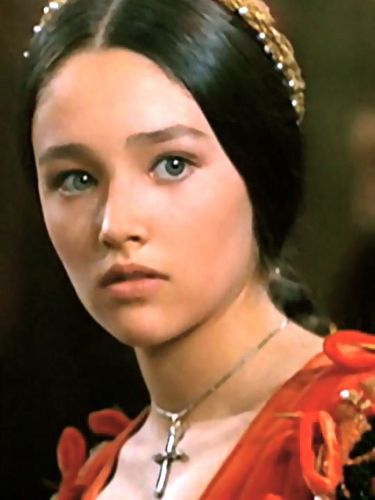
Olivia Hussey as Juliet in Franco Zeffirelli’s 1968 film version of the play.
Listen to an informed performance of Romeo and Juliet and when Juliet says these words, it’s the third “Romeo” that she stresses: “O, why do you have to be Romeo? Any other name would be fine. But no: you turn out to belong to my family’s enemies!” If you don’t know what you’re saying, you can’t mean what you need to mean. The words won’t mean what they could. Understand what Juliet says, and her next lines make perfect sense:
Deny thy father and refuse thy name
Or if thou wilt not, be but sworn my love,
And I’ll no longer be a Capulet.
‘Tis but thy name that is my enemy …

Dionysus in ’69. Photo by Brett Brookshire.
Because drama is a component of ritual, films and plays have something to teach us about owning the words and actions of ritual in deep and creative ways. Ancient Greek drama was sacred to Dionysus. In Athens, no weapons were allowed in the theater precinct during the Dionysia Festival of tragedies and comedies. The ritual of theater was an act of worship, a sacred thing dedicated to the god.
Serious about addressing ritual glitches, the crew of MAGUS ’17 asked participants to memorize their parts. Come ready to speak with intention, since you won’t need a piece of paper in front of you. Improvise, once you know the energy of the traditional words. Call North, and let us hear and feel North. I was North, a small but important part. I did call North, with original words and images I’d been composing orally — I felt their power myself — then flubbed a short line North says a page or two later that I couldn’t remember and couldn’t for the life of me find, for an ungodly amount of time, as I pawed through the printed ritual in my hand. Ritual flow broken, I finally found my place and shamefacedly read off my line.
Fortunately, Druids are forgiving folks. It both did and didn’t matter. Ritual isn’t made or marred by a single person. Smiles and laughter heal many a weak line reading, dropped candle, overenthusiastic blessing with water. It took time before I could laugh, because I was so annoyed at myself — all the more reason I needed to.
Contrast this with my Ovate self-initiation: my wife away for the weekend, all lights in the house extinguished except for a single small candle. I sit on the floor in a dim and flickering circle of light, words of the open and closing ritual at hand, but foremost in my awareness a dedication I speak as the words come to me, along with a palpable sense of witnesses around me as I proceed. The ritual pacing my pace, the words my words, the experience my own and that of those who, I sense, share it with me. Powerful, personal, memorable, unscripted at its peak, and especially potent for that reason.
The two poles of ritual? Both valid, necessary — and each distinct.
/|\ /|\ /|\
Images: Ross Nichols; Juliet; Dionysus in 69.
… that you can give to yourself and others. Many of these are simple, elemental — as they can and may be, needing nothing beyond what we have already. If not one flame coming as a gift, then welcome another. Try one a day for all 13, or choose one or more according to a rhythm that makes sense to you. If a nudge should come to try something else, ah, nurture it for what it can be. Flame sparks flame, light reflects light.
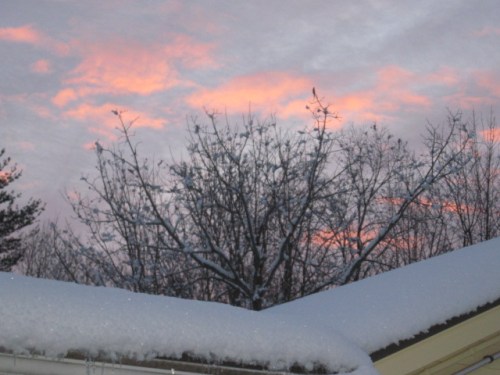
recent mid-December dawn over our roof
Silence. What needs stillness? Find even a brief moment where you can give yourself quiet, if not silence. What flows from that interval? The flame of silence flares when we tend it, and dies back down to embers when we turn up our internal and external volumes. There’s healing in stillness, often because we can finally hear what we’ve been missing, as well as what we can give that we overlooked. Stillness brings a kind of space and light all its own.
Sound. What needs a voice? Music, the human voice, instruments, a happy dog barking, a cat purring, a child’s laughter. These too are gifts to cherish and celebrate. What do I have that I can say, what can I contribute to the conversation? What can I start (or continue) saying that I haven’t said before? What other voices can I listen to and help be heard?
Light. What needs illumination? The Festival of the Returning Sun that is Solstice means the days will begin to grow longer again after this Saturday. We may notice the lengthening more in mid-January, at least in the Northeastern U.S., with the cold, clear days that bespeak deep winter. What’s lighting up for me now? What can I help light up for others?
Ritual. What needs to be celebrated and made more conscious in my life? The smallest things may be asking and answering. Lighting a candle, or a fire. Bathing in a tub for a change, instead of showering (go all out with candles — or bathe in the light of a single flame). Sharing a meal. Watching a video together. Singing a favorite song. Wandering somewhere, off the clock, without a destination.
Kindling. What needs to catch fire? Think kindling as both the action and the materials for it. Go wide — be metaphorical, too. In addition to paper and twigs, think art of all kinds. Sketchbooks, fine paper and pens, glorious fabrics, seed catalogs. Parts, supplies, cleared spaces for projects. Plans, hopes, dreams.
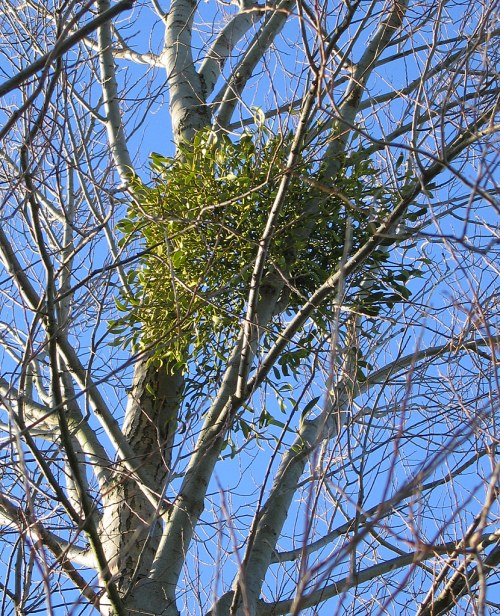
Mistletoe in silver birch. Photo courtesy Chris Miksic.
Prayer. What needs asking and acknowledgement? Wordless is fine. Asking is a good part of prayer, and there are many other prayers. Gratitude is powerful prayer. Linked with silence, it can become a dedicated daily practice. Or try out words. “Let my prayer rise like incense” says Psalm 141: “… the lifting up of my hands like evening sacrifice”. Find a verse or lyric, song or poem and let it be your prayer. Listen for the prompts everywhere: other people’s words, advertising jingles, casual remarks, a headline, a child’s question, the wordless eyes of animals, the “slow gestures of trees”, as UK LeGuin called them.
Service. What and who do I serve already? Can I build on that? Where are new forms of service looking for me? Who is serving me already that I can acknowledge? I start small, and the list grows. Dropping off a meal to a shut-in. Shoveling a driveway. Serving myself, saying “no” when I need time and space.
Change. What can I help be born? What is seeking to emerge? How can I help shape it? What can I let go of in my life, so that a new thing can find birth? What can I welcome that’s arriving?
Contact. What needs touching? Is it me? What can I invite to touch me? If I don’t have human presences, are there animals who enjoy touching and be touched? What can I bring into connection that’s separate right now? What parts of my life deserve to meet each other, and would flourish if they did?
Reading. What deserves my attention? It may be an actual book, of course, a collection of poems on my altar, or a beloved book from childhood that I can make a ritual of re-reading myself, or sharing with others. (And dogs and cats can make good listeners for this, too.) It may be things I’ve been noticing in my life. What am I reading in my life, in others’ lives, in the world, in my dreams, that wishes to offer guidance?
Memory. What can I recall? What deserves forgetting, letting go? What can I bless, regardless of where it’s going? What scrapbooks, physical or inward, do I turn over, or revisit? What does memory offer that I can enrich my life with today? Sorting the mix we all have, setting aside some images (burning them?), while keeping others, blessing all, a second time. And a third. What can I add to my store of memory? What memories deserve sharing with others? What memories do others have that also touch on my life? What memories can I honor that have little or nothing to do with me? What memories does this elm have, that hickory? Let me honor them.
Nourishment. What needs feeding? Is it for me to feed them, or for someone else? How have I been fed? What forms of nourishment can I bring into my life? What am I bringing in already? What forms can I share with others? What prayer of gratitude can I say, acknowledging those gone, those still here, for feeding things in me that might never have survived without their help?
Freedom. What needs to run free? What do I hold on to that would make both of us happier if I let go? What can I welcome that comes to me freely, unbidden, unlooked-for? What symbols of freedom speak to me that I can bring into my attention, my spaces, as reminders and for my growth?
As Mary Oliver exclaims in one of her poems, “so many questions more beautiful than answers”.
/|\ /|\ /|\
[Part One | Part Two]
If you’ve ever planned for the future, you’ve practiced a form of magic. Wait a minute, you say. That’s not magic.
Sure it is. You have an intention or goal, and you imagine it, seeing, hearing, feeling, tasting it in ways that seem so ordinary and commonplace we mostly pay no attention to the marvel of what we’re doing. Only when we find ourselves saying “But it didn’t turn out like I thought it would!” do we encounter a mismatch between the picture we painted and carried around with us, and the reality as it finally manifested. Obviously we held a pattern, image, blueprint, plan, etc. in our awareness. It took a few side-roads on the way to appearing here, where we can see and interact with it. No matter. More than before. Do it differently. Revise, modify, experiment.
I may be a visual person, or an auditory or a kinesthetic one, or some other kind of perceiver and manifester, by predilection and experience, that doesn’t have a ready label. Further, the event I manifested may or may not match what I expected or hoped, but it did manifest — as it never would have, if I hadn’t set it in motion in the first place. “As above, so below” — in this case, the above was my plan, and the below was the physical form it took. Schools that could teach us how to get better at this ability instead teach almost everything else but that. Often that’s because the teachers themselves have had the ability taught right out of ’em.
Plenty of folks would like to deny us recognition and use of this basic ability altogether, because it’s the key to freedoms and joys of many kinds, and so it cuts into their power plays. Our politicians insist that only they can fix what’s ailing the town, province or planet, our partners insist they’re essential to our happiness (or we are, to theirs). Priests, pastors and imams would prefer we not discover how independent of them we actually can be, so the ability gets labeled evil, sinful, diabolical, dangerous, forbidden, and any other convenient and manipulative name, even though every one of us alive uses it daily in its simplest forms. But the more advanced levels in particular, the ones that grant larger abilities to change and grow, are naturally more dangerous to the stable order of things, and to those who ardently desire to profit from “the way things are”.
That’s one reason fear is such a popular tool for control, and so widespread today. Keep people ignorant and afraid, keep them from using or even knowing the potentials of their own ability, keep them dependent on a big mommy or daddy for a pitiful, reduced version of life, liberty and the pursuit of happiness, and you’re halfway home to power — of a sort.
Cover up the push into ignorance and dependency with a skillful blend of threats and promises, of magicking up a useful opponent to take the fall, the blame, the consequences of the fear you’ve sown in people’s hearts and minds — and there are so many opponents ready to hand — to distract people from what you’re doing to them, and you’re home free.
If you can attack the very freedom you’re taking away as the cause of the troubles the people face, you’ve graduated to “excellent dictator” status. Congratulations! You’ve mastered one form of debased magic, depriving other people of their birthright. No need to argue whether it’s successful — just look at today’s headlines.
If such low and often negative magic can accomplish so much, what of more positive varieties?
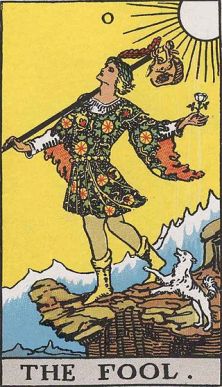 Experiment with learning more about your animal familiar — an ancient and worldwide practice. Animal guardians and teachers abound in myth, legend and folktale for good reason. Many of us know instinctively why we keep pets, and every year we learn more about the health benefits and remarkable abilities domesticated animals bring into our lives. The tarot Fool sets out on the long journey toward wisdom already accompanied by an animal. Who are your companions and what can they teach you?
Formal study and practice of traditional magic may not be for you, temperamentally or practically. But if you decorate your living space with harmonious colors, bringing in plants and pictures that uplift you and establish an oasis of harmony and balance, you’ve magicked your dwelling to aid you in daily life. Or look at your musical tastes and contemplate the harmonics of sound that feed and nourish you. Investigate the effects and use of song, chant, rhythm, pitch, etc. Drums, bells, musical instruments of many kinds can assist you in sound magic. Again, many religious and spiritual traditions speak to the power of the word, voice, sound of creation, music of the spheres, names of gods and angels, etc. Long human wisdom testifies to the potency of sound magic.
Dream work can help put us in touch with levels of experience and consciousness beyond the daily news awareness that can seem like all there is. Plenty of resources exist for studying dreams, recording them, analyzing them, and learning from what they have to teach us. And inspire us. Work on anything that asks you for creativity, and if you focus long enough, the work will follow you into dream. Write, and your characters will begin to talk to you. Paint seriously, and you’ll eventually see patterns, colors, worlds of beauty inwardly nearly impossible to render with earth tones and hues. Garden, and you may be led to plantings and pairings you hadn’t anticipated, or to resources to help you and your plants flourish. Many gardeners know how restorative the work can be. And so with many professions and occupations. It’s hard in fact to think of one that lies outside the purview of dream power and exploration.

Rachel Pollack
The Tarot is a course of magical (and life) instruction all by itself. Find a good overview or book of practical exercises. Two texts I can recommend from long work with them are 78 Degrees of Wisdom by Rachel Pollack and 21 Ways to Read a Tarot Card by Mary Greer. They pair well together, these masterworks by acknowledged masters of the Tarot, complementing each other’s perspectives. When I just checked a few minutes ago, both were available used for $8 or less. Rachel Pollack’s pocket admonition: “To learn to play seriously is one of the great secrets of spiritual exploration”.
Another excellent and quite painless way to acquire a set of vantage points for a magical understanding is to immerse yourself in fantasy and mythology, while practicing visualizations and ritual work with the archetypes present in the latter in particular. Fantasy propels us into alternate realities through the written word, already a magical act. Add the further dimensions that film affords, combining sound and color and embodiment by (usually) skilled actors, and you expand the experience into one quite close to ritual. It’s no surprise that the magical and visionary arts have enjoyed a resurgence in the last century, when we have such preliminary training on hand in these popular forms.
To sum up, then, magic is our birthright, something we practice already, and can explore and refine, like any talent. We shift states of consciousness every day, and what we can’t do in one state, we can often do easily in another. The methods and techniques for shifting, because they bring us to face locks on consciousness, as the previous post indicated, allow us to begin to circumvent, break down or dissolve these impediments.
Then we begin to discover that there are many worlds, and at the same time we discover how to gain access to them, since we intermittently inhabit them already, in moments of heightened experience, in grief, joy, love, exaltation, intense focus and creativity. Each of us is and has a doorway, eventually multiple ones, that we can activate to explore and grow and delight in. And it is there that we meet and shape and begin to fulfill our destinies.
/|\ /|\ /|\
[Part One | Part Two]
In a recent comment, Steve writes:
A broader definition of magic sounds interesting, especially when compared with some of the ideas about it I have encountered over the years.
Do you have a working definition you could share or is this something you have developed in your blog?
I do have a working definition of magic, and I’ve also written about it in various forms fairly frequently, though not always under that label. But it’s good to regularly take out opinions and understandings, dust them off, rattle them, note what shakes free, scrape off the rust, and buff and polish the rest. So with the spur that Steve’s comment provides, that’s what I’ll do in this post.
Yevgeny Zamyatin / Wikipedia / public domain
Our definitions come, mostly, after experiences. Before that, we don’t have much to attach them to, and if anyone who’s reading this is anything like me, your definitions at that point may not match things that you later DO experience. So then we get mired in the mismatch, rather than referring back to the original experience. Or — even better than looking backward — experiencing more, other, wilder. So I open up once again a page where I can re-read irascible old revolutionary Yevgeny Zamyatin (1884-1937), whose essay “On Literature, Revolution, Entropy, and Other Matters” reminds me: “Dealing with answered questions is the privilege of brains constructed like a cow’s stomach, which, as we know, is built to digest cud”.
“Privilege”? Tired of a too-steady diet of cud, I aim to forage more widely.
So I’ll begin by asserting we all practice magic, and work outward from there, using this as a core assumption and seeing how it holds up. We do much of our magic half-consciously, so that we often don’t perceive the patterns, causes and effects of what we set in motion as clearly as we might. After all, like most of us, I insist on who I am: in my case, straight, white, male, employed, married, healthy, intelligent, rational. But when even one of these breaks down, as every one of them has for at least some of us over a lifetime, my world trembles violently, even if it doesn’t collapse outright, and I scurry and latch on to explanations for what’s going on.
Isn’t such an interval about the least likely time for any of us to notice the patterns, causes and effects of what we’ve set in motion? And even if and when we do, we tend to account for them only with naturalistic explanations (Pagans may add supernatural but not necessarily more accurate ones), including blaming other people, fatigue, stress, illness, the government, conspiracies, the Man, our reptilian overlords, a loveless marriage, plain bad luck, and so on, forgetting how much even of our conscious experience at the very moment of our explaining has been programmed by education, habit, expectation, culture, practice, a “reasonable explanation”, and a simple, overriding human desire not … to … be … weird.

But … magic?!
At the heart of this often-inaccurate accounting is a precept that disturbs and offends Westerners in particular, taught as we are that we are free and independent beings, with wills and choices subject to our conscious attention. We are not so free after all, but if we can’t even examine this assertion in the first place, what are we to do? If we all practice magic, as I claim, we all need to, because as musician and mage R. J. Stewart observes:
With each phase of culture in history, the locks upon our consciousness have changed their form or expression, but in essence remain the same. Certain locks are contrived from willed patterns of suppression, control, propaganda, sexual stereotyping, religious dogma; these combine with and reinforce the old familiar locks restraining individual awareness; laziness, greed, self-interest, and, most pernicious of all, willful ignorance. This last negative quality is the most difficult of all to transform into a positive; if we truly will ourselves to be ignorant, and most of us do in ways ranging from the most trivial to the most appallingly irresponsible and culpable, then the transformation comes only through bitter experience. It may seem to be hardship imposed from without, almost at random, but magical tradition suggests that it flows from our own deepest levels of energy, which, denied valid expression by the locks upon our consciousness, find an outlet through exterior cause and effect (Stewart, Living Magical Arts, pg. 20-21).
“[D]enied valid expression by the locks upon our consciousness”: we might think such a “locked-up” person simply needs re-education, or better training, maybe positive reinforcement, a decent opportunity. (I note here that it’s almost always some other person who’s the problem, or needs the help — never me. After all, I’m awake and in charge of my life.) This is also where we get much of the American program of self-improvement, “pulling ourselves up by our own bootstraps”, as it used to be called. Those who can afford it try therapy, or weekend retreats and workshops. Those who can’t may rely on pharmaceuticals or liquor or increasingly available weed. As the evidence mounts, as the growing dysfunction, suffering, addiction, unhappiness and all-around misery attest, something’s not working.
So why magic, of all things? Surely any number of other options would be preferable to something so half-baked, superstitious, irrational, etc., etc. — the list of slanders, some of them justified by pernicious snake-oil salesmen, is long.
J. M. Greer, ecologist, blogger, conservationist and mage, puts it this way:
[t]he tools of magic are useful because most of the factors that shape human awareness are not immediately accessible to the conscious mind; they operate at levels below the one where our ordinary thinking, feeling, and willing take place. The mystery schools have long taught that consciousness has a surface and a depth. The surface is accessible to each of us, but the depth is not. To cause lasting changes in consciousness that can have magical effects on one’s own life and that of others, the depth must be reached, and to reach down past the surface, ordinary thinking and willing are not enough (J. M. Greer, Mystery Teachings from the Living Earth, Weiser Books, 2012, pg. 88).
To put it another way, in what is not a particularly poetic magical Druid triad: Magic stems from an experiential fact, an experimental goal, and an endlessly adaptable technique.
The fact is that each day we all experience many differing states of consciousness, moving from deep sleep to REM sleep to dream to waking, to daydream, to focused awareness and back again. We make these transitions naturally and usually effortlessly. They serve different purposes, and what we cannot do in one state, we can often do easily in another. The flying dream is not the focus on making a hole in one, nor is it the light trance of daydream, nor the careful math calculation. What we do mechanically and often without awareness, we can learn to do consciously.
The goal of magic is transformation – to enter focused states of awareness at will and through them to achieve insight and change. Often, for me anyway, this is nothing more mysterious than moving out of a negative, depressed or angry headspace at will into a more free, imaginative one, where I can problem-solve much more effectively, and also be much more pleasant to be around. Or so my wife tells me.
“The major premise of magic,” says R. J. Stewart, “is that there are many worlds, and that the transformations which occur within the magician enable him or her to gain access to these worlds” (R. J. Stewart, Living Magical Arts, pg. 7).
The technique — a cluster, really, of practices and techniques — is the training and work of the imagination. This work typically involves the use of one or more of the following: ritual, meditation, chant, visualization, concentration, props, images and group dynamics to catalyze transformations in awareness. “… [O]ur imagination is our powerhouse …” says Stewart. “… certain images tap into the deeper levels of imaginative force within us; when these are combined with archetypal patterns they may have a permanent transformative effect”.
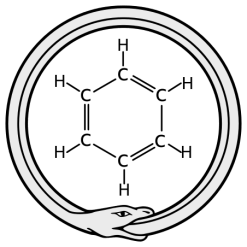 Even mundanely, golfers visualize a hole in one, carpenters see the finished design long before it emerges from the blueprint, chemists rely as much on inspiration as any artist for discoveries like that of August Kekule, who dreamt of the structure of the benzene ring via the archetypical image of a snake swallowing its tail.
Furnish the imagination with the food it needs, and it can be a powerful tool and guide. Abandon it to others who do not know us, nor have our best interests at heart, and we cast away our birthright.
PART TWO — Applications — coming soon.
/|\ /|\ /|\
NOTE: Normally I steer clear of politics, not because current events are insignificant, but because too often they’re already sufficiently chaotic and jangling in themselves to sway us from a focus on things of our own wiser choosing — things we need to hold in our loving attention, if we’re to transform ourselves first. This is indeed the only method I’ve found, over decades of living, to effect lasting and positive change in anything else. Of course, your mileage may vary.
In addition, often we know more down the road from an incident. Immediate commentary is frequently premature: we simply don’t have the overview and detail we need to make an informed assessment. Yes, we have freedom of opinion; no, not all opinions are equal — like everyone else, I’m free to be an idiot, or to act with discipline, love and wisdom. (Most of the time I arrive somewhere in between.) Political and cultural analysis isn’t my forte.
A year from now, it’s guaranteed some other event will have kindled outrage in at least some quarters.
However, silence can be assent. So if I raise an issue, you’ll know what you want to do with it.
With that said, therefore, if you’re seeking upbeat post-Thanksgiving reading, you won’t find it in this post. Instead, save it for some other time, or not all. OK — you’ve been warned.
/|\ /|\ /|\
British author and religious scholar Ronald Hutton, no stranger in Pagan circles, sets forth an admirable and down-to-earth “mission statement” for Pagan groups. In a December 2016 interview called “Reframing Modern Paganism” with Pagan Dawn magazine, Hutton observes,
For those in traditions which stress group work, training, initiating, supporting and coordinating is vital. The end product should be people who are decent to others in the group, as to humans in general, good communicators and effective ritualists, loyal to their fellow initiates and their tradition. They are the best advertisements for that tradition. Any Pagan who wins the respect of non-Pagan neighbours and fellows in a workplace, as a person, and then informs them of her or his beliefs, is doing invaluable work to gain regard for those beliefs.
While Paganism and Druidry certainly have their share of colorful characters who often seem at least subconsciously to resist any movement towards normalization, Hutton adds:
Pagans don’t squabble as much now as they used to do, at least in Britain. In my opinion Doreen Valiente – with whom I had a very strong mutual respect and affection – got it right at the beginning, in the 1950s, by recommending that Pagans spread knowledge of their tradition by writing attractive books about it (nowadays, we would add websites and social media), avoiding journalists and publicity stunts. Also important is a sustained, effective Pagan presence at interfaith meetings, cultural events and demonstrations concerning environmental issues.
/|\ /|\ /|\
The wise counsel Hutton gives above unfortunately flatlines in the face of events like the Saturday, October 20 hexing of U.S. Supreme Court judge Brett Kavanaugh in a Brooklyn bookstore. Whatever our politics, we cannot honestly characterize this as a “sustained, effective Pagan presence”.
Event organizer Dakota Bracciale told Newsweek, “If [the hex] causes suffering and harm and trouble and chaos and mayhem for anyone in the GOP, I’m happy”.
The hex, according to another article in the Independent, was “livestreamed on Facebook and Instagram on Saturday” October 20.
Huffington Post notes, “Kavanaugh will apparently be a focal point for the hex, but not the only target. The public hex is meant to exact revenge on ‘all rapists and the patriarchy at large which emboldens, rewards and protects them,’ a Facebook page dedicated to the event states”.
Part of the ritual intent was to provoke and anger those on the right. The brief flurry of sensationalistic reporting from a number of news outlets made this possibly the most successful aspect of the ritual.
Bracciale conceded, “I don’t for a second shelter a hope within me that he [Kavanaugh] would ever have some change of heart and become a human being”.
In what must be one of the more remarkable assertions of brash naivete and dubious publicity, “If you put it out there, then it’ll happen”, another participant said. “If you watch Oprah, then you know how to do witchcraft”.
Bracciale apparently proclaimed at one point during the ritual, “I will have my justice even if I have to face your jealous God, look Him in his eye and walk backward into Hell”.
The Mercury News recounts how San Jose exorcist and Catholic priest Fr. Gary Thomas offered masses to counter-act the hex. “This is a conjuring of evil — not about free speech”, noted Father Thomas.
Protestors outside the bookstore offered prayers and chants during the ritual. Presumably that also qualifies as “putting it out there” — the fighting of “ritual fire” with fire.
Reuters provided the most nuanced and objective comment:
The planned casting of an anti-Kavanaugh spell, one of the more striking instances of politically disgruntled Americans turning to the supernatural when frustrated by democracy, has drawn backlash from some Christian groups but support from like-minded witch covens.
By the sound of most reports, we can probably call the whole thing a draw. Like two competing cheer squads at an athletic event, whoever offers up more energy may help tip the scales slightly one way or the other, though usually without supplying a defining element of victory or defeat. Strength of intent, however, doesn’t equate to “justice”, or this would be a very different world.
/|\ /|\ /|\
Bracciale reportedly announced a secondary goal for the event: “If [attendees] come in beat up and leave with a renewed hope and a fire in their belly then I’ll know I did my job”.
Though it mostly got lost in the psychic noise around the event, here is a much more positive ritual goal anyone can set for themselves. Rituals that purge us of unproductive emotion have their place, freeing us for more clearly-defined action that can make a bigger difference. As a small example, after my first serious girlfriend broke up with me when I was in my twenties, I burned her picture — a common ritual many do at some point — and dumped a lot of anger into the flames, because I no longer wanted it. I certainly felt better afterward. With much of my anger out of the way, within a year I was freer to move into a relationship that has become a successful marriage.
If such uplift comes at cost to another, I need to examine my motives and priorities. Given the nature of magic, with dark workings any spear I choose to cast must pass through me first to reach and harm my enemy. That’s a cost few sane people are willing to pay. The mixed motives, ritual targets, sensationalism, scattering of focus, and admission of larger defeat permeating this recent hexing ritual simply do not model either best practices or beneficial outcomes for the greater good. We can understand and stand witness to the anger, bitterness and frustration of the hexing ritual participants without copying their methods.
We can do better.
Mending human relations has become even more challenging, and hence more necessary, at present. Not easy work — I can also testify to that firsthand. Frustrating, but worthwhile. I’ll close by reiterating Hutton’s words from the opening section:
The end product should be people who are decent to others in the group, as to humans in general, good communicators and effective ritualists, loyal to their fellow initiates and their tradition. They are the best advertisements for that tradition. Any Pagan who wins the respect of non-Pagan neighbours and fellows in a workplace, as a person, and then informs them of her or his beliefs, is doing invaluable work to gain regard for those beliefs.
/|\ /|\ /|\
Photo courtesy Srinivas Ananda.
Granderson, Benjamin and James Granderson. Falling in the Flowers: A Year in the Lives of American Druids. Amazon, 2017. Kindle Edition.

Stone Circle at Four Quarters Sanctuary — photo courtesy Anna Oakflower
The Granderson brothers, a photojournalist and ethnographer team, key their book to the general reader, taking care to provide a short introduction to Paganism and some of the main strands of contemporary Druidry. But given their focus on a particular OBOD Grove, Oak and Eagle (hereafter abbreviated OAE), and largely on the two leaders of the grove, David North and Nicole Franklin, the text has a valuable immediacy often lacking from such studies. The 97 color photos also go far to bringing the reader into an experience of living Druidry, and grounding it in vivid sensory detail. (Respecting copyright, I include other images here to enliven the text of this review.)
The Grandersons are also careful not to generalize too far from their experience embedded with a specific Grove. Benjamin writes:
Unlike my previous project on Paganism, this work is a tighter focus; one which examines a very select group of Pagans who follow a specific Druid school of thought: The Order of Bards, Ovates, and Druids, or OBOD for short. Starting with Dave and Nicole, my brother and I investigated the lives and practices of these individuals who called themselves OBOD Druids (pg. 10).
In addition to taking care not to paint all Druids or even all OBOD members with the same brush, the authors nevertheless back up assertions like the following with specific examples, detailed description and photos.
Since the OAE is more intensive than a typical Seed Group, the core members are very tight-knit and comfortable with one another, and often consider the others to be close friends and confidants. From woodland camps to the living rooms of suburban houses, there is a clear culture of openness, where one moment raucous drinking and jokes are interspersed with moments of deep discussion and potent ritual (pg. 23).
One comes away with the impression of the significant trust the OAE members placed in the Grandersons, and the authors don’t betray this trust in intimate portraits of OAE members and their practice of one form of 21st century Druidry.
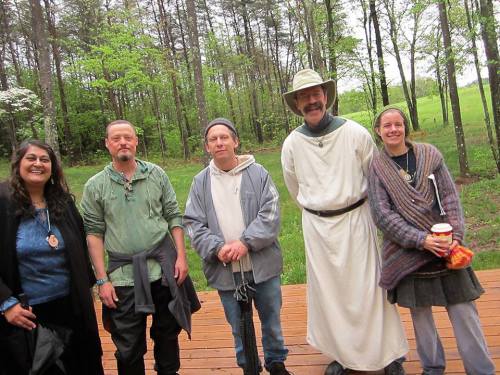
David North, second from left. Photo courtesy Gail Nyoka.
Catching David at a point near the completion of his Ovate studies, and the transition of OAE from Seed Group to Grove, Granderson perceptively observes,
While what constitutes “completion” of the course material varies from person to person based on the correspondence between them and their mentors, before all else, a person’s evolution through the grade work determines if they feel like they have achieved balance (pg. 35).
Much of the non-hierarchical and non-dogmatic character of OBOD comes across in comments like these, in large part one of the signal accomplishments of OBOD’s current leader, Philip Carr-Gomm.
The authors also show themselves sensitive to picking up on Druid cultural practices:
(a) widespread hugging in greeting and farewell, often even among those meeting for the first time;
(b) the relaxed quality of “Pagan” or “Druid Standard Time”, in which events happen in a fluid and intuitive way, not on a strict schedule, but more when the group as a whole feels ready, and almost everyone alert to group energies feels a subtle shift toward action;
(c) unspoken taboos against bad-mouthing other Druid groups (in part because people are often members of more than one, each affording a unique set of teachings and perspectives), and
(d) a kind of ritual respect, so that during unscripted moments in ritual, when attendees are invited to toast, offer thanks, blessings, prayer requests, etc., one forgoes invoking a deity or energy out of keeping with the group, or exclusive to one’s personal practice.
Part of the authors’ experience drew them in deeply enough that the boundaries between observer and participant start to blur. Undesirable as this continues to be in good ethnography, it confers the authority of personal witness to what the Grandersons can recount:
I situated myself on the floor, text in hand, and I began reading. The text started off like the beginning of the Imbolc ritual, with the calling to the corners and the centering of the self. While I read the text aloud, Dave moved from corner to corner of the room, gazing into the expanse—at what I did not know. The text then changed, and from that point onwards I began to lose any understanding, only picking up something about ancestors. I was intent upon trying to guess when to stop to give Dave time to perform the ritual, while also fighting my excitement about getting a good photo (pg. 81).
Something of the eclecticism present in OBOD practice emerges. While much of the study material is Celtic in origin or spirit, OBOD members come from such varied and often mixed backgrounds that the OBOD ethos encourages members
to throw away selectivity and investigate and study the wisdom and traditions of all their ancestors, spanning time and geography, to form a complete profile that honors all of those that came before … to be open toward other traditions and practices that do not belong to one’s ancestral background, and to be willing to recognize wisdom and truth no matter what source it comes from (pg. 89).
Recording the mood, participants, ritual actions and aftermath of several of the Great Eight seasonal festivals of Druidry and Paganism generally, the Grandersons caught the generally relaxed ritual mindset, as well as the personalities of individuals:
There were some slip-ups, with a ritual participant or two walking the wrong way at first, starting a line too late, or failing to light a candle due to a stubborn lighter. An occasional glance would be cast at Dave or Nicole, seeming to seek their validation. Dave looked on stoically, though always welcoming and patient; he knew from experience these rituals were never flawless (pg. 109).
Though much of modern Druidry is indeed visible, or at least detectable with some modest effort at inquiry, if one is interested, there is a quality of what might be termed “spiritual privacy” to even its public rituals. This is a cherished skill among the Druids I know, one for intermittent discussion, certainly, and always a matter of judgment and discretion. Each person assesses the line he or she prefers to observe in how public the individual practice of Druidry should be. The Grandersons capture it well:
OAE wasn’t afraid to be out in public, but they made that public space private. They didn’t hang a sign up saying, “Druid Meeting Here,” or make announcements on a loudspeaker. They also chose a pavilion that, by design and location, created seclusion; it was a reserved piece of land that they sanctified, and they created an island for themselves for a day. Again, this speaks to the contemporary Druid’s ability to take what is modern—a state park pavilion—and make it ancient, carry out their practices in the open air, and somehow remain largely hidden (pg. 124).
The authors divide their book in to poetically captioned sections: Introduction; What is A Druid?; Opening the Door; Naked Before the Full Moon; Into Spring; Beltane; Branching Out; Trip to Four Quarters; The Latter-Half of the Year; Living with Dave and Nicole (a ritually full time, with a wedding of Druid Hex Nottingham and his wife Daisy, East Coast Gathering, a baby-naming ceremony during the same Gathering weekend, a local Pagan Pride Day, etc.); A Detour to New York (with an interview with another Druid, Nadia Chauvet); and The End of the Journey.

cabin banners at East Coast Gathering
This review has focused more on the first half of the book; the second half builds on it, with more interviews of members we have already encountered, and observations specific to their experiences.

MAGUS Beltane fire-circle. Photo Courtesy Wendy Rose Scheers.
In sum, I recommend this book to the “Druid-curious” for its detailed reporting and photography, and for conveying, as close as text and photos can, something of the experience of what doing Druidry actually feels like. And to those familiar with Druidry who may also know many of the Druids it portrays and interviews, it’s a pleasure to read and ponder. Finally, as an insight into the energy, organization and personalities behind the very successful MAGUS gatherings of 2017 and 2018, it also deserves exploration by anyone interested in contemporary Druidry and in organizing focused and effective Pagan events.
/|\ /|\ /|\


 A Druid Way
