Some teachings run you through their rituals.
Find your own way – individuals
know what works beyond the shown way:
try out drinking with the Ancestors.
Chat ‘em up — don’t merely greet ‘em;
such rites are chummy: do more than meet ’em.
(Spend your weekends with a mummy?)
But I like drinking with my Ancestors.
Another round of pints and glasses
will have us falling on our asses.
Leave off ritual when they’re calling —
you’ll be drinking with your Ancestors.
By and with the spirits near us —
“Don’t invoke us if you fear us” —
good advice: if you lose focus
though you’re drinking with your Ancestors,
in the morning you’ll be uncertain
if you just dreamed or drew the curtain
on some world where it more than seemed
that you were drinking with your Ancestors.
Alcohol works its own magic,
and not all good – it’s downright tragic
if you’re just hung over from what could
have been you drinking with your Ancestors.
They come in all shapes, and in all sizes:
some are heroes, some no prizes
(they’re like us in all our guises).
Listen: they are singing, they are cussing,
they can advise us if we’re fussing
over where our lives might go
or put on a ghostly show.
We’re the upshot, on the down low.
We’re the payoff, crown and fruit
(we got their genetic trash, and loot),
we’re their future – “build to suit.”
So start drinking with your ancestors.
* * *
Ancestor “worship” is sometimes a misnomer, though not always — some cultures do in fact pray to, propitiate and appease the spirits of the ancestral dead in ways indistinguishable from worship. But others acknowledge what is simply fact — an awful lot (the simple fact that we’re here means our ancestors for the most part aren’t literally “an awful lot”) of people stand in line behind us. Their lives lead directly to our own. With the advent of photography it’s become possible to see images beyond the three- or four-generation remove that usually binds us to our immediate forebears. I’m lucky to have a Civil War photo of my great-great grandfather, taken when he was about my age, in his early fifties. In the way of generations past, he looks older than that, face seamed and thinned and worn.
The faces of our ancestral dead are often rightfully spooky. We carry their genetics, of course, and often enough a distant echo of their family traditions, rhythms, expectations, and stories in our own lives — a composite of “stuff,” of excellences and limitations, that can qualify as karma in its most literal sense: both the action and the results of doing. But more than that, in the peculiar way of images, the light frozen there on the photograph in patches of bright and dark is some of the purest magic we have. My great-great-grandfather James looks out toward some indeterminate distance — and in the moment of the photo, time — and that moment is now oddly immortal. Who knows if it was one of his better days? He posed for a photo, and no doubt had other things on his mind at the time, as we all do. We are rarely completely present for whatever we’re doing, instead always on to the next thing, or caught up in the past, wondering why that dog keeps barking somewhere in the background, wondering what’s for dinner, what tomorrow will bring, whether any of our hopes and ambitions and worries justify the energy we pour into them so recklessly.
And I sit here gazing at that photo, or summoning his image from what is now visual memory of the photo, as if I met him, which in some way I now have. Time stamps our lives onto our faces and here is his face. No Botox for him. Every line and crease is his from simply living. And around him in my imagination I can pose him with his spouse and children (among them my great-grandfather William) and parents, and so on, back as far — almost unimaginably far — as we are human. Fifty thousand years? Two hundred thousand? A million? Yes, by the time that strain reaches me it’s a ridiculously thin trickle. But then, if we look back far enough for the connection, it’s the same trickle, so we’re told, that flows in the veins of millions of others around us. If we can trust the work of evolutionary biologists and geneticists, a very large number of people alive on the planet today descend from a relative handful of ultimate ancestors. Which seems at first glance to fly in the face of our instinct and of simple mathematics, for that spreading tree of ancestors which, by the time it reaches my great-great-grandfather’s generation, includes thirty people directly responsible for my existence (two parents, four grandparents, eight great-grandparents and sixteen great-great grandparents). Someone called evolution the “ultimate game of survivor.” And now I break off one line, stalling forever this one particular evolutionary parade, because my wife and I have no children.
The poem of mine that opened this entry, “Drinking with the Ancestors,” suggests we can indeed meet and take counsel with members of this immense throng through the exercise of inhibition-lowering and imagination-freeing imbibing of alcohol. Of course there are also visualization exercises and still other techniques that are suitably alcohol-free — more decorous and tame. Depending on who you want to talk to among your clan, you can have an experience as real as most face-to-face talks with people who have skin on. The difference between us in-carnate and ex-carnate folks is indeed the carne. No sudden dispensation of wisdom automatically accrues to us just because we croak. A living idiot becomes a dead idiot. Likewise a wise soul is wise, in or out of flesh.
It seems fitting to end with an experience of the ancestors. Not mine, this time — I keep such things close, because often when we experience them, they are for us alone, and retain their significance and power only if we do not diminish them by laying them out for others who may know nothing of our circumstances and experiences. Wisdom is not a majority vote. Even my wife and I may not share certain inner discoveries. We’ve both learned the hard way that some experiences are for ourselves alone. But it’s a judgment call. Some things I share.
So in my place I give you Mary Stewart’s Merlin, in her novel The Hollow Hills*, recounting his quest for Excalibur, and an ancestor dream-vision that slides into waking. The flavor of it captures one way such an ancestral encounter can go, the opposite end of the easy beery camaraderie that can issue from making the libations that welcome ancestral spirits to a festival or party, as in my poem. Note the transition to daytime consciousness, the thin edge of difference between dream and waking.
I said “Father? Sir?” but, as sometimes happens in dreams, I could make no sound. But he looked up. There were no eyes under the peak of the helmet. The hands that held the sword were the hands of a skeleton … He held the sword out to me. A voice that was not my father’s said, “Take it.” It was not a ghost’s voice, or the voice of bidding that comes with vision. I have heard these, and there is no blood in them; it is as if the wind breathed through an empty horn. This was a man’s voice, deep and abrupt and accustomed to command, with a rough edge to it, such as comes from anger, or sometimes from drunkenness; or sometimes, as now, from fatigue.
I tried to move, but I could not, any more than I could speak. I have never feared a spirit, but I feared this man. From the blank of shadow below the helmet came the voice again, grim, and with a faint amusement, that crept along my skin like the brush of a wolf’s pelt felt in the dark. My breath stopped and my skin shivered. He said, and I now clearly heard the weariness in the voice: “You need not fear me. Nor should you fear the sword. I am not your father, but you are my seed. Take it, Merlinus Ambrosius. You will find no rest until you do.”
I approached him. The fire had dwindled, and it was almost dark. I put my hands out for the sword and he reached to lay it across them … As the sword left his grip it fell, through his hands and through mine, and between us to the ground. I knelt, groping in the darkness, but my hand met nothing. I could feel his breath above me, warm as a living man’s, and his cloak brushed my cheek. I heard him say: “Find it. There is no one else who can find it.” Then my eyes were open and it was full noon, and the strawberry mare was nuzzling at me where I lay, with her mane brushing my face (226-7).
/|\ /|\ /|\
*Stewart, Mary. The Hollow Hills. New York: Fawcett Crest Books, 1974.
[Related posts: Shinto & Shrine Druidry 1 | 2 | 3 || Shinto — Way of the Gods || Renewing the Shrine 1 | 2 || My Shinto 1 | 2 ]
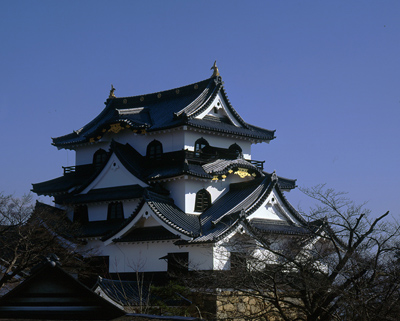
Almost two decades ago now, in the early 1990s, my wife and I lived for a year in Hikone, a medium-sized city in central Japan, about an hour’s train ride north of Kyoto. The city’s most visible claim to fame is Hikone Castle, a 380-year-old wooden fortress that dominates the downtown skyline. But the most enduring memory I took from Japan and have never forgotten is the profound impression of its many Shinto shrines — roughly 80,000 of them, according to various sources — that dot the landscape and invite the casual visitor as well as the reverent worshiper. I usually found myself somewhere between the two. But this wasn’t ever a problem. Visitors, including foreigners, are welcome.
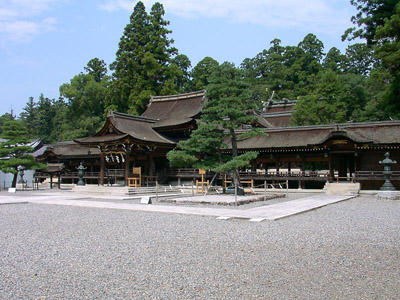
Shinto shrines are impressive for their openness. Many (especially the smaller and rural ones) are free to visit (though of course donations are gratefully accepted), wonderfully peaceful, and lovingly tended. Not once did I see any graffiti or vandalism in the dozen or so shrines I frequented, in either countryside or city. Often enough I was the only person present, which allowed for a meditative experience of the grounds and atmosphere. Here’s a shot of the entrance to Taga Taisha, about 20 minutes from our apartment in Hikone.
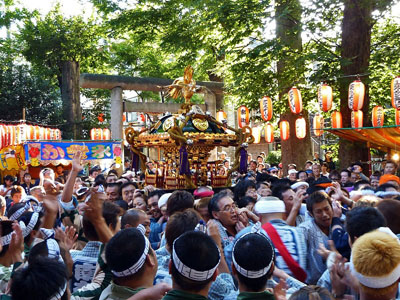
During matsuri or festivals, however, a shrine can be absolutely mobbed, and that’s a wholly different experience, also not to be missed! You can catch something of the energy of a festival in this shot below of Tenso Jinja shrine. The celebrants in the background carry a mikoshi, a portable shrine, back to Tenso Jinja after a day of parading it around the town. Usually there’s a musical accompaniment, and the bearers of the mikoshi can get very enthusiastic in their chants, drawing quite a crowd. In retrospect, the experience felt very Druidic — all that energy, all the communal good feeling, everyone included.
Shinto is the “way of the kami,” the Japanese word used to translate both English “god” (and “God”) as well as “spirit,” “ancestor” or “essence.” From the Shinto perspective, the world of the kami overlaps with ours. Everything has its kami, and the natural world is full of places that manifest the particularly strong presence of kami.
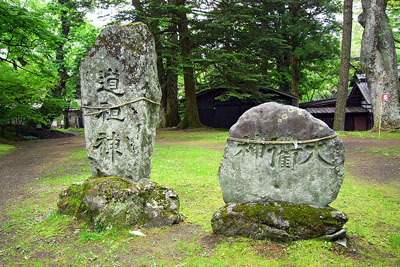
Thus, natural objects pervaded with kami often receive a small marker shrine and sometimes other identifying signs, like at Hatagoiwa just off the coast in Ishikawa prefecture. Note the rope linking the large ocean rocks, as well as the small red shrine atop the larger rock.
Shinto focuses on practice more than belief. One of its key practices is purification, so that we can participate in the world of the kami more consciously and harmoniously. For that reason, the entrance to a Shinto shrine typically includes a temizuya (literally “hand-water-spot”) or basin for ritual washing before proceeding further. Here you can see the basin and the bamboo dippers for washing.
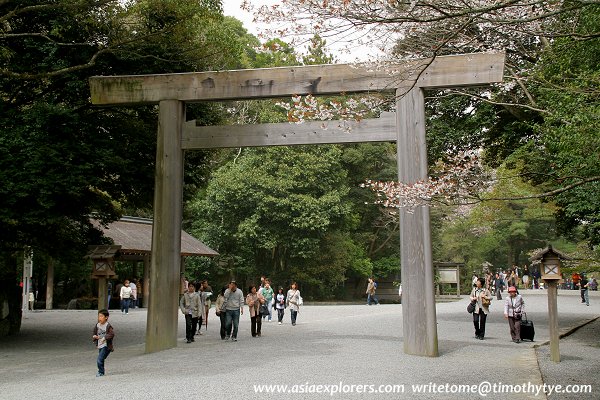
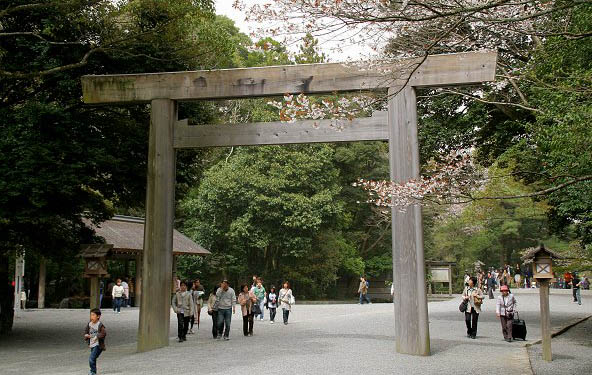
The marker signalling the sacred space of a shrine is the torii gate, through which all visitors pass. The torii may be simple, like this wooden one at Ise, one of the oldest and most famous shrines.
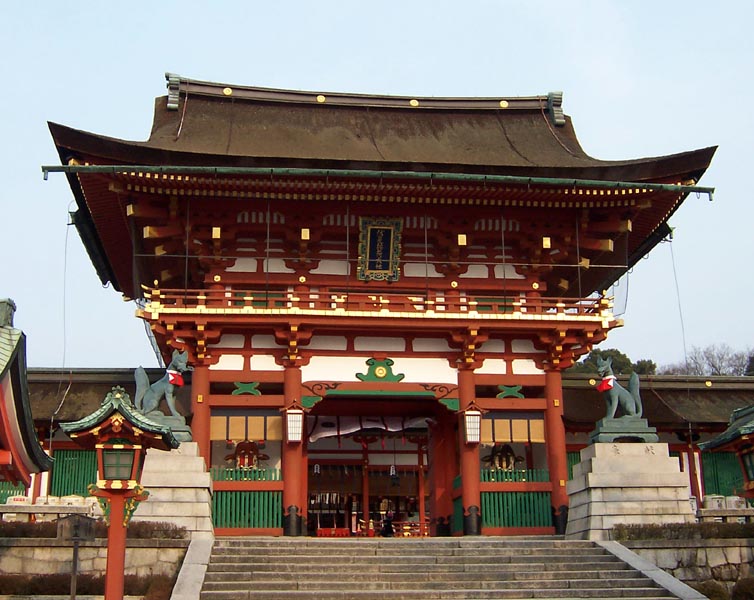
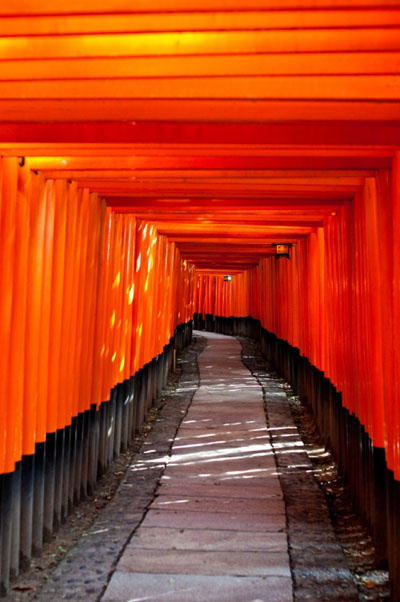
Or it can be wonderfully elaborate, like the main entrance of Fushimi-Inari Jinja near Kyoto, and inside, its sloping corridor of seemingly endless red torii.
Lest you feel this is all well and good, but for all that still remote from your life, there’s a major Shinto shrine in Washington state, near Seattle, named Tsubaki Grand Shrine. And among its kami is Kokudo Kunitama-no-Kami, who protects the North American continent.
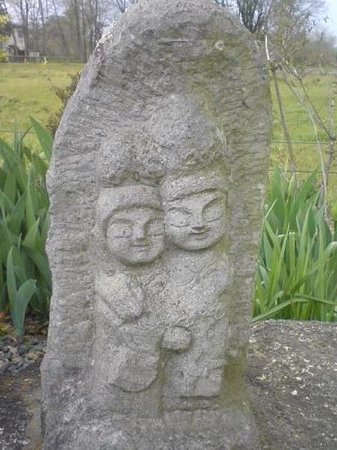
Here’s a shot of the interior of a shrine, featuring dosojin, or kami representing an ancestral married couple. Dosojin are protective spirits, and often placed along borders and boundaries.
The last shot is of a dosojin more recognizably human, marking a field border.
An altar is an important element of very many spiritualities around the world. It gives a structure to space, and orients the practitioner, the worshipper, the participant (and any observers) to objects, symbols and energies. It’s a spiritual signpost, a landmark for identifying and entering sacred space. It accomplishes this without words, simply by existing. The red color of the Taoist altar below immediately alerts the eye to its importance and energy.
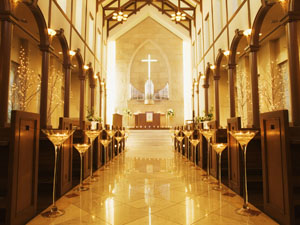
As a center of ritual action and visual attention, an altar is positioned to draw the eye as much as any other sense. In Christian churches like the one below, everything is subordinated to the Cross and the altar immediately below it. Church architecture typically highlights this focus through symmetry and lighting. But in every case, enter the sacred space which an altar delineates, and it tells you what matters by how it is shaped and ordered and organized.
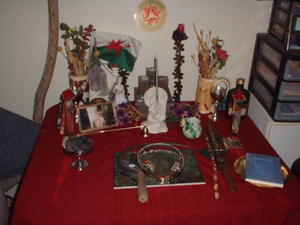
Part of OBOD* training is the establishment and maintenance of a personal altar as part of regular spiritual practice. Here’s a Druid altar spread on a tabletop. Nothing “mundane” or arbitrary occupies the space — everything has ritual or spiritual purpose and significance to its creator.
Such obviously physical objects and actions and their appeal to the senses as aids in spiritual practice all spring from human necessity. We need the grounding of our practices in the physical world of words, acts and sensations in order to “bring them home to us,” and make them real or “thingly,” which is what “real” (from Latin res “thing”) means.
Religions and spiritual teachings accomplish this in rich and diverse ways. We have only to think of Christian baptism, communion and the imposition of ashes at Easter; Hindu prasad and tilak; Jewish bris/brit (circumcision) and tallit (prayer shawl) and so on.
Atheists who focus exclusively on belief in their critiques and debates thus forget the very real, concrete and physical aspects of religious and spiritual practice which invest actions, objects and words with spiritual meaning that cannot be dismissed merely by pointing out any logical or rational cracks in a set of beliefs. Though you may present “evidence that God doesn’t exist” that seems irrefutable to you, you haven’t even begun to touch the beauty of an altar or spiritual structure, the warmth of a religious community of people you know and worship with, the power of a liturgy, the smell of incense, the tastes of ritual meals, the sounds of ritual music and song.
Just as we hear people describe themselves as “spiritual without being religious” as they struggle to sift forms of religion from the supposed “heart” of spirituality, plenty of so-called “believers” are “religious without being spiritual.” The forms of their spiritual and religious practice are rich with association, memory and community, and can be as important as — or more so than — a particular creed or set of beliefs.
Having said all of this, I’ve had a set of experiences that incline me away from erecting a physical altar for my Druid practice. So I’m working toward a solution to the spiritual “problem” this presents. Let me approach it indirectly. Once again, and hardly surprising to anyone who’s followed this blog or is as bookish as I am, the trail runs through books.
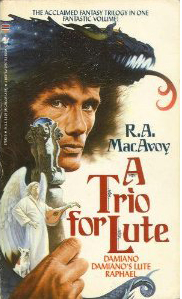
Damiano, the first volume in a fabulous (and sadly under-known) trilogy by R. A. MacAvoy, and recently reissued as part of an omnibus edition called Trio for Lute, supplies an image for today’s post. Damiano Delstrego is a young Renaissance Italian who happens to be both witch and aspiring musician. His magic depends for its focus on a staff, and we see both the strengths and limitations of such magical tools in various episodes in the novel, and most particularly when he encounters a Finnish woman who practices a singing magic.
When I read the trilogy at its first publication in the 80s, the Finnish magic sans tools seemed to me much superior to “staff-based” power. (Partly in the wake of Harry Potter and the prevalence of wands and wand-wielders in the books and films, there’s a resurgence of interest in this aspect of the art, and an interesting new book just published reflecting that “tool-based” bias, titled Wandlore: the Art of Crafting the Ultimate Magical Tool).
So when I then read news of church burnings, desecrated holy sites, quests for lost spiritual objects (like the Holy Grail) and so on, the wisdom of reposing such power in a physical object seemed to me dubious at best. For whatever your own beliefs, magic energy — whether imbued by intention, Spirit, habit, the Devil, long practice, belief in a bogus or real power — keeps proving perilously vulnerable to misplacement, loss or wholesale destruction. Add to this Jesus’ observation that we are each the temple of Spirit, and my growing sense of the potential of that inner temple of contemplation — also a feature of OBOD practice — and you get my perspective.
Carrying this admitted bias with me over the years, when I came last year to the lesson in the OBOD Bardic series that introduced the personal altar, I realized I would need both contemplation and creativity to find my way.
My solution so far is a work in progress, an alpha or possibly a beta version. My altar is portable, consisting of just five small stones, one for each of the classic European five elements — four plus Spirit. Of course I have other associations, visualizations and a more elaborate (and still evolving) practice I do not share here. But you get the idea. (If you engage in a more Native-American nourished practice, you might choose seven instead: the four horizontal directions, above [the zenith], below [the nadir] and the center.)
I can pocket my altar in a flash, and re-deploy it on a minimal flat space (or — in a pinch — right on the palm of my hand). One indulgence I’ve permitted myself: the stones originate from a ritual gift, so they do in fact have personal symbolic — or magical, if you will — significance for me. But each altar ritual I do includes both an invitation for descent and re-ascent of power or imagery or magic to and away from the particular stones that represent my altar. Lose them, and others can take their place for me with minimal ritual “loss” or disruption. Time and practice will reveal whether this is a serviceable solution.
This post is already long enough, so I’ll defer till later any discussion of the fitness of elemental earth/stone standing in for the other elements.
/|\ /|\ /|\
*OBOD — the particular “flavor” of Druidry I’m studying and practicing.
To get you into the spirit of Imbolc and Groundhog’s Day tomorrow, February 2nd, here’s a Youtube video documenting record attendance at Gobbler’s Knob outside Punxsutawney, Pennsylvania, on Groundhog’s Day, 2008.
If you’re impatient and don’t wish to watch the entire seven-minute video, begin with the first 20 seconds or so, as the town’s “Inner Circle” in black coats and top hats process to Gobbler’s Knob, and then cut to when the action picks up again with Phil’s appearance shortly after the four-minute mark.
For the “official” Groundhog Day site and up to the date info, as well as other videos, visit groundhog.org.
With energies flowing around us from so many end-of-year holidays and celebrations, it seemed fitting to think and write about initiation. It’s one more piece of a Religious Operating System (ROS), it’s an important key to Druidry and — most importantly — it’s something we all experience. For good reason, then, the subject cuts a large swath through spiritual, religious and magical thought and practice. As author Isaac Bashevis Singer opens his book The Chosen, “Beginnings are difficult times.” That’s one reason New Year’s resolutions often end up on the cutting room floor of the film version of our lives. (Some ways to keep them alive and well and not merely part of the special extended version of our lives that may not see wide release into the “real” world will be the subject of a post upcoming in the next few days.)
Some opportunities for initiation recur each year, and are built into our cultures. Right now the festival holidays of Hanukkah, Christmas, Diwali, Kwanzaa and so on are opportunities for annual initiation — if we let their celebrations reach into us and change us. As breaks from “profane” or ordinary time, holidays take us into altered if not sacred space, and then return us to our lives somehow — ideally, anyway — changed. Of course, specific religions and spiritual paths each offer their own initiations. For Christians, it’s baptism (and for Catholics and some other denominations, confirmation as well). A Jew passes through a bar or bat mitzvah, and so on.
But we needn’t look so far or so formally. First kiss, first love, first sexual experience, first drink (consider the particular sequence of these in your own life). Driver’s license, prom, graduation, military draft. Each transforms as a rite of passage. We “pass through” and come out on the other side, different, in ways others may or may not notice. We ourselves may not fully absorb the changes until much later.
As with the kinds of freedom I considered in a previous post, there seem to be both “transitive” and “intransitive” initiations — initiations which enable or empower the initiate to do something — typically in the future — and initiations which recognize a standard or awareness already attained, and put a “seal of approval” on it. Of course these need not be separate. Both kinds can occur simultaneously. Initiation is a “beginning” (from Latin initio “start, beginning”) both a path or direction that another agency, power or person starts us on, and also something one does or experiences oneself.
Some big initiations are inclusive. Like annual holidays, we all experience them. Though we may not often think of it, death — our own, or that of a loved one, or of a public figure with symbolic power, like a John F. Kennedy or a Princess Diana — can be a powerful, transformative initiation. Through the grief and the inevitable breaks in familiar routine that come with the first shock, the family gatherings, the arrangements and the funeral itself, we’re brought to face loss, change, mortality, and endings and beginnings in ways. We may take on new, unfamiliar roles, like caretaker, mourner, survivor, with all the challenge and growth they can bring. The first death we encounter (apart from pets), given the usual number of years between generations, comes almost like clockwork sometime in our teens, with the passing of a grandparent. In the freshman dorm at the boarding school where I teach and serve as adviser, there are four or five deaths of grandparents each year, and all the myriad changes they carry with them for those involved. It’s a close study in family dynamics (and our capacity as advisers to provide support) to witness how kids and their families deal with it all.
Marriage often seems to occupy a sort of middle ground as far as these categories operate. On the one hand, no one is married in the eyes of either the law or a religious organization until they pass through the requisite ceremony. Yet we all know couples who are already “so married” that the ceremony confers nothing that they don’t already manifest in abundance. In this case, the initiation of marriage simply recognizes and formalizes a connection and a state of relationship that already exists and — if the ritual or ceremony still carries any power — blesses and charges the thing consecrated. My wife and I have two anniversaries, ten days apart, and each conveyed to us different energies. First was a spiritual ceremony by a cleric in our tradition, and second came the state ceremony, performed by a justice of the peace. Interesting, too, who we see as performing or undergoing the initiation. Ideally, to my mind, the one experiencing the initiation should play at least some part, if not an active role, in its enactment. For initiation takes place both outwardly, where it is often witnessed by the state if not also by family, and more importantly inwardly, on the subtle planes (which deserve their own post or series of posts).
“Where is wisdom to be found?” goes the old query. Initiation is one major source. Not all initiations “show” right away, or even ever. What we begin may never end. It can take a lifetime to sort out the effect of even “lesser” initiations, to say nothing of the big ones. Those “long” words, never and always, very much belong with initiations.
As we near Samhain (see previous post), I want to do some thinking out loud about sacrifice. And that includes moving randomly, and in less than smooth gestures, as thought moves (at least mine does), and leaving some avenues for later reflection. And input from readers, too.
Sacrifice literally means something that makes sacred or holy, though a sacrifice in contemporary usage has come to signify as well a loss or voluntary giving-up, in return for some advantage. Why should the holy link with a giving up? Something good, in exchange for something better. It carries with it associations of unpleasantness or suffering — the difficulty or pain involved in the giving up, even if the advantage is fully worthwhile.
But need the sacrifice always entail giving up? The making sacred of each moment may involve my giving up scattered attention, or a bad mood, but these are not usually things I’ll miss.
I go to my altar during a ceremony or ritual, and give in offering something I have purchased, grown or made — most recently, some home-made incense. It has “objective” value, as far as that can be measured, in dollars or in what dollars can purchase. But it has “subjective” value in terms of what it’s worth to me. I hope it may have value as well to whoever receives the sacrifice. Even more, if it costs me something essential to provide it, people often consider it a more “true” sacrifice. And if it’s a fair exchange, I’ll gain an equivalent for what I give. Well and good. Many sacrifices stop there. But what of sacrifice that gives all and expects nothing?
There is a joy in that kind of giving, if the sacrifice is voluntary. Much was made in ancient cultures of the “sacrifice that goes consenting.” A sacrificial animal delivered a bad omen if it resisted axe or blade, or shied away from the sacrificer. Human offerings, though apparently fairly rare, might have their senses dulled with drugs, so that the pain or apprehension — or defiance — did not taint or diminish the sacrifice. Does this reduce its value? Does the sacrifice still go “consenting”?
So far I’ve looked at this entirely from (my) human point of view. If I make an offering to a god or thought-form or some higher wavelength of consciousness (and these may or may not be the same thing), I change the situation by my actions, even if only in a small way. As a marker in memory, ritual breaks the flow of “profane” time with a division or irruption into consciousness of another kind of act. Actions done consciously, with intention, in formal words and gestures and attitudes of mind and body, are simply different from our daily-life consciousness. They feel different, and we remember them differently. They mark time as altars, chapels, shrines, temples, churches and sanctuaries mark space. Whether “holy” or not, they are different and distinctive for that reason. They don’t fit the pattern. In terms of consciousness, they are marked, while the “ordinary” is un-marked, the default mode of most of our experience.
But what of the view “from the other side”? Apart from whether gods exist, the universe tends towards an equilibrium, at least locally. Extremes don’t last, and we return to “normal.” Almost. The short span of “not normal,” of marked, of ritual time, of sacrificial consciousness, has left things changed, however small the change. Does a god perceive such human action and awareness? If so, how? And does what I’ve called ritual or sacrificial consciousness come across any differently to That Which Watches?
In crude terms, a sacrifice is a claim on another. Roman culture expressed this as do ut des: “I give, so that you may give.” I’ll scratch your back if you will later scratch mine. The initiative in this case comes from me: if I act, you are obliged in some sense to respond. There is trust here, a kind of faith in “how the universe works.” Many moderns might be utterly perplexed at this kind of thinking. All I can say is, don’t knock it till you’ve tried it.
In mainland Chinese culture, everyone is conscious of guanxi, the obligation or connection they have with others. In fact, one way of saying “you’re welcome” is mei guanxi — “no obligation or connection.” You don’t owe me; there’s no need to repay. On the flip side is the the incidence of one Chinese literally chasing another down the street with a gift the first person does not wish to accept. Take the gift and you acknowledge connection, obligation. If the sacrifice is accepted, you’ve built up some credit with Another, with the divine, with Otherworld energies. (Can we make a sacrifice without expecting anything, even if it’s just a sense of satisfaction or wholeness in the act of making the sacrifice?)
But the sense of sacrificial debt or obligation does not stop there. Again in Roman culture, the flip side, the necessary correspondence, is da ut dem: “You give, so that I may give (in the future).” Complete the cycle. Establish reciprocity, build the relationship. We depend on each other, gods on humans as much as humans on gods. Note that the goal isn’t to pay off the debt, or reach a new equilibrium, but to establish a connection through mutual commitment and generosity — to build a history together. In other words, to keep the exchanges going.
Eventually we may begin to see all our actions as ritual and as sacrifice. Whatever we sanctify comes into to our lives through reciprocity, because we are inevitably part of the whole, in relationship with the cosmos. “What you do comes back to you,” for the simple reason that you asked it to, by placing attention on it, by performing the ritual of desire and attention, and often, the dedication of resources, of the holy substance of the living world, to achieve or create or earn or win (or steal) whatever it was you thought you wanted.
But the act of desiring something, of investing energy and consciousness into it, changes us. We all know the old saying: be careful what you wish for, because you just might get it. When “it” comes, we’ve often moved on to other goals and desires, and no long wish for it, or even recognize it when it arrives. We’re on to the next thing, and the consequences of one of our old wishes or desires may no longer fit us where we are. We may even see it as a kind of obstacle, some piece of bad luck, a bump in the road, not knowing we asked for at some earlier point.
Here magic has its place, not as stage showmanship and illusion, not as Harry-Potter wand-waving, not as Hollywood “spfx” or special effects, but as a way of clarifying our desires and our consciousness, as well as reducing the occasions when we randomly or less than consciously send out desires for things we don’t actually want, or which won’t serve our best interests. Instead, we learn (how slowly and often painfully!) to act with intention, to change consciousness through ritual, discipline, focused psycho-drama, meditation, making ourselves the center of change, which then ripples outward from our own changed awareness into the wider world around us. All things flee from us, or come to us, in accordance with our state of awareness.
As a wise person said, “The only miracle is a changed consciousness.” That is the chief form of the plenitude that comes with true sacrifice — a test for its validity.
OK — now I’ve given myself lots of abstractions to test with specific concrete examples from daily life. Any comments or observations?
We’re a few days from the old Celtic harvest festival at summer’s end. For those of us the northeastern U.S., with the recent frosts and snow in the forecast, it feels like summer’s end as well. As a time of endings and beginnings — the new year begins as the old one ends — it is a time of introspection, intuition, dream and creativity. As an acknowledgment of change and completion, it can also include a remembrance of the dead.
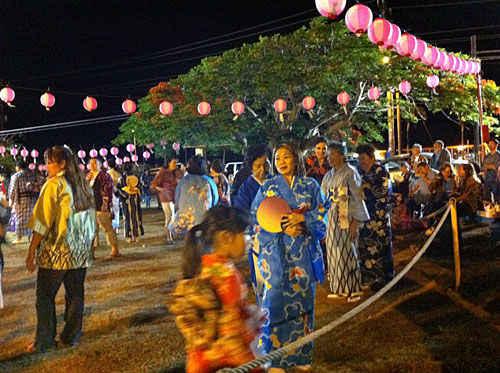
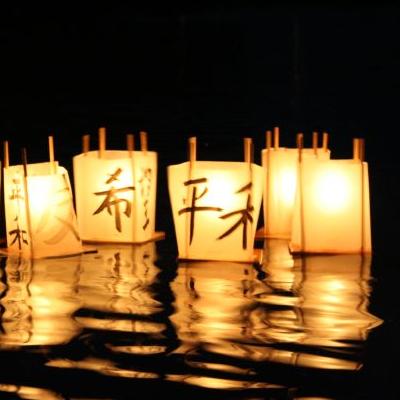
The holiday was adopted by the Church and transmuted to a three-day observance from Oct. 31 to Nov. 2. It begins the night before, on All Hallows Eve*, or Hallowed Evening (Halloween), continues with All Saints Day, and concludes on All Souls Day. In many other cultures there are similar observances, though not necessarily all on the same dates. Spanish speakers celebrate Dia de Los Muertos, and Christian Arabs observe Yom El Maouta, both meaning “Day of the Dead.” The Japanese observe O-Bon, remembering and honoring their ancestors. Held during July or August, depending on location and local tradition, the holiday feels to me (I lived in Japan for two years) like a cross between Halloween and the Fourth of July. Originating as a Buddhist observance, it also includes a dance — the bon-odori — to give thanks for the sacrifices of ancestors, fireworks, carnivals and a concluding Lantern festival, imaging the return of the souls of the dead. This Asian holiday captures the Druid spirit of Samhain for me: celebratory yet reverent, and family-oriented.
Druids and other Pagans have adopted the older Celtic name of Samhain or Samhuinn (pronounced approximately SAH-wen or SOW-en — the “mh” in Irish spelling indicates a sound like “w”) — as they have other Celtic names, since for them the holiday has association and symbols different from those current in the Church. The “sam-” is cognate with English “summer” — the word means simply “summer’s end.” (Christian anti-Pagan propaganda tracts like this one ignorantly and wrongly portray Halloween as “The Devil’s Night” and “Saman” as an evil “Lord of Death” — scroll down to the 15th frame. No evidence exists for a Celtic deity with that name and association. Besides, American commercialization of the day has obscured the invitation of its spiritual potential, though it remains still at hand. Somehow Americans also seem to have trouble achieving both “mirth and reverence,” as the “Charge of the Goddess” in the Wiccan tradition exhorts us.)
At the school where I’ve taught for a decade and a half, students themselves often took the initiative to celebrate this autumn holiday. Some two months into the school year, with exams looming and — for the seniors — college apps drawing more and more of their attention, they still found a supervising adult so they could get official permission and use school meeting areas, put up posters to invite everyone who wished to attend, and write their own rituals. I’ve saved several years’ worth of photocopied ceremonies in wildly varying degrees of elaboration, and I’ve attended both large and small gatherings, indoors and out. Some were largely excuses, it’s true, to dress up in capes and masks, light candles, scare and amuse each other, and then gorge on candy afterward. But others were moving commemorations of the season, an opportunity for acknowledgment from everyone who’d lost a relative or friend in the past year. The event helped acknowledge grief and cleanse the emotions through a group ritual of shouting and crying, burning messages in a cauldron, and closing with a group meditation. If the larger culture doesn’t make room for such things, subcultures often do.
The autumn equinox last month was the first time I celebrated that holiday as a Druid, and with fellow Druids, at the East Coast Gathering. In my part of the U.S., Druids are thin on the ground, though a couple of us are considering a small gathering. But whether or not in the end we manage to find time for a group celebration, I’ll also observe the day myself, this marker of moving in time and experiencing the fullness of human life.
/|\ /|\ /|\
*”All Hallows Eve” precedes the day dedicated to the hallows or saints (Old English halga) — All Saints Day.









 A Druid Way