The first of what richly promises to be an annual event, the Mid-Atlantic Gathering U.S. (MAGUS) took place over this last weekend, Thursday to Sunday, at Four Quarters Sanctuary in Artemas, Pennsylvania.
photo courtesy Wanda Flaherty
The initial inward glimpse of the Gathering came to one of the organizers almost a decade ago. There’s yet another indication, if I need the reminder, of the possible time-gap between first seed and outward manifestation.
And our hosting venue, Four Quarters, an interfaith sanctuary launched in 1994, was the perfect place to hold a Beltane Gathering. As the Four Quarters home page observes, it’s
a membership-driven non-profit, a vibrant community of real people living real lives. And Four Quarters actually owns the Land, buildings and equipment that make our work possible, forever set aside from the vagaries of private ownership.
The lovely and wild 150 acres of the sanctuary lie in the Allegheny foothills in southern PA, just miles from the Maryland border. Home to a stone circle, labyrinth, retreat center with bunkhouse and dining pavilion, a brewery, a drum and dance circle, sweat lodge, a handful of permanent residents, and the clean-flowing Siding Creek defining part of its periphery, Four Quarters strives to
honor the many world traditions that reflect an Earth Based Spirituality, and we work to support those traditions and welcome their people. We do not teach “One Way” of belief. We do not have “The Answer”. We do have good questions.
Here’s the Stone Circle seen from the north, a work in progress (with annual megalithic-style stone raisings open to anyone willing to join the rope-pulling and log-rolling stone lifting team). Note the nearly three-foot-long camp bell suspended from the tripod in the foreground — a deep voice audible throughout the property.
photo courtesy Wanda Flaherty
A wide-angle shot can’t capture the majesty of the stones or the power of the circle. Here’s a closer view of some of the lovely rough surfaces, mottled with rust in places, asking for touch and communion.
photo courtesy Wanda Flaherty
The first time I walked the circle Thursday evening, I sensed a quiet hum of presence. The next time I came more at ease, eager to touch and listen to the land and the inner voices. By the time I reached the eighth stone, sudden tears filled my eyes. The circle holds indisputable power.
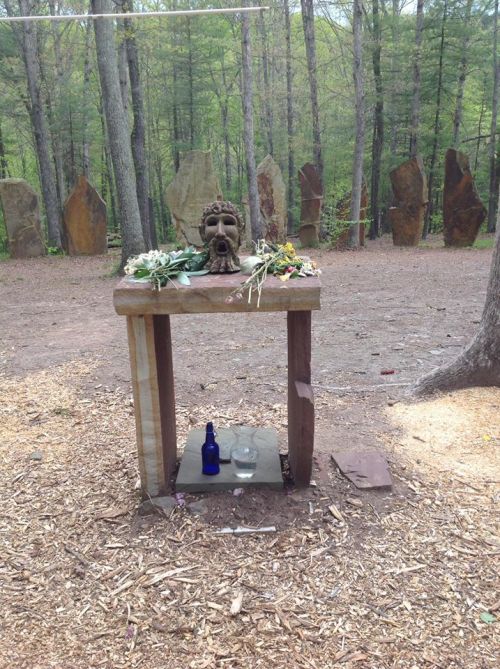
Here’s one of the altars near the center of the stone circle. The ancestors speak strongly here, if I give even half an ear.
photo courtesy Wanda Flaherty
How to convey the blend of the speaking land, the personal and the tribal at such Gatherings?! You come as someone new to Paganism, or to OBOD more specifically. Or you come knowing you’ll reunite with your people once more, across the miles. If we saw each other every day, we might begin to forget the human and spiritual wealth that surrounds us. In ritual, in conversations in the dining pavilion (below) or over coffee during breaks, we’re reminded that we’re never alone, no matter how solitary we may live the rest of the year. Inner connection exists over any distance.
dining pavilion — photo courtesy Wandy Flaherty
Typically when I reflect on a Gathering a few days after, one or two things stand out sharply. But when I started naming them over breakfast this morning, I ended with a list of a score of items — nearly the entire weekend as I experienced it, a blend not to be parcelled out in soundbites or highlights.
From the place, with its cool air crackling with oxygen from the vigorous trees, to the faces and energy of the Tribe and its rituals, formal and informal, to the songs of spiritual presence that all places offer, everything stands out in memory. Impossible to narrow down. This post is a small attempt to hint at that Everything — to urge you, if you want a taste of a particular kind of marvelous, to attend a Gathering if you can.
The way of the Solitary can indeed be a blessed one, but the Tribe also offers a great deal to reinvigorate even the most hermetic of Solitaries. A Gathering can paradoxically reaffirm the Solitary, because you meet other Solitaries. You witness the integrity of the individual path, as well as the gift of the Tribal way. Gatherings have changed me into an avid Tribe-seeker, at least a few times each year, so that when I retreat to my own smaller circle, the closing words of OBOD ritual echo true: “May our memories hold what the eye and ear have gained.”
/|\ /|\ /|\
“Kindling the Flame” was our Gathering theme. We apparently also needed the blessing of Water, in the form of steady rain from late Thursday afternoon through the night, and intermittently all Friday, to help remind us that all the elements gather, whenever any one of them is invoked. “Thus is balance preserved”.
Thursday included an opening orientation by our special guest OBOD Druid Renu Aldritch, a workshop I delivered on “Kindling Our Sacred Fires”, the opening ritual, and preparation for Bardic initiations the next morning.
After breakfast Friday, we initiated 12 Bards. Like many others, I’ve come to see how priceless it is to support initiations and attend whenever I can, regardless of whether I have an assigned “role”. The rite washes over us all, renews the experience each of us had during our own initiation, helps us rededicate, and allows us to greet the newly initiated within ritual space.
Always there are small hiccups and endearing glitches during a ritual. I think without them we’d have to make sure we added them. And we come to expect them: they humanize a dramatic moment, when someone with a major or minor role misplaces a prop or drops a ritual spoken line, topples the incense or bowl of water, mispronounces a magical name, and so on. We laugh, disarmed, and then the next part of the ritual can reach deeper, because we’ve opened up that much more. Each initiation is unique: tears, laughter, the presence of Spirit, the call of bird or beast to punctuate a word or silence.
Friday gave us Renu’s workshop, “Kindling the Spiritual Warrior”, a theme that bears ongoing attention. Dana’s workshop “Land Healing on the Inner and Outer Planes”, her ritual later that afternoon, “Ogam Tree Galdr in the Northern Tradition”, her generous personal readings using her own tree divination system, and her conversation fired many with renewed love and commitment to this path. That evening also brought initiation to three Ovates under moonlight and the background throb of drums from a drum workshop. We couldn’t have asked for a better ritual setting.
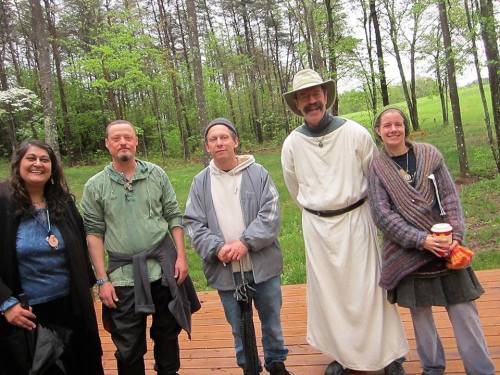
Downhill from the Labyrinth, prepping for the evening Ovate initiation in the open air: Renu, Dave, Ahote, me and Cat. (We opted later for a covered stage, in case the rain continued.)
photo courtesy Gail Nyoka
Saturday gave us Wanda’s workshop, “Awakening Your Beltane Sensuality” with its creative chance to heighten one sense by muting the others. Now that the rain had ceased, we could hold our main Beltane rite in the stone circle.
Here’s an evocative pic from Saturday night, the Fire Circle alight, a few dancers visible, along with Brom, our Fire Master, tending the flames.
photo courtesy Wendy Rose Scheers
By Saturday night I’d mostly finished my other ritual responsibilities, including providing a glitch for the main Beltane ritual where I had a speaking part — I dropped a line. “When that ritual pause goes on a little too long and you look around, you’re probably what’s missing”, as someone quipped over the weekend.
I was looking forward to enjoying the Fire Circle without performing for the eisteddfod, the Bardic arts portion of most OBOD festivals that welcomes the evening fires and the awen-inspiration of a Gathering and offers it back again in song and poetry and story.
But as Bards know from experience, the awen sometimes has other ideas. Fire gave me an opening line a few hours earlier during dinner. And it kept gathering more lines to it, right up to the evening Fire Circle. Verses kept changing and I didn’t have pen and paper handy, so I kept playing with lines and rhymes and their order. “Fire says improvise” came the first line. I’d invoked fire, after all, during my workshop, in several different ways. What did I expect?! Here’s the poem:
Fire says improvise —
no surprise,
when such orange wonder
seeks out skin and eyes.
Fire can burn all to black
but before,
that hot roar lifts me
to soar beyond
anything I thought to think I lack.
Most times I’m no fool —
how does this jewel
get to be so hot and cool?
Old rule, it says.
Burn madly, gladly,
or — if you must — sadly:
one way only among those other two.
For I will heat you from your crown
to your open-toed shoe.
The fire, friend,
the fire is in you.
Just get up and say it, came the nudge. Doesn’t have to be polished. I delivered the lines, gazing at the flames the whole time, then stumbled back fire-blind to my seat on one of the Fire Circle benches. The version here is close to what I remember saying, probably edited a little. Fire didn’t want an editor. Just flame, large or small. The other Bards obliged, and this eisteddfod was among the most varied and interesting I’ve known.
One of the oldest pieces of spiritual counsel in the Indo-European tradition is this: “Pray with a good fire”.
/|\ /|\ /|\
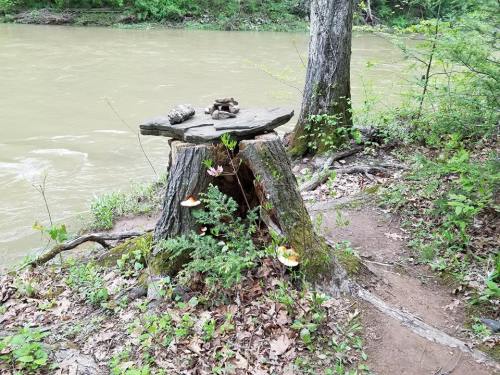
Below is an informal altar by Siding Creek, which curls around Four Quarters, another voice audible through much of the Sanctuary as a background whisper.
photo courtesy Renu Aldritch
Four Quarters brews its own mead, a taste of the Land to take inside the body. Warmed by place, fire and fellowship, we return to our lives richer by each person who attended. Long live MAGUS!
photo courtesy Wanda Flaherty
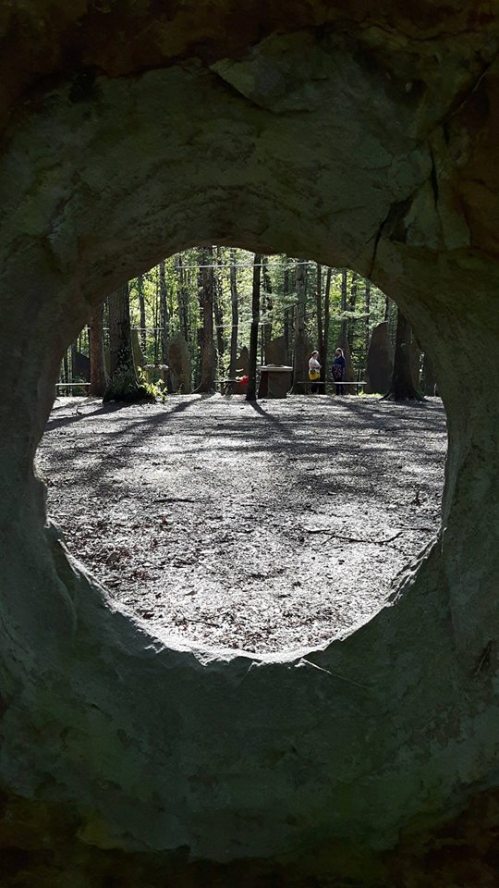
A final view of the Circle through the eye of the Mother Stone:
How do I keep the inward doors open? (How do I even begin to locate them and find their handles?) How do I pick up on subtle nudges? How do I hear the quiet inward speech of things — the “still small voice” as older versions of Christian scripture call it? We all get the big events — no need to go looking for them. They burst on the scene, kicking down the door a few times in a life, unmistakably loud and messy, whether good or bad, and usually a mix. But they break through, and everything shifts.
“Go out and stand on the mountain in the presence of the Lord, for the Lord is about to pass by.” Then a great and powerful wind tore the mountains apart and shattered the rocks before the Lord, but the Lord was not in the wind. After the wind there was an earthquake, but the Lord was not in the earthquake. After the earthquake came a fire, but the Lord was not in the fire. And after the fire came a gentle whisper. When Elijah heard it, he pulled his cloak over his face and went out and stood at the mouth of the cave. Then a voice said to him, “What are you doing here, Elijah?” (1 Kings 19:11-13).
With wind and earthquake and fire, how do we ever catch the whisper? And then, even if we manage to hear the “still small voice”, we may find that instead of resolution or insight or growth, we’re left with questions, like Elijah. Our own lives interrogate us. “What am I doing here? How did things end up like this?”
Most traditions urge a daily practice. As much of Christianity has become focused on belief rather than practice, it has lost much of what monastic practice has preserved. A site on Trappist monasticism notes:
The practice of lectio divina, (divine reading), is foundational to monastic life. So important is divine reading to the spiritual well-being of a monk that, traditionally, we devoted some of the best hours of the day to this practice. Lectio Divina is a discipline whose fruits are experienced over time. One needs to understand the practice and then commit to it with some regularity.
Practice matters. Not because it makes our lives “safe” or “easy”: no life is that I know of. If I think about it, most lives resemble the character throw in role-playing games (RPGs) like Dungeons and Dragons. You toss the game dice for talents, strengths and weaknesses. You may for instance roll a high intelligence, but your physical body is weak. You can’t rely on it. If you’re allowed to roll again, your strength, your vitality, may be high this time, but you’re none too bright. Or on the third throw, both intelligence and strength come up high, but your temper makes your life a train-wreck of impulse and blame.
A daily practice helps build spiritual stamina. It’s something like what our grandparents and great-grandparents used to call “inner resources”, though they may rarely have shown us how to develop ’em. (Merely “following the rules” doesn’t usually help.) But they knew enough to recognize people who had them. (In RPGs like Dungeons and Dragons, you can improve even weak qualities of your character over time, through experience. Funny thing!)
One of my teachers says that even if we could know the future, we’d have a hard time accepting just the good things to come in our lives. (That they might not always resemble “good things” from our present standpoint rarely occurs to us.) We build stamina over time, so that the big lifting is more manageable, and the daily lifting can become a small pleasure in itself.
A daily practice helps us hear that whisper, catch the still small voice. And that in turn can help us ride the worst of the big bad events, and make the most of the big good events (and little ones, too). And that can lead to all kinds of wonderful things. But the practice itself doesn’t deliver them. It catalyzes. It doesn’t guarantee.
One Druid I know makes it a point, whatever the weather, to visit a small outdoor shrine in his backyard each morning, before he heads off to work. He says a short prayer, or holds a meditation, makes an offering, etc. His practice builds over time, with things added or discarded. If, under pressure of a tight schedule or occasional family craziness, he misses his practice one morning, he feels the lack. But that in itself has deep value — it’s one way to recognize the value of a practice. It’s a good habit. The gods know we all cherish enough bad ones.
So working with the habit-forming tendencies we all have, we put them to work here and there. We start small. A daily practice can be a form of magic, of empowering ourselves to live more fully. Because really, what else is there? If we’re so sunk in difficulty that every day is a struggle just to survive, we’ve got nothing extra to share with anyone or anything. Our work is simply to endure. And sometimes that has to be enough. But beyond survival, one goal can be to spend our surplus as we choose, consciously, with intention. The goal is to find ways to get to a surplus in the first place, so we have something to spend, something to give back, to build on, to build up.
As Philip Carr-Gomm has written, “In a world sorely lacking in meaningful ritual, it can feel like a balm to the soul to engage in actions that are not obviously utilitarian, that are designed to help us enter into a deeper sense of engagement with life –- to give expression to our belief in a world of Spirit that infuses this physical world with energies that bring healing and inspiration.” If such ideas seem foreign or strange, that’s a measure of how far we’ve wandered from ways of living proven over millennia to help us make the most of our few decades here.
The Christian “Lord’s Prayer” is brief, and usefully so. Or if you’re a Catholic, the Rosary is comparably short. Most traditions offer short usable rites like prayers or visualizations. Along with similar prayers, OBOD Druids and others may practice a Light Body exercise.
Repetitions done mindfully can be remarkable in their effects over time, hard to describe until you try them out. Like any exercise, they build strength and stamina. We can propose to ourselves any number of fine practices, elaborate rituals, intense mystical exercises. But the small one we actually follow through on every day for a month will be the one that begins to convince us of its value, and of the value of a practice.
The key is to find what works, and what I can stick with. I keep a record. Did this for a week. Liked it. Kept it up for a year. Discarded it. Felt the lack. Picked it up again and added it back in to the mix a year later. Forgotten I’d made that experiment till I re-read my journal from that time.
Finding what works for me, ultimately, is a practice all its own, one of the most “practical practices” I can try.
/|\ /|\ /|\
I’ll close with a Youtube clip of “Pirililou”, which as its description states, is
an old Gaelic Chant sung at the Western ocean’s edge to the soul of the departed, in the first days after death, to assist the soul travelling from this world to the next ones. It is said to imitate the call of a shore bird … a bird dedicated to Bridhe and St Brigit, who assist the birth of souls in this world as well as the next.
As a meditation before sleep (that practice journey we all make nightly), this kind of meditation can lead to deep insight. Have we, after all, been fully born into this world, never mind any other one? Playing (singing, composing) a short devotional song that moves you deeply, and listening (performing) with intention, can make for the beginning of a profound practice.
There was the briefest mention of fire in the previous post, but much more about the other three elements. Why?
Deborah Lipp notes in her The Way of Four Spellbook (Llewellyn, 2006):
Fire has always been set apart from the other elements, because Fire alone has no natural home on the earth; Air has the sky, Water the sea, and Earth the land, but only Fire stands apart from geography. In nature, Fire is the outsider; it is out of control, and it conforms to no known rules (pg. 10).
Now Lipp’s observation both captures the nature of fire and also feeds our stereotypes about impulse, passion, strong feeling. How often we may long — or fear — to be out of control, fearless, spontaneous! Who hasn’t felt like an outsider at some point? Why would the Australian-inspired Outback Steakhouse restaurant chain opt for its advertising slogan “No rules. Just right”? Because there is indeed a rightness to fire — it can only flame up where there’s something to burn, after all. And most of us have been storing combustible material for a long time. How else to explain our explosions, outbursts, flares of temper? Even our language about these things draws on fire for metaphor.
Following the theme from the last post, we can speak of a fire baptism. You’re wholly in it when that happens. The full experience, nothing held back.
John the Baptist, Jesus’s precursor, explains to those asking, “I indeed baptize you in water … but he that cometh after me is mightier than I … he shall baptize you in the Holy Spirit and in fire”. We sense the power in fire, of all the elements closest in so many ways to Spirit. It can purify, transform, forge and anneal. Its extreme heat can also scorch, char, consume and destroy. Each element transforms its own way. “We didn’t start the fire”, sings Billy Joel. “It was always burning since the world’s been turning”. But he goes on: “We didn’t start the fire. No, we didn’t light it, but we tried to fight it”. And sometimes we even try to “fight fire with fire”. Yet we also long for fire to kindle cold hearts, to heat a flagging will, to spark the spirit deepest in us. We yearn to be fire.
“O! for a muse of fire”, cries Shakespeare’s Chorus in the first line of Henry V, “that would ascend the brightest heaven of invention”. We long to blaze, because we feel in fire something native and free. We are both it and other, too, as with all the elements. “Time is the substance from which I am made. Time is a river which carries me along, but I am the river; it is a tiger that devours me, but I am the tiger; it is a fire that consumes me, but I am the fire”, says Jose Luis Borges. The elements are natural sacraments, folds and garments for Spirit all around us. For fire, we light candles in so many traditions, for so many reasons, the flame cheering to the eye and heart.
I both am and am not fire. Self and other: the quest of our days, the distinction we cherish and also long to cast away. Pagan, Christian, Buddhist, Muslim, Jew, atheist, shaman, through all these experiences and intuitions we still ask ourselves, each other and the world: “What makes a good burn?”
/|\ /|\ /|\
Maybe the purest ritual Druids and Christians might share is one which seeks not to fill our ears with answers, but that gives us space and silence to listen to and ponder the questions. In some ways, the long, slow burn of Spirit in us is fire in its most potent form of all.
/|\ /|\ /|\
Beltane approaches, that festival of fire. The Edinburgh-based Beltane Fire Society celebrates 30 years this year of a dramatic festival of thousands, from 8:00 pm to 1:30 am. Here’s the “Drums of Beltane” subpage of the Society’s website. As the page notes,
Beltane may be known as a fire festival, but it may as well be considered to be a drum festival too. Drums are the beating heart of Beltane that create the rhythm of the festival, drive the procession forward, and soundtrack the changing seasons. They have been an integral part of Beltane since our tradition was first re-imagined on Calton Hill in 1988.
Looking for a fix of Beltane energy to get you launched? Here’s a video of the Drum Club which will be among the groups performing this year for the event. Just the first five minutes will give you a fine taste of Beltane fire in sound form. We can spark from anything, but sound and rhythm are powerful keys.
We commonly expect healing to arrive from the future — from a doctor’s prescription we’ll have in hand after an upcoming appointment, from an outpatient procedure in a clinic, from a series of therapy sessions or an interval of exercises.
We don’t expect healing to lie in the past, waiting for us to recognize it.
The historian-mythographer Geoffrey of Monmouth (1100-1155), whose glorious Historia Regum Britanniae (History of the Kings of Britain) blends history and legend almost seamlessly, is one primary source for the Arthurian legend. In the Eighth Book of this magnum opus, also gives us an early glimpse of legends about Stonehenge, supplying a foundation, however wobbly, for the idea that the stones originated in Ireland — or even further afield.
If we follow Geoffrey, in fact, the impetus behind Stonehenge is the desire for a war memorial:
The sight of the place where the dead lay made the king [Aurelius Ambrosius], who was of a compassionate temper, shed tears, and at last enter upon thoughts, what kind of monument to erect upon it. For he thought something ought to be done to perpetuate the memory of that piece of ground, which was honoured with the bodies of so many noble patriots, that died for their country [in the fighting against Hengist]. — Historia, Bk. 8, 10.
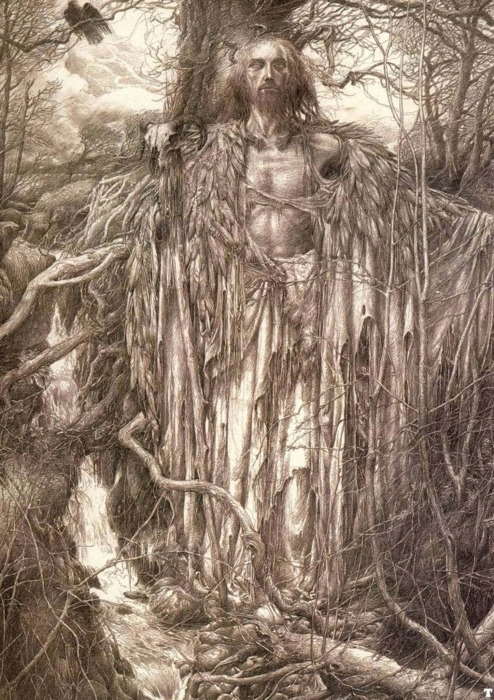
Unable to find among his own builders and engineers the technical ability to construct what he envisions, the king seeks out Merlin and asks for his help:
Merlin made answer:
Mysteries of this kind are not to be revealed but when there is the greatest necessity for it. If I should pretend to utter them for ostentation or diversion, the spirit that instructs me would be silent, and would leave me when I should have occasion for it. … [But] if you are desirous to honour the burying-place of these men with an everlasting monument, send for the Giant’s Dance, which is in Killare, a mountain in Ireland. For there is a structure of stones there, which none of this age could raise, without a profound knowledge of the mechanical arts. They are stones of a vast magnitude and wonderful quality; and if they can be placed here, as they are there, round this spot of ground, they will stand forever.
Merlin is, of course, just the person to manage this feat. The Giant’s Dance comes east to the plains of Salisbury, to “stand forever”. But wait — Merlin hasn’t finished. There’s more. The stones themselves are charmed, and of a provenance far from their apparently temporary Irish resting-place. Merlin declares:
They are mystical stones, and of a medicinal virtue. The giants of old brought them from the farthest coast of Africa, and placed them in Ireland, while they inhabited that country. Their design in this was to make baths in them, when they should be taken with any illness. For their method was to wash the stones, and put their sick into the water, which infallibly cured them. With the like success they cured wounds also, adding only the application of some herbs. There is not a stone there which has not some healing virtue. — Historia, Bk. 8, 11.
We seek for future cures, while the Merlins of our spiritual history attempt to alert us to sources of healing all around us. There is not a stone there which has not some healing virtue.
How many healings casually happen to me all the time? A scratch scabs over and even the mark fades with time. A cold passes and I recover, the hacking cough subsiding to a tickle and then to nothing. The purging of food poisoning wracks me and wrings me out, but my temperature control eventually leaves fevers and chills behind, I regain my appetite, and the memory of the nausea and dizziness and malaise slowly withdraws.
If we want the marvelous, the cause and occasion must match the healing outcome. The ordinary will not do: Mysteries of this kind are not to be revealed but when there is the greatest necessity for it.
What do we require? A wise guide and that guide’s counsel, certainly. But more: the conjunction of the potential and the place where it needs to be founded. The stones must be brought to a specific location for the desired result … if they can be placed here, as they are there …
It’s significant that the stones do not remain in Ireland. While giants placed them there for their own purposes, it takes human agency to bring them to their final location. Almost as if they had been waiting all along for human awareness to catch up to them, to finish their journey.
/|\ /|\ /|\
I don’t need to disdain modern medicine to avail myself of ancient healing. We do need the latter. Modern medicine often does an excellent job alleviating symptoms, but leaves the deeper roots of the problem untouched, often because invisible, underground. The taproot of an illness or other problem may nourish itself in causes invisible to a materialist eye. I may continue to feed its source even as I claim to long for healing. Why else is it, in our modern and supposedly healthier age, that so many Americans — more than ever before — rely on prescriptions (link to Harvard University studies) against anxiety, depression, insomnia, and so on? The stats have made headlines, but no one wants to address the root cause, because it’s sunk in the rich darkness of our cultural blindspots.
/|\ /|\ /|\
I add to my practice a henge-meditation. We needn’t bother ourselves to make any such claim as “Druids built Stonehenge” to make use of the spiritual dynamic it offers as a source of healing. Merlin sets the precedent: Stonehenge-as-symbol, in Geoffrey’s telling is older than its present home in southern England anyway. Not its origin but its power is what we need. Magic thrives when our intent makes the occasion a necessity: our focus is single and sharp not from force of will but from desire, emotion, need, want, hope, imagination, planning and preparation, ritual foundation, and love.
If I don’t move the stones here, their virtue can’t find me. Inner work is just as necessary as finding the right doctor, the proper regimen, the appropriate treatment.
Curious that the words of Jesus fit here so well: “The stone which the builders reject has become the cornerstone”. There is not a stone there which has not some healing virtue.
Highland Oak Nemeton, Fontainebleau State Park in Mandeville, LA, the magic of assembled Druids, and a sunny weekend of Gulf Coast weather in the 70s and 80s worked their cumulative spell on the 50 or so attendees of this year’s OBODGulf Coast Gathering. The spirits of the land witnessed Druids from OR, CT, VT, PA, FL, TX, LA, NE, VA, MI and other states make their way to the south-central U.S.
image courtesy Steve Cole
The workshops explored the Gathering theme “Opening The Seven Gifts” of Druidry. OBOD offers a lovely 2:30 video that presents the Seven Gifts more attractively than a bald recital could.
Our presenters kept the topics lively, sharing insights and fielding comments. Druidry needs no “outside experts” — the spiritual path generates its own.
Nonetheless, it’s always a draw to have a visiting speaker — and once again we welcomed the always-fabulous Kristoffer Hughes, one of Her Majesty’s Coroners, author, professional actor, OBOD Druid, and head of the Anglesey Druid Order in the U.K.
Kris spoke on “When the Last Leaf Falls: Death, an Awfully Big Adventure”, examining Western attitudes toward, and treatment of, the dead, and ways Druids can respond creatively and spiritually to the frequently dysfunctional nature of the Western “death industry” and its dehumanizing and ecologically destructive practices. He also urged us to bring each other in on, and discuss, our own plans for our deaths, disposal of remains, and the types of memorials we want.
Kris during his talk — photo courtesy Kezia Vandilo
Dana dispelled stereotypes of magic during her evening talk around the fire our first night, the opening ritual fresh in our memories. The following morning Richard addressed the core of Druidry — getting back in touch with nature.
Richard and Dana
Lorraine helped many meet a new animal guide, Gabby drew us to consider healing, Jacob turned our thoughts to philosophy, and I explored the awen and the potentials for inspiration. Even if [below] my gesture at one point suggests a fish story — “the big one that got away”.
photo courtesy Kezia Vandilo
We initiated three Bards and five Ovates, held opening and closing rituals, along with the Seasonal Alban Eilir (Spring Equinox) ritual, went on nature walks, and visited the Seven Sisters Live Oak in nearby Mandeville, LA.
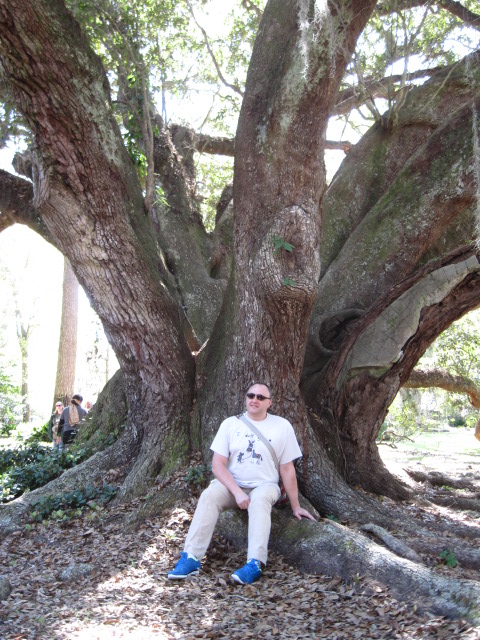
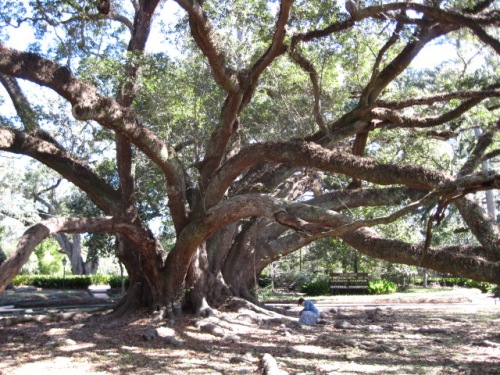
Below is our Welsh Druid guest communing with the tree, estimated to be over 1500 years old, and below that is a more distant shot to suggest something of its size.
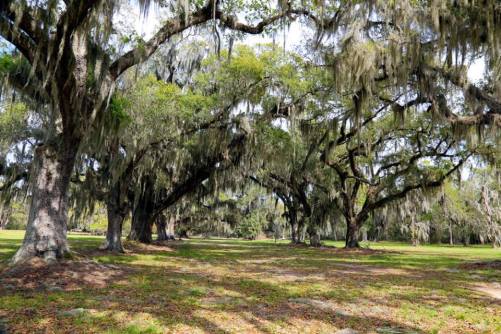
John Beckett captured an image of the atmospheric Spanish moss parasitic on so many trees south of the Mason-Dixon line.
photo courtesy John Beckett
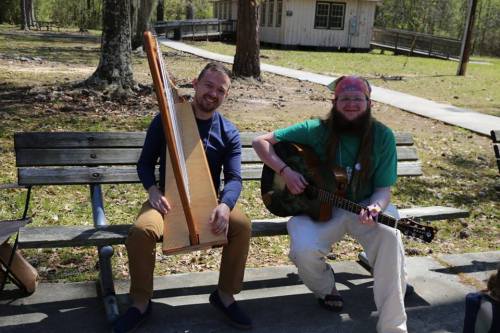
Storytellers and musicians, notably Jacob Pewitt and Brian Van Unen, made the slowly cooling evenings magical around the fire.
Jacob and Brian — photo courtesy John Beckett
What better way to leave behind the 18″ of snow in Vermont from the recent March nor’easter?!
Always, always, it’s the faces, the reunions, the collapse of miles between us, and the conversations that make each Gathering so memorable.
Don’t know anyone before you arrive? You will before you leave!
Sovereignty, Lady of an inner realm which flows ceaselessly into this one, you birth, nourish and sustain us. May my deeds serve not my own will alone, but your larger shaping for the good of all. In my words here, in my deeds, thoughts, feelings and dreams, let that light and song and fire illumine where it can, whom it may.
If conditions here no longer allow for the manifold inner purposes and directions to manifest outwardly, physical life may well withdraw from one world, moving to another. Yet in spite of the uncertainty and dark despair that may arise in our hearts from time to time, this lovely, difficult, damaged world is far from exhausting its spiritual purposes.
As a sacred laboratory for experiences for many beings, and for spirit to inhabit all lives, possibilities and forms to know itself again, the world unfolds still, rich with potential. Both established forms yet with us and new ones coming into being offer choice, beauty, misery, destruction and growth. From the small to the great, from the inner to the outer, from seed and leaf to flower and fruit, through decay and transformation and renewal, it has ever been so.
True it is, that all realms touch, intermingle and answer each other. Events here send their ripples and taproots elsewhere for good and bad, and a shift there brings about a corresponding change here. The walls of the world echo. The great wonder is not that we have no influence on life, but that our influence often exceeds our knowledge. Day to day is not always the place to look for vision, though what we see elsewhere in vision and dream returns us here to labor anew.
Because that’s what makes a uni-verse, a one-turning. We are part of the work and movement of a marvelous many-faceted whole. It’s a measure of our priorities and the fading of the ancient heritage we have received and often abandoned in our pursuit of other things that many of us no longer know this in our bones, that we have to re-learn it through often bitter experience before we can begin again to make use of it to shape something better. But our cells know better, and our dis-ease may yet call us back to here and now, our suffering may still wake us to rebellion and questioning and discovery, our losses may perhaps stir us to compassion rather than endless lament and blame and surrender.
/|\ /|\ /|\
The seed of ritual, planted. The promise of spring, uttered. The shaping of hands to make each thing happen, foretold and prefigured at the birth of each woman and man into this world, from the great family ranged behind and all around us, that family of blood and friendship and teaching in the other worlds. Ancestors, hear us.
Slowly we apprehend what is essential and what is not, the long journey fashioned and felt and followed as we abide in multitudes of forms.
For us, the essential thing is that there is everywhere a conception of the end and the beginning of a temporal period, based on the observation of biocosmic rhythms and forming part of a larger system — the system of periodic purifications (cf. purges, fasting, confession of sins, etc.) and of periodic regeneration of life. This need for a periodic regeneration seems to us of considerable significance in itself. Yet the examples that we shall presently adduce will show us something even more important, namely, that a periodic regeneration of time presupposes, in more or less explicit form — and especially in the historical civilizations — a new Creation, that is, a repetition of the cosmogonic act. And this conception of a periodic creation, i.e., of the cyclical regeneration of time, poses the problem of the abolition of “history,” the problem which is our prime concern in this essay. — Mircea Eliade, Cosmos and History.
Lady, we gather in your grove, where your blessing yields all seasons at once. You abolish time in each moment, directing us forward and back, to ends and beginning, seed and leaf and fruit and fallow time. You regenerate us constantly, your dark and bright moons, this daily sun, stars overhead — who cannot see it?
Often, we cannot. Teach us again, three by three by three.
“The Goddess of Sovereignty gives three drinks from her cup, purveying the white milk of fostering, the red milk of lordship and the dark drink of forgetfulness. These she offers successively in her aspects as Foster-Mother, Consort and Renewer” — Caitlin and John Matthews, The Arthurian Tarot, pg. 43.
Clothed in rags, we walk the streets of the cities and wastelands, forests and plains and mountains of Time.
Although now long estranged,
Man is not lost nor wholly changed.
Dis-graced he may be, yet is not dethroned,
and keeps the rags of lordship once he owned … — J. R. R. Tolkien, “Mythopoeia”.
/|\ /|\ /|\
“If wishes were horses, beggars would ride,”
(some wishes are horses – watch out where they stride!)
but my words are wingéd – they fly to your side
to wish you a happy New Year ’17.
It’s not for myself that I say it – I mean
may you flourish and grow, whatever the weather:
as long as we’re in this, we’re in it together.
Mantle of Brighid about me,
Memory of Brighid within me,
Protection of Brighid around me
keeping me from harm,
from ignorance, from heartlessness,
this day and night,
from dawn till dark,
from dark till dawn.
— John O’Donohue (adapted), The Four Elements, Transworld Ireland, 2010, pg. 109. (Also available in Random House editions.)
I find in this poem a prayer most fitting for these darkening days till Yule and sun-return (never mind the ritual season). I add to it these visualizations as I say the opening triad of actions:
I see and feel the soft, warm cloak of Brighid furl and drop around me. I touch the weave of the cloth. I see the mantle extend outward, expanding the presence of Brighid all around me. “Beneath your mantle you gather us.”
I feel the memory of Brighid arrive as I whisper her name, her presence in thought and feeling, in the hearth-fire, in human warmth and affection, in animal caresses, in the sun’s brightness, hidden behind clouds or yellow in the December sky. Her mantle means we help manifest her, bring her here. “Remind us how to kindle the hearth.”
I feel the awen of the divine kindling in and around me whenever I put off despair and choose better. I sense the awen in others, upholding me even as I uphold them. I name them now, sitting or standing before any fire or flame or light, which I declare Brighid’s fire and flame and light.
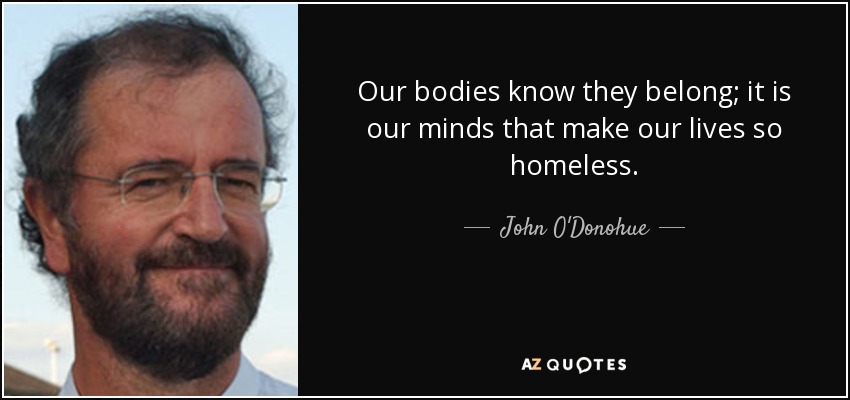
O’Donohue writes: “One of the reasons for the modern poverty of spirit is amnesia. Even though there is a great harvest of healing energy within memory, people seem to make so little use of it. Rather than living from this harvest within them, they seem in the demented rush of modern life to live more out of their poverty” (pg. 113).
I hold my hands up before me and say more of this prayer-poem:
To keep it bright,
to preserve the flame,
your hands are ours,
our hands in yours
to kindle the light
both day and night.
And then I close, repeating the opening triad once or twice more as it feels right.
Mantle of Brighid about me,
Memory of Brighid within me,
Protection of Brighid around me.
And I see Brighid’s cross, feel it foursquare, if I receive no other intimation of the goddess. I sein my thoughts, feelings, and actions of the day with it, sometimes continuously through the hours if I need it, to preserve, preserve, preserve the flame.
To begin this post I invoke with the words of a great Bard, the late Leonard Cohen, who sings in his song “Anthem” : “Ring your bells that still can ring./Forget your perfect offering./There’s a crack, a crack in everything./That’s how the light gets in.”
/|\ /|\ /|\
Doing my small part to ring some bells and locate some nearby cracks to work with, it’s been in my thought more and more to explore Wantastiquet. But it took word of another’s recent climb to the peak to prod me into visiting this local treasure. As a Nigerian acquaintance said to me recently, quoting an African proverb, “Those who live nearest the church arrive late.”
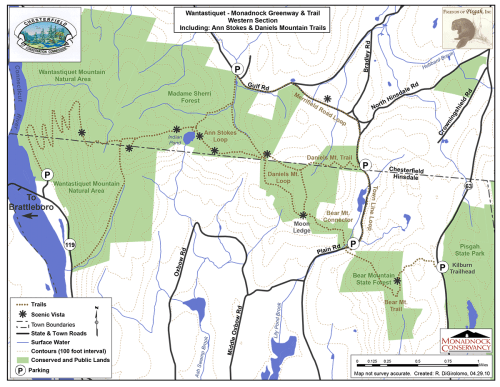
Just over the Connecticut river east into New Hampshire, Wantastiquet Mountain rises to approx. 1350 feet. It’s a moderate 1.5 mile hike to the summit — about an hour’s walk along numerous switchbacks for this 57-year old. From downtown Brattleboro it’s a little over half a mile to the foot of the mountain, so plenty of hikers and their dogs were out enjoying the afternoon. The sunny weather hovered in the mid 50s, oak leaves carpeted the trail all the way to the top, and as mountain treks often do for me, the climb had the feel of pilgrimage. There is a berg-geist, a mountain spirit, if I silence the mind chatter and attend. The rumble of weekend traffic from nearby interstate 91 which the river valley amplifies begins to fade around 500 feet up.
The site is a perfect shanshui — landscape, literally “mountain-water” — one of my favorite Chinese words from a year in the mid-80s spent teaching English in the People’s Republic of China. The Connecticut river valley defines the state line between New Hampshire and Vermont for 150 miles, and seen from the west, the peak appears to ascend right out of the river. Here’s a view from perhaps 70 feet up on the trail, looking back toward Vermont.
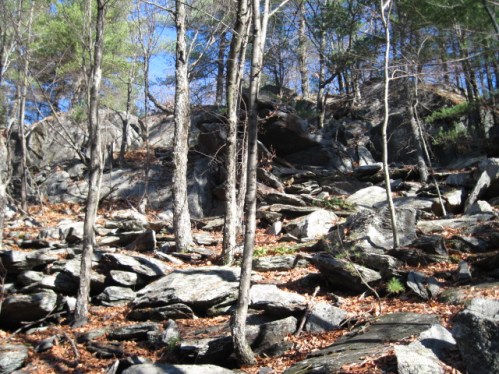
Evergreens march along either side of the path, but the few remaining leaves on oak branches above them account for the trail’s leaf cover.
The pines and oaks busy themselves both splitting the rock and holding it in place.
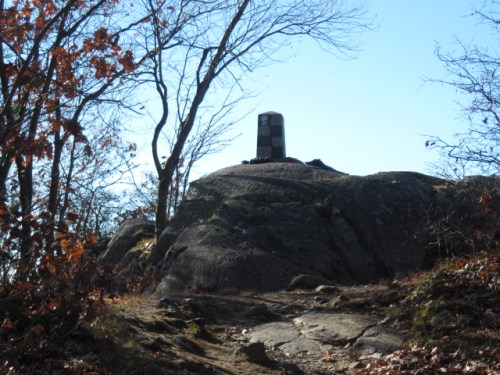
Gathered near the marker at the summit were several resting hikers who left shortly after I arrived.
In the distance, the peaks of Ascutney (45 miles north) and Hogback (13 miles due west) loom through the haze.
I’d gathered a handful of acorns along the way, thinking to plant them as I establish my grove at home. But as I neared the top, an impromptu ritual (my favorite kind) threaded into my attention and I made an offering instead. Finding a clearing a few hundred yards away, I bowed to each direction.
Beltane’s nearly upon us, and Alison Lilly’s most recent blogpost “Holy Adoration: Fire as Prayer” catches the energy behind this fire festival. For it is after all the day of the Fires of the Celtic solar god Bel, as even a traditional source like the BBC calmly informs us on their website. Some seasons you’ve just had enough of the world, and most of all yourself as a tame fire, to paraphrase Alison. Do check out her blog. She evokes and invokes Beltane in a personal and poetic meditation.
You too may long to spark, flare, burn and roar. Heap the kindling of my life and ignite, you whisper — or shout. Beltane is here for you.
Part of the Bardic training of Druid groups like OBOD and others, and much of the initial work in the outer grades of the magical Order of the Golden Dawn focuses on exploring and balancing the elemental energies flowing in and around us. We don’t — normally — want to burn up or out. But a healthy conflagration may burn off the wintry torpor that clings to our mood and outlook. Beltane is tonic, purgative, exhiliration, ignition.
The symbolism of the four physical elements of earth, water, air and fire persists in the cultural and magical imagination of the West because they express important truths about human life. They serve as a powerful shorthand for a whole cluster of ideas, images, experiences and memories, and their presence in ritual and story, song and myth will endure as long as we inhabit the same worlds where they manifest.
Their existence as physical entities endows them with the further potential to serve as sacraments. As always, though we keep forgetting, reverence and engagement are our choice, an opportunity like any other that we may welcome or reject. Here, too, fire can kindle us to possibility and change.
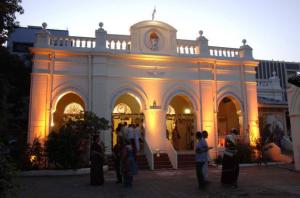
Fire Temple, Chennai, India
Further afield from Celtic-flavored European Druidry, fire is also central to the religious practice of Zoroastrians, the people popularly known as Parsis. Their Fire Temples offer just one more illustration of why reducing fire to an explanation like “rapid oxidation in an oxygen-rich environment like earth’s atmosphere” says nothing about our actual experience of fire, its light and warmth and flickering presence, and its long association in human consciousness with spiritual reality, energy and life. Anyone who’s experienced a good bonfire knows this to some degree. It’s our human art to extend these experiences and celebrate their effect as spiritual opportunities for transformation and joy.
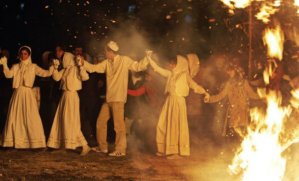
Zoroastrian Sadeh Festival
Fire calls to ancestral human memory. Cultural practices and beliefs that center on it only endow it with additional significance and power. Druids may say as part of ritual “Let us pray with a good fire,” an invocation traceable to the worship of the Hindu Agni and a hymn in the Rig Veda (Bk. 1, 26). And Wendy Doniger in her translation* notes that “When Agni becomes the priest, his robes are both the flames and prayers.” Thousands of years of human experience with fire has not dulled its power.
/|\ /|\ /|\
Whether you’re part of an OBOD Beltane gathering that follows the traditional ritual, or some other group and ceremony, or you’re a solitary celebrating alone in your own way, may you too share that shiver of anticipation and delight as the day and the rite opens for you at the birth of summer. May you and the Sun both grow in strength. “By the power of star and stone, by the power of the land within and without, by all that is fair and free, we welcome you to this rite of Beltane …”
After a complete slug-down from posting, brought on by a harsh bout of flu and subsequently a general lethargy, A Druid Way is back for a 30-day series on each day’s energies and perspectives. (Say awen, somebody. And all the freeze-dried grasses in my lawn say it, in their rustling speech. The tree limbs say it, and the twigs and branch-ends that have reddened and yellowed and greened with rising sap say it wordlessly, all night and all day long.)
/|\ /|\ /|\
Long-time readers know I largely shy away from big social issues of the day. You’ll see very few comments here about politics, gay rights, abortion, race, the primaries, terrorism, climate change — the stuff of American and world headlines and the churn of the news cycle. I’m more interested in the opportunities each of us has to grow and love more in the small chances and changes right here. You could say that’s a kind of pure selfishness. And it is. We’re all engaged in self-crafting, one way or another. One way doesn’t negate another, I hope.
And I find these moments most easily not in the noise of our sometimes poorly-wrought human world, but in the silences when our human chatter subsides. When we can’t hear ourselves think, we too often think things that aren’t worth hearing. Or saying, though we keep on talking. Consider this blog a partial fast from the noise of the moment. Of course it’s a a fast in words, but paradox should be an old friend by now.
Don’t worry — if you really miss the latest batch of outrage and disaster and doom, they’ll keep till you’re done here. Rest easy, now. A few clicks will bring you right back into the middle of them. Many traditions invite us into silence, not to live our entire lives there. Speech matters. But to live always next door to silence, to befriend it, to let it teach us, to be rest and a refuge for us, as a true friend can.
The noise of the moment is of course one more testing ground. You CAN find many valuable lessons there, and you can hone your sense of rightness and justice and value to a keen edge, burnish them to a high sheen. (How much does my activism activate?) But we live mostly in the spaces between such tension points, and there I find rich terrain that never grows stale or flat. A half hour in the air and light, with birdsong or fog or frost and wind, is enough to restore a balance point that can go badly awry if we neglect the spiritual recalibration nature offers. Getting and spending, we lay waste our powers, says the poet.* But that’s only because what we mostly expect and work to get and spend a bunch of things that do not serve our highest good. How does a tree spend its powers, and does it have anything to say to me today?
Here for a reason, I say. Others scoff. Well, make your own reason. Then improve it. Better than drifting without one at all. Been-there done-that material. BTDT, as my wife and I say to each other. So try something you haven’t done, go somewhere you haven’t gone, says the awen in me, the awen spread across this blue cool late March sky.
Equinox energy is real. You can feel it in the stirring of so many things, blood and light and dream, storm and desire and birdsong. Not by accident do many magical and spiritual orders align their rites and festivals to the Equinoxes. Initiate then, in any senses of the word, and you catch a wave that can take you very far indeed. Out to the far isles beyond the horizon, where the Otherworld beckons beyond the ninth wave. In to the inner-verse that is always waiting like a beach after storm, strewn with all manner of oddments and debris, the flotsam and jetsam and occasional treasure you’ll find nowhere else. The one thing you need right now, washed up on your own shore, ready for the receiving into your hands. The spring break of the spirit, drunk with fear and longing and possibility.
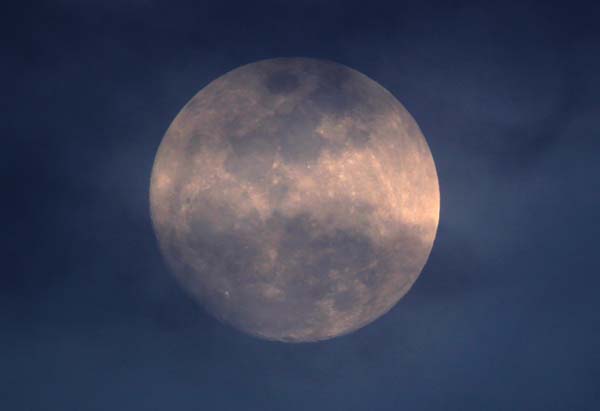
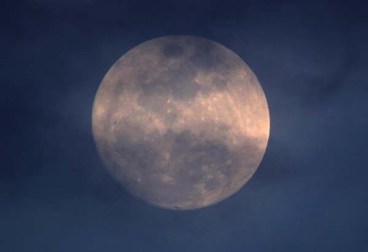
Ah, tonight, first full moon of spring, rising in us, mounting the sky, stepping toward mystery.
/|\ /|\ /|\
*Wordsworth.The Bards still keep trying to reach us, teach us, anything that doesn’t merely preach to us but means what we seek.
[This is an early version of what is becoming a page on Ritual, a link from the header menu above.]
From small rituals like shaking hands vs. bowing, or saying your culture’s equivalents of “please” and “thank you,” to family traditions at the holidays, and outward to public ceremonies like reunions, annual festivals, weddings, funerals, ship-launchings, inaugurations, dedications, etc., ritual pervades all human cultures.
Even animals exhibit ritualized behavior, if we count courtship displays, and dominance/submission behavior in pack and herd animals. What is instinctive in animals becomes conscious among humans, and though anthropologists and psychologists have developed a range of explanatory theories, none captures all the richness, variety and potential power of ritual.
Whenever I catch myself thinking “empty ritual,” I realize I’m what’s missing. Ritual is simply a form, like a recipe or dance move or martial arts kata. And like a kata, it’s “a routine or pattern of behavior that is practiced to various levels of mastery,” as the Wikipedia entry for kata puts it.
So if my heart isn’t in it, if the pattern-making doesn’t hold my attention, if it doesn’t carry significance to me, it will naturally feel empty to me — because I haven’t filled it with my dedication, my energy and imagination, my preparation, my sense of participating in something larger than myself. The essential component is me. If we want meaningful rituals, it’s up to us to create them.
Families and friends develop rituals to celebrate their relationship — you may have our own examples of a favorite gathering-place, in-group slang and allusions to past shared events opaque to outsiders, and so on. Humans are meaning-seekers and pattern-makers. Ritual is one expression of how human consciousness works.
/|\ THE WHEEL OF THE YEAR
Ritual is simply another tool, and Druidry as an earth-centered spirituality includes the ritual celebration of the seasons. The eight-fold seasonal cycle common to Wicca and Druidry and many Pagans generally is a modern conception. It appears to be the happy result of a collaboration, or at least of mutual influence, between Gerald Gardner and Ross Nichols. In the middle of the last century they were inspired to merge the four Fire Festivals of the Celts of early February, May, August and November with the equinoxes and solstices. The names we give the holidays may vary, but roughly every six weeks you can find a festival marking the turning of the Wheel of the Year.*
Ritual can be magically simple, and needn’t take place only on one of the “Great Eights.” Ritual needs nothing more than you and your intention. You visit a favorite meadow or grove or stone outcropping, and you whisper to yourself a favorite poem, maybe even a verse — simplicity itself — like “This is my rock” by David McCord:
This is my rock
and here I run
to steal the secret of the sun;
This is my rock,
and here come I
before the night has swept the sky;
This is my rock,
this is the place
I meet the evening face to face.
/|\ /|\ /|\
*The Wheel of the Year
October 31 – November 2: Hallowe’en, Samhain/Samhuinn, All Hallows Eve, All Saints Day, All Souls Day, Todos Santos, Day of the Dead, Dia de Muertos.
December 20-22: Yule, Winter Solstice, Alban Arthan.
February 1-2: Imbolc, Oimelc, St. Brigid’s Day, Groundhog Day, Candlemas.
March 20-22: Spring Equinox, Ostara, Alban Eilir.
May 1: May Day, Beltane, Bealtainne, Walpurgis Night.
June 20-22: Summer Solstice, Midsummer, St. John’s Day, Litha, Alban Hefin.
August 1: Lughnasad/Lunasa, Lammas(tide).
September 20-22: Autumn Equinox, Alban Elfed, Mabon.
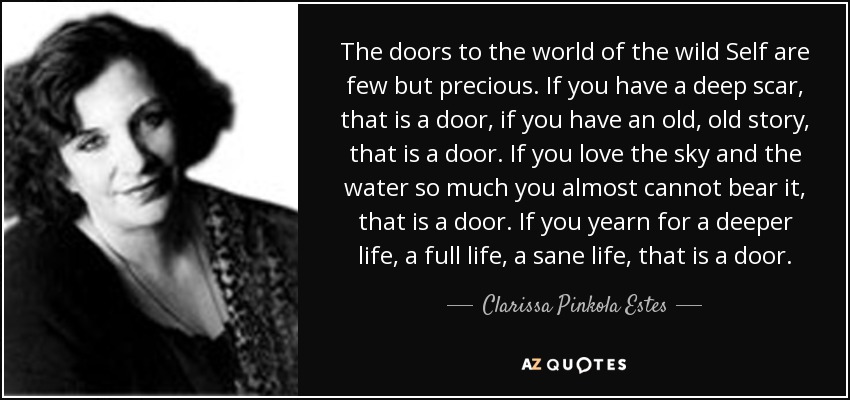
You can find out more about Clarissa Pinkola Estés here.
In part, the doors Estés refers to are a matter of human time. Live long enough and you’ll very likely wear such scars, carry such stories, cherish such loves. One way to find common ground with others is to focus on these doors. And one of the best ways to access them is by careful listening to ourselves and to each other.
Often enough, we may fear such a world and such a self as much as we yearn for it. A doorway means change. Even if it just opens onto another room, it’s not the room we were in a moment ago. Fears can outline such a door, too — including fear of a door itself. If you’re anything like me, you know or have been someone who at one time or another has walked into a cage and exulted as it clanged shut behind you, reassured that at least you wouldn’t have to walk through yet another damned door.
How to recapture the sense of the preciousness of these doors, as Estes calls it? For in the end our own longing compels us to find them and walk through. Ritual is one way, though by no means the only. By defining boundaries in ritual we can make a door easier to see and peek through. If the past is difficult country for me, I can approach it with safeguards in place. Ritual can help with its prescribed beginnings and endings, its containers of energy and wisdom we can safely draw on at need for balance and perspective and protection. A holiday like the upcoming Samhain, like Hallowe’en, a holy evening for remembering who and what has passed from our lives, offers a safe space to honor and to say farewell to what is gone. Sometimes all that is needed is for us to agree that we can finally let go.
One of the most moving Samhain celebrations I’ve ever experienced was organized by a high-school student — I’ll call her C. — who during her senior year led the Alternative Spiritualities group I advised while teaching at my former school. C. was an atheist who deeply understood the power of ritual theater. Under her leadership, our meetings often were focused discussions about perception and consciousness. Ritual, however, happened just once.
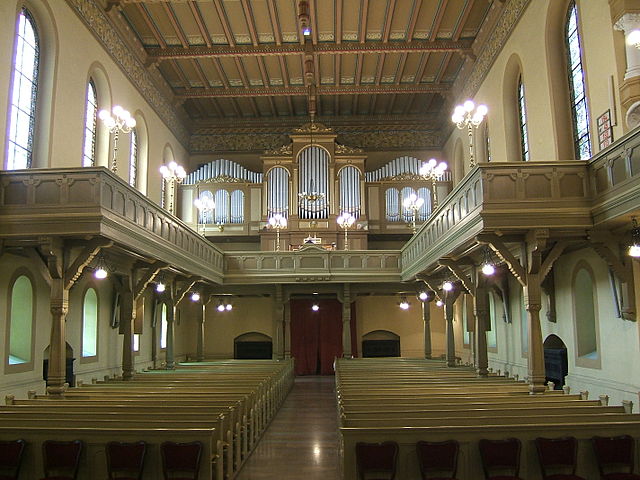
Interior of a Protestant church, looking from the altar toward the rear entrance.
Halloween fell on a Saturday that fall, as it does this weekend. Just after sundown a group of perhaps a dozen students and I gathered in our school chapel with its old, austere New England style, opened the windows — it was a mild October evening — and lit incense and candles. You take, and make, doors where you find them.
C. briefly explained what we’d be doing, then gathered us in a circle, led us in a simple chant and circle dance, and at length asked us to recall someone or something we wanted to say goodbye to. Any script C. had was entirely in her head. The ritual flowed smoothly because everyone knew its purpose and no one was worried about making mistakes. After all, you couldn’t go off-script. Both tears and laughter fit any moment of that evening.
We each wrote the name of this person or thing on a slip of paper and folded it tightly. One person collected them, and then ceremonially burnt them in a large bucket of sand in the center of our circle on the chapel floor. We chanted as the smoke rose, and I saw several students crying quietly. We cleaned up and sat on the altar steps for candy and snacks and soda, sugaring ourselves into a lighter mood. Many students said at our next meeting the following week how meaningful the experience was for them.
Reclaiming the wild self is work we’re all doing. Much of what I try to write about here is an attempt to document my journey to do just that, along with my sidesteps, mishaps, meanderings and insights along the way. We may call this spiritual objective by different names, but the deep yearning in us is the same, if we stop and talk with and listen to each other. We can if we wish walk part of the way in each other’s company.
May you find such doorways on your own journey, and may they be blessings.
This last weekend marks the 5th East Coast Gathering I’ve attended, the 6th since its launch in 2010, and another gift of Spirit and mortal effort.
You can read my accounts of three of the previous years: 2012 | 2013 | 2014. A special thank-you to John Beckett, several of whose professional photographs illustrate this post. You can visit John’s own articulate and insightful blog “Under the Ancient Oaks: Musings of a Pagan Druid and Unitarian Universalist” over at Patheos here.
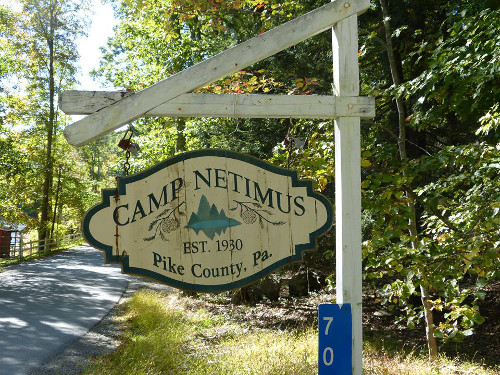
Camp Netimus — site of the ECG. Photo courtesy Krista Carter
Registration for the weekend filled within 20 hours of opening this last spring. Gatherings like this answer an obvious need in the Druid and Pagan community, and more are in the works in other locations. It’s on us to help make them happen. A dedicated team can bring the same joy, support, inspiration and community to other regions.
Yes, we’re all solitaries some or much of the time, but every solitary benefits from celebrating and learning in the company of others. That chance conversation, ritual insight, day- or night-dream, word or phrase that lights up just for you, the hugs you give and receive, the opportunities to serve the community through offering a workshop, cooking, cleaning, organizing, driving — these make Gatherings like this such richly rewarding experiences. The dark and light halves of each year are real, and we need all the help and laughter we can find to thread our way through the labyrinth of time.
/|\ /|\ /|\
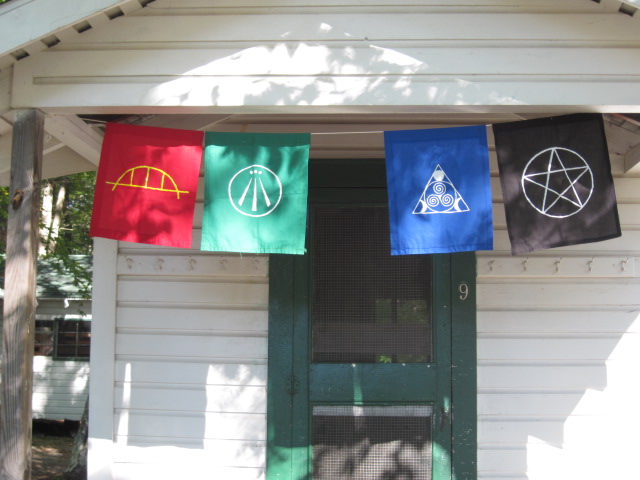
I arrived Thursday afternoon early enough to check in and unpack before the opening ritual. My cabin mates had already hoisted a banner, which also made the building easier to distinguish from the others in the dark, when the “9” on the door was no longer readily visible.
Cabin banner. Photo by A Druid Way
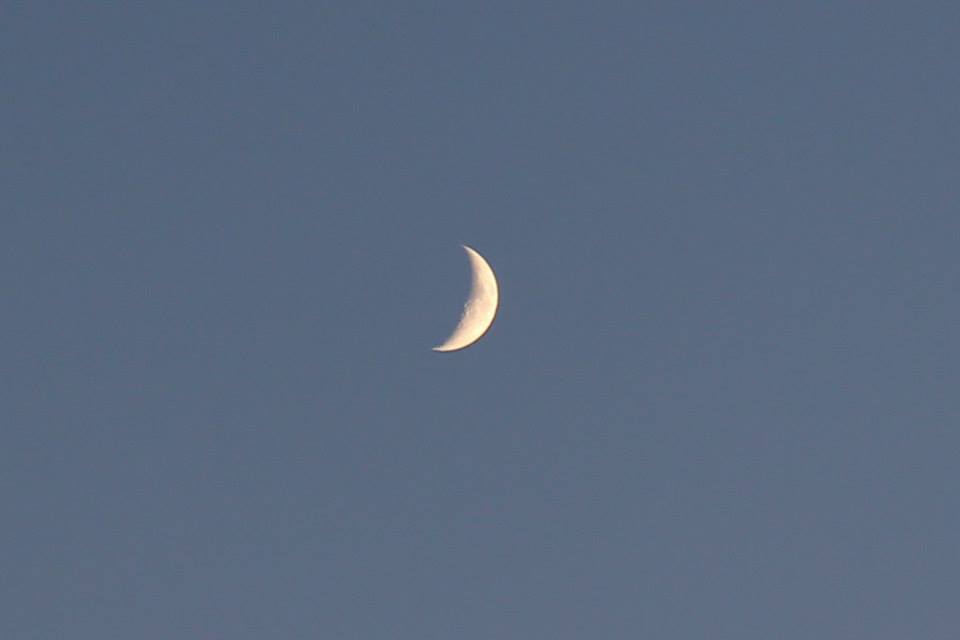
Equinox marks the shifting energies of days and nights, rebalancing the world. A lovely moon bore witness, waxing each evening through wonderfully clear skies, lighting the path to evening events like the Ovate initiation ritual and illuminating the short uphill walk from the cafeteria to the nightly fire circle.
Crescent moon in a twilit sky. Photo courtesy John Beckett
The theme this year was ritual, and the whole weekend focused our attention on its magical possibilities through a dozen workshops, demonstrations and ceremonies. You can get a sense of the range of approaches from the list of workshops here. We also welcomed returning U. K. guests Damh the Bard, Cerri Lee, and Kristoffer Hughes.
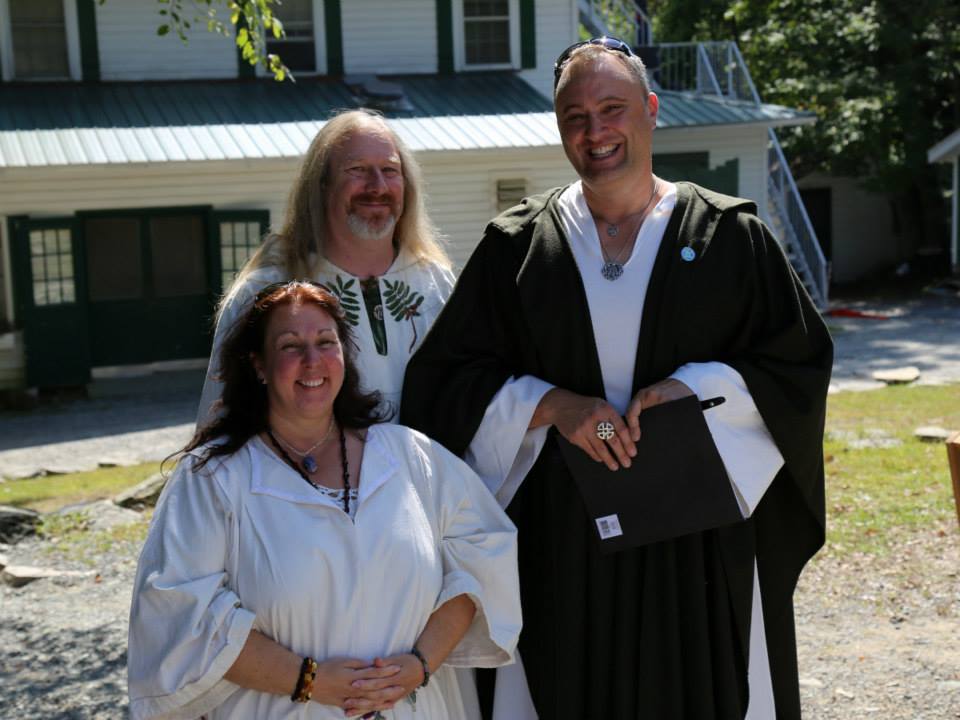
Cerri Lee, Damh the Bard and Kris Hughes. Photo courtesy John Beckett
/|\ /|\ /|\
Damh’s workshop on “The Bardic Voice” underscored the centrality of the Bard in Druidry. Like many Druid groups, OBOD orders its teaching in the sequence of Bard, Ovate and Druid. But they do not form a linear progress or erect a hierarchy of achievement. They spiral. In an Ovate breakout group a day later, several people mentioned how they often return to the Bardic coursework, its insights deepening through their Ovate practice. And likewise with the work of the Druid grade.
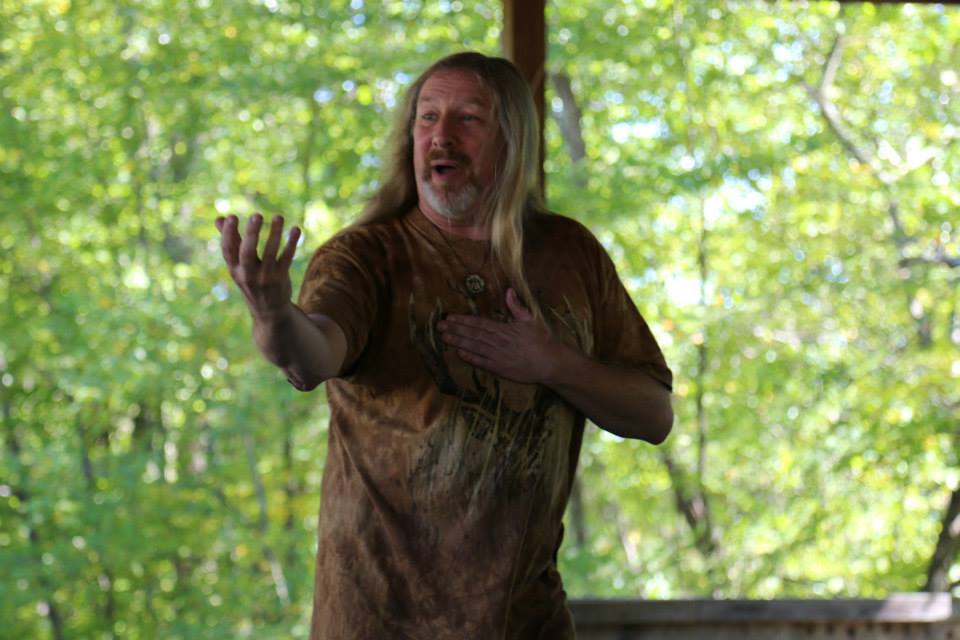
Damh is a fine teacher, an animated storyteller and ritualist of deep experience. With his wife Cerri he leads Anderida Grove. [For an audio inspiration, listen to his hour-long recording for inner journeying here.]
Damh in teaching mode. Photo courtesy John Beckett
/|\ /|\ /|\
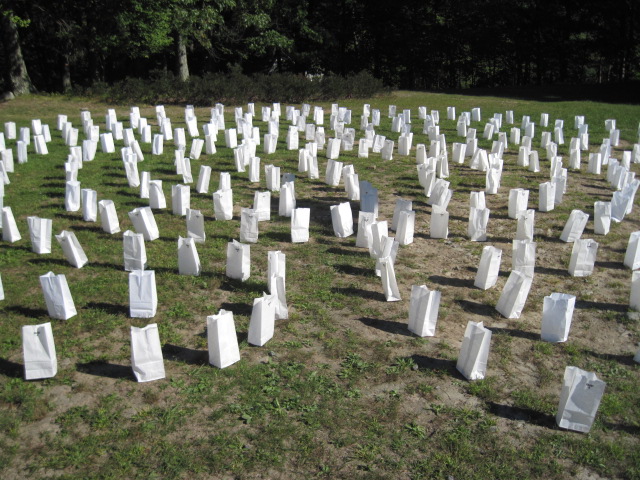
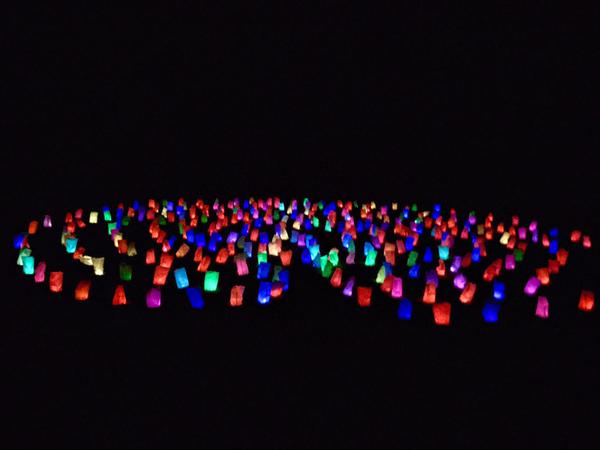
Reminders of ritual possibility filled the weekend. Below is a picture of a labyrinth, another gift of the weekend, lovingly constructed by Cat Hughes and friends.
Labyrinth by day — entrance. Photo by A Druid Way.
Volunteers switched on each light every evening, then turned them off again when everyone else had gone to bed.
Labyrinth by night. Photo courtesy Damh the Bard.
/|\ /|\ /|\
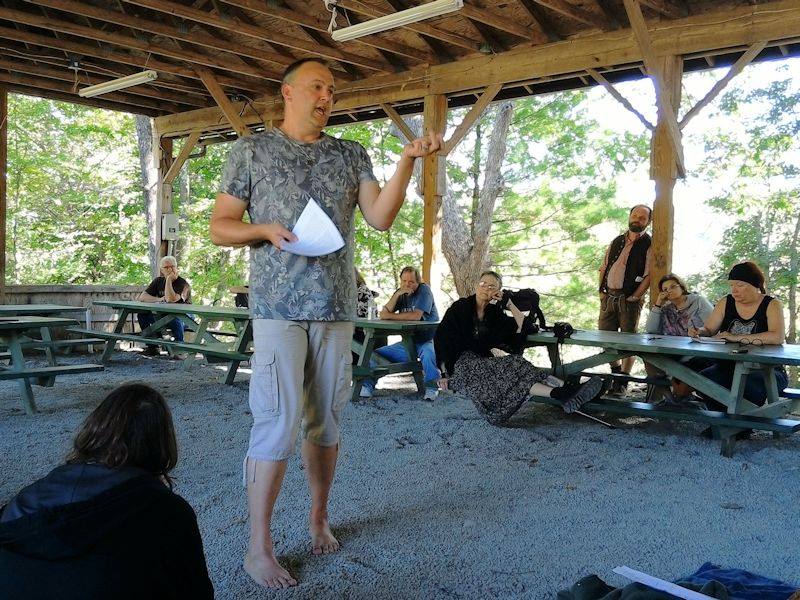
Kris’s workshop, “Laudanum, Literature and Liturgy — the Ritual Legacy of Iolo Morganwg,” featured the ritual — in Welsh — that Morganwg first performed on the Summer Solstice on Primrose Hill (London) in 1792, launching the Druid Revival and establishing the Welsh Gorsedd of Bards. Morganwg is also the author of the Druid’s Prayer, still used in many modern Druid groups including OBOD, and a major influence on generations of Druids from his time to the present. Kris’s Celtic eloquence in praise of Morganwg and his passion for Druidry took him off script and left many of us with tears in our eyes.
Kris during his workshop on Iolo Morganwg. Photo courtesy of Dana Wiyninger.
/|\ /|\ /|\
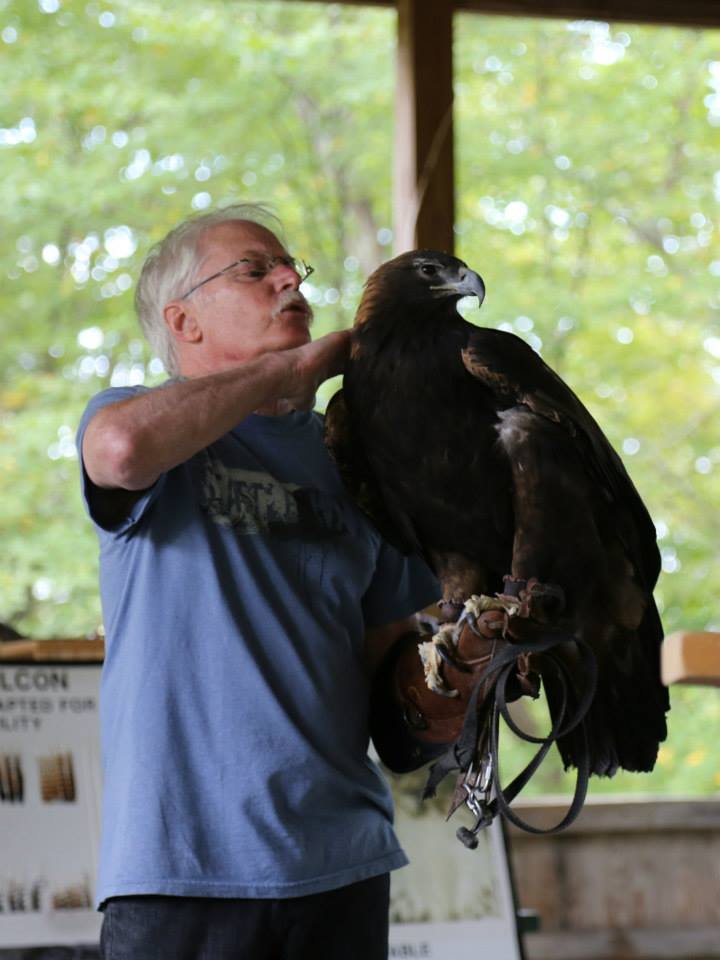
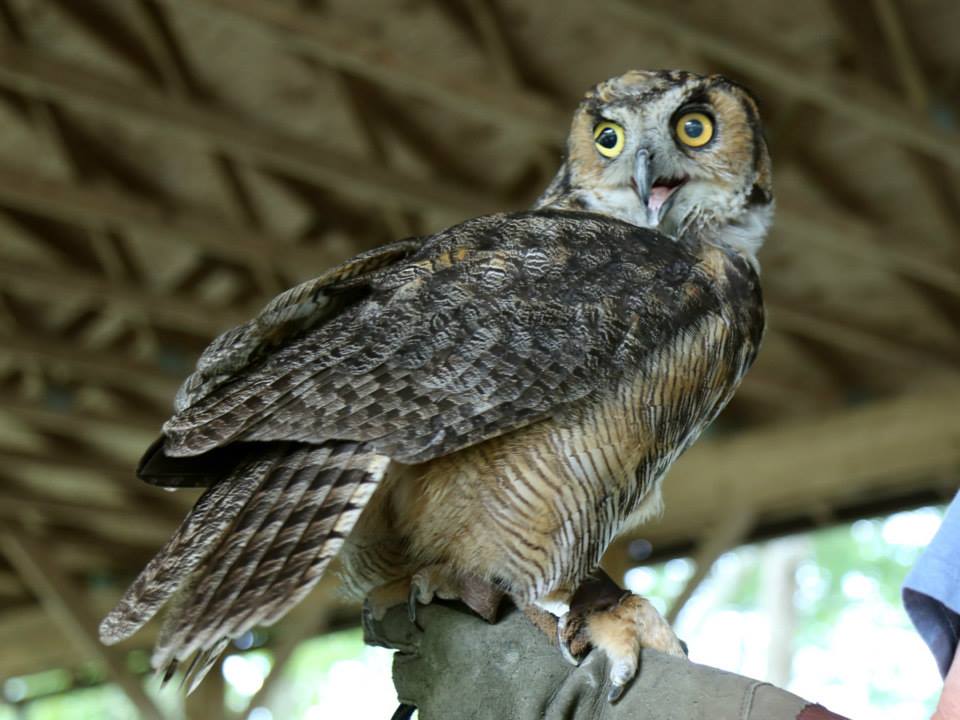
Bill Streeter from the Delaware Valley Raptor Center, the charity designated for this year’s Gathering donation, brought six birds and made a fine presentation on raptors, their abilities, the dangers (mostly human) facing them, and the challenges of rehabilitating injured birds.
Bill Streeter of the DVRC with a golden eagle. Photo courtesy John Beckett.
These magnificent birds have often suffered neurological injuries that worsen over time. Though both the eagle above and the owl below look normal, both are blind in one or both eyes, or suffer other injuries like crippled wings, and thus could not survive in the wild. But the birds help save the lives of their kin through their appearances in info sessions like this one.
Great Horned Owl. Photo courtesy John Beckett.
/|\ /|\ /|\
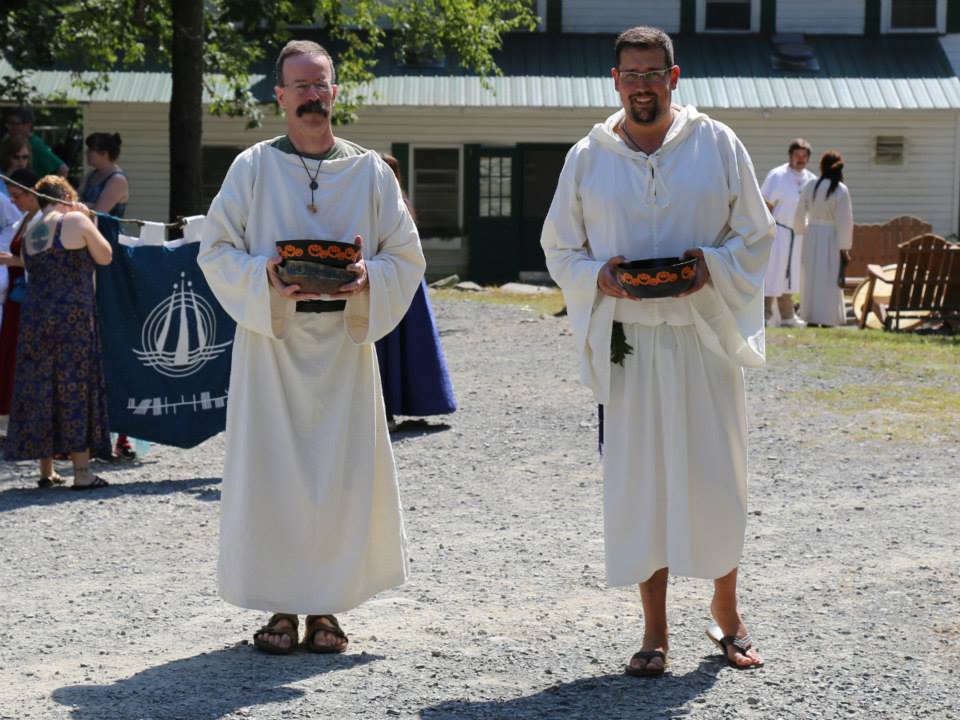
The Alban Elfed ritual celebrating the Equinox includes gifts from children, guests and each of the three grades of Bards, Ovates and Druids. Here are Chris and I holding bowls of acorns, part of the Ovates’ ritual gift, just before the ritual procession into the Circle.
Chris (r) and I (l) just before Alban Elfed ritual. Photo courtesy John Beckett.
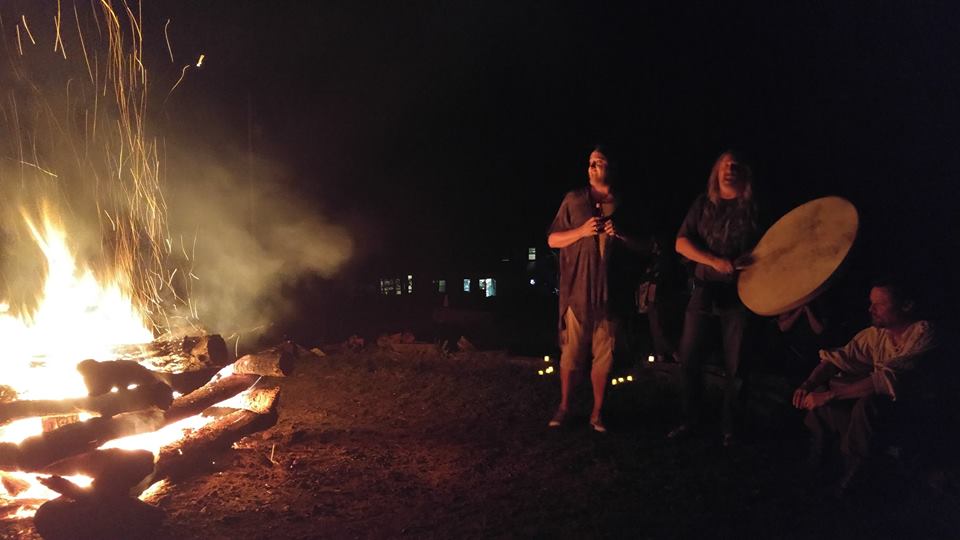
The evening eisteddfod (music and poetry circle) one night featured a splendid duet from Kris and Damh — see the image below.
Kris and Damh singing at the fire circle. Photo courtesy Hex Nottingham.
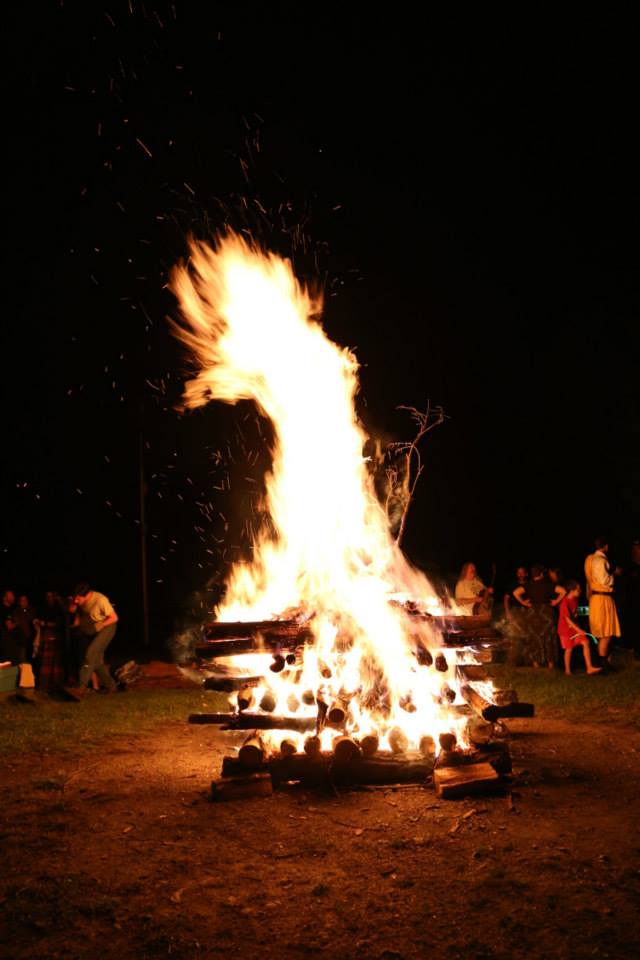
Below is another pic of the fire circle one night. Our enthusiastic and skilful fire-makers Derek and Brom love large, carefully-constructed bonfires.
Evening bonfire. Photo courtesy John Beckett.
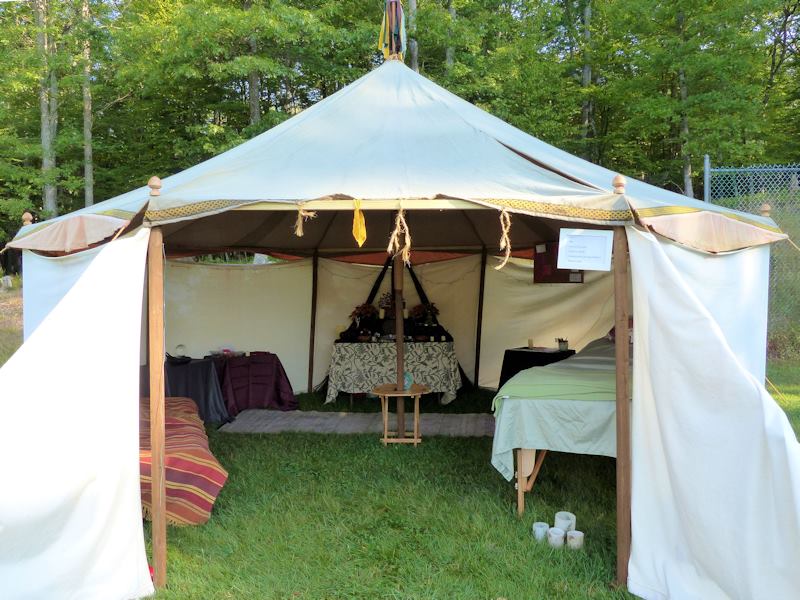
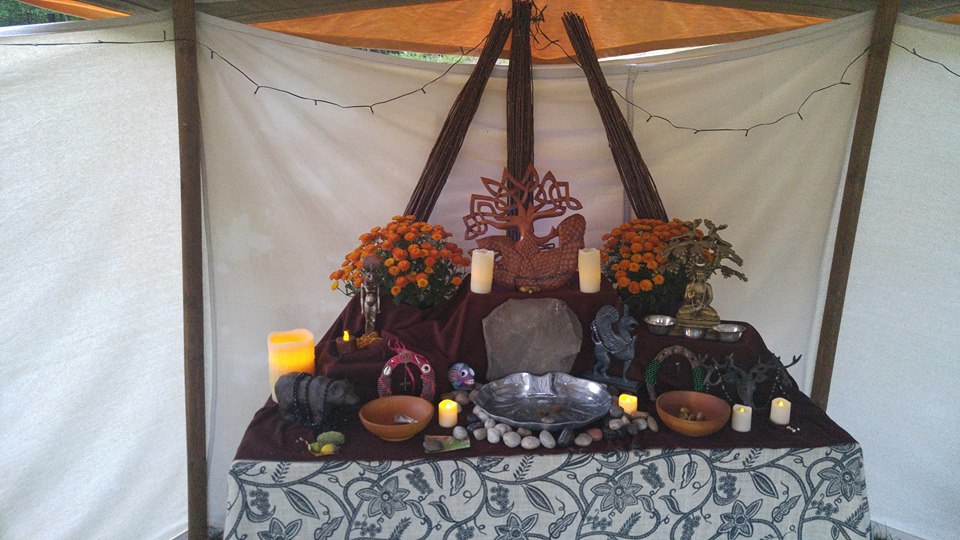
Once again Dana set up her meditation tent on the campground for all to visit and enjoy.
Approaching the tent. Photo courtesy Dana Wiyninger
Altar in Dana’s meditation tent on the camping field. Photo courtesy Hex Nottingham.
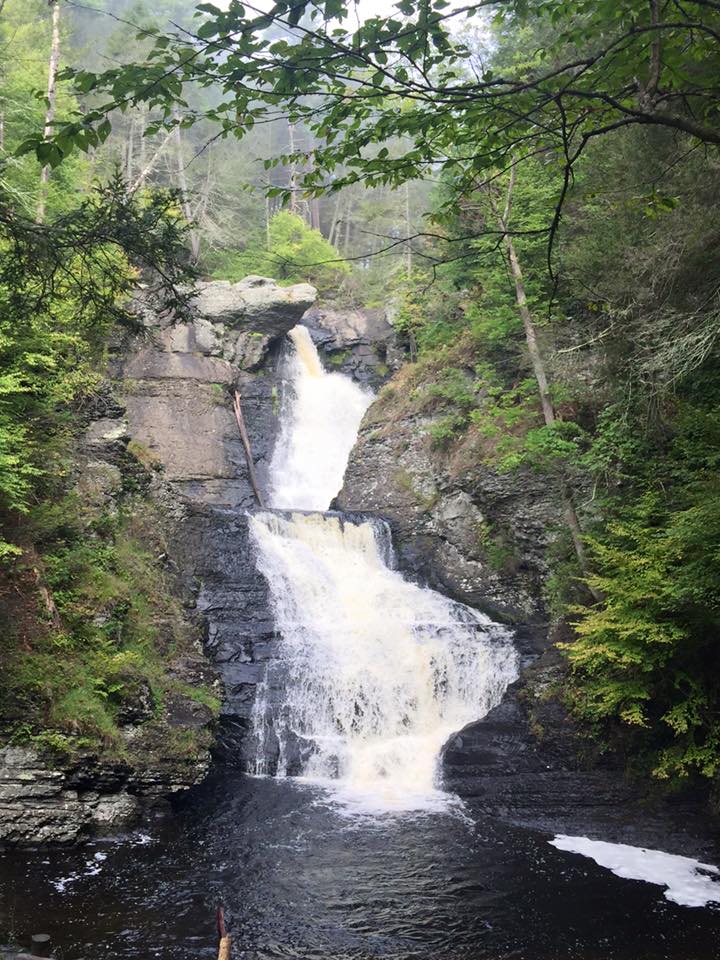
A small group made a side excursion to nearby Raymondskill Falls. Here’s a view of one of the waterfalls.
And for those of us who can’t wait an entire year, the Gulf Coast Gathering will celebrate its second year in March 2016. Blessings of the Equinox to all!
Anciently, Ireland was known as Inis Fail, the Isle of the Lia Fail, the Stone of Fal from the magical city of Falias and the Goddess Danu, one of the Four Hallows of Ireland, also called the Stone of Destiny, which roared when a true king sat or stood upon it. The Isle of Britain was called Clas Myrddin, Merlin’s Enclosure, and continuing the island theme, its holy and magical city Glastonbury was Ynys Witrin, the Isle of Glass. Such lore can indeed take you some way along a path, the names themselves an invocation as magical as any.
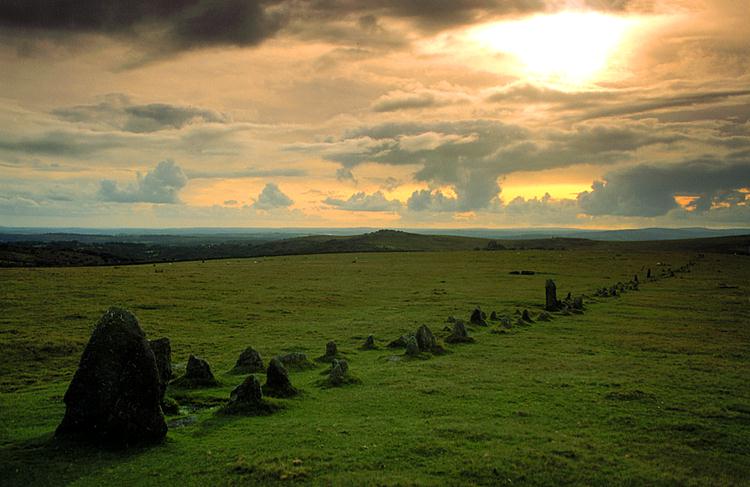
Merrivale Stone Rows, Devon
Outside of Britain we may well long for our own mythological names, gestures of respect and power toward the spirits of the land, honoring them with noble names, and opening doorways. Yes, by borrowing for an interval a tongue from across the Water and bowing to our ancestors of spirit from there, we could do worse than call North America by one of its native names, Turtle Island, rendering it in Welsh: Ynys Crwban. Old tongue, New World. But the spirits here aren’t Welsh, and they’re wilder, and steeped in their own ways and works.
Still, Earth and Stone are North, and Winter, and Night. I sit and calm myself, finding the Pole Star in inner sight. The sky’s too cloudy for it outwardly, with a light snow falling most of the day and into the evening. I do a private ritual, and then in vision I’m drawn toward a stone circle. But instead of the broad windswept Salisbury Plain, and the great Henge there that all know, I’m given to see a different circle. Here the stones set their feet deeper, cradled in earth. The place feels both older and more intimate. The lintels stand just chest-high, low enough I can see over their tops and into the circle, which is some twenty feet across.
Vision wavers for a moment. Briefly I’m back and conscious of the room. Yes, I sit here in Vermont, just feet from snowdrifts outside the window, but in vision rough gray stones rise from a green cloak of moss that more than half-covers them. I’m there again. To enter the circle I have to go down on all fours and crawl through the space between two uprights and a heavy lintel. My palms and legs rub against the cool dampness. The rich chocolate scent of earth fills my nose — leaf-rot, moss, lichen, chlorophyll — the planet’s kitchen working, working endlessly. Each pace forward and I move over lives too small to see unaided. But they’re still here. Then I’m inside. I begin to sense an invisible dome overhead, a kind of presence shaping the space. The stones hum just below hearing, holy engines, the sound stillness makes, not empty at all.
Suddenly needing their strength I rise to my knees and hug an upright stone, its cool solidity reassuring against my arms and cheek and chest. With that, the welcome surges through me. You’re here, you’re here, we say to each other. In that instant I don’t worry who or what I’m talking to, only that we’re glad to be together — together again. This is not the first time for any of us. I spin in a half-dance, half-frenzy, soon enough falling dizzily to the ground. Wetness on my face — rain, tears, I’m not sure which. Both. I am earthed, spent, embraced, recharged, home.
A log shifts in the stove in the next room and brings me back. Now is the hour of recall, goes the line from OBOD ritual. The Circle in the vision is real enough it’s got me wondering if it exists on this plane. The thought comes Build it so it does. I sit with that impression a while longer, trying to absorb the implications for this vision and others. Build it so it exists on this plane.
/|\ /|\ /|\
The Piccolo San Bernardo Circle in Val d’Aosta, Italy, straddles the French-Italian border in a mountain pass at about 2000 meters. The circle appears for only a few weeks each year, when the snows recede enough to reveal the stones. The ancient Roman satirist Petronius appears to refer to it and remarks, “Winter covers it with a persistent snow and it raises its white head to the stars.” This seemed a fitting image to close with for the solstice in the North. What will manifest in our circles, when the circles themselves lie half-hidden to our sight?
[Related posts: Shinto & Shrine Druidry 1 | 2 | 3 || Shinto — Way of the Gods || Renewing the Shrine 1 | 2 || My Shinto 1 | 2 ]
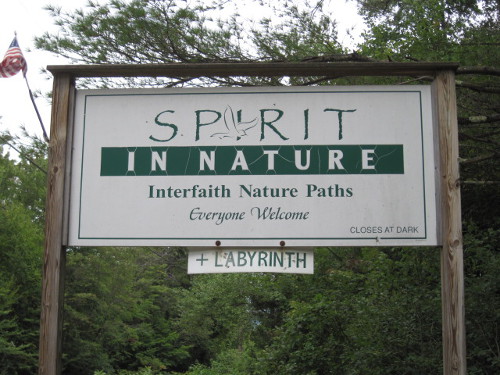
Below are images from our recent visit to Spirit in Nature in Ripton, VT, some eight miles southeast of Middlebury as the crow flies. An overcast sky that day helped keep temperature in the very comfortable low 70s F (low 20s C). At the entrance, Spirit in Nature takes donations on the honor system. The website also welcomes regular supporters.
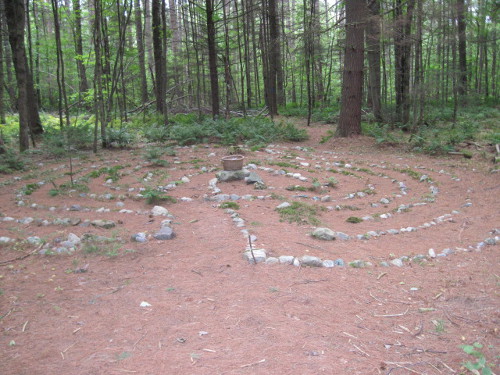
As an interfaith venture, Spirit in Nature offers an example of what I’ve been calling Shrine Druidry, one that allows — encourages — everyone into their own experience. Everyone who chooses to enter the site starts out along a single shared path.
The labyrinth helps engage the visitor in something common to many traditions worldwide: the meditative walk. The labyrinth imposes no verbal doctrine, only the gentle restraint of its own non-linear shape on our pace, direction and attention.
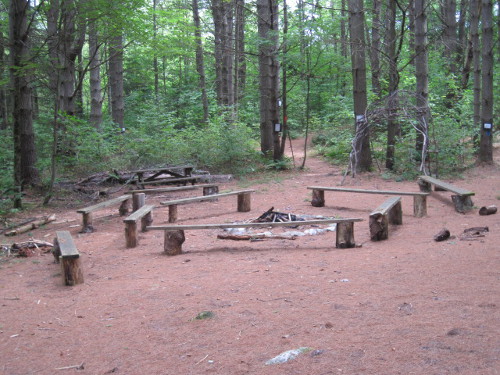
Beyond the labyrinth, a fire circle offers ritual and meeting space. Here again, no doctrine gets imposed. Instead, opportunity for encounter and experience. Even a solitary and meditative visitor can perceive the spirit of past fires and gatherings, or light and tend one to fulfill a present purpose.
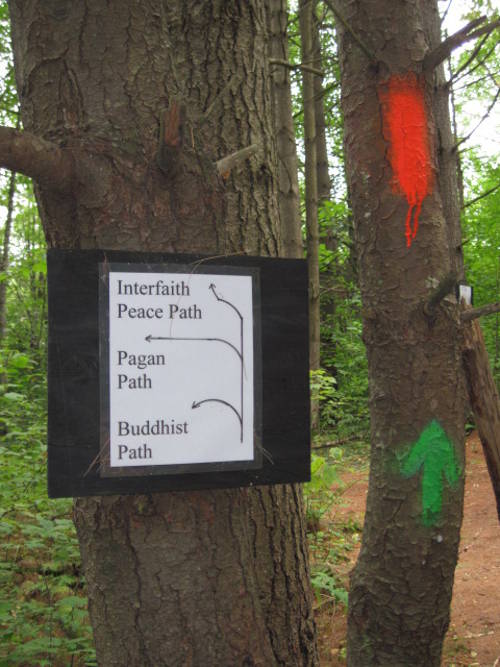
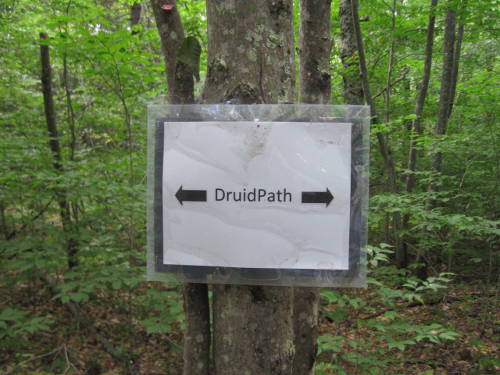
Beyond the circle, the paths begin to diverge — color-coded on tree-trunks at eye-level — helpful in New England winters, when snow would soon blanket any ground-level trail markers. When we visited, in addition to the existing paths of 10 traditions, Native American and Druid paths branched off the main way, too new to be included on printed visitor trail maps, but welcome indicators that Spirit in Nature fills a growing need, and is growing with it.
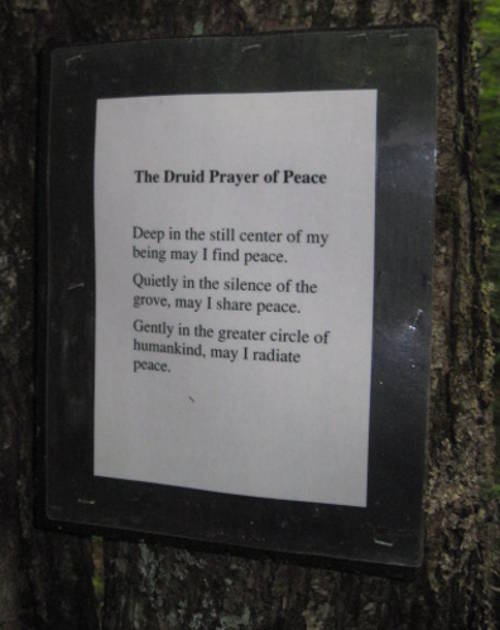
The Druid Prayer captures a frequent experience of the earth-centered way: with attention on stillness and peace, our human interior and exterior worlds meet in nature.
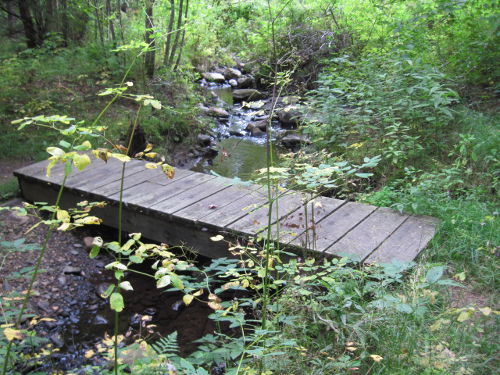
The trails we walked were well-maintained — the apparently light hand that brings these trails out of the landscape belies the many hours of volunteer effort at clearing and maintenance, and constructing bridges and benches.
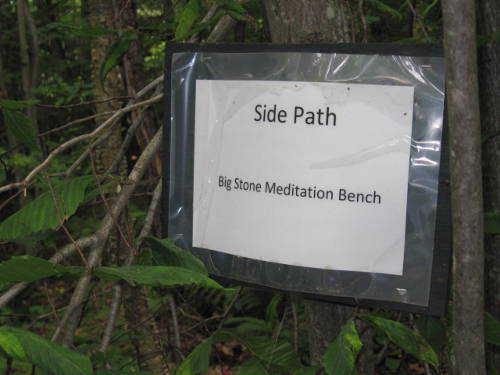
A bench, like a fire pit and a labyrinth, encourages a pause, a shift in consciousness, a change, a dip into meditation — spiritual opportunities, all of them. But none of them laid on the visitor as any sort of obligation. And as we walk the trail, even if I don’t embrace the offered pause, the chance itself suggests thoughts and images as I pass that the silence enlarges. I sit on that bench even as I walk past; I cross the bridge inwardly, even if it spans a trail I don’t take.
Sometimes a sign presents choices worthy of Yogi Berra’s “When you come to a fork in the road, take it.”
Perhaps it’s fitting to close with the North, direction of earth, stone, embodiment, manifestation — all qualities matching the interfaith vision of this place.
/|\ /|\ /|\
This is the 200th post at A Druid Way. Thanks, everyone, for reading!






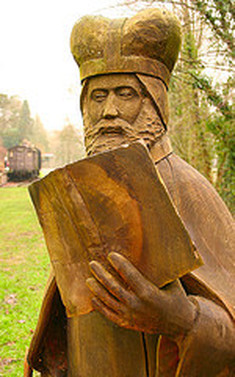 The historian-mythographer Geoffrey of Monmouth (1100-1155), whose glorious Historia Regum Britanniae (History of the Kings of Britain) blends history and legend almost seamlessly, is one primary source for the Arthurian legend. In the
 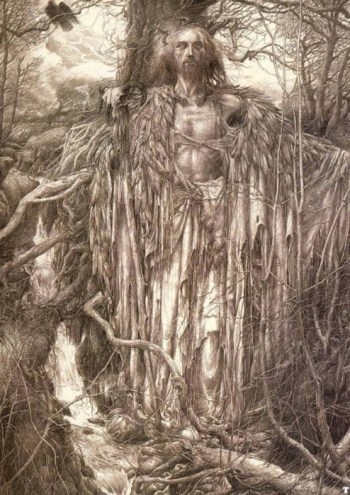 Unable to find among his own builders and engineers the technical ability to construct what he envisions, the king seeks out Merlin and asks for his help:

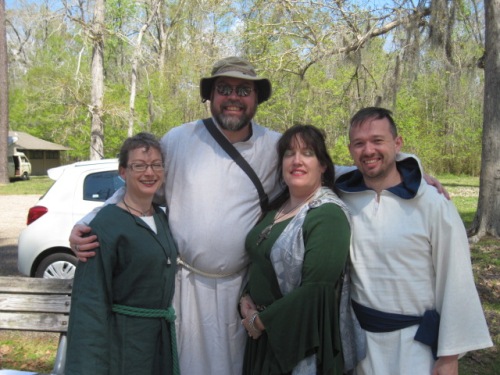
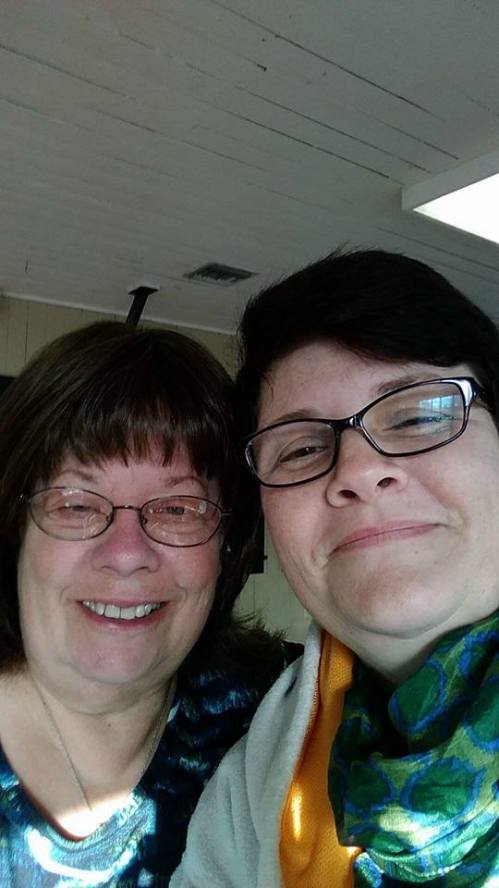
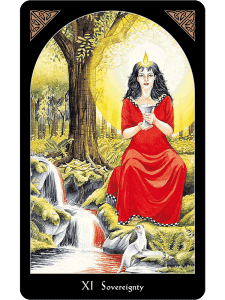 Sovereignty, Lady of an inner realm which flows ceaselessly into this one, you birth, nourish and sustain us. May my deeds serve not my own will alone, but your larger shaping for the good of all. In my words here, in my deeds, thoughts, feelings and dreams, let that light and song and fire illumine where it can, whom it may.
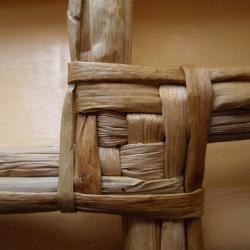 I find in this poem a prayer most fitting for these darkening days till Yule and sun-return (never mind the ritual season). I add to it these visualizations as I say the opening triad of actions: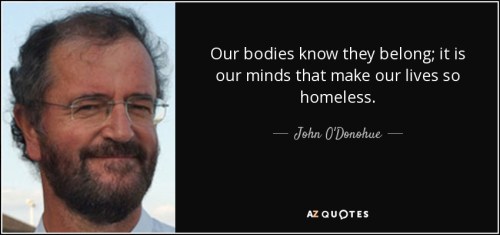


 Equinox energy is real. You can feel it in the stirring of so many things, blood and light and dream, storm and desire and birdsong. Not by accident do many magical and spiritual orders align their rites and festivals to the Equinoxes. Initiate then, in any senses of the word, and you catch a wave that can take you very far indeed. Out to the far isles beyond the horizon, where the Otherworld beckons beyond the ninth wave. In to the inner-verse that is always waiting like a beach after storm, strewn with all manner of oddments and debris, the flotsam and jetsam and occasional treasure you’ll find nowhere else. The one thing you need right now, washed up on your own shore, ready for the receiving into your hands. The spring break of the spirit, drunk with fear and longing and possibility.




 A Druid Way

.jpg)