Archive for the ‘philosophy’ Category
 Since my wife and I are too cheap to spend money on cable, we get most of our programming through the internet. Vermont sometimes gets tagged in people’s minds as one of the hinterlands of the U.S., though in fact it’s scheduled to have ultra high-speed internet by 2013, billed as “fastest in the nation,” and VTel (Vermont Telephone) installers are actually ahead of schedule in some areas.
One result of our cable-free existence and frequent obliviousness to whatever is “trending now” is that we often discover programs toward the end of their initial run, or well after they’ve already gone to syndication or archive status. Hulu is one of our friends, so if you’ve already watched the Canadian series “Being Erica” and you’ve moved on to newer fare, this post may not be for you. It may be a case of BTDT (been there, done that). So my electronic alter ego here with his Druidry and opinions and evident desire to pry where it’s sometimes uncomfortable (but interesting!) to pry isn’t offended if you log off and go do your laundry, or at least surf onward toward something more engaging.
==PILOT EPISODE SPOILER ALERT==
If you’re still here, the show’s pilot episode does a good job of making the series premise clear. 32-year old Erica feels she’s over-educated (a Master’s degree) and under-fulfilled (single, and with a low-level telemarketing job). The pilot brings her to a low point — she wakes up in a hospital bed after an allergic reaction, and receives a brief visit from a Dr. Tom, who leaves her with a business card that reads “the only therapy you’ll ever need.” As Erica and the audience simultaneously discover, he’s able to send his patients back through time to deal with events in their pasts that they regret. Not to “fix” them in some facile way, but to learn more fully what they have yet to teach.
Vancouver Actor Erin Karpluk, who plays Erica, reveals a wonderful vulnerability and resilience, and she develops a daughter-father chemistry with Dr. Tom, played by veteran Michael Riley. There’s also a “Canadian” flavor to the series, by which I mean something mostly vaguely felt, but nevertheless detectable at certain moments: many episodes are less politically correct, more real, better scripted and more risk-taking than the typical formulaic and “safer” equivalent might end up being in the States. There’s been abortive planning to make both U.K. and U.S. versions.
So you know I just have to make a connection about now. Ah, and here it is, right on schedule. In my experience, the past is not some fixed thing, written into concrete forever, like one false step into a bog that draws you down and suffocates you. Instead, it depends for its whole existence on you, in your present, here and now, in these circumstances and with this awareness, to understand and explore it. Change your understanding of the past, and your past itself can change in almost any sense you care to claim. Not what the “facts” are, which is almost always the least important thing*, after all (peace to all those police procedural shows and their fans!), but how they matter and still shape you today. Just as history gets revised through time, as we gain new understandings and perspectives, so too do our own experiences, choices and destinies appear new or different to us as we change. That bully in grade school turns out to have helped us develop a thicker skin, or empathy — or an unacknowledged contempt for “trailer trash,” or a keen taste for revenge that dogs our heels to this day. Pick your blessing or poison.
The future is what is fixed, the track we’re still following, and reconfirming right now with our current habits, choices and focus — fixed, and set in stone — until we “change” our pasts by knowing and owning them more fully. Seen from this perspective, “fate” is undigested, rejected past that’s come back to haunt you. Healing comes not from literally changing “what happened” — possible only through repression or selective recall — but from squeezing out of each experience every last drop of wisdom and growth we can get from it. Yes: easier said than done. Much easier, often.
But if we find our pasts too painful to deal with, we’ll not only carry them around with us anyway, regardless, but miss out on their lessons as well. As therapist Rollo May said, “Either way, it hurts.” The point is not avoidance of pain, but growth. My past comes at me whispering (or shouting, depending), “Do something with your pain, Dude.” Revisiting and re-imaging the past may sound all New-Agey and Hallmarky, but if it’s one way among many to heal, why mock it or discount it, unless you love your pain more than anything else you have? “Yes, it may be pain, but it’s mine, my darling, my precious. Go dredge your own.” Gollum much?!
This present moment is the pivot, the hinge, the point of transformation, if I’m ever going to act on those New Year’s resolutions that now seem so distant. How many of them have I achieved? (In a December post, I confess to not making any, at least not big ones, partly for this reason.) Baby steps. What’s the smallest change I can make? That’s often the best starting point, because unlike the large resolution, I really can do the small stuff, and stick with it. And then build on it. Treat it all as experiment. Document it — write it down. (Oscar Wilde says one should keep a journal so that one always has something sensational to read.) My life as lab for change. Talk about a show.
Part of the appeal of “Erica,” of course, is watching somebody else go through this. Yet this isn’t merely a voyeuristic thrill so much as it is a provocation to reflect. A significant part of the interest of the series for me is that even Erica’s therapist Dr. Tom, while often truly guru-wise with her issues, isn’t God, or some perfected being. (We often really can see and understand others’ problems more clearly than our own. The challenge is not to abuse this insight, but make the most of it in the best way for our own specific circumstances.) He still has his struggles too — deep ones, as we come to discover, ones that come play a role in Erica’s therapy, to the dismay and growth of both of them.
And my response was “How right!” A perfect being would be a bit of a pain, and might have forgotten (or never known) what it’s like, this human gig. Jesus is never more useful and accessible than when he suffers humanly: when his friend Lazarus dies and he weeps, when he gets angry and physical at the money-changers for profaning the Temple, when the fig tree has no fruit because it’s not the season, and Jesus curses it anyway, when his friends ditch him to save themselves. This human thing, he gets it.
Incidentally, I’ve never understood the Christian obsession with sin. We’re all guilty and imperfect. Check. We’ve messed up. Check. But the point is that our pasts are our teachers. They help us grow. Our “sin” is what tempers and forges and perfects us in the end. Yes, it’s a long end. We’re all slow learners, those “special ed” kids, every one of us. A sequence of lives to learn and experience and grow and love in makes sense for this reason alone. For God or any Cosmic Cop to damn us to hell for “sin” cuts off the whole reason we’re here, from this perspective. It’s like flunking everyone out of first grade because we haven’t mastered algebra yet. We’re not ready. Give us time. Life’s tough enough to break every heart, several times if necessary — and to remake it bigger. OK, here endeth the lesson.
==Final Season Spoiler Alert==
Except not quite. The fourth and final season — Hulu doesn’t carry it — of “Being Erica” comes out this month on DVD, and Amazon.ca just sent email confirmation that it’s shipped. My wife and I are looking forward to watching Erica become a therapist: “Dr. Erica” in her own right. Isn’t that part of our journey, too? Out of our experience we grow, and then we can help others along the way, specifically because of who we are, and what we’ve learned. Our imperfection and individuality are our great gifts, which we grow into ever more fully. That’s an eternity to look for, if you’re in the market for one.
/|\ /|\ /|\
*Even facts prove slippery, as any attorney, judge and gathering of eyewitnesses knows. But sometimes it’s precisely a fact that makes all the difference. Then it’s usually a fact that confirms or disproves a perspective, and so it throws us back to the centrality of perspectives and understandings once again.
Image: Being Erica.
[Earth Mysteries 1 | 2 | 3 | 4 | 5 | 6 | 7]
Here, in the third of this series on J. M. Greer’s principles from his book Mystery Teachings, we come to the Law of Balance:
“Everything that exists can continue to exist only by being in balance with itself, with other things, and with the whole system of which it is a part. That balance is not found by going to one extreme or the other or by remaining fixed at a static point; it is created by self-correcting movements to either side of a midpoint.”*
The Dao de Jing (Tao Te Ching), another keen guide to the natural order of things, observes, “Extremes do not last long.” After storm, sun. After destruction, rebirth. But what are we to make of natural disasters? How in hell, literally, are we supposed to “live in harmony” with an earthquake or hurricane or tornado?
Our science, which is just another word for knowing or wisdom, has only begun to recover some of the nature wisdom of our ancestors and spiritual traditions. And perhaps too much time, at least in some of the “hard” sciences, is spent in pursuit of a grand theory, where close observation might serve our immediate purposes better. But we’re recovering lost ground as we can.
The horrific tsunami of December 2004 in southeast Asia makes for a good study. Here and there, among the human and natural devastation in its wake, are curious and instructive stories. The case of 10-year Tilly Smith, vacationing with her parents in Phuket, Thailand, merits recounting. According to the Telegraph‘s article, Tilly saw the tide drop unnaturally, remembered a recent geography lesson about tsunami warning signs from her school back in the U.K., and alerted her parents. They were wise enough to listen to their daughter, warned the hotel where they were staying to evacuate inland, and over a hundred lives were saved as a result.
Another story comes from off the coast of India, in the Andaman Islands. One of the aboriginal peoples living there is the Onge, who still practice hunting-gathering. When the sea level dropped abruptly, the tribe responded immediately. After a quick ritual scattering of pig and turtle skulls to propitiate the evil spirits they perceived at work, they retreated inland. Unsuspecting tourists and local fisherman walked the exposed beach and gathered the fish floundering there, only to perish in the approaching monster waves. The National Geographic account from about a month afterwards includes commentary from Bernice Notenboom, president of a travel company specializing in indigenous cultural tourism and one of the few westerners to have visited the area. She observed of the Onge, “Their awareness of the ocean, earth, and the movement of animals has been accumulated over 60,000 years of inhabiting the islands.”
While this isn’t exactly expert testimony, every member of the tribe did survive, and her reasoning is sound. The commercial influence of Western culture has uprooted many tribes, and this is something Notenboom does know, since she’s on the forefront of it with her tour company. She remarked that one day in another nearby village, an old man approached her and said, “It is great to have you here, but let’s not make it a habit.” There can be a cost to careless physical ease and the acquisition of material abundance, and if we “gain the whole world and lose our souls,” to paraphrase the renowned Galilean master, we may be swallowed up, figuratively or literally.
Balance doesn’t mean stagnation. Many Westerners have felt the stirrings of a vague dis-ease with their own lives. We point to this or that cause, shuffle our politicians and opinions, our allegiances and subscriptions to cable, but to reuse the almost-cliche, it’s another version of rearranging deck chairs on the Titanic. When the problem is systemic, tinkering with symptoms won’t help. The “solution” is not one single thing to apply like a band-aid, but it will indeed involve changes of heart, which will come in different ways for different people over time. Anyone who has a single prescription for the troubles that ail us is frankly talking out his ass. Getting the ____ into or out of political office won’t budge the problem.
The “self-correcting movements to either side of a midpoint” of the Law of Balance sound so innocent. But whenever the balance shifts, the corrections come just as predictably and inevitably. Whether we like them or not, welcome or resist them, is another matter entirely. We forget that we’re not “in control”: there’s no helm to manage, no boss to prop up in place so that “things keep going the way they always have.” Already they aren’t, and they won’t. We’re part of a whole: whatever happens to the whole happens to us, and what happens to us happens to the whole. This is good news for those who work with the whole, and bad news for those who think this particular rule doesn’t apply to them.
There is such a thing as natural “justice” — it’s another name for rebalancing — but not always as humans would have it. There’s no court of appeal when we’ve fouled the air and water, destroyed local economies with mega-corporations, junk-fed ourselves sick, fought our way to a glutton’s share of the world’s resources which are running out, and tried to rationalize it all. Now we have to find ways to live through the re-balancing. What tools do we need? The inner resources are still available, though we’ve burnt through so many outer ones. The classic question of “Where is wisdom to be found?” really needs to be answered individually. It’s a fine quest to devote a life to, one that I happen to think is far better than anything else you can name. Right now especially, money certainly doesn’t look like it’s worth the game. I know that I feel more alive looking for wisdom, and finding a piece of it I can test and try out in my own life, than I do swallowing anybody else’s brand of fear and paranoia and cynicism. This blog is a piece of that quest for me. Whose life is this, anyway? Make of life a laboratory for truth.
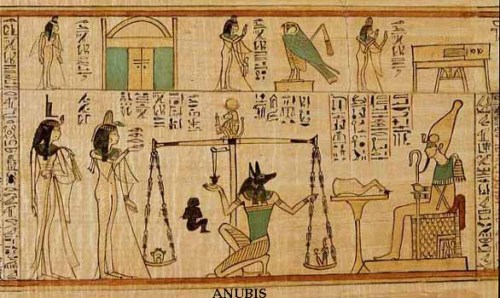 In the end, balance really is a matter of the heart. One Egyptian image of the after-world that’s stuck with me is the Scales of Anubis. The jackal-god of the Underworld places the human heart of the deceased in his scales, to weigh it against the feather of truth, of Ma’at, the natural order, cosmic justice or balance. (For inquiring minds, that’s Anubis to the right of the support post.) Only a light heart, literally one not weighted down by human heaviness (you can fill in the ____ with your favorite kinds), can pass muster. One distinguishing quality of the truly holy or wise ones that we encounter in their presence is a lightness of being, a kind of expansion and opening up. There is always possibility, a way forward. Whatever happens, we can face it better with that kind of heart beating in our chests. Look for that, in others and yourself, in your quest.
/|\ /|\ /|\
Image: scales of Anubis.
*Greer, John Michael. Mystery Teachings from the Living Earth. Weiser, 2012.
Edited/updated 11 October 2017
[Earth Mysteries 1 | 2 | 3 | 4 | 5 | 6 | 7]
The second principle or law Greer examines is the Law of Flow. Before I get to it, a word about spiritual or natural laws. In my experience, we tend to think of laws, if we think of them at all, in their human variety. I break a law every time I drive over the speed limit, and most of us have broken this or some other human law more than once in our lives. We may or may not get caught and penalized by the human institutions we’ve set up to enforce the laws we’ve established, though the majority of human laws also have some common sense built in. Driving too fast, for example, can lead to its own inherent penalties, like accidents, and besides, it wastes gas.
 But spiritual or natural law can’t be “broken,” any more than the law of gravity or inertia can be “broken.” Other higher laws may come into play which subsume lower ones, and essentially transform them, but that’s a different thing. A spiritual law exists as an observation of how reality tends to work, not as an arbitrary human agreement or compromise like the legal drinking age, or monogamy, or sales tax. Another way to say it: real laws or natural patterns are what make existence possible. We can’t veto the Law of Flow, or vote it down, or amend it, just because it’s inconvenient or annoying or makes anyone’s life easier or more difficult. There are, thank God, no high-powered lawyers or special-interest groups lobbying to change reality — not that they’d succeed. Properly understood, spiritual or natural law provides a guide for how to live harmoniously with life, rather than in stress, conflict or tension with it. How do I know this? The way any of us do: I’ve learned it the hard way, and seen it work the easy way — and both of these in my life and in others’ lives. Once it clicks and I “get” it, it’s more and more a no-brainer. Until then, my life seems to conspire to make everything as tough and painful as possible. Afterwards, it’s remarkable how much more smoothly things can go. Funny how that works.
OK, so on to the Law of Flow:
“Everything that exists is created and sustained by flows of matter, energy and information that come from the whole system to which it belongs and return to that whole system. Participating in these flows, without interfering with them, brings health and wholeness; blocking them, in an attempt to turn flows into accumulations, brings suffering and disruption to the whole system and its parts.”*
“Participating in these flows, without interfering with them,” can be a life-long quest. Lots of folks have pieces of this principle, and some of the more easily-marketed ones are available at slickly-designed websites and at New Age workshops happening near you. But note that the goal is not to accumulate wealth beyond the wildest dreams of avarice. (As Greer points out, if the so-called “Law of Attraction” really worked as advertized, the whole planet would be a single immense palace of pleasure and ease. Though who would wait on us hand and foot, wash our clothes, make our high-priced toys, or grow and cook our food, remains unclear.) Flow means drawing from system, contributing to it, and passing along its energy. “Pay it forward” wouldn’t be out of place here.
If all this sounds faintly Socialist, well, remember that as Stephen Colbert remarked, “Reality has well-known liberal bias.” It means sharing, like most of us were taught as toddlers — probably shortly after we first discovered the power and seduction of “mine!” But it could just as easily and accurately be claimed that reality has a conservative bias. After all, these are not new principles, but age-old patterns and tendencies and natural dynamics, firmly in place for eons before humans happened on the scene. To know them, and cooperate with them, is in a certain sense the ultimate conservative act. The natural world moves toward equilibrium. Anything out of balance, anything extreme, is moved back into harmony with the larger system. The flows that sustain us also shape us and link us to the system. The system is self-repairing, like the human body, and ultimately fixes itself, or attempts to, unless too much damage has occurred.
Ignorance of this law lies behind various fatuous political and economic proposals now afloat in Europe and America. Of course, what’s necessary and what’s politically possible are running further and further apart these days, and will bring their own correction and rebalancing. We just may not like it very much, until we change course and “go with the flow.” That doesn’t mean passivity, or doing it because “everybody else is doing it.” Going with the flow in the stupid sense means ignoring the current and letting ourselves be swept over the waterfall. Going with the flow in the smart sense means watching and learning from the flow, using the current to generate electricity, or mill our grain, while relying on the nature of water to buoy us up, using the flow to help carry us toward our destination. Flow is not static but dynamic, the same force that not only sustains the system, but always find the easier, quicker, optimum path: if one is not available, flow carves a new one. The Grand Canyon is flow at work over time, as are the shapes of our bodies, the curve of a bird’s wing, the curl of waves, the whorls of a seashell, the spiral arms of galaxies, the pulse of the blood in our veins. Flow is the “zone” most of us have experienced at some point, that energy state where we are balanced and in tune, able to create more easily and smoothly than at other times. Hours pass, and they seem like minutes. Praised be flow forever!
/|\ /|\ /|\
Images: river.
*Greer, John Michael. Mystery Teachings from the Living Earth. Weiser, 2012.
 Druid teaching, both historically and in contemporary versions, has often been expressed in triads — groups of three objects, perceptions or principles that share a link or common quality that brings them together. An example (with “check” meaning “stop” or “restrain”): “There are three things not easy to check: a cataract in full spate, an arrow from a bow, and a rash tongue.” Some of the best preserved are in Welsh, and have been collected in the Trioedd Ynys Prydein (The Triads of the Island of Britain*, pronounced roughly tree-oyth un-iss pruh-dine). The form makes them easier to remember, and memorization and mastery of triads were very likely part of Druidic training. Composing new ones offers a kind of pleasure similar to writing haiku — capturing an insight in condensed form. (One of my favorite haiku, since I’m on the subject:
Don’t worry, spiders —
I keep house
casually.
— Kobayashi Issa**, 1763-1827/translated by Robert Hass)
A great and often unrecognized triad appears in the Bible in Matthew 7:7 (an appropriately mystical-sounding number!). The 2008 edition of the New International Version renders it like this: “Keep asking, and it will be given to you. Keep searching, and you will find. Keep knocking, and the door will be opened for you.”
Apart from the obvious exhortation to persevere, there is much of value here. Are all three actions parallel or equivalent? To my mind they differ in important ways. Asking is a verbal and intellectual act. It involves thought and language. Searching, or seeking, may often be emotional — a longing for something missing, a lack or gap sensed in the soul. Knocking is concrete, physical: a hand strikes a door. All three may be necessary to locate and uncover what we desire. None of the three is raised above the other two in importance. All of them matter; all of them may be required.
 And what are we to make of this exhortation to keep trying? Many cite scripture as if belief itself were sufficient, when verses like this one make it clear that’s not always true. Spiritual achievement, like every other kind, demands effort. Little is handed to us without diligence on our part.
And though the three modes of investigation or inquiry aren’t apparently ranked, it’s long seemed to me that asking is lowest. If you’ve got nothing else, try a simple petition. It calls to mind a child asking for a treat or permission, or a beggar on a street-corner. The other two modes require more of us — actual labor, either of a quest, or of knocking on a door (and who knows how long it took to find?).
It’s possible to see the three as a progression, too — a guide to action. First, ask in order to find out where to start, at least, if you lack other guidance. With that hint, begin the quest, seeking and searching until you start “getting warm.” Once you actually locate what you’re looking for — the finding after the seeking — it’s time to knock, to try out the quest physically, get the body involved in manifesting the result of the search. Without this vital third component of the quest, the “find” may never actually make it into life where we live it every day.
Sometimes the knocking is initiated “from the other side” In Revelations, the Galilean master says, “I stand at the door and knock.” Here the key seems to be to pay attention and to open when you hear a response to all your seeking and searching. The universe isn’t deaf, though it answers in its own time, not ours. The Wise have said that the door of soul opens inward. No point in shoving up against it, or pushing and then waiting for it to give, if it doesn’t swing that way …
/|\ /|\ /|\
*The standard edition of the Welsh triads for several decades is the one shown in the illustration by Rachel Bromwitch, now in its 3rd edition. The earliest Welsh triads appearing in writing date from the 13th century.
**Issa (a pen name which means “cup of tea”) composed more than 20,000 haiku. You can read many of them conveniently gathered here.
book cover; door image.
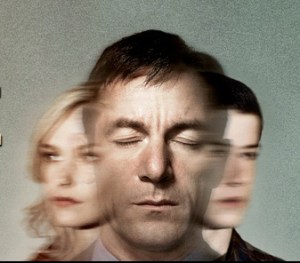 I’ve been thinking over the last several weeks about the NBC midseason replacement series Awake. Maybe you’ve seen it or at least heard about it. (With the continually growing number of networks and choices, it’s become harder to find media experiences to talk about that most of us have in common. Besides, each of us is busy enough as it is, pursuing our own reality show called Life.)
In its eighth episode as of this post, the drama stars Jason Isaacs as L.A. detective Michael Britten. The premise is an intriguing one: after a car accident involving Britten, his wife and son, his reality splits: on alternating mornings he wakes to one life in which his wife Hannah survived the accident but not his son Rex, and in the other reality to a life in which Rex has survived, but not Hannah.
Britten is seeing two different therapists, one in each reality, each attempting to convince him that the current reality is the only “real” one. Britten experiences some “bleed-through” of both similar and different details and situations from each reality to the other. This naturally confuses him at times, but also gives him odd clues and insights into criminal cases he is working on, and into family dynamics that previously had too easily slid past him, until the accident forced him to pay more attention to the surviving family member in each alternate reality.
The series concept is a provocative one on several levels. Who among us hasn’t wondered at least a little how things would be different if (fill in your own blank here)? But more significant in Britten’s case is the immediate matter of his sanity. Is this schizophrenia? Can both of his realities be “real”? Or is one destined to win out, forcing the detective to abandon what one of his therapists insists is an unhealthy clinging to an illusion that is preventing Britten from healing? Which reality might prove “false” — one in which his wife Hannah is gradually coming to terms with their son’s death and planning a new life for them both, or the other, in which Britten is slowly learning to be a better father and to connect with the teenage Rex for the first time? Who could ask a person to choose between these two?
Both realities are internally consistent, and as far as Britten can tell, neither offers any evidence of being “more real.” Several spiritual traditions describe this consensus reality of ours as a kind of dream. By itself, however, that’s never been a useful piece of information as far as I can see. More helpful is guidance about how to live the dream fully and gracefully, and to shift in and out of this dream and other dreams. Most of us try not to leave a trail of dead bodies or broken lives behind us, and we generally see this as a good and admirable thing — not something we’d worry about if this were “merely a dream.”
I remember going through a period in my twenties of perhaps six months of very violent dreams, featuring me both as victim and perpetrator, but the experience didn’t disturb my waking world. No one arrested me as a serial killer, and the dream dismemberments, stabbings, shootings, beheadings and so on didn’t disturb my digestion or emotional life. (They did give me useful material for contemplation and growth, but that’s a separate post.) The whole time of the dreams I was both actor and disinterested spectator in that curious way dreams can have. Obviously the quality of realities is different: waking and dreaming matter as category distinctions. If they didn’t, most of us would face radically different waking lives as a consequence of what we’ve dreamed! Unless you’re seriously repressing, you’ve had at least some dreams that would probably garner an X film rating. And if you don’t remember them, you’re missing out …
So if Britten is truly “awake” in both realities, he doesn’t need to choose, but simply to keep them straight. If you’ve ever had a lucid dream, however, in which internal consistency and conscious awareness approach, equal or even surpass that of waking reality, the distinctions can become much harder to sustain. Britten wears different colored wristbands to help him distinguish which reality he’s currently in. (Curiously, we don’t hear about his dreams. Perhaps “waking twice” consumes enough energy that he doesn’t need to — or can’t — dream.)
I have no idea how the writers of Awake intend to play this through. But it seems to me that it would be an enormous and series-destroying mistake ever to call one reality “true” and the other “false.” For better or worse, Britten logs parallel lives.
For most of us, both dream and waking are normally discontinuous. Each has its own interval of duration, and each eventually ceases before the other resumes. Under the influence of extreme fatigue, illness, or psychotropic substances, we can hallucinate and experience a “bleed-through” of dream-like perception into waking reality. For most of us this is a temporary state of affairs, perhaps useful or insight-producing up to a point, but not something we desire to sustain permanently. A good night’s sleep, a return to health, or the exit from an altered state of consciousness resets consciousness. Generally this is a good thing!
Yet when life goes flat, when the “same-old” of our daily experience — which is almost always a symptom of our inattention and soul-sickness — threatens to bore us literally to death, we need those moments of “awake now!” that may arrive with an accident, death in the family, close escape, or other major transition. Drama is punctuation to life — I don’t seek it habitually (unless I’m a bored teenage girl). Regular spiritual practice, as I’ve learned from experience (positive and negative, in the doing and in the ignoring), can both defuse the sense of “same old” and deliver us to smaller and less life-upsetting moments of insight, inspiration and — yes — transformation. We all dream of becoming more, better, greater, wiser, more loving, more fulfilled. Now is the always and only time to awaken in that dream — to “live twice,” awake both times.*
/|\ /|\ /|\
NBC series image
*Many of us “get” small bursts of at least the potential for transformation from art and music, or from sheer beauty on the playing field, or in a craft or manual skill. The Chinese poet Li Po exchanged poems with his contemporary and friend Tu Fu, and on one occasion exclaimed, “Thank you for letting me read your new poems. It was like being alive twice.”
Go to Part 1 | Part 2 | Part 3 | Part 4 | Part 5 | Part 6
I speak for myself, of course. It’s all that any of us can do. But as I approach what is most deeply true for me, I find I can begin to speak true for others, too. Most of us have had such an experience, and it’s an instance of the deep connections between us that we often forget or discount. I’m adding this Part Two because the site stats say the earlier post on initiation continues to be popular.
/|\ /|\ /|\
Within us are secrets. Not because anyone hides some truths from us, but because we have not yet realized them. The truest initiations we experience seem ultimately to issue from this inner realm of consciousness where the secrets arise. Deeper than any ocean, our inner worlds are often completely unknown to us. “Man is ‘only’ an animal,” we hear. Sometimes that seems the deepest truth we can know. But animals also share in profound connections we have only begun to discover. We can’t escape quite so easily.
Our truest initiations issue from inside us. Sometimes these initiations come unsought. Or so we think. Maybe you go in to work on a day like any other, and yet you come home somehow different. Or you’re doing something physical that does not demand intellect and in that moment you realize a freedom or opening of consciousness. Sometimes it can arrive with a punch of dismay, particularly if you have closed yourself off from the changes on the move in your life. In its more dramatic forms initiation can bring with it a curious sense of vulnerability, or even brokenness — the brokenness of an egg that cracks as this new thing emerges, glistening, trembling. You are not the same, can never be the same again.
The German poet Rilke tries to catch something of this in his poem “Archaic Torso of Apollo.” He’d been blocking at writing the poems he desired, poems of greater depth and substance, instead of the often abstract work he’d composed until then, and his friend the sculptor Rodin sets him to studying animals. Rilke admires Rodin’s intensely physical forms and figures, and Rilke ends up writing about a classic figure of Apollo that is missing the head. Yet this headless torso still somehow looks at him, holds him with eyes that are not there. Initiation is both encounter, and its after-effects.
We cannot know his legendary head
with eyes like ripening fruit. And yet his torso
is still suffused with brilliance from inside,
like a lamp, in which his gaze, now turned to low,
gleams in all its power. Otherwise
the curved breast could not dazzle you so, nor could
a smile run through the placid hips and thighs
to that dark center where procreation flared.
I may witness something that is simply not there for others, but nonetheless it is profoundly present for me. Or I see something that is not for the head to decipher, interpret, judge and comment on. There’s nothing there for the intellect to grasp. In the poem, the head of the sculpture of Apollo is missing, and yet it sees me, and I see or know things not available to my head. I feel the gaze of the sculpture. I encounter a god. Or just a piece of stone someone shaped long ago into a human figure, that somehow crystallizes everything in my life for me right now. Or both.
The sensation of initiation can be as intensely felt and as physical as sexuality, “that dark center where procreation flared.” It hits you in your center, where you attach to your flesh, a mortal blow from a sword or a gesture that never reaches you, but which still leaves you dizzy, bleeding or gasping for breath. Or it comes nothing like this, but like an echo of all these things which have somehow already happened to you, and you didn’t know it at the time — it somehow skipped right past you. But now you’re left to pick up the pieces of this thing that used to be your life.
Otherwise this stone would seem defaced
beneath the translucent cascade of the shoulders
and would not glisten like a wild beast’s fur:
would not, from all the borders of itself,
burst like a star: for here there is no place
that does not see you. You must change your life.
You feel Rilke’s discovery in those last lines*, the urgency, the knowledge arriving from nowhere we can track. I have to change, and I’ve already changed. I know something with my body, in my gut, that my head may have a thousand opinions about. I may try to talk myself out of it, but I must change. Or die in some way. A little death of something I can’t afford to have die. There is no place in my life that does not see me, that feeling rises that I can’t escape, and yet I must escape. It’s part of what drives some people to therapy. Sometimes we fight change until our last breath, and it takes everything from us. Or we change without knowing it, until someone who knows us says, “You’ve changed. There’s something different about you. I can’t put my finger on it,” or they freak at the changes and accuse us, as if we did it specifically to spite them. “You’re not the person you used to be,” meaning you’re no longer part of the old energy dynamic that helps them be who they are, and now they must change too. Initiation ripples outward. John Donne says, “No man is an island, entire of itself. Each man is a piece of the continent, a part of the main.” Sometimes it’s my own initiation, sometime I’m feeling the ripples from somebody else’s. The earthquake is in the neighborhood, right down the street, in the next room, here — or across the ocean. But ripples in each case.
Sometimes we “catch” initiation from others, like a fire igniting. We encounter a shift in our awareness, and now we see something that was formerly obscure. It was there all along, nothing has changed, and yet … now we know something we didn’t before. This happens often enough in matters of love. The other person may have been with us all along, nothing has changed … and yet now we feel today something we didn’t feel yesterday. We know it as surely as we know our bones. We can feel the shift under our skin. The inner door is open. Do we walk through?
Go to Part 1 | Part 2 | Part 3 | Part 4 | Part 5 | Part 6
/|\ /|\ /|\
*Mitchell, Stephen, trans. The Selected Poetry of Rainer Maria Rilke (English and German edition). Vintage, 1989.
“Only what is virgin can be fertile.” OK, Gods, now that you’ve dropped this lovely little impossibility in my lap this morning, what am I supposed to do with it? Yeah, I get that I write about these things, but where do I begin? “Each time coming to the screen, the keyboard, can be an opportunity” — I know that, too. But it doesn’t make it easier. Why don’t you try it for a change? Stop being all god-dy and stuff and try it from down here. Then you’ll see what it’s like.
OK, done? Fit of pique over now?
I never had much use for prayer. Too often it seems to consist either of telling God or the Gods what to do and how to do it (if you’re arrogant) or begging them for scraps (if they’ve got you afraid of them, on your knees for the worst reasons). But prayer as struggle, as communication, as connecting any way you can with what matters most — that I comprehend. Make of this desire to link an intention. A daily one, then hourly. Let if fill, if if needs to, with everything in the way of desire, and hand that back to the universe. Don’t worry about Who is listening. Your job is to tune in to the conversation each time, to pick it up again. And the funny thing is that once you stop worrying about who is listening, everything seems to be listening (and talking). Then the listening rubs off on you as well. And you finally shut up.
That’s the second half, often, of the prayer. To listen. Once the cycle starts, once the pump gets primed, it’s easier. You just have to invite and welcome who you want to talk with. Forget that little detail, and there can be lots of other conversations on the line. The fears and dreams of the whole culture. Advertisers get in your head, through repetition. (That’s why it’s best to limit TV viewing, or dispense with it altogether, if you can. Talk about prayer out of control. They start praying you.) They’ve got their product jingle and it’s not going away. Sometimes all you’ve got in turn is a divine product jingle. It may be a song, a poem, a cry of the heart. The three Orthodox Christian hermits of the great Russian novelist Tolstoy have their simple prayer to God: “We are three. You are three. Have mercy on us!” Over time, it fills them, empowers them. They become nothing other than the prayer. They’ve arrived at communion.
/|\ /|\ /|\
Equi-nox. Equal night and day. The year hanging, if only briefly, in the balance of energies. Spring, a coil of energy, poised. The earth dark and heavy, waiting, listening. The change in everything, the swell of the heart, the light growing. Thaw. The last of the ice on our pond finally yields to the steady warmth of the past weeks, to the 70-degree heat of Tuesday. The next day, Wednesday, my wife sees salamanders bobbing at the surface. Walk closer, and they scatter and dive, rippling the water.
/|\ /|\ /|\
I once heard a Protestant clergywoman say to an ecumenical assembly, “We all know there was no Virgin Birth. Mary was just an unwed, pregnant teenager, and God told her it was okay. That’ s the message we need to give girls today, that God loves them, and forget all this nonsense about a Virgin birth.” … I sat in a room full of Christians and thought, My God, they’re still at it, still trying to leach every bit of mystery out of this religion, still substituting the most trite language imaginable …
The job of any preacher, it seems to me, is not to dismiss the Annunciation because it doesn’t appeal to modern prejudices, but to remind congregations of why it might still be an important story (72-73).
So Kathleen Norris writes in her book Amazing Grace: A Vocabulary of Faith. She goes on to quote the Trappist monk, poet and writer Thomas Merton, who
describes the identity he seeks in contemplative prayer as a point vierge [a virgin point] at the center of his being, “a point untouched by illusion, a point of pure truth … which belongs entirely to God, which is inaccessible to the fantasies of our own mind or the brutalities of our own will. This little point … of absolute poverty,” he wrote, “is the pure glory of God in us” (74-5).
So if I need to, I pull away the God-language of another tradition and listen carefully “why it might still be an important story.” Not “Is it true or not?” or “How can anybody believe that?” But instead, why or how it still has something to tell me. Another kind of listening, this time to stories, to myths, our greatest stories, for what they still hold for us.
One of the purest pieces of wisdom I’ve heard concerns truth and lies. There are no lies, in one sense, because we all are telling the truth of our lives every minute. It may be a different truth than we asked for, or than others are expecting, but it’s pouring out of us nonetheless. Ask someone for the truth, and if they “lie,” their truth is that they’re afraid. That knowledge, that insight, may well be more important than the “truth” you thought you were looking for. “Perfect love casteth out fear,” says the Galilean. So it’s an opportunity for me to practice love, and take down a little bit of the pervasive fear that seems to spill out of lives today.
Norris arrives at her key insight in the chapter:
But it is in adolescence that the fully formed adult self begins to emerge, and if a person has been fortunate, allowed to develop at his or her own pace, this self is a liberating force, and it is virgin. That is, it is one-in-itself, better able to cope with peer pressure, as it can more readily measure what is true to one’s self, and what would violate it. Even adolescent self-absorption recedes as one’s capacity for the mystery of hospitality grows: it is only as one is at home in oneself that one may be truly hospitable to others–welcoming, but not overbearing, affably pliant but not subject to crass manipulation. This difficult balance is maintained only as one remains [or returns to being] virgin, cognizant of oneself as valuable, unique, and undiminishable at core (75).
/|\ /|\ /|\
This isn’t where I planned to go. Not sure whether it’s better. But the test for me is the sense of discovery, of arrival at something I didn’t know, didn’t understand in quite this way, until I finished writing. Writing as prayer. But to say this is a “prayer blog” doesn’t convey what I try to do here, or at least not to me, and I suspect not to many readers. A Druid prayer comes closer, it doesn’t carry as much of the baggage as the word “prayer” may carry for some readers, and for me. “I’m praying for you,” friends said when I went into surgery three years ago. And I bit my tongue to keep from replying, “Just shut up and listen. That will help both us a lot more.” So another way of understanding my blog: this is me, trying to shut up and listen. I talk too much in the process, but maybe the most important part of each post is the silence after it’s finished, the empty space after the words end.
/|\ /|\ /|\
Norris, Kathleen. Amazing Grace: A Vocabulary of Faith. New York: Riverhead Books, 1998.
Some teachings run you through their rituals.
Find your own way – individuals
know what works beyond the shown way:
try out drinking with the Ancestors.
Chat ‘em up — don’t merely greet ‘em;
such rites are chummy: do more than meet ’em.
(Spend your weekends with a mummy?)
But I like drinking with my Ancestors.
Another round of pints and glasses
will have us falling on our asses.
Leave off ritual when they’re calling —
you’ll be drinking with your Ancestors.
By and with the spirits near us —
“Don’t invoke us if you fear us” —
good advice: if you lose focus
though you’re drinking with your Ancestors,
in the morning you’ll be uncertain
if you just dreamed or drew the curtain
on some world where it more than seemed
that you were drinking with your Ancestors.
Alcohol works its own magic,
and not all good – it’s downright tragic
if you’re just hung over from what could
have been you drinking with your Ancestors.
They come in all shapes, and in all sizes:
some are heroes, some no prizes
(they’re like us in all our guises).
Listen: they are singing, they are cussing,
they can advise us if we’re fussing
over where our lives might go
or put on a ghostly show.
We’re the upshot, on the down low.
We’re the payoff, crown and fruit
(we got their genetic trash, and loot),
we’re their future – “build to suit.”
So start drinking with your ancestors.
* * *
Ancestor “worship” is sometimes a misnomer, though not always — some cultures do in fact pray to, propitiate and appease the spirits of the ancestral dead in ways indistinguishable from worship. But others acknowledge what is simply fact — an awful lot (the simple fact that we’re here means our ancestors for the most part aren’t literally “an awful lot”) of people stand in line behind us. Their lives lead directly to our own. With the advent of photography it’s become possible to see images beyond the three- or four-generation remove that usually binds us to our immediate forebears. I’m lucky to have a Civil War photo of my great-great grandfather, taken when he was about my age, in his early fifties. In the way of generations past, he looks older than that, face seamed and thinned and worn.
The faces of our ancestral dead are often rightfully spooky. We carry their genetics, of course, and often enough a distant echo of their family traditions, rhythms, expectations, and stories in our own lives — a composite of “stuff,” of excellences and limitations, that can qualify as karma in its most literal sense: both the action and the results of doing. But more than that, in the peculiar way of images, the light frozen there on the photograph in patches of bright and dark is some of the purest magic we have. My great-great-grandfather James looks out toward some indeterminate distance — and in the moment of the photo, time — and that moment is now oddly immortal. Who knows if it was one of his better days? He posed for a photo, and no doubt had other things on his mind at the time, as we all do. We are rarely completely present for whatever we’re doing, instead always on to the next thing, or caught up in the past, wondering why that dog keeps barking somewhere in the background, wondering what’s for dinner, what tomorrow will bring, whether any of our hopes and ambitions and worries justify the energy we pour into them so recklessly.
And I sit here gazing at that photo, or summoning his image from what is now visual memory of the photo, as if I met him, which in some way I now have. Time stamps our lives onto our faces and here is his face. No Botox for him. Every line and crease is his from simply living. And around him in my imagination I can pose him with his spouse and children (among them my great-grandfather William) and parents, and so on, back as far — almost unimaginably far — as we are human. Fifty thousand years? Two hundred thousand? A million? Yes, by the time that strain reaches me it’s a ridiculously thin trickle. But then, if we look back far enough for the connection, it’s the same trickle, so we’re told, that flows in the veins of millions of others around us. If we can trust the work of evolutionary biologists and geneticists, a very large number of people alive on the planet today descend from a relative handful of ultimate ancestors. Which seems at first glance to fly in the face of our instinct and of simple mathematics, for that spreading tree of ancestors which, by the time it reaches my great-great-grandfather’s generation, includes thirty people directly responsible for my existence (two parents, four grandparents, eight great-grandparents and sixteen great-great grandparents). Someone called evolution the “ultimate game of survivor.” And now I break off one line, stalling forever this one particular evolutionary parade, because my wife and I have no children.
The poem of mine that opened this entry, “Drinking with the Ancestors,” suggests we can indeed meet and take counsel with members of this immense throng through the exercise of inhibition-lowering and imagination-freeing imbibing of alcohol. Of course there are also visualization exercises and still other techniques that are suitably alcohol-free — more decorous and tame. Depending on who you want to talk to among your clan, you can have an experience as real as most face-to-face talks with people who have skin on. The difference between us in-carnate and ex-carnate folks is indeed the carne. No sudden dispensation of wisdom automatically accrues to us just because we croak. A living idiot becomes a dead idiot. Likewise a wise soul is wise, in or out of flesh.
It seems fitting to end with an experience of the ancestors. Not mine, this time — I keep such things close, because often when we experience them, they are for us alone, and retain their significance and power only if we do not diminish them by laying them out for others who may know nothing of our circumstances and experiences. Wisdom is not a majority vote. Even my wife and I may not share certain inner discoveries. We’ve both learned the hard way that some experiences are for ourselves alone. But it’s a judgment call. Some things I share.
So in my place I give you Mary Stewart’s Merlin, in her novel The Hollow Hills*, recounting his quest for Excalibur, and an ancestor dream-vision that slides into waking. The flavor of it captures one way such an ancestral encounter can go, the opposite end of the easy beery camaraderie that can issue from making the libations that welcome ancestral spirits to a festival or party, as in my poem. Note the transition to daytime consciousness, the thin edge of difference between dream and waking.
I said “Father? Sir?” but, as sometimes happens in dreams, I could make no sound. But he looked up. There were no eyes under the peak of the helmet. The hands that held the sword were the hands of a skeleton … He held the sword out to me. A voice that was not my father’s said, “Take it.” It was not a ghost’s voice, or the voice of bidding that comes with vision. I have heard these, and there is no blood in them; it is as if the wind breathed through an empty horn. This was a man’s voice, deep and abrupt and accustomed to command, with a rough edge to it, such as comes from anger, or sometimes from drunkenness; or sometimes, as now, from fatigue.
I tried to move, but I could not, any more than I could speak. I have never feared a spirit, but I feared this man. From the blank of shadow below the helmet came the voice again, grim, and with a faint amusement, that crept along my skin like the brush of a wolf’s pelt felt in the dark. My breath stopped and my skin shivered. He said, and I now clearly heard the weariness in the voice: “You need not fear me. Nor should you fear the sword. I am not your father, but you are my seed. Take it, Merlinus Ambrosius. You will find no rest until you do.”
I approached him. The fire had dwindled, and it was almost dark. I put my hands out for the sword and he reached to lay it across them … As the sword left his grip it fell, through his hands and through mine, and between us to the ground. I knelt, groping in the darkness, but my hand met nothing. I could feel his breath above me, warm as a living man’s, and his cloak brushed my cheek. I heard him say: “Find it. There is no one else who can find it.” Then my eyes were open and it was full noon, and the strawberry mare was nuzzling at me where I lay, with her mane brushing my face (226-7).
/|\ /|\ /|\
*Stewart, Mary. The Hollow Hills. New York: Fawcett Crest Books, 1974.
“I heard you saw the movie yesterday. So what’s it about?” “Jean and Bill are arguing again. What’s that about?” “OK, he tried to explain and it still doesn’t make sense to me. But you understand those kinds of things, so tell me about it.” And there’s the old-time newspaper seller’s cry: “Extra, extra! Read all about it!!”
This elusive quality of aboutness is core to so many of our ways and days. We spend years in education (and life) dividing things up into their parts and labeling them, and then at least as much time putting them back together, searching for the links and connections between them, so that we can “grasp” them, “get” them, understand them. Re-assemble and it might resemble what it used to be. We crave community, fellowship and friends along the way at least as much as we prize our American individualism and independence and self-reliance. We long for aboutness.
About is near, close, approximately, almost — good enough for daily reckoning, for horseshoes and hand-grenades. It’s about five miles. We’re about out of time. About is sometimes the guts, the innards, the details, all the juicy pieces. About is also the whole, the overview, the heart of the matter. If you know about cars or cooking, you don’t need to know every specific model or recipe to “know your way around them.” What you don’t know you can usually pick up quickly because of family similarities they share. If you under-stand, you know the sub-stance. Position yourself in the right place and time (apparently beneath what you desire to comprehend, according to the peculiar English idiom), and you’ll get the gist.
Layers, strata. This onion-like reality keeps messing us up with its levels. Its aboutness won’t stay put as just one thing, but consists of stuff piled on other stuff below it. Often you gotta dig down through the fossil layer to reach the starting point. Peel it all away, though, and sometimes all you have is peel. You may know the simple and lovely blessing — there are several versions extant:
Back of the loaf is the snowy flour,
back of the flour is the mill;
back of the mill is the wheat and the shower,
the sun and the Maker’s will.
Sometimes if you pay attention you can catch it like a melody on the wind, something that lingers behind the sunlight. We know more than we know we know. This is the natural mysticism that comes with living, however hard we may try to ignore it. This is the aboutness that underlies our lives and our days, while we scurry from one thing to another, in pursuit of happiness. So it follows us, shaking its head at our antics. It could catch up to us if we stopped, looked and listened, if we made space for it to live with us, rather than renting out a room next door, trying vainly to catch our attention.
Robert Frost is one of my go-to guys for insight, as readers of this blog discover. In “Directive” he begins with that sense of constriction, and our partial memory of a past that shines brighter because of what we’ve forgotten about its difficulties. Yes, the poem’s “about” dying New England towns and abandoned houses, but also about us:
Back out of all this now too much for us,
Back in a time made simple by the loss
Of detail, burned, dissolved, and broken off
Like graveyard marble sculpture in the weather …
If there’s a place and home for us, he goes on to say, it’s reachable only by misdirection. “You can’t get there from here,” because the “here” has no more substance than anything else. It won’t serve as a starting point. Time has wrenched it free of its moorings. Things drift.
The road there, if you’ll let a guide direct you
Who only has at heart your getting lost,
May seem as if it should have been a quarry—
Great monolithic knees the former town
Long since gave up pretense of keeping covered.
And there’s a story in a book about it …
Yes, there’s a story, maybe several stories, a hint or two that maybe somewhere else, or someone else, will do it for it us, will finally deliver to us what we’ve been seeking. The stories of art, of music, of the great myths we want to believe even when we can’t. Sometimes the hints are maddening, sometimes the only comfort we can lay hands on in our seeking.
Make yourself up a cheering song of how
Someone’s road home from work this once was,
Who may be just ahead of you on foot
Or creaking with a buggy load of grain.
Aren’t we almost there? Or is it merely illusion? Is this a path anyone else has traveled and succeeded in the end, or our own unique interstate roaring straight toward disaster? What lies are we telling ourselves today? And are we waking up to them at last? You gotta get in to get out, go the Genesis lyrics (the band, not the Bible). You have to get lost in order to be found. That experience is necessary, though painful. Not one of us is the son who stays at home. We’re all prodigals.
And if you’re lost enough to find yourself
By now, pull in your ladder road behind you
And put a sign up CLOSED to all but me.
Then make yourself at home.
Might as well get comfortable being lost, because it’s gonna last a while. Though we never can be wholly comfortable in illusions. No end in sight. The problem is that we don’t know this until the end actually IS in sight. What illusions do we need that will actually bring comfort for a time, at least? They’re not illusions until we outgrow them, live through and past them. In fact we need truths now that only later become illusions precisely because they will be too small for us anymore.
First there’s the children’s house of make-believe,
Some shattered dishes underneath a pine,
The playthings in the playhouse of the children.
Weep for what little things could make them glad.
Then for the house that is no more a house,
But only a belilaced cellar hole,
Now slowly closing like a dent in dough.
This was no playhouse but a house in earnest.
Our house in earnest, playhouse in our childhood, has collapsed, or will. Our old selves won’t do. They don’t fit. We shuffle them off like snake-skins that bear the imprint of what lived in them, down to scar and scale, and we mourn and mistake them for ourselves, another illusion, standing there in the mirror that consciousness provides.
Who then can show us the way? From this perspective, we need, not salvation, but someone to show us where we can walk on our own two feet. Not out of vanity or stiff-necked pride, but because we have to make our way ourselves. Otherwise it doesn’t stick. It vanishes like a dream on waking. Yes, others have carried us there briefly, by art or alcohol or sex or those moments of ecstasy that come on us unannounced and unsought, glimpses of home through the fog.
Tolkien has Gandalf and Pippin touch on it briefly in The Lord of the Rings:
Gandalf: The grey rain-curtain of this world rolls back, and all turns to silver glass. And then you see it.
Pippin: What? Gandalf? See what?
Gandalf: White shores … and beyond, a far green country under a swift sunrise.
Frost continues, wise old poet-guru. (Sigmund Freud once remarked, “Everywhere I go, I find that a poet has been there before me.”)
Your destination and your destiny’s
A brook that was the water of the house,
Cold as a spring as yet so near its source,
Too lofty and original to rage.
We keep flowing — we’re not meant to stay put. Heaven as stasis, as a static destination, an endpoint, a final arrival, nothing beyond, is a false heaven. Enchantments of different kinds surround us. Some deceive, and some actively conceal what we know we must have in order to live at all. Yet what we seek also and paradoxically lies hidden in plain sight. The water was “the water of the house.” It’s right here. What can we use to gather it up?
I have kept hidden in the instep arch
Of an old cedar at the waterside
A broken drinking goblet like the Grail
Under a spell so the wrong ones can’t find it,
So can’t get saved, as Saint Mark says they mustn’t.
(I stole the goblet from the children’s playhouse.)
Here are your waters and your watering place.
Drink and be whole again beyond confusion.
Be whole again. What was lost is now found. Restoration. Return to what is native to you — your watering place. This is the command that drives us onward, the quest buried in our blood and bones. Reach for it. Whole again beyond confusion.
/|\ /|\ /|\
 Yes, secrets can be dangerous. But live long enough and you notice that most things which may be dangerous under certain conditions are often for that very reason also potential sources of valuable insight and energy. Poisons can kill, but also cure. Light can disinfect, and also burn. Different societies almost instinctively identify and isolate their favorite different sources of energy as destructive or at the least unsettling, just as the physical body isolates a pathogen, and for much the same reason: self-preservation.
For many Americans and for our culture in general, sex is one great “unsettler.” We need only look at our history. Problems with appropriate sexual morality have dogged our culture for centuries, and show no signs of letting up, if the current gusts of contention around contraception, abortion, homosexuality and abstinence education mean anything at all. Wall up sexuality and let it out only on a short leash, if at all, our culture seems to say. Release it solely within the bonds of heterosexual monogamy. Then you may escape the worst of its dangerous, unsettling, even diabolical power. You can identify this particular cultural fixation by the attention that even minor sexual miss-steps command, surpassing murder and other far more actually destructive crimes. Let but part of a breast accidentally escape its covering on TV or in a video, even for a moment, and you’d think the end of the world had truly arrived.

a Mikvah -- ritual bath
Other cultures diagnose the situation differently and thus choose different energy sources to obsess about and wall up, or shroud in ritual and doctrine and taboo. For some, it’s ritual purity. At least some flavors of Judaism focus on this, with the mikvah or ritual bath, various prohibitions and restrictions around menstruation, skin diseases and other forms of impurity, and the importance of continuing the family along carefully recorded bloodlines. The first five Biblical books, from Genesis to Deuteronomy, list such practices and taboos in often minute detail.
The Bible also testifies, in some of its more well-known stories, to the fate of individuals like Jacob’s brother Esau, who married outside the family, and thus forfeited God’s blessings and promises that came with blood descent from their grandfather Abraham. And one need only consider Ishmael, son of Abraham but not of an approved female, who is driven out into the wilderness with his mother Hagar, a slave and not a Hebrew. This Jewish Biblical story accounts for the origins of the Muslims, descendants of Ishmael or Ismail. (The Qur’an, not surprisingly, preserves a different account.) The flare-ups of animosity and sometimes visceral hatred between Jews and Muslims thus originate quite literally in a family inheritance squabble, if we take these stories at their word.
If secrets have at their heart a source of potent energy and culture-shattering power, no wonder Americans in particular suspect them. We like to think we can domesticate everything and turn it to our purposes: name it, own it, market it, even cage it and sell tickets for tourists to see it in captivity, properly chastened by our mastery. But the numinosity of existence defies taming.
Such an oppositional stance of course almost guarantees conflict and misunderstanding and ongoing lack of harmony. But the experience of some human cultures tells us that we can learn to discern, respect and work with primordial forces that do not bow to human will and cleverness. (Likewise, Western and American culture have demonstrated that fatalism and passivity are not the only possible responses to disease, natural disasters, and so on.) Master and servant are not the only relations possible. For a culture that prizes equality, we are curiously indifferent to according respect to sex, divinity, mortality and change, consciousness and dream, creativity and intuition as forces beyond our control, but wonderfully amenable to cooperation and mutual benefit.
So how do secrets fit in here? The ultimate goals of both magical and spiritual work converge. As J. M. Greer characterizes it,
… the work that must be done is much the same–the aspirant has to wake up out of the obsession with purely material experience that blocks awareness of the inner life, resolve the inner conflicts and imbalances that split the self into fragments, and come into contact with the root of the self in the transcendent realms of being (Greer, John Michael. Inside a Magical Lodge, 98).
Of course, much magical and spiritual practice does not (and need not) habitually operate at this level — but it could. “By the simple fact of its secrecy, a secret forms a link between its keeper and the realities that the web does not include; a bridge to a space between worlds,” Greer notes. This space makes room for inner freedom, and so the effort of maintaining secrecy can pay surprising psychological dividends.
Keeping a secret requires keeping a continual watch over what one is saying and how one is saying it, but the process of keeping such a watch has effects that reach far beyond that of simply keeping something secret. Through this kind of constant background attention certain kinds of self-knowledge become not only possible but, in certain situations, inevitable. Furthermore, this same kind of attention can be directed to other areas of one’s life, extending the reach of conscious awareness into fields that are too often left to the more automatic levels of our minds … Used in this way, secrecy is a method of reshaping the self … (Greer, 116-117).
Thus, the actual content of the secret may be quite insignificant, a fact that baffles those who “uncover” secrets and then wonder what the fuss was all about. Is that all there is? they ask, usually missing another aspect of secrecy: “things can be made important–not simply made to look important, but actually made important–by being kept secret” (Greer, 118). The effort of maintaining secrecy and the discoveries that effort allows can mean that the supposed secrets themselves are often next to meaningless without that effort and discovery.
In this case, the danger of secrecy lies in what it reveals rather than what it conceals. Once we discover the often arbitrary and always incomplete nature of the web of communication (and the cultural standards based on that web), we perceive their limitations and ways to step beyond them. Here secrecy has
a protective function on several different levels. To challenge the core elements of the way a culture defines the world is to play with dynamite, after all. There’s almost always a risk that those who benefit from the status quo will respond to too forceful a challenge with ridicule, condemnation or violence. Secrecy helps prevent this from becoming a problem, partly by makng both the challenge and the challengers hard to locate, but also by making the threat look far smaller than it may actually be (Greer, 127).
 Secrecy forms part of the “cauldron of transformation”* available to us all. Most of us balk at true freedom and change. We may have to relinquish comforting illusions — about ourselves and our lives and the priorities we have set for ourselves. So like a mouse I take the cheese from the trap and get caught by the head — I yield up the possibility of growth in consciousness in return for some comfort that seems — and is — easier, less demanding. All it costs is my life.
Guard the mysteries; constantly reveal them, goes an old saying of the Wise. The deepest secrets we already know. That is why awakening confers the sensation of coming home, of return, of reclaiming a birthright, of dying to an old self, of extinction of something small that held us back — so many metaphors that different traditions and cultures and religious and spiritual paths hold out to us, to suggest something of the profound, marvelous and most human experience we can have.
/|\ /|\ /|\
Images: cartoon; mikvah; cauldron;
* See John Beckett’s excellent blog post on this topic here.
Secrecy often emerges as a national issue in times of crisis. Recall the debate over the Patriot Act enacted in the wake of the Sept. 11th attacks, and the kinds of broad governmental powers the Act authorized, including significant reductions of citizen privacy. Secrecy can become central to state security, and exists in uneasy tension with the “need to know.”
President Kennedy declared in an April 27, 1961 speech that unjustifiable secrecy is repellent, dangerous, and virtually un-American:
The very word “secrecy” is repugnant in a free and open society; and we are as a people inherently and historically opposed to secret societies, to secret oaths and to secret proceedings. We decided long ago that the dangers of excessive and unwarranted concealment of pertinent facts far outweighed the dangers which are cited to justify it.*
Of course, he was addressing the American Newspaper Publishers Association, and also standing implicitly against the Communist bloc and its perceived threat to the West. (You can listen to a portion of Kennedy’s speech on Youtube here.) Nevertheless his points are well-made, and still almost painfully applicable today, in the wake of Wikileaks and similar events.
Yet secret societies, in spite of Kennedy’s assertions, do have a long and well-established place in the history of America, and many still thrive today. They flourish at many colleges like Yale, with its Skull and Bones the most famous — or notorious — of several societies for college seniors. Another similar and infamous example, though not affiliated with a school, is the Bohemian Grove. Both have generated entertaining conspiracy theories, books, films, and news articles, all of which occasionally offer pieces of the truth. Both exist, and both count among their membership some of the most powerful and influential people in the world. Bohemian Grove counts among its members George H. W. Bush, Clint Eastwood and the late Walter Cronkite, according to a Univ. of California Santa Cruz website.** Should we be worried?!

Opening Night at Bohemian Grove
Many sororities and fraternities also share elements of secret societies, depending on their charters and missions. Still other similar organizations enjoy spotless reputations, such as the PEO Sisterhood, mostly public in its support for education, but still retaining some secret aspects.
 Secret organizations are in fact particularly American, or were in the past. At the nation’s founding, all but two of the signers of the Declaration of Independence were by some accounts members of the Masons or other society. In the late 1800s, roughly 40% of the U.S. population belonged to the Freemasons, Odd Fellows, Knights of Pythias, the Grange, Knights of Columbus, Order of the Eastern Star, or other secret, service, fraternal or social organizations. The 19th century was in many ways the heyday of such groups, which have declined since, even as Americans began to lament the loss of community cohesiveness and devotion to public service, unaware of the irony.
To step even further back in time, secrecy was after all crucial to the survival of Christianity, which took form as a sect within Judaism, and within a generation was perceived as a threat to Rome. Suspected Christians were arrested, forced to worship the reigning Roman emperor (who in some cases claimed divinity) and recant their faith, or face execution in various bloody forms, including by wild animals, in the Circus Maximus, Colosseum or Amphitheater. Until the emperor Constantine in the 300s made the religion a recognized faith of the Empire, Christianity was often an underground practice, with the ichthys (sometimes called the “Jesus fish”) as one of its secret signs, by which fellow believers might recognize each other.
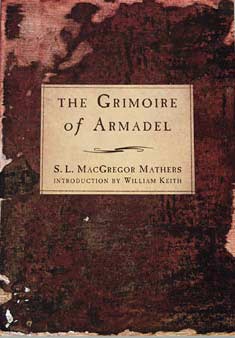 The range of contexts in which secrecy manifests can be surprisingly wide. The discipline of keeping a secret sometimes serves as a test for membership in a group. If you can keep a secret about something insignificant, then you may earn the right to gain access to the greater secrets of the group, because you’ve demonstrated your integrity. Shared secrets are a key element to defining in-groups and out-groups. In the Middle Ages, much knowledge was automatically assumed to be secret. If it was disseminated at all, it appeared in a learned language like Latin or Greek which only literate persons could read and access, and as often it was a zealously-guarded guild or trade secret which only guild members knew. Significantly, the Old French word gramaire meant both “grammar” and “magic book,” and is considered the most likely source of the word grimoire, also meaning a magic book. Inaccessible or secret language and hidden or secret knowledge were the same thing, and occult meant simply “hidden.”
Some kinds of knowledge are experiential and therefore in a different sense hidden or secret from anyone who hasn’t had the experience. Consider sex: there is no way to share such “carnal knowledge” — you simply have to experience it to know it. And thus Adam and Eve “know” each other in the Garden of Eden in order to conceive their children. Many languages routinely distinguish “knowing about” and “knowing” with different words, as for instance German kennen and wissen, French savoir and connaitre, Welsh gwybod and adnabod, Chinese hui/neng/zhidao. The kinds of experiential knowledge humans encounter in a typical lifetime are substantial and significant: first love, first death, first serious illness and so on. Note how these are often connected with the experience of initiation, discussed in a previous post.
It’s vital here to note that it is not secrecy itself but the nature of the secret that is crucial in assessing its significance accurately and dispassionately. I continue to cite J.M. Greer for his lucid and keen observations about the importance and potentials of secrets and secrecy, and the influence of his thinking pervades this series of posts. I mentioned in Part One that though we all take part in the web of communication, there are ways to see it from the outside and more objectively. We can occasionally and briefly free ourselves of its more negative effects and minimize its compulsions, then return to it for its positive benefits of human solidarity and companionship. As I’ve mentioned, solitude can temporarily ease its influence, and grant us a clearer space for reflection. Another group which experiences a consciousness apart from the web are sufferers of mental illness, who are sometimes involuntarily forced outside it. There they may perceive the arbitrary nature of cultural assumptions and behaviors, the “blind spots” inherent in every culture and human institution, and the hollowness of social convention. Their unwitting shift away from the web can make their perceptions, words and actions bizarre, frightening and difficult to manage. Clearly there is danger in breaking the web, or leaving its patterns of coherence that allow us to make sense of the world.
Greer observes:
To have a secret is to keep some item of information outside the web, so that it does not become a part of the map of the world shared by the rest of society. A gap is opened in the web, defined by the secret, and as long as the secret is kept the gap remains. If the secret in question is something painful or destructive, and if secrecy is imposed by force rather than freely chosen, this kind of breach in the web can be just as damaging as the kind opened by madness. If secrecy is freely chosen and freely kept, on the other hand, it becomes a tool for reshaping awareness, one with remarkable powers and a range of constructive uses.**
An examination in the next post of the conscious use of secrecy for positive ends will conclude this series.
/|\ /|\ /|\
*A transcript of Kennedy’s entire speech is available at the JFK Library here. (The quoted portion above begins in section 1, after the prefatory remarks.)
Bohemian Grove dinner image and article.
Grimoire image.
**Greer, John Michael. Inside a Magical Lodge. p. 116.
If you believe that everything should be “out in the open,” you’ll probably admit to a certain impatience with concealment and secrecy. We’ve heard the old saw: “If you’ve got nothing to hide, you’ve got nothing to fear” and up to a point we believe it. Particularly in the U.S., we equate openness with being “aboveboard” and honest. “Don’t beat around the bush.” “Say what you mean.” “Be upfront about it.” We admire “straight talk.”
The Freedom of Information Act helped make at least some government activities more transparent, and we often welcome “full disclosure” in a variety of situations. We still think of ours as an “Open Society,” and the current practice of large and anonymous campaign contributions from corporate sponsors has some American citizens up in arms. We’re wary of the con, and we tend to suspect anyone who doesn’t “tell it like it is.” We’ve got talk shows where people “spill it all,” and public figures starting at least with Jimmy Carter who began a confessional politics by admitting he had “lust in his heart.” But not all secrets are sinister. They do not automatically concern information anyone else needs to know. Each of us has some things that are innocently private. And in fact, well beyond this concession, secrecy can serve remarkable purposes that conspiracy theorists and even regular citizens rarely acknowledge.
Some secrets, of course, appear to be built into the stuff of the Cosmos. Robert Frost captures this in a brief two-line poem, “The Secret Sits”:
We dance round in a ring and suppose,
But the Secret sits in the middle and knows.
We circle the thing we’re after, all the while convinced it’s there, that something will answer to our seeking, but somehow we still persist in missing it. In spite of a couple of hundred years of scientific exploration, and prior to that, millennia of religious and spiritual investigation, existence and meaning and purpose often remain mysterious and not easily accessible. What matters most to us springs from sources and energies we can’t simply subject to laboratory scrutiny and then write up in learned journals and magazines. As some of the Wise have put it, “the eye sees, but cannot see itself” (at least not without a mirror). Something about the nature of consciousness blocks us from easily comprehending it.
In our search, we reduce matter to atoms (literally, “unsplittables”) and think we’ve arrived at the true building blocks of the universe, only to learn that atoms can indeed split, and that they’re composed of subatomic particles. Quantum physics further reveals that these particles are probabilities and exist only with the help of an observer. Space-time itself is generated by consciousness. We live in a “nesting doll” universe, worlds inside other worlds, an onion-like cosmos of endless layers. True secrets, it appears, can’t be told. They’re simply not part of the world of words. As the Tao Te Ching wryly has it, “The Way that can be talked about isn’t the real Way.” If that doesn’t have you pulling your hair out, it can at least cast you down into a terminal funk. Where can a person get a clear answer?
Serious seekers in every generation come to experiment with some form of solitude, and if they persist, they may discover some very good reasons that underlie the practice of removing themselves even briefly from consensus reality and the web of communication we’re all born into. This web helps us live with each other by building enough common ground that we can understand each other and cooperate in achieving common goals. But it also builds our entire world of consciousness in ways we may not always want to assent to. However, solitude by itself isn’t reasonable for most people as a lifestyle. As my mother liked to remind me, “You have to live in the real world.”
But this “real world” runs surpassingly deep and wide in its influence. Author, blogger and Druid J. M. Greer notes,
The small talk that fills up time at social gatherings is an obvious example. There might seem to be little point in chatting about the weather, say, or the less controversial aspects of politics, business, and daily life, but this sort of talk communicates something crucial. It says, in essence, “I live in the same world you do,” and the world in question is one defined by a particular map of reality, a particular way of looking at the universe of human experience.*
We need maps – there’s a reason we developed them. But they limit as much as they guide. We could even say that this is their genius and power – they guide by limiting, by reducing the “blooming buzzing confusion” of life to something more manageable. Advertizing does this by simplifying our desire for meaning and connection and significance into a desire for an object that will grant us these things. Trade one symbol – money or credit cards, paper or plastic – for another symbol, a status symbol, an object sold to us with a money-back promise to grant wishes like a genie’s lamp or the cintamani, the “wish-fulfilling” gem of the East. (If that’s not magic, and a questionable kind at best, I don’t know what is. How much more wonderful it would be – how much closer it would come to “true magic” — if it actually succeeded in quenching that original desire, which is merely sidetracked for a time, and will re-emerge, only to be distracted again, by another “new and improved”** model, spouse, diet, house, product or lifestyle. We need a remarkably small minimum of things to flourish and be happy. In a territory far beyond the blessed realm of that minimum, the market survives, yes, while the heart slowly dies.***)
Greer continues,
We thus live in an extraordinarily complex web of communication, one that expresses and reinforces specific ways of thinking about the world. This is not necessarily a problem, but it can easily become one whenever the presence and effects of the web are unnoticed. To absorb the web’s promptings without noticing them, after all, is also to absorb the web’s implied world-view without being aware of the process – and what we do not notice we usually cannot counteract.
The very common habit of passivity toward our own inner lives, a habit that is responsible for a very large portion of human misery, shows itself clearly here. It’s one thing to accept a map of the world as a useful convenience, one that can be replaced when it’s no longer useful, and quite another to accept it unthinkingly as the only map there is—or worse, to mistake the map for the world itself.*
A secret breaks the web. It remains something apart, the fragment that doesn’t fit. It’s the puzzle piece left over that doesn’t match the gap in the nearly-finished picture staring up at you, that one annoying bolt or washer or other component remaining after you’ve put together the “easy to assemble” appliance or device. It’s the hangnail, the sore thumb, the mosquito bite of awareness that something’s off-kilter, out of whack, out of step, no longer in synch. We have words for these things — we can name them, at least — because they happen to us frequently enough to break into the web. And we struggle to fix them as soon as we can, or barring that, ignore them as much as possible, that uncomfortable fact, that inconvenient discovery. As Churchill quipped, “Men occasionally stumble over the truth, but most of them pick themselves up and hurry off as if nothing happened.”
I’ll continue this topic in Part Two.
/|\ /|\ /|\
*Greer, John Michael. Inside a Magical Lodge, pp. 114-115. I reread this book about once a year, and its lucid style makes this pleasurable apart from its subject matter. In addition to being a “guided tour” of the workings of lodge dynamics (fraternal, magical and social) and group magical practice (with an example magical lodge that Greer examines in considerable detail), the book is a clear, demystifying meditation on group consciousness, secrecy, and the magical egregore or “group mind” at work in all human organizations, institutions and collectives, including families, churches, political parties, companies, clubs, sports teams — the scope is immense.
**As comedian Chris Rock says, “Which is it, new or improved?!”
***As a teacher at an expensive private school for students whose parents expect them to gain admission to the top colleges and universities in the country, I here acknowledge that I myself participate in another kind of wish-fulfilling enterprise marketed to a considerable degree to that now widely suspect 1%. In defense of the school, however, if not of myself, every year scholarship students are admitted solely on merit. They succeed out of all proportion to their numbers in earning top class rankings and coveted admission letters to the best schools.
This will be a sentimental “cute doggie” story only in passing. Not because I’m averse to sentimentality (I’m often a “softie” as my wife reminds me), or because emotion is somehow automatically suspect (it’s not), but because sentimentality on its own can be a distraction when there’s some other and more valuable discovery I can usually make. Such a discovery may underlie the sentiment it raises like a flag waving, a blush at sudden emotional vulnerability. But the discovery itself often reaches much deeper than sentiment can take us. Let sentiment always claim first dibs on my attention and I may never make the discovery that so often seems to slip past right under my nose. It’s like, well … licking off the dressing and throwing out the salad. OK, imperfect metaphor, but you get the idea.
Sentiment deserves its proper place. That’s a lesson on its own, I’ve found — figuring out what that place is in all the various experiences of our lives — and worth its own post. But this is a story about animals as our teachers, a theme in Druidry (and elsewhere, of course) that never grows old, at least for me. And it’s a story about one particular furred teacher, in this case a dog. Often animals are some of our earliest and best teachers.
Some time ago, while my wife Sarah was slowly recovering from cancer surgery, the after-effects of follow-up radiation, and the side-effects of long-term use of an anti-seizure med, she fulfilled a two-decade dream of getting another Newfoundland. For those of you who don’t know them, the Newf is the more mischievous cousin of the St. Bernard, with whom it is sometimes confused. Both are the giants of the dog world. And both drool pretty much continually.
Sarah’s first Newf, her beloved and mellow Maggie, saw her through a rough time in her teens. But her second Newf, Spree, was entirely different in temperament. Strong-willed and stubborn, unlike Maggie in the latter’s eagerness to please, and formidably intelligent, where Maggie could be somewhat dim, Spree simply demanded much more from both of us. Leash-training, house-breaking, socialization — all were more involved than either of us had experienced with previous dogs. Spree’s first mission seemed to be to wrench Sarah out of a lingering mild post-op depression — by canine force, if necessary. “I am now your black-furred, drooling world,” she insisted. Lesson One: “There’s more to pay attention to. Watch (me)!” A second Lesson followed closely on that one: “You can still trust this physical body (to take care of me, for a start.) There are years of use left in it. Now move that fanny!”
Maggie had suffered from severe hip-displasia, a weakness in many large and large-boned breeds like Newfs that can leave them effectively crippled. Sarah was determined by any means in her power to avoid this with Spree, if she could. She researched bloodlines and ancestries, kennels and breeding practices. Finally she made her choice from a recently-born litter in Ohio, eight hundred miles from our home. On top of that, Sarah was prepared to cook from scratch all of Spree’s food for her first two years, while her bones grew and she matured. Spree did in fact end up with good bones, as a couple of tests demonstrated to everyone’s satisfaction, and she never suffered from displasia, but she had a number of food allergies that plagued her the rest of her life. The next Lesson didn’t seem to be only “Guess what? First problem down. Next?” It was more like “In the decade or so I am with you, I will stretch you and teach you to love more. And you’ll be starting with me. Ready?”
During all but the first of the eleven years Spree was with us, we lived in a dorm apartment at the boarding school where we worked. Most of the freshman girls in our dorm adored her — certainly she was a great conversation starter for any visitors. We put up a dog gate to protect the dog-phobic minority, an obstacle Spree despised.
It’s true that at 124 pounds she did outweigh many of the girls. (More than once, out and about on campus with her, we heard pedestrians near us exclaim, “Oh my God, is that a bear?!”) And on evenings when I was on dorm duty, Spree had her many fans among the girls who just had to pet that soft lush black fur before they could settle down to study hours. And during breaks they’d come back to visit — Spree of course, not me. One of the lessons here, which she seemed to express with a contented doggy gaze at me as she received the girls’ caresses which she took as her due, was “Remember the wisdom of the body. It is after all your life in this world. We all need touch to thrive. (I volunteer to demonstrate. Pet me.) Remember good food. (Feed me.) Remember exercise. (Walk me.)”
The last few months of her life, Spree dealt with bone cancer that started in her neck and shoulder and spread, weakening bone and aching more and more. We always knew Spree had a very high tolerance for pain. A score of incidents throughout her life had shown us that. Injuries that would set other dogs crying or yelping she would bear in silence, and keep on running, playing, eating — whatever was more interesting than pain. We learned to slow her down for her own good many times, to minimize further damage, to check just what had happened, to bandage and treat and clean her. In her final weeks, however, even on medication, her suffering continued to increase. It was winter, and she would ask to go outside several times a day to lie in the snow, her great coat keeping the rest of her warm enough, as she chilled and eased the hurt, rolling slowly in the snow, then lying on her back and side for half an hour or more at a time. The three shallow back steps to our small yard were eventually agony for her to climb either up or down, but she refused the sling we’d borrowed to help her. She cried out only once, in her last days, when it simply hurt too much. A Lesson: “I stayed longer than my kind usually can. [The average Newf life-span is roughly 8 years.] Make the most of what you’re given. You two are obviously slow learners on that score. Why else do you think I hung around this long?”

Spree in her final springtime, age 11
The last hour of her life, at the vet’s office, was on a snowy winter day (she loved the snow). Dazed from a liberal dose of morphine, but as a result now blissfully free of pain, she enthusiastically greeted the three of us, Sarah and me and a fellow Newfie owner, who came to say goodbye as she was euthanized. Several difficult lessons. “There will be pains and pain. Guaranteed. You can still do much. There will be hurt, but there’s no need to grant it more power over you than it must have.”
Spree greeted the vet who came to administer the euthanasia with her typical curiosity and people-love. A wagging tail, a nose pressed into the person’s thigh. The last seconds before she passed, she lay full-length and at ease. The vet had earlier inserted a catheter in her left paw to make both morphine and euthanasia easier to give, fuss-free. Spree nosed the syringe that held the dose as the vet pushed the plunger. “What is this?” Always she had explored her world first through her exquisite sense of smell. Near-sighted as she was her whole life, smell was her go-to sense. It is of course the chief sense for most dogs, but so much more so, almost obsessively so, in her case. Each shopping trip we brought into the house required a comprehensive smell-check, each item sniffed and investigated completely, regardless of whether it was (to a Newf) fit for food. In part, the Lessons here seemed to be “Sniff out whatever comes into your orbit. Find out its nature, whether it directly concerns you or not. And enjoy the physical senses. They also do not last, but each will tell you much about this life.” And yet another lesson: “Dying may suck, true. Death, however, does not deserve our fear. Pain does not last forever. Be curious about everything. Friends, isn’t that a better way?”
Animals teach wordlessly, and therefore often more effectively, through their nature as other spiritual beings who share the planet with us. Here I have interpreted into language some of that teaching as best I could, without excessive anthropomorphizing. I send gratitude for this fur-teacher in our lives. And I thank old wisdom-teacher William Blake for writing, “Everything that lives is holy, life delights in life.”
/|\ /|\ /|\
I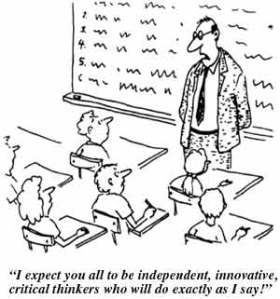 teach at a boarding school, and a few years ago, one of my freshman advisees asked a seemingly innocent question during one of our first meetings. I was still learning the scores of new names teachers must match with faces each fall, but Molly’s inquiry made her stand out from the other students: “What question should I ask, and what’s the answer?”
I vaguely remember replying that I’d have to give her question some thought, but I’d be sure to get back to her. As a bit of playfulness, the matter might have ended there. But Molly brought up the question again, almost every time we saw each other in fact, and it soon became a kind of inside joke. She graduated before I wrote this, but she’s on Facebook, so I’ll be sending this along to her, only half a decade late.
Ideally, teaching and learning invite questions. Good questions distinguish students who are thinking well, and they can move classes in rich and unforeseen directions. Good students and teachers distinguish themselves by the mileage they can get out of each other’s questions. How often I’ve shut students down by dismissing a question out of lack of time, answering it poorly, not hearing it as it was intended, or deferring it in the face of “more important things” and ultimately forgetting it. A class often comes alive with student questions. They break up a teacher monolog, and — better, often, than teacher questions — reveal student thinking, which may well be superior to anything the teacher has planned for the day. For me, following wherever such questions lead at least once a week has proven worth the time again and again.
For questions imply answers. Insofar as it can be put into language, a desire to know carries the seeds of its own response. Often we already “know” much of what an answer should “look like” – which some might say is a problem, because it conditions the kinds of answers we can receive, or those we will devote the most energy looking for. When the man searching for his lost key is asked why he’s looking under a streetlight, he replies, “Because that’s where the light is.”
If we ask simple informational questions, such as “What time is it?” we already know a great deal about the form of the answer. “Half a cup” or “Poughkeepsie” or “grayish green” won’t do for answers in this case. “Not yet” edges somewhat closer, since it has at least something to do with time. “4:18 pm” serves very well, whether or not it’s accurate, because it has the form of the kind of answer we seek. So it satisfies the formal requirement without necessarily satisfying the content requirement.
In the case of “large” questions, though, it can be more difficult to recognize whether an answer even satisfies the formal requirement. But as The Hitch Hiker’s Guide to the Galaxy insinuates, though we may have an answer, even one as specific as 42, without its “inciting” question to steady and direct it like a rudder on a boat, an answer by itself may not help us very much.
Mary Oliver notes in one of her poems, “there are so many questions more beautiful than answers.” Living in our questions is one way to keep a spiritual search alive. Resist the craving for an answer too soon. In her poem “Spring,” she asserts, “‘There is only one question:/how to love this world.” The biggest questions may not have an “answer” in any sense we expect or demand, but they may nonetheless propel us in necessary or powerful directions, ones we need to travel.
Molly’s inquiry is a meta-question – a question about questions. It asks about quality. It also assumes the listener might know more than the speaker, at least about questions and their answers. It implies that another can recognize – and provide – good or worthwhile questions worth asking, can anticipate the kinds of questions you may have, and has good answers.
Now all of this is unfair to load onto a probably offhand and casually teasing question. But by continuing to ask it, Molly slowly transformed it into a kind of riddle or meditation object, deepening its significance. What a lesson there!
One kind of answer to that question is also a general one, and sounds like advice for someone setting out on a journey: ask the best kinds of questions you can, and trust that you also need to seek out your own answers. Those anyone else can supply, except for day-to-day matters, aren’t really worth your time, except as provisional responses, first approximations to the answers you can best provide for yourself. Question authority, because some sacred cows stopped giving milk a long time ago. Question authority to find out if that authority deserves the name — does it feed you stock answers, or does it actually possess the power to lead you toward your own answers? And better, authorize questions — encourage yourself, and others, to keep asking.
/|\ /|\ /|\
Image: cartoon
 One of the more useful skills I’m practicing with Druidry (we all learn our lessons from many sources, in different guises and from different teachers, throughout our lives) concerns binary thinking. It’s easier to recognize when we’re not practicing it ourselves. You’re with us or you’re against us. It’s good or it’s bad. You’re young or you’re old. Hot or cold. 1% or 99%. And so on. Next door in New Hampshire, the state license plates famously read “Live free or die.”
We can get distinctly uncomfortable around ambiguity that doesn’t fall into one or the other of two neat categories. Advertisers after all market to categories, and spend time labeling both products and consumers so they can target their products. WordPress asks for tags and categories. If you have something to sell that doesn’t fit under a label, you can have a devil of a time getting it on the shelves or in front of people’s noses. Likewise, if you want to locate something that doesn’t fit a category, it can sometimes be a long challenge to track it down.
Of course, we can see plenty of this dualistic patterning in action now on a large scale in the States, and without needing to look any further than our presidential primaries. Just tune in, and you’re sure to hear some variant of the following, especially across party lines: one candidate’s or party’s ideas and proposals constitute all Goodness and Light and Upright Living, while the other threatens our very way of life. Filled with greed, selfishness, and all signs of true evil, that Evil Other will — if we make the mistake of listening to/believing in/voting for them, deliver us individually and as a nation into the hands of utter darkness, despair and destruction.

 Of course the drift into binary or polar thinking doesn’t originate or end with politics. As author, blogger and Druid J. M. Greer notes, “Binaries exert a curious magnetism on the human mind. Once we get caught up in thoughts of yes or no, right or wrong, love or hate, truth or falsehood, or any other binary, it can be hard to realize that the two poles of the binary don’t contain all of reality … Druid philosophy offers a useful tactic in situations of this kind. When you encounter a binary, you simply look for a third factor that is not simply a midpoint between the two poles. Find the third factor and you convert the binary into a ternary, a balanced threefold relationship that allows freedom and flexibility.”*
We all know numerous proverbs and images of three-ness. “Third time’s the charm”; the three parts of a syllogism (thesis, antithesis and synthesis); beginning, middle and end; the Three Blind Mice; Brahma, Vishnu and Shiva; Father, Son and Holy Ghost; the examples are nearly endless. What they amount to is a widespread recognition of the liberating and creative power of Three. As the Tao Te Ching says (Ch. 42), “From the One comes Two, from the Two Three, and from the Three the Ten Thousand Things” of existence in this world. The key is not to stop at two if we want to create. Move on to three.
Greer amplifies the discussion of binary thinking in a post on his weekly blog. He notes that
… the hardwired habit of snap judgments in binary form is always right below the surface. In most cases all it takes is a certain amount of stress to trigger it. Any kind of stress will do, and over the years, practitioners of mass thaumaturgy have gotten very good at finding ways to make people feel stressed so that the binary reaction kicks in and can be manipulated to order.
That’s when thinking in binaries goes haywire, the middle ground becomes invisible, and people think, say, and do resoundingly stupid things because they can only see two extreme alternatives, one of which is charged to the bursting point with desire … or fear … Watch the way that many people on the American right these days insist that anybody to the left of George W. Bush is a socialist, or tfor that matter the way that some people on the American left insist that anybody to the right of Hillary Clinton is a fascist. Equally, and more to the point in our present context, think of the way the peak oil debate was stuck for so long in a binary that insisted that the extremes of continued progress and sudden catastrophic collapse were the only possible shapes of the postpetroleum future.
Binary thinking is evolutionarily useful, Greer notes, because it allows us to make snap judgments that can save our lives in crises. But in situations where more careful thinking is not only possible but necessary, our ancient wiring and programming can leave us stranded at one pole or another, in stalemate, with no sense of the way forward.
Greer continues, observing that (in various kinds of Druid and magical training) “Back in the day, beginning students used to be assigned the homework of picking up the morning paper each day, writing down the first nine binaries they encountered, and finding a third option to each binary.” This bit of training can offer a salutary unlocking and rebalancing of the debates of the day — or of any complex problem handicapped and hampered by sharply polarized thinking.
This useful little exercise [of identifying and expanding binaries] has at least three effects. First of all, it very quickly becomes apparent to the student just how much binary thinking goes on in the average human society. Second, it very quickly becomes at least as apparent to the student how much of an effort it takes, at least at first, to snap out of binary thinking. Third and most crucial is the discovery, which usually comes in short order, that once you find a third option, it’s very easy to find more—a fourth, a ninety-fourth, and so on—and they don’t have to fit between the two ends of the binary, as most beginners assume.
Ternary thinking isn’t just a liberating technique for the person who practices it. It carries with it a desirable ripple effect, for
… when a discussion is mired in reactive binary thinking, it only takes one person resolutely bringing up a third option over and over again, to pop at least some of the participants out of the binary trap, and get them thinking about other options. They may end up staying with the option they originally supported, but they’re more likely to do it in a reasoned way rather than an automatic, unthinking way. They’re also more likely to be able to recognize that the other sides of the debate also have their points, and to be able to find grounds for mutual cooperation, because they aren’t stuck in a mental automatism that loads a torrent of positive emotions onto their side of the balance and an equal and opposite torrent of negative emotions onto the other side.
Given how shrill our political dialog has become, and how intransigent and loath to compromise the principal players remain, we could use a healthy dose of such thinking. As one of the Wise has said, “God is what opposites have in common.” For me that means that the “truth” of a matter is less than likely to lie at either extreme of a binary, but somewhere else — not “in the middle” necessarily, as though God were a moderate or centrist deity. The Tao Te Ching also notes (somewhat wryly, I’ve often felt) that “Extremes do not last long.”
But beyond the political sphere, the ternary in other settings leads us directly to the Ten Thousand Things, the world of possibility and options and freedom. To give just one personal example, after my cancer surgery and the follow-up radiation months later, I was weak and suffering from uncomfortable and chronic internal radiation burns in the lower colon. “I’ve got to get better or I’ll have to quit my job,” I thought. “I can’t work like this,” when almost every bathroom visit brought blood and pain. Binary alert! I was able to arrange a medical leave, during which a change of diet, specific exercise, rest, an inspiring class I audited, and several new activities and spiritual practices have helped with healing.
One of the latter is the subtly powerful principle of “both-and.” Rather than stalling in a binary, embrace the whole. So often I hear people saying, “I’m so upset!” or “I can’t believe it!” or some other incantation. The more often they repeat it, the more forceful their mental and emotional state seems to become for them. (Our most common targets of “black magic” are typically ourselves.)
“Both-and” works like this. “I’m upset and I can also be calm.” Both are true. Rather than denying what may be a very real state or situation, include it and move outward to include more. This avoids the resistance or denial that often plagues affirmations or stubbornness or exertions of the will, as if we could force the universe to do what we’re simultaneously insisting it must not to! (I want to be calm, but “I’m so upset!”)
 Whitman, our old American proto-Druid, gets it. “I am as bad as the worst, but, thank God, I am as good as the best.” Both-and, alive and well. And as he also and famously said in “Song of Myself,” “Do I contradict myself? Very well then I contradict myself. I am large, I contain multitudes.”
The Ten Thousand Things all are moving about on their many and beautiful ways. Come walk with me, and with them.
/|\ /|\ /|\
*J. M. Greer, The Druid Magic Handbook, 19.
Images: NH license; Obama; Gingrich; Whitman.

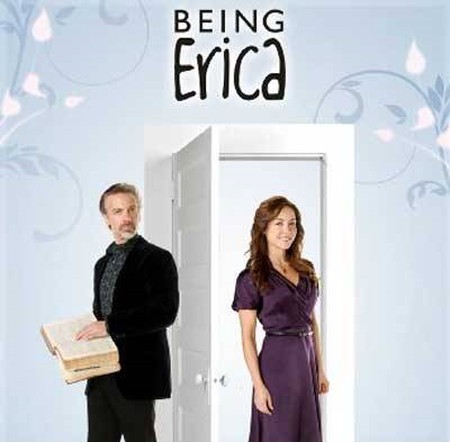 Since my wife and I are too cheap to spend money on cable, we get most of our programming through the internet. Vermont sometimes gets tagged in people’s minds as one of the hinterlands of the U.S., though in fact it’s scheduled to have ultra high-speed internet by 2013, billed as “fastest in the nation,” and VTel (Vermont Telephone) installers are actually ahead of schedule in some areas.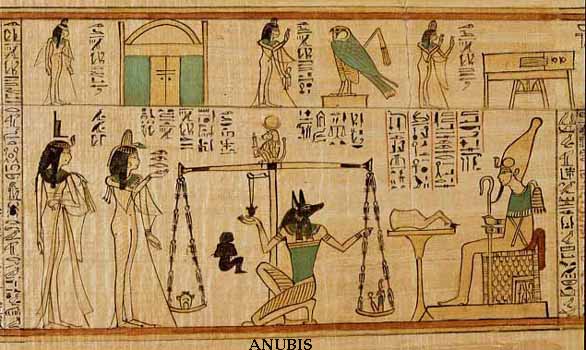



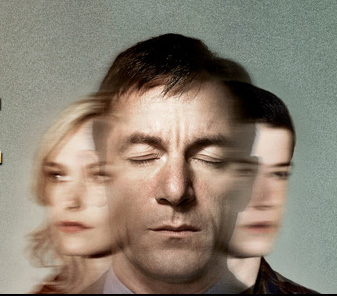






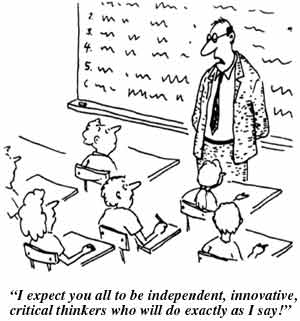





 A Druid Way


