Archive for the ‘nature’ Category
I’m picking up on Steve Schwartzman’s recent comment here for a title to this post: “happy hunger.” We usually think of hunger as a “simple” biological drive, the body’s impulse towards food or sex or life. Yes, as sometimes conscious beings we can override our hungers, at least up to a point, for some other purpose. But to think of these or any hungers as “happy” I take as a prod in a good direction — a pointer, a reminder, a prompt that a shift in attention and consciousness is possible and has arrived full of benefit.
 So what of other hungers? A hunger for connection, a hunger for the sacred, a hunger for contact with the natural world — all of them vital hungers which we struggle to answer and fill each day. And so many “unhappinesses” when we don’t meet these hungers — crimes and random behavior and restlessness and secondary hungers for stimulation — sugar, fat, salt, second-hand sex (porn), alcohol and drugs (to change awareness any way we can!), gossip, fits of temper, violence — these stem, I know at least in myself, from unfulfilled primary hungers, from attempts to shift consciousness out of the bland, boring, mundane, even unreal sensation of “just existing.” As if life, the most real or literally “thingly” thing we experience, could also be “unreal.”* (Which it also is. And that’s neither a good or bad thing, but part of the way the universe apparently works.)
Those of you familiar with psychologist Abraham Maslow’s hierarchy of needs know that, in his schema, these other hungers, and especially the hunger for the sacred, aren’t considered the “largest” or most “immediate” ones at all. They’re at the top of his hierarchy, most distant from Maslow’s naming of our “primary” needs for food and sex and safety. But I’d argue that in fact the need for the sacred is our primary hunger, and that all the rest fall in line behind it. The less we’re connected to the sacred, the more we’re just flesh machines. Fortunately we’re always connected to some degree — that’s what being alive is. The task is to blow the spark to fire, to nourish and feed that singular flame through and with all the others, so that eating and lovemaking and all the “daily-ness” of our lives, potentially everything, becomes sacrament, a door for the sacred to enter this instant, right here, and transform us. It’s what Christians call the abundant life, what Zen means by satori, and what we all experience in those transcendent moments that do not last because we also live through the (potential) sacrament of time, that sweeps us ever onward to the next, the latest, the new. A physical world can only manifest eternity as time. And our next task is to see time our ally, to make it and to know it as a sacrament as well. Not as endpoint — it can’t be that, in its ceaseless flow — but as ongoing opportunity for practice and reverence and worship.
So the “happy hunger” is the hunger that connects us, the hunger we recognize and welcome and honor. As a Druid I have a tool-kit to make room for the sacred, to invite and witness it around and within me and all whom I meet, to increase its presence in my consciousness, and then to bring more of it into my world and surroundings and atmosphere and aura and presence, so that others may encounter it, too, and access it in their own lives. We all have access points to many ways to do the same thing. The tools aren’t what’s lacking. It’s the courage and love and trust and responsibility to make use of them for our own good, for the good of the whole. This is my prayer and my goal for practice, my ritual and my path. May you strive and realize, delight and rejoice, as you discover and find your own.
/|\ /|\ /|\
*”real,” from Latin re-alis, “real, thingly,” from re-s, “thing, matter, affair.” Thus the “real” means simply whatever is a “thing,” and so the “unreal” is the realm where distinct “things” disappear, where there is a whole, a network, an interplay, an eco-system, and not a collection of separate things to be counted — the “real” is whatever we can count, or assign a number to. And so then of course we turn around and protest that we’re not just numbers to be counted, we’re not just statistics, or collateral damage, we “matter” (odd use of the “material” to point to the sacred!). Here is our recognition that the spark in us is sacred, that it knows more that “this.”
Between legs of my flight back early this morning from my cousin’s wedding, I stood in an airport shuttle at Washington/Dulles, watching for a long minute as the sun edged into view in a glory of red and orange. Then the shuttle turned as it headed towards the main terminal, and I couldn’t see the horizon anymore.
I glanced around at my fellow passengers. Every single one of them was looking down, intent on a cell phone or iPad or some other device. Had they all missed beauty? Then finally I heard one couple directly ahead of me say something about the colors along the skyline. How often have I missed what’s just beyond my vision at the moment, but accessible with just a slight shift of attention — off myself and onto things in the larger circles of the world?

How easy we overlook what’s freely given to us! Would we attend to it, value it more, if we had to pay a small fee each time we wanted to witness a sunrise or a rainbow or a storm?!
It’s true that we often treat what we buy with more respect than what comes to us gratis. It’s also true that by “owning” something we feel we have a right to do with it whatever we wish because it’s “ours.” Nature as entertainment, as a product for consumption. “My” holly bush, “my” yard. Imagine nature a signatory even to one of our decrees concerning it.
Meanwhile, the holly spreads its sharp leaves, unconcerned. Red berries flash into vision, and wind sifts between leaf and fruit.
and a time to every purpose under the heaven, says Ecclesiastes. Nowadays people say in partial and often unconscious echo, “Everything happens for a reason.” It’s a loaded statement. In the natural world we can find pattern and order, and much of the appeal of Druidry lies in acknowledging and celebrating such patterns. The physical world reflects an order that does not depend on human effort, a pattern which recurs and circles and balances itself: dark with light, death with life, decline with renewal.
These are comforting notions, but what of violent crimes, natural disasters, horrific diseases? Then the words turn glib and facile, if not downright cruel. Tell a burn victim, a family made homeless by a tornado, the target of sexual assault that there’s a reason or purpose behind their suffering. The statements are much less cheery or supportable in such instances.
But the statements assert even more this. A “reason” suggests the “purpose” of the original quotation, an intention and even an intelligence behind it all, perhaps “out there” in the world, perhaps “in here” in human perception and the urge to make sense of experience. Is the universe malevolent? Does it intend us ill? Or, as many suspect, is it in fact not conscious at all, and wholly indifferent to human presence?
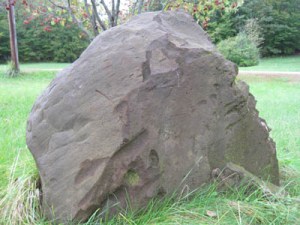
[My wife and I found this half-ton boulder two years ago when we dug up a new garden area. It now sits upright in our front lawn, more or less aligned north-south, and it’s starting to acquire a patina of lichen. Unsought. Beautiful.]
My experience with Druidry thus far has pointed me toward a perspective that comes through experience rather than principally through argument or rational process. These questions matter most prior to experience.
It can, for instance, be pleasant to lie in the sun. Actually lying in the sun delivers this realization after the fact. The warmth feels good, and the body responds to the heat and light. But beyond that, the relaxation may bring a discovery about something completely unrelated to sunbathing — a problem or difficulty I’m having. Likewise, the practice of Druidry can put a Druid in the position of discovering and knowing things unsought, without feeling the need to take a position on them either for or against. You simply know.
Of course we can seek out experiences expressly to test the validity of a belief or opinion for ourselves — that is, after all, good scientific method — but the after-the-fact quality of unsought insight allows one to absorb the experience in a less-conditioned way, without expectations or already-formed conclusions. Experience is primary, and all our explanations follow. Otherwise, we’re merely echoing others’ opinions about their experiences. Once you’ve experienced it yourself, any opinions about it start to matter a lot less.
That’s one reason that Druids I’ve met are tolerant of often divergent beliefs — they know that experience can dissolve doubts and contradictions and disagreements and leave us on the far side of mental processes and constructs, where a new landscape has opened up, and the former questions don’t matter so much any more. Or they’ve been transformed. Or new questions have arisen that are much more challenging and engaging. The world itself has changed for us.
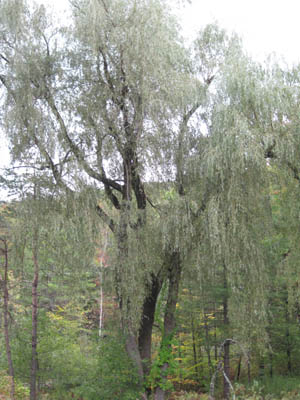 Here’s one of my favorite trees, a tall willow behind our house, on a rather cloudy day yesterday. The tree suffered winter storm damage a few years ago — an almost horizontal branch cracked, broke and fell into the snow — but it’s beautiful still.

And here’s the road up the hill behind the willow. The end curves away out of sight (at least until the leaves drop). A metaphor for the paths we’re all on? Sure. And it’s also — and first — a road. I’ll update the pictures as the changes come.

 So what of other hungers? A hunger for connection, a hunger for the sacred, a hunger for contact with the natural world — all of them vital hungers which we struggle to answer and fill each day. And so many “unhappinesses” when we don’t meet these hungers — crimes and random behavior and restlessness and secondary hungers for stimulation — sugar, fat, salt, second-hand sex (porn), alcohol and drugs (to change awareness any way we can!), gossip, fits of temper, violence — these stem, I know at least in myself, from unfulfilled primary hungers, from attempts to shift consciousness out of the bland, boring, mundane, even unreal sensation of “just existing.” As if life, the most real or literally “thingly” thing we experience, could also be “unreal.”* (Which it also is. And that’s neither a good or bad thing, but part of the way the universe apparently works.)


 A Druid Way