Archive for the ‘Jesus’ Category
An altar is an important element of very many spiritualities around the world. It gives a structure to space, and orients the practitioner, the worshipper, the participant (and any observers) to objects, symbols and energies. It’s a spiritual signpost, a landmark for identifying and entering sacred space. It accomplishes this without words, simply by existing. The red color of the Taoist altar below immediately alerts the eye to its importance and energy.

As a center of ritual action and visual attention, an altar is positioned to draw the eye as much as any other sense. In Christian churches like the one below, everything is subordinated to the Cross and the altar immediately below it. Church architecture typically highlights this focus through symmetry and lighting. But in every case, enter the sacred space which an altar delineates, and it tells you what matters by how it is shaped and ordered and organized.

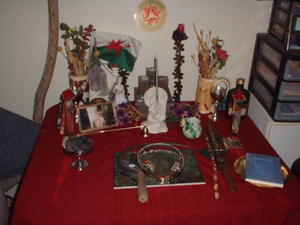
Part of OBOD* training is the establishment and maintenance of a personal altar as part of regular spiritual practice. Here’s a Druid altar spread on a tabletop. Nothing “mundane” or arbitrary occupies the space — everything has ritual or spiritual purpose and significance to its creator.

Such obviously physical objects and actions and their appeal to the senses as aids in spiritual practice all spring from human necessity. We need the grounding of our practices in the physical world of words, acts and sensations in order to “bring them home to us,” and make them real or “thingly,” which is what “real” (from Latin res “thing”) means.
Religions and spiritual teachings accomplish this in rich and diverse ways. We have only to think of Christian baptism, communion and the imposition of ashes at Easter; Hindu prasad and tilak; Jewish bris/brit (circumcision) and tallit (prayer shawl) and so on.
Atheists who focus exclusively on belief in their critiques and debates thus forget the very real, concrete and physical aspects of religious and spiritual practice which invest actions, objects and words with spiritual meaning that cannot be dismissed merely by pointing out any logical or rational cracks in a set of beliefs. Though you may present “evidence that God doesn’t exist” that seems irrefutable to you, you haven’t even begun to touch the beauty of an altar or spiritual structure, the warmth of a religious community of people you know and worship with, the power of a liturgy, the smell of incense, the tastes of ritual meals, the sounds of ritual music and song.
Just as we hear people describe themselves as “spiritual without being religious” as they struggle to sift forms of religion from the supposed “heart” of spirituality, plenty of so-called “believers” are “religious without being spiritual.” The forms of their spiritual and religious practice are rich with association, memory and community, and can be as important as — or more so than — a particular creed or set of beliefs.
Having said all of this, I’ve had a set of experiences that incline me away from erecting a physical altar for my Druid practice. So I’m working toward a solution to the spiritual “problem” this presents. Let me approach it indirectly. Once again, and hardly surprising to anyone who’s followed this blog or is as bookish as I am, the trail runs through books.

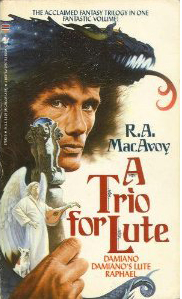
Damiano, the first volume in a fabulous (and sadly under-known) trilogy by R. A. MacAvoy, and recently reissued as part of an omnibus edition called Trio for Lute, supplies an image for today’s post. Damiano Delstrego is a young Renaissance Italian who happens to be both witch and aspiring musician. His magic depends for its focus on a staff, and we see both the strengths and limitations of such magical tools in various episodes in the novel, and most particularly when he encounters a Finnish woman who practices a singing magic.
When I read the trilogy at its first publication in the 80s, the Finnish magic sans tools seemed to me much superior to “staff-based” power. (Partly in the wake of Harry Potter and the prevalence of wands and wand-wielders in the books and films, there’s a resurgence of interest in this aspect of the art, and an interesting new book just published reflecting that “tool-based” bias, titled Wandlore: the Art of Crafting the Ultimate Magical Tool).
So when I then read news of church burnings, desecrated holy sites, quests for lost spiritual objects (like the Holy Grail) and so on, the wisdom of reposing such power in a physical object seemed to me dubious at best. For whatever your own beliefs, magic energy — whether imbued by intention, Spirit, habit, the Devil, long practice, belief in a bogus or real power — keeps proving perilously vulnerable to misplacement, loss or wholesale destruction. Add to this Jesus’ observation that we are each the temple of Spirit, and my growing sense of the potential of that inner temple of contemplation — also a feature of OBOD practice — and you get my perspective.
Carrying this admitted bias with me over the years, when I came last year to the lesson in the OBOD Bardic series that introduced the personal altar, I realized I would need both contemplation and creativity to find my way.
My solution so far is a work in progress, an alpha or possibly a beta version. My altar is portable, consisting of just five small stones, one for each of the classic European five elements — four plus Spirit. Of course I have other associations, visualizations and a more elaborate (and still evolving) practice I do not share here. But you get the idea. (If you engage in a more Native-American nourished practice, you might choose seven instead: the four horizontal directions, above [the zenith], below [the nadir] and the center.)
I can pocket my altar in a flash, and re-deploy it on a minimal flat space (or — in a pinch — right on the palm of my hand). One indulgence I’ve permitted myself: the stones originate from a ritual gift, so they do in fact have personal symbolic — or magical, if you will — significance for me. But each altar ritual I do includes both an invitation for descent and re-ascent of power or imagery or magic to and away from the particular stones that represent my altar. Lose them, and others can take their place for me with minimal ritual “loss” or disruption. Time and practice will reveal whether this is a serviceable solution.
This post is already long enough, so I’ll defer till later any discussion of the fitness of elemental earth/stone standing in for the other elements.
/|\ /|\ /|\
*OBOD — the particular “flavor” of Druidry I’m studying and practicing.
Images: Singapore Taoist altar; Christian altar; Druid altar; Amazon/Trio for Lute.
/|\ /|\ /|\
Updated: 27 July 2013
So if you found my previous post about fear and death (and nerds — yay!) a bit too off-putting, here’s a reprieve. What else might a new “religious operating system” have on offer?  In a Huffington Post article from some time ago (Sept. 2010) titled “The God Project: Hinduism as Open Source Faith,” author Josh Schrei asserts that the principal distinction between Hinduism and other more familiar Western faiths is not that the former is polytheistic and the latter are monotheistic, but that “Hinduism is Open Source and most other faiths are Closed Source.” (We’re already increasingly familiar with the open-source approach from computer systems like Linux and community-edited resources like wikis.) In this series on what a more responsive and contemporary religious design might look like (here are previous parts one and two), this perspective can offer useful insight.
If we consider god, the concept of god, the practices that lead one to god, and the ideas, thoughts and philosophies around the nature of the human mind the source code, then India has been the place where the doors have been thrown wide open and the coders have been given free rein to craft, invent, reinvent, refine, imagine, and re-imagine to the point that literally every variety of the spiritual and cognitive experience has been explored, celebrated, and documented. Atheists and goddess worshipers, heretics who’ve sought god through booze, sex, and meat, ash-covered hermits, dualists and non-dualists, nihilists and hedonists, poets and singers, students and saints, children and outcasts … all have contributed their lines of code to the Hindu string. The results of India’s God Project — as I like to refer to Hinduism — have been absolutely staggering. The body of knowledge — scientific, faith-based, and experience-based — that has been accrued on the nature of mind, consciousness, and human behavior, and the number of practical methods that have been specifically identified to work with one’s own mind are without compare. The Sanskrit language itself contains a massive lexicon of words — far more than any other historic or modern language — that deal specifically with states of mental cognition, perception, awareness, and behavioral psychology.
 It’s important to note that despite Schrei’s admiration for Hinduism (and its sacred language Sanskrit — more in a coming post), the West has all of these same resources — we just have developed them outside explicitly religious spheres. Instead, psychology, so-called “secular” hard sciences, social experimentation, counter-cultural trends and other sources have contributed to an equally wide spread of understandings. The difference is that far fewer of them would be something we would tag with the label “religion,” especially since the pursuit of things like ecstatic experience — apart from some Charismatic and Pentecostal varieties — generally lies outside what we in the West call or perceive as “religion.”
The underlying principle that drives such a range of activity perceived as “religious” also stands in sharp contrast with religion in the West. (Of course there are exceptions. To name just one from “inside religion,” think of Brother Lawrence and his Practice of the Presence of God.) As Schrei remarks, “At the heart of the Indic source code are the Vedas, which immediately establish the primacy of inquiry in Indic thought.” To put it another way, India and Hinduism didn’t need their own version of the American 60s and its byword “question authority,” because implicit in open-source religion is “authorize questions.” Nor did they need debates over Creation or Evolution, because scientific inquiry could be seen as a religious undertaking. Schrei continues:
In the Rig Veda, the oldest of all Hindu texts (and possibly the oldest of all spiritual texts on the planet), God, or Prajapati, is summarized as one big mysterious question and we the people are basically invited to answer it. “Who really knows? Who will here proclaim it? Whence was it produced? Whence is this creation? The gods came afterwards, with the creation of this universe. Who then knows whence it has arisen?” While the god of the Old Testament was shouting command(ment)s, Prajapati was asking: “Who am I?”
This tendency to inquire restores authority to its rightful place. In an era in the West when so many faux authorities have been revealed as spiritually hollow or actively deceitful, we’ve arrived at a widespread cynical distrust of any claims to authority. But true authorities do still exist. Their hallmark is an invitation to question and find out for ourselves. Jesus says, “Ask and you will know, seek and you will find, knock and it will be opened to you.” These aren’t the words of one who fears inquiry. To paraphrase another of his sayings, when we can learn and know the truth about something, we will meet an increase of freedom regarding it. It will not intimidate us, or lead us to false worship, or mislead us. One identifier of truth is the freedom it conveys to us. 
Authorities also benefit us because out of their experience they can guide us toward the most fruitful avenues of inquiry, and spare us much spinning in circles, pursuing wild geese, and squandering the resources of a particular lifetime. Whether we choose to follow good advice is a wholly separate matter. Authorities can point out pitfalls, and save us from reinventing the wheel. At a time when so many look East for wisdom, only recently have we been rediscovering the wisdom of the West hidden on our doorsteps.
Examples abound. The Eastern Orthodox church has preserved a wealth of spiritual practices and living exemplars in places like Mount Athos in Greece. The Pagan resurgence over the last decades has done much useful weeding and culling of overlooked and nearly forgotten traditions rich in valuable methods for addressing deeply the alienation, disruption, dis-ease, physical illness and spiritual starvation so many experience. Individuals within Western monotheisms like Rob Bell and his book Love Wins have served as useful agents for reform and introspection. While it may not be always true, as Dr. Wayne Dyer claims, that “every problem has a spiritual solution,” we’ve only just begun to regain perspectives we discounted and abandoned through the past several centuries, mostly through the seductions of our increasing mastery of a few select processes of the physical plane and their capacity to provide us with comforts, sensations, entertainments and objects unknown until about 75 years ago. We’ve self-identified as “consumers” rather than spiritual beings. Hamlet identified the problem centuries ago: “What is a man if his chief good and market of his time be but to sleep and feed?” Or as another of the Wise asked, “What does it profit a man, if he gain the whole world and lose his soul?” Let us be soul-finders and soul-nourishers. Otherwise, why bother?
/|\ /|\ /|\
Images: open-source cartoon; veda; Mount Athos
Nerds talk a lot, one way or another. If they don’t speak, they write. That’s annoying, because it’s often hard to get them to shut up. And now, armed as they are with blogs and email and Twitter and Facebook and Myspace and a myriad of other venues — well, you get where I’m going with this. More words than people on the planet, every single day.
But while not all of us are Nerds, or even nerds, one thing we all face, nerd or otherwise, is fear. Since we often do our level best not to talk about fear, why not put the nerd instinct to good use? Resist the flow. Be awkward, that thing nerds excel at, and talk about it. (Along the way I get to include a Youtube link, and references to the plague, Jesus, and a medieval poem. Good stuff — a regular pot-luck entry.)
One big fear, of course, is fear of death. Reader, if you’ve found a sure-fire way around it, get busy marketing. You’re set to make your fortune. And no, I’m not talking about any Afterwards. That’s a separate post. I mean the process, the whole sucky thang of the roof caving in on the house, the ground floor dropping away into the basement, and the walls tumbling down. The Demolition (or Eviction, depending on your take regarding a Landlord). The Snuff, the Blowout, the Final Exit, the Nobody Home of your life.
Have I got you thoroughly depressed, and on your weekend, too? Sorry for that, though I won’t apologize for the topic. If we’re going to be morbid, let’s do it right, with style and flair, and a literary reference. Here’s your serving for the day. There’s a well-known Middle English poem I keep coming across from time to time which partly inspired this post. I read it in college and I’ve taught it in high school in British Lit. Pause here for a digression — just skip the rest of this paragraph, and the next one, if you’re in an impatient mood when you read this.
Still with me? OK. Yes, I get it — unless you’re also a fan, Middle English is next door to Old English and Beowulf and all that other stuff your high school or college English teacher inflicted on you. Or if it wasn’t English, it was something else. Let’s just acknowledge that at one time or another you’ve been on the receiving end of, and made to suffer for, an intellectual enthusiasm or obsession you didn’t share. And no — I’ve never shed the geek/nerd label since it first attached itself sometime in high school — the difference nowadays is that I make my living from it as a teacher. It’s as if I wrote a book called Nerdiness for Fun and Profit. Which might actually sell. So I’ll apologize in advance for whatever my educational peers have put you through — you and my own students.
So here’s an excerpt from approximately the first half of the poem. The spelling’s been modernized, and the few words that haven’t made it through into modern English are clear enough in context that you should be able to catch the gist without me being even more nerdy and annotating the damn thing. But I’ll do it anyway. And one other note: the Latin tag in italics translates as “The fear of death disturbs me.”
In what estate so ever I be
Timor mortis conturbat me.
As I went on a merry morning,
I heard a bird both weep and sing.
This was the tenor of her talking: [substance, topic]
Timor mortis conturbat me.
I asked that bird what she meant:
“I am a musket both fair and gent; [sparrowhawk/nobly-born]
For dread of death I am all shent: [ashamed, confused]
Timor mortis conturbat me.
When I shall die, I know no day;
What country or place I cannot say;
Wherefore this song sing I may:
Timor mortis conturbat me.”
In medieval Europe death was everywhere. People died at home, people died young, and people died from — among other things — the series of perfectly nasty plagues that swept Europe and took out a good third of the population. Today we’ve got it easy in many ways. Our life expectancy is twice that of the 1400s, we can usually moderate pain through medication, and many medieval diseases have been eliminated. No, I’m not asking you to be ever so grateful and click on over to EasyDeath.com. But what’s interesting is that the speaker of the poem isn’t concerned with pain but with uncertainty. It’s that sense of being ambushed by an invisible assailant that adds to our fear.
There are several things to say, Druidic and otherwise, in response. First, those who’ve had out-of-body experiences often report that they’ve lost their fear of death. You may be one of those people yourself. To quote Genesis (the band this time–not the book–in their song “Carpet Crawlers”), “You’ve got to get in to get out.” Or in this case, get into other states of reality, see that this one is one among many, and that leaving this one is less of a Big Deal. These kinds of experiences are more common than we’re lead to believe, and those who’ve had them often keep quiet about it because of the general atmosphere of fear, skepticism, and materialism that denies whole facets of human existence. What I’ll say for victims of these mindsets is that they deserve compassion for living on the porch and never venturing into the house, never bothering to find out if there even is a house.
A powerful technique I’ve found is to send love to my fears. I can make it a daily prayer. If we’re worried about a difficult dying, send love to that future self which will die. Break down the patterns of fear that sap and sabotage our present possibilities for joy. As Jesus observed, “Perfect love casts out fear.” And don’t worry if your love isn’t “perfect.” Any love is a good start, an improvement on dread. Most fear is learned.
For those of us who believe in or have had experience of other lives, the sense of deja-vu often replaces fear. Gotta go through it all — again!
I’ll close with another citation, which I find Druidic in sensibility. This one I ran across in school, decades back, and copied down into my journal. The paper I’m reading from as I type this is yellowed and crinkling on the edges. It describes a kind of initiation. The quotation is long but I hope worthwhile for the “tough wisdom” it teaches.
The American Indian’s insistence on direct personal religious experience remains preserved when he comes into contact with Christianity: he finds it difficult to accept experiences of the other world which are said to have happened two millennia ago and which are attested to only by a book.
An empirical attitude toward the other world is a difficult one to put into action. It requires an emptying of the mind and the body, a humbling of the self before all other beings, “even the smallest ant.” It is not as though the Indian [you can substitute Druid here — ADW] is “close to nature” and therefore found such an experience easier to come by than ourselves; he speaks of the journey as carrying him “to the edge of the Deep Canyon,” and he feels it as nothing less than death itself. While he is there he sees a universe where everything is not only animate, but a person, and not only a person but a kinsman. On his return from the journey he is reborn; he is no longer the same person he was before. Having seen for himself the reality of the other world, he now has what William Blake called “the double vision,” as opposed to the single vision of Newton. Alfonso Ortiz describes this double vision in the teachings of his Tewa elders, who “saw the whole of life as consisting of the dual quest for wisdom and divinity.” It is not that the Indian has an older, simpler view of the world, to which we an Newtonian thinkers have added another dimension, but that he has a comprehensive, double view of the world, while we have lost sight of one whole dimension.
The way to his understanding is not found with the road maps of the measurable world. One begins by finding four roads that run side by side and choosing the middle one. The Road, once found, is cut by an impassable ravine that extends to the ends of the world. One must go right through. Then there is an impenetrable thicket. Go right through. Then there are birds making a terrible noise. Just listen. Then there is a place where phlegm rains down. Don’t brush it off. Then there is a place where the earth is burning. Pass right through. Then a great cliff face rises up, without a single foothold. Walk straight through. If you travel as far as this and someone threatens you with death, say, “I have already died.” (Teaching of the American Earth, xx.)
/|\ /|\ /|\
So there you have it — one of my stranger posts, oddly organized, with weird tonal shifts. Hope you get something useful from it. Thanks for reading.
 It’s no accident that this time of year turns us toward thoughts of resolutions. After the family gatherings and excess of the holidays — and let’s be honest, some excess and abandon can be fun, or would be, if our Puritan strain didn’t kick in, and kick us — we can feel slack and listless. We’ve crested the peak of seemingly endless sugar and fat in our holiday diet — unless New Year’s Eve is the bigger holiday for you, in which case you’re just getting in training. In the shadow of the sugar low, just combine these things with cloudy days, at least here in the northeast U.S., and you face a perfect storm of sloth and dejection and mild to severe loathing. At some point our usually inevitable American self-improvement gene then steps forward, and it’s off to fix ourselves.
Whenever we push happiness or improvement into the future, we can be in trouble. If it’s in the form of satisfaction with ourselves, twice the trouble. How many times have we started and quit some scheme of fix-up? Lose weight, get in shape, hold your temper with the left- or right-wing relative who always gets under your skin, forgive your neighbor, keep a diary, save more money each month, clean the basement or garage — paper for all the lists of vows and resolutions could keep Staples in business all by itself. And if you truly enjoy flogging yourself, you key in your list to your favorite electronic device, so you can torture yourself with it several times a day.
You should know I tend not to make many resolutions. Partly, my personal standards are lower, I’ll admit — and that makes things easier. I confess to a startling capacity for indolence. Both my wife and I have had years where we’re either flat out — busy, or flat out — in sloth. Partly as a result of that, I’m a pragmatist. No use flailing and contorting to begin something I won’t finish. Shorten the list, I tell myself. Throw it out altogether. Delete the to-do’s accumulating on your virtual or actual desktop. Be realistic. You’ll be happier not making yourself miserable with what you fail to accomplish. Or just keep it off the list in the first place. Guilt may be a Catholic specialty, but most Americans, regardless of religious ancestry or affiliation, have managed to add it to their personal repertoire of masochism and psychological waterboarding. Thus do I lower expectations. And I’m only exaggerating slightly. Low expectations let me rejoice in walking down a hallway and back — once — after my cancer surgery. Then twice. And so on. In three months I was jogging three miles a day. Which was not my intention, and would have seemed daunting at the outset. I just increased my distance a little each day. The gifts of fresh air and daily sunrise were more than half of my success.
Which brings me to magic.
Not a transition you saw coming, I imagine. Enough for at least a couple of readers to stop in disgust. We’ll ignore the fact that what gets called “magical thinking” is exactly what propels many of our resolutions to change. Such thinking is indeed unrealistic, because — to use the physical metaphor — we try to do the equivalent of the Boston Marathon without first taking up merely a short daily walk. Too often we simply crash and burn.
So let’s define magic as most actual practitioners do: the art of creating changes in consciousness in conformity with the will.
This isn’t the “will” of willpower, as if we could compel the universe to do anything it isn’t already inclined to do. That kind of will is the popular image of the witch or magician, however, muttering arcane mantras and spells, and perhaps waving a wand. It’s Harry Potter magic, which is why many practicing magicians found the Evangelical Christian hysteria (here’s a more balanced overview) over the book series and its supposed promotion of “Satanism” and “witchcraft” to be hysterical, as in funny. See how far you get waving a wand and shouting “Expelliarmus” or “Avada Kedavra.” (“Expecto Patronum”* might get you incrementally closer to achieving something, if only because it may lead you to focus on a positive.)
Actual — as opposed to Hollywood or popular — magic is a matter of discerning the patterns and tendencies of the natural world and its powers and forces, and then aligning oneself with them. Quite simply, any other approach is highly unlikely to succeed. As Druid and occult author J. M. Greer observes, if it “ignores the momentum and flow of natural patterns, it’s clumsy and wasteful of energy. It’s much like trying to cross a lake on a rowboat without paying attention to the winds and the currents. If you ignore these, you can put plenty of effort into rowing and make very little headway, or even end up further away from your goal than you started” (The Druid Magic Handbook, 18). Blindly asserting the will is rowing while oblivious to movements and energies of the larger world. Far from being supernatural, magic is thus deeply involved with the natural world.
 The will involved in magic is much better identified as intentionality, and it’s intentionality that helps our New Year’s resolutions actually succeed. Greer continues: “Real will is effortless. It corresponds, not to struggle and strain, but to what philosophers call ‘intentionality,’ the orientation of the mind that locates meaning in objects of experience” (20). He gives the example of choosing to look at a window, or through a window at something on the other side. The well-known image of faces or a vase offers a similar instance. It’s by intention that we shift our perception. Strain has nothing to do with it. You perceive the two dark faces in profile looking at each other, or you perceive a white vase on a black background. It’s hard to see both simultaneously. But intentionality lets you shift between them. It’s a choice.
One technique, therefore, for training the will or the intentionality, is to do something simple and comparatively effortless. Set yourself a ridiculously easy task, follow through on it, and record your results. The purpose of this training is to reveal and separate all our defeatist and negative self-sabotaging attitudes from an actual act of intentionality. For instance, five times during the day, stand up, turn three times in a circle and sit back down again. Record the date and time on each instance that you do this.
Now presumably nothing interfered with your success, except perhaps a mild feeling of embarrassment. But you set up an intention, and manifested it without strain. You simply did it. Yoda’s words are apropos here: “Do, or do not. There is no try.” The “trying” is the strain, the effort of will to do something you actually don’t want to do. Intentionality bypasses that. You simply do it because you decided to. This is a form of preliminary magical training: doing small, effortless, things you know you can achieve without strain, in order to gain confidence in intention.
Because intentionality is a choice, not a struggle, many aspects of our lives can come under its influence. Greer continues,
If you face a challenge with confidence, for example, you chances of success are much better than if you face the same challenge full of doubts and worries. Intentionality is the reason why. What the confident person sees as potential opportunities, the worried person sees as potential obstacles, and they are both right, because whether something is an opportunity or an obstacle usually depends on how you choose to approach it (Greer, 21)
— that is, on your intentionality.
We use a form of magic whenever we make a resolution — in this sense, we’re all magicians at work.
The difference between intentionality and ordinary ideas of willpower explains many of the failures that bedevil beginners. When you try to use magic to will the world into obedience [in the case of a resolution, you will yourself to change your own behaviors and habits — ADW], you set up an intentionality of conflict between yourself and the world … The harder you try to make the world obey, the more it fights back, because all your efforts reinforce the intentionality and amplify the conflict. Change your intentionality to one of moving in harmony with the world, and the conflict disappears (Greer, 21).
This is not unfamiliar territory to Christians, either, or shouldn’t be. Jesus says, “Agree with thine adversary quickly, while thou art in the way with him.” “Turn the other cheek,” and so on. In other words, don’t make additional and entirely unnecessary trouble for yourself. Don’t stand in your own way.
Because we often practice “black magic” on ourselves, sabotaging and short-circuiting our own best intentions with negative thinking and self-limiting behavior, and setting up conflicting, opposing intentionalities, we waste time and energy “rowing against the current.” Many beginning magicians
try to use magic to achieve financial prosperity, and it’s common for their efforts to backfire and leave them poorer than they started. Why? In many cases, their magic focuses on wanting what they don’t have. This sets up an intentionality of wanting and not having, and so they end up wanting money and not having it. As with so many things in life, the more energy they put into chasing something, the faster it runs away (Greer, 22).
Because Greer has such insightful and useful things to say about intentionality — and thus resolutions — I want to let him have (almost) the final word:
If you want to use magic to become prosperous, your intentionality has to focus on being prosperous, not on wanting to be prosperous. One effective approach starts with noticing the prosperity already in your life — if you have a roof over your head, three meals a day, and the leisure to read this book, after all, you have more prosperity than half the people on this planet — and letting the change in focus from wanting to having gently redefine your intentionality toward wealth. Another useful strategy focuses on seeing opportunities for abundance around you. This redefines your surroundings as a source of opportunity, and as [our life energy] follows intentionality, and shapes experience, opportunities appear (Greer, 22).
So to sum up, practice intentionality with actions that don’t haul negative habits of thinking along with them. Focus on having and being, rather than on wanting and lacking. Experiment. Use the power of choice to shift consciousness — to see the vase, the faces, or whatever your intentionality is. Repeat as needed.
/|\ /|\ /|\
Images: resolutions and faces/vase
Postscript: when I was searching for the first image, a list of resolutions, I came across pictures of computer screens, too — another meaning of resolution — the pixel resolution or clarity of image that a screen possesses. Likewise, my clarity in visualizing the goal — of having or being what I desire — is key to “keeping” my resolutions. Imagining what it is like being and having what I desire is halfway to my manifesting it. I already know something of what it feels like to succeed. (I’m using this strategy as I revise my nanowrimo draft.)
*”Expecto patronum” — (Latin, literally, “I await a patron/protector”) summons a familiar or symbolic representation of the self to protect one against negative energies, such as Dementors in the HP series. Harry’s patronus is a stag, as was his father’s. Of the three spells I cite above, this one is good defensive magic and actually works well against nightmares. The following is part of the entry from the Harry Potter wiki on the Patronum spell:
A Patronus is a kind of positive force, and for the wizard who can conjure one, it works something like a shield, with the Dementor feeding on it, rather than him. In order for it to work, you need to think of a memory. Not just any memory, a very happy memory, a very powerful memory… Allow it to fill you up… lose yourself in it… then speak the incantation “Expecto Patronum”.
-
—Remus Lupin teaching Harry Potter the Patronus Charm




 A Druid Way