A water meditation, to be read slowly to oneself, in the same way water flows and falls.
“The highest good is like water,” whispers chapter eight of the Tao Te Ching. Jump in a pool or lake on a summer day, or take a hot shower after working up a sweat, and who would disagree? Whisky, brandy and other distilled spirits have variously been called aqua vitae, “water of life.” And “whiskey-bey” or uisce beatha, the Gaelic for whisky, is literally “water of life.” St. Patrick reportedly used the term aqua vitae both for alcohol and the waters of baptism. Jesus baptized with water (and — with the coming of the Holy Spirit at Pentecost — with fire: with both masculine and feminine elements). The Spirit of God hovered over the surface of the deep in the Biblical account of creation in Genesis, as if water were there all along, part of the primal substance God found on hand, in the dark, and used to create everything else. Water the divine unconscious, adapting to whatever form it finds. All things turn toward water.
“The highest good is like water.” Water itself says this, if I listen. Splash of the ocean’s tide, fall of water in a cascade or fountain. “Earth my body, water my blood,” goes the Pagan chant. It’s in us, of us — we’re of it. The human body is mostly water, we hear from many quarters. Hydrate!! We answer to what we’re made from, the amniotic fluids that bathe and nourish the growing fetus. The womb shelters a pool, a miniature sea. The Great Mother, Stella Maris, Star of the Sea.
Medieval magicians called water a “creature,” a created being, and the personification of water in the figure of the undine puts a face to the endlessly changing aspect that water wears. To be a water druid is first to listen to water. I never learned to swim till I reached my twenties, and a recurring dream throughout my childhood of falling into water and drowning left me with fear of heights over water. (Heights by themselves, though, are no problem for me.) There was my path through and to water. I listened, though part of the act was listening to fear. But that got my attention like nothing else could, so I count it useful. I strive to listen wider.
“Water benefits all beings without contending with them, and flows to the lowest places men disdain. In this manner it approaches the Way.” Tao, the way that water flows. “dao ke dao fei chang dao”: the way that can be followed as a way isn’t the way the way goes, to “English” it rather clumsily. Water flows, following its nature without thinking about it.
I don’t need to look any further for a sacrament, a way to make things sacred. Drinking, bathing, being born is worshiping, Attention, intention, makes the offering. The words of the old Anglican wedding vow “With this Ring I thee wed, with my body I thee worship” get it right. If we want to worship, we can begin with the body, with the waters ringing our planet and flowing in our blood. We don’t need to disdain the body because it’s “only” flesh, but celebrate it. To be alive is a holy act. The elements help us remember this, signify it, and make it so. Thus sings the Water Druid.
/|\ /|\ /|\
Images: waterfall; Mei Yang Selvage‘s remarkable painting of the character “tao” or dao, with the final elonngated bottom stroke forming the boat the man poles.
I’m a fake Druid. So is everyone else who names Druidry as the path they walk. And I’ve come to love it.
In a guest essay on the ADF website, J. M. Greer notes,
The very last of the ancient Druids went extinct in the ninth century, and the surviving scraps of their teachings and lore are so fragmentary, diffuse, and contradictory that they don’t form anything like a workable system. All modern Druid groups—OBOD, ADF, and everyone else—were invented in the last three centuries by people who used some mix of scholarly writings, personal spiritual insight, speculation, and sheer fantasy as raw material for their concoctions.
Thus if “real Druidry” is defined as the sort that was practiced by Druids in Celtic countries before the arrival of Christianity, all modern Druids practice fake Druidry. That can’t be avoided, since “real Druidry” hasn’t existed anywhere for more than a millennium. What differentiates one modern Druid tradition from another is the particular kind of “fake Druidry” each practices.
Of course, Greer writes here as an outsider might see it, to try on a truth many still feel uncomfortable to admit. As Archdruid of AODA, he obviously doesn’t habitually dwell on his particular flavor of Druidry as “fake.” And when I practice my Druidry, it doesn’t feel like a “concoction” at all. It coheres, because like anything used — steps, coins, dishes, skin, planets — the edges get smoothed, a few chips and dents show up, and everything takes on that “lived-in” look, that patina that makes antiques look antique, that gives worry-stones their shine, and faces their habitual smile or frown lines. I make an offering at an altar, I join my Druid brothers and sisters at a festival, I sit for an hour in moonlight meditating, and whether a group of people 300 years ago rediscovered things most traditional peoples have long known doesn’t really concern me. Clearly, the moment itself offers me better things to do.
Greer continues:
The Druid community has on occasion been racked by squabbles between traditions, caused as often as not by simple misunderstandings that could have been quickly cleared up by people familiar with more than their own tradition. Since none of us have any right to claim possession of the One Genuine Real Live Druidry, a willingness to share the world with other Druid traditions, and to participate with them in celebrating the cycles of nature and the miracle of the living Earth, is a virtue that may well be worth cultivating by Druids of all kinds.
Ah, “One Genuine Real Live Druidry” — Ogreld, I’ll call it. My new tradition, founded right now as you’re reading this. Here we go … unlike every other practice and belief on the planet, Ogreld sprang into existence full-grown and perfect, without parents or kin. To get that essential temporal edge over other faiths and practices, Ogreld is the original “source faith” of humanity, practiced when people first became human. In fact, to top it off, it was Ogreld that madethem human. Now we’re cooking! … This is faking with a vengeance. “I’m faker than you are. Na-na-na-na-na!”
In the Egyptian afterlife, the human heart is weighed against the feather of Maat, who personifies truth and justice. The Wise among us understand that whether I acknowledge three elements of earth, water and air, or four elements of earth, air, fire and water, or a god whose elements are bread and wine, my rituals will still work in accordance with the reverence and love I bring to them, and the holy presences that empower them. Whether I have helped or hurt the earth and its inhabitants will matter a lot more than the color of my robes, the rank I’ve achieved, or the number of gods I pray to. The only real Druidry is a “path with heart,” a way of walking the earth that wisely honors all paths with heart. I’m busy faking that wisdom, practicing till I get it “righter” than before. Insofar as faking is doing something, it’s generally better than not doing anything at all. So yes, I’m a fake Druid. Have you met any other kind?!
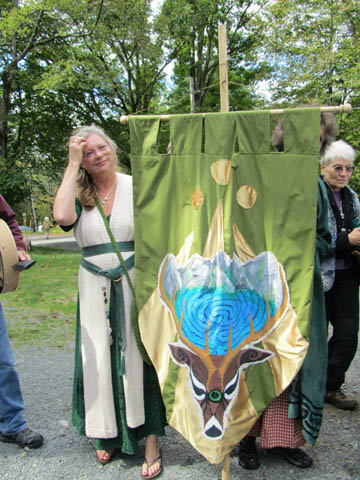
The OBOD East Coast Gathering offers a chance for Druids to walk among friends, attend workshops, and (re)connect with a beloved landscape in northeastern Pennsylvania. Here’s the OBOD banner, the color easy to see, the three-rayed Awen symbol of the Order a little harder to make out. (Photo by John Beckett)
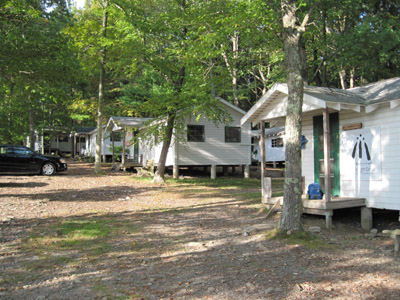
The camp which hosts the Gathering offers both tent areas and basic cabins.
With more people attending this year than last, the ample space helped.
The area is splendid for large group rituals as well.
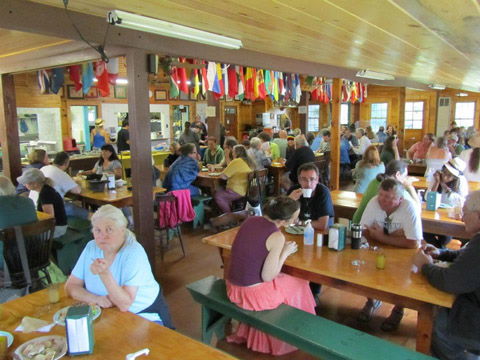
The rainstorm over the weekend brought with it cooler weather, which just made us all the more grateful for hot drinks and the varied meals our staff of Druid volunteers cooked for us.
(Dining room photo by John Beckett)
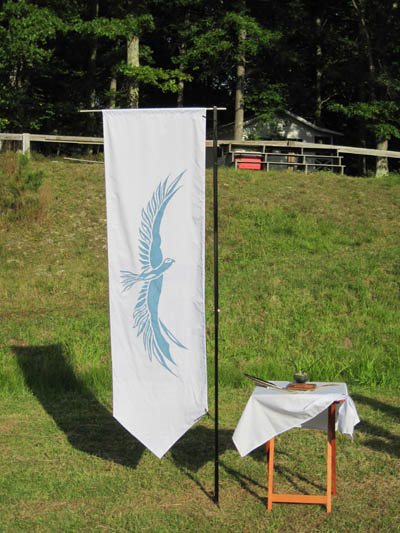
I didn’t arrive in time for the opening ritual. But the Closing was held on the same grounds, with the same altars. Here are shots of the two entry cairns seen looking south, along with the four directional altars and their banners: Stag of the South, Salmon of the West, Bear of the North and Hawk of the East.
One of the added pleasures this year was the attendance of more Druids from different orders, including ADF. Here are members of Cedar Light Grove assembled around their grove banner (photo by John Beckett).
OBOD groves brought banners too.
And this year, the third Gathering and my second, yet another draw was the chance to meet and learn from both OBOD’s Chosen Chief Philip Carr-Gomm, and AODA’s Archdruid John Michael Greer.
The first photo is of Philip giving a talk in Storyteller’s Grove a little north of camp.
The second shows John Michael during one of his morning talks in the Pavilion.
In the third, both join for a conversation and Q&A. (3 photos by John Beckett)
And of course no Druid gathering would feel complete without the ceremonial garb that makes the rituals visually distinctive and memorable.
Here are JM Greer and John Beckett:
Topping off each day were the evening fire-circles and drumming, music and song and ample home-brewed mead, cyser and sack from our resident firekeeper and brewer, Derek. Then came the Hour of Recall, truly. The Closing ritual, goodbye hugs, departures, promises to keep in touch, to plan events, to meet again. Another remarkable East Coast Gathering comes to an end, with opened hearts and subtle changes to take away and live through for the coming year. Till 2013!
“When I wake up, the other side of the bed is cold,” says Katniss Everdeen, opening Suzanne Collins’ novel The Hunger Games as both narrator and protagonist, and launching a major theme and complex of imagery in the book.
The widely-anticipated movie version of the novel arrives in a little over a month, in late March. The transformation of novel into film, with its inevitable directorial choices, budgetary limitations and too-specific casting of too-attractive young actors, will enchant some and disappoint others. No film can perfectly incarnate the word-world of a book to everyone’s satisfaction. (Here’s a link to an official trailer, in case you’re curious and haven’t yet seen it.) But it’s the novel I wish to focus on here.
The presence or absence of warmth is a recurring theme: heat — passion — violence — fire continually trade places throughout the story. Human warmth is, after all, what initially launches Katniss into the story. She volunteers on the spur of the moment to take the place of her beloved sister Prim, in the annual national lottery that selects a pair of youths from each of the twelve districts of a future North America and drops them into a televised death match. It’s blood sport with a vengeance.
**Spoiler Alert**
Prim is now safe, thanks to Katniss. But once Katniss is taken from her home, along with the other chosen youths who are now her rivals, she is pampered, buffed, polished, trained — and made over to show off an explicit fire imagery her stylists have conceived for her. As part of the lead-up to the competition, along with her rivals, she is interviewed and paraded on a nationally broadcast special program. But first, the finishing touches.
The team works on me until late afternoon, turning my skin to glowing satin, stenciling patterns on my arms, painting flame designs on my twenty perfect nails. Then Venia goes to work on my hair, weaving strands of red in a pattern that begins at my left ear … They erase my face with a layer of pale make-up and draw my features back out. Huge dark eyes, full red lips, lashes that throw off bits of light when I blink. Finally, they cover my entire body in a powder that makes me shimmer in gold dust. (127-128, pprbk. edition)
After the makeover, Katniss is dressed in her costume for the evening.
I can feel the silken inside as they slip it down over my body, then the weight. It must be forty pounds … The creature standing before me in the full length mirror has come from another world. Where skin shimmers and eyes flash and apparently they make their clothes from jewels … the slightest movement gives the impression I am engulfed in tongues of fire. (128)
I’m not perceiving something new here — other authors have gone further — there’s a book out titled The Girl Who Was on Fire which explores this theme in the novel in depth. Soon the gritty, violent death-match will replace this world of artifice and polish, and with the starkest contrast leave a trail of bodies dispatched bloodily, and even the survivors gashed, burnt, deafened, half-poisoned, dehydrated and starving. But the elemental world the novel has conjured persists in these sharply unglamorous forms. Fire of the spirit, the singular drive to survive. Fire of anger at the political motivation underlying the contest which deploys needless violence and death. Fire for cooking, fire as weapon, water for thirst and bathing, earth — a cave — for protection. Fire of human passion, whether genuine or contrived for show.
The Hunger Games has already achieved the dubious distinction of banned book status, as if it advocated violence instead of patently demonstrating against it. But violence nevertheless permeates our world, and the younger readers who have taken this book to heart and made it into a phenomenon respond enthusiastically to a story and an author who acknowledges this fact honestly. Further, Katniss offers a strong female protagonist in place of the one-dimensional tag-along female romantic interest more typical of plot-driven stories with male leads. She manages to confront imminent death, make hard choices, and still retain her integrity in the face of what is after all adult manipulation and advocacy of institutionalized violence for political ends. The same human capacity for strong feeling that draws us toward violence can also lead us to bonds of strong affection and loyalty that are one antidote to violence. If that is fighting fire with fire, it often works.
An altar is an important element of very many spiritualities around the world. It gives a structure to space, and orients the practitioner, the worshipper, the participant (and any observers) to objects, symbols and energies. It’s a spiritual signpost, a landmark for identifying and entering sacred space. It accomplishes this without words, simply by existing. The red color of the Taoist altar below immediately alerts the eye to its importance and energy.
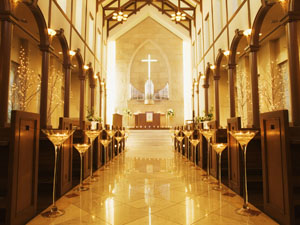
As a center of ritual action and visual attention, an altar is positioned to draw the eye as much as any other sense. In Christian churches like the one below, everything is subordinated to the Cross and the altar immediately below it. Church architecture typically highlights this focus through symmetry and lighting. But in every case, enter the sacred space which an altar delineates, and it tells you what matters by how it is shaped and ordered and organized.
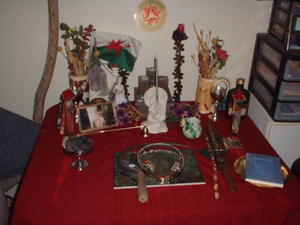
Part of OBOD* training is the establishment and maintenance of a personal altar as part of regular spiritual practice. Here’s a Druid altar spread on a tabletop. Nothing “mundane” or arbitrary occupies the space — everything has ritual or spiritual purpose and significance to its creator.
Such obviously physical objects and actions and their appeal to the senses as aids in spiritual practice all spring from human necessity. We need the grounding of our practices in the physical world of words, acts and sensations in order to “bring them home to us,” and make them real or “thingly,” which is what “real” (from Latin res “thing”) means.
Religions and spiritual teachings accomplish this in rich and diverse ways. We have only to think of Christian baptism, communion and the imposition of ashes at Easter; Hindu prasad and tilak; Jewish bris/brit (circumcision) and tallit (prayer shawl) and so on.
Atheists who focus exclusively on belief in their critiques and debates thus forget the very real, concrete and physical aspects of religious and spiritual practice which invest actions, objects and words with spiritual meaning that cannot be dismissed merely by pointing out any logical or rational cracks in a set of beliefs. Though you may present “evidence that God doesn’t exist” that seems irrefutable to you, you haven’t even begun to touch the beauty of an altar or spiritual structure, the warmth of a religious community of people you know and worship with, the power of a liturgy, the smell of incense, the tastes of ritual meals, the sounds of ritual music and song.
Just as we hear people describe themselves as “spiritual without being religious” as they struggle to sift forms of religion from the supposed “heart” of spirituality, plenty of so-called “believers” are “religious without being spiritual.” The forms of their spiritual and religious practice are rich with association, memory and community, and can be as important as — or more so than — a particular creed or set of beliefs.
Having said all of this, I’ve had a set of experiences that incline me away from erecting a physical altar for my Druid practice. So I’m working toward a solution to the spiritual “problem” this presents. Let me approach it indirectly. Once again, and hardly surprising to anyone who’s followed this blog or is as bookish as I am, the trail runs through books.
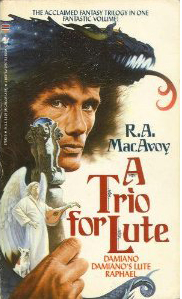
Damiano, the first volume in a fabulous (and sadly under-known) trilogy by R. A. MacAvoy, and recently reissued as part of an omnibus edition called Trio for Lute, supplies an image for today’s post. Damiano Delstrego is a young Renaissance Italian who happens to be both witch and aspiring musician. His magic depends for its focus on a staff, and we see both the strengths and limitations of such magical tools in various episodes in the novel, and most particularly when he encounters a Finnish woman who practices a singing magic.
When I read the trilogy at its first publication in the 80s, the Finnish magic sans tools seemed to me much superior to “staff-based” power. (Partly in the wake of Harry Potter and the prevalence of wands and wand-wielders in the books and films, there’s a resurgence of interest in this aspect of the art, and an interesting new book just published reflecting that “tool-based” bias, titled Wandlore: the Art of Crafting the Ultimate Magical Tool).
So when I then read news of church burnings, desecrated holy sites, quests for lost spiritual objects (like the Holy Grail) and so on, the wisdom of reposing such power in a physical object seemed to me dubious at best. For whatever your own beliefs, magic energy — whether imbued by intention, Spirit, habit, the Devil, long practice, belief in a bogus or real power — keeps proving perilously vulnerable to misplacement, loss or wholesale destruction. Add to this Jesus’ observation that we are each the temple of Spirit, and my growing sense of the potential of that inner temple of contemplation — also a feature of OBOD practice — and you get my perspective.
Carrying this admitted bias with me over the years, when I came last year to the lesson in the OBOD Bardic series that introduced the personal altar, I realized I would need both contemplation and creativity to find my way.
My solution so far is a work in progress, an alpha or possibly a beta version. My altar is portable, consisting of just five small stones, one for each of the classic European five elements — four plus Spirit. Of course I have other associations, visualizations and a more elaborate (and still evolving) practice I do not share here. But you get the idea. (If you engage in a more Native-American nourished practice, you might choose seven instead: the four horizontal directions, above [the zenith], below [the nadir] and the center.)
I can pocket my altar in a flash, and re-deploy it on a minimal flat space (or — in a pinch — right on the palm of my hand). One indulgence I’ve permitted myself: the stones originate from a ritual gift, so they do in fact have personal symbolic — or magical, if you will — significance for me. But each altar ritual I do includes both an invitation for descent and re-ascent of power or imagery or magic to and away from the particular stones that represent my altar. Lose them, and others can take their place for me with minimal ritual “loss” or disruption. Time and practice will reveal whether this is a serviceable solution.
This post is already long enough, so I’ll defer till later any discussion of the fitness of elemental earth/stone standing in for the other elements.
/|\ /|\ /|\
*OBOD — the particular “flavor” of Druidry I’m studying and practicing.
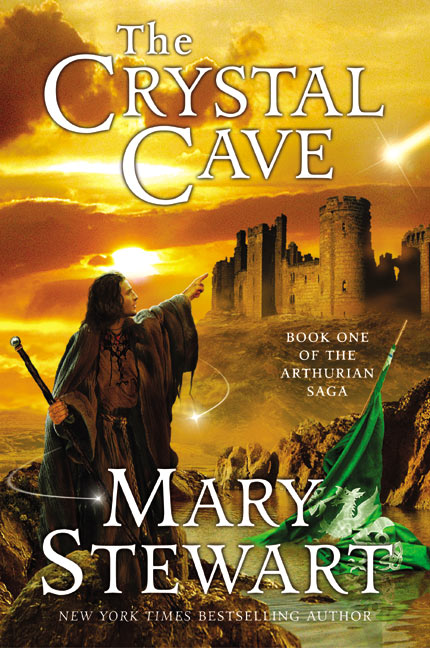
Historical novelist Mary Stewart writes vividly of 500 C.E. Britain in her “Merlin Trilogy,” which begins with The Crystal Cave and the childhood and youth of Merlin the enchanter, who will become Arthur’s chief adviser. Here (1970 edition, pp. 174-5) are Merlin and his father Ambrosius discussing the Druids. At this time, in Stewart’s conception, laws are already in place banning Druid gatherings and practices. Merlin has recently discovered that the tutor his father has arranged for him is a Druid.
* * *
I looked up, then nodded. “You know about him.” It was a conclusion, not a question.
“I know he is a priest of the old religion. Yes.”
“You don’t mind this?”
“I cannot yet afford to throw aside valuable tools because I don’t like their design,” he said. “He is useful, so I use him. You will do the same, if you are wise.”
“He wants to take me to the next meeting.”
He raised his brows but said nothing.
“Will you forbid this?” I asked.
“No. Will you go?”
“Yes.” I said slowly, and very seriously, searching for the words: “My lord, when you are looking for … what I am looking for, you have to look in strange places. Men can never look at the sun, except downwards, at his reflection in things of earth. If he is reflected in a dirty puddle, he is still the sun. There is nowhere I will not look, to find him.”
Of course, anyone who followed this noble-sounding principle to even reasonable lengths would have a very interesting and possibly very exhausting time of it. As I mentioned in my post about Open Source religion, when virtually every human practice with any numinous quality about it can be and has been pressed into service as a vehicle for religious encounter and a means to experience a god or God, then sacred sex won’t even top the list of things a person might do “to find him.”
Yet Merlin (and Stewart) have a point. Spiritual inquiry and practice require a kind of courage, if they are to remain fresh and not decline into dead forms and mere gestures of religion. It is these things that the media quite rightly criticize. When I’m in the grip of a quest, I only hope I can continue to be brave enough to follow out conclusions and — if need be — “look in strange places.” It looks like courage to an observer, but I find that ultimately it’s a kind of honesty with oneself. I want to keep looking. Anything less feels suffocating and aggressively pointless, like painting garbage or eating styrofoam. Any self-disgust we feel almost always arises from living a lie, which poisons our hours and toils and pleasures.
“Things of earth” cannot ultimately satisfy the inner hunger we feel, but they are valuable pointers, sacraments in the full sense, vehicles of the sacred. To return to everyone’s favorite numinous topic, pursue sex of any variety, sacred or otherwise, and you’ll prove again for yourself one of Blake’s Proverbs of Hell: “The road of excess leads to the palace of wisdom.” Of course, along the way, as a witty recent post on Yahoo Answers has it, it may often happen that “The road of excess leads to the All-You-Can-Eat Buffet of Gluttony, which leads to the Bordello of Lust, which then leads to the Courthouse of Divorce, the Turnpike of Bankruptcy, the Freeway of Despair, and finally, the Road to Perdition.” Blake did after all call these the Proverbs of Hell.
We just don’t discuss what comes after Hell. Blake says it’s wisdom. Hard-earned, yes. And there are easier ways, which is one good thing that the Wise are here for. Rather than following any prescription (or Prescriber) blindly, I hope to ask why, and when, and under what conditions the strictures or recommendations apply.
So we return and begin (again) with the things of earth, these sacred objects and substances. As sacraments, earth, air, fire and water can show us the holy, the numinous. Their daily embodiments in food and drink and alcohol, precious metals and gems and sex, pleasure and learning and science, music and literature and theater, sports and war and craft, are our earliest teachers. They are part of the democracy of incarnate living, the access points to the divine that all of us meet and know in our own ways.
Drink deep, fellow traveler, and let us trade tales over the fire. And when you depart, here’s an elemental chant by Libana, well-known in Pagan circles, to accompany you on your going.

 A water meditation, to be read slowly to oneself, in the same way water flows and falls.
 “Water benefits all beings without contending with them, and flows to the lowest places men disdain. In this manner it approaches the Way.” Tao, the way that water flows. “dao ke dao fei chang dao”: the way that can be followed as a way isn’t the way the way goes, to “English” it rather clumsily. Water flows, following its nature without thinking about it.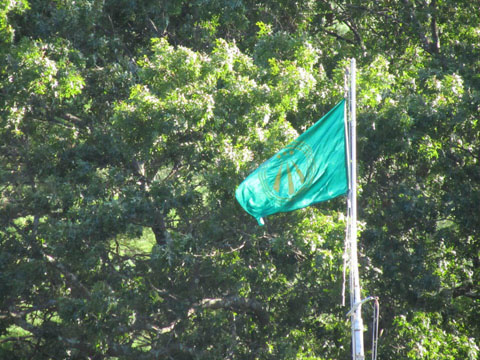










 A Druid Way


