Archive for the ‘Druidry’ Category
Like so many truths, the title for this post is both a truism and a guide.
Want to perceive something? Set it in high contrast to something — often, anything — else. Human consciousness, biologists tell us, is built to detect patterns and contrasts. Among other things, consciousness is a sophisticated survival mechanism. What stands out from the background may be friend, food or foe. That’s one good reason why we won’t be color-blind any time soon, any more than we typically ignore hair or eye color, gender or height or clothing. These are all vital signals that convey information too useful to ignore.
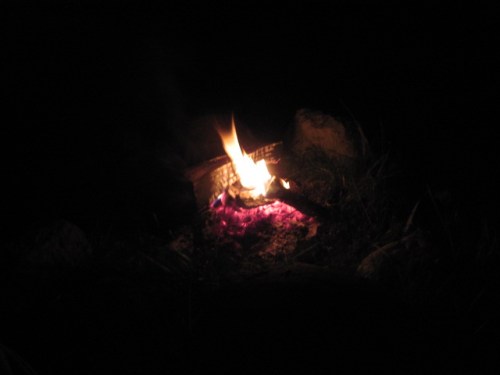
Fire, full moon, night, autumn — as my wife said, after we’d sat for an hour talking and fire-gazing, “It’s very grounding.”
Why not “ground and center” with fire? Oh, I know the reasons: earth helps neutralize imbalances, reconnects us to our physicality when we may be lost in thought or feeling, and so on. Earth’s a great insulator. It helps deaden psychic forces, just like eating meat does after intense ritual or magic or a nightmare. Ground and center, that basic of Pagan practice, one that renews itself as we walk our paths.
But sometimes if I’m too grounded, neutralized and banked and bermed, I need fire. The centering’s still crucial — focus is part of our struggle in this age of so many distractions. In this case, it’s “spark and center”. (With water or air, then, it can be “bathe and center”, or “breathe and center”.)
Kindle me to action, don’t drug me to inertia. In our age of rampant anti-depressants and opioids, you might say we need new prescriptions if we’re to flourish and thrive as the gods invite us to do.
And by “kindle” I don’t mean “prod me to outrage”. That’s a “flash in the pan”. I’m going for a slow burn, the kind that makes good stews and soups, that’s perfect for barbecue so tender the meat falls off the bone, and the ashes keep warm for hours after the flames have died down.
That’s also the kind of kindling that keeps me warm through winter. In this counterspell to our times, I turn us counterclockwise, from West in the last post to South and Fire. As we edge toward Winter in the northern hemisphere, I evoke Summer in us. After all, my preparations of food preservation and stacking firewood and insulating and covering and closing all aim to shelter the sacred fire within.
It takes sacred fire to understand sacred fire, so I lit one last night. Like any dedicated practice, and like all good ritual, action and prayer embody each other.
In these times, the sacred shines all the more brightly by contrast.
/|\ /|\ /|\
Here we are, autumn of the year, gathering the harvest of what we have sown, both bitter and sweet. Hail to the West, place of the setting sun, of evening, of fullness and reflection and maturity.
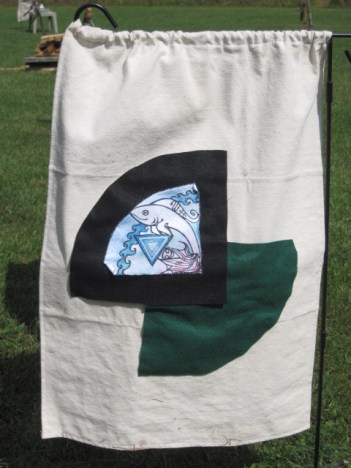
ECG ritual banner of the West. Design by Dana Driscoll.
West, traditional place of feeling and intuition, and in this cycle, the moon waxing toward fullness, too. I know: in the associations of many tables of correspondence, West is the waning moon. Why not attune to what will light the sky this evening, rather than a pattern that obviously doesn’t fit the moment? Tonight I’ll sit at my fire-circle for an evening contemplation, open as I can to what comes.
With the full moon can come illumination of what was previously hidden. We move in cycles, nourishing some causes and energies in the unconscious, till they move into awareness and we can assess whether they work to our advantage.
Larger cycles concern nations and planetary systems, whole species and immense and intricate patterns, while smaller ones shape our communities and individuals. Disasters and tragedies will keep coming, whether through deeply-rooted patterns in human psyches, or in natural cycles of change, disruption and rebalancing.
After a hurricane, rather than recriminations, it’s most useful to serve obvious need. Likewise after a human tragedy like a shooting. Let my sympathies rouse me to understand causes better, work for change, or open my compassion in concrete forms of aid. Otherwise, am I doing anything more than muddying the astral waters?
Emotional reaction has its place — we feel what we feel — but it can most lovingly be grounded in prayer, ritual and contemplation, and action, for my own good as well as for the good of others. Look to your own self first. the beginning point of all thought and action, counsel my inner guards and guides.
Here’s a first draft of a ritual meditation I’m still working on:
Earth in my hands, my gaze to the horizon,
I cast fear away, hate away, anger away.
clearing the bodies for health.
Water in my hands, my gaze to the wells of spirit
I wash in love, I bathe in compassion, I cleanse with caring,
clearing the springs of the heart.
Fire in my hands, my gaze to the flame of purification
I burn away limitation, I incinerate obstacles, I ignite useful anger,
clearing the will for further growth.
Air in my hands, my gaze to the way of wisdom
I conceive a change, I know a change, I understand a change,
clearing the mind for action.
I don’t say these things because they’re easy, but because they’ve proven themselves to me to be among the best responses over time, and the best ways to take a pro-active stance as well. They’re a practice, something I find worth doing in itself like any practice worth the name, and for healing needed so plainly and deeply.
/|\ /|\ /|\
Maybe you are (or you know you prefer to be) an Order of one. It’s simplicity itself. Spontaneous rituals can be, well, spontaneous. Or you live far from any group you know of, your work nights and sleep days, you’ve been burned by groups in the past, your spirits or guides take you where no group goes … Whatever the reason, you feel allergic to Orders, groups, traditions, the whole degrees and status and rules and standard-ritual-format thing. You honor your own life and its direction by walking and practicing alone.
I hear you. And for 350 days out of each year, we could be twins. Or at least close cousins. As a mostly-solitary, most if not all of your reasons are also mine.
Except.
Even solitaries belong to a Tribe. We’re distant kin. If evolutionary biologists have read the genomes right, we can all trace our ancestry back to a few ultimate grandmothers, and possibly even just one. So cousins it is.
People need people. Even (or especially) if your ideal dosage is low.
I’ve written of my experiences with Gatherings on several occasions. I “belong” to OBOD, the Order of Bards, Ovates and Druids, in the sense that I study with them through a postal course. No membership card, no annual dues beyond the cost of coursework mailings. I’ve completed the work of the Bard, the first of OBOD’s three grades, and I have a tutor in the U.K.. for my current Ovate study. Apart from any Gatherings I choose to attend once or twice a year, that’s the extent of my group involvement. It’s almost as solitary as it gets. And I certainly don’t restrict my reading or practice or ritual work to OBOD. Nor am I ever asked to.
I maintain a lively interest in several other orders — from a distance. I know several people who have studied with more than one Order. And compilers of the course materials of several of the larger Orders like OBOD and BDO, the British Druid Order, have consciously designed their coursework to be complementary. Study with more than one group and you’ll gain from different emphases. And any overlap, beyond serving as useful review, can deepen understanding because it issues from a different perspective and experience and set of practices.
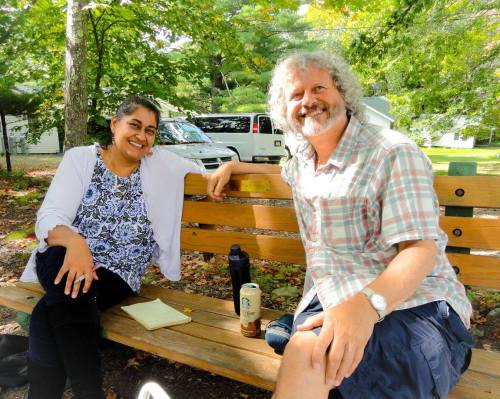
Renu Aldritch, OBOD Druid and founder and editor of Druid Magazine*, interviewing OBOD Chosen Chief Philip Carr-Gomm at East Coast Gathering ’17. Photo courtesy Gerfalc Hun.
The current leader of OBOD, Philip Carr-Gomm, has wisely observed that OBOD is a “flat hierarchy”. What matters are individual Druids and their love of the earth. Beyond them, any Groves they may opt to form or associate with. Philip is respected — and teased — and held in generally solid affection by most OBODies I know. But I could complete all three grades of OBOD coursework, never meet him, and never need to meet him or know anything about him. I could self-initiate, and practice on my own, with the useful focus that the study materials of an Order can offer, and never encounter hierarchy at all. Unless you count correspondence with the home office about mailings, or subscribing to the Order’s journal Touchstone, or exchanging letters or emails with a tutor.
I know four other Vermont OBODies, as members informally call themselves. Two of them live three hours away to the north. Another two live 10 minutes to the south. The “Northerners” attended the recent East Coast Gathering. I hadn’t seen them for a year or more. One member 10 minutes to the south joined me and we celebrated Lunasa about two months ago. But we three local OBODies have never managed to get together for coffee, in two years of trying. Solitary, often, right in the middle of being “members of an Order”. As they say, organizing Druids is like herding cats.
In the end, whether you’re an Order-member or a Solitary isn’t an either-or thing. Seeing it as such presents us with a false choice. On the strength of my limited experience as one person, I’d assert that everyone needs both in some form.
Because if I don’t spend time alone with trees and beasts, and energies of human and planetary existence that I can acknowledge and learn from and participate in, I won’t be more than half a Druid at best. And if I don’t learn from others — whether in the quiet company of books, the conversations we all have with “teachers of the moment” that we meet wherever we go, or in the noisier online worlds we’ve made, or the physical Gatherings that can provide so much recharging and good energy and fellowship and new friends — then I miss out on half that the Druid path can offer.
/|\ /|\ /|\
*Druid Magazine is published online free, three time annually. You can find the current issue, as well as more information, here.
Here’s the second half of the set of values I began looking at in Part 1.
Let go and move on.
Set goals.
Care for self and others.
For a nation that claims to be forward-thinking and looking, we’re accumulating an impressive ability to lick old wounds and live in the past. “Times were better when” can afflict the best of us. But even if it’s true, I live now, not then, and I need to begin with what I have today. I’m older (any “wiser” part is an independent variable).
If I’m listening to here, safe in my home cosmos, and honest with Deep Self, I already have a foundation to build on (“here”, “safe” and “honest” are the first three values from Part 1), one that lets me proceed to the next three steps. (Hint to self, or Self: they’re not necessarily steps in a sequence. Repeat-practice any as needed. Each also offers me an extended theme for meditation.)
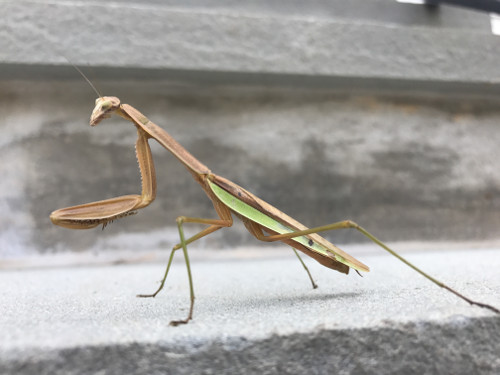
Mantis, 4 Sept. ’17. Photo courtesy Jodi Klue.
Mantis, you landed on nearby steps to interrupt a casual conversation a few weeks past, so this time I invite an image of you here to do the same. You become a prayer I can pray often. Let me see interruption as spiritual opportunity, the green world and all the persons in it as companions and allies and teachers, not adversaries. If you offer difficult gifts, I will not just refuse them outright.
You are my divination and message-bearer. (Yes, “sometimes a bird is just a bird” — until awareness greets it like a friend, with understanding that makes good sense of experience. Nothing has the “final word”. The Spiral opens onward, even as it offers rest and respite. Keep questing.)
Plainly you’re turning with the year, the vibrant green of early adulthood now muted, brown as leaves that carpet the yard and driveway. Hunter, are you weary? What have you seen with those complex many-faceted eyes? The power of awen: the empathy to enter other lives and know them, to sing their energies and possibilities, to feel slender legs beneath me, two powerful ones raised and ready to clutch. To sing and die and rise again, to thread the labyrinth of time.
Ah, shape-shifting is a mighty way to “let go and move on”! We do it each night in dreams, a practice I can extend to waking hours. Who can I become to know this world better? What links of sympathy connect me to all life? How does this moment offer doorways into what the cosmos needs next? How can I serve? Out of self and into Self and into other selves. Brother fox and sister hawk, I hear you breathing, your lungs contract and fill in my own chest.
Sometimes I can serve by setting a goal. Let me take the last two practices together: I set a goal to take care of myself so I can take care of others. After all, I can only serve if I CAN serve. How often I misunderstand self-sacrifice! If I can only perform the sacrifice once, chances are I’m limiting myself.
O wisdom-guide, you whisper, Often the best sacrifices are ones you can keep doing. The point isn’t burnout. Make it sacred, sacri-fice it, so you can make it sacred again.
Those of us who attended the recent East Coast Gathering are resuming our “mundane” lives. How to integrate the vision and energy of a Gathering, or any time of intense spiritual uplift, back into daily living is a perennial challenge.
But slowly I am coming to see that I need to “get spiritual” just so I can begin to see that the “mundane” is also absolutely overflowing with spiritual energy. We need to re-charge, yes: so we can flow again. Or to put it another way, my ability to tune in to a seemingly “ordinary” interaction in line at the supermarket, or pumping gas, or climbing the steps at work can transform the apparently mundane into a spiritual connection. The “apparently mundane” in all its flatness and dullness is our workshop, laboratory, spiritual opportunity. Empty canvas. It’s easy to perceive and ride the spiritual currents during events like ECG. Then I get to practice during “everyday life”. I am transformer, I am catalyst, I am pathway in and of myself. It can always begin again with each of us.
/|\ /|\ /|\
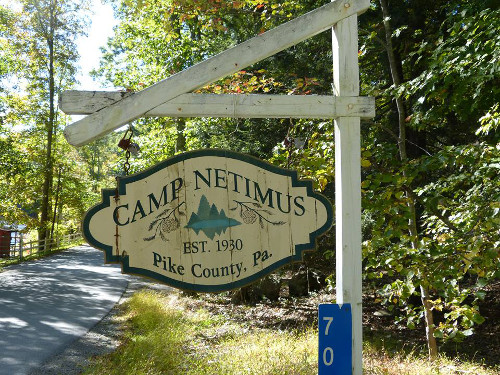
East Coast Gathering’s host camp. Photo courtesy Krista Carter-Smith.
Once again the Tribe — as many as could attend — converged on a hilltop in northeastern Pennsylvania near the autumn equinox for the 2017 OBOD East Coast Gathering. Some travelers contended with the after-effects of Hurricane Irma, others with more personal challenges. If you can make the effort, you experience the reward.
This year featured a Croning Ritual honoring nine women who requested this rite of passage, and a coming of age ritual for a young member. As Druid (and other Pagan) groups mature, similar opportunities will continue to arise to commemorate and honor such capstone events of our lives.
/|\ /|\ /|\
The spirits of the Land know us and often have a message for those among us who can hear them. And this weekend in particular we were urged simply to listen — more on that later.
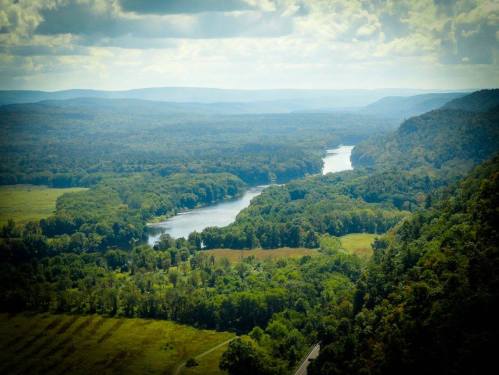
The Land near ECG. Photo courtesy Gerfalc Hun.
The overriding theme this year, twinned with our official theme “Discovering Awen: The Bardic Arts”, was clearly gratitude. Our delight poured forth on the several Facebook pages we frequent. Again and again, attendees wrote of their thanks to others for simply coming. With their presence and conversation, workshops and smiles, they reminded us of the beauty, fellowship and vitality of our chosen path.
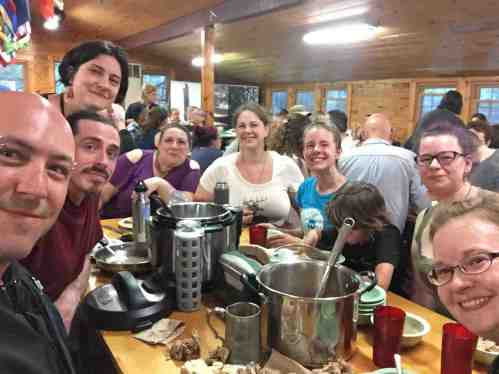
Members of Mystic River Grove. Photo courtesy Dana Driscoll.
This year marked my seventh Gathering in the PA hills. ECG opened its gates in 2010 and has subsequently given birth to the Gulf Coast Gathering and, last year, to MAGUS as well, the Mid-Atlantic Gathering (my review here).
Once again the event sold out quickly, and once again part of the draw, besides reconnecting with friends, was our special guest, this year the Chosen Chief of OBOD, Philip Carr-Gomm.
Philip and his wife Stephanie had been in the States longer this time. They’d just come off the previous weekend of giving workshops with the Green Mountain Druid Order in north central Vermont.

OBOD Chosen Chief Philip Carr-Gomm with attendees. Photo credit Elysia Cook
/|\ /|\ /|\
Partly to honor the Chief, the Opening Ritual received special attention. Mystic River Grove, with members across New England, prepared thoroughly.
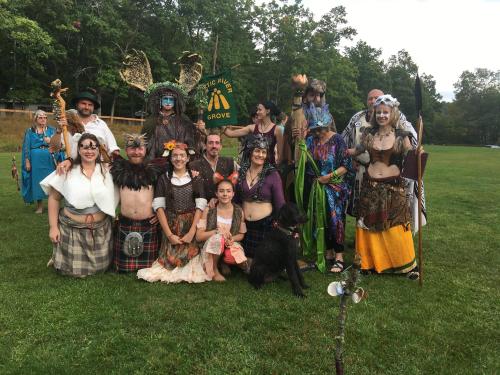
Mystic River Grove prepares for Opening Ritual. Photo courtesy Gerfalc Hun.
Because of a new job, Saturday was the only day I could attend, so I made the most of it, rising early and driving to camp to arrive at breakfast.
Saturday included the main Equinox ritual, as well as a lunchtime talk by Philip, Ovate initiations, and as always the bonfires to draw the Tribe together after nightfall. I missed the Opening Ritual, ably led by Mystic River Grove, the oldest OBOD group in the States. The pictures hint at how marvelous it was.
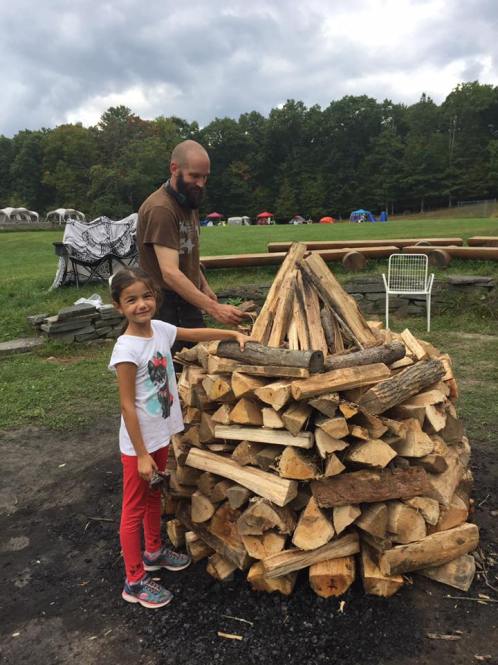
Brom putting the final touches on another masterpiece, with Alkandra helping. Photo courtesy Nadia Chauvet-Thanasoulas.

Interior of a camp cabin — home for the Gathering. Photo courtesy Jo Ami.
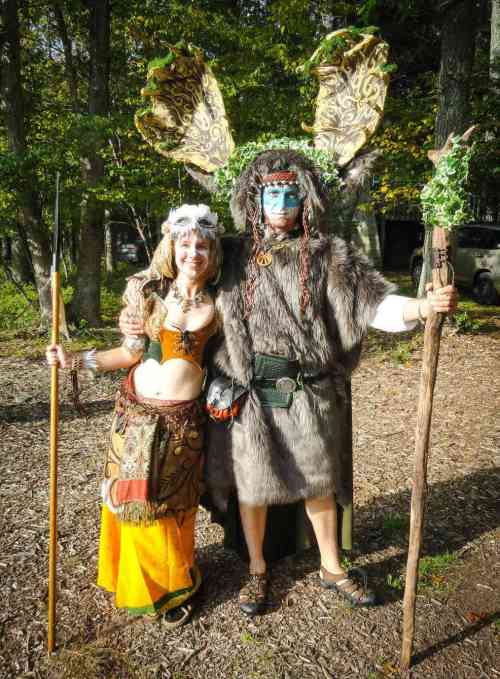
Cat and Gerfalc of Mystic River Grove in ritual garb as Owl and Moose. Photo courtesy Gerfalc Hun.
Loam introduced us to the Indian practice of rangolee or kolam, a form of ritual painting with rice flour. Below you can see the rangolee ogham (a splendid merger of Hindu and Druid traditions!) taking shape in the fire circle.
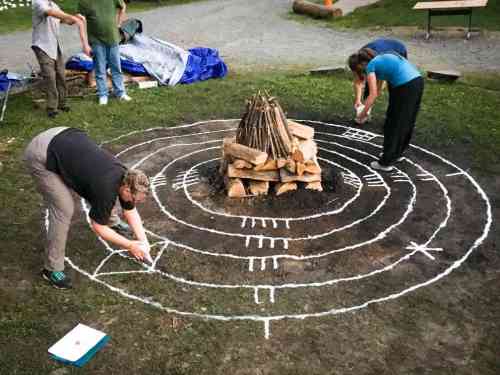
Loam and a friend laying rangolee, ritual painting with rice flour, around the firewood. Photo courtesy Gerfalc Hun.
The unusual warmth of the weekend spurred me to stay robed from the afternoon ritual all the way through until the evening Ovate initiations. (Thank-you’s again to my wife for choosing a very breathable fabric when she fashioned my robe!) I’m sitting and gazing into the fire below. The rangolee remain vivid in firelight.
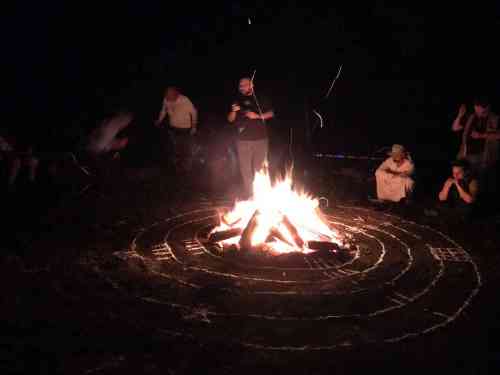
After the Saturday evening Ovate initiations. Photo courtesy Steve Cole.
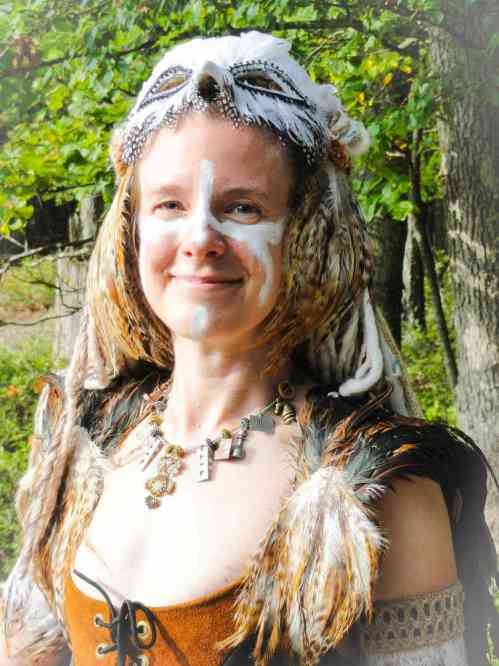
Cat spearheaded the ritual planning and mask-making for Mystic River Grove’s Opening Ritual. Here she is as Owl. Photo courtesy Gerfalc Hun.
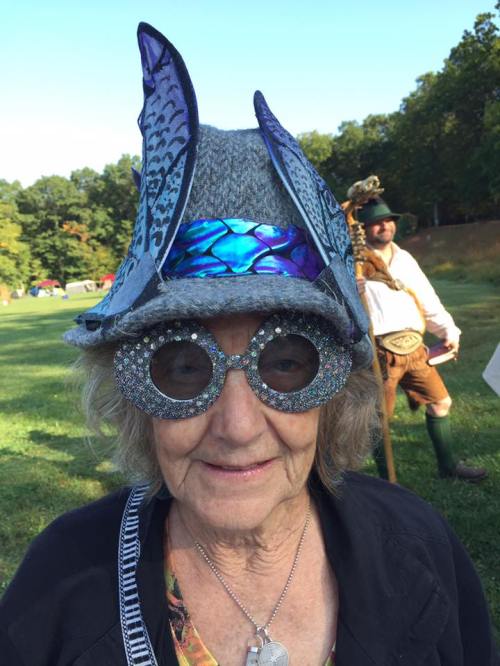
Sarah F. as Salmon for Mystic River Grove’s Opening Ritual; she also served as Grove Mother during initiations. Her long-running astrology blog always has something to teach. Photo courtesy Gerfalc Hun.
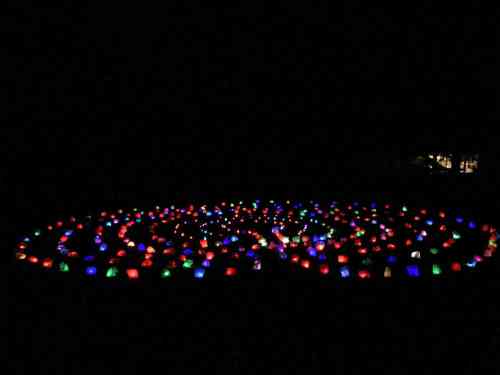
“Again the Labyrinth” — Cat gathers a team to set up the scores of electric tea lights in paper bags, switching them on and later off each night. Photo courtesy Steve Cole.
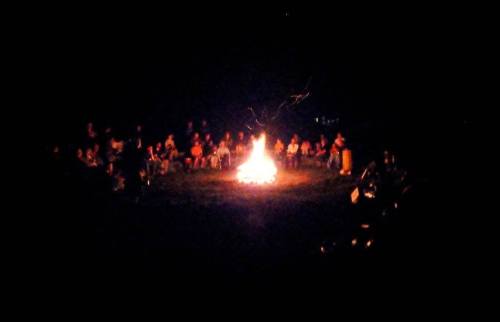
Late Saturday — last night of the Gathering, people linger
“May the harmony of our circle be complete” go the words of standard OBOD ritual. If we’re growing at all as Druids, we keep getting reminded just how large our circle is.
Those who attend the Camp before and after us each year all contribute their energies, and not everything meshes automatically. But in particular, Druids can imagine themselves more in tune than others, and this in turn can lead to an arrogant obliviousness to what the Land is actually saying, and to a disrespect of the expressed wishes of the non-human inhabitants. As guests, the messages ran, we can do better.
As a result of the experience of past years and this year in particular, by both organizers and some attendees, and messages received from the land spirits of the Camp, next year’s Gathering will reflect a change in approach and perspective. These changes will appear on the ECG website. Listen, respect, celebrate. Old lessons, perennially new.
Here’s to the spiral of 2018!
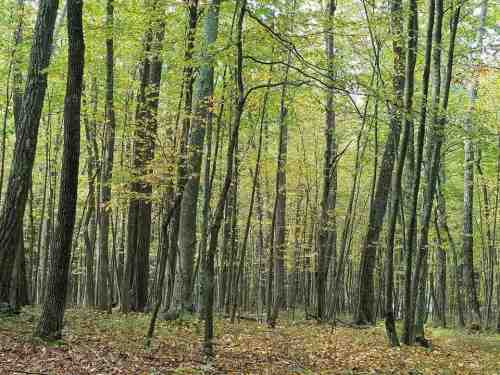
Trees of Camp Netimus. Photo courtesy Elysia Cook.
[Part 2]
As a set of guidelines, the six principles my new school works to embody and put into practice offer a new angle on some profound Pagan principles. I’ll list them, then look at each one from my own perspective. (Season to your taste. After all, in the end we’re the ones who choose to adopt — or refuse — whole sets of values. Whatever story we tell about them later, we’ve chosen or turned from them.)
Be here.
Be safe.
Be honest.
Let go and move on.
Set goals.
Care for self and others.
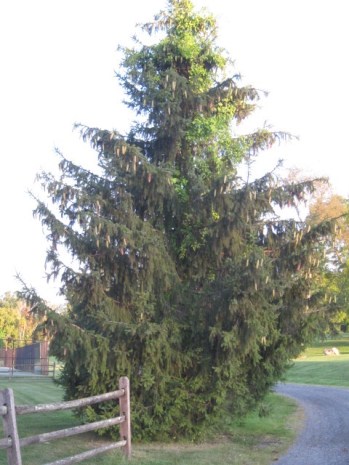 Be here. Am I here, fully, now? Well, in New Jersey, yes. Over our last week of professional development, one presenter made a point I’ve been carrying around. We tell kids, and adults too, to “pay attention!”. But do we ever teach how to do that? What’s it mean, really? Is it just one thing, or a collection of practices? Is it even always the same thing?
I’m going to look at “being here” in terms of trees. When I walk up to and greet one of my new favorite trees here in NJ, I’m also listening for a rhythm, a wave of energy that has its own pulse. It may take me a bit to tune in to it, or once I do tune in, to harmonize with it. Touch can help. The give-and-take is part listening, part sinking into myself. I’m both more with the tree, and also more with myself. Trees differ as much as humans, so the rhythm or pulse differs with each one. Some challenge. Some welcome. Some heal. Some rouse. Some just have better things to do than interact with humans — nothing personal, you understand.
Being here is listening, feeling, monitoring, relaxing, attending — a whole cluster of practices and responses that intermesh and modify each other. Fortunately, the tree (usually) takes part and helps, like in any conversation, to make an exchange happen, and make it instructive or beneficial for both parties.
Be safe. Many of the girls at the school have struggled in other places, had bad experiences as learners, face significant gaps in capacities that would let them thrive in public high schools, and vary widely in their command of work-arounds, strategies, self-awareness, support systems, and so on that help them play to the strengths each one has. How can they or any of us feel safe in a world of change and challenge and heartbreak? Significantly, other people can be a resource. In the favoritism that the West and particularly the U.S. shows to independence and self-reliance, we often overlook the family, the group, the tribe.
The girls — and faculty, too — are trained to “call group”, to ask for the help of class, team, squad, dining table, or entire school. Call group for clarification: what does each person understand about the task at hand? Call it for celebration: let’s acknowledge what we’ve accomplished. (Ask another person to call group on your behalf, if you’re too shy or stressed to do it yourself). Call it for confrontation: let someone who has bullied or threatened another hear that the group knows and rejects that behavior. Can we do that and still be safe? Can we do it and not become bullies or sources of intimidation ourselves?
Are we ultimately safe in this universe we inhabit? Is the cosmos malevolent, seeking us out to crush us and pulverize every plan and hope? If we know fully our kinship with all life, the great teachers tell us, then we can indeed be safe here. But how to get there, just like how to pay attention, is something we rarely teach, or are rarely taught ourselves. Pay attention! Be safe! How, please, can I do that? Is it safe to be here, where I’m called to be?
Be honest. Can we be honest, and safe, too? Show me!
Mary Oliver’s poem “Wild Geese”, which gets quoted a lot for various purposes, offers a kind of Pagan gospel, a trust in a deep and intricate order that our human drama often belies. Maybe we could call this the Pagan trust, one of the most honest things a Pagan can tell you about life and the cosmos.
You do not have to be good. [Really? So many moral codes tell us otherwise!]
You do not have to walk on your knees
For a hundred miles through the desert, repenting.
You only have to let the soft animal of your body
love what it loves. [Danger! say many scriptures. Disaster! Damnation! Doom!]
The poem shifts in what feels to me like its second pulse, the second chamber of its heart. It doesn’t say our soft animal bodies automatically transform every problem. They’re a start, not an endpoint. Start with the fact of embodiment, says Oliver. Whether or not my attention is here right now, my body sure is. But what’s next?
Tell me about your despair, yours, and I will tell you mine.
Meanwhile the world goes on.
Meanwhile the sun and the clear pebbles of the rain
are moving across the landscapes,
over the prairies and the deep trees,
the mountains and the rivers.
Meanwhile the wild geese, high in the clean blue air,
are heading home again.
What are we to make of the “meanwhiles”? Like so many of us, you may have experienced the strange double vision of intense grief or other emotion, while the whole rest of the world all around you goes on, continues, unconcerned. Depending on where you are in your intensity, that may confuse or enrage or sadden you. How dare the cosmos not notice my suffering? Or, alternatively, if you’re swept up in a big high, why aren’t more people celebrating the amazingness of simply being alive?
But we’re not alone in the lows any more than in the highs, however isolating our internal hurricane can feel at times. But how can something of the wild geese “high in the clean blue air” communicate itself to me here in the middle of my grief or rage or despair? Here, where I’m paying attention, because I’m held in the grip of an immensity and can’t do anything else anyway, even if I wanted to.
Oliver generously, Druidically, gives us three “meanwhiles”, so perhaps we may hear at least one. But how exactly do I “head home again” out of all this?
One powerful key, or two together, appear in what I feel is the final “pulse” of the poem:
Whoever you are, no matter how lonely,
the world offers itself to your imagination,
calls to you like the wild geese, harsh and exciting —
over and over announcing your place
in the family of things.
Imagination and family. How do we access this connection, our place in the family of things? One way is through the imagination, which — like attention — we’re rarely taught how to use. No wonder the West suffers. It’s thrown aside many of the skills and strengths of imagination. We see the suspicion of art and the fear of imagination and transformation outside any sanctioned practices or churches or political persuasions or sexual orientations. So often we see the world, or a pretty fair chunk of it, as “out to get us”, instead of “inside to help us”. Imagination, that bottomless source of so much misery and joy. It’s imagination that connects us to our true family.
Meanwhile — Oliver’s wonderful, terrible word — meanwhile, the cosmos pays no attention to our fear. It just keeps sending us messengers, in spite of anything we do. It just keeps announcing the deep good news of our real place in the family.
I find more and more I want to pay attention.
/|\ /|\ /|\
How to sing in a new land? Sing of it, o mortal.
The New Jersey Geological Survey characterizes this region of Somerset County as “Devonian, conglomerate, sandstone, shale, limestone”.
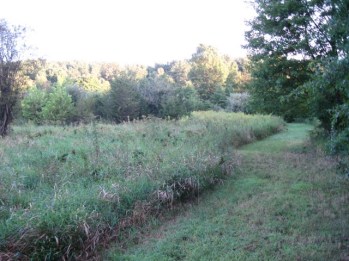
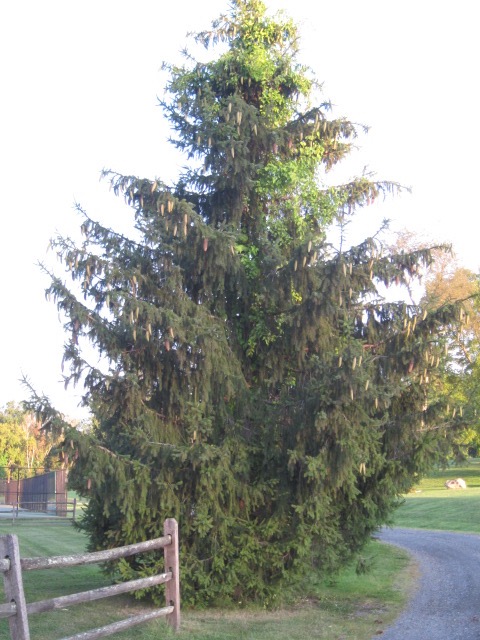
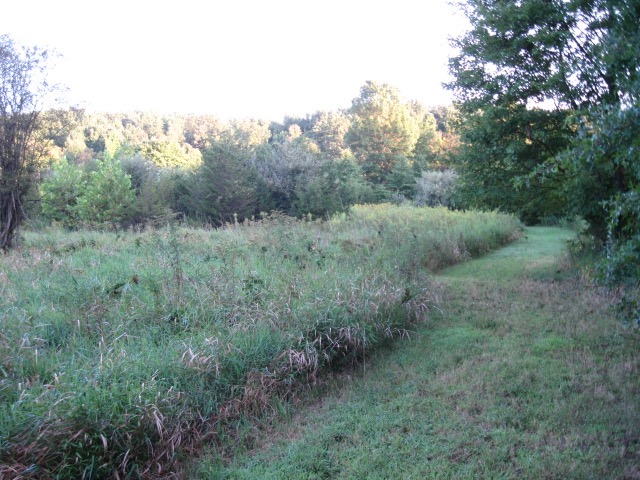
Not surprisingly from that description, the boarding school where my wife and I are living and teaching for the next year lies in “horse country”. Equestrian clubs dot the area, and wealthy landowners with a desire for large tracts and quiet have helped preserve the area from further development. The gently rolling hills rise a mere 45 miles (72 km) west as the crow flies from Manhattan, yet the air is clean and green abounds. In return for claiming our lives pretty much 24/7 while term is in session (teaching, dorm parenting, coaching, advising, overnight duty, etc.), the school grants us all good air to breathe and a green legacy of preservation, whatever its original motive.
For many east-coast Americans like me, a superficial acquaintance means that “New Jersey” conjures Rt. 95 and the ecological dead-zone of the northern part of the state. Yet “the Garden State”, the NJ nickname, is no misnomer. The Jersey Pine Barrens (below) offer one counterweight to heavy industry. Or as the Wikipedia entry puts it,

photo Famartin; Wikipedia Creative Commons
Despite its proximity to the sprawling metropolitan cities of Philadelphia and New York City right in the heart of the very densely populated Boston-Washington Corridor on the Eastern Seaboard, and the fact that the heavily travelled Garden State Parkway and Atlantic City Expressway run through it, the New Jersey Pine Barrens are largely rural and undisturbed.

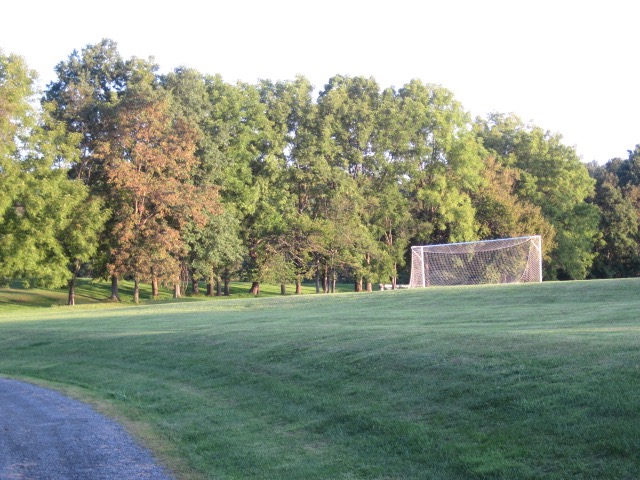
Our campus offers the usual vistas of playing fields and manicured greens, but vestiges of the original farm that became the school abound.
A sunrise walk brings you on small herds of white-tailed deer — frequent mowing means the vegetation is tender, and of course there’s no hunting on school grounds. In fact, we discovered on late evening walks that deer often bed down on the lawn of a faculty house on the campus periphery.
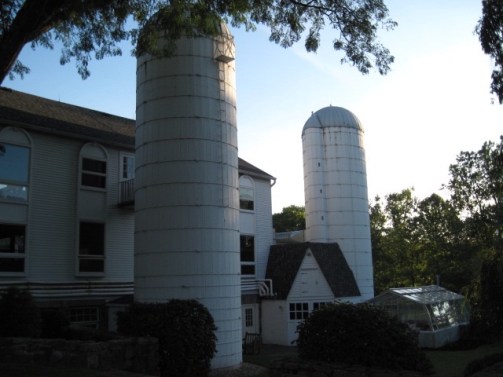
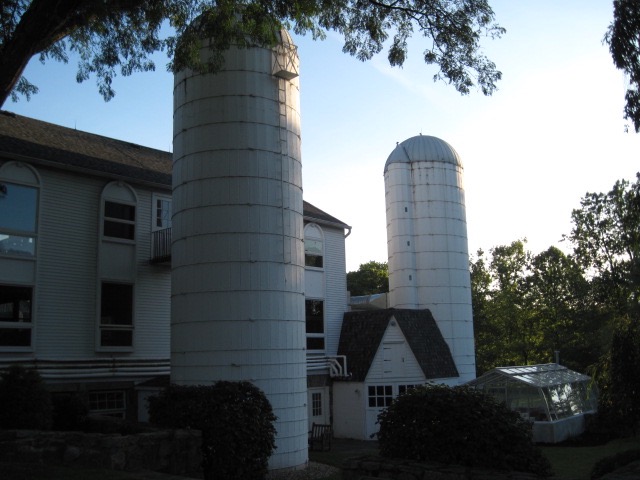
Two old silos remain standing next to the school library.

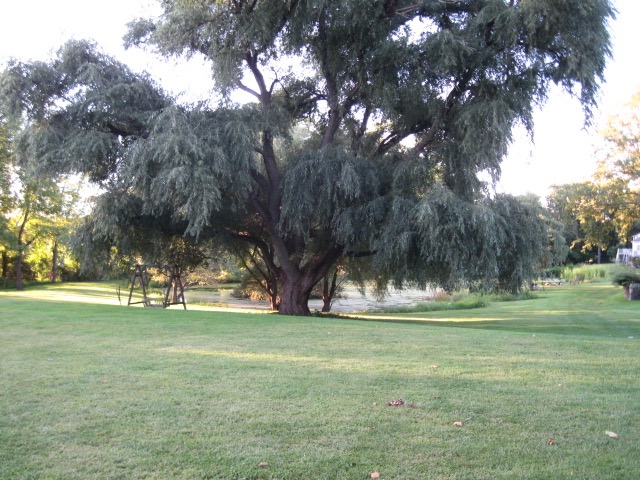
The fine old willow guarding a pond on the eastern campus.

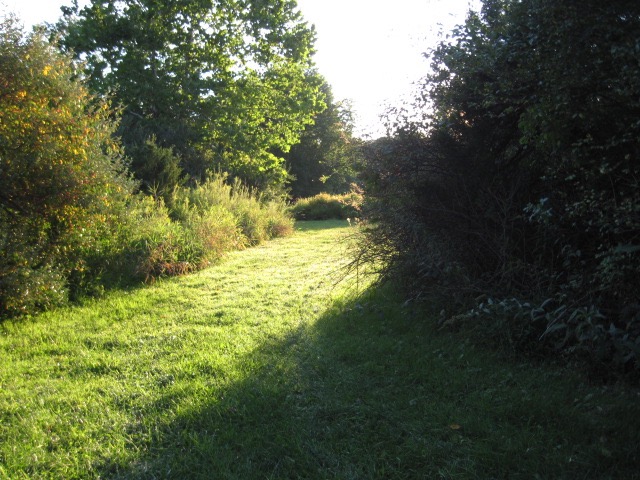
Sunrise walk on the northern part of campus.

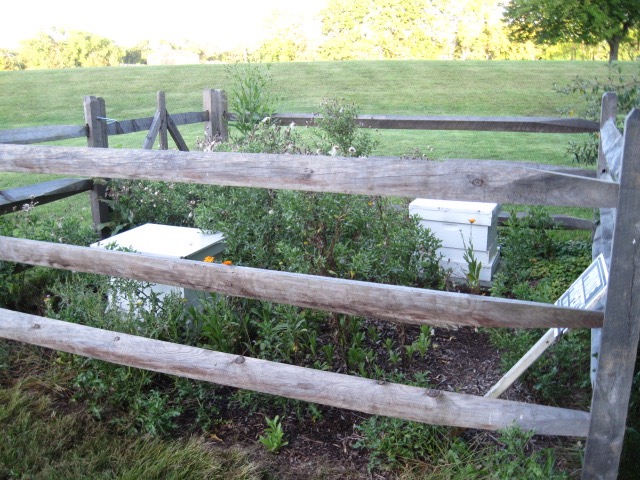
Who keeps the campus bees? Haven’t found out yet.

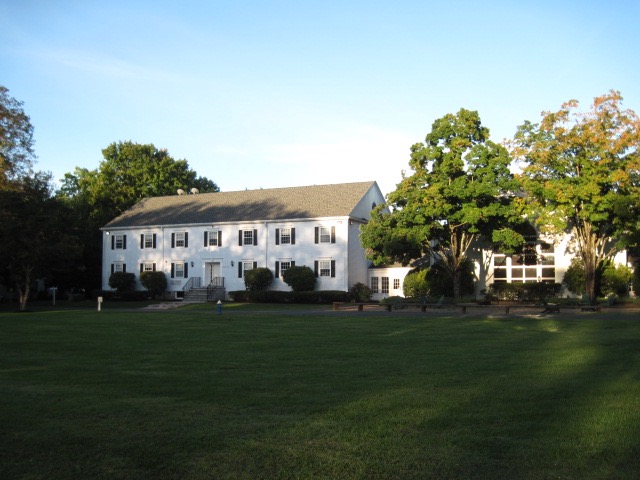
Nothing against “education brick”, but this plain style feels less institutional.
/|\/|\/|\
Image: Pine Barrens.
Melas commented thoughtfully on the previous post, and I’d like to reflect on his words here. In trying to explore the questions he raises, ultimately I end up pushing hard against my own doubts and understandings and probable prejudices. By this I mean I’m mostly arguing with myself, not Melas. So here goes …
First, Melas’s initial observation:
The poem, though short, is moving, especially upon a reflection, as you have provided. Without considering the poet’s evident meaning or original intention, I’d venture upon a somewhat different interpretation than yours, that is, one based on my traditional views. Let us at least agree that ancestry bears some degree of importance in any tradition of polytheism; the difficult questions are, how much, and what if one is of mixed ethnic ancestry?
I’ll add to Melas’s two “difficult questions” here and make them four: Does ancestry in fact matter, how much, what if one is of mixed ancestry, and does polytheism affect the issue one way or another? (One or many gods, or none, we all have the same energies to work with. Or do we live in wholly different universes simply because we group and name and work with these energies differently?) To continue a theme from the previous post, if we consider a person of Greek descent whose ancestors for at least ten or more generations were most likely Orthodox Christians, is practicing Hellenismos, reconstructed Greek polytheism, a comfortable or straightforward way to find harmony with these most recent ancestors, to enlist their aid, or to maintain their tradition? Or consider the opposite: is the Orthodox Christian angering all those ancestors who preceded Christianity? Is it merely a numbers game?
When I welcome ancestors — the occasionally monotheist, sometimes pantheist, intermittently polytheist being that I am — I invite those sympathetic to me, one of their descendants, today. (Who else, after all, would want to come? Think of those family events you’ve tried to escape!) In this sense, ancestry is indeed everything. I’m here because of them, and with them rest both my gratitude and reverence. But I face choices and challenges both similar to and different from ones they faced. I have ancestors who were Christians, Pagans, atheists, agnostics, animists, polytheists and shamans. How do we sort out such identifications and allegiances?
Do the last thirty generations of so of Christian ancestors of varying degrees of devotion and wisdom trump hundreds of generations and more of pre-Christian ancestors? Will the polytheists among them fight the monotheists in the Otherworld, or at my ritual circle? Does more recent ancestry matter more than the more ancient strains? OBOD’s standard ritual includes a declaration of peace, without which no work can proceed. Those who work the rituals can attest to the power of that declaration, and to the tenor and energy of the rites that follow. What we do, and who we welcome, matter here and now. A feast is ultimately for those who actually attend (though even to be invited is pleasing, too). To paraphrase Jesus, many are called, but fewer are fed.
King’s poem in the previous post acknowledges his
people
back to the beginning of
life,
In the witness of the gods
and the ungods
Back to the beginning: bug and bird, beast and beech tree. I suspect, one of the words I prefer to use in place of believe, because it captures both my doubt and my intuition, that such matters as commitments and practices from one life may recede when we drop the body of that life. We work on what we need to learn. If we truly do experience all things as we move through each circle of existence and awareness, as some Druids teach, then so do our ancestors along their journeys. Some things we give up, even as we take on others. (Some will follow us through many lives.) Whether this time around I was baptized into the “right” church, or offered the traditional gifts to welcome my spirit guide on my vision quest, may matter little compared to our enduring work along the Spiral of all beings to learn and grow in strength and love. And from what I’ve seen, we’re all slow learners. The Spiral is large and long.
Melas comments:
To the first [how much does ancestry matter?], I would say as much as possible, since a connection by blood is an inner force and connection (literally and figuratively) that can’t be replaced easily or dispensed with as unessential. I am not wholly Greek in ancestry, but my ancestors are partly from neighboring nations, and therefore choosing for me is easier than someone half-Greek and half-Chinese. In such a case, it would be best to take a side, I mean join one tradition without scorning the other, since large distance is inconvenient and causes confusion in the mind and heart.
When the choosing is clear, the choice can align the chooser quite effectively within a tradition that can be a solace and a guide, a source of strength and identity. Today many are still born with such a clear ancestral heritage. In such a case, it may indeed “be best to take a side, I mean join one tradition without scorning the other”. Perhaps Americans feel more keenly the “confusion in the mind and heart” that Melas talks about, with our often mixed ancestries. Confusion may result, whether the distance is physical, cultural, linguistic, genetic, spiritual, psychological, etc.
But should I then be a Christian, because everyone in my immediate family was, and because though I’m deliciously mongrel in many ways, most of my more recent Swiss German, English, Welsh, French, and Scottish ancestors were Christian as well? (I have transcripts of letters from one ancestor eight generations back, admonishing her children to strengthen their faith in trying times.) Should I be Catholic, or Protestant, or provoke ire on all sides and practice a blend of Christianity and Druidry?
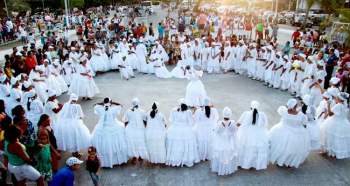
Candomble ritual, Brazil
And I call to mind people known to me personally, who don’t count among their keys to identity a genetic match in this particular life to a particular tradition that nonetheless calls deeply to them. Is there no place for an Asian or African in an often Euro-centric tradition like Druidry? Most traditions of Druidry I know welcome all who come with good will and an open heart, regardless of DNA. And that feels right to me, and to many others. Does that weaken the tradition, or strengthen it? Or indeed not affect it either way?
What are we to make of those whose inner experiences orient them toward traditions outside their apparent genetic heritage? What of the Euro-American adopted into a Native American tribe? The person of mixed ancestry who practices two or more traditions, a syncretism that seems more the rule than the exception, if we look at human history? Many homes in America find ways to honor a colorful braid of ancestral strands, Latino and Jewish and Thai, Catholic and Native American and Nigerian, etc. Haitians practice Vodoun, and Candomble and Santeria flourish in many places in the Americas — syncretistic forms all of them.
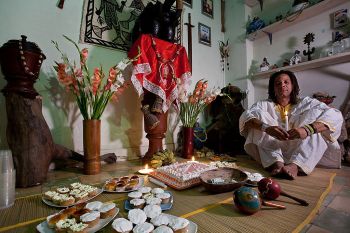
Santeria initiate
What of other new traditions, and restored ones, among people who already have a clear cultural and genetic identity? Native Americans have established the Native American Church, a distinctive set of beliefs and practices blending Christianity and shamanism, with sacramental use of peyote. As a Wise One once quipped, “There is little nature likes so much as to destroy old forms and then create new ones like them”. Do the ancestors of Native tribes ignore their descendants because of this innovation? I suspect — that word, again — that the ancestors either haven’t figured out yet, or worry about it a great deal less than we do.
Melas closes:
This point of the essential connection between ancestors and polytheism is too often overlooked nowadays, and I think it is dangerous. If we don’t stick firmly and mainly to a certain tradition and people (again, without scorning others), we expose ourselves to the uneasiness (sometimes misery) of uncertainty, and further we render traditions unlasting, empty and jumbled by removing distinctions from them.
Does the distinctiveness of a tradition depend on ancestry, or on honoring the ancestors? I see these as different things. I may know next to nothing of my ancestry, or through misinformation and deliberate ancestral deception I may believe things that are inaccurate, but the existence of my ancestors is still indisputable. And what of ancestors of spirit, those who have taught and trained and nourished me though we have no kinship by blood? They matter equally to me and to many others. Are such calls outside our blood the calls of those ancestors?
In the end, I’d argue that the distinctiveness or value of a tradition is simply this: does it meet the needs of those who practice it? Does it nourish the heart and spirit? Does it answer our innermost cry? If it does, it thrives and flourishes: we thrive and flourish in it. If it doesn’t, then like all things in this world, it changes or dies. It may be distinct, but dead. We contain, but also surpass, all that we do. That’s time-bound, however wonderful it is. And we live in more than one world at once, acting in each. But each of us is also still a seed, a potential, waiting in the earth, even as along time’s spiral we fruit and die, sprout again and blossom. The world shows us that much every year.
/|\ /|\ /|\
Images: Candomble; Santeria.
Irish poet Dennis King opens his poem “Altú” “Grace” like this: “I láthair mo mhuintire …” “In the presence of my people …”, finding reason in human existence itself for thanks. So often we need gratitude most when we feel it least. But on to the poem:
In the presence of my
people
back to the beginning of
life,
In the witness of the gods
and the ungods,
In homage to the
immense
generosity of the universe,
I give thanks
before my portion.
I’m going to do the English teacher thing you and I both have learned to detest: take a perfectly good piece of writing and analyze its parts. My goal, however, is not some obscure symbol-hunt or post-Modern Deconstructionist manipulation, but the pursuit of wisdom. What can this poem teach me?
First, King acknowledges witnesses. I live in the presence of my people, whether I belong to an extended family of the living, by blood or choice, or to the default tribe each of us can claim, one among a host of ancestors. All we do and are takes place in their presence. We don’t need to summon, invoke, or invite them, though it’s a courtesy in ritual, and it serves to remind us we’re companioned always.
Look in the mirror and you see the ancestors in eyes, nose, hair, line of jaw and length of limb. Consider what goes deeper than skin, and you can find them in your temper, your tastes, native tongue, social class and assorted beliefs and prejudices. Yes, you’ve added your own variations on these themes, and many of these you can shift to some degree through chance and choice and effort.
Send off for the increasingly popular DNA check, and you may find, depending on the accuracy of the particular test, that your tribe includes ancestors from unexpected places, that you can claim roots in many lands — that you even have something like a choice of tribes, if you’re looking to trade labels or identities.

Hellenic ritual
If the genetic test runs true that my father’s cousin ran a few years ago, I have some Greek ancestors, though family trees I’ve received and researched back ten generations or more on both sides offer no hint to explain an “8% Hellenic background”. But what does that mean, anyway? Wanderers, all of us, with ancestors as human, amorous, deceitful and restless as any of our relatives alive today. If because of all this I opt to worship Zeus, Athena, Hermes or Dionysos, they may or may not deign to notice. It’s an option for me, of course, and there are Reconstructionist Hellenists today who are reviving the old ways, Olympian style. But is that my call, or calling?
“Back to the beginning of life”, King continues. Whoever played a part in launching this whole enterprise of living, “gods or ungods” or lightning zapping the primordial chemical stew of a young Earth, we’re here and thinking (and drinking) about these things. And so these possible witnesses deserve acknowledgement, too. Why?! Because whether or not they exist, to remember and honor them even for a moment does me good. It enlarges my sympathies, and sets my life in a field much larger than what my social security number and bank PIN code and town tax ID and physical address suggest I am. We’re more, I hope we keep remembering, than the boxes we check on the endless forms we fill out. No single identity can define me, so why insist on just one? Pagan, white, childless, married, cancer survivor, writer, heterosexual, teacher, male: any one of these, and many more, could be a life-project to explore. Does one contradict or deny another? Does a census or a faction or political party or church begin to define me? Yes, you say?
Who are the true “authorities” in my life? Ancestors of scores of millennia, or a few political office-holders of the current arrangement, fulfilling one piece of their own lives by holding up one political system among how many possibilities? “I am large”, says Walt Whitman. “I contain multitudes”. (Easy to say, Walt, if no one insists on you being small, single, unitary, one thing only. Box checked, census complete, status once-and-for-always. But how large a claim about me, this thing I was born into, am I willing to assert?)
To exist at all is gift. “In homage to the immense generosity of the universe”: what would my life look like if I lived it daily in such homage? Can I begin to imagine it? Could I begin today, in small ways that could build over time?
“I give thanks before my portion”. Physically before: there it is, on plates and in bowls and cups. And temporally: before I take any of it into my body, I thank. Not after. Gratitude, how many doors can you open?
My portion: each of us has a part, a piece, a portion. If you’re a Christian, and you take Communion, the bread and wine or grape juice represent, or become, the inexhaustible blood and body of God. We eat and drink god-stuff, ungod-stuff. Our portion is endlessly refilling, and replenishing. To find and know and cherish my true portion: another project worthy of a life, of living.
/|\ /|\ /|\
Image: Hellenismos ritual;
In the previous post I said I’d talk about prayers and praying. If there’s a blogger’s equivalent to stage fright, I get it at least 50% of the time. I commit, I step up, and — yup, there it is, running its paws along my spine. (It helps keep me paying attention to guidance I receive.) Who am I to write some of the stuff I’ve written? I’m a person like you, alive today. That’s all the authority any of us needs.
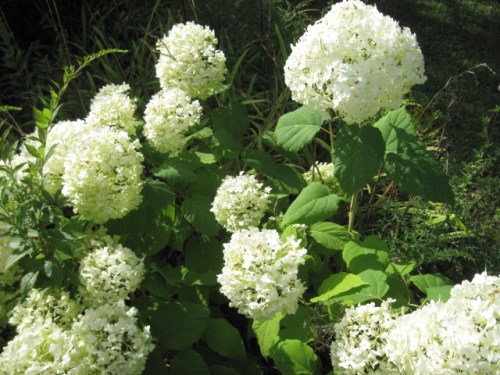
front yard, hydrangeas, 17 August 2017
Anne Lamott’s Help, Thanks, Wow: The Three Essential Prayers offers a helpful starting point for prayer and fasting. Because each of the three kinds of prayers in her title combine both: I can’t ask for help if I don’t fast from pride or despair. I can’t be grateful if I’m caught up in fear and anger, and so on. Prayer IS fasting, and vice versa — a magical choice to place our attention not where anybody else wants it but where we choose.
Sometimes all I can do is ask for help. Often asking — even trying to ask — opens a door, especially if I can shut up before and after, even if it just means hearing the hinges squeak. Something’s in motion that wasn’t before.
After a three-year job search, I despaired of outside help. Persistence and patience between them do gather up tremendous reservoirs of energy. But you get in line, one of my wife’s go-to techniques, and you advance until it’s your turn just wasn’t working for me.
Until it did. Last week I received a solid job offer to do just what I’d been asking for. But because it was out-of-state, because it meant a move and other changes — because it asked me to grow into it — I immediately found several reasons to say, quite loudly, NO! Fortunately, just not to the person offering me the job. As U. K. LeGuin so gracefully puts it, I had to enlarge my heart to accept the gift.* And I had to recognize the gift as gift before I could even do that.
I ask you — what can the gods do with such mortals?!
Often, a lot.
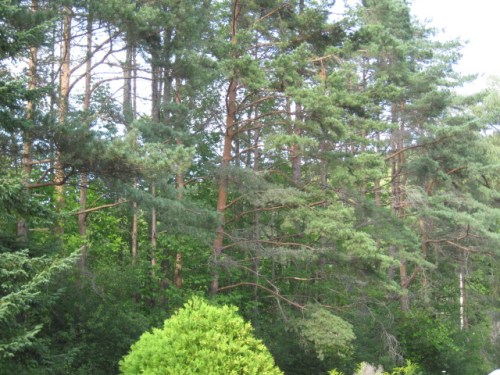
Hemlocks, north property line, 17 Aug. 2017
Other times you just want to say thanks. If I haven’t done so for a while, I can tell by how it feels to start up again. Like I’d forgotten a key ingredient. But now it’s back in the sauce, the mix tastes sweeter, the glue sticks, the paint dries to an appealing hue.
This blog offers guarantees very rarely, and for good reason. But practice no other prayer than gratitude for a year and a day, then get back in touch. I guarantee this triad: transformation, wonder, and a new conviction in you.
Wow is a third kind of prayer. If you choose, you can perceive awe as a form of tribute, a gift at the altar. “The finest emotion of which we are capable”, Einstein exclaimed. “is the mystic emotion. Herein lies the germ of all art and all true science”. Even if we scale it back for the sake of the skeptical among us, who doesn’t appreciate awe? How else to feel so small and so connected at the same time?
In a post from a few years ago I looked at a “prayer prompt” I still find valuable.
The prayer serves as a starting point for how I try to pray for others in difficulty without mucking things up further for them with what I think they need. It’s also more eloquent than I can usually manage to be, which never hurts either.
In the excerpt below, from Mary Renault’s splendid evocation of classical Greece, The Last of the Wine, a friend of the main character Alexias is speaking, near the tail end of the suffering that much of Greece experienced during the three brutal decades of the Peloponnesian War:
We have entreated many things of the gods, Alexias. Sometimes they gave and sometimes they saw it otherwise. So today I petitioned them as Sokrates once taught us: ‘All-knowing Zeus, give me what is best for me. Avert evil from me, though it be the thing I prayed for; and give the good which from ignorance I do not ask.’ — Mary Renault. The Last of the Wine. Pantheon Books, 1964, pg. 344.
Can I pray for what’s best for me, can I keep alert for its first stirrings when it arrives, even or especially when it’s not what I thought I wanted? If I can answer yes even some of the time, change can open my heart to possibilities I’d otherwise turn away from, if not actively shut down. Then maybe I’m ready to pray for others, too. (We won’t mention changes that come to all of us anyway, unasked for. Welcome, travelers of all realms, whisper the gods, to these worlds of time and space. Buckle up.)
Other times prayer means simply immersion. I go for a favorite walk, I sit with a favorite CD, a song or chant for meditation, or I follow a theme in a series of meditation sessions, and I’m in it. Borne away from here-and-now to there-and-then. Sometimes I only know when I return, like waking from a dream, that wherever I was, it sure wasn’t here. And I’m better for it.
Formal prayer has its place, too. As many do, I find Iolo Morganwg’s Gorsedd Prayer, also called the Druid Prayer, which Morganwg first spoke publicly at the 1792 summer solstice, a comfort:
Grant, O God/dess/Spirit/etc., thy protection,
and in protection, strength,
and in strength, understanding,
and in understanding, knowledge,
and in knowledge, the knowledge of justice,
and in the knowledge of justice, the love of it,
and in that love, the love of all existences,
and in the love of all existences, the love of God/dess/etc.,
and all goodness.
You may turn to other prayers, or you’ve written your own. I’ve mentioned sources like Caitlin Matthews’ Celtic Devotional. Sometimes all I can manage is the spontaneous cry of the heart, standing at my backyard fire circle, facing an indoor altar, or stunned to despair while I stand in the shower, hot water indistinguishable from tears. You go with what comes.
Sometimes it’s stillness I’m called to. In the stillness I may receive much. The blessing of turning off the monkey mind. Intimations of the future. A nudge towards or away a choice, a pattern, a practice, a person. Or any of a range of still small voices that will never shout to be heard, that have waited patiently for me to listen once again.
Sometimes it’s a reminder about a commitment I’ve made. In that case it’s a god invoking me, rather than the other way round. How have I answered, how will I answer, now? The offering I made was for my own good as well as a gift. The service I vowed transforms me in the doing of it, even as it fulfills a request by guide or god or spirit I have promised.
Sit, sing, and wait, counsels one of my teachers, if I need things to clarify, and no other path seems clear. And a book that same teacher delights in offers two additional pieces of advice, opening and closing the same paragraph: “Hold all and wait … Drop all and start over again.” Both valid, both true, both potent for good. How to know which to practice, other or either, if not both at once? I turn once again, I return, listening, praying, fasting. Don’t we all?
/|\ /|\ /|\
LeGuin, U. K. A Wizard of Earthsea. Bantam Books, 1968, pg. 69.
You’ve probably heard some version of it before. It crops up like an overnight mushroom, whenever an event like Charlottesville or Brexit or Charlie Hebdo or Syria or Iraq or Rwanda or 9/11 or-or-or shakes us loose from our torpor and shrieks for attention, for a reaction. You can fill in your choice of event, from a whole ungainly series of them over the last year, decade, or lifetime.
We could quite accurately call the reaction the “20-40 rule”, courtesy of one of its literary expressions from some 80 years ago, in James Hilton’s Lost Horizon. The two speakers here are Chang, an inhabitant of the famed valley of Shangri-La, and Conway, the main character:
“We keep ourselves fairly up to date, you see”, he [Chang] commented.
“There are people who would hardly agree with you”, said Conway with a smile. “Quite a lot of things have happened in the world since last year, you know”.
“Nothing of importance, my dear sir, that could not have been foreseen in 1920, or that will not be better understood in 1940”.

Now the argument here, a philosophical version of wait-and-see, has its obvious appeal as well as its downsides. In considerably less than a year, the political (or ecological or spiritual) landscape can shift dramatically. Irreversible change may swallow up — or end — lives. Wait for expanded understanding, however rich or apt, and it may simply arrive too late. Look solely at the long game, and I miss the immediate stakes.
But even knowing this, if you’re like many, you may start to experience “apocalypse fatigue”. You have little adrenalin or passion or initiative left in the tank. You’ve felt and you’ve empathized and you’ve resolved, and maybe you’ve also marched or written or witnessed or organized or simplified. Maybe you still do. Or maybe now you keep your head down and try to live your own life as best you can, because that’s all you feel you can do, as the world unquietly keeps crashing and burning. You brush off the ash and pick through the rubble — you stand up and do it again tomorrow. You endure.
For a thoughtful and balanced set of responses to crisis — not just one, and with Charlottesville simply the current face it wears — I suggest you read John Beckett’s 10 August ’17 post here. While we don’t always see things the same way, I value his hard-earned perspectives.
And when he observes, “My political posts weren’t well read, I didn’t particularly enjoy writing them, and every political post I wrote meant there was a religious, spiritual, or magical post that didn’t get written”, my experience echoes his. Long-time readers of this blog don’t come here for politics anyway.
/|\ /|\ /|\
But here I want to look at an approach that I’ve found addresses the -cosms of the title, the keen needs of the moment as well as the more subtle draw of the long view, an approach that can serve the politically engaged and the quietly witnessing and the spiritually armed and ready, as well as the hermit sage. In a word, stamina. Fortitude, courage — though not quite the same thing. Staying power.
The approach sources, among other wells and fountains, the wisdom of the Galilean Master, who counseled prayer and fasting. And to make it a Druidic triad, we’ll add listening, because listening is another face it wears. Listening, prayer and fasting. LPF.
And that means listening to all of our -cosms, macro- and micro- and meso-, too — all our worlds, and the world “in between”, this middle earth where we spend so many of our daily hours. I’ve found if something’s shaking in one world, the others vibrate with it, too.
I’ll go personal from here forward, because that’s often how I think and talk best. If it’s true for me, it may — or may not — also work for you. But you’ll see it tried out with me first.
If I don’t fast from frequent tugs towards anger or fear, if I don’t re-connect with the innermost truths I know, I can’t pray (or act) effectively. I drag along the trash and flotsam and jetsam from others’ anger and fear. Don’t need ’em. Got enough of my own to let go of. This happened most recently in a job situation I won’t go into, because I’m still praying and fasting about it. Work-in-progress. Material for an upcoming post.
The danger of another’s anger and fear is I may not recognize them until I make them my own. I may confuse them with almost anything but a limitation. Unless I fast from their effects, listen to their seed-causes, and pray, I open the door to them. Now in addition to my own, I’ve invited in another’s fear and anger.
So if I’m not praying, I can’t fast or act with justice to myself or anyone else. And without praying, I can’t listen. Some of my prayer will be silence, a space where counsel from wise guides and teachers and ancestors and spirits has room to reach me.
Without this practice, whether I launch myself into a protest march at the statehouse in Montpelier, Vermont’s capital, or weed my garden and share with my neighbor a bundle of chard or a basket of carrots or — soon — potatoes, I’m missing my best path.
Because whether I link arms with another protester or cross my yard to my neighbor’s and listen to his life over the past few weeks, I’ll miss what I most need, and miss what I most have to give. The opportunity, the exchange, is often a seeming small one. But that’s why I need to listen or I miss it.
This has happened so many times to me, both the listening and also the missing-the-moment, that I’m actually beginning to learn it. (Like I’ve often said here, I can be really thick and slow about these things.)
The test, always, for me, is the quality of the encounter, the sense of rightness. This sense doesn’t exclude physical difficulty. Whether I’m about to go into surgery, or face an angry person waving a sign on the street corner, or talk with a friend, the words, the tone, the energy exchanged between us is my guide. How does it manifest? Can I watch the exchange without deep attachment to its outcome? Can I watch the — for lack of a better word — the ecology of the moment work its own energy?
I’ve acted, prepared, prayed and fasted and listened. Now comes the wonder, when I’ve gotten out of the way of Spirit manifesting in the situation. Or not.
For me, the listening IS the prayer and fasting. The fasting IS the prayer, and the prayer IS the fasting. One of the best Druid triads I know.
Pray and fast, and things go smoother for everyone, not just me, whatever I do. Miss the optimum alignment, and I discover that, too. This is my love laboratory, this world where we all are trying out our truths, where the test, in the end, is this: Does it build? Does it open? Does it give? Does it connect? Have I served?
And what forms of prayer might work? Material for the next post.
/|\ /|\ /|\
One of the great pleasures of the “Great Eight” seasonal festivals on the Wheel of the Year, if you have a group to celebrate with, is the unique combination of private and community rites that can mark each season. They can merge and nourish and colour each other in subtle and provocative ways.
I’ve written here about my own recent private rite consecrating a new fire circle. Earlier today I hosted a small group rite of Lunasa.
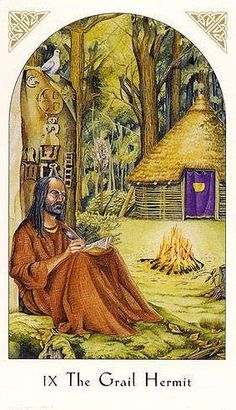 Card drawn before the rite from the Arthurian Tarot: the Grail Hermit. Caitlin and John Matthews’ deck provides rich material for meditation. A partial interpretation: while group ritual is important, personal communion with the Source and its many guises is crucial to balance. I don’t need to “go anywhere” to find the Grail or the inner hermitage, but I do need to make an effort to allow them to manifest in the busy-ness of my life. I note too that some things can only be discovered and mastered alone. A group can become a distraction if its main contribution is more busy-ness and not useful centering and grounding in practice. That’s a message that’s still deeply applicable to me and my practice.
The hanging over the door of the Hermit’s hut is purple, with a golden image of the Grail on it. The royal road of true spirituality calls us to claim our spiritual identity as heirs to an inner kingdom. As with all above-below and within-without paradoxes, the apparent poverty, obscurity and simplicity of the Hermit contrast and foreshadow the spiritual wealth within. One clue: the fire burning in the clearing.
For the group rite we made space in our weaving room with looms and fibers for backdrops. Appropriate for the Weaver at the Loom, Shaper of All!
Here on the altar the firsfruits: blueberries, candles, a sheaf of grasses, corn meal and ritual objects sheltered from the weekend of rain.
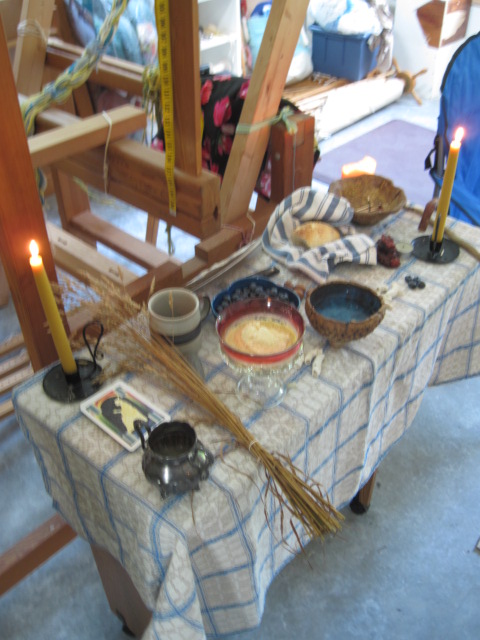
Halfway through the rite, the thunder receded, the rain stopped and the sun emerged.
Hail Lugh, hail Earth Mother. In the words of the ritual — her words — “I will nurture you … I will comfort you … I will bless you through all the days of your lives”.
Thanks to BW for composing and leading our ritual, and to those who celebrated with us.
/|\ /|\ /|\
Matthews, John and Caitlin. Illustrated by Miranda Grey. The Arthurian Tarot. Aquarian Press, 1991; 25th anniversary edition, Connections 2015.

An offering to Thecu Stormbringer:
Hail, Goddess. I will go with what I know,
with what you show: you give me
nine runes, nine paths of storm;
you tell me their wisdom lies in riding changes,
walking the storm-paths. So I ask how
I may serve in return for your gift.
Speak how, instead of squaring the circle,
to try circling the square. Not to share
exact shapes [of the runes], but their greater principle
you may share. [For] they form a sequence:
linear as you received them, but also
a circle or spiral. Four by three, and three by four:
ending and beginning lie side-by-side,
or — you will understand it —
directly above and below each other,
[on] different rounds of the spiral.
The Runes of Thecu combine straight lines
and circular shapes — lines of force
and vortices or whorls [of energy in motion].
How to ride changes?
Practice [with the runes] to find out.
And I will guide you.
How to transcribe what you receive in such instances? Well, the obvious answer is this: you do the best you can. And you ask, usually more than once, for clarification.
Let me puncture any mystery here: the words I attribute above to Thecu came during three intervals. The first and second, along with runes, over the past week, in two separate periods of meditation. The first led to the insight that Thecu was offering guidance on how to walk “nine paths of storm”, and a preliminary sense of what that might mean. The first five runes also came then, drafts scribbled on scrap paper, as I tried to get their shapes to match the different flows of energy my inner experience felt like it conveyed. The same thing a second time, two days later.
Then this morning: I already knew I was going to write about this, and I’d made a draft, along with the admonition I’d received not to share except in general terms the insight of the runes. So in about five minutes the above lines came, as I attempted to pull together fragmentary notes about the runes and render the impression of those meditation sessions into something more like continuous speech.
Are they “the words of the goddess”? Sure. Also, no and yes. In keeping with the deep wisdom of unverified personal gnosis (UPG), they’re meant to be tested and tried out, to see how their truths work for me. One key to practice, and it can be disconcerting, is to shift from “UPG mode” to “critical thinking mode”. I get this stuff in ways similar to how I get pieces of poems and stories. And it’s the same kind of thing: then you have to figure out what to do with them. Sometimes the message, image, metaphor is clear. Other times, it needs shaping or untangling. And to keep honest about proportions of these things has indisputable value, but not — it needs to said as well — spiritual primacy. The impulse-message-insight-inspiration needs to get recorded before, like such things do, it flows away like cloud.
And I share this experience for what it’s worth to others who may encounter similar impressions, nudges, doubts and insights. What to make of such things? For me, it’s to see how and where they might fit in living my life, and whether their usefulness, if any, merits passing along anything about them to others. So I serve notice here most of all to myself. Any value to this experience will emerge, or not, in and over time. And I will try to report that here.
/|\ /|\ /|\
Image: stormcloud — “free for commercial use”.
We can of course take an a-gnostic approach to all of the above as well: I sense changes coming (no surprise at all, given the state of the world!) and my imagination/subconscious is throwing up images, ideas, tools, hints to help me deal with them. Useful, wholly apart from the nature of their origin, because they’re intended to be empirical: their value lies in what they can do, what I can do with them. Who says the imagination or subconscious has no practical value? In some ways, that’s the ONLY thing it has.
 “So how did the ritual go?”
Site statistics for the last post drew readers from surprisingly varied lands: Vietnam, South Africa, Argentina, Ukraine and Latvia among them. I highlight these simply because their national languages aren’t English (with the exception of S. Africa). Not only are readers there interested in Druidry, but they’re seeking out English-language media that talk about it.
“Show us applied Druidry and we’ll pay attention”, you’re saying.
Here’s a follow-up, an excerpt from my “post-mortem” journal entry after the ritual. Because “feels” don’t really tell the whole story, as you’ll see. How I think a ritual progressed, and the whole picture with every factor included, can be two different things.
First off is the ritual set. You know: state of mind, weather, time of day, preparation. Alert. Noticing many animal presences, especially ants, flies, aphids, grasshoppers. Slightly edgy, the way I often feel when stuff’s going on I know I don’t otherwise notice. (Material for later meditation there.) Weather sunny and clear, 73 F (23 C). Approximately 2:00 pm. Preparation minimalist, with a few objects I was led to choose in meditation earlier that day. (Barely visible, behind and below the cup to the left/north sits a black Cherokee owl cup, containing objects from my first OBOD initiation, along with a symbol of the wild boar, one of my animal guides. (Yes, in one sense this wasn’t “minimalist” at all; I’d pulled out all the stops for this rite.)
Below is an image with the fire lit, a little more than halfway through the rite. I began with a standard OBOD ritual opening: “By the power of star and stone, by the power of the land within and without …”

In the picture I’m facing East. Directly in front of me is the blue bowl of water for West. To the right, South, the dragon candle-holder, with a green candle.
“Green for South?” I hear the purists gasp. Yup. Why? As one of my friends might say (and spell) it, that’s the color of “the green fyre” of nature. I’d been nudged to use green at our Midsummer ritual. More than the sun, how the Land flourishes under the sun at the solstice says “summer” to me. Your climate and tools differ? Excellent! We’re both learning to listen to what’s in our faces and under our feet and in our hearts.
On the far side of the circle in the East is a deer-bone whistle from Serpent Mound. Its high pitch matched the cry of birds overhead, the wind in the trees. Finally, to the left and North is my Ovate anchor stone and one of several offerings, a cup of milk and a slice of bread (already offered by the time of this picture), white for the northern snow, for Lugh Lord of Light, and for Thecu Stormbringer*, for fertility and harvest both, how we are all nourished from the time we are born, “the fat of the land”. What is it that fire burns, after all?
Dry wood lay ready, kindling and newspaper, too. I’d just said these words “I ask your aid in consecrating this fire circle and the greater circle, that has its center here, its circumference everywhere.”
Out with the book of matches. One after another. Nothing. The fire wouldn’t light.
So back into the house for wooden matches. “Disaster! Bad omens abound! No fire means no passion, no energy for your work. AND you broke your ritual circle!”
Well, no. Remember the part above about the “greater circle”? I was still in it. I pondered the nudge to include this line as I wrote it earlier in the day. And if such “ritual breakage” distresses you in your own rites, you know what to do: cut yourself a ritual doorway, The circle won’t blow away during the few minutes you’re gone.
Sometimes a break in the ritual points to a specific focus for the ritualist to attend to. I took the need to get better matches as a ritual message: when I tend any fire — energy — passion — heat — will — decision — I need to pay particular attention to beginnings, to my tools, to an extra step that might be necessary to assist with manifestation. Fire spoke: any ritual worth its salt links self-as-home together with the ritual action. Fire comes from within as much as from without. Much more useful and to the point than irrational fear of bad ritual mojo.
“I kindle this fire in honor of all the elements, earth and form and north the altar, air and breath and east the means, water and cauldron and west the capacity.”
At length, after a meditation I’m still reflecting on, the closing, again adapted from OBOD ritual: “As the outer fire dies down, may it remain a pure flame within. This circle is closed in the apparent world. May its inspiration continue within us all, a gift”.
/|\ /|\ /|\
*In the next post, an update on my work with Thecu of the Nine Paths of Storm.
“The hours of folly are measured by the clock, but of wisdom no clock can measure” — William Blake, “The Proverbs of Hell”.
/|\ /|\ /|\
“Where do you get your ideas from?” Every writer’s been asked this question, and every writer morosely ponders it anew, when inspiration flags and the blank page or screen stares back. When the awen is flowing, writing’s a pleasure. When it’s not (or as my guide might say, “It’s flowing differently”), often the real work begins: to listen, to bless the fallow times. To let go. Or as one of my teachers puts it, “Sit, sing, and wait”. No — not a prescription for doing nothing, but rather a particular kind of blessing. To bless ourselves is often the hardest work of all. It asks less than we’re willing to do, because doing isn’t the issue. At least not the kind of doing I usually do.
Often I get ideas from you, my readers. I look at the site statistics and find an old post from a year or two past is getting traction again. Why that topic? Why the interest now? I re-read it and listen for what might be speaking. What are you looking for? What’s shaking in your lives right now? Often, too, human memory being what it is, I don’t remember the post well (or at all), and so I can come upon it with something like fresh perception. Your interest helps me look and listen. And if it’s happening with you, it’s almost a sure thing it’s happening with me, too.
In the previous post, I wrote of honoring the mundane, respecting this world and its rhythms and changes. I go out later today to a new fire circle in my backyard to ask that it be consecrated. I initially wrote “to consecrate it”, and that could well be accurate, if I took on the sole responsibility of hallowing it. But even then, other energies and presences are involved. Because do I ever act alone? More and more, I’m learning at least my own answer to that question.
I ask for consecration, as well as performing it myself, in order to hear something of what goes on around and through me. As a capacitor and transformer of spirit, I find listening almost always clues me in that there’s more going on than I suspected. This is a suspicious universe, and I mean that in the best sense of the word. There’s so much to imagine might be happening, and imagination will pull back the curtain, open the window. I suspect the sacred all around and within me.
And then? Often, because vision’s my default sense, I expect, or suspect, I’ll see something. Instead, an air blows through the open space that carries me with it. Or a bird calls, or one of the sugar ants that have invaded our house this summer crawls across my arm. I start, and grumble at a meditation interrupted, until slowly it occurs to me this is a message. I’m part of a host of others, of selves, and we spiral together. Consecrate a circle or grove, and every square centimeter is stuffed with beings. Even counting only those with skins on.
In a post from a few years back that’s been drawing readers, I wrote,
So we return and begin (again) with the things of earth, these sacred objects and substances. As sacraments, earth, air, fire and water can show us the holy, the numinous. Their daily embodiments in food and drink, precious metals and gems and sex, pleasure and learning and science, music and literature and theater, sports and war and craft, are our earliest teachers. They are part of the democracy of incarnate living, the access points to the divine that all of us meet and know in our own ways.
Not bad, but I’d add: “their daily embodiments” in embodiments. In all the Others that journey with me. These are the ones I’ll invite to join me as I open my inner grove, and as I light the first fire in the new fire circle later today.
/|\ /|\ /|\
While digging up our yard for a new foundation last fall, our contractor unearthed a lot of stones. We asked him to pile them on the edge of the excavated area, suspecting we’d find places for them eventually, and wanting them nearby and handy, rather than neatly dropped along our property line — and further away to carry. Puzzled, he agreed. When his crew returned two months ago to reseed the area with grass, they added to the pile as they raked and smoothed the dirt. We could hear them talking and see them shaking their heads as they threw more onto the pile in what looked to them like the middle of our back yard.

And now some serve for a fire circle, and others — the two or three large ones above — may work for seats or altar stones, if we can manage to shift them and set them firmly in place. To give you an idea of size, the large one to the right weighs a few hundred pounds (150 kilos or more).

/|\ /|\ /|\




 A Druid Way


