Earlier today my co-admin Steve on the Druid and Christianity Facebook group posted this link to one of Caitlin Matthews’ blogposts from several years back about “Omen Days” — the southern Celtic (Wales and Brittany) tradition of using the Twelve Days of Christmas for divination. As an intercalary period, one literally “between the calendar(s)”, from Christmas to Twelfth Night or Epiphany on January 6, the days have long been considered “time out of time”, and therefore especially apt for such practices. Like the holy space of a ritual, set aside from ordinary time, the Twelve Days are — or can be — magical.
In some versions of the divination, each day aligns with one month of the year: December 26th with January, December 27th with February, and so on, offering a particular flavor to the practice.
Looking, too, for a link between solar and lunar calendars, it seemed fitting to me to make it 13 days, starting on Christmas Day, rather than just 12 by starting the day-count after, on the 26th. But there is a new moon on the 26th this year, and that can play into any decision.
And when we consider that this period after the solstice is a liminal one, open as at Samhain to the Ancestors and the spiritual realm, it’s worth reflecting on Dickens’ choice to set his “sacred holiday ghost story” of A Christmas Carol during this interval, with its Druidic as well as Christian series of three spirits, and we can enjoy as well such a context for other stories, like those of the Wild Hunt, active in the winter and so around Yule, and the Medieval “Day of Misrule”, the inversion of “normal” order, on Twelfth Night itself.
In the same post, Matthews mentions dvoverie, a Russian word meaning dvo “two” ver–ie “faiths” — or holding “two beliefs”, a word to describe the persistence of an old worldview after the arrival of a new one. (The Russian ver– is cognate with our Latin-derived verity — “truth”. Two truths for one.)
For a while this cultural expression was thought to characterize or be unique to Russia, especially prevalent among folk practices. Think of our ongoing custom of treating the sun as if it rises and sets each day, in spite of astronomical awareness that it’s the earth that moves, not the sun. Though this source go so far as to call dvoverie “an academic myth”, as if dismissing something as a “myth” makes it untrue, rather than simply ahistorical, I’d argue we’re all quite “dvoverian”, and in more ways than we might imagine.
In some Christian circles, it’s true, the lament persists that certain symbols, practices and beliefs are “Pagan”, “not Biblical”, etc. Pagans sometimes return the favor. (Personally, I find such “purity tests” too often lead to sub-optimal results, just like they do for many women today in only slightly different circumstances, and for often similar reasons.) I’d prefer to ask those symbols, practices and beliefs: “Are you worthwhile? Do you grant insight, increase our understanding, grow our capacity for gratitude and love?”
(And lest we too quickly conclude that divination is never a Christian practice, we have only to look at the Apostles drawing lots in order to identify Matthias as a replacement for Judas Iscariot in the Book of Acts, or at ancient practices in Israel. St. Thomas Aquinas among many others exercised himself on the topic in his Summa Theologica.)
Let’s make Omen Days a “dvoverian” experiment.
/|\ /|\ /|\
My divination today follows the practice of asking my question outdoors, then spinning around eyes closed, opening them to the first thing seen, or asking the question indoors and then going outdoors to observe whatever offers itself. In either case, the sign or omen is what first comes to the attention.
“What can these divinations teach me?”
For me it was jet-trail and birdsong — the seen and the heard at the same time. I looked up to see the jet-trail, and then I became aware of the song. The trail had no sound, the song no visible bird. A useful reminder that a single sense rarely provides all the evidence, or any kind of “complete picture” (note the bias toward the visual in such expressions!).
If you live in an urban area near an airport, of course, this may prove no omen at all for you. (That’s why omens are not universal signs, in spite of our best attempts to codify the cosmos.) But in southern Vermont, a plane of any size passing over is unusual. Except for June or July, when the nearest airbase sometimes makes training runs for days at a time over Vermont (and usually seems to halt each time the complaints reach a certain threshold), a flyover merits attention.
The birdsong belonged to a song sparrow, a very common bird, a cheery voice for our northern winters. No, it wasn’t a Raven, or some other bird with mythic weight and portent to weigh down an omen till it crumbles under its own gravity. If I want to push it even a little, I might recall the Gospel verse: “Are not two sparrows sold for a penny? Yet not one of them will fall to the ground outside your Father’s care”.
Here’s a Youtube video of a song sparrow in our neighboring state of New York:
The worlds of human (jet) and animal (bird) need not be opposed, and aren’t at heart separate worlds at all, in spite of our unwise attempts to uphold such a false division. The Song all around and within us keeps rising, in spite of our jet-trails, in spite of our restlessness to be somewhere else other than where we are. We hear it. How can we heed it more fully?
2020: jet-trail and birdsong — a divination of our times.
Those of you on Facebook may find much valuable reflection in this 31 October ’19 Samhain post from a regular series by the Anglesey Druid Order/Urdd Derwyddon Môn in Wales. Check out the other posts, too — a very worthwhile monthly series of good insight and perspective, from a member of the Welsh Order run by the estimable Kristoffer Hughes.
/|\ /|\ /|\
Last night before our main ritual, we performed two Ovate initiations with Mystic River Grove — Samhain being particularly appropriate for Ovate work in the inner realms, the Otherworld, the ancestors, divination, etc. We all already do considerable imaginal work, consciously or not, and while photos can help nourish that capacity, at times it also feels right to forbear from posting pictures of private ritual sites, so no images this time.
By “imaginal work”, I mean the content of imagination, dream, and visualization, as well as self-conscious association and emotional loading of experiences. We come to new experiences well-equipped by our previous ones, for ill or good, to accept or reject or transform — and all of this often happens outside of conscious awareness. It can be the task of magic and of ritual and personal work to make such things more conscious, to work more deliberately with the Cauldron of images we each carry around with us, and out of which we supply much of the color and tenor and flavor of our days. Our instinctive likings and antipathies for people, places and things spring from this “pre-loading” of consciousness, and to take charge of our own reactions and responses can serve us very well.
Rather than mechanically pursuing or fleeing things that attract or repel us, we can begin to ask whether they are for our benefit or not. Rather than assuming the attraction or repulsion lies in the person or thing, we can begin to learn that it lies in us — the external is merely a convenient channel through which those energies reach us. Because one way or another, they will — we’re open to them, we’ve invited them in some way, and placed ourselves in agreement with them. The difficult thing that can strengthen us, the seductive thing that may weaken or distract us — this is the Long Work, the magnum opus we are all engaged in: to live out the consequences of our choices, yes; but even more, to choose wisely in the first place, to choose with love and foresight and wisdom how we will spend our lives, even as everyone and everything around us is doing the same.
/|\ /|\ /|\
A year ago I drew a personal Tarot reading for the coming year and shared it here.
With 3 of the 10 cards coming from Pentacles, resources and the physical world will be a prime focus of the year personally and for the planet. Balancing feminine energies to the mature male energies in play are an immediate aspect of the present and near future. Destiny and past influences at work, though not inevitable, are ones we have both initially set in motion and strengthened by our sharp focus on materiality. Our outer fixation on security and stability may feel reasonable, given such destabilizing forces at work. But while our hopes and dreams focused on these things are valid, pursuing them along a still-material path, even with a renewed youthful vigor, will not return us to what is stable and safe. Other directions we have recently begun to explore can prove more beneficial. We’ll see moon-like changes, darkness and light alternating in phases.
I’ll return to this in a year and see how I did.
As a take on the times, both public and private, little here should be a surprise. (Was my reading too vague, or too influenced by my own perspectives? Quite possibly both.) “Our outer fixation on security and stability may feel reasonable … but pursuing them along a still-material path, even with a renewed youthful vigor, will not return us to what is stable and safe”. I take this most of all as a guide for my own focus: anything I wish to manifest outwardly rises from within, and that is where it is easier, more prudent and far-ranging to work, to spend my energies and time. Whether my region, my nation, my planet chooses to do that is much more out of my hands, unless I opt to engage it through a very large gesture. I could — so could each of us — but most of us will not, through a combination of inertia, distraction and providence. We see such radical gestures — in the U.S., often accompanied by guns — from people who despair of any other avenue for change, or outcome.
(We always see individual actors attempting these things — check the headlines of your own country or region for the relevant political, military, cultural and economic actors at work in your spheres — but few achieve what they imagine they are pursuing. To look for a moment at my own country, whether Donald Trump or Elizabeth Warren or Bernie Sanders or Joseph Biden becomes president in 2020, most of the issues we face right now will still remain for us to deal with. A change of one face, or even of the faces clustered around that one face, will not easily shift large causes we have already set in motion over time. As egregores of particular vigor, nations have karma, too.)
As for personal applicability of the reading, I find in it valuable reminders of long-term trends and tendencies in my own behavior and outlook that I continue to grapple with and learn from. (Want to know what these are? You have only to read what I’ve been posting here all along!)
Consider doing your own divination, with your preferred oracle. Most of us are already doing this anyway: among our chosen oracles might be a best friend, partner, coin toss, stock market report, a horoscope, whim, toss of the dice, impulse, and so on.
/|\ /|\ /|\
So — onward to a reading for the coming year, with the Celtic Cross spread. I make frequent references below to Rachel Pollack’s excellent 78 Degrees of Wisdom: A Book of Tarot, Thorsons/Element, 1997, both because many value her insights, and also because they offer me a corrective to my own biases.
1: Ace of Wands (reversed) — the present, the Self, the querent’s state of mind.
2: 10 of Cups — the immediate influence, problem, challenge, etc.
3: Hanged Man (reversed) — destiny — in some spreads placed above as the “crown” of past experiences.
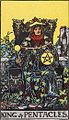
4: King of Pentacles — distant past, or some spreads, the future.
5: Page of Cups — recent past, or conscious focus.
6: King of Wands — future influence; or the unconscious, the underlying or the true driving force of a situation.
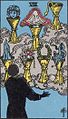
7: 7 of Cups (reversed) — The querent; the querent’s self-perceptions.
8: Knight of Pentacles — external influences.
9: 8 of Wands — inner emotions.
10: Temperance — outcome or final result.
Wands and Cups predominate in this spread — for me, a reminder of the need to balance fire energy with water, active with receptive, conscious with intuitive. Always good advice! But how might that work, more specifically? How do we “grasp” the fire of Ace of Wands? What “hand” or means do we use? Rachel Pollack in her magisterial 78 Degrees of Wisdom comments: “At the beginning of some situation, no card could signal a better start” (pg. 183). I take reversed simply to mean the challenges attendant on manifesting the energy of a card, or missing the opportunity it brings. The “crossing card” of the 10 of Cups is a Grail, the completing or fulfilling Cup — a balance to the fire of Wands. The third card, a reversed Hanged Man, to me signifies that every time I ignore shamanic, yogic, inner wisdom, I miss the insight of inner experience.
The four elements suggested by the shape of the hanged figure can serve our spiritual intention only when they are in the service of spirit: allowed to be fully themselves, not distorted through social expectation, but liberated from it. Given my age in this incarnation, the personal applicability of Card 4, the King of Pentacles, suggests past (even past-life) successes, which could lead to present complacency, which the fire of wands should help allay. The figure’s greenness in this deck also suggests the natural world. Moving on, Pollack comments that “the Pages all have a student quality” (pg. 192), suggesting that from the Page of Cups issues an appropriateness for a study program or course of discipline to develop intuition or psychic/inner awareness.
While Court cards like the King of Wands suggest people who exert influence in the querent’s life, they can just as well signify aspects of the querent, and also need not be associated with expected gender: male doesn’t have to mean “man”, but a kind of energy (now clouded and confused by our current political correctness, of course, but no more than at other times, with their own preconceptions and misunderstandings) — Angela Merkel or Lady Gaga, Elizabeth Warren or my wife.
The “final four”: for the 7 of Cups, Pollack insightful notes, “it is a mistake to think that daydreams are meaningless because of their content; on the contrary, they often spring from deep psychological needs and images. [But] they lack meaning because they do not connect to anything outside themselves” (pg. 198). The reversed Knight of Pentacles, Pollack suggests, offers a paradox inherent in Knight, even not reversed: “deeply grounded in, yet unaware of, the magic beneath him, he identifies himself with his functions. He needs to discover the real source of his strength, within himself and in life” (pg. 238). The 8 of Wands suggests completion of a cycle, “the addition of Pentacles’ grounding to Wands’ energy” (Pollack, pg. 172), and I’m finishing my 60th year, the fifth of a series of 12-year cycles, significant on the other path I also follow.
The outcome of all these forces and influences, in play for the year, the self, the world?
Temperance — and yet again, Pollack proves insightful. “If a reading shows a person split between say, Wands and Cups, activity and passivity … then Temperance, moderation, and acting from an inner sense of life, can give a clue to bringing these together” (pg. 109).
Adding the digits of its number 14, Temperance is a higher harmonic of 5, the Hierophant. We live in an era that has increasingly often rejected priests or outer spiritual authorities over our lives, so “perhaps the interpretation of the Hierophant as representing secret doctrines suits our age better. For then the doctrine does not tell us what to do, but instead gives us direction to begin working on ourselves” (pg. 55).
This reading suggests much of value to me, but also of value to our nation and planet. The perennial spiritual quest remains perennial, because we always will need the springs and founts of wisdom to be found in the quest.
Around a fire into the evening on Tuesday, a delicious and quiet Samhain with three others. Before that, a lovely group Samhain of 40 last Friday in Western MA. And one more Samhain celebration to come, with our Vermont Seed Group on Saturday, in two days’ time.
A fine invocation for Thursday evenings of the Samhain season, in Caitlin Matthews Celtic Devotional:
As the Winter closes about our ears, and the wind blows chill, I call upon my soul’s teacher to show me the progress of the day. In the depths of doubt and uncertainty, may we always be shown the next step of the road.
And we are.
Three years ago on Samhain I wrote:
We stand at the eve of winter in the northern hemisphere, with the change to standard time in the U.S. to underline the shift and bring on darkness an hour earlier in the evening. The change proves useful, I find, to draw me out of private thoughts and back toward awareness of the planet beneath my feet and all around me, awareness too of all the kin who whisper and flap and caw and bark and write blogposts and sit across the table from me.
I’m called to fast, I’m summoned to be born. Ignore the call, and I suffer, goes the divination.
So I heed my own words and listen.
What does the Tarot say? With the classic 10-card Celtic Cross spread, I ask about the shape of the coming year. Here are the cards I drew, with fairly standard interpretations of the positions first.
1–The present. Also, the self, or the querent’s state of mind: King of Pentacles.
2–The crossing card, placed over the first card; the immediate influence, problem, challenge, etc.: Queen of Swords.
3–Destiny; in some spreads, placed above as the “crown” of past influences: Devil.
4–Distant past; or in some interpretations, the future — to the right: 5 of Swords.
5–Recent past, or conscious focus, above: 7 of Cups.
6–Future influence; or the unconscious, the underlying or the true driving force of a situation — below: 9 of Pentacles.
7–The querent; self-perceptions: 4 of Pentacles.
8–External influences: Knight of Wands.
9–Inner emotions, a tangle of fears and hopes: The Star.
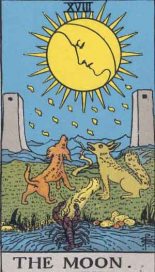
10–Outcome or final result: The Moon.
Detailed Analysis:
I start with seeing the major arcana as the soul’s journey, and minor arcana as individual human lives. Here, both as my own physical incarnation and as a wider representation of earthly powers and princes, card 1 with the King of Pentacles is dominant. The Court cards may be interpreted as personalities, with the king as an older male, and pentacles concerned with resources. The challenge or immediate influence of card 2 is the Queen of Swords, a feminine influence or figure in thought. As a past influence or tendency toward destiny, card 3 with the Devil is immersion in materiality, often polarized as male and female, or dual in nature. It can also represent dark magic, against and by the self most of all. Numerically his Tarot number 15 reduces to 6, linking this card, and the Devil’s influence, both to the future and to the unconscious — no surprise.
The distant past (or future) of card 4 in the spread is the 5 of Swords, a mental sorting or balancing. This can lead to a crisis or challenge all its own, because — arising from a single element — it is incomplete. It presages the later Star of card 9.
The recent past and conscious focus of card 5 is the 7 of Cups, magic, spirituality, results, completion, mixed with or focused on emotion. The unconscious or true influence of card 6 is the 9 of Pentacles, a fixing, ending or culmination of resources. Card 7, self-perception, is the 4 of Pentacles, stability or security — again, of resources. The external influence of card 8, the Knight of Wands, is a younger personality or presence, more fiery and ambitious. Card 9, the card of hopes and fears, is the Star, deeply important on the other path I practice, and present in our proverbs and idioms as guiding star, north or pole-star, and also as dis-aster, ill-starred-ness. Its Tarot number 17 reduces to 8, and hence influences or pairs with card 8. The final outcome or result of all of this is the Moon, whose Tarot number 18 reduces to 9 and pairs with card 9: a strong linking of the last three cards.
Summation:
With 3 of the 10 cards coming from Pentacles, resources and the physical world will be a prime focus of the year personally and for the planet. Balancing feminine energies to the mature male energies in play are an immediate aspect of the present and near future. Destiny and past influences at work, though not inevitable, are ones we have both initially set in motion and strengthened by our sharp focus on materiality. Our outer fixation on security and stability may feel reasonable, given such destabilizing forces at work. But while our hopes and dreams focused on these things are valid, pursuing them along a still-material path, even with a renewed youthful vigor, will not return us to what is stable and safe. Other directions we have recently begun to explore can prove more beneficial. We’ll see moon-like changes, darkness and light alternating in phases.
I’ll return to this in a year and see how I did.
/|\ /|\ /|\
Once again I’ve set out on the remarkable journey that is Nanowrimo, churning on toward my first day’s word-count goal of 1666 words (50,000 words divided by the 30 days of November). Not too late to join us!
IMAGES: The original 1910 Rider-Waite deck is now in public domain in the U.S.; these images from that edition come from Wikipedia.
For me, four of the prime holds to loosen are don’t, can’t, shouldn’t and won’t. Each pretends to wisdom, when in fact it’s almost always mere legalism. And if it isn’t (a fifth hold?), a practice I try out will almost always begin to reveal it for what it is.
Let’s look at each hold in turn. Don’t presupposes tendency or present fact. “People don’t do X or Y”. Peer pressure being what it is, “majority rule” often enough shunts people away from even trying something different. Don’t try out Nanowrimo, the new job, the blind date, the salsa, the nudge to take a different route home.
Don’t as command can also, perversely, provoke instinctive rebellion, so that some people will do something simply because someone in authority forbids it — not from careful reflection, but reactively. This opens up a second meaning of don’t: pure prohibition. And our first encounter with this form as children has a sometimes dubious accompanying parental justification: “because I said so”. We can take at least one step forward and say what it is we actually do, rather than defining ourselves or anyone else by exclusion.
How to simplify a lifetime of teaching, if your nickname has become “The One Who Teaches”? Choose again, counsels the female messiah Aenea in Dan Simmons’ Hyperion Cantos.
Can’t opens up a whole set of assumptions that have been successfully challenged over time. Some have to do with the capacities of a subset of humanity, whether we select on the basis of gender or ethnicity or social class or some other criteria. Further, there are two kinds of can’t: permission of another person and our own personal abilities. We hear “You can’t do that!” often enough that we may carry its echo within us to the grave. “What demon possessed me that I behaved so well?” asks Thoreau of such times. Often that inner echo is enough to stop us from ever testing the second kind of can’t: are we in fact actually able to do it? Do we possess the will, grace, skill, energy and courage? The Nike campaign of “Just Do It” may not be the best single counsel, but taken with other helpings of wisdom at the meal of decision-time, it’s a plucky guide.
Shouldn’t may arise from the prudent counsel of another, but as a percentage of shouldn’ts that most of us hear, it rates pretty low. Much more common are the shouldn’t of fear, of concern for appearances (what will the neighbors/family/friends/coworkers think?), or of the speaker’s own incapacity, not mine. What does my dog think, when I run it by her? How about the friendly oak in the back yard, or the rowan guardian out front, that I’ve consulted in the past?
Won’t is a limit all its own. “It won’t work. You won’t succeed. Thing won’t turn out as you expect. You won’t like it once you get it”. Again, many of these are envy or fear of another’s success, or the habitual naysayer’s discouragement. A few won’ts may rise from loving concern, a desire to protect us, but they’re almost always better phrased as positives. “How about X? Have you thought about Y? Maybe Z would also work”.
Like other valid spiritual practices, Druid teachings generally offer positives in place of such holds on action, freedom, discovery and expression. Here are a Druidy set of seven I go to:
1) Ask for guidance. It can come in many forms: our animal neighbors, dreams, chance conversations in the checkout line, pets, flyers on a bulletin board, children, lines from books, a phrase on the evening news, and so on. Unless it’s a split-second decision, a choice usually benefits from at least a day’s reflection. Assemble your Wise Ones, consult them, and proceed from there.
2) Practice a form of divination to uncover factors you may not perceive are at work. A “divinatory attitude” increases options, and need never rule out my common sense. Tarot, impulse, hint, chance, ogham, runes, bibliomancy (opening a book of wisdom at random and focusing on what appears there) — there are many forms to try of openness to the cosmos.
3) Pray. Who and what you pray to and for, and how, and when, are up to you. Many resources exist to help open up this universal and age-old practice. If you’ve tried prayer, and had no success, maybe your target audience needs a switch. Ancestor, deity, ideal, energy — we open up when we pray. Turn the switch, open the valve, unlock the door, crank the window, twist off the lid. Breathe. Give thanks for a pulse.
Pythagoras the rooster — what is he saying? Photo courtesy Dana Driscoll.
4) Consult tradition. While each of us breaks new ground by simply existing in ways and places and spaces no one else has, we also share immense common ground with others. The insights of the best of them have been preserved for our benefit, and it’s pure foolishness for me to overlook what they may have to say to me. They’re called classics for a reason. Pick your oracle. I light incense, a candle, toss a coin in a fountain, leave a larger tip in a restaurant, offer a piece of quartz to a favorite tree. Offerings, especially spontaneous ones, help open me up to listen, before and after. For me it’s part of cultivating an intention.
5) Follow intuition and guidance. When I write down my dreams and images and words from contemplations, even if I don’t always catch what’s coming through at the time, they prove their value as guides over time when I read them a day or week, month or year later.
6) Listen for creative nudges and work-arounds. We may admit later to factors in action that we turned away from at the time. Keep options in play. Everything in my heart and out my window has something to say, and that’s just one small corner of what’s available to me. I choose the red leaves on the blueberry bushes out the window as I write this, which remind me to bring in the garden hose before the next frost tonight.
7) Watch for signs. One good reason you and I exist — we’re individual responses to factors at play right now. We can hear and see things no one might notice or know of. Mentioning them from time to time to a trusted friend or partner is a useful reminder. They might have missed them. I have something to contribute to the conversation the world is always having with anybody listening.
“The awen I sing — from the deep I bring it” — Taliesin.
In Welsh, Yr Awen a Ganaf, Or Dwfn y Dygaf. Badly, uhr AH-wehn ah GAH-nahv, ohr DOO-vn uh DUH-gahv.
Chanting this quietly to myself — a practice all its own.
For my divination today, I take up the ogham sail(le)/willow, which I mentioned in a recent post — the ogham stave each of us received during Mystic River Grove’s Equinox Ritual two Fridays past.
perfecting the “garden gnome” look in our back yard, with snow receding, on Thursday, a day before new snowfall
A link from that post to an article on the OBOD site about willow (and here’s Wikipedia’s entry) examines a tree lush with meanings, especially significant to Ovates, the Druid spiral where I’ve been wandering and learning these past few years.
Already I know firsthand of willow’s love of water — ours flourishes by the north-flowing outlet of our pond. And its ability to sprout from fallen branches. (Until an inadequately-supervised landscaper remove a sapling I’d started a few years ago from a green and fallen branch, we had a second willow rooted and growing, the future left side of a willow arbor I had planned. But given the tree’s predilection for rooting from green windfall and even low-hanging branches, it will be little trouble to replace.)
I went to the back yard this morning for windfall branches after last night’s gusts, made offerings to both willow and pine, and returned with a suitable length from each tree which will launch a southern Vermont ogham set.
I find I can’t follow the OBOD weekly gwersi/courses for now, though I know I’m doing some of the work regardless. In the OBOD sequence, some gwersi come out of season — autumn work, for example, not right for spring. Some require herbs or trees I don’t have access to, though I can find reasonable substitutes. Some address work I’ve done, sometimes in other modes, so meditative sifting and re-integration are in order.
I make an annotated index of the coursework as I go, even if the gwers matches no opening in me, so I can lay hands on a gwers when I need it, or when it calls for my attention. Like many spiritual paths that depend on initiative and interest rather than simpler attendance at a weekly service, the path of the Ovate at times is trackless. As Antonio Machado writes, “Wanderer, your footsteps are the road, and nothing more; wanderer, there is no road, the road is made by walking. By walking one makes the road, and upon glancing behind one sees the path that never will be trod again”.
/|\ /|\ /|\
Ogham of new snowfall yesterday, a reading for early April. How many other readings come to us and remain unread? Flash of temper at some ego-obstacle a clue to new practice, bird-call lifting us momentarily out of ourselves, air redolent of wet earth and rot and renewal. Old Land, you become young again. Wisdom of guides, ancestors, spirits, land wights, all folk of good intent, may we hear you heedfully.
Ciggendra gehwelc wile þæt hine man gehere, runs an Old English proverb: “Everyone who cries out wants to be heard” (Lit., of-criers each wills that him man hears). How do I hear you, criers of the moment? Can I honor your crying and ask that you listen to mine? What is your crying? Not merely lament for worlds lost, species gone, ills still perpetrated, deep suffering. Also crying for attention now, worthy cries, cries of alert and alarm and warning for what is yet to come. No one person can answer all cries. (I don’t expect everyone to answer mine.) Let me honor them all, then choose (be guided to) those I can serve.
Here’s a triad I initially wrote about almost two years ago:
“Three reasons for supplicating the Mighty Ones: because it is a pleasure to you, because you wish to be a friend of the Wise, because your soul is immortal” — traditional.
Lovely reasons, all of them. Long-time readers of this blog know I like to take out truths and proverbs and see how they fit my experience. Not to either “prove” or “disprove” them, but to try them on for size, share something of the results, and possibly add to my spiritual toolkit.
Supplication as a source of pleasure: does this apply to my interactions with Thecu Stormbringer? [blogpost links 1, 2, 3]
My first response is “up to a point”. When my fear of change kicks in, it’s less pleasurable to learn more. But what have I learned?
When I last wrote, I’d received nine runes of change. But instead of trying them out, I stashed them in an envelope, because I was living them. That was manifesting as a move to an out-of-state teaching job that included housing. And then a return move back home within the month, when the job proved a “poor fit” — an often wry educationese euphemism that, in the words of Shakespeare’s Juliet, meant the whole scenario turned out to be “too rash, too unadvised, too sudden”.
And Thecu alerted me well in advance of the whole thing.
We often think — or I do, anyway — that if we could only know the future, we’d be armed against it, as if change were the enemy.
But to choose just one element of the whole experience that I’m writing to my Ovate tutor about, it was in the month before my wife and I made the change and packed up for a year out of state that I’d finally found a solid link to the land here in southern Vermont.
So leaving it hurt. And returning felt like a reprieve, or a fresh start. At the heart of it lay the increasingly clear perception that where we live has at last become our spiritual home.
More change coming. That’s this morning’s word to me from the goddess. To anyone alive today, change shouldn’t come as a surprise, though of course it still does.
I draw one rune from the envelope, even as I make a new place on my shelf-altar for Thecu.
(Surprised I hadn’t already? That’s the human inertia we all work with, which helps ballast us against small daily changes that shouldn’t upset us, and yet paradoxically weakens us when the big changes come along, because we’ve resisted incremental adjustments that would have made the transition much smoother.)
American children in schools across the nation “pledge allegiance to the flag” — an inanimate representation of the U.S. Is it so strange to extend reverence for an energy or consciousness reaching out to alert me of change and storms to come?
The rune I draw is the sixth of nine, last of the second set of three. For storms, angular energy, and wind sheer. For changes, side factors that contribute significantly, but which I overlook. For responses and initiatives, avoid a frontal resistance, and seek out angles and directions that can use the momentum and energy of change to shift to a better state and condition. Scuttle sideways, crab-like. Crab totem coming …
“When in doubt, divine”, says a journal entry from just about a year ago. A fragment, a contemplation seed, a gift, waiting for me to accept and receive it.
As I note at the end of a previous post about Thecu and change:
We can of course take an a-gnostic approach to all of the above as well: I sense changes coming (no surprise at all, given the state of the world!) and my imagination/subconscious is throwing up images, ideas, tools, hints to help me deal with them. Useful, wholly apart from the nature of their origin, because they’re intended to be empirical: their value lies in what they can do, what I can do with them. Who says the imagination or subconscious has no practical value? In some ways, that’s the ONLY thing it has.
And likewise, a reasonable response to a gift is gratitude for what’s been given.
/|\ /|\ /|\
Image: stormcloud — Pixabay “free for commercial use — no attribution required”.
One of the great pleasures of the “Great Eight” seasonal festivals on the Wheel of the Year, if you have a group to celebrate with, is the unique combination of private and community rites that can mark each season. They can merge and nourish and colour each other in subtle and provocative ways.
I’ve written here about my own recent private rite consecrating a new fire circle. Earlier today I hosted a small group rite of Lunasa.
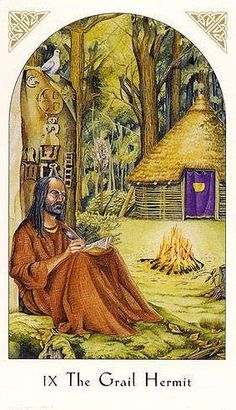
Card drawn before the rite from the Arthurian Tarot: the Grail Hermit. Caitlin and John Matthews’ deck provides rich material for meditation. A partial interpretation: while group ritual is important, personal communion with the Source and its many guises is crucial to balance. I don’t need to “go anywhere” to find the Grail or the inner hermitage, but I do need to make an effort to allow them to manifest in the busy-ness of my life. I note too that some things can only be discovered and mastered alone. A group can become a distraction if its main contribution is more busy-ness and not useful centering and grounding in practice. That’s a message that’s still deeply applicable to me and my practice.
The hanging over the door of the Hermit’s hut is purple, with a golden image of the Grail on it. The royal road of true spirituality calls us to claim our spiritual identity as heirs to an inner kingdom. As with all above-below and within-without paradoxes, the apparent poverty, obscurity and simplicity of the Hermit contrast and foreshadow the spiritual wealth within. One clue: the fire burning in the clearing.
For the group rite we made space in our weaving room with looms and fibers for backdrops. Appropriate for the Weaver at the Loom, Shaper of All!
Here on the altar the firsfruits: blueberries, candles, a sheaf of grasses, corn meal and ritual objects sheltered from the weekend of rain.
Halfway through the rite, the thunder receded, the rain stopped and the sun emerged.
Hail Lugh, hail Earth Mother. In the words of the ritual — her words — “I will nurture you … I will comfort you … I will bless you through all the days of your lives”.
Thanks to BW for composing and leading our ritual, and to those who celebrated with us.
/|\ /|\ /|\
Matthews, John and Caitlin. Illustrated by Miranda Grey. The Arthurian Tarot. Aquarian Press, 1991; 25th anniversary edition, Connections 2015.
I wrote up a version of the following for my journal, a practice in itself, and now for this post.
John Beckett’s helpful article “A Pagan Framework for Discernment” suggests a three-part approach for anyone doing the hard work of sifting experience and belief for their weight and significance and value. “Religious and spiritual ideas”, he observes, “are notoriously resistant to proof, as our atheist friends like to remind us. But if we wait on absolute proof, we’ll end up abandoning beliefs and practices that are meaningful and helpful to us.”
Divination is a useful practice at such a juncture, for several reasons. First, it acknowledges a need for help. I’m never alone, though too often I face challenges as if I am. [As that Christian triad (Matthew 7) has it, “Ask, and it shall be given you; seek, and ye shall find; knock, and it shall be opened unto you”. No, really!]
Second, divination gives me “something to do” that often relaxes the inner channels sufficiently that I’ll receive guidance “before” I actually do the divination. There’s little support or comprehension in our culture for anyone who talks about “voices in the head” — that kind of talk is one step toward getting you committed. So be careful who you talk to, I hear. Maybe if you started out committed, I hear, you’d know better how to respond to “voices in the head”. Rather than ignoring them, freaking, or heeding them unthinkingly, we’d assume there’s a wider range of options from which to choose.
Third, divination offers suggestions and potential wisdom apart from the usual gossipy, opinionated mechanical self that pretends to conscious awareness most days. Wisdom received often has a qualitative difference from what I’d usually say to myself.
“A belief is true if it works”, Beckett continues, “if it conforms to known facts, and if it’s helpful. But some factors have no bearing on truth even though we might wish they did.”
With such things in my thought as I consider how Thecu initiated communication a couple years ago, and then again recently, I ask for guidance on divination, figuring I’ll draw a card or three from a deck to assess possible directions. To my surprise I’m told to makean impromptu “deck” of nine folded pieces of paper. “Let each be a doorway”, I hear. That’s not quite right; there are no audible words. But the sensation is the same; the words are in my mind.
After I prepare the papers and document the moment with a photograph, almost before I can ask for the next step, I’m given nine words or names to write on them: hampu, lutec, nef, abal, tahilte, renha, lam, tseme, umun. Then, as smoothly as the sense of guidance arrived, it falls away, and I’m left with no further sense of direction. Upheld, then let down.
While the linguist in me putters in the background, turning over the names for a clue to their origin and meanings, I light a small candle and some incense, as much to forestall disappointment as anything else. The incense is homemade, from a workshop some years ago. It needs intermittent relighting, but that’s OK. I send out a silent “thanks and query” with each relighting. It feels right to do so.
Perhaps half an hour later, I receive further instruction, as I’m making some notes about a job lead: “The nine words are associated with the numbers 1 to 9. They are not numbers themselves, but they belong with them. Write the numbers on the cards you made in the order the words came.”
The following day I light candle and incense again, and add a spoken element. As I listen, I try pairing Thecu’s name with each of the nine words, in an impromptu chant, each pair repeated twice, with some playful riffs: “hampu Thecu, hampu Thecu, lutec Thecu, tec, tec Thecu, etc.” In one way, it’s nonsense, but all sound has a quality and an effect, so the practice is not a waste of time in any sense, unless I stupidly insist it is. I will practice this and listen again several more times to test it.
“We are wise”, Beckett closes, repeating his opening assertion,
to focus our attention on our actions rather than on our beliefs. But our actions generate experiences, and in our attempt to interpret and understand our experiences we form beliefs. Our experiences may be so strong or so frequent we are certain our beliefs about them must be right, but if we are honest with ourselves, we can never be completely sure they are right.
But we can ask ourselves if our beliefs work, if they conform to known facts, and if they help us lead better lives. If we can answer yes to these three questions, we can be confident that they are as right as they can be.
How do I pray to you, goddess of storms? Let this my prayer be a litany of questions.
At MAGUS ’17, Dana (on the left — check out her excellent blog The Druid’s Garden) generously offered readings for several of us, using her set of tree staves. You can see four of us (I’m on the right) sitting bundled in every layer we brought with us — the weather had turned cold.
I’d sat in on a couple previous readings (with permission!), and Dana’s infectious love of trees and tree lore made each reading memorable and full of wisdom. With her combination of hands-on experience and extensive reading in herbals and Native American lore, each of us learned anew how Druidry has much to teach. I say “how” because any time spent in Druid practice shows us we go just as far as we’re willing to put in time and energy.
If we’re new to divination we may bring to it our skepticism, or an uncritical acceptance of whatever we hear, or a cherished obtuseness to anything outside our blinkered perspectives. Having run through these and a range of other even less useful inner “sets” in the past, I tried simply to listen. Drawing for an awen spread of three staves — past influences, present circumstances and future tendencies — can help give a sense of dynamics that may be working through some part of our lives.
My notes here are a merging of Dana’s reading, my own study and insight from subsequent meditation and reflection.
Here are the three staves I drew: birch, white pine and cottonwood.
Birch (genus Betula) is a common hardwood, with species ranging worldwide throughout the northern hemisphere. The northeastern U.S has perhaps a dozen species. The bark, famous for canoes, also makes excellent kindling, I’ve discovered, even when it’s damp, because its oils will still burn. With medicinal, cosmetic and industrial uses, the birch is widely used. It’s also a pioneer tree, adaptable to varied conditions, among the first to appear in pastures, meadows and burnt areas. As such, birches frequently represent beginnings, initiations, growth, renewal, and so on. The associated ogham is beith. As part of my Ovate work, I’m identifying the trees on our 2 and a half acres, and there are nearby birches to get to know.
The past is a beginning. It’s not destiny, but simply a direction taken. I find the past a surprisingly fluid thing. (The birch is flexible). Because as I grow and change, I perceive my own past differently, coming to value some difficult experiences for what they taught me, and seeing whole decades in a different light than they appeared at the time.
To choose just one example, my first serious relationship, shortly before I met my wife, dragged me along an emotional roller-coaster, passionate and full of drama at the time. But it taught me patience, dispelled a fair amount of romantic nonsense, and showed me that kindness more than anything else should grow at the core of my relationships if I want them to last.
Rather than a fixed past, I find it’s the future that’s fixed — at any single moment. But then the moment shifts, my awareness and choices enter in, and the future shifts as well. Taking a reading is like sounding the depth of coastal waters — it’s accurate for that interval, but you need to know if the tide’s coming in or going out. Twelve hours earlier or later, to say nothing of twelve days or twelve years, conditions will have changed. Birches aren’t especially long-lived, but they “open the way” for others.
White Pine (Pinus strobus), like the Birch, is a common tree in the northeast U.S. Other Pinus species flourish in Europe and Asia. A softer wood, a long-lived tree (the record in the U.S. is 500 years), the white pine is prized for woodworking, lumber, and medicinal properties. It’s the “peace tree” of the Haudenosaunee or Iroquois, and it has also produced the tallest trees in the eastern U.S. (the famous sequoias take the prize in the west). Pine needles contain quintuple the vitamin C of lemons, and a needle tea is a healthful drink — a good medicine for me, because I’m prone to lung and skin problems. Algonquian tribes in the region knew other uses — the Adirondack Mountains in New York take their name from the Mohawk adirodaks, meaning “tree-eaters”, their term for the Algonquians.
As a guide to the present, white pine tells me, in Thoreau’s words, “be not simply good, be good for something”. And as a Druid, to me this means to be good at something, too. For a long time I’ve worked with words, making a living as teacher and writer. Druidry urges me to expand my knowledge and practice, and learn my neighbor trees better. It’s time to give back more, to support trees in distress, learn the landscape and do my part to help the biome as it adjusts to climate changes. (Both for its useful info and for its misleading title, spend a few minutes with “American trees have started migrating west and no one knows why“.)
As I delve more deeply into the Ovate grade, and improve my knowledge of healing, otherworld mysteries, and divination, white pine is a worthy signal tree and spiritual landmark. “If not this, then something better” has been my mantra during a protracted job search. Looking outside my accustomed region/specialty is both good job-search advice and good physical-spiritual foraging advice, too. Go further afield.
Cottonwood (Populus species) is the third stave. Dana and I laughed at this one. At least the cottonwood she had in mind is not a native to the east, but a western tree, so this third stave seems to confirm and extend some of the energetics present in the white pine above. (Some species do inhabit the eastern U.S.)
Cottonwoods constitute a varied group of trees, including aspens and poplars. Populus trichocarpa is the first tree species to have its genome sequenced. It grows fast, and can reach nearly 60 feet (18 meters) in about a decade. Varieties of cottonwoods have flourished in unlikely places, and helped re-tree barren areas, notably the Faroe Islands and Iceland. Like the birch and white pine, it has food and medicinal uses.
As a tree speaking about the future, the cottonwood is a good reminder both to play to strengths and also to try out new areas, to adapt, to “do my own thing” while finding new niches where that “thing” can thrive. “Grow where you’re planted” isn’t bad counsel as a start — we all do that inevitably anyway, at birth. It’s flowering after that that’s the work of our days. “To go to seed” isn’t a bad thing, despite the connotations of “seedy”. How else to pass along who we are, what we’ve gained? To give back as we do, completing the cycle, walking the circle, answering the Druid call to service.
Over the past several days I’ve assembled the results of three forms of divination into what may seem a hodgepodge of craft but which serves the purposes I’ve felt called to work with. More about them in a minute. When even our choice of the means of divination we’ll use is itself potentially a matter for divination, we can quickly get lost in a hall of mirrors and never get out and actually do something. Turtles all the way down.
We’ll continue to make mistakes anyway, even with the best of divinatory insights. There’s small advantage in refraining from acting simply because our guidance is incomplete. It’s incomplete at the best of times. That’s not a weakness but the definition of the proper field for human action. The gods don’t want, need, or make puppets, after all. (Not most of ’em, anyway. Those that do, flee as fast as you can.) Deprive us humans of initiative and will and vision, and neither human nor divine sovereignty means much.
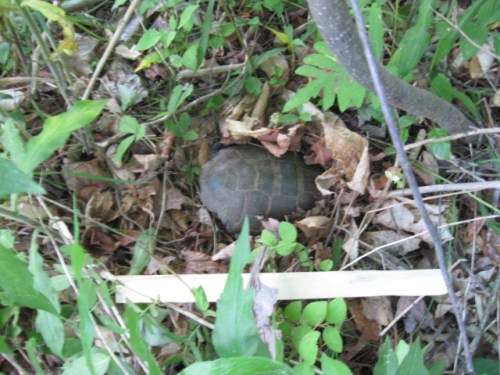
The first divination I already mentioned in the previous post: the turtle in our yard, crawling north. Near midsummer, a reminder of the North, of earth, of manifestation, of the vessel for all this heat and light — the realm of form. After I completed my work of mowing for the day, I spotted a fellow being on its own journey. End of story? No. Whatever we do individually, we’re also companions on the way all creatures follow, alive here in time and space. All things are themselves and signs. We, too, endlessly offer our existences as tokens, pointers, guides to others. Meaning is what we do. Our presences always carry a specific weight and effect.
One thing imprinted itself clearly in my awareness, a laugh at self. I’ve been turtle-slow to acknowledge this inner tug, this call for a grove, and to work with it. The turtle, blood warmed in solstice heat, vigorously crawled some five meters without pausing. Even I am faster than you these days, human.
The turtle or tortoise is absent from the Celtic-inspired Druid Animal Oracle, but it’s a living symbol among native peoples of North America. Turtle Island. Many tribal stories recount how turtle does its thing, swimming to the bottom and resurfacing. A guide, an opener of possibility. In the efforts of many spirit beings to create land for plant and animal life to dwell on, turtle carries on its back the earth that muskrat or duck or some other bearer brings up from the bottom. Carry the earth to us, for us, under us. Turtle carrier, guide, creature yourself, alive in this place, complete in your own being and purposes.
We could work out a new divination system following the shell markings of the turtle. The idea certainly isn’t new with me — it exists in various forms already. Anciently the Chinese oracle bones derived from turtle shells. But even as new tarot versions and re-workings of the runes and ogham make their ways into our awareness, so too does the power of all things to serve a dual potential as themselves and as symbols. We’re always ourselves, but linked as we are, we’re also more. We live and we signify.
A second divination: obstacles, multiple reversed runes, blocked energy. Taking the three divinations I performed as past, present and future, this second divination certainly outlines an accurate picture of the present. After-the-fact interpretative retrofitting of a divination? Sure … why not? Or take it as 1) existing causes, 2) materials, circumstances, contributing influences, and 3) consequences, results, practices to assist coming manifestations. Either way.
Entering my potential grove from the northwest, and facing east. What have I let grow to block my way?
I’ve worked most with the Arthurian Tarot, so it seemed prudent to turn to this for the third divination, because I seek insight into constructing a Druid grove.
Sovereignty
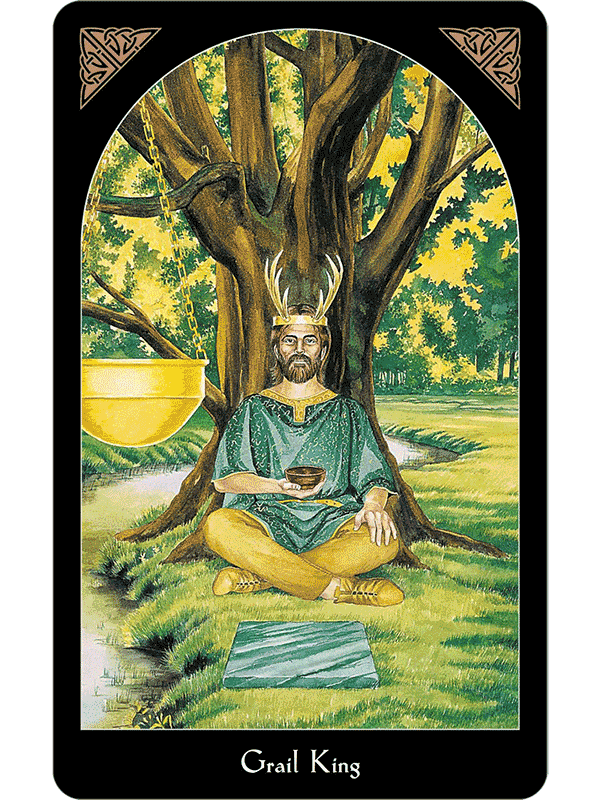
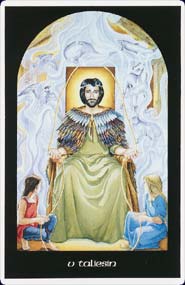
I enter my potential grove space from the northwest, improvising an invocation and pausing at each of the quarters and then the spirit center to lay face down a card I chose by touch and guidance from the deck. I circle a second time to each quarter and pick them up and view them. Here are my cards: North — the grail king; East — Arthur; South — the Spear Maiden; West — 2 of Spears; Spirit center — Taliesin.
/|\ /|\ /|\
Blending my two paths, dedicating each direction respectively, starting with the North, to word, thought, deed and feeling, all in the circle and presence of Sovereignty, of Spirit, I take the following reading:
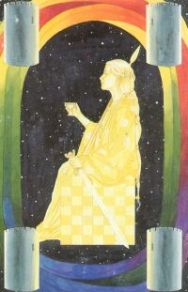
Grail King
The Grail King, associated with the West, guards hidden mysteries, approachable through imagination, dream, feeling. Yet he shows up in the north, and also paired with words. He offers guidance to negotiate the path if I am alert. If I abandon a stubborn fixity and pay fluid attention to the earth, to my body, to our shared physicality, then needed energies will come for manifestation. I can help myself by writing the way, by wording my passage as I go, by welcoming, shaping, and passing along my share in the voice of awen.
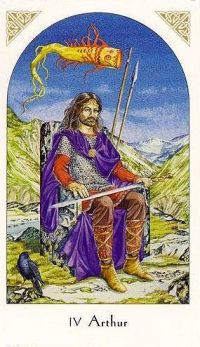
Arthur, from the major arcana, occupies the traditional fourth Emperor position. The Matthews’ handbook* notes, “The primary feature of Arthur’s role is guardianship and defence of the land … His creative energy is fuelled by close Otherworld contact through the mediation of Sovereignty” (Matthews, pp. 29-30).
In the realm of thought, Air and the East, he offers a gift of dynamic strength, along with a clear reminder of where strength derives. The Matthews further observe, “Whenever he attempts to depart from his kingly responsibilities … or live a life of his own, he comes to grief” (p. 30). Once we walk a certain distance along the path, we can no longer validly make a permanent retreat from human life, much as a hermit-like withdrawal still appeals to me — has, for much of this lifetime.
The Spear Maiden, signifier for the South, “shows the way through impossible situations by her daring, often by disguise or by shape-shifting” (Matthews, pg. 78). Again, I need not insist on a particular form, but allow it to remain supple, fluid. And take boldness for my approach, not this listless, hesitant, intermittently indulgent and slothlike state that’s dogged me for over a year. Boldness fuelled by Otherworld/Innerworld contact. The work of the OBOD Ovate grade, which I entered formally at the equinox last fall with initiation, but haven’t really yet engaged.
Spears again for the West, this time the 2 of Spears. A theme’s emerging. Matthews’ text says, “The skilled organization of resources leads to the achievement of desire; intuitive synthesis; dynamic drive” (Matthews, pg. 74). South in the West: intuition, yes, but propelled by the fires of the South.
2nd image of Sovereignty as a major arcanum
Finally, the Spirit-center, under Sovereignty. A fitting place for Taliesin to appear, chief of Bards, initiatory model for Druids. He represents transformation “of the mundane into the spiritual,” a worthy goal for the making and purpose of a Druid’s grove. He is ready to aid the seeker in contacting “the living wisdom of the Otherworld … [B]y prophecy and far memory, he can instruct and guide … well able to represent images to the receptive mind and forge connections in the waiting heart” (Matthews, pg. 32).
Solstice light, blessings and inspiration to you all! And to everyone Down Under at the official start of winter, may the Light grow within and without!
With this post I finally complete the “Thirty Days of Druidry” series I began back in April. And ever as one cycle ends, another begins. We enter the dark half of the year with the greatest light and energy, a lesson in itself that things are never wholly as they appear, that each thing bears its apparent opposite in its bosom, as the Dao De Jing gently urges us to realize.
Beyond the binary surface of the polarities all around us lie multitudes of other relationships to explore. Water offers itself as a teacher: we’re either above or below the surface. But what about right at the face of the water? There we encounter surface tension, the point of contact, where air and water meet and the silver mirror may open in either direction to allow us entry. Or dancing. Water striders live at the boundary and let it support and sustain them. Air and water together allow for dancing as well as power. What other such natural meetings may we attend?
Texas Falls, Hancock, Addison County, Vermont
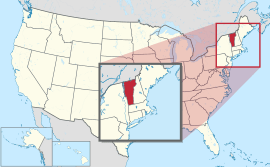
Here in Vermont in the NE part of the U.S., summer moved in weeks ago, with days in the high 80s and low 90s (27-31 C), and blessed nights in the 50s and 60s (13-17 C), perfect for sleeping. With open windows, birds wake us between 4:30 and 5:00 am, sometimes, it seems, just because they can. They’re out and about, so why shouldn’t the rest of the world be? Or in the middle of the night, the pair of owls that nest nearby rouse us with hunting calls under a moon full last night.
Sometimes life consists of what you can sleep through, and what grabs you drowsing and drags you back to consciousness. War, pestilence, earthquake, songbirds, rain on a standing-seam roof, gentle breathing of your bed-mate. De-crescendo. Wake, or sleep on?
The chimney sweep came this last Friday to brush and vacuum. Even with filters and professional care, for an hour after he left, a trace of ash and soot perfumed the air indoors. And we await delivery next week of the three cords of wood that will see us through to next summer. Bars of gold, sunlight stacked in tree-form. Solstice days.
/|\ /|\ /|\
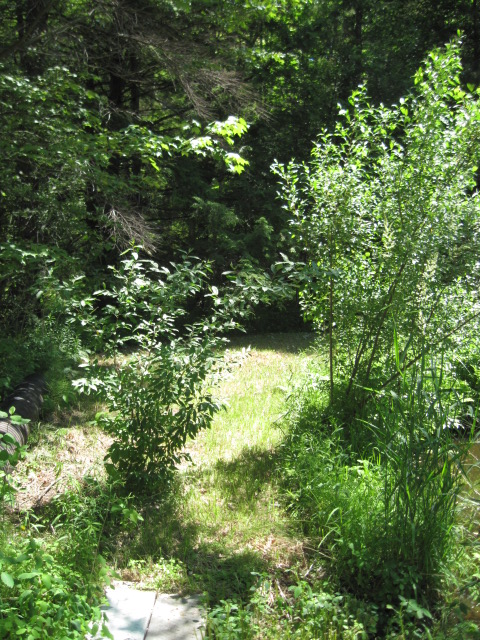
I ask for divination. Over the last weeks the nudge has come to build a small Druid circle in our back yard. It’s another liminal place. Leave it unmowed, and blackthorn and milkweed eagerly launch a takeover. Not sunny enough for a garden, though it gets about two hours of light mid-morning. But here, by 11:50 am at midsummer, it’s already mostly in shade. Here’s the space, looking north, our small pond to the left beyond the uncut grass.
The first divination came a few days past, as I was finishing mowing. A box turtle animated by the day’s heat, crawling north across our yard. As quick as I was to grab my camera, here it is at the treeline. Unhappy with my attempts to stage it in order to get a better picture, it’s nosed its way under leaves. A foot-long paint-stick lies next to it, to give a sense of scale.
What does it “mean”? Divination benefits from context, and I’m going for three readings, a small but proven sampling of the currents of awen afoot.
[Here’s the second half of a topic begun in the previous post.]
In the way the universe moves, as soon as I focus on health and healing, results come back from blood-work a few weeks past. The naturopath I consult phones me to share the data, and the numbers aren’t altogether positive. We agree to some diet, exercise and supplement changes, and a follow-up blood-draw in three months to see whether some of the more worrisome numbers are a blip or part of a concerning trend.
I mention this not to garner any sort of sympathy — I’ve been vague enough here I hope that’s clear — but to consider for a moment a couple of things. I use my life as material because I’m in it. I trust it’s part of our common experience, and countless experiences of feedback prove to me that, mostly, it is. (I reserve just a few quirks as my own indulgences.) From my perspective, we’re all in this life-lab together, here to try things out. I understand my own experience better than anyone else’s, and every writer can’t help but mine autobiography for material, however coy or deflective they may be about that fact when you ask.
So here goes. First, you may call it the merest coincidence that in post 14 in this series I examine health, and the next day medical tests come through, and I take it as part of a divination. The pending results were on my mind, you say, and naturally enough they emerged in a post. Nothing mysterious about it. Well, I don’t know about mystery. (That’s why they call it mystery.) But I’ve found that strikingly few things are “mere coincidence.” The dangers of over-reading such circumstances as “signs” or “spirit communications” or “meaningful data” pale in comparison to missing the opportunities for discovery, growth and change that such events offer. As an unreconstructed animist, I know that everything’s alive (especially rocks, and even more especially Vermont rocks!), everything’s affected and influenced by everything else, and everything talks constantly about it all. I like to join that conversation.
Second, I get to try out my spiritual toolkit, as soon as I remember I have one. (You shouldn’t be surprised at our capacity for ignoring resources already in our hands. We love sympathy, until it gets boring or annoying, and then we often swat it away. I loathe self-pity, and have been known to turn away well-intentioned compassion at every turn.)
I take hawk-guise and soar over the problem or challenge. Below, on the field of my life, personalities and forces and energies can stand out more clearly. As the seer of my own life, I can regroup quite literally. Who and what shall I pair or separate? What lies off the horizon that touches on this moment? What offers itself to me? Where I can I offer myself to others? If I want this clue, this cure, this healing, where I can be a part of such a cure and healing and solution for others? How can I take without giving? Yes, of course. But how I can give without taking? What circles and cycles wait for me to complete them, ones that only I can? Not because I am “special” or “gifted” or “unique,” but simply because I am. I exist, in this place, in this time. The stubbornness of the particular is a clue to meaning, as well as much else of value.
Yes, I’ll even concede that “every problem has a spiritual solution,” if we can also agree that “spiritual” may sometimes mean a warm bath, a glass of wine or mead, time and space for reflection. Sometimes it’s a bit longer than that. I turn and see it’s a whole life-project: part of the reason I seem to be here at all, one of a small set of Big Kahunas, a major theme for this incarnation. Druidry reminds me constantly that this physical world is a vital resource and a field for discovery. With all its pain and uncertainty and possibility and simple pleasure, it’s a toolkit all its own, one of astounding quality and diversity and energy. Herbs, totems, power objects, shrines, wise trees and beasts, spirits, fatigue, rest, hot and cold, the seasons, human physical contact and presence. I could devote (I feel I have devoted) many lives just to exploring these things, never mind the array of things on other levels of reality.
Salmon, Dragon, Bee, companions on the Way, I thank you for your wisdom, and through the transmutations of identity and experience, I offer some wisdom of my own.
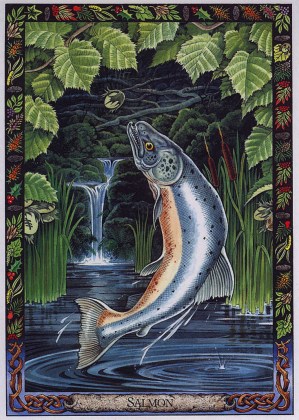
Sometimes divination highlights what is absent. As soon as I started working with the Druid Animal Oracle, I discovered the deck lacked two cards, though two other cards had duplicates. What is the lesson of compensation here? The deck lacks the Salmon and the Water Dragon, but has two each of the Earth Dragon and the Bee. Lack and excess: an imbalance to ponder carefully.
The line that lights up for me from the reading of the missing Water Dragon is this: “It is often best for healing and wholeness to be achieved slowly.” I have been patient, I thought, since my cancer surgery and radiation, working with diet, meditation, supplements and exercise. Still more to do.
I will take the doubled Earth Dragon as a reversal, and the line I focus on here from the reading feels relevant: Somehow I am “relating in an inappropriate way to my inner reserves and potential.” The connection between this imbalance and the delay in healing feels clear.
Likewise, I will take the double Bee as an indication of reversal or imbalance, with the reading’s focus: “I am out of place, unsure of my role in the world.” Ever since leaving my old job, I’ve lacked the same degree of focus, though the move to Vermont and the more sane pace of life here have been gifts.
Finally, the missing Salmon, oldest of creatures in at least one Druid tradition, reveals a message that has been seeking me out this week from other sources: reversed effort. The Salmon returns to the place of its birth; it is “able to jump upstream not by fighting against the current, but by utilizing its knowledge of the reverse current which flows beneath the surface current.”
After sleeping on this divination tonight, I will conclude the work of the reading in tomorrow’s post.


 1: Ace of Wands (reversed) — the present, the Self, the querent’s state of mind.
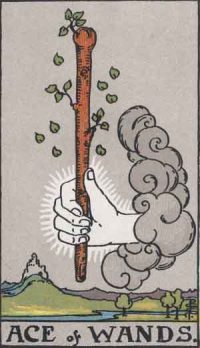 Wands and Cups predominate in this spread — for me, a reminder of the need to balance fire energy with water, active with receptive, conscious with intuitive. Always good advice! But how might that work, more specifically? How do we “grasp” the fire of Ace of Wands? What “hand” or means do we use? Rachel Pollack in her magisterial 78 Degrees of Wisdom comments: “At the beginning of some situation, no card could signal a better start” (pg. 183). I take reversed simply to mean the challenges attendant on manifesting the energy of a card, or missing the opportunity it brings. The “crossing card” of the 10 of Cups is a Grail, the completing or fulfilling Cup — a balance to the fire of Wands. The third card, a reversed Hanged Man, to me signifies that every time I ignore shamanic, yogic, inner wisdom, I miss the insight of inner experience.
 Temperance — and yet again, Pollack proves insightful. “If a reading shows a person split between say, Wands and Cups, activity and passivity … then Temperance, moderation, and acting from an inner sense of life, can give a clue to bringing these together” (pg. 109).
 So I heed my own words and listen.
 I start with seeing the major arcana as the soul’s journey, and minor arcana as individual human lives. Here, both as my own physical incarnation and as a wider representation of earthly powers and princes, card 1 with the King of Pentacles is dominant. The Court cards may be interpreted as personalities, with the king as an older male, and pentacles concerned with resources. The challenge or immediate influence of card 2 is the Queen of Swords, a feminine influence or figure in thought. As a past influence or tendency toward destiny, card 3 with the Devil is immersion in materiality, often polarized as male and female, or dual in nature. It can also represent dark magic, against and by the self most of all. Numerically his Tarot number 15 reduces to 6, linking this card, and the Devil’s influence, both to the future and to the unconscious — no surprise.
 The recent past and conscious focus of card 5 is the 7 of Cups, magic, spirituality, results, completion, mixed with or focused on emotion. The unconscious or true influence of card 6 is the 9 of Pentacles, a fixing, ending or culmination of resources. Card 7, self-perception, is the 4 of Pentacles, stability or security — again, of resources. The external influence of card 8, the Knight of Wands, is a younger personality or presence, more fiery and ambitious. Card 9, the card of hopes and fears, is the Star, deeply important on the other path I practice, and present in our proverbs and idioms as guiding star, north or pole-star, and also as dis-aster, ill-starred-ness. Its Tarot number 17 reduces to 8, and hence influences or pairs with card 8. The final outcome or result of all of this is the Moon, whose Tarot number 18 reduces to 9 and pairs with card 9: a strong linking of the last three cards.
 With 3 of the 10 cards coming from Pentacles, resources and the physical world will be a prime focus of the year personally and for the planet. Balancing feminine energies to the mature male energies in play are an immediate aspect of the present and near future. Destiny and past influences at work, though not inevitable, are ones we have both initially set in motion and strengthened by our sharp focus on materiality. Our outer fixation on security and stability may feel reasonable, given such destabilizing forces at work. But while our hopes and dreams focused on these things are valid, pursuing them along a still-material path, even with a renewed youthful vigor, will not return us to what is stable and safe. Other directions we have recently begun to explore can prove more beneficial. We’ll see moon-like changes, darkness and light alternating in phases.
 Once again I’ve set out on the remarkable journey that is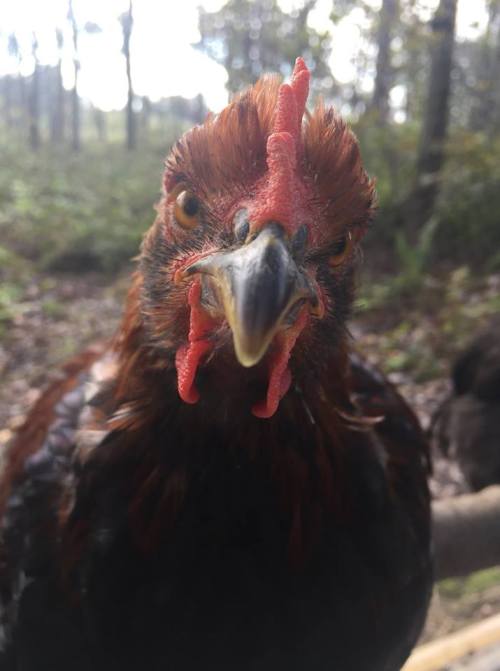


 Card drawn before the rite from the Arthurian Tarot: the Grail Hermit. Caitlin and John Matthews’ deck provides rich material for meditation. A partial interpretation: while group ritual is important, personal communion with the Source and its many guises is crucial to balance. I don’t need to “go anywhere” to find the Grail or the inner hermitage, but I do need to make an effort to allow them to manifest in the busy-ness of my life. I note too that some things can only be discovered and mastered alone. A group can become a distraction if its main contribution is more busy-ness and not useful centering and grounding in practice. That’s a message that’s still deeply applicable to me and my practice.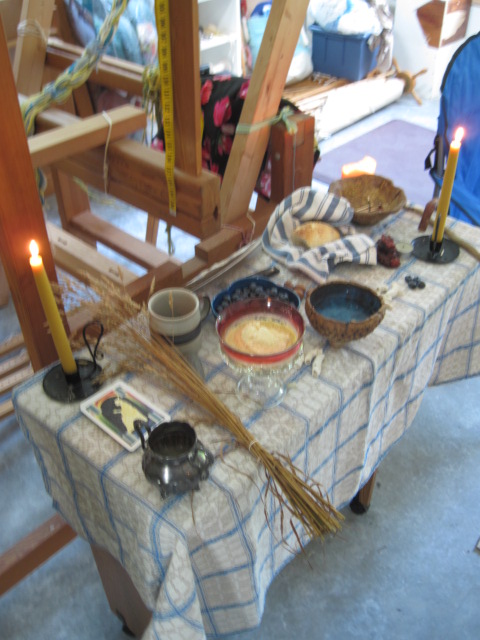
 After I prepare the papers and document the moment with a photograph, almost before I can ask for the next step, I’m given nine words or names to write on them: hampu, lutec, nef, abal, tahilte, renha, lam, tseme, umun. Then, as smoothly as the sense of guidance arrived, it falls away, and I’m left with no further sense of direction. Upheld, then let down.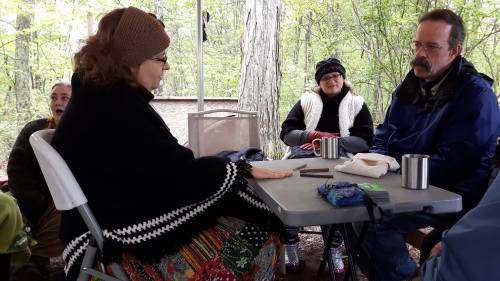

 In the realm of thought, Air and the East, he offers a gift of dynamic strength, along with a clear reminder of where strength derives. The Matthews further observe, “Whenever he attempts to depart from his kingly responsibilities … or live a life of his own, he comes to grief” (p. 30). Once we walk a certain distance along the path, we can no longer validly make a permanent retreat from human life, much as a hermit-like withdrawal still appeals to me — has, for much of this lifetime.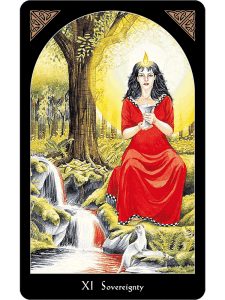
 With this post I finally complete the “Thirty Days of Druidry” series I began back in April. And ever as one cycle ends, another begins. We enter the dark half of the year with the greatest light and energy, a lesson in itself that things are never wholly as they appear, that each thing bears its apparent opposite in its bosom, as the Dao De Jing gently urges us to realize.
 Here in Vermont in the NE part of the U.S., summer moved in weeks ago, with days in the high 80s and low 90s (27-31 C), and blessed nights in the 50s and 60s (13-17 C), perfect for sleeping. With open windows, birds wake us between 4:30 and 5:00 am, sometimes, it seems, just because they can. They’re out and about, so why shouldn’t the rest of the world be? Or in the middle of the night, the pair of owls that nest nearby rouse us with hunting calls under a moon full last night.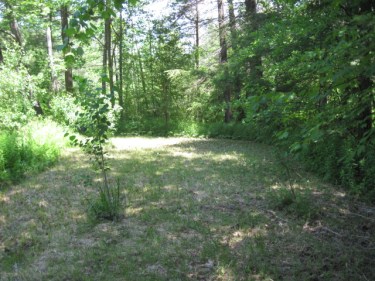
 Finally, the missing Salmon, oldest of creatures in at least one Druid tradition, reveals a message that has been seeking me out this week from other sources: reversed effort. The Salmon returns to the place of its birth; it is “able to jump upstream not by fighting against the current, but by utilizing its knowledge of the reverse current which flows beneath the surface current.”


 A Druid Way



.svg)
