
[Earth Mysteries 1 | 2 | 3 | 4 | 5 | 6 | 7]
Here, in the third of this series on J. M. Greer’s principles from his book Mystery Teachings, we come to the Law of Balance:
“Everything that exists can continue to exist only by being in balance with itself, with other things, and with the whole system of which it is a part. That balance is not found by going to one extreme or the other or by remaining fixed at a static point; it is created by self-correcting movements to either side of a midpoint.”*
The Dao de Jing (Tao Te Ching), another keen guide to the natural order of things, observes, “Extremes do not last long.” After storm, sun. After destruction, rebirth. But what are we to make of natural disasters? How in hell, literally, are we supposed to “live in harmony” with an earthquake or hurricane or tornado?
Our science, which is just another word for knowing or wisdom, has only begun to recover some of the nature wisdom of our ancestors and spiritual traditions. And perhaps too much time, at least in some of the “hard” sciences, is spent in pursuit of a grand theory, where close observation might serve our immediate purposes better. But we’re recovering lost ground as we can.
The horrific tsunami of December 2004 in southeast Asia makes for a good study. Here and there, among the human and natural devastation in its wake, are curious and instructive stories. The case of 10-year Tilly Smith, vacationing with her parents in Phuket, Thailand, merits recounting. According to the Telegraph‘s article, Tilly saw the tide drop unnaturally, remembered a recent geography lesson about tsunami warning signs from her school back in the U.K., and alerted her parents. They were wise enough to listen to their daughter, warned the hotel where they were staying to evacuate inland, and over a hundred lives were saved as a result.
Another story comes from off the coast of India, in the Andaman Islands. One of the aboriginal peoples living there is the Onge, who still practice hunting-gathering. When the sea level dropped abruptly, the tribe responded immediately. After a quick ritual scattering of pig and turtle skulls to propitiate the evil spirits they perceived at work, they retreated inland. Unsuspecting tourists and local fisherman walked the exposed beach and gathered the fish floundering there, only to perish in the approaching monster waves. The National Geographic account from about a month afterwards includes commentary from Bernice Notenboom, president of a travel company specializing in indigenous cultural tourism and one of the few westerners to have visited the area. She observed of the Onge, “Their awareness of the ocean, earth, and the movement of animals has been accumulated over 60,000 years of inhabiting the islands.”
While this isn’t exactly expert testimony, every member of the tribe did survive, and her reasoning is sound. The commercial influence of Western culture has uprooted many tribes, and this is something Notenboom does know, since she’s on the forefront of it with her tour company. She remarked that one day in another nearby village, an old man approached her and said, “It is great to have you here, but let’s not make it a habit.” There can be a cost to careless physical ease and the acquisition of material abundance, and if we “gain the whole world and lose our souls,” to paraphrase the renowned Galilean master, we may be swallowed up, figuratively or literally.
Balance doesn’t mean stagnation. Many Westerners have felt the stirrings of a vague dis-ease with their own lives. We point to this or that cause, shuffle our politicians and opinions, our allegiances and subscriptions to cable, but to reuse the almost-cliche, it’s another version of rearranging deck chairs on the Titanic. When the problem is systemic, tinkering with symptoms won’t help. The “solution” is not one single thing to apply like a band-aid, but it will indeed involve changes of heart, which will come in different ways for different people over time. Anyone who has a single prescription for the troubles that ail us is frankly talking out his ass. Getting the ____ into or out of political office won’t budge the problem.
The “self-correcting movements to either side of a midpoint” of the Law of Balance sound so innocent. But whenever the balance shifts, the corrections come just as predictably and inevitably. Whether we like them or not, welcome or resist them, is another matter entirely. We forget that we’re not “in control”: there’s no helm to manage, no boss to prop up in place so that “things keep going the way they always have.” Already they aren’t, and they won’t. We’re part of a whole: whatever happens to the whole happens to us, and what happens to us happens to the whole. This is good news for those who work with the whole, and bad news for those who think this particular rule doesn’t apply to them.
There is such a thing as natural “justice” — it’s another name for rebalancing — but not always as humans would have it. There’s no court of appeal when we’ve fouled the air and water, destroyed local economies with mega-corporations, junk-fed ourselves sick, fought our way to a glutton’s share of the world’s resources which are running out, and tried to rationalize it all. Now we have to find ways to live through the re-balancing. What tools do we need? The inner resources are still available, though we’ve burnt through so many outer ones. The classic question of “Where is wisdom to be found?” really needs to be answered individually. It’s a fine quest to devote a life to, one that I happen to think is far better than anything else you can name. Right now especially, money certainly doesn’t look like it’s worth the game. I know that I feel more alive looking for wisdom, and finding a piece of it I can test and try out in my own life, than I do swallowing anybody else’s brand of fear and paranoia and cynicism. This blog is a piece of that quest for me. Whose life is this, anyway? Make of life a laboratory for truth.
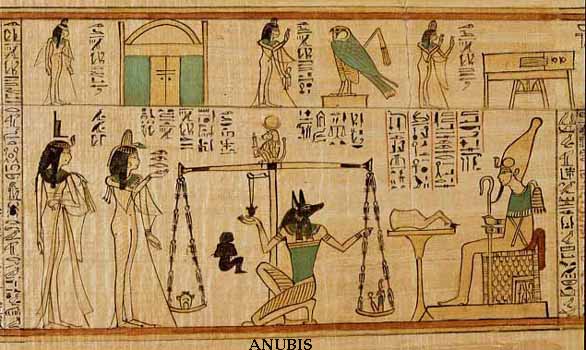 In the end, balance really is a matter of the heart. One Egyptian image of the after-world that’s stuck with me is the Scales of Anubis. The jackal-god of the Underworld places the human heart of the deceased in his scales, to weigh it against the feather of truth, of Ma’at, the natural order, cosmic justice or balance. (For inquiring minds, that’s Anubis to the right of the support post.) Only a light heart, literally one not weighted down by human heaviness (you can fill in the ____ with your favorite kinds), can pass muster. One distinguishing quality of the truly holy or wise ones that we encounter in their presence is a lightness of being, a kind of expansion and opening up. There is always possibility, a way forward. Whatever happens, we can face it better with that kind of heart beating in our chests. Look for that, in others and yourself, in your quest.
/|\ /|\ /|\
Image: scales of Anubis.
*Greer, John Michael. Mystery Teachings from the Living Earth. Weiser, 2012.
Edited/updated 11 October 2017



 A Druid Way