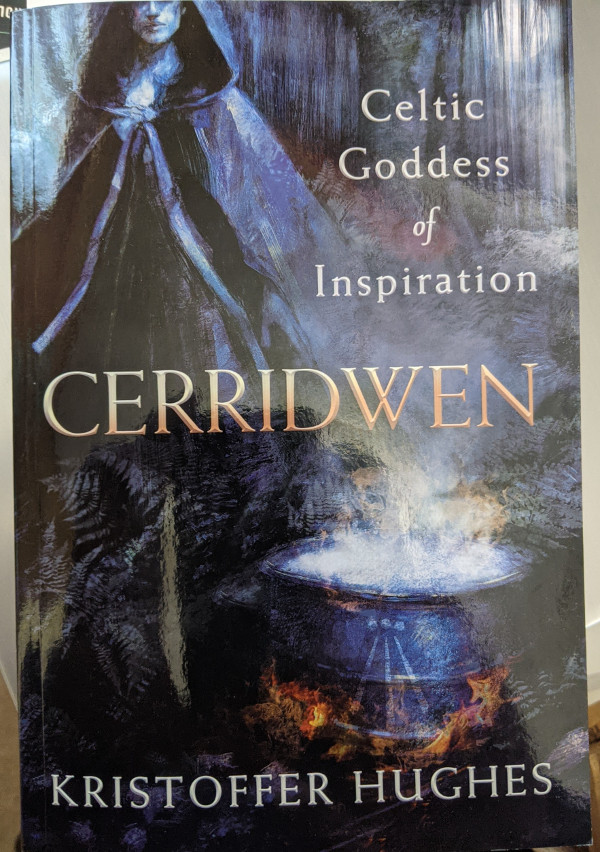
Part 2 — because how can a book of lore that also offers a path of initiation and suggestions for a regular practice be properly reviewed in a single take?
Kristoffer Hughes has helpfully made Youtube recordings of some of the Welsh that appears in this book, because the sound of the language is one approach among others to entering into sacred space with the goddess. As of today, there are four videos on his Youtube channel: “Ritual to meet Cerridwen”, “Welsh ritual phrases”, “Guide to Welsh pronunciation”, and “Cerridwen: glossary of words”.
The dedication page is brief: I Cerridwen — Mam yr Awen: “To Cerridwen — Mother of Awen”. And because she is Mother, Kris reminds us, we are Plant Cerridwen — the children of Cerridwen.
All of us, whether we’re Welsh or not? Of course. But a caveat … As Kris notes in the opening paragraphs of his first chapter, “The Quest for Cerridwen”:
The current New Age trend of spiritual commercialism has dissected the mysteries to their component parts … This has profoundly affected our relationship with the mysteries … The permanent individuation of the gods to the exclusion of the landscape in which they exist does them a disservice, for the landscape inspires and breathes life into the divine … (pgs. 1-2).
Yes, those wishing to enter relationship with Cerridwen and gain initiatory wisdom and insight from her mysteries can do so anywhere. No, she is not “a universal goddess, never mind what we call her”. So if we wish to avoid “damage to an archetype” as Kris calls it, a real possibility if we wield our indifference like a blunt instrument, and thereby miss much that Cerridwen asks of us and offers in return, there are several things we can put into practice. One that should come as no surprise is observance of the Wheel of the Year.
Such observance “causes us to stop, take heed, and observe a world that we believe we are familiar with. To those who fully engage, they begin to sense more to the world than first meets the eye” (pg. 202). The “apparent world fades”, as OBOD standard ritual reminds us — a world largely created by the inner chatter that, unchecked, fills our waking hours. “To sense the subtle and perceive the space between spaces that connects all beings, we must learn to be still and identify that space within our own beings. In my tradition we have a name for this process: we call it finding one’s taw” (pg. 202).
In a section titled “Appropriate Appropriation”, Kris addresses such concerns head on:
There is a strong possibility that you, reading this book right now, may not be Welsh or even have a connection to Wales. But somehow, by some means, you have found your way to reading this particular book. Cerridwen has found a way to seed within you the spark of Awen. You are the sum totality of all things that went before you, including the magic of the Welsh bardic tradition, which is held somewhere deep in the recesses of our species memory. By all means, learn a little Welsh or at least strive to understand the complexities of the history that brought Cerridwen into the light of twenty-first century Paganism. Know that you are equally expressive of the Plant Cerridwen and have as much right to claim that title as any Welsh person.
Whilst it is important to develop honest, nonappropriative practise, do not ever think that you don’t have the right to claim Cerridwen as a goddess that is valid for you … she is more alive today than she has been for the last four hundred years (pg. 261).
Kris then offers 13 excellent suggestions for ways to develop a non-appropriative practice that will not cramp anyone’s style. He also states clearly that any limitations we face as modern people can serve as opportunities for creative work-arounds:
I cannot see Cerridwen physically–she does not possess a carbon based physical body–so the manner by which I develop my relationship with her must somehow address these limitations. Nothing beats heading over to Bala for an afternoon spent at her lake, for there is a sense there that is different to anywhere else on earth–there is a tangibility to her presence in that location, as if the landscape holds a different kind of lyric. However, Bala is just over an hour from my home, and my schedule does not permit me the luxury of going there every day. Therefore I have re-created a sense of what I feel at Bala at home, and it is centred around my altar … (pgs. 264-5).
This book is rich in suggestion and opportunity, with keys Kris draws from personal experience. Visualization proves difficult for many, and Kris supplies a most helpful tool in the form of sigils — several appear throughout the text. As he notes, “… application of the magic will invariably have a physical aspect to it” (pg. 204). Just like humans need to ground and center, magic needs that grounding too, or it remains a mental head-trip the other parts of ourselves never take.
It is perhaps inevitable that some readers will merely skim the book and zero in on the section “Stirring the Cauldron”, with its wealth of suggestions for practice. But practice often runs dry without roots, which the text amply supplies, and a practice unmoored in understanding and respect for a tradition will soon leave the restless seeker wandering off to the next book. The fulfillment of anything that worthwhile books promise can only come from the same thing such books usually counsel us to remember and put into practice — full immersion.
For us to practice such immersion, the Welsh traditions of song and awen, poetry and inspiration, silence and speech have literal significance and application:
The Awen is active, and to sense its blowing through us, we must actively vocalise and energetically move into its power. We live on a unique world, a place where expression is facilitated by the atmosphere that surrounds and imbibes us. Breath is the bridge between the density of the physical and the lightness of spirit (pg. 246).
An excursus on tradition, culture and purpose follows. If you’re not interested and you just want to pick up the story of Gawain and his deadly appointment where the last post left off, scroll down to the first break below marked by the triple awen /|\.
You’re still here? Part of my intent in this series of posts about Arthur and Gawain is to begin examining a native source of wisdom that’s not wholly Celtic in origin. The story of Taliesin from the Welsh tradition has been fruitfully mined by many modern Druid orders. But we can also seek more widely and find fertile sources of insight, wisdom and technique within other English language traditions, demonstrating how much of our lore, Arthurian and other, truly is a marvelous mix of multi-cultural magic. And this holds true with many cultural and linguistic traditions — what we need are explorers to locate and bring these half-forgotten treasures back to wider awareness. The sense of restlessness, rootlessness and apathy that beleaguers many people today has both real causes and real solutions.
In other words, as vital and growing traditions like Wicca and Druidry already have demonstrated, we don’t need to focus our spiritual journey only on Shamballa, or join an ashram in India, or sit under a Bo tree in meditation in a quest for wisdom and enlightenment beyond the physical and financial means of most people outside those traditions. These are all fine and worthy resources — but closer ones have also always stood lurking shadow-like on the edge of our vision.
Of course, it’s not a case of either-or, but both-and. The cultural garb that wisdom occupies, and the training any one culture gives in moving within that specific garb, properly belong to that culture. Wearing that cultural garb, to continue the metaphor, when I’m not entitled to it by participation in that culture, is indeed a kind of impostership. That’s cultural (mis)appropriation.
Tlingit totem and community house
But the wisdom which the cultural garb clothes is the common inheritance of all of humanity. I can’t rightly erect a Tlingit totem in my living room or front yard, to cite a single example, and claim to be a Tlingit shaman empowered to pass on Tlingit cultural forms to cash-flush weekenders looking for a quick psychological pick-me-up in a workshop — or even a serious course of study. But shamanism itself is a worldwide phenomenon with common features across cultures, and it can be learned without raiding anyone’s cultural heritage.
And so stories like Sir Gawain and the Green Knight offer immediate hints of ways that Druidic and Christian themes, images, precepts and practices may be fruitfully explored and adapted to modern life without injury to or theft from either tradition. Even questions like “But can you be both Christian and Druid?” are found to dissolve in actual practice, when each way illuminates the other. It’s typically those on the outside of a practice who ask that question, after all. We’d rather justify our opinions to others than genuinely test their validity for ourselves.
It betrays an unseemly and groundless fear of a universe permeated with the divine, if we shy from investigating any of its corners and crannies. Certainly such fears have no place in modern Paganism, nor should they find any home in Christianity either. For the latter tradition, to put the matter in explicit Christian and Biblical language, such fears betray a painful lack of faith in an all-powerful God who declared his original creation “good,” whose Son incarnates out of love of that creation in order to redeem all things, and whose divine will is sovereign.
The fact that whole traditions like Christianity have become toxic for many people is actually a most helpful guide when we come to look at Celtic Christianity, and particularly at movements like the Gnostic Celtic Church, which gently points out that the practice of sacramental nature spirituality “can be pursued apart from the various pathologies of political religion” (article at GCC link above) and serve all life, not just an in-group.
Beyond such immediate hints, then, deeper study, practice and contemplation of stories like Sir Gawain and the Green Knight reveal a wealth of images, lessons, techniques and perspectives useful not just to “those on a spiritual path” but to anyone alive today.
All right — back to our regularly scheduled program.
/|\ /|\ /|\
Over the next three days at Bertilak’s Castle, Dec. 29th, 30th and 31st, Gawain faces a perfect triad of temptation, reward and opportunity. It’s just hard for him (and us) to tell which is which. On each of the three days Bertilak returns from the hunt, he has different game to offer his guest, and though his wife plays the same game of flirtation with Gawain while her lord is away, she skilfully ratchets up the sexual tension each time. She speaks:
And right here you lie. And we are left all alone,
with my husband and his huntsman away in the hills
and the servants snoring and my maids asleep
and the door to this bedroom barred with a bolt.
She should know — she’s the one who barred it behind her!
I have in my house an honored guest
so I’ll take my time; I’ll be talking to him for a while.
You’re free to have my all,
do with me what you will.
I’ll come just as you call
and swear to serve your will.
(Armitage translation, pg. 103)
The Middle English of those last four lines is even more explicit: ” Ye ar(e) welcum to my cors (body)”!
The delicate challenge of the situation, as the original audience to this poem knew well, is one founded in the Medieval traditions of Courtly Love: if Gawain is to uphold his reputation and preserve both his own honor and the Lady’s, he must do what she asks, while at the same time not giving in to the temptation she clearly offers him.
Toward the end, before they negotiate things to just a kiss, she even scolds him: you can’t be the famous Gawain, she exclaims, or you would have acted long before now and taken what I offered.
Well, then, he replies, “I schal kysse at your comaundement … so pleade it no more.” Thus he succeeds this first time in walking a very fine line. His good name and the Lady’s still secure, he bounds up from bed, dresses and dashes off to Mass.
Immediately the scene shifts to the hunt, with explicit details over some 40 lines of the gutting, butchering and feeding of the innards to the dogs, with the dressed carcass at length hauled back to the Castle. The first day the hunters bring back deer — a haul of venison the biggest Gawain’s “seen in seven years.” And in exchange he gives Bertilak a kiss — all he’s had from the Lady. They renew their pact.
Day Two moves things along, with the hunt in pursuit of a boar this time, and the same graphic description of flaying the carcass and butchering it. “Back at the Castle” in Gawain’s chamber, the lovely Lady makes it clear to Gawain that he should take from her what he wants and what she’s already offered, and if he’s rebuffed, why then he’s certainly got the youthful strength to take by force.
But that’s not the custom in my land, replies Gawain, nor the practice for “each gift that is geven not with good wylle.” The Lady chides him again: For somebody so famous, lord, can it be you’re truly ignorant of love, or don’t know how to take full advantage of a lady who’s shown she’s interested?
But at last they bargain things down to two kisses this time, and so once again Gawain barely escapes with reputation and honor intact.
That evening, on Bertilak’s return, Gawain delivers the two kisses according to their pact, which they again renew. He resists all teasing inquiries about the how’s and who’s of the kisses.
The Lady, meanwhile, is still so intent on Gawain, “so loving … with stolen glances and secret smiles,/ that it muddled his mind and sent him half mad …” (Armitage, pg. 131). Somehow he keeps his composure — it’s a near thing — and does not turn from her rudely for his own self-preservation, but courteously engages her all evening.
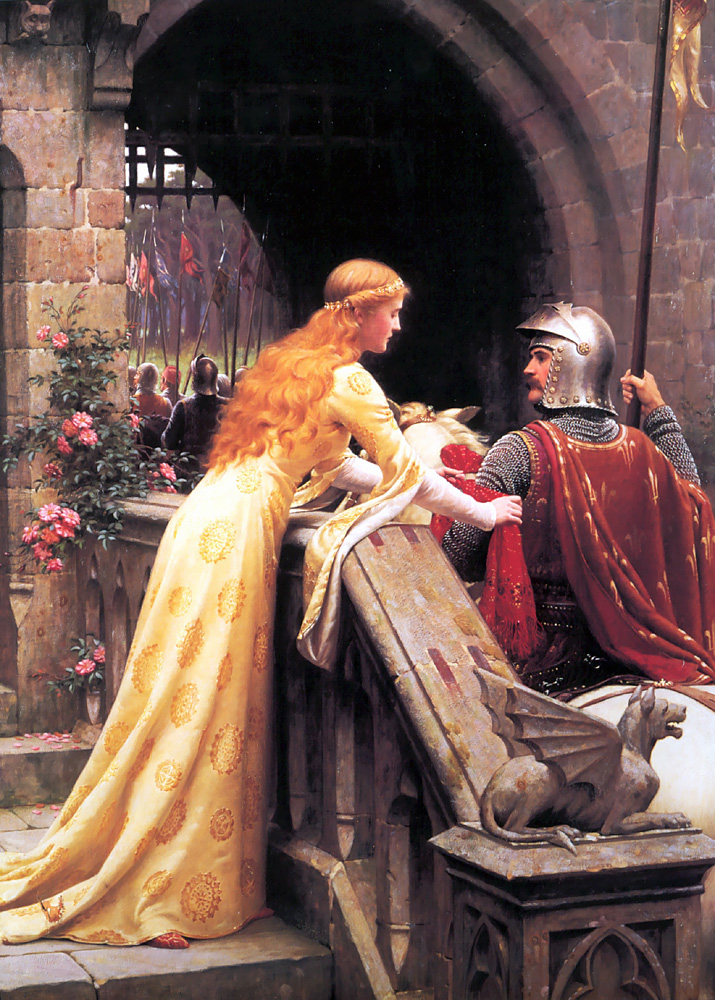
Edmund Leighton’s God Speed!
Bertilak for his part delights in his guest’s honor — so far. Gawain begs to leave early the next morning to be sure of arriving on time, but Bertilak will hear none of it. He declares to his guest: You’ll reach the Chapel well before dawn in the light of the first day of the New Year, so don’t concern yourself with that. “For I have fraysted [tested] you twice, and faythful I fynd thee. Now ‘third time throw best,’ think in the morn./ Make we merry while we may!” and they drink and at length agree to fulfill their original pact through the third day. If you’re thinking at this point that Bertilak has a pretty good idea what goes on at home while he’s out on his winter hunts — well, you’re not wrong!
It’s Day Three, the third hunt takes Bertilak and company off on the trail of a fox, and we know from prior experience with threes and with past stories that this third time will be the true test.
And so it is. The Lady certainly pulls out all the stops. The next morning she arrives at Gawain’s chamber scantily clothed, her shoulders and back both bare, the cut of her shimmering robe scarcely covering her breasts, clusters of tiny gems sparkling in the tresses of her hair. As before, she bars the door from inside, and in Gawain “a passionate heat takes hold in his heart” (Armitage, pg. 137). The Lady lowers herself onto him and kisses him, and when he doesn’t take things further, berates him for not loving her now that things have gone so far between them. “Telle me that now trwely,” she insists: there must be somebody else. Another lady, perhaps?
No! says Gawain. No one!
“That is a worde,” answers the Lady, “that worst is of alle.” You reject me for no other reason than myself. But surely then you have some gift, some token to give me, to ease the ache of memory when I recall you and our meeting?
Alas, Gawain replies, on this journey I brought nothing to such an unknown land that would serve. The best I could do would be one of my gloves.
Well, says the lovely Lady, “though I have naught of yours, yet shall you have of mine.”
First she offers a ring, which he refuses. And then a green silk girdle, which he treats likewise — until she reveals something of its worth:
“And now he sends back my silk,” the lady responded,
“so simple in itself, or so it appears,
so little and unlikely, worth nothing, or less.”
But if he only knew its value: “the body which keeps it
buckled robustly around him,
will be safe against those who seek to strike him
against any trickery in the world.
Gawain finally relents at that, hoping, we understand, to up his chances at surviving the axe-blow tomorrow. Then tell my lord nothing, the Lady entreats him. Gawain consents to this as well, and
His thanks are heartfelt then.
No sooner can he say
how much it matters, when
three kisses come his way.
(Armitage, pgs. 144-5)
Bertilak returns, receives from Gawain the three kisses (and nothing else), and laments he has only a stinking fox-hide to offer in return. They feast and drink again, the lord celebrates Gawain’s perfect gift of three kisses, agrees to offer him a guide to the Chapel in the morning, and they part to their bed-chambers.
The Medieval poet closes this third of four “fitts” or sections of his poem like this:
If Gawain sleeps soundly or not, I can’t say.
For he had muche in the morn to mind, if he would, in thought.
Let him lie there stille,
he has near what he sought;
If you will a while be stylle,
I schall telle you how they wrought.





 A Druid Way

