Archive for the ‘Christianity’ Category
“And some of the Pharisees from among the multitude said unto him, Master, rebuke thy disciples. And he answered and said unto them, I tell you that, if these should hold their peace, the stones would immediately cry out.” (Luke 19:39-40)
What shall we do till the stones start to speak,
or whom can we turn to and trust in these days?
Can we hear even echoes of truths that we seek,
catch mere flickers of fire to illumine our ways?
The stones broadcast secrets we now scarcely hear —
the earth bears true witness, though leaders stay mute,
to remind us of love that is stronger than fear.
Goal and path rise within us — there’s no other route.
The animals know much — in each neighboring eye
is the ghost of the knowledge hard-won from their days:
make the most of each moment, for this body will die —
tomorrow’s new compost, though it shouldn’t amaze
us when walls turn to doors: we walk through them to find
the doors of our hearts were more narrow by far.
Trust the paint-box you’re given, though your dear ones are blind,
though your culture berates you, fear sets up a bar.
We must watch as we journey, be mindful of stones
that mumble or shout, rousing sleepers to wake.
Learn to feel the right path in the set of our bones,
trust the deep self to know the next step to take.
[Updated 1 July 2020]
[Part 1 | 2 | 3 ]
More freedom – can I handle it? Can there be too much freedom? I don’t mean lack of restraint – I mean freedom. Is there a difference? What is it?
In his baccalaureate address at Earlham College from about a quarter-century ago (1987), philosophy professor Peter Suber distinguishes among several freedoms:
There are many kinds of freedom. I do not wish to speak about all of them, or to give the impression that all of them reduce to one type. There is political liberty, or the freedom from coercion by public power. There is the political freedom of enfranchisement, or the distribution of public power through the vote. There is freedom as independence, or freedom from the power and opinions of others, which tends to reinforce and isolate individuality. There is freedom from pain, hunger, cold, illness, violence, and ignorance: a freedom that can only be purchased by institutions that limit independence and liberty. There is the freedom to enjoy one’s time or friends in peace, which requires cooperation more than independence for, as James Branch Cabell said, you can live at peace only as long as your neighbor chooses. There are freedoms, then, that individuals claim against communities and freedoms that only communities can create for their members.
These are freedoms of the body, and they’re vital. Without them, our lives reduce to an animal struggle, below the level of anything one calls civilization. Think of films like The Road or any of a growing number of post-apocalypse films and novels over the past century. Without some basic physical freedoms, it’s true, we’re too occupied with survival to accomplish much else. They’re some version of “life, liberty and the pursuit of happiness.” But they’re also necessary without being sufficient. There are further freedoms we eventually learn we need with an almost instinctive bodily hunger. Without them we’re malnourished.

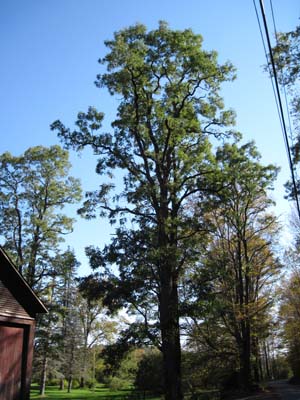
A neighborhood elm — free in autumn
Suber goes on to make an important observation about kinds of freedom from a different perspective, one sometimes downplayed or ignored in current discussion of rights and freedoms.
“A distinction first made explicit by Kant is that between positive and negative freedom. Negative freedom is freedom from —from coercion, constraint, compulsion. Positive freedom is freedom to —to guide oneself from within without taking one’s rule from outside, to be one’s own master and legislator.”
Negative freedom is the kind of freedom many people seem to mean, if they talk about freedom at all. It’s the kind of freedom that libertarians typically build their platforms around. However, one kind doesn’t automatically guarantee the other will arrive with the burgers and the beer, so we can all party. As Suber notes,
“Kierkegaard seems to have been the first to notice that one can attain negative without positive freedom. One can cut oneself loose from enslaving influences and yet have developed no internal or home-grown sources of guidance at all. Kierkegaard in fact finds this state, beyond negative freedom and short of positive freedom, to be a recurring predicament for human beings in the modern world. He calls it hovering, to be free from everything, hence to have no basis for the choices one is then free to make; to be independent but empty.”
“A basis for the choices one is free to make.” Now we’re getting a little closer to what freedom is for. And I’m setting the stage for one kind of freedom we’ve neglected so far and Suber at first seems to leave out. This is spiritual freedom. The word “spiritual” gets bitch-slapped around a lot, so let me explain what I mean here. When people are centered on “a path with heart,” they can endure remarkable physical setbacks and obstacles and still achieve their goals, or die trying without feeling they have failed. Throw them in jail, torture them, exile them, they just keep rolling and rising back up, like the old 70s “weebles wobble but they won’t fall down” ads. Think Gandhi, think Aung San Suu Kyi in Myanmar, think any number of freedom fighters, rebels (whether we like their politics or not), ornery patriots, and similar cussedly independent folks. There’s an integrity to their choices we can admire, even if the choices themselves happen to be abhorrent to us.
Yes, we can call to mind great spiritual heroes — some of them end up as founders of religions – but we have examples closer to home. Most of us know, or know about, people who are “survivors.” They get ill, they go broke, their families desert them, business goes bad, marriages fail, kids land in jail — but they bounce back. They have what an older generation called “inner resources.” We don’t hear about those kinds of resources much, maybe because we don’t have them much in evidence. But the seeds of them are still in us (and seem to emerge most often in hardship). The rest of the time they just make us restless, usually because we’re often living less than authentically. Face it, I get lazy when my life is easy. I want things to stay the same, which they almost always resolutely, infuriatingly, refuse to do. Like they’re refusing to do right now in the West, not to mention many other parts of the world.
What is needed, then, is the judgment to decide what to do with the freedoms we already have, and Suber proceeds to examine what that kind of judgment looks like.
A surprising test for freedom of judgment, in fact, is whether complexity overpowers, intimidates, and defeats us, or challenges, arouses, and incites us to comprehend it. In our spiritual apprenticeship complexity prevents us from feeling our power or wanting to control our own fate. We are happy to learn more first. Freedom before this point is merely self-assertion without the foundation of judgment needed for making choices. But as Hobbes said, if he spent his life reading books by other people, he’d never know more than they did. When we emerge from this dependency into our own freedom it is because we are ready to direct ourselves and make the decisions that this requires.

Bald Eagle — flight as freedom
So are we really free in the U.S. right now? Ignore for a moment whatever your local conspiracy theorist or naysayer or grumpy partisan has to say. The vast majority of Americans have food and shelter. Most of us have a car, won’t get stopped at state borders, and so have freedom of movement (if we can afford the gas). We have freedom from pain and suffering to a larger degree than any other time in history, with all the painkillers and routine buffers from the hard corners of reality that our heated and air-conditioned and work-saving-device-crammed houses and cars and buses and planes can provide. Most Americans live better and longer than medieval kings and queens, with a vast array of entertainments at our command.
Are we free? Material things are enjoyable — you don’t see me volunteering to give mine up just yet — but they can’t help us “emerge from this dependency into our own freedom … because we are ready to direct ourselves and make the decisions that this requires.” When our things get threatened, we complain out of a supposed “freedom” that is “merely self-assertion without the foundation of judgment needed for making choices.” We have the freedom to complain and criticize. But where is the judgment for the choices and changes we need to make?
There is one more factor I want to consider. I mentioned Aung San Suu Kyi earlier, the Myanmar freedom fighter and legally elected official confined to house arrest for years. One of her most famous speeches is her “Freedom From Fear” speech, which begins: “It is not power that corrupts but fear. Fear of losing power corrupts those who wield it and fear of the scourge of power corrupts those who are subject to it.” This is one of the last great “unfreedoms” we face. Think how much fear there is in headlines, on talk shows, in the news, in people’s faces. Suber observes:
The larger kinds of unfreedom abroad in the world and within … are not affected in the slightest until people who recognize them as unfreedom rouse themselves to challenge them.
Religions aren’t always up to the job of helping people wake up and “recognize unfreedoms,” either. I’m including Druidry here along with the rest. One problem with Christianity (to pick on a religion I know and which has had longer to make an impact) is that it has defined freedom theologically and thus very narrowly. That is, until I am saved, I am a slave to sin and subject to its penalties of wasted chances and dissatisfaction and emptiness, and ultimately to damnation. After I am saved by the substitutionary atonement of Christ, who died in my place and paid the price for sin that otherwise I would have had to pay myself, I am free from the penalties of sin, and therefore able to go to heaven at death. But I am no more free immediately after salvation than I was before from the responsibility of judgment, and the consequences of my own and others’ bad and good judgments. My dissatisfaction with Christianity isn’t that it doesn’t save people; it’s that it seems to transform too few of them into better versions of themselves. Where’s the “new creature” promised in the New Testament? A saved jackass or a damned jackass is still a jackass. Salvation may get you to heaven, but we have to live with you till then.
To offer you any kind of definitive “answer” to what freedom is for is to promote an unfreedom. I’m working closer to my own answers, but you need to find your own. Suber acknowledges this:
To take one’s judgments from others is exactly the unfreedom to be avoided. To negate the judgments of others, without more, takes one just as directly to dependency and enslavement, though by a path that is one step longer. To judge by standards that one finds inescapable is still bad faith, for one has chosen to adhere to them, and is not taking responsibility for that choice. To recognize that we are responsible for all our judgments, including our standards of judgment, is the beginning of positive freedom and self-direction. Then we will recognize that all the noisy certitudes of the world are not primarily candidates for truth but appeals to our judgment.
That is, all these supposed “certitudes” are jumping up and down, waving flags, cheering and whistling and shouting and saying to us, “Here I am. What do you think?” rather than “Here I am. Do what I tell you.”
For me, more and more I find as the years pass, freedom is for loving more. Nothing else matches up, noting else offers the challenge and delight and fulfillment. It’s life-long. I’m most loving of myself and others when I’m free, and — paradoxically? — I’m most free when I’m loving. What’s freedom for in your life?
/|\ /|\ /|\
Eagle image credit
In her blog, Alison Leigh Lily writes beautifully about the human body as a holy thing, an altar:
So, too, my body is the altar in the nemeton [sacred grove–ADW] of my soul — that small, solid piece of world that settles down like a stone into my awareness. And that awareness in turn is carved by the spiraling torrents of the sacred world, the sun that crafts the seasons out of mud and wind, the moon that pushes the sea to its extremes, the stars that draw the eye into the great distances that yawn open between us, the deer, the jay, the badger, the rustling oak and every being and body that dances through its longing, hunger, fear, curiosity and sleep. All these things turn about the sculpted edge of my nemeton, the sanctuary my soul has made of itself, the self that calls itself “I” and reaches out into the world to touch the chaos that has given birth to it. Sitting in the center of that nemeton is my body, all surface, the appearance of skin and hair and angles and soft curves of fat and loose muscle. Like a ladder that reaches into the dark. A spine, a wellspring, a single tree, a tongue of flame. My body is the altar around which my spirit gathers itself into stillness. Not a temple, but only a simple, useful table where I sit down to do my work.
And some of the work we are called to do is to recognize that altar. In the Bible I read, “I will go up into the altar of God” — introibo ad altare dei in Latin. I use it as a mantra, a chant, to be mindful of the altar as a place to ascend to. For it feels like we do actually rise up, into the body, out of thought, out of waking, out of the distractions and worries and daily obsessions, the small news that passes for important events that other people call “headlines,” but which are mostly just footnotes — out of the image and into the reality, into this body that is part of the world, not a thought or an idea or a remove from the thing itself, but the place where we experience a universe.
I strive to occupy this body, this world, as fully as I can, to be fully incarnate. Not to forsake this great, unheralded, impossibly large opportunity to know, to dare, to will and to be silent, to listen for the voices of the Others who move all around me, chickadee at the feeder, crows scavenging a dead squirrel on the road early this morning as my wife and I drove through the dark and the fog to her weaving apprenticeship.
And Tom, who introduced himself yesterday afternoon — a neighbor, out chopping wood. He paused from his work and called to my wife and me, walking slowly over to where we were unloading our car. “It’s something I can still do, and it needs doing,” he said to us, as he stood before us, dressed in blue sweat pants, a gray sweatshirt, a blue hoodie, pieces of leaves and bark plastered to this clothes. “I was just recovering from knee surgery when I had a stroke. And I was recovering from the stroke when I lost my job. But I can still chop wood, as long as I don’t have to bend my legs too much.” So I touch that friendliness, and something of the spirit in him, that brought him to our doorstep to chat in the fading afternoon light of a day in early November. Is any song more wonderful?
“Sanctuary my soul has made of itself,” Alison says — a poem, a song, a prayer for this life, this world.
“Prayer is about being hopeful,” says Sister Alice Martin. “It is not a phone call to God’s hotline. It’s not about waiting around for an answer you like, especially since sometimes the answer you’re going to get is NO!” And she continues, “If you are going to pray, then don’t worry. And if you are going to worry, then don’t bother praying. You can’t be doing both.” I know which one I want to choose, often as I can, prayer at this altar of my body.
“But ask the animals, and they will teach you; the birds of the air, and they will tell you; ask the plants of the earth, and they will teach you; and the fish of the sea will declare to you” — Job 12:7-8.
Mourning doves at the feeder this morning, blue jays squabbling on our standing-seam metal roof, shortly before dawn a fox leaping through the snow nearby, mice in the garage foraging on birdseed I spilled and haven’t yet swept up, a few geese lingering and looking forlorn as they forage in the dark water of a lake, made darker by contrast with the surrounding snows.
Visible kin, feathered and furred. Beneath the surface of the pond, a few salamanders who haven’t yet burrowed into the mud to winter there. Scaled kin.
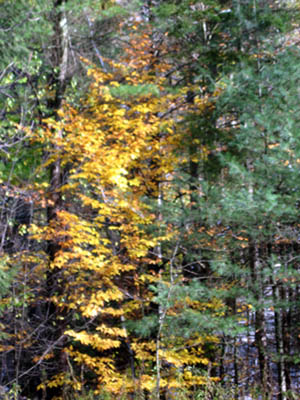
And golden till the end — leafy kin — a young maple in our back yard, shouldering its way up among larger pines.
 What can I ask, and what will they teach, tell and declare?
Isn’t everything open and shut at the same time, the glory and the wretched side by side, the fox killing the hare, the wonder of sunrise, a birth and a death both?
But what of the between, where we all live, where it is often neither? The third way we pass over, because it constantly moves with us, never stopping to be wholly seen or felt, a shadow at our backs, a light in front of us, a suspicion of beauty and the marvelous: peering through the grime and fog of a dirty window, a commuter on the way to work, waving; a bare branch with exactly seven sparrows wing to wing, puffed against the cold; the surprise of light on water, perfect mirror; a child’s unflinching gaze. O my world, altar of how many things to see and know and suffer and enjoy and give up and welcome again, how can I do anything else than love you, in the end?
We’re a few days from the old Celtic harvest festival at summer’s end. For those of us the northeastern U.S., with the recent frosts and snow in the forecast, it feels like summer’s end as well. As a time of endings and beginnings — the new year begins as the old one ends — it is a time of introspection, intuition, dream and creativity. As an acknowledgment of change and completion, it can also include a remembrance of the dead.
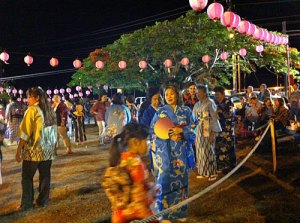
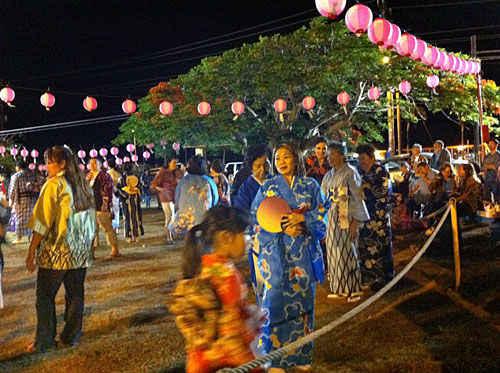
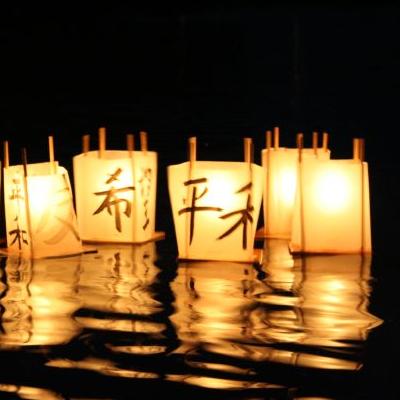
The holiday was adopted by the Church and transmuted to a three-day observance from Oct. 31 to Nov. 2. It begins the night before, on All Hallows Eve*, or Hallowed Evening (Halloween), continues with All Saints Day, and concludes on All Souls Day. In many other cultures there are similar observances, though not necessarily all on the same dates. Spanish speakers celebrate Dia de Los Muertos, and Christian Arabs observe Yom El Maouta, both meaning “Day of the Dead.” The Japanese observe O-Bon, remembering and honoring their ancestors. Held during July or August, depending on location and local tradition, the holiday feels to me (I lived in Japan for two years) like a cross between Halloween and the Fourth of July. Originating as a Buddhist observance, it also includes a dance — the bon-odori — to give thanks for the sacrifices of ancestors, fireworks, carnivals and a concluding Lantern festival, imaging the return of the souls of the dead. This Asian holiday captures the Druid spirit of Samhain for me: celebratory yet reverent, and family-oriented.

Druids and other Pagans have adopted the older Celtic name of Samhain or Samhuinn (pronounced approximately SAH-wen or SOW-en — the “mh” in Irish spelling indicates a sound like “w”) — as they have other Celtic names, since for them the holiday has association and symbols different from those current in the Church. The “sam-” is cognate with English “summer” — the word means simply “summer’s end.” (Christian anti-Pagan propaganda tracts like this one ignorantly and wrongly portray Halloween as “The Devil’s Night” and “Saman” as an evil “Lord of Death” — scroll down to the 15th frame. No evidence exists for a Celtic deity with that name and association. Besides, American commercialization of the day has obscured the invitation of its spiritual potential, though it remains still at hand. Somehow Americans also seem to have trouble achieving both “mirth and reverence,” as the “Charge of the Goddess” in the Wiccan tradition exhorts us.)
At the school where I’ve taught for a decade and a half, students themselves often took the initiative to celebrate this autumn holiday. Some two months into the school year, with exams looming and — for the seniors — college apps drawing more and more of their attention, they still found a supervising adult so they could get official permission and use school meeting areas, put up posters to invite everyone who wished to attend, and write their own rituals. I’ve saved several years’ worth of photocopied ceremonies in wildly varying degrees of elaboration, and I’ve attended both large and small gatherings, indoors and out. Some were largely excuses, it’s true, to dress up in capes and masks, light candles, scare and amuse each other, and then gorge on candy afterward. But others were moving commemorations of the season, an opportunity for acknowledgment from everyone who’d lost a relative or friend in the past year. The event helped acknowledge grief and cleanse the emotions through a group ritual of shouting and crying, burning messages in a cauldron, and closing with a group meditation. If the larger culture doesn’t make room for such things, subcultures often do.
The autumn equinox last month was the first time I celebrated that holiday as a Druid, and with fellow Druids, at the East Coast Gathering. In my part of the U.S., Druids are thin on the ground, though a couple of us are considering a small gathering. But whether or not in the end we manage to find time for a group celebration, I’ll also observe the day myself, this marker of moving in time and experiencing the fullness of human life.
/|\ /|\ /|\
*”All Hallows Eve” precedes the day dedicated to the hallows or saints (Old English halga) — All Saints Day.
Dance image link
Lantern image link
I’m picking up on Steve Schwartzman’s recent comment here for a title to this post: “happy hunger.” We usually think of hunger as a “simple” biological drive, the body’s impulse towards food or sex or life. Yes, as sometimes conscious beings we can override our hungers, at least up to a point, for some other purpose. But to think of these or any hungers as “happy” I take as a prod in a good direction — a pointer, a reminder, a prompt that a shift in attention and consciousness is possible and has arrived full of benefit.
 So what of other hungers? A hunger for connection, a hunger for the sacred, a hunger for contact with the natural world — all of them vital hungers which we struggle to answer and fill each day. And so many “unhappinesses” when we don’t meet these hungers — crimes and random behavior and restlessness and secondary hungers for stimulation — sugar, fat, salt, second-hand sex (porn), alcohol and drugs (to change awareness any way we can!), gossip, fits of temper, violence — these stem, I know at least in myself, from unfulfilled primary hungers, from attempts to shift consciousness out of the bland, boring, mundane, even unreal sensation of “just existing.” As if life, the most real or literally “thingly” thing we experience, could also be “unreal.”* (Which it also is. And that’s neither a good or bad thing, but part of the way the universe apparently works.)
Those of you familiar with psychologist Abraham Maslow’s hierarchy of needs know that, in his schema, these other hungers, and especially the hunger for the sacred, aren’t considered the “largest” or most “immediate” ones at all. They’re at the top of his hierarchy, most distant from Maslow’s naming of our “primary” needs for food and sex and safety. But I’d argue that in fact the need for the sacred is our primary hunger, and that all the rest fall in line behind it. The less we’re connected to the sacred, the more we’re just flesh machines. Fortunately we’re always connected to some degree — that’s what being alive is. The task is to blow the spark to fire, to nourish and feed that singular flame through and with all the others, so that eating and lovemaking and all the “daily-ness” of our lives, potentially everything, becomes sacrament, a door for the sacred to enter this instant, right here, and transform us. It’s what Christians call the abundant life, what Zen means by satori, and what we all experience in those transcendent moments that do not last because we also live through the (potential) sacrament of time, that sweeps us ever onward to the next, the latest, the new. A physical world can only manifest eternity as time. And our next task is to see time our ally, to make it and to know it as a sacrament as well. Not as endpoint — it can’t be that, in its ceaseless flow — but as ongoing opportunity for practice and reverence and worship.
So the “happy hunger” is the hunger that connects us, the hunger we recognize and welcome and honor. As a Druid I have a tool-kit to make room for the sacred, to invite and witness it around and within me and all whom I meet, to increase its presence in my consciousness, and then to bring more of it into my world and surroundings and atmosphere and aura and presence, so that others may encounter it, too, and access it in their own lives. We all have access points to many ways to do the same thing. The tools aren’t what’s lacking. It’s the courage and love and trust and responsibility to make use of them for our own good, for the good of the whole. This is my prayer and my goal for practice, my ritual and my path. May you strive and realize, delight and rejoice, as you discover and find your own.
/|\ /|\ /|\
*”real,” from Latin re-alis, “real, thingly,” from re-s, “thing, matter, affair.” Thus the “real” means simply whatever is a “thing,” and so the “unreal” is the realm where distinct “things” disappear, where there is a whole, a network, an interplay, an eco-system, and not a collection of separate things to be counted — the “real” is whatever we can count, or assign a number to. And so then of course we turn around and protest that we’re not just numbers to be counted, we’re not just statistics, or collateral damage, we “matter” (odd use of the “material” to point to the sacred!). Here is our recognition that the spark in us is sacred, that it knows more that “this.”




 A Druid Way


