
Part 2 — because how can a book of lore that also offers a path of initiation and suggestions for a regular practice be properly reviewed in a single take?
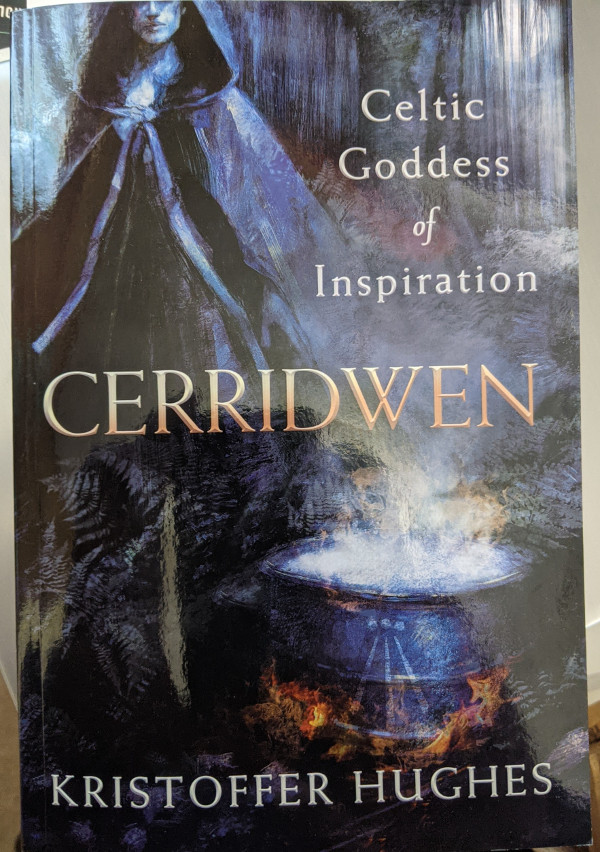
Kristoffer Hughes has helpfully made Youtube recordings of some of the Welsh that appears in this book, because the sound of the language is one approach among others to entering into sacred space with the goddess. As of today, there are four videos on his Youtube channel: “Ritual to meet Cerridwen”, “Welsh ritual phrases”, “Guide to Welsh pronunciation”, and “Cerridwen: glossary of words”.
The dedication page is brief: I Cerridwen — Mam yr Awen: “To Cerridwen — Mother of Awen”. And because she is Mother, Kris reminds us, we are Plant Cerridwen — the children of Cerridwen.
All of us, whether we’re Welsh or not? Of course. But a caveat … As Kris notes in the opening paragraphs of his first chapter, “The Quest for Cerridwen”:
The current New Age trend of spiritual commercialism has dissected the mysteries to their component parts … This has profoundly affected our relationship with the mysteries … The permanent individuation of the gods to the exclusion of the landscape in which they exist does them a disservice, for the landscape inspires and breathes life into the divine … (pgs. 1-2).
Yes, those wishing to enter relationship with Cerridwen and gain initiatory wisdom and insight from her mysteries can do so anywhere. No, she is not “a universal goddess, never mind what we call her”. So if we wish to avoid “damage to an archetype” as Kris calls it, a real possibility if we wield our indifference like a blunt instrument, and thereby miss much that Cerridwen asks of us and offers in return, there are several things we can put into practice. One that should come as no surprise is observance of the Wheel of the Year.
Such observance “causes us to stop, take heed, and observe a world that we believe we are familiar with. To those who fully engage, they begin to sense more to the world than first meets the eye” (pg. 202). The “apparent world fades”, as OBOD standard ritual reminds us — a world largely created by the inner chatter that, unchecked, fills our waking hours. “To sense the subtle and perceive the space between spaces that connects all beings, we must learn to be still and identify that space within our own beings. In my tradition we have a name for this process: we call it finding one’s taw” (pg. 202).
In a section titled “Appropriate Appropriation”, Kris addresses such concerns head on:
There is a strong possibility that you, reading this book right now, may not be Welsh or even have a connection to Wales. But somehow, by some means, you have found your way to reading this particular book. Cerridwen has found a way to seed within you the spark of Awen. You are the sum totality of all things that went before you, including the magic of the Welsh bardic tradition, which is held somewhere deep in the recesses of our species memory. By all means, learn a little Welsh or at least strive to understand the complexities of the history that brought Cerridwen into the light of twenty-first century Paganism. Know that you are equally expressive of the Plant Cerridwen and have as much right to claim that title as any Welsh person.
Whilst it is important to develop honest, nonappropriative practise, do not ever think that you don’t have the right to claim Cerridwen as a goddess that is valid for you … she is more alive today than she has been for the last four hundred years (pg. 261).
Kris then offers 13 excellent suggestions for ways to develop a non-appropriative practice that will not cramp anyone’s style. He also states clearly that any limitations we face as modern people can serve as opportunities for creative work-arounds:
I cannot see Cerridwen physically–she does not possess a carbon based physical body–so the manner by which I develop my relationship with her must somehow address these limitations. Nothing beats heading over to Bala for an afternoon spent at her lake, for there is a sense there that is different to anywhere else on earth–there is a tangibility to her presence in that location, as if the landscape holds a different kind of lyric. However, Bala is just over an hour from my home, and my schedule does not permit me the luxury of going there every day. Therefore I have re-created a sense of what I feel at Bala at home, and it is centred around my altar … (pgs. 264-5).
This book is rich in suggestion and opportunity, with keys Kris draws from personal experience. Visualization proves difficult for many, and Kris supplies a most helpful tool in the form of sigils — several appear throughout the text. As he notes, “… application of the magic will invariably have a physical aspect to it” (pg. 204). Just like humans need to ground and center, magic needs that grounding too, or it remains a mental head-trip the other parts of ourselves never take.
It is perhaps inevitable that some readers will merely skim the book and zero in on the section “Stirring the Cauldron”, with its wealth of suggestions for practice. But practice often runs dry without roots, which the text amply supplies, and a practice unmoored in understanding and respect for a tradition will soon leave the restless seeker wandering off to the next book. The fulfillment of anything that worthwhile books promise can only come from the same thing such books usually counsel us to remember and put into practice — full immersion.
For us to practice such immersion, the Welsh traditions of song and awen, poetry and inspiration, silence and speech have literal significance and application:
The Awen is active, and to sense its blowing through us, we must actively vocalise and energetically move into its power. We live on a unique world, a place where expression is facilitated by the atmosphere that surrounds and imbibes us. Breath is the bridge between the density of the physical and the lightness of spirit (pg. 246).
/|\ /|\ /|\


 A Druid Way