
Away to MAGUS 2018. until my return on Monday 7 May. Here’s an image from last year’s MAGUS for contemplation: “Through the Mother Stone”.

Four Quarters Mother Stone. Photo courtesy Wendy Rose Scheer
Away to MAGUS 2018. until my return on Monday 7 May. Here’s an image from last year’s MAGUS for contemplation: “Through the Mother Stone”.
Four Quarters Mother Stone. Photo courtesy Wendy Rose Scheer

Serpent Mound, OH — learning and growth, like insight and practice, often curve
MINING for INSIGHT
I’m reading and re-reading an obviously older poem I found in my parents’ papers, hand-copied into a notebook in my mother’s careful but aging secretarial script, with no title or author. (If you know anything about it, I’d appreciate a reference or citation!)
Of the poem’s two stanzas, this couplet in particular caught my attention:
Through worlds unnumber’d though the god be known,
‘Tis ours to trace him only in our own.
The times don’t stand still, and neither do our habits of speech. Older poetic diction can throw us off. So, for that matter, can the assumption of a male deity — or deity of any kind. But if I work with it, squeeze it for what I can get out of it, I can often find useful material for contemplation in older literature. Springs of Druidry flow in the most remarkable places.
Of course such literature and writings may run rife with sexism, racism, other isms — take your pick. That’s almost a given. Our words today are no less weighted with assumptions that will no doubt seem quaint, distracting, or deeply objectionable in a few decades or centuries. Our wise descendants will know how to sift and choose the silver from our dross. If I’m to rank their equal, I can learn to do the same today with the small portion of our ancestral planetary inheritance that comes within my purview.
MULTIPLE WORLDS
We’ve known we dwell in a poly-verse for some time. Include our inner worlds and the number of realms increases exponentially. Whatever anybody else says, our lives hand us each a unique set of specifics. So many deities ready for discovery, service, respectful exclusion, whether they’re given name and form through a tradition by the experiences and insights of many, or called by other names and shaped by the imperatives of hunger, sex, fear, desire, or drives for wealth and power nearly as strong.
Part of our challenge is that we’re such fluid and supple movers-between-realms, so that in any one moment we can forget where we’ve been and where we’re headed, even in just a single 24-hour cycle.
Dream, waking, trance, listening-to-music, buzzing on caffeine, focused on a computer game or craft or sport, praying, daydreaming, balancing our checkbooks — every day we slip in and out of a dozen or more states of consciousness — worlds all their own — and, most days, never pay it much mind at all.
I needn’t attempt to track down such a force, power, god or instinct in every world, or insist that because I find it in my world that it must exist in yours, too. Ideally, many-ness can induce in me an endless wonder at variety, along with a humility to learn from yet another manifestation of this immense cosmos we inhabit.
Through a paradox that seems to root quite deeply in our cosmos, in at least this world and a few others I know of, if I tend to my own truth deeply enough, it awakens echoes for others. And the same holds true for them. We know this when we’re open enough to recognize in another’s experience an analog of our own. The god, the cosmos, our individuality, the Singularity, intelligent protoplasm, whatever your current favorite label, finds itself in sameness-within-difference, much as my breakfast eggs each contain a yolk, but each egg is different. The Cosmos seems to adore individuality.
We know the dangers of inbreeding. First the thoroughbred, refined for a specific trait (or whole basketful of them), but the ideal pursued too far runs toward the genetic multiplication of undesirable traits.
Cosmos seems to say, OK, you exist, mostly the same as others of your kind. Now — get different!
Or to put it in terms of finding ourselves, clone not, lest thou be owned. It’s that quest to find the happy medium between copycat-dom and a Frank Sinatra-insistence on doing it “your way” in all things.
INHERITANCE and MISSION
‘Tis ours to trace him only in our own.
Dropped squarely in our individuality are both legacy and goal. We look backward and forward, too. Those two form the third thing of a self. I keep noticing that the most creatively alive and spiritually limber people aren’t those who cherish the mantra What’s the point? or How can I even ___ ? They manage to find something interesting enough to them that, at least while we’re in their orbit, they often infect us with that same enthusiasm and delight.
That’s simply more fun that judging and condemning others. It just takes a while to wean our human selves from the high of fear and substitute other and healthier highs. Or to put it in other words, reptile brain is useful, but needn’t call all the shots.
Like you, I’m the sum total of everything I’ve been, regardless of whether you count just this life or a thousand previous ones. Looking just genetically, I’m the end result of all my ancestral DNA, and if those mitochondrial strands hold nothing more of the genetically marvelous than we’ve so far discovered, I can make the most of my present here and now because all my ancestors did the same in theirs. Otherwise I simply wouldn’t be here. I’m their evidence, if they need it. Just a little late for use during their lifetime, or explanation or defense for what they were up to.
In many ways, the divine is at its most alive in the physical world. Make of my existence an object for contemplation, a laboratory for experiment and discovery, and an opportunity to participate in what the universe is doing all around us — transforming — and I never again need to wonder or worry What’s the point?
So among my strategies are mining our cultural wisdom for its value and insight, granting older assumptions and states of consciousness the same respect I try to grant my parents and grandparents, even if my way is different, has shifted from theirs. It’s the same freedom from criticism and censure I try to grant myself. Not out of any softness or over-generous assessment or misplaced loyalty, but simply because it accomplishes nothing. It’s an energy sink, a pothole on the way. Here is wisdom; take from the hoard what you can use and put it to work.
(If it needs a new handle, or the edge needs sharpening, well, what tool doesn’t benefit from loving care?)
The form of things is part of their value and identity. A limit is a tool like anything else. To the extent I see the facets of my personality, my partner, my situation, my perspective, even my “problems” in this liberating light, I make good use of my inheritance, and begin to fulfill my mission in ways that delight and build and expand.
As Greer observes in his Mystery Teachings from the Sacred Earth,
Everything in existence exists and functions on one of several planes of being or is composed of things from more than one plane acting together as a whole system. These planes are discrete, not continuous, and the passage of influence from one plane to another can take place only under conditions defined by the relationship of the planes involved.
These conditions are part of our learning, practice and mastery.
To be continued.
/|\ /|\ /|\
Greer, J. M. Mystery Teachings from the Living Earth. Weiser Books, 2012.
Image: Serpent Mound, Ohio, USA.
One of the pleasures of OBOD Gatherings is taking part in the group initiations with those who opt for them.
Many don’t. An initiation is always personal, and many wish to honor that by outward solitude. It’s no surprise that the two initiation experiences, solitary and group, can each have a very different feel. As they should.
With a solitary initiation, at a time of your own choosing, you dedicate or consecrate your work, your attention, your energies to a task in ways personal and unique to you.
Of course, no initiation is wholly solitary. What you say, think, and feel are all between you and those present, with and without their skins on. In fact, in one of the paradoxes of spirituality, those others can help make the initiation more personal and solitary. My first Ovate initiation — I won’t say “self-initiation”, because in my experience all true initiations come about the same way, whether like my first you do them in your living room, or with a group, as with my second OBOD Ovate initiation — my first initiation packed a punch significant enough that I wrote about it to my Ovate tutor.
Recording it, shaping it for telling, if only for a journal entry, is an important facet of the experience, and communicating something of that to one’s tutor is recommended in OBOD, and wholly appropriate. The deepest experience can’t really be written about anyway. In this way we learn to honor the Law of Silence, one fourth of the old occult dicta, to know, to dare, to will and to be silent. Mix ’em and match ’em: know your will, and dare to be silent, rather than casting your pearls before swine. (Jesus knew more than a thing or two about magic.) As with telling dreams, others often cannot experience the most meaningful part of what we’re trying to communicate anyway.
As you’ve doubtless heard: “Guard the Mysteries! Constantly reveal them!”
It’s one of the delights of OBOD that it recognizes, and encourages, either or both forms of initiation. After all, fire is fire.
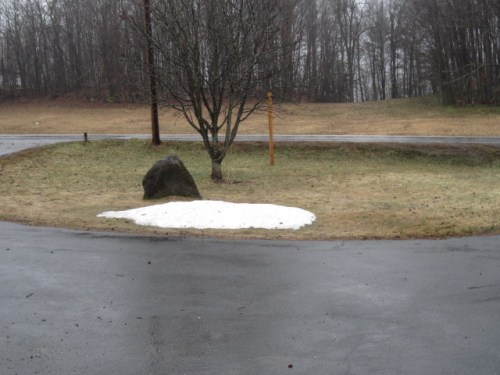
front yard this morning — fire in the rain: last of the snow, first hint of the green
At MAGUS 2018, in a week and a day, we’ll be initiating Bards, Ovates and Druids in separate rituals. A good half of ritual is theater, and there one can experience the truth of the lines from the “Charge of the Goddess“: “Therefore, let there be beauty and strength, power and compassion, honor and humility, mirth and reverence within you”. If we don’t let them, how will they manifest? Learning how is the practice of our path.
As a Wise One has said, “At birth we’re fitted with a consciousness that allows us to go to school, get a job, and make our way through life. But we owe it to ourselves to reach higher, deeper, beyond. These don’t come with being born — we have to reach for them”. For me at least that rings true. Hence, among other things, this blog. Maybe I should rename it “A Druid’s Reach”.
/|\ /|\ /|\
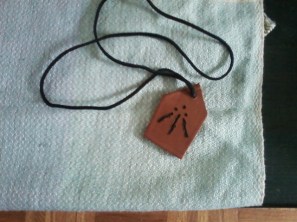
awen pendant
As I write this it’s drizzling outside. I’m adding one more awen pendant to the set I’ve made as Bardic gifts for the initiates — a last-minute addition has appeared on our roster of initiates. As a participant in the ritual I also get to say some of the most wonderful lines — a privilege, to assist in the shaping of others’ initiation experiences.
Beith — birch (genus Betula) — is a tree associated with the Bard. The first letter of the ogham alphabet, beith/birch is a pioneer tree, one of the first to take root in an open area. As a tree of beginnings, it’s an apt reminder of the focus of stepping onto a Druidic path: song, voice, word, music, poetry, imagination — all prime tools of the Bard, and never abandoned as one proceeds to deepen one’s practice of Druidry.
I’ve written elsewhere here of MAGUS and Beltane (MAGUS ’17 | the series Touching the Sacred | Triad for Rekindling Sacred Fire | Beltane 2016). In the latter post, I wrote:
Beltane, like the other “Great Eight” festivals of contemporary Druidry and Paganism generally, draws on a swirl of energies as democratic and mongrel and vital as you could wish for. Find a group to celebrate with, or if you prefer solitary practice, get outdoors, invite the season, contemplate on images and energies alive and at work in your awareness. Bring them into some physical form to ground and manifest them in your world. We all need reminders to help us through those “difficult” days with humor and grace and even, spirits friendly and stars favorable, with gratitude. What better than with something that’s come into your world through you?
/|\ /|\ /|\
It’s Unverified Personal Gnosis, of course, but I have a sneaking suspicion that the mic is always hot. The universe — intelligent Web that it is (after all, it gave birth to you and me, right?) — is always listening, manifesting and responding to us.
Often it can feel like we pray and get no response. For that reason, some — many — may have sensibly dispensed with prayer. No surprise there, since asking has never done much in isolation. Oh, it does a little. It opens a few windows and doors, but if we don’t look out or walk through, they soon close again. Follow-through, follow-through, I say to myself.

What about the prayers the universe prays to us? Do I really think it only goes one way?! How many prayers have I left unanswered? What is my part in manifesting? If I’m god-like, then what’s god like?
Part of the magic (it’s all “mostly magic”) is a matter of scale. Hot mic Druidry, just like hot mic Christianity (and hot mic atheism, for that matter) is partly a responsiveness to being alive, a sensitivity to here and now, this moment. So much of the time I’m anywhere but here. We use the future as a substitute for a larger present.
I shrink the present into the longest I can pay attention before something better takes its place. But (one of the handful of truly powerful and magical words in English, along with yes and if, why? and thanks! and even our own names, magical or mundane, chanted with intention, until the potential of what we are starts to resonate and I gasp at large we all really are) — but with loving attention, the present can expand to contain everything else. And I know that’s when the magic happens.
Most of us experience this intermittently, in “flow” moments. To taste this is to experience the “kingdom within”, as José the Carpenter put it. The old Hermeticists and Qabbalists spoke of Malkuth, kingdom, just below Yesod, foundation. The kingdom is just that close, and once the windows and doors open, we have the Foundation for everything else. And the “eye of the needle”, so easy or hard to pass through, depending? Well, that’s the eye of our own perception, clenched tight from disuse, or opening to let in the Light and Voice of the Silence. We don’t need any more teaching at this point. We need prods and reminders to put into practice what we already know.
What metaphor will catch my attention this time? Which one will work for me and aid me in taking that next step? Truth-of-this-Moment, enough to jump start the next one.
So I keep catching pieces, fragments, glimpses, echoes. Sometimes it’s downright embarrassing how much of my time here I squander, until I recall that this too is mission. There’s no hurry along the spiral. Only the Fire burning in each of us. Sit still warming myself a little too long, and that part gets scorched. On to the next, in turn. (The “best” among us just get basted more evenly.)
In this season of the approaching fire festival of Beltane, it’s no surprise our images and metaphors are fire. Cold can burn, too. If we can fight fire with fire, can we not welcome fire with fire?
/|\ /|\ /|\
Images: Edinburgh Fire Festival bonfire.
The Summer 1973 issue of “Vermont History, Proceedings of the Vermont Historical Society”, preserves a letter from a young Vermont woman who went to Clinton, MA to labor as mill-worker. She was determined to enter Oberlin College, and mill-work was one path she could take to advance towards that goal.
Dated June 29, 1851, the letter from Lucy Ann (no family name known) to her cousin Charlotte derives from a period where people wrote each other frequently, and this surviving letter clearly stems from a history of lively exchanges between the cousins.
Cousin Charlotte–,
Your letter was joyfully received last Thursday evening, and this morning I take my pen with a right good will to answer you. This is Sabbath morning, and can I spend it better than writing to you?
After some light social gossip about her roommates in the mill-town, she continues:
Perhaps I am offending you to write such things on the Sabbath, so I will change the subject. — You say, “I am afraid you do not love the house of God”. The house of God, what do you mean? Our churches? And can you call such a place of desecration a house of God? If you can ’tis a place I cannot worship. I can only listen to truths or untruths, as the case may be, and ponder on their importance or unimportance, but to worship there, there is no feeling of devotion–no it would seem mockery to worship there amidst that crowd of well dressed idle gazers. Once perhaps the house of God was a place of worship, but it has degenerated into a place of vain idle show …
When Hemingway was asked if there was one thing essential to being a good writer (and, I would add, a free human being), he remarked, “Yes, a built-in, shock-proof crap detector”. Lacking that, we get scammed, conned, taken, had, bamboozled, misled, tricked, fleeced, robbed, used. And we give it up voluntarily, because as another writer — this one Roman — said, Mundus vult decipi — “the world wants to be deceived”. Yet our inner integrity will not relinquish our best interests so easily. It does not surrender the innermost citadel of the self, and our personalities will feel the unavoidable conflict till we resolve it — however long that takes. The longer we resist, the more the inner disharmony flails about to express itself in bad temper, illness, dysfunction, hypocrisy, projection on others, etc.
Lucy Ann perseveres:
There are places where even I feel devotional. Wherever this feeling steals over us there is our church. Mine is in the wild-woods. I never walk alone amidst nature’s solitudes without that same indescribable sensation of awe & devotion, & how inexpressably holy, calm and happy are such feelings. Then our thoughts are raised to something higher & nobler than the days dull routine, then do we feel that we have a Soul-immortal, & shall I say only then?
And so we see the Forest Church movement, one among its many more positive contemporary forms, arising from the middle of the Christian neglect of and even paranoid suspicion toward (see “Resisting the Green Dragon” and one useful counter-view from the UK’s Guardian) the physical world and ecological awareness. The sweetly saccharine song “I know a green cathedral” (lyrics by Gordon Johnstone, music by Carl Hahn).
Having forsaken so many keys, paths, practices and perspectives that for long helped keep humans in harmony with their planet, many seek to rediscover them anywhere and everywhere but where they have long existed — in earth-religion and earth-centered spirituality.
The Druid and Pagan sensibility doesn’t go away merely because the dominant culture disapproves of it, punishes it, mocks its deep hunger for true devotion and its proper place, or misunderstands it and offers in its stead a mad grab for a host of poor substitutes that con us into thinking they’ll answer our need, and which only enrich the pockets and egos of others.
How very many have felt this but struggled to ignore it? “There are places where even I feel devotional. Wherever this feeling steals over us there is our church. Mine is in the wild-woods”.
/|\ /|\ /|\
As I write, the sleet and rain of a mid-April winter storm blanket southern Vermont, patter on the roof, and coat our driveway and solar panels.
Dana Driscoll in her wonderful Druidgarden blog writes:
This unseasonably cold spring offers a number of powerful lessons. The first is in studying people’s reactions to the cold vs. the land’s reactions to the cold. Humans have grown to expect predictable certainty; the certainty of the seasons coming on a schedule that we could depend on, the certainty of USDA* zones and last frost dates. But that’s not what this planet can offer us anymore. Predictable certainty says that by mid April, we “should be” firmly in the spring months. There “should be” buds and flowers. There “should be” warmth. But climate change prediction models say otherwise–-the East Coast of the USA, where I live, is likely to see shorter springs and longer winters, particularly as the jet stream continues to shift. The truth is that spring will come, but it may take longer than any of us would like. Spring will come and frost will come, and summer and fall will also come-–but no longer on predictable schedules. The daffodils understand this-–they simply wait. The animals and insects understand this–-they wait. The flowers and seeds understand this–-they, too, wait.
[*United States Department of Agriculture zones for estimating growing seasons, planting dates, plant hardiness, etc.]
Such patience is cauldron and wand working together.
/|\ /|\ /|\
I recently obtained a copy of Hewson’s Dictionary of Proto-Algonquian (Canadian Ethnology Service Mercury Series Paper 125). If we’re serious about wanting to talk with the spirits and land-wights in North America, and we also want to avoid cultural appropriation of living languages and practices, why not go to the source?! Just like with Proto-Indo-European for Europe, we can learn Proto-Algonquian! (Right now I’m looking at how place-names are constructed.)
Except.
One of the fallacies we cherish involves continuity and change. In our search for authenticity we often grant an unconscious, and sometimes conscious, primacy and superiority to “languages-spoken-when”: we study Old English or Old Icelandic if we’re Heathens or Asatruar, we turn to Irish or Welsh or Gaelic to be truer to the Celtic tradition, just as Catholics may pick up some Latin if they attend Catholic schools or regularly attend a traditional Mass, and more conservative Jews acquire some Hebrew as a language of their heritage and tradition for Bar and Bat Mitzvahs and Seders and Synagogue prayer and ritual. Languages of lore and wisdom are valuable gifts from the past, from the ancestors.
But just as speakers of English no longer speak Old English as a native tongue to greet the dawn and the land, or pass the bread and butter, the spirits and land wights can connect through our modern tongues just as well with us, and we with them, as we ever could in the past.
Robert Frost, old bard of the land, like any true bard, had access to Otherworld wisdom. You can hear it in “The Gift Outright” (which I often return to when this topic comes up), through the views and stances and limits of his time — as through ours, limits which we cannot yet wholly see — when he peers into that deeper well for vision and understanding:
The land was ours before we were the land’s.
She was our land more than a hundred years
Before we were her people. She was ours
In Massachusetts, in Virginia,
But we were England’s, still colonials,
Possessing what we still were unpossessed by,
Possessed by what we now no more possessed.
Something we were withholding made us weak
Until we found out that it was ourselves
We were withholding from our land of living …
Possession, possessed by, withholding — we carry deep attitudes and archetypes not lightly to be dismissed. Indeed, they are part of our work. But for all that, the Land where I live here in New England doesn’t “withhold” itself from me because I say Lake Champlain rather than Bitawbakw, or Burlington rather than Winooski. Rather I withhold myself through heedlessness. It’s my intent and practice that make up any difference.
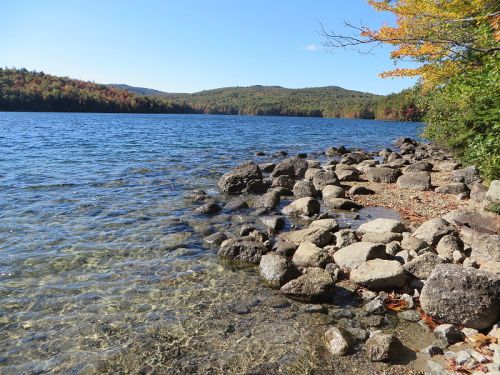
view of Nubanusit from Hancock, NH
Every land has seen many people on it come and go. The language — any language — is for my comfort and focus — for any act of consciousness. If out of respect I devote energy to learning old ways of address, the Otherworld (and this world) accepts that gift in the spirit it is given. Let it outweigh other considerations, though, and I’ve stepped out of balance. To use the terms of the previous post, my speech and ritual are my cauldron and wand.
Yes, it’s still a pleasure to say the New Hampshire Abenaki lake names Skatutakee [skah-TOO-tah-kee], Nubanusit [noo-bah-NOO-sit] and Winnepesaukee [win-neh-peh-SAH-kee], even if they’re poorly Anglicized.
Names matter. Echoes remain. That’s how we fashioned a modern Druidry. Trust the echoes, if they’re all I have at the moment, follow them, and they lead to the originals.
Wiccan ritual often demonstrates an instinctive understanding of the power and wealth of names and naming. The Charge of the Goddess reminds us to attend to echoes and inner music:
Listen to the words of the Great Mother; she who of old was also called among men Artemis, Astarte, Athene, Dione, Melusine, Aphrodite, Cerridwen, Cybele, Arianrhod, Isis, Dana, Bride and by many other names …
Here we’re close to the Jewish Psalm 137, a song of exile sung in Babylon:
How shall we sing the LORD’S song in a strange land? If I forget thee, O Jerusalem, let my right hand forget her cunning. If I do not remember thee, let my tongue cleave to the roof of my mouth; if I prefer not Jerusalem above my chief joy.
If I do not recall and recite the old names, may I lose the power of speech as proper penalty. A curse, just as with a blessing, is not a thing to be summoned lightly.
/|\ /|\ /|\
To paraphrase the old adage of the Hermetic Mysteries: “Pilgrim on earth, thy home lies in all the worlds; stranger, thou are the guest of gods”.
MacLir (cited below and in the previous post) notes:
We find other wands in myths that are the sources for our modern wands. One wand user, the Greek god Hermes (Roman Mercury), has long been linked to passage between earth and the higher realms. The staff or rod … the caduceus of Hermes-Mercury has come to be associated with healing and the medical profession due to its similarity to the rod topped with a brazen serpent employed in the Bible by Moses to work healing magic. It has also been mixed up with the wand of Asklepios, a Greek demigod closely associated with medicine and healing. Asklepios used a wand that is usually depicted as a rough branch with a single snake spiraling around it (Wandlore, pg. 7).
Wand, staff, ogham stave, intention to plant, to sow and to manifest, I honor you.
Spring, east, dawn, wind, intelligence, will, knowledge, wand-realm — cauldron has called you forth, evoked and invoked you. Kundalini, serpent power always coiled, wand and cauldron, now I will work with you both, doing the work humans are uniquely called to do, standing between earth and heaven, foot and hand in so many worlds.
/|\ /|\ /|\
Images: Lake Nubanusit.
Hewson, John. 1993. A computer-generated dictionary of proto-Algonquian. Gatineau – Quebec : National Museums of Canada. 281 p. ISBN : 0-660-14011-X.
MacLir, Alferian Gwydion. Wandlore: The Art of Crafting the Ultimate Magical Tool. Woodbury, MN: Llewellyn Books, 2011.
Devotees of Brighid, fans, and the simply “Brighid-curious” may enjoy John Beckett’s post “Solas Bhride: A Goddess Speaks Softly in Many Forms”, a reflection on his recent pilgrimage to Ireland.
/|\ /|\ /|\
In 2015, I posted the still-popular “Beltane and Touching the Sacred.” In it I said (updated for the current next Full Moon at the end of April 2018):
Here we are, about two weeks out from Beltane/May Day — or Samhuinn if you live Down Under in the Southern Hemisphere. And with a Full Moon on April 29 (0058 GMT April 30) there’s a excellent gathering of “earth events” to work with, if you choose. Thanks to the annual Edinburgh Fire Festival, we once again have Beltane-ish images of the fire energy of this ancient Festival marking the start of Summer.
You may find like I do that Festival energies of the “Great Eight”* kick in at about this range — half a month or so in advance. A nudge, a hint, a restlessness that eases, a tickle that subsides, or shifts toward knowing, with a glance at the calendar. Ah! Here we are again!
I’m off again in a few weeks for the 2nd Mid-Atlantic Gathering — MAGUS 2018, with the theme “Sacred Time, Sacred Space”. Looking for a fore-/after-taste? Here’s last year’s post.
/|\ /|\ /|\
Effective people, says Philip Carr-Gomm in his little book Lessons in Magic, “use both their cauldrons and their wands”.
Often a short quote like that is enough to launch me, set me off on reflection and contemplation and experimentation. (Echoing the near-endless spate of how-to books and guides to personal transformation, the idea of being “more effective” underlies the Protestant work ethic, its distortions in the American disdain for the poor as deserving their struggle, and much besides of bad and good.)
Put “effective” into the most crass terms: how to get what you want.
We often assume creativity — inspiration — comes first, and any manifestation second. But just as with so many things, it can be illuminating to examine assumptions as much for what they leave out as in. What can we learn, I ask, from both its truths and falsehoods?
The most famous creation story portrays both a creator and an “earth without form and void, and darkness … on the face of the deep”. Some translations suggest we can reasonably render the first few lines like this: “When God was creating the heavens and the earth, the earth was formless and empty, and darkness hovered over the waters”. In other words, creativity needs material to work on. And the material in this version of the story is already present. Creation in such a case is a forming and shaping of cosmic substance already in existence.
You could say the cauldron is the scene — the stage for creation, the setting. Without it, no workshop, no lab, no tubes of paint and brushes and palettes. No place for anything to “take place” — an idiom itself full of significance and teaching. Everything hovering, like the spirit of the god over the waters in the Genesis account, but no entry-point into manifestation. Waiting in creative tension, but with no results. Brooding on the nest, but no eggs to sit and warm and hatch.
And here’s the wand — or a compass in this case. Some kind of magical tool or instrument helps focus our creative energy.

French — ca. 1250
But Carr-Gomm rightly lists the cauldron first. Cauldron — Grail — womb of Mary in the Christian story — these precede creation. And they’re not passive, either, Mary is invited — not compelled — to nurture and carry the divine child. Her assent isn’t automatic, or pro-forma. Blessing our materials — inviting their participation — helps our creative process. Indeed, some kind of blessing is the key that makes creativity possible. We just often do it unconsciously. Ritual can help prod us to greater awareness. (As with all careless acts, ritual done badly can send us deeper asleep.)
For the Grail in the Arthurian mythos truly “has a mind of its own”. Though it may seem to be “just an object” — the goal of male knightly questing — it’s the Grail that chooses who ultimately satisfies its steep requirements, who may catch a glimpse, and when it will materialize and manifest.
The Wikipedia entry for “Holy Grail” notes that Chrétien de Troyes, the first to put the story in its Medieval form in the 1100s with Perceval as questing knight,
… refers to this object not as “The Grail” but as “a grail” (un graal), showing the word was used, in its earliest literary context, as a common noun. For Chrétien a grail was a wide, somewhat deep dish or bowl, interesting because it contained not a pike, salmon, or lamprey, as the audience may have expected for such a container, but a single Mass wafer which provided sustenance for the Fisher King’s crippled father. Perceval, who had been warned against talking too much, remains silent through all of this and wakes up the next morning alone. He later learns that if he had asked the appropriate questions about what he saw, he would have healed his maimed host, much to his honour.
So much of value here to note: the importance of a middle way between extremes, applicable to easily perceived tools in hand as well as more subtle tools like language. Don’t talk too much, but don’t shut up entirely..
With the slipperiness inherent in non-physical things and experiences, and the names we give to them, the san graal or “holy grail” becomes in Medieval French also the sang real “royal blood”, launching one of the oldest conspiracy theories still popular today concerning the possible existence of surviving lineal descendants of Jesus and Mary Magdalene. Add to this the World War II legends of a struggle between Hitler and “the forces of Light” for possession of the historical Grail and its immense powers, and you set the stage for the flowering of a new generation of Grail myths and legends. Archetypes continually regenerate; indeed, the Grail is among many other things an illustration of just such archetypal power.
And as we know from our own experiences with creativity, there are indeed many grails each time we manifest something — even if you prefer that they’re all subsidiary to a single magical One and Holy Grail. (Which in a certain sense they are.) Another question to ask, practice to experiment with: “What is the grail in this situation?”
Now this is all well and good, you say. Good fun, diverting, the stuff of fat best-sellers and million-dollar movie scripts and much silliness in pop culture and media. What of the wand? And what does any of this have to do with me?
Fear not. The wand gets at least its fair share of star billing before the end.
To take a turn through pop culture, why does Harry Potter take Hagrid’s advice and seek out Ollivander’s, apart from Hagrid’s plug that “there ain’t no place better”? Harry needs a wand. He survived the attack on him as an infant, with the scar as mute but vivid testimony of its potency.
But for any serious and conscious creative-magical work (all creativity is inherently magical), he’ll need a wand. It’s simply a matter of time before we ourselves come to the same conclusion.
“I wondered when I’d be seeing you, Mr. Potter!” says Ollivander.
And as with active Grail, the wand, we learn from Ollivander’s, and elsewhere, “chooses the wizard”. [Note how tall the interior of the shop is in the video clip — the airiness and “head-space” appropriate to a wand. And it’s at Ollivander’s words “I wonder” as he goes for the third wand that we hear again the hallmark and mysterious musical theme.]
And of course, with the tradition of clusters of three long associated with things magical, the third wand’s the charm.
Franz Bardon, no slouch when it comes to personal experience, magic and occult instruction, observes in his fine text Initiation into Hermetics that
Everything that can be found in the universe on a large scale is reflected in a human being on a small scale” (pg. 31) and “A true initiate will never force anyone who has not reached a certain level of maturity to accept his truth” (pg. 55).
Again, as with so many things, truth is better treated as experimental — to be tested through our own direct experience, rather than either swallowed credulously, or rejected out of hand — both falling short of the magical quality inherent in threes. Either-or too often simply misses the point we seek.
A wand extends and sharpens the creative ability — the inspiration and clarity of East, the dawn, air, what a bird sees when it flies, the overview, the big picture, the influx of Light from the sun. Its time is spring — the perfect tool in the hand of a gardener, whose version may take the form of trowel or spade.
Consult the recent and masterly exposition Wandlore and you’ll discover a major key:
The most basic hidden secret of magic is that the wizard must go within … inside the mind, and there, encountering Hermes, lord of communication, be led into the otherworlds.
As Carr-Gomm notes in The Druid Tradition, talking of Iolo Morgannwg, the brilliant creative mind behind much of the Druid Revival, but with important teaching more widely applicable and relevant to today’s headlines,
… when it comes to working with the esoteric, we are to large extent under the influence of Mercury, or Lugh, the god of communication between human and divine worlds … But Mercury is also the god of thieves and of deception — of stage magic, and the manipulation of illusion as well as of high magic — the manipulation of consciousness and the causal world. Those who have not clarified their relationship with Mercury fall prey to both aspects of his influence, and it is then hard for the academic [or anyone! — ADW] to understand how the same person can combine genuine material with the fraudulent, how they can channel both divinely inspired insights into Druidry and complete nonsense, how they can be upright and honest and engage in deception or delusion (pg. 27).
And rather than belabor the benefits of walking a spiritual path, and also to cover a truly immense amount of ground, the end result, recorded in T. S. Eliot’s grand poem The Four Quartets, in the last line of the final section “Little Gidding“, is that “the fire [of wand and purified will] and the rose [of the Grail and the perception of spiritual unity] are one”.
/|\ /|\ /|\
Image: Christ with compass: “he set a compass upon the face of the depth” (Proverbs 8:27)
Carr-Gomm, Philip. Lessons in Magic. Lewes, East Sussex: Oak Tree Press, 2016.
Bardon, Franz. Initiation into Hermetics. Merkur Publishing, Inc., 2016.
MacLir, Alferian Gwydion. Wandlore: The Art of Crafting the Ultimate Magical Tool. Woodbury, MN: Llewellyn Books, 2011.
Carr-Gomm, Philip. The Druid Tradition. Rockport, MA: Element Books, Inc. 1991.
For an evocative single-page note of just some of the material behind Eliot’s poem, see here.
http://blog.sciencemusings.com/2011/07/setting-compass.html
For my divination today, I take up the ogham sail(le)/willow, which I mentioned in a recent post — the ogham stave each of us received during Mystic River Grove’s Equinox Ritual two Fridays past.

perfecting the “garden gnome” look in our back yard, with snow receding, on Thursday, a day before new snowfall
A link from that post to an article on the OBOD site about willow (and here’s Wikipedia’s entry) examines a tree lush with meanings, especially significant to Ovates, the Druid spiral where I’ve been wandering and learning these past few years.
Already I know firsthand of willow’s love of water — ours flourishes by the north-flowing outlet of our pond. And its ability to sprout from fallen branches. (Until an inadequately-supervised landscaper remove a sapling I’d started a few years ago from a green and fallen branch, we had a second willow rooted and growing, the future left side of a willow arbor I had planned. But given the tree’s predilection for rooting from green windfall and even low-hanging branches, it will be little trouble to replace.)
I went to the back yard this morning for windfall branches after last night’s gusts, made offerings to both willow and pine, and returned with a suitable length from each tree which will launch a southern Vermont ogham set.
I find I can’t follow the OBOD weekly gwersi/courses for now, though I know I’m doing some of the work regardless. In the OBOD sequence, some gwersi come out of season — autumn work, for example, not right for spring. Some require herbs or trees I don’t have access to, though I can find reasonable substitutes. Some address work I’ve done, sometimes in other modes, so meditative sifting and re-integration are in order.
I make an annotated index of the coursework as I go, even if the gwers matches no opening in me, so I can lay hands on a gwers when I need it, or when it calls for my attention. Like many spiritual paths that depend on initiative and interest rather than simpler attendance at a weekly service, the path of the Ovate at times is trackless. As Antonio Machado writes, “Wanderer, your footsteps are the road, and nothing more; wanderer, there is no road, the road is made by walking. By walking one makes the road, and upon glancing behind one sees the path that never will be trod again”.
/|\ /|\ /|\
Ogham of new snowfall yesterday, a reading for early April. How many other readings come to us and remain unread? Flash of temper at some ego-obstacle a clue to new practice, bird-call lifting us momentarily out of ourselves, air redolent of wet earth and rot and renewal. Old Land, you become young again. Wisdom of guides, ancestors, spirits, land wights, all folk of good intent, may we hear you heedfully.
Ciggendra gehwelc wile þæt hine man gehere, runs an Old English proverb: “Everyone who cries out wants to be heard” (Lit., of-criers each wills that him man hears). How do I hear you, criers of the moment? Can I honor your crying and ask that you listen to mine? What is your crying? Not merely lament for worlds lost, species gone, ills still perpetrated, deep suffering. Also crying for attention now, worthy cries, cries of alert and alarm and warning for what is yet to come. No one person can answer all cries. (I don’t expect everyone to answer mine.) Let me honor them all, then choose (be guided to) those I can serve.
/|\ /|\ /|\
A 4:34 video of the recent Gulf Coast Gathering by M. Fowler:
C. S Lewis titles a chapter in his book Mere Christianity “Right and Wrong as a Clue to the Meaning of the Universe”, and there are many such clues. Much of spirituality consists in looking and listening long enough to perceive them.
Rather than a set of don’t’s, a livable spirituality consists mostly of do’s, if only because they give us a path of action rather than avoidance. Do try out what you’ve learned, do love other beings, do test your understanding of the universe against the universe itself and see where you can improve what you do, if only for the pure pleasure of the doing. Do watch for patterns and spirals, do celebrate when you can, because much passes by, never to return. Do drink deep, because with or without you, life keeps brewing marvels.
Love and timing: two powerful ways to live which — combined — work even better. Each is a mode of dancing with life, rather than resisting it. Feel the sway of your lover’s back, note the slight change in pressure of your lover’s arms, and be ready to move on into the next steps. Part and return, part and return again. These bodies wear out anyway. Why darken the changes with unneeded stress, violence and worry?
/|\ /|\ /|\
In a post from late 2014 I invoked Brid and Ogma for a tongue, and over time received a set of them, Hurundib and Fizaad and Hodjag Rospem, among them conlangs for my fiction, as well as impetus for my Facebook group that practices Old English and among other things right now is reading Peter Baker’s Old English translation of Alice in Wonderland/Æðelgyðe Ellendæda on Wundorlande.
Ask, and it shall be given — just usually not in the limited way I’ve set up. Make my parameters too narrow, in fact, and I effectively shut off the very thing I seek. How often that’s happened to me I can’t begin to count, even in retrospect. Sometimes (most of the time?) our prayers need escape clauses. When I learn to give Spirit room to work through its endless forms and wisdom and energy (after all, it permeates all things, not just this middle-aged Druid), it’s amazing what results and can manifest. A home in the country, time to write, healing from cancer. It just took longer, with many more twists and turns to get there, than I’d planned: read that as “expected and thought I’d constrain the energy of the universe to manifest for me”.
/|\ /|\ /|\
Today, wind and sun and cold — a defiance of anything the calendar has to say. Yet even and especially in the darkest and coldest of times, the promise of solstice: a fire burns at the heart of things.
Hail, then, Eternal Flame! May the awen, the gift of Brighid, the truth that nourishes lives and worlds, burn bright for you all.

Winter Solstice fire 2017
[Updated 23 Aug 2019]

With a name like *Wantastiquet …
Already you can tell the post is Druidy. Beyond the obviousness of “Druid” in the title, there’s a symbolic number involved. If not Seven, then Three. Yes, definitely Three.
hack (from Dictionary.com)
Question: Wait … are these hacks to become a Druid, or to practice Druidry more effectively?
Answer: yes.
“Guard the mysteries. Constantly reveal them”.
/|\ /|\ /|\
ONE: Explore a habit — a piece of the human psychological code.
With the three definitions of hack available to suggest strategies, (a) cut, gash or notch the habit. That is, interrupt it in some way and see what happens and how it feels. If I favor one hand, try the other. Is it merely training that makes one easier or harder, or some other factor? (b) modify the habit in a skillful or clever way. See what else it can do. Or attack it with “malicious” intent. Sabotage my own habit. (c) Develop a new habit or modify an existing one as a strategy for managing something more efficiently.
To give a personal example, in breaking an undesirable habit, every time I felt a craving, I used the desire as a prompt to do a short meditative or imaginative practice. Not necessarily with the aim or replacing the habit, but borrowing its energy to launch a new one. Though in more than one case, the new practice became more interesting than the original habit, which eventually dried up.
This is just the beginning. Such exploration can reveal a great deal that was formerly half-conscious. And that can be useful — how much do I let myself be programmed unconsciously? Turns out quite a lot.
I make a set of “habit” cards, letting connections to the Tarot develop as I go. Turns out this is a much deeper practice than I’d anticipated. More on this in later posts.
TWO: Down with a pulled muscle in my back these last few days, I’ve had time to focus on what needs my attention next. And what kind of attention. Can I give love to aspects of my life I’ve labeled *bad*? Can I find reasons to stop liking something I now like? How much of *me* is merely whim, attraction and dislike. Is that *all* I am? No wonder people have a hard time understanding and experiencing immortality before they die, if they expect a self consisting of labels and whims to endure beyond physical death. Trees (most of them, anyway) drop their leaves each fall. What lesson is there in that for me? Hold on, then let go. Pulse. Rhythm. Cycle. Tree ritual: gather a handful of brown leaves in a basket. These are my “temporarily usefuls”. I drop them, one by one, back to the ground where I gathered them. A gust of wind whirls a bunch of them from the basket. Soon it’s empty. I bless the basket — it’s lighter now — then sit in meditation for an interval. When I get up, my back reminds me it needs love, too.
THREE: What’s on my altar right now? It doesn’t matter if I have a formal altar or not. (In a recent fit of cleaning and organizing, I don’t.) In fact, I’ve probably got more things on *invisible* altars than on *visible* ones. A prompt for meditation all its own.
Can I move one thing off an altar that doesn’t need to be there? Can I set one thing there that deserves a place of its own? Once it’s there, let me acknowledge and honor it in a short ritual. My wife, here is your presence on my altar, as in my life. A piece of quartz from a walk, for a start. Then under it, a card. What do I write on it? How will I decorate it? How often will I move, replace, re-dedicate it? Will the object take on a different symbolic form? Sea shell found on a beach walk together? Photograph? A note that *she* wrote to *me*?
FOUR: I had and have no idea beyond the title “Druid hack” where this post would and will go. I still don’t. Each new hack comes with some reflection and meditation after I finish the previous one. Here at Four, the midpoint of Seven, I still find myself disliking the word “hack”. For me it’s still too colored by its computer associations — a hacker is a vandal or thief. A “life hack” sounds like a cheap trick, a shoddy excuse for a valid strategy. Such an association is on me to work with.
For very different reasons I’ve resisted learning the ogham, though it’s a valid part of many Druid traditions. But piece by piece, quite literally — ogham sticks handed out in rituals, the most recent being saille ᚄ “willow” at the Spring Equinox — my resistance is wearing down. Where else am I resisting? Is it a productive resistance? By the slow magic of time, the self can change less traumatically than through abrupt shifts that can do needless violence to our lives. Brew my slow magic with me, o my days.
I find myself thinking of the variety of trees that live in the neighborhood that I can visit, ask for the gift of a twig, and offer a gift in return. That I can charge my ogham with meditations about the specific trees that contributed. Not merely ash, but this ash. That the use of ogham can be a conversation between a group of trees and the student of the ogham, of tree wisdom. What *IS* tree wisdom? I’m just beginning to learn. (Hence the long journey of the Ovate that many experience.) Willow ogham, gift in hand from the Equinox ritual, I begin again with the willow in the backyard, long a companion already.
FIVE: Creativity is messy. Manifestation in particular. Think baby being born, think art project, think carving, smelting, painting, sculpting, gardening. Think soul-making. I’m doing a month of daily writing as I work on a Nanowrimo novel that needs further work. 333 words a day is small enough I can manage that much even with the groans and delays of my Great Procrastinator, a bad back, and still the same household tasks as always. My wife’s off to a job interview; I stare at the computer screen. Window to magic.
Because creativity is messy, where can I celebrate my next mess of creation? In a novel that’s “about” two worlds meeting, among other things, where else are worlds meeting in my life already, without strain or struggle? Where and how can I celebrate that fact? (This Pagan says ritual! and gets all tingly at the thought.)
A poet friend performs a simple ritual each time he sits down to write. Invoking the Muse isn’t merely a metaphor, he says. I rise to build up the fire on this spring morning, a whispered acknowledgment to Brighid. Even the thought of gratitude can be invocation.
SIX: Where else can I dance? Turns out, everywhere. I hadn’t danced for twenty years — until I danced at a ritual around a fire, and enjoyed it. I look forward in a month to Beltane for this reason, among so many others. But I’m certainly not waiting that long. I’m learning to dance more often, and in places and ways I’d overlooked for a long time. I have a desk covered with papers, bank statements to file, notes to organize, pamphlets, copies of Green Living, old newspapers ready for transfer to the kindling box. There’s barely room for the computer where I write this. But I’m dancing as I clean, and it feels … different. No hurry, a rhythm inherent in the action itself, a song accompanying, a song that says things without words, and sometimes with them, without any need for meaning. Cleaning for me is always a matter of “more than before”. And the dance carries over to the writing, dancing with words. Because the words are already dancing. I match my rhythm to them, and they flow more easily. (Dancing, it turns out, also helps loosen up my back. It’s sitting still that doesn’t help me stay loose. Funny, though, that lying still, on an ice-pack, is just fine. “Chill before moving” is excellent advice in a number of human endeavors.)
SEVEN: Combine what’s isolated and separate what’s together. This can apply concretely to things like composting and recycling, of course. Not mere polarizing perversity, this. I look at the previous six hacks and consider how dancing a habit and its changes can reveal a unique rhythm, a song of power that can accompany the experimental shifting and play with habits. Consciousness itself is a series of settings we play with all day long, with food, stimulants, activity, rest, conversation, daydream, reading, work, listening to music, sleep, exercise, and so on. I can distinguish at least ten distinct states of consciousness in just an average day, without any particular attempt to shift. What about you? How effectively can I deploy the possibilities of one setting to accomplish something another setting cannot? Rather than butt my head against energetic barriers, shift the consciousness. A whole laboratory waiting for me to explore it.
The hack of creating new hacks is one of the most remarkable things humans do. It’s recursive — it loops onto itself, in a fractal kind of way, making patterns that can teach us things unknown before they take shape.
So there you have them — seven Druid hacks: exploring a habit (and the habit-making mechanism) and then Tarot-izing it, doing a tree-leaf ritual, “altar-izing” something not there before, trying out and consulting tree wisdom, welcoming the mess of creativity, dancing more than before, and playing with consciousness-settings.
/|\ /|\ /|\
*Wantastiquet: “the language belongs to the land“
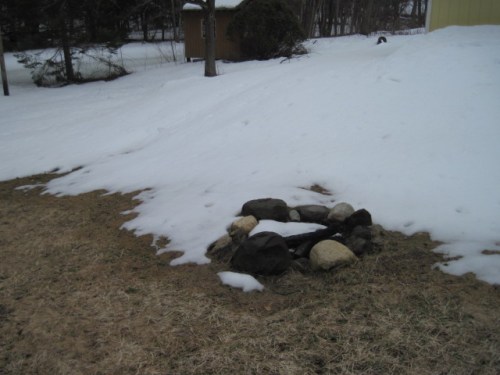
On an overcast, mild and rainy day, the stones of our backyard firepit emerge at last from the retreating snow. No thing exists “entire of itself” or for itself only. It also touches things around it, making and meaning for them a whole range of significances. For the moles in the lower yard, warming weather soaks the earth with snowmelt, and that means flooded burrows. For the deer who’ve survived the New England winter, fresh browse as the grass greens again under the strengthening sun, with the tender shoots of new growth burgeoning everywhere. For the returning birds, nesting material, the first bugs, and surfacing worms.
One of the core teachings explains that the macrocosm (literally ‘the great universe,’ the universe around us) and the microcosm (the ‘little universe,’ the universe within us) are mirror images of each other.
Thus, we can look to the world of nature around us for help in understanding our own nature, recognizing that if a theory about the nature of the universe proves to be a mistake when tested against the world around us, it will also prove to be a mistake when applied to the world within us (Greer, J. M. Mystery Teachings from the Living Earth, pg. 15).
Inner turmoil, strange dreams I can recall only fragments of on waking, a sense of being reminded of — and held to — a standard I agreed to long ago. A sense of being on the cusp of some ordination, relied on for a spiritual responsibility. “Ready or not, here I come”, says Spirit.
“Every human being is already a priest”, says John Plummer in his book Living Mysteries,
in a very primal sense. We stand between earth and sky, like pillars in an ever-moving temple. We find ourselves within and among other humans and many other orders of being (stones, plants, animals, elementals, angels, etc.) with energies flowing back and forth, consciously and not … Our outer personalities mediate the sacred presence at the core of our being, more or less well. We are all points in an extraordinarily complex web, through which divine power moves. That power … is much greater than us, and not particularly concerned about whether we understand how it is working, at any given moment (pg. 13).
Whether baptized or called by the spirits, pursued and confronted by an animal guardian, taught in dreams, initiated through suffering or illness or other trauma into a spiritual quest, roused by the shakti of a guru or the accumulated potency of intensive meditation, ignited by our own unanswered questions and a divine discontent, or turned off all spirituality by its many fakes and shams into a formidable and rationalistic atheism, we are called.
Plummer continues:
… we cannot turn our back on it. If we try, it will come knocking louder and louder, until we re-open the door. We have to feed it from our own substance, letting it grow through us, and then hand it forward to those who come after us, whoever they may be. To fail to transmit what we have received is to dam a stream until it becomes a stagnant pond, rather than free-flowing, clear water (pg. 15).
And so we come to this weekend, both April Fools’ Day and Easter, that lovely Pagan celebration — after all, it does take place on the first day of the Sun, after the first full moon, after the Spring Equinox — a true Pagan Triad of Light.
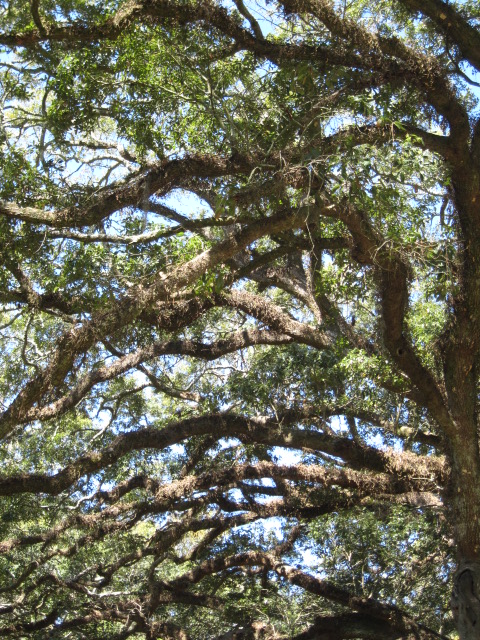
Gulf Coast Gathering ’17, Live Oak canopy
Water and Light, and the holy Trees as witnesses.
/|\ /|\ /|\
Greer, J. M. (2012). Mystery Teachings from the Living Earth: An Introduction to Spiritual Ecology. Weiser Books.
Plummer, John. (2006). Living Mysteries: a Practice Handbook for the Independent Priest. Berkeley, CA: Apocryphile Press.

photo courtesy Brenda Ash
OBOD Chosen Chief Phillip Carr-Gomm at this weekend’s Gulf Coast Gathering in Louisiana. The Alban Eilir/Equinox altar features Spanish moss and whelk shells. I didn’t attend, but through a magic as palpable and marvelous as any, an image consisting of light particles carries this moment from the event to all of us. Surely we can number images among our altars — beloved photographs of dear ones, of family and friends gathering, of the large moments and smaller ones of our lives.
And in the image below, Mystic River Grove’s Equinox celebration, which I was able to attend, processes through the March snow toward their ritual site in a Massachusetts park.

photo courtesy Anna Oakflower
Here are many altars: the altar of the event, held in imagination and expectation. The altar of the location, a park, a dedicated space of a different kind: the will existed to preserve a natural space from development and for the public, an acknowledgement of common wealth, re publica, for which the Commonwealth of Massachusetts is named in aspiration. The altar of each body present, beaver (broad tails slapping the water when we edged too near), birch, stone, water, human (about 25 of us gathered in eastern Mass.), avian (crows, and an owl hooting during an Ovate initiation preceding the main rite), canine (coyotes yipping just at the close of the ritual and as darkness settled in).
“I make of my intentions an altar”: something I can practice doing at any moment, if and when I remember. And how often the moment makes its own altar, if I pay attention: sunlight and silence on an afternoon walk, or a caucus of crows startled into flight and talk. A found stone that perfectly fits your hand. The first drops of needed rain finally beginning to fall. The greeting of a passing jogger or hiker out like you for word from the sun and the air and the world around us.
These are the democratic altars of existence, moments and openings of life and energy accessible to all. In them lie the origins of Druidry and so many other practices, a “momentary stay”, as Frost says, “against confusion”. Even the effort to “stay”, or simply to celebrate as it all passes by, is an altar, a focus.
We gather after the ritual at a long-time member’s home, another kind of ritual. Two soups go onto the stove, chicken and potato-leek. A salad comes together, and — warmed by a generous assortment of alcoholic contributions, an altar of bottles on the kitchen counter — several of us nibble at irresistible dessert cookies while the main course warms. We glow a little brighter in each other’s company, another altar we make by choice and effort. We could have stayed home for any reason, but we didn’t. An important altar. Others — a parent’s death last autumn, remembered; an upcoming surgery and a request for prayers; a first home and all the discoveries of ownership.
The “secular” is the “world” — Druidry recovers the world in all its sacredness, a human forgetting changed into human recollection.
Trees, humans too, we stand against the sky, a grove of profiles, outlines against the sky. Feeling our ways along, delighting — given half a chance, making one for ourselves — in all the altars of our worlds.

/|\ /|\ /|\

one tree, two trunks — our old willow
We stand a little past the Equinox, and here, east of the Green Mountains (a hopeful name!), the snow’s half-gone, or going. As of today where I live in southern Vermont, sunrise came at 6:46 am, and sunset tonight will clock in at 7:06 pm — the day now 20 minutes longer than the night.
As always and forever, the planet — and that includes our neighborhoods on it, wherever they are — matters more pervasively, and holds more true and enduring interest, than whatever’s shrieking for our attention in the media. Politicians trade places, and learn with us the pointed lessons of one kind of power. Meanwhile, another and greater power plays across the earth, in our marrow, in our hearts and the roots of things.
 Here in the Northern Hemisphere, flocks of geese wing towards hatching grounds in Canada, foraging along the way in snow-fields, and shivering in half-frozen ponds and lakes. A mated pair of cardinals bob and swing at the feeder in the front yard, now up again after the bear alert.
The first brave flowers push through snow, snowdrops here, and a friend in Boston, two hours to the east and moderated by the Atlantic, reports honeysuckle and monkshood. In the back yard, boulders with their thermal mass warm each day in the strengthening sun and thaw a semicircle in the snow around them.
The willows everywhere hold out their green-yellow twigs, waiting, preparing. I stand for a moment with the great willow in our lawn. Last autumn a large upper branch snapped in a storm, and amazingly it hasn’t yet fallen, half-supported by a nearby pine. In another few weeks I’ll climb and saw it the rest of the way. Willow deadfall — the tree sheds like a Labrador — light and punky once it dries, has served as our principal kindling all winter long.

backyard blueberries, red sap rising
Here in Vermont, NG, a Druid in the north part of the state, has launched our first seed group, the initial step towards forming an OBOD grove. As with seedlings, the first steps of care ask for our regular attention. We may gather at midsummer to bless the young sprouts and tender shoots of that initial intention — it depends on whether we reach the critical mass all groups need in order to move from idea into manifestation. There are possibly a half-dozen of us so far around the state linked by a mailing list, a May website.
This afternoon I’ll gather with Mystic River Grove in Massachusetts for their Alban Eiler/Equinox rite. Members and friends come from Maine, Connecticut, New Hampshire and Vermont. After, it’s feast time, a chance to (re)connect with the many members of OBOD’s first and largest Grove in the U.S., see how we’ve all wintered, and celebrate the turn towards warmth and light. “By the power of star and stone …”
May the light, clarity and sanity of March bless you all.
/|\ /|\ /|\
As a practitioner of what the following podcast calls “blended spirituality”, I was particularly interested in Tapestry’s recent conversation with Rev. Shawn Beck.
You can find the entire podcast (38′) here, along with some print excerpts of the interview.
As an OBOD Druid and an ordained priest in the Anglican Church in Canada, Beck faces a range of reactions when people learn of his practices.
“Well, that’s sorta neat, but actually you can’t do that” go some of the responses, both Christian and Pagan.
“In fact, I’ve been practicing it for a while, and I can”.
Our human liking for boundaries shows clearly here.
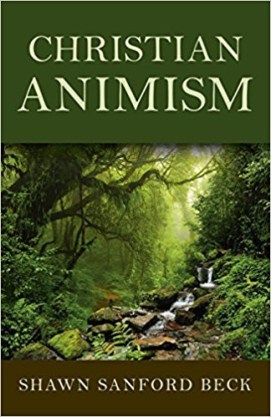 “What I find so interesting is that you’re not dabbling … you’re committed to both traditions”, says interviewer Mary Heinz.
One of the occasions for the interview is the publication of Beck’s book Christian Animism, which promptly goes onto my reading list.
Beck remarks, “I do identify myself as primarily Christian — heavily influenced and really spiritually transformed by Neo-Paganism”.
Asked how these two paths impact his daily practice, he notes that bringing in the feminine divine, and the value of nature as sacred, touches both his daily prayer life and public ritual.
“If I give a blessing, I may say … ‘one God, creator and mother of us all'”, says Beck. For him, the blending of paths augments language and practice, expanding them and their sensibilities.
“What do your superiors in the Anglican Church have to say to you when they weigh in?” queries Heinz.
Besides keeping his bishop apprised of his work and thought (and his blog*), Beck notes, “As a priest, I need to be sensitive to what’s actually going to be helpful to the people that I’m with”. Whether it’s skipping a Starhawk reference with those who might find it frightening, or — in the other direction — “gently giving permission to people to explore that part if it’s helpful …”, Beck uses discrimination and experience to guide his priestly work.
Though he doesn’t currently serve a parish, he is responsible for the training of other Anglican priests — such is the continued confidence his superiors repose in him.
Converted to Christianity in his teens, while also exploring Eastern religions through reading, Beck observes that many of his teen peers at the time belonged to a Fundamentalist church. Even then, he learned and practiced discretion. “And so if I wanted to talk about not just Jesus but also some of these other things that I was reading and exploring, I would always know that the emotional tension in that room or in that relationship would get sky-high”.
“How much of this journey can I share with others?” is therefore one guiding question for him, as for so many of us.
“Alive — magical — responsive”: this is some of the language Beck uses of his Pagan practice that catches the interest of the interviewer.
“For the last five years, I’ve been blessed to live on a lake, on a farm, off the grid”, Beck replies (11:45). “In Saskatchewan … No running water … I run and get the water … It’s a life embedded within nature”.
What does that permit him? “Part of it for me is being attentive to presences within nature”. As a Christian animist, he says, “the world is filled with a myriad of neighbors … So it’s about recognizing that that tree that I’ve been praying beside is alive and conscious and praying with me … It’s not just a vague sense of spirit, but that the universe is comprised of persons, and these persons are my neighbors”.
“Christians when they see a person addressing a non-human person in any way, they assume that it’s worship”, Beck says.
“I ask things of my human neighbors all the time, and they ask things of me all the time. And we don’t call that praying to each other. We just call it talking to each other”.
For a decade his family has been hosting talking circles. Among the directions of these sharing opportunities, people answer the question, “Where have you found Sophia in your life this past moon? Lady Wisdom — where has she been at work in your life?”
These are some of the highlights from the first half of the interview — I hope you find it worth listening to the whole.
/|\ /|\ /|\
*Beck’s most recent blogpost as of this writing is from March 9th: “A ChristoPagan view of magic and prayer”.
Here as promised in yesterday’s post is a statement of my personal philosophy, developed as a supporting document required as part of my application with a teacher placement agency. I don’t always state things in Druid terms here — this document was intended to address life and educational philosophy for secondary schools, after all. And if you’ve ever tried to get down on paper a statement of your philosophy — a very worthwhile spiritual practice, worth spending time on! — you’ll no doubt find yourself tweaking it, if you continue to live and grow and change.
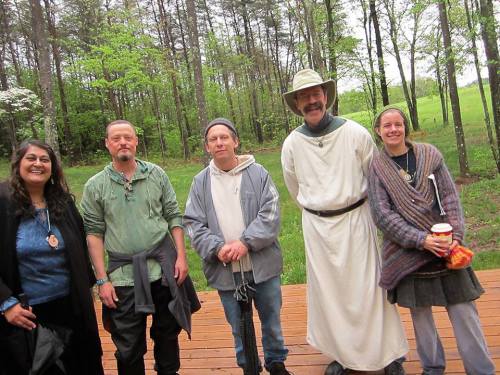
Five of us scouting a ritual site at MAGUS ’17. Photo courtesy Gail Nyoka
1) “The three pillars of achievement: a daring aim, frequent practice, and plenty of failures” – old Welsh triad. Very succinctly, try one more time than you fail. Helping students, colleagues and myself practice this principle boosts successes. Give me a worthwhile daring aim, and I’ll try that extra time.
2) “Think inside the box – it’s fresh territory again. Everybody else has left”. As long as I don’t overuse this, I can still get my wife to laugh at it. More to the point, it’s increasingly true. “Tried and true” techniques, practices, strategies and principles that don’t grow old with time or use really do still exist and merit our attention and implementation. (Often they’re just lying there in the box.)
3) Listen early and often. “Everybody’s talking at me/I don’t hear a word they’re sayin’” sings Harry Nilsson. Goes double for adolescents. Help being heard not be a novel experience for others.
4) “Time is but the stream I go a-fishing in. I drink at it; but while I drink, I see the sandy bottom and detect how shallow it is. Its thin current slides away, but eternity remains. I would drink deeper; fish fill the sky, whose bottom is pebbly with stars” – Thoreau, Walden. Among many other things, a mantra for calm and perspective. Ask me about my focus and I’ll be recalling center-points like this.
5) One and one and one and one and one and one and one and one and one and one are 10. Hint: the double-digit sum really doesn’t come out of nowhere. Even despite appearances. Or to steal from Neil Armstrong, it’s that next small step that makes a giant leap possible.
6) Upren masei kapotas ambei solna ir mitmu aljagotvei djuva. Literally, “Over our heads are both the sun and a most changeable sky” – Sovermian proverb (one of my constructed languages). Constants and variables aren’t equivalent, though we mistake one for the other constantly (and variably). And where does literature not illustrate this?!
7) Man déð swá hé bið þonne hé mót swá hé wile. Loosely, “folks do as they are when they can do what they want” – The Old English Durham Proverbs. Alternatively, both a justification for the rule of law, and for the positive consequences of accepting responsibility for oneself. Worth modeling.
8) “Is the juice worth the squeeze?” (AKA, good things can come from student film recommendations!) Pithy and fresh enough to stick in adolescent brains. Better than most “don’ts.”
9) If it’s avoidable, avoid it. If it’s celebratable, celebrate it. If it’s mnemonicizable, mnemonicize it. And if it has scales and fins, in which direction does it actually swim? (I’m a fan of mnemonics and other learning strategies.)
10) “All materials to build your home in this world or the inner cosmic worlds come from within, from the God center in your heart” – Paul Twitchell. Good for resetting the relative positions of responsibility, source, potential and manifestation. Frequently applicable in classrooms and curricula. “Ask me how!”
11) “… by now my desire and will were turned,/Like a balanced wheel rotated evenly,/By the Love that moves the sun and the other stars” – Dante, Paradiso. A life goal.
 | Nancy Hart on Flowing With, Not Through |
 | gvk23 on Radiate, sayeth Moon |
 | Catriona McDonald on Returns |
 | Steve Shelton on Returns |
 | Dana on Returns |
 A Druid Way

