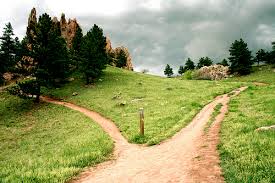
Imagine a path you create as you go. We don’t need to call it “shamanism” or “Druidry” or “earth spirituality” or anything else in particular. If anyone asks, it’s “nothing special.” It’s just “what you do every day.” I call it my life.
You respond, or you don’t, to the guidance of hints, nudges, dreams, gut instinct, chance encounters, coincidence. You seek, or you don’t, for something that begins to answer the call inside you, the tickle or itch that won’t go away. Oh, you can dull it for days or decades with a wider variety of distractions now than at almost any other time in the last ten millennia.
Sometimes, perversely, it seems the call or itch or tickle is ITSELF the distraction. Can’t do it all. Just gonna live my life. Keep my head down. Leave me alone, will ya? Not gonna get suckered into a wild goose chase, a will o’ the wisp, a fool’s errand. (How many names we have for them …) YOLO. You only live once. Just do it. Live like nobody’s watching.
And the silence, which never quite goes away, which nothing ever completely fills, which opens ever more deeply inward.
Until the day it doesn’t. A barrier, a wall, a blockage. Maybe a guardian who challenges you there. Inside, perhaps, or outside. That restless partner, impossible boss, difficult co-worker, awkward relative, rebellious child. Just for you. Old story. New each time it happens to me, though. OK, so what is it this time? What’s the point, the life lesson? Sometimes a pain in the ass can just be a pain in the ass and nothing else, right? Please? Can’t the growth thing give me a break?
Then, oddly, it does. A month, a year. Smooth sailing. What’s new? Nothing much. Your holiday notes are short because, blissfully, things are going well. If you’re the suspicious type, you wonder why. If you’re just grateful, you go with it.
Soon enough the sane plainness of it all threatens to run you stark raving mad. Something, anything different. The uneventful routine you longed for has sucked you dry as last month’s bread. You’d prefer a little drama, maybe — you hear yourself actually say it — a minor, manageable disaster. Just, you know, for some color. Something different.
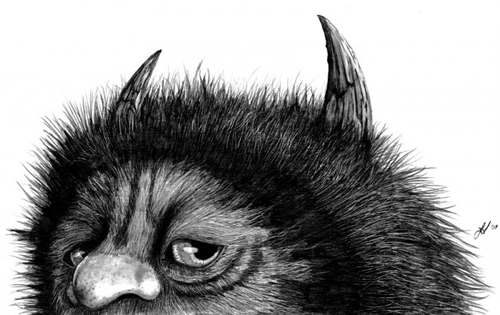
The universe, remarkably compliant, gives us what we ask for (or what we fear, which is asking by negation; or what we’re least prepared for, which is a gift for our carelessness; what we never saw coming, which is “a little something” for our blind indifference), whether we want it or not. The universe: compliant, and monstrous. Monster under the bed, enormous, hairy and fanged. Or snake-slick and implacable. Or less distinct, and thus scarier: dark tunnel over there, on the other side of the light, which the whirlpool of this dream drags you toward, closer, closer …
If you know all this, have done all this, seen it all, heard it all before, know it inside and out, welcome. You’ve just finished the introductory material. Now for the actual beginning.
/|\ /|\ /|\
In the first chapter of The Lord of the Rings, Bilbo sings of the path, his path as he leaves the Shire. (That’s old wisdom, not taught much anymore. When in doubt about something, make a song of it. It helps.)
The Road goes ever on and on
Down from the door where it began.
Now far ahead the Road has gone,
And I must follow, if I can,
Pursuing it with eager feet,
Until it joins some larger way
Where many paths and errands meet.
And whither then? I cannot say.
/|\ /|\ /|\
Walking two paths and contemplating the Ovate grade feels something like this to me right now. The real climb is about to commence. (Already has.) I’m standing where I’ve always been, which is on the way to somewhere I can’t quite make out. Glimpses, sometimes. A voice I know, then a good conversation one afternoon. Or a curve in the path opens onto a familiar vista. The waterfall, or lake, or mist over the valley. The call of a bird. A memory, piercing in clarity. A discovery, one that time brings you, or one that has nothing to do with time. Rest point. Then back out into it.
The start of Ovate is both the vehicle that has brought me here, and simply a step with a label off the shelf that I grab for convenience and plaster on my experience because it’s there (both experience AND label), because it caught my eye. “Oh-vate.” A little inspired, a little crazy. Vatic power, and all that. Indo-European *watis “inspired, mad, possessed, crazy.” Ancient word sent through its changes, re-surfacing in Old Irish fáith “seer, prophet” and then as Woden or Odin, god who hangs on the World Tree Yggdrasil for nine days for the gift of wisdom, for insight. God who sacrifices one good eye for the same reason. Your life comes asking “What’s it worth to you?”
Warrior, traveler, initiator, self. Homeless person you meet on a street corner, and turn from, because he reeks of sweat and urine, because he’s mumbling (or screaming) to himself. So not the Druid I was looking for.
And yet this, too, is useful, or not. We reach for images to see the invisible, to name the nameless. The Way that can be walked isn’t the real (lasting, eternal) Way, says the Tao Te Ching. Six words in Chinese: dao ke dao fei chang dao. “Way can way not lasting way.” A mantra for the possible, for the (in)sane, for the despairing. “Over the river and through the woods to grandmother’s house we go.” Same woods where Little Red Riding Hood meets a man-eating wolf on her path.
Carl Larsson’s Little Red Riding Hood. Wolf at your elbow?
But we walk it anyway, because there isn’t any other way. No way! people say when they don’t believe something. No path to understanding. I’m stuck in surprise and disbelief. Not a problem. You can “way” it anyway. “What’s love got to do with it?” asks Tina Turner in her signature song. What’s belief — or a clear path — got to do with it? Some people stop at the first line. But the Tao Te Ching does actually offer some useful advice mixed in with the maddening inscrutability of its lines:
True, the way you can walk ain’t no lasting way. The name you give it (or yourself) ain’t no lasting name. Give one thing a name and you find a whole world of (other) things. Long for anything and you may run up against its shape (or its opposite) everywhere. Give up longing, though, and it opens into a mystery. Both of these come from the same source. If I had to name it, it’s darkness. Darkness IN darkness, a door to understanding. Really? Uh-huh.
Understanding. Great word. When you stand-under it, and don’t grab at it, it comes to you of itself, like dawn, arriving every morning without any tugging on your part. Like a bird at the feeder which grows accustomed to your presence as you patiently fill and refill the seed each day. Feed your mystery until you feel its wings beat and hear its chirping.
/|\ /|\ /|\
The last chapter of The Lord of the Rings (which is never the last chapter, another piece of old wisdom now fallen into sad disrepute) gives us additional words to Bilbo’s walking song:
Still round the corner there may wait
A new road or a secret gate,
And though I oft have passed them by,
A day will come at last when I
Shall take the hidden paths that run
West of the Moon, East of the Sun.
Looking at the current roster of candidates for U.S. president, all I can think of are the words of Dr. Horrible (a marvelous Neil Patrick Harris) in Joss Whedon‘s unique Dr. Horrible’s Sing-along Blog: “The world is a mess and I just need to rule it.”
You can catch the good doctor’s comment (along with another quip about the “status quo”) near the end of this 1-minute clip:
/|\ /|\ /|\
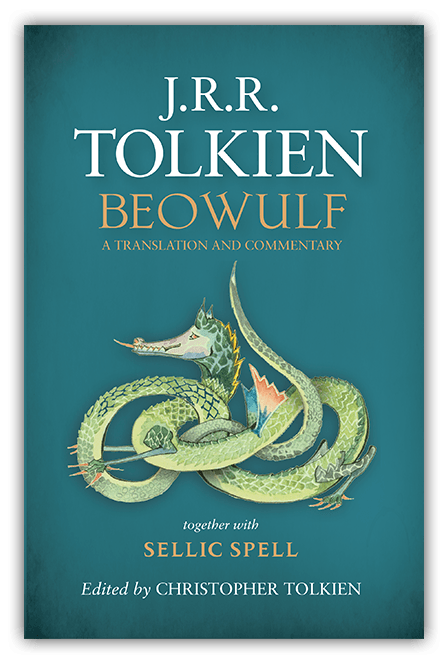
Just back from the 50th Int’l Congress on Medieval Studies (held every year in Kalamazoo, MI) where I survived delivering my paper on “Tolkien’s Beowulf and the ‘Correcting Style'” and hobnobbed with some 3000 other medievalists from around the world. The Congress is always a remarkable experience: the 4-day event this year included 567 sessions of papers, roundtables and presentations, along with the always-popular publishers’ room (BOOKS! we’re NERDS!), concerts, mead-tastings, interest-group meetings, the annual Saturday Dance, the Pseudo Society’s mock lectures and delicious satiric send-ups of all things medieval, housed in typical 1950s-style concrete block dormitories with university cafeteria food and coffee, in always variable Midwestern U.S. May weather.
/|\ /|\ /|\
Also visited again the striking Serpent Mound near Locust Grove in southern Ohio, and learned there’s a winter Solstice celebration at the site that includes the placing of lights to outline the earthwork serpent that loops across a rocky outcrop of the Adams County countryside:
(WILDART ALBRECHT 12/20/10) Volunteers light the 900 luminaries at the Serpent Mound in Adams County for the winter solstice. (Dispatch photo by Eric Albrecht)
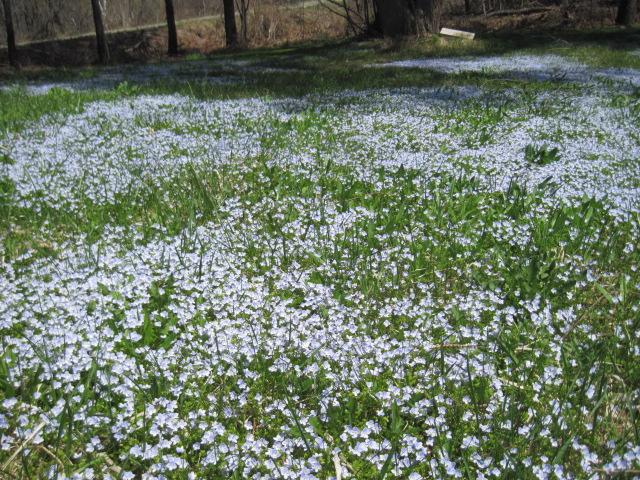
Bluets carpet our backyard lawn, an easy seduction into putting off the mowing I’ll need to do in another week. The air itself is a welcome. I no longer brace myself to step outside. Instead, I peel off an unnecessary extra layer and stand still, feeling my body sun itself in the coaxing warmth. Bumblebees chirm around the first blooms, goldfinches dart across the front yard, and our flock of five bluejay fledgelings from last year wintered over without a single loss and now sound a raucous reveille every morning.
In this last of a four-part series on Beltane, I want to look at our “found festivals” — how we also touch the sacred in the daily-ness of our lives. We don’t always have to go looking for it, as if it’s a reluctant correspondent or a standoffish acquaintance. When I attend to the season and listen to the planet around me, I touch the sacred without effort. The sacred encounter, like a handshake, is a two-part affair. How often do I extend my hand?
Susanne writes in a Druid Facebook group we both follow that finally in her northern location “the last bit of snow on the north side of the house melted away on Beltane day.” Gift of Beltane. Something to dance for.
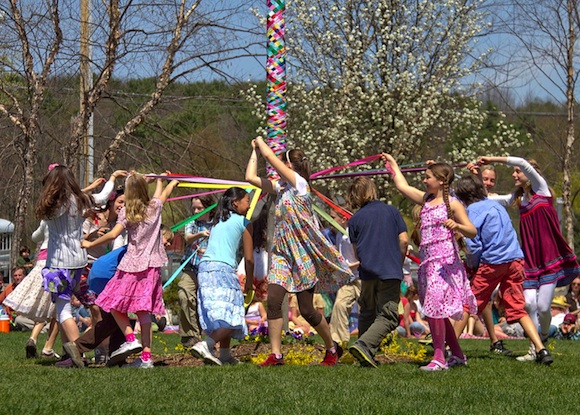
Rudolf Steiner school celebration in Great Barrington, MA
The ritual calendar of much modern Paganism meshes with the often milder climate of Western Europe where it originated. It doesn’t always fit as well in the northern U.S. or Canada, or other places that have adopted it. (So we tweak calendars and rituals and observances. Like all sensible recipes say, “Season to taste.”)
It’s a cycle that the medieval British poet Geoffrey Chaucer celebrates in the Canterbury Tales by singing (I’m paraphrasing lightly):
the showers of April have pierced the droughts of March to the root … the West Wind has breathed into the new growth in every thicket and field … the small birds make their melodies and sleep all night with open eyes …
A Vermonter like me looks at Beltane looming on May 1 and reads those lines of Chaucer’s and thinks, “About a month too early, Geoffrey.” Spring, not summer, begins at Beltane, though to feel the recent temperatures on your face you might well think Beltane is the start of summer indeed. Game of Thrones fans, never fear: Winter will come (again). But now … ah, now … Spring!
Susanne continues:
and even though they are a symbol of Imbolc, the snowdrops are blooming merrily followed closely by the daffodils. The peepers are peeping, the owls are hooting, the woodcocks are rasping ‘peent’ on the ground and twittering in flight.
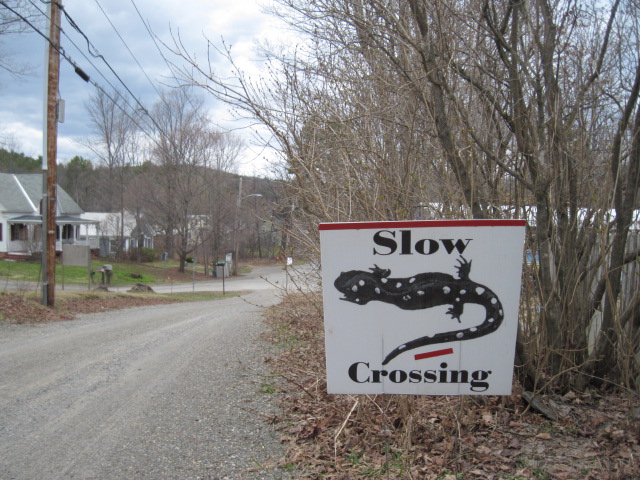
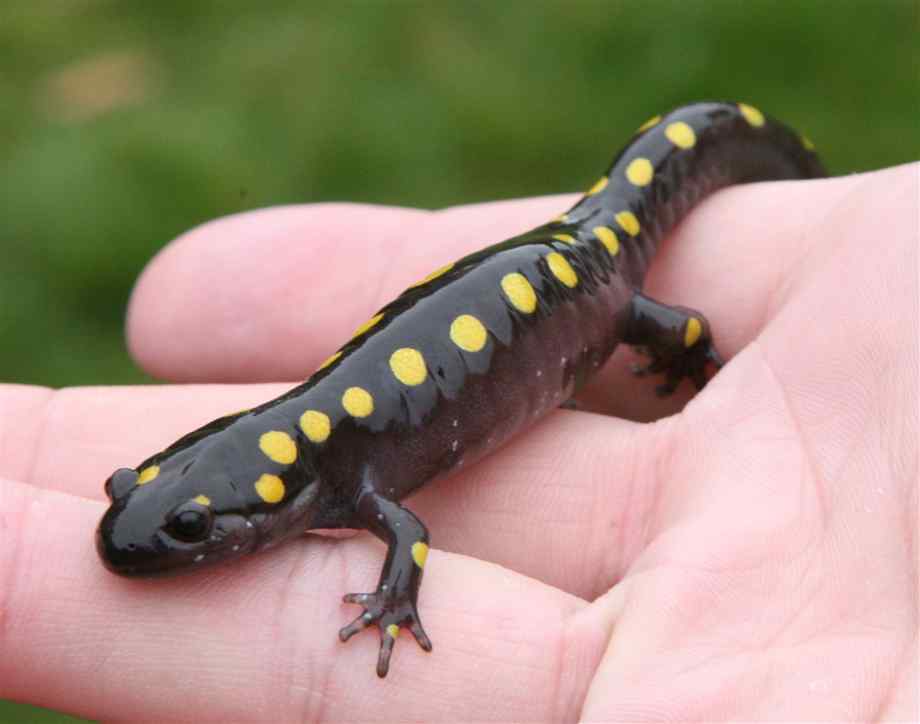
salamander crossing signs in our nearest town
Late April and early May here in southern VT, and in your home area, too, means an annual migration of some sort. Here it’s spotted salamanders. After dark, volunteers with flashlights man the gullies and wet spots to escort the salamanders safely across roads, and slow the chance passing car to the pace of life.
Beltane finds Susanne with her hands in the earth, responding to the call of Spring:
The weekend was spent with Spring clean up, turning the soil and sowing the greens and peas in the garden. I was a bit disappointed in myself that I haven’t held a Beltane ritual but then I realized that this was the ritual…working with the soil, plants and spirits of the land, listening to my favorite songs …
On the second day of Beltane, the Old Gods said to me:
Dance round the fire, and then say what you truly long to be …
I always find Beltane lasts longer than a single day. This year I’m celebrating it over three days, from yesterday, the “official” May-Day, through tomorrow, with the Full Moon at its peak at 11:42 pm, Eastern Standard Time in the U.S. (that’s 03:42 Greenwich Time, May 4).
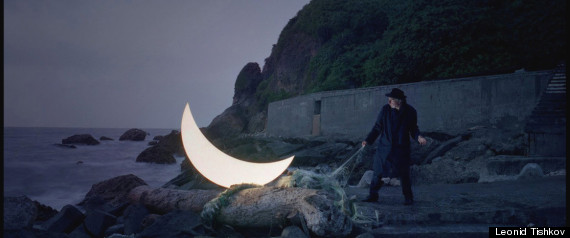
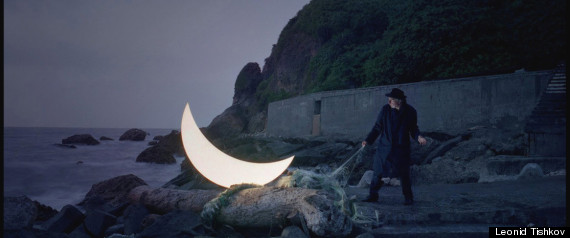
Do you carry a private moon with you? At times like these I feel I do. It’s tucked under my ribcage, trembling like a small forest creature that’s heard an owl: I have a lunar heart. Or in place of my mouth, a moon. No words, just white shadow wherever I turn to speak.
I do the original moonwalk, following shimmering paths visible at no other time. Or I hold out my hands and each palm glows with a hemisphere of unearthly light. I clap them together and the blow sparks new planets all up and down my spine.
Leonid Tishkov: “Private Moon”
Festival observances, like other rituals, can make us vulnerable to ourselves in powerful ways. Often we’re taught to leave dreams in childhood, as if adults don’t need to dream at all, let alone dream bigger than we ever dared as children.
Open myself to desire and dream, and longings I’ve shoved aside, sometimes for years, can rush back full-force. What I still dream and wish for are gifts my childhood has kept in store. Not just for the grown-up me, though it can feel that way. These gifts may have taken human or animal form, wandered homeless, raggedy and broken and weeping, or snarling, feral, wild things no child could understand. Things it runs from, things that hide under the bed, in the closet, that stretch and loom after the bedroom light gets turned off.
But the child also recognizes them as blood kindred, curls up with them each night, and each dawn they glimmer and vanish till the next twilight gathering. They reappear in that book you read and re-read till it fell apart in your hands, in the story no bedtime retelling could ever wear out. The childhood rituals that primed you for adult ones of deeper mystery: sex, death, creation.
What I do with them now are the gifts I give back to that younger self, some fulfilled, others still orphans. But I have brought them out and looked at them head on, and hugged them. I take them in even as I give them back. And in that circuit lies power.
Beltane pairs with Samhuinn across the ritual year, its opposite pole, and this Beltane-with-a-Scorpio-Moon I’m feeling it particularly strongly. No surprise, the astrologically-minded say:
The sun is now anchored in the sign of Taurus. Beltane occurs when it is precisely half way through the sturdy earth sign. The sign is symbolized by the fertile bull and, given its association with the fecundity of the springtime in the Northern hemisphere, Beltane in particular is a full-fledged celebration of life, creativity and the abundance of the upcoming summer season.
But, its polarity, Scorpio, is not.
Scorpio’s domain deals with matters that no one else wants to: the vile, the putrid, the petrifying, the intense, the rejected, the betrayed, the scorned, the scathing, the denied and the dead. Scorpio reminds us that we can repudiate anything for an eternity but that doesn’t mean it will be resolved, it doesn’t mean that it will be repaired, and it doesn’t mean that it will go away.
Ritual is one way to approach the difficult as well as the beautiful, to manage them in more bite-sized (ceremonial-sized) pieces. And sometimes, to discover the beautiful and the difficult, the deformed and the immensely powerful, amount to the same thing.
Beltane carries Samhuinn in its belly, or on its back. Or Samhuinn is Beltane turned inside-out. Both are fire-festivals, and fire does not always lie easily on the hearth. Sometimes it flames forth, blows past barriers and oppositions in its guise of wildfire.

 Imagine a path you create as you go. We don’t need to call it “shamanism” or “Druidry” or “earth spirituality” or anything else in particular. If anyone asks, it’s “nothing special.” It’s just “what you do every day.” I call it my life.
 The universe, remarkably compliant, gives us what we ask for (or what we fear, which is asking by negation; or what we’re least prepared for, which is a gift for our carelessness; what we never saw coming, which is “a little something” for our blind indifference), whether we want it or not. The universe: compliant, and monstrous. Monster under the bed, enormous, hairy and fanged. Or snake-slick and implacable. Or less distinct, and thus scarier: dark tunnel over there, on the other side of the light, which the whirlpool of this dream drags you toward, closer, closer …
 The start of Ovate is both the vehicle that has brought me here, and simply a step with a label off the shelf that I grab for convenience and plaster on my experience because it’s there (both experience AND label), because it caught my eye. “Oh-vate.” A little inspired, a little crazy. Vatic power, and all that. Indo-European *watis “inspired, mad, possessed, crazy.” Ancient word sent through its changes, re-surfacing in Old Irish fáith “seer, prophet” and then as Woden or Odin, god who hangs on the World Tree Yggdrasil for nine days for the gift of wisdom, for insight. God who sacrifices one good eye for the same reason. Your life comes asking “What’s it worth to you?”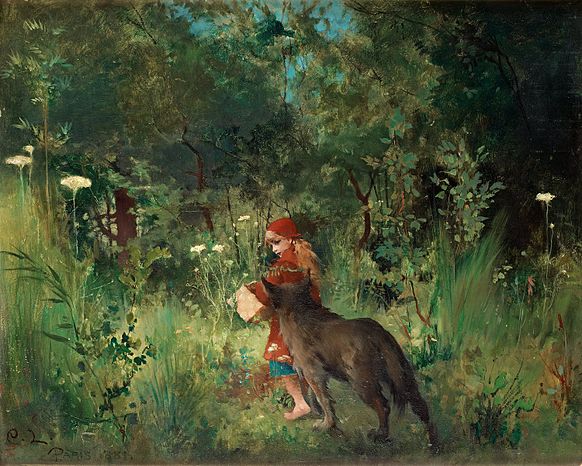




 A Druid Way


.jpg)


.jpg)