
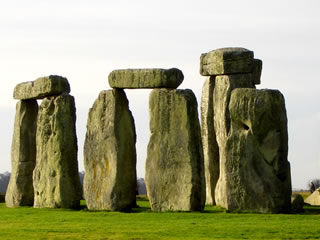
Selfless trilithons
Will Self’s June ’14 article in The Guardian (“Has English Heritage Ruined Stonehenge?“) has recently been (re)making the rounds on Facebook groups I frequent, and the author’s lively reportage offers generous “blog-bites” to quote (starting with that title), so it’s ready grist for the mill of A Druid Way.
In fact, if you just jump straight to his article, read it and — in the way of our Net-lives, surf on to the Next Interesting Thing (a NIT to pick, if there ever was one) — if you neglect to return here, I’ll not only not be hurt but will rest content that I’ve served one of my purposes.
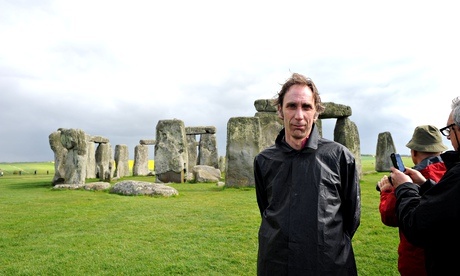
“Selfies with Trilithons”: Will Self visits Stonehenge. Image Mike Pitts, The Guardian.com
I admit to a fondness for titles that use questions.They successfully play on our inherent OCD, setting themselves up like an itch begging to be scratched. They’re Zen koans for the non-Zen types among us. You read them to find out the answer, or at least what the author thinks is the answer, and so you relieve the itch, even if the particular scratch the article provides ultimately irritates you further.
New, worse itch? No problem. The latest diet, scandal, must-see series, sex technique, disaster or investment opportunity all await you, just a click away, and many will use questions to draw you in. The “Top 10” list relies on a similar strategy: human experience boiled down to a concentrate. Just add water! Maybe at best our lives are indeed “selfies with trilithons” and everything else slips downhill from there. Or so a great part of the Western world’s surface culture would have you believe.
The article byline asks, “The summer solstice, King Arthur, the Holy Grail … Stonehenge is supposed to be a site of myths and mystery. But with timed tickets and a £27m visitor centre, does it herald a rampant commercialisation of our heritage?”
You’re being wholly reasonable if you guess Self’s answer is “yes.”
English Heritage earns decidedly mixed reviews here. It’s the U.K. organization that oversees such sites as Stonehenge, and for Self it serves a very mixed role as an institution whose “very raison d’etre consists in preventing the childish public from chipping away at stuff they don’t understand much – beyond the bare fact that it’s very old – so they can cart off a free souvenir, rather than shelling out for a Stonehenge snow globe in the superbly appointed new gift shop.”
“Stonehenge snow globe” works fine as an alternative title for this post.
Self’s wit attacks a range of easy targets besides English Heritage. It’s little surprise Druidry comes in for a smackdown, too. “As inventions of bogus deep-time traditions go, British druidism has to be one of the most enduringly successful.” Except that unlike Stonehenge, all modern forms of Druidry that expect to be taken seriously assert precisely the opposite. They’re comparatively new on the scene, and they dispense with bogusness. They’re no older than the Druid revival of the past few centuries because that’s their real origin story — and this revival coincides point-for-point with rediscovering and wondering about and valuing things like Stonehenge and Avebury and Newgrange. You know — those Neolithic things that have always lurked in the neighborhood and have been with us for a very long time. We just never paid them much attention.
Until we did.
[Even Reconstructionist Pagan groups — who point with some justifiable pride at archaeological and other scholarly evidence to back up their practices and who sometimes sniff disdainfully at groups like OBOD, which draw on both legend and myth and on Druid Revival writings — benefit in the end from the scientific investigations ultimately launched by those same enthusiasms and, yes, those initial misconceptions of the Revival.]
We like our monuments and religions old, though we want our gossip and news “live, local and late-breaking” and our technology to be version X.X + 1 — whatever’s one higher than last week’s version (unless it’s Windows). “Selfie with a trilithon” pretty much sums it up.
But if modern Druids are the philosophical and spiritual equivalent of “the childish public … chipping away at stuff they don’t understand much – beyond the bare fact that it’s very old,” then what is it that we “cart off” from it? A reflected glory from old things? A fine wild-goose-chase for the ego? The illusion of connection with something larger and more lasting? (“All this and more for twelve easy payments of just $39/month! Our representatives are standing by for your call now!”)
These are the surface manifestations of vital and unquenchable hungers that have wakened in large numbers of people, however much a passel of hucksters manages to package and market empty and pricey facsimiles of them. Self does concede that “in important ways the [P]agans and the archaeologists retain a common cause: both groups, after all, venerate the monument, even if it’s in radically different ways.”
Self also contrasts Stonehenge at present with ancient sites:
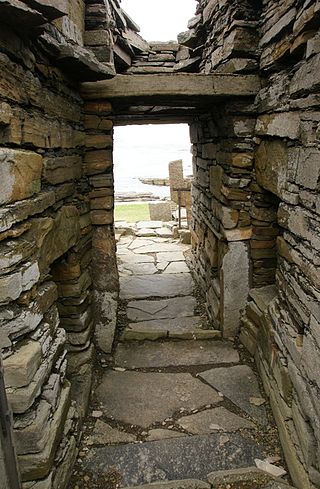
Midhowe broch
… in the Orkney islands, where I lived over the winter of 1993-4 – I’ve returned many times since – Neolithic remains can seem more significant than the contemporary built environment. A couple of miles from the house I stayed in on the island of Rousay, there’s the ruin of an iron age broch, or fortified dwelling, and beyond this there’s a Neolithic chamber tomb, Midhowe, that’s dated to the third millennium BCE. Midhowe is a large and complex structure, although by no means as obviously important as Stonehenge. It was fully excavated in the 1930s and 40s by Walter Grant (of the distilling family) who owned the Trumland estate on Rousay, which included this site and several other important tombs. Since the roof of Midhowe has long since gone, Grant covered up the exposed stonework with hangar-like structure, but the curious thing is that this doesn’t detract at all from its powerful and brooding atmosphere.
During my times in Orkney I’ve visited a great many of the Neolithic sites. I’ve sat in tombs, laid in them, dreamed in them, and tried to grasp the sort of mindset – whether individual or collective – that’s implied by buildings that took shape over thousands of years, and were built by people with life-spans far shorter than our own. I have felt the wonder – felt it most of all, because at Midhowe there is hardly any of the furniture and signage associated with the modern tourist attraction: no ticket office, no custodian, and only discreet information boards. Apart from in high season, you can visit Midhowe and most of the other great Orkney sites with the confident expectation that you’ll see scarcely another human being.
If, as Self notes, “archaeologists seem fairly convinced that implicit in the Stonehenge’s design is some form of ancestor worship; for us there can be no doubt: we revere the idea of their reverence, we are engaged in a degraded form of meta‑ancestor worship,” then we can also see, in our longing to (re)connect, a “degraded” form of magic. “I don’t want anything to do with magic,” we often say, as we unwittingly absorb endless hours of advertising and political language which constantly attempt to manipulate our desires and emotions with crude magical techniques. We let ourselves be “magicked” but refuse to learn how to practice any “defense against the Dark Arts” — or learn how to do magic well and for our benefit rather than someone else’s.
“No magic — that’s for kids,” we say, as our lives propel us willy-nilly along a path of magical initiation tailor-made for us out of the circumstances of our lives, our likes and dislikes, and our choices. Fate, or freedom? Yes! “When you come to a fork in the road, take it,” as Yogi Berra is reputed to have said.
“I don’t believe in magic,” we say, all the while daydreaming and planning, imagining and remembering — magical techniques in embryo, every one of them. Christian, atheist, Muslim, Pagan, SBNR, or “those who just don’t roll that way” — we all make our ways through these mortal lives which are also lives of manifestation and transformation, the essence of magic.
Author and practicing magician Josephine McCarthy, whose book “Magic of the North Gate” I reviewed here, notes that people react variously to the relative powerlessness that life in Western culture urges onto so many. But often a (paradoxically) powerful personal experience, an abrupt break with the past or the every-day world, sets some of them on a journey. In the first book of her Magical Knowledge series, McCarthy observes:
When a person chooses not to play a part in that circus, they look elsewhere. Some people begin … in search of their own power, some begin in search of knowledge, and some approach that path from a sense of deep instinct.
The beginning of the path … is very much about personal development, be it spiritual, intellectual or self-determination … This is the first rung of the ladder and has many dead ends woven into it … designed to trap and teach them a lesson that is needful for their development … The ‘dead ends’ … are often related to our relationship to power, glamour and ego. We all go through it in one form or another and most climb out of it with a very red face, ready to move on, lesson well learned. There is nothing wrong in making mistakes and doing silly things, it is all part of the learning process. The first rung teaches us about ourselves, our weaknesses and strengths, our true desires and fears, and the real extent of our ability to be honest with ourselves. Remember the words over the door to the temple: Man, know thyself.* The threshold of the temple must be crossed with the intention to be willing to look in the mirror with an open mind and see what is really there. (McCarthy, Magical Knowledge: Book 1, pgs. 30-31)
In the end you cannot study “men,” as C. S. Lewis once observed. “You can only get to know them, which is quite a different thing.” And current trends notwithstanding, we very much need each other’s compassion along the way, given the difficulties and joys of life. That’s an act of High Magic. Given how we all will face death, it’s fair to say we also deserve that compassion from each other. And death? Death is one more potential magical initiation.
/|\ /|\ /|\
Image: selfless trilithon; Midhowe broch.
*Translation of the sign over the Temple of Apollo in Delphi, Greece that read “gnothi seauton.” [Gno- related to English know, Latin cognitio, Greek gnosis. Seauton related to English and Greek auto- meaning “self.”]
McCarthy, Josephine. (2013). Magical Knowledge: Book 1 — Foundations. Oxford: Mandrake of Oxford.
Updated 9 August 2015



 A Druid Way

