Archive for March 2013
Go to Part 1 | Part 2 | Part 3 | Part 4 | Part 5 | Part 6 If we long for transformation and seek initiation, we’re looking for it in a culture which, at least in North America, seems short of ready options. One alternative, however, remains open for most people, and that is pilgrimage. Spring stirs it in us. Feel it?  Start small: weekend out of town, morning walk to work, afternoon run around the block. I jog my neighborhood, making it by intention and action a ritual as well as exercise. I greet the morning sun with a line from the Odyssey that resonates for me: “All one brightening for gods and men.” As I round the first corner, I move from brisk walk to jog. Down the hill towards woods and swamp the town must have set aside as unbuildable or protected — no one has tried, at any rate. A blessing on the spirits there, blessings in return back at me. Past the front yard garden of a lovely retired couple, a plot no more than 60 or 70 square feet, that will bloom in another month or so with all manner of flowers, then grow into a climbing, sprawling wonder of vines and stalks and pods, with sunflowers towering golden above the rest. Past the small trim house of the Latino family who has done fine stonework on a retaining wall out front, though they still face snowmelt every winter from neighbors with lots uphill from them, so now I leap puddles gathered in the cracked sidewalk. Each one lush with billions of invisible lives, even in the coolness of early spring, paramecia and bacilli and rotifers. Past juniper and ash and aspen, past the 150-year-old copper beech the school has, thanks be to the Powers who helped, chosen to save and build around rather than over. Here are battles epic and acts heroic, if I only look. Across the main campus intersection, which at this hour is mostly empty, the students still on break. Hundreds making plans to return, my colleagues emerging to photocopy and staple, recharge iPad, dust off class text, take down old classroom posters and put up new ones. The lacrosse fields and baseball diamonds still spotted with nubbly snow. A car passes, the driver waving. I wave back, not recognizing either vehicle or person, but glance at the bumper to see if it’s stickered and marked as a school vehicle. This is my community, my tribe of work.
 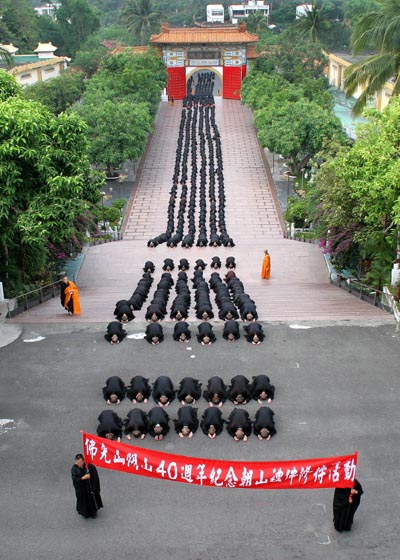 Past the chapel, pines spindly and lopped from a hundred years of pruning and thinning, but still there in spite of a campaign to “open up” the campus. But the cut trees once shaded buildings in summer, and cooling bills rose after that. There is my myth, ogre in the far land, troll at the bridge, orc to dodge and trick and slay. Each time I run I tell myself another story, and the landscape holds up each one briefly, then settles it in, saying, “This too belongs, that one also seeks its home.” After about a mile, a turn and a steep hill, the houses shouldering each in miniature plateaus up the incline. I drop to a walk at top — I haven’t run this for a couple of weeks, since the last heavy snowfall, and my loss of wind and tone shows. The next mile flat, past the downtown, the post office and diner and banks. Thousands of lives, feet, hands, eyes seeing much of what I now see, ears hearing earlier sounds of horse and buggy, wagon and cart, and sounds that never change: children, wind, voices we hear from two worlds that are also one. Want bigger myths? Find larger stories to tell, meanings that invest your landscape. I start small, for practice, then turn my thoughts toward Derby, VT, home of my father’s ancestors, a small town north of here by some five hours. I’ve never been; I’m visiting this summer, to walk the graveyard where some of my ancestors are buried. Because at a “cabin-fever” dinner in southern Vermont last weekend, I chanced to hear (there are no chances; everything is chance) a story set in Derby that I took to heart, from Joan who taught there, years ago. Everything, they say, is connected. Not so much a matter of believing as finding out how it’s true. Now the name of the town has been kindled for me. I will visit. Pilgrim, says my life, look around.
/|\ /|\ /|\
Images: Saint Helier, isle of Jersey; Fo Guang Shan; 2009 spring pilgrimage
Three welcomes I know: babe to breast, body to earth, and spirit to cosmos.
The title for this post comes from an entry by fellow Druid John Beckett on his blog Under the Ancient Oaks, which is well worth frequenting. John closes with these beautiful words: “What I cannot know by fact, I believe by love.”
So here’s my riff on it, a prayer-song and a poem and a question. I know the hawk flies overhead; I believe he is kin to me because we arise from the same world, share the same earth, water and air, and will return to them. I know my heart still beats as I write this; I believe I will have more opportunities to love before it finally stops. I know the touch of my beloved; I believe what love has taught me outweighs college degrees and years in school. I know the gifts of time and silence; I believe I can make use of them not only for my own benefit but to give back to life. I know the sun shines behind this afternoon of cloud; I believe the shade to be necessary as the sun. I know gratitude is a choice; I believe it is one of the most powerful choices I can make. I know the snow covers part of a world once green; I believe it will turn green again for many millenia yet, the cycles continuing. I know the spider I rescued from the bathtub yesterday counts for little against the hundred of bugs I have killed at other times; I believe life cannot be valued in numbers alone. I know many things hard to believe; I believe some things I may never know. And I am content that this should be so.
/|\ /|\ /|\
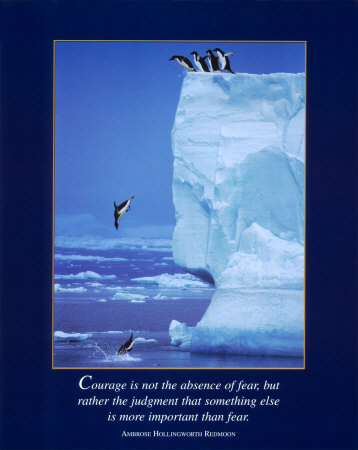 I’m still learning courage, just as we all are. Tests along the way, but no endpoint, no “I’m as brave now as I can be.” Courage is a practice. And I’ve learned that I miss opportunities for bravery where I need to, and can, practice it daily — in the face of my lazinesses and indulgences. These opportunities don’t look particularly heroic or brave, but that’s because I’m still learning what courage is. Too often I think it’s something somebody else has, or needs to have. Or I bewail its lack in others to whom I give power over my life, giving away the courage I already have. I slip into fear, and then into denial as soon as someone points it out, makes me aware, that I’m acting out of fear.
These are not words of self-blame. They’re words of clearing away, of washing the dishes, polishing the silver, emptying the ash from the woodstove. They are words of working the soil, turning the compost, preparing the growing space for the season to come. Actions that make room for courage to happen. As I prepare for health reasons to leave this teaching career of almost two decades at a private boarding high school, I look for new work. Some of it, some of what I know I need to do, doesn’t offer a paycheck. Some asks me for payment instead, and of a different kind.
Sometimes courage is just inconvenient. I’ll do it, whatever has to be done. If I’m the penguin next off the ice floe, I know that water’s cold. I’m not looking forward to it, but I know it’s necessary. I bring the best heart to it I can, if not for my own sake at this moment, then for others, as I move forward. Plunge. Afterward, I discover — maybe — that was courage. At the time I thought it was “just living my life.” “Guess what,” my life says back at me. “No difference.”
In the end, curiosity is stronger than fear. If I can imagine something different, I’m halfway there. Just catch a hint of it, a flavor, a whisper of something new yet also oddly familiar. There it is again …
Teacher, counselor and author Stephen Jenkinson has become a voice I listen to (“Yes, I hear voices”), to see what I can learn from him. He speaks, among many other things, about our need for elders — for people who have done the work and learned and earned wisdom. He talks about cultural death and the need for witness:
There is a lot of work to be done now, right now, in our time. Some of it is ecological, some political and economic, but all of it is cultural. Work I think is best understood as ‘the thing you’re least inclined to do’, and so we have our work cut out for us. The dominant culture, as near as I can tell, is in the beginnings of a terminal swoon. I don’t think it can be avoided. It’s end can only be prolonged or prompted, veiled or midwifed; those are our choices. The dominant culture was not built as if the last five hundred years on these shores had happened; it was built in spite of those years. It was built with a shrug to the past, and with the view that the past is gone. That is the principal reason for its ending. A culture unwilling to know its ragged, arbitrary origins is fated to a kind of perpetual, uninitiated adolescence, and it is by this adolescent spirit of privilege and entitlement and dangerous amnesia that our culture is known in the world.
We have to be in the culture making business, and soon. Real culture is not built on bad myths of superiority or inevitability or victory. It is built by people willing to learn and remember the stories that slipped from view, the rest of the truth that the empire won’t authorize. That learning and remembering costs people dearly. The work of building culture is learning and remembering how things have come to be as they are, without recourse to premature, temporary fixes, or to depression and despair. The way things are now, despair is a laziness no one can afford.*
That’s useful: knowing what I can afford. Fear leaves, despair leaves, when I know I can’t afford them any longer. Not a matter of will, or often even of anything other than a realization one day. A judgment, wisdom coming at last. Something taking its place — the place of fear — but also something taking its own place, its rightful position all along. Something bigger, more important. Fear turns out to be just a temporary place-holder, a filler, padding, a zero that ultimately let me count how many spaces have room for something more, native from the beginning. Return.
/|\ /|\ /|\
*From “There’s grief in coming home“.
Thanks to Philip Carr-Gomm for sending me a link to Griefwalker, a moving and provocative video about some of Stephen’s work. You can watch a trailer here:
http://www.youtube.com/watch?feature=player_embedded&v=xLQWM2j3AVg
You can watch the whole film, approximately 70 minutes long, here:
http://www.cultureunplugged.com/documentary/watch-online/play/7728/GRIEFWALKER–

 Start small: weekend out of town, morning walk to work, afternoon run around the block. I jog my neighborhood, making it by intention and action a ritual as well as exercise. I greet the morning sun with a line from the Odyssey that resonates for me: “All one brightening for gods and men.” As I round the first corner, I move from brisk walk to jog. Down the hill towards woods and swamp the town must have set aside as unbuildable or protected — no one has tried, at any rate. A blessing on the spirits there, blessings in return back at me. Past the front yard garden of a lovely retired couple, a plot no more than 60 or 70 square feet, that will bloom in another month or so with all manner of flowers, then grow into a climbing, sprawling wonder of vines and stalks and pods, with sunflowers towering golden above the rest. Past the small trim house of the Latino family who has done fine stonework on a retaining wall out front, though they still face snowmelt every winter from neighbors with lots uphill from them, so now I leap puddles gathered in the cracked sidewalk. Each one lush with billions of invisible lives, even in the coolness of early spring, paramecia and bacilli and rotifers. Past juniper and ash and aspen, past the 150-year-old copper beech the school has, thanks be to the Powers who helped, chosen to save and build around rather than over. Here are battles epic and acts heroic, if I only look. Across the main campus intersection, which at this hour is mostly empty, the students still on break. Hundreds making plans to return, my colleagues emerging to photocopy and staple, recharge iPad, dust off class text, take down old classroom posters and put up new ones. The lacrosse fields and baseball diamonds still spotted with nubbly snow. A car passes, the driver waving. I wave back, not recognizing either vehicle or person, but glance at the bumper to see if it’s stickered and marked as a school vehicle. This is my community, my tribe of work.
  Past the chapel, pines spindly and lopped from a hundred years of pruning and thinning, but still there in spite of a campaign to “open up” the campus. But the cut trees once shaded buildings in summer, and cooling bills rose after that. There is my myth, ogre in the far land, troll at the bridge, orc to dodge and trick and slay. Each time I run I tell myself another story, and the landscape holds up each one briefly, then settles it in, saying, “This too belongs, that one also seeks its home.” After about a mile, a turn and a steep hill, the houses shouldering each in miniature plateaus up the incline. I drop to a walk at top — I haven’t run this for a couple of weeks, since the last heavy snowfall, and my loss of wind and tone shows. The next mile flat, past the downtown, the post office and diner and banks. Thousands of lives, feet, hands, eyes seeing much of what I now see, ears hearing earlier sounds of horse and buggy, wagon and cart, and sounds that never change: children, wind, voices we hear from two worlds that are also one. Want bigger myths? Find larger stories to tell, meanings that invest your landscape. I start small, for practice, then turn my thoughts toward Derby, VT, home of my father’s ancestors, a small town north of here by some five hours. I’ve never been; I’m visiting this summer, to walk the graveyard where some of my ancestors are buried. Because at a “cabin-fever” dinner in southern Vermont last weekend, I chanced to hear (there are no chances; everything is chance) a story set in Derby that I took to heart, from Joan who taught there, years ago. Everything, they say, is connected. Not so much a matter of believing as finding out how it’s true. Now the name of the town has been kindled for me. I will visit. Pilgrim, says my life, look around.


 A Druid Way
